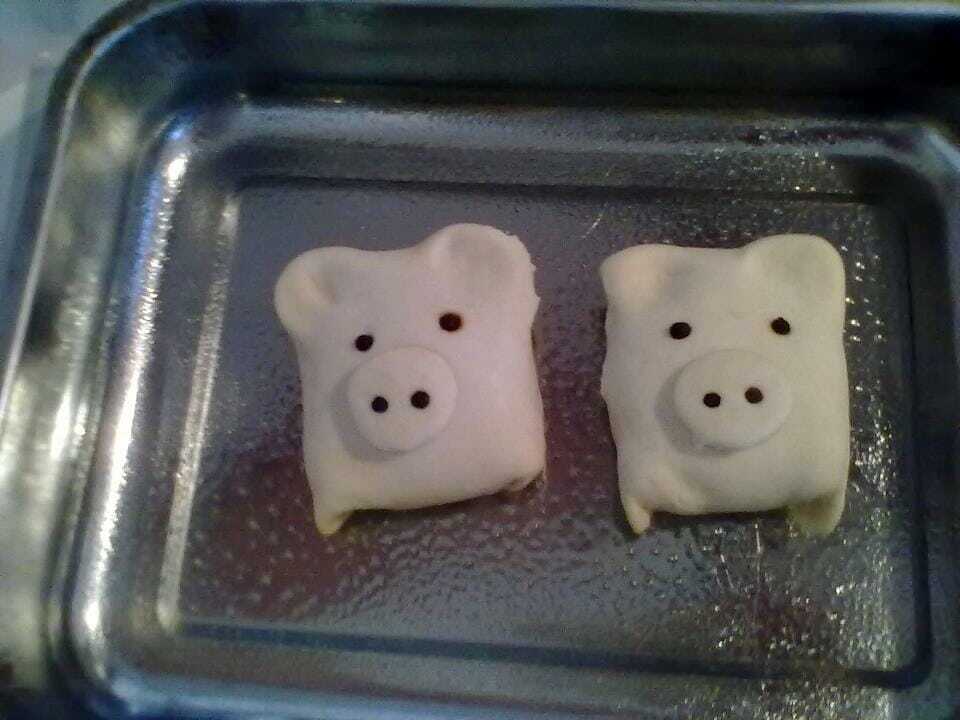
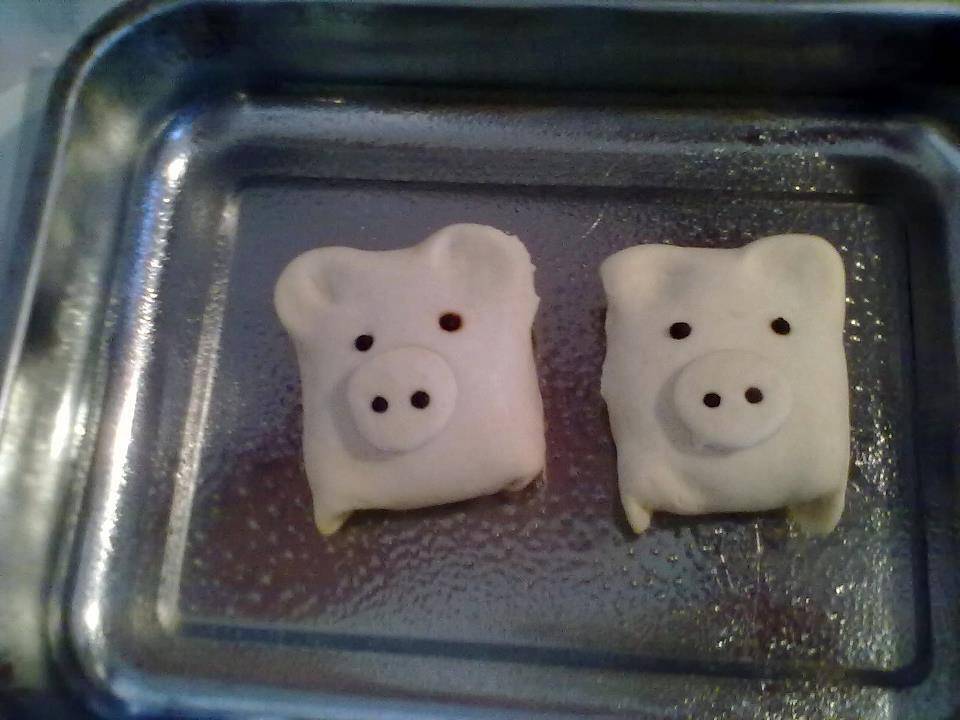
Susan Flint’s, Piggy Tenderloins. Inspired from a German product.
Today I’m sitting through a six-hour session on finance. While I appreciate how important it is for any farm or any business to understand operating performance and getting a return on one’s investments, I have to admit that my mind has wandered more than once to food!
Asset turnover brought to mind apple turnovers. Margins brought to mind margarine, which in turn led to think about how Real® butter makes everything better. Butter made me think about bacon – and we all know that bacon makes everything better! 🙂
Thoughts of food reminded me that I have yet to share some of the wonderful recipes that were submitted for Latham’s Pin It to Win It Sweepstakes held in conjunction with the Super Bowl. There are so many great comfort foods and crock pot creations that you can bet I’ll be making many of these in the coming weeks for my family.
P.S. Be sure to turn to TheFieldPosition.com tomorrow when our Sweepstakes winner shares two of her family’s favorite recipes with us.
Emotion Catches Attention & Gives Reason to Share a Message: Social Media Told Ag’s Story on Super Bowl Sunday
Even if I hadn’t been tuned into the Super Bowl on Sunday, news feeds on Facebook and Twitter accounts provided a play-by-play account – at least of the commercials. Who would’ve guessed that “farmers” would be trending during the Super Bowl?
The top Super Bowl spot, at least during the first quarter, was the “Got Milk?” ad featuring Duane “The Rock” Johnson. Soon thereafter Budweiser’s “Brotherhood” Clydesdale ad surpassed the Milk “Morning Run” as top ad, according to Forbes.
The commercial about the little Clydesdale is very much a true picture of how farmers feel about our animals. This particular commercial did a masterful job of telling a farmer’s story and showing an emotional connection with his animal, which brings up an important point I’ve been trying to make: emotion attracts the attention of those whom we want to share our message.
For years and years, those of us in the ag community have talked about facts and science. We’ve been armed with research and data– and we’ve been largely overlooked. To get noticed for the right reasons, farmers must use emotion to gain attention of the non-farming public and to share our messages! Why? Because agriculture is relevant today – maybe even more so if you take into consideration the growing world population – as it was when 98% of all people were farmers.
Recently, U.S. Secretary of Agriculture Tom Vilsack said rural America is less relevant now. Really? Farmers and ranchers provide food, fiber, and fuel for this country. Products made from agricultural products are used to make medicines and other products used for healing, such as pig skin for burn grafts and heart valves. Knowing that my pigs are helping feed people – and heal their hearts – is a source of pride.
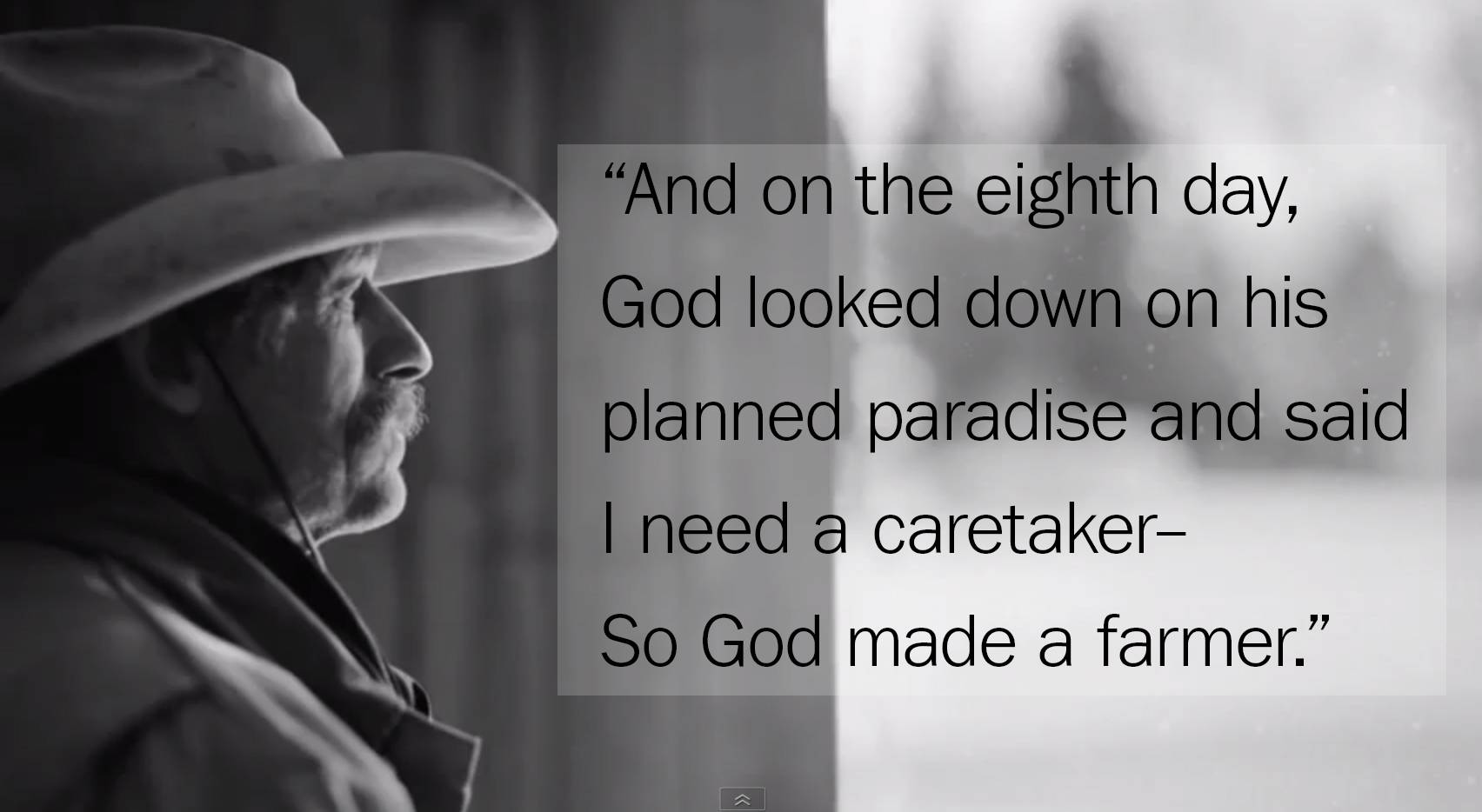
There are many reasons that I Am Agrihculture Proud. Nothing stirred Pride, Passion and Conversation on Sunday – and nearly every minute since it aired – like the Dodge Ram truck commercial featuring a poem recited by Paul Harvey during the 1978 FFA annual convention. It was a nice, little piece that paid tribute to farmers and God, both of which have been getting bad press lately!
Dodge Ram’s ad is part of a campaign to support the National FFA Foundation’s hunger initiative “Feeding the World – Starting at Home.” Each time this commercial is watched online, the National FFA earns $1 up to $1 million! Check out this post by fellow Franklin Count farmer, Val Plagge, “for the rest of the story.”
Also be sure to check out these related blog posts from farmers across America:
While this list is long, I’m sure it’s not complete. Feel free to share additional links. A special thanks to I Am Agriculture Proud for starting this list of great blogs!
Guest Blog from Dan Gogerty, Communications Editor for CAST
Dad, my uncle, and my grandparents farmed together and lived on three homesteads that were spittin’ distance from each other. The combined kid-count for the families eventually reached fourteen, so we could move like a swarm of locusts from house to house–playing in the yards, spilling kool-aid in the kitchens, and tracking in enough mud to start small indoor gardens.
Before we were old enough to chore and drive tractors, the adults tolerated this mayhem. As Mom recalls, “On a snowbound day, you kids could wreck my house in the morning and then move on to Aunt Ruth’s place for a second shift in the afternoon.” With no video games, cartoon networks, or battery-driven toys, we built pillow forts, played hide-n-seek, and concocted games with marbles, plastic army men, and knicked-up Lincoln Logs. When cabin fever reached a certain point, the folks would relent and let us brave the snow and cold. Even in the dead of winter, a Midwest farm in the 60s could be a vibrant playground.
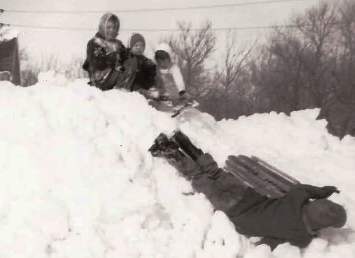
(photo from dhochwender.tumblr.com)
We might start in the yard with snowball fights, snow angel designs, and our own kamikaze version of duck-duck-goose. With Mom’s home-sewn snow suits on, we survived tumbles on the ice and wrestling matches with the dogs, but as we grew a bit older, our boundaries expanded. Red plastic saucer sleds worked well on snow drifts and short inclines, but large runner sleds gave us more speed. We’d take off down the lane, often with brothers or cousins jumping on until a sled might look like a shaky pile of logs with a boy at the bottom groaning in pain until all three or four of the bobsledders crashed in a heap.
The creeks and pastures called us further afield even when they looked like silver arctic zones. The two streams on our farm provided a Jack London setting, and we would walk on the ice looking for muskrat trails and rare beaver dams. As in London’s famous story “To Build a Fire,” one of us would occasionally break through the ice and fill a boot with frigid water. Unlike the story’s main character, we all survived, although I’m sure we entertained the shivering victim on the fast walk home with tales of frozen fingers and amputated toes.
Survival was tougher when we became old enough to skate and play hockey on the creek. We’d make holes in the ice for goals and the pucks were rocks, clods, or maybe a frozen “road apple” from an old cow pie on the bank. Scores were low but wet clothes and near concussions came regularly from our awkward falls and lack of skating ability.
When cold winds started to numb our cheeks, we might seek refuge in one of the barns. Hogs and cattle provided a type of bio-heat that came from warm animal bodies and the steamy straw-manure bedding they lay on. The heat rose into the haymow where we’d make tunnels and play some type of king-on-the-hill turf war. It was a bonus if we found a nest of baby kittens and a bummer if someone crawled through a tunnel that the raccoons had used for a litter box.
A classic winter day on the farm ended with a peel-and-pain routine. We’d peel off wet gloves, four-buckle boots, and ice-laden coveralls and then complain as our fingers and noses burned with the stinging pain of the thawing-out process. We then huddled in front of the furnace vent and got warm with the help of fresh-baked rolls. Mom knew how to cure frostbite. She also knew how to acquire some sanity on snowbound days. In an era long before smartphones, Mom had an app for kid cabin fever: it was an aperture called the front door, and she knew how to download it—you dressed the kids in warm clothing, turned the door handle, and let them access the winter wonderland that came already installed on a Midwest farm.
It is only the farmer who faithfully plants seeds in the spring, who reaps a harvest in the autumn. — B C Forbes
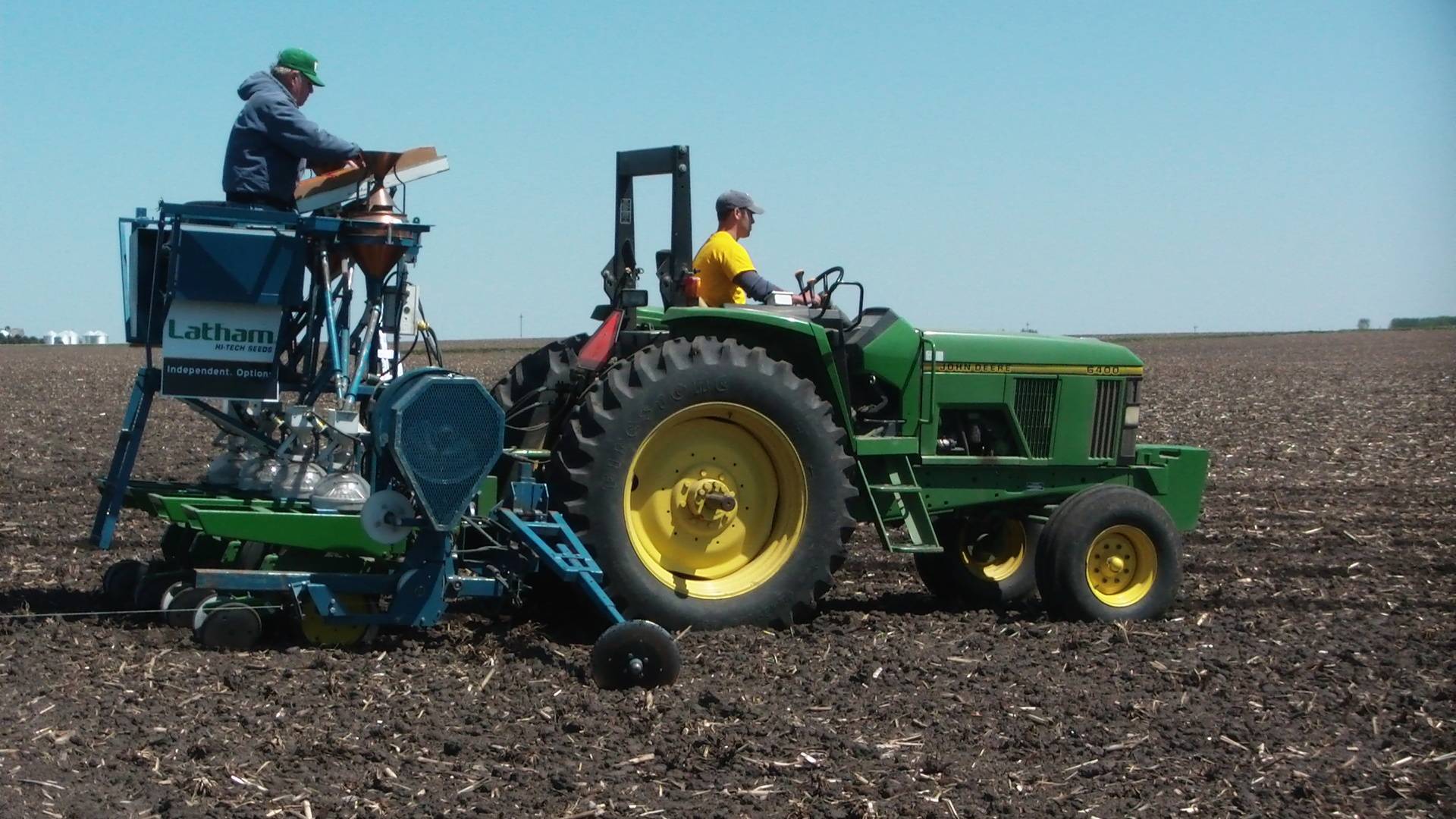
Trips to Oregon and Alaska top the “top do” list for Gary Bennett, who retired in December after serving nearly 28 years as a research coordinator for Latham Hi‑Tech Seeds. Then like any other Iowa farmer, he’ll look forward to spring when he can till the soil and plant the 2013 crop.
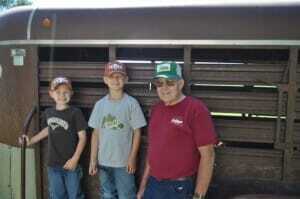
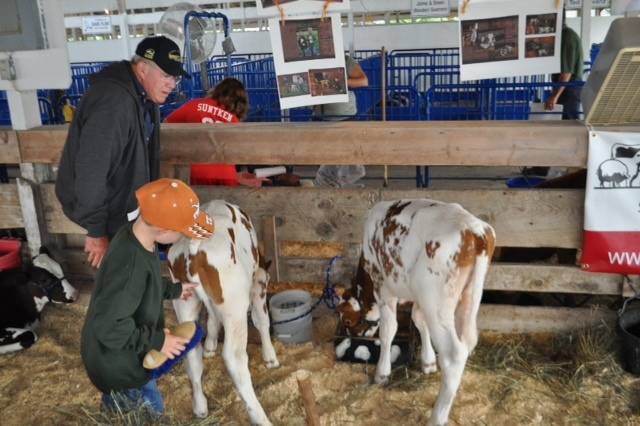
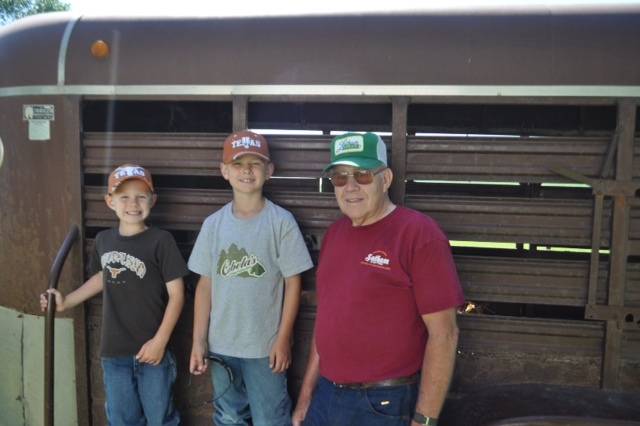
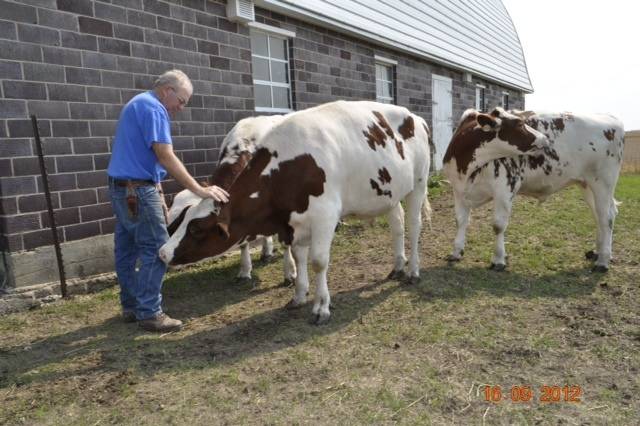
“I’m not sure how I ever had time to work!” says Gary with his signature easygoing smile. He’s stayed busy this past month by insulating and paneling the garage, as well as remodeling barn stalls. He’s getting everything in order for the spring arrival of bucket calves, which his grandkids will break to lead and exhibit at the 2013 Franklin County Fair. Then they finish out the steers and sell the beef by the quarter. This tradition started 10 years ago when his first grandchild was old enough to show in the open class.
“I really believe it’s important for kids to have responsibility,” says Bennett. “Raising livestock teaches them every living thing has its purpose. They learn the importance or completing a task and the feeling of accomplishment when a job is well done.”
Raising livestock is something Gary has enjoyed since he was a child himself. He grew up on a farm in Howard County where he was a member of both 4-H and the FFA. He had the honor and pleasure of attending state and national conventions. During his junior year of high school, he earned the Iowa Farmer degree and was also runner up to the Star Dairy Farmer. When his kids were old enough to join 4-H, Gary served as their Northwest Franklin club leader.
Gary and his wife, Diane, moved to Franklin County in 1975 when he accepted a position as Dairy Herd Improvement Association (DHIA) supervisor. After working five years for DHIA, milked his own herd of dairy cows for five years before joining Latham Hi‑Tech Seeds.
“I really enjoyed my career with the company,” says Gary. “It was always fun to plant the new varieties and see which ones made the cut. Technology continued to change and genetics improved – many changes happened over the years.”
Although Gary said he’ll miss seeing his colleagues, he’s looking forward to spending more time with family. Oldest son, Kelly and his wife, Lisa, live in Ankeny, Iowa, with their son and daughter. Middle son, Eric, and his wife, Peggy, live in a suburb of Portland, Oregon, with their son and daughter. Youngest daughter, Karianne, and her husband, Scott, live in Altoona, Iowa, with their two boys.
Gary’s also looking forward to doing some landscaping around his farm this spring. He’ll also enter a few tractor rides with his restored 1953 Super M Farmall. We wish Gary many enjoyable days relaxing in the great outdoors this spring and summer.
There are still a few winter months that all Midwesterners must endure before we can turn our attention to gardening and farming. To help get us through a few more weeks of wintry weather, today Diane shares with us a few of the Bennett family’s favorite recipes for soup & cookies. Enjoy!
With the extremely stressful weather conditions we experienced last year, growers are starting to inquire about using soybean inoculants going into the 2013 planting season. While there is no definitive answer to this question, here are a few tips to keep in mind:
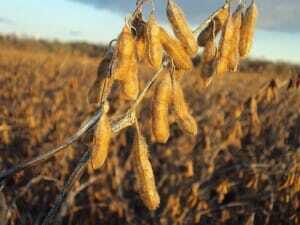
Soybean inoculant is comprised of living bacteria (Bradyrhizobia japonicum), which is necessary for the establishment of the nitrogen nodules on the roots of young soybean plants. Soybeans can require more than 300 pounds of nitrogen per acre and most of it is needed during the initial flowering through seed-set stages. Living organisms do need adequate moisture to thrive.
Inoculate the seed if soybeans haven’t been grown in your field for four or five years. If the field is sandy or in the event of severe weather problems (e.g., flood or drought), you might consider inoculating if the field has not been in soybeans for as little as three years.
Nitrogen is essential to photosynthesis. Nitrogen is usually supplied to soybean plants by a process called nitrogen fixation, which is associated with Rhizobia bacteria in the soil. It’s important to note, however, these bacteria are not always present – especially if soybeans haven’t been grown in a field for a few years. In this case, consider adding an inoculant to your soybean seed.
Scouting your fields and digging up plants to assure proper nodulation is crucial for achieving top-end yields. If you decide to use inoculants in your own fields, be sure to study whether the inoculants benefitted your production levels.
Get to know your local Latham sales representative, who can introduce you to our Seed-2-Soil program. This program helps determine the best varieties to plant in your fields, giving you the best possible chance to achieve high yield.