Latham Hi-Tech Seeds

(641) 692-3258

  • Home
  • Performance
  • Products
    • Corn
    • Soybeans
    • Soybean Blends
    • Alfalfa
    • Corn Silage
    • Seed Guide
  • Find a Rep
  • Media
    • Blog
    • News
    • Videos
    • Podcasts
    • TECHTalk
  • About Us
    • Company History
    • Our Mission
    • Careers
    • Become a Rep
    • Sowing Seeds of Hope
  • Contact Us
  • Latham Hi‑Tech Seeds

    “Drought” Implications are Top of Mind This Week

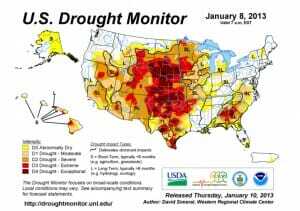
    US Drought Map1

    The only snow left in North Central Iowa is in the ditches or lining dry creek beds – just one more reminder that the Midwest still suffers from drought.  Here’s an excerpt from “crop comments” posted yesterday to agweb.com:

    1/15 – Lancaster County, Nebraska: Still dry with a little moisture in the top foot from 1ft to 6ft not any moisture. We will need some terrific rain events this spring to recharge subsoil, one of those events were you get 1/4 to 1/2 inch every day for 2 weeks (like that ever happens?)

    1/15 – Palo Alto County, Iowa: First year I can recall without any ice in the drainage ditches in the area. We have had a little snow and maybe a tenth of an inch of rain a few days ago. Never gone into spring as dry as we are right now. If this is a sign of what’s to come this next growing season id be crazy to sell the remainder of the 2012 crop and even consider selling for 2013. Lots of new irrigation equipment being put up this winter even in areas where on a normal year it’s not necessary.

    1/9 – Trempealeau, Wisconsin: If the Mississippi level any is an indicator of potential yield with average moisture, certainly areas that depend on subsoil moisture to get average crop will suffer. It seems to me that we will need an inordinate amount of moisture to compensate to get yield up to average, but what is average?

    Drought-related topics also grabbed the attention of farmers attending the American Farm Bureau Federation’s annual meeting last Sunday in Nashville.  During that meeting, a representative from Monsanto talked in details about the 2013 introduction of Genuity® DroughtGard TM hybrids in western states like Kansas, Colorado and Nebraska.

    Since it will be another year or two before farmers in the Upper Midwest will be able to purchase DroughtGard hybrids, there are steps you can take to help conserve soil moisture and a few things to consider when choosing seed for 2013 planting.  Click on the articles below for additional resources:

    • How Drought Might Affect 2013 Crops
    • Corn or Beans: Which Will You Choose in 2013?

    Team Latham

    January 16, 2013
    Drought, General, Weather
  • Latham Hi‑Tech Seeds

    HSUS or AFBF: Which Would You Consider a Front Group?

    FrontGroups1

    “Musings of a Pig Farmer” by Larry Sailer

    Every cloud has a silver lining or so the saying goes.  Last week I had a cloud over my head.  I was literally “down and out” with a torn ligament in my foot.  Fortunately, the silver lining was that my grandson Devin was still on winter break from college and was able to do chores.  That left me with idle time, which I used to catch up with some reading.

    Today I’d like to share some of the information I read from a particular site called sourcewatch.com.  That site talks about Front Groups, or a group that claims to support a public cause while actually serving a special interest or another group that’s objective might be obscured or concealed.  It shocked me to see Source Watch call the American Farm Bureau (AFBF) a front group!

    Here’s the first sentence:  The American Farm Bureau Federation is a right-wing lobbying front for big agribusiness and agribusiness-related industries that works to defeat labor and environmental initiatives, including climate change legislation. A side box on the Source Watch website reads: Front Groups…Appearances may be deceptive.

    WOW… talk about deceptive!  This Source Watch website is truly deceiving readers about the AFBF.  I’m very involved in the workings of the Farm Bureau, and I can tell you that Source Watch is way wrong here.

    While farmers in general tend to be a little conservative, the Farm Bureau does not represent huge agribusiness corporations.  I’m a small farmer, and I’ve been involved in the process of choosing candidates we believe will support our position.  During this selection process, we very much keep the candidates political affiliation out of the picture.  We analyze their positions and interview them to find out their current stance. Yet, sourcewatch.org makes it look like the entire agriculture community is made of big corporations out to make a quick buck at the expense of the environment and its citizens.

    More than 90% of farms are family owned and managed.  Family farm come in all sizes, and yes, some are even incorporated.  I own an LLC myself.  An LLC is a business structure, and I use it just like any Main Street business would.

    I’ve often said that urban and rural residents “speak different languages, and this is another example of that.  Some of the other things that Source Watch accuses AFBF of are completely hog wash!  (Yep, I’m using old hog farmer term because it’s fitting.)

    We must communicate with one another.  I urge consumers to talk with and listen to the people who raise your food.  Ask questions.  Listen to the answers from someone who farms.  I’m always willing to listen to your concerns, too.

    Larry Sailer, Musings of a Pig Farmer

    January 15, 2013
    Agriculture, General, Industry News
  • Latham Hi‑Tech Seeds

    Something Delicious is Stirring at Latham

    Crockpot Win

    Sharing never tasted so good.

    As New Year’s parties become mere memories, my focus shifts to the next big reason Americans have to gather together and celebrate with great food – Super Bowl Sunday.

    I’ve learned that massive quantities of hot food and cold drinks are paramount for hosting a successful party.  That’s why I’ve asked Latham employees to share some of their favorite recipes for comfort foods and appetizers.  What I really enjoy about these recipes is that you can “fix ‘em and forget ‘em.”  There’s no need to spend your time in the kitchen when there’s a party going on!

    What are your favorite party or potluck recipes?  Email them to me at
    shannonl@lathamseeds.com or submit your recipe via our Latham Hi‑Tech Seeds Facebook page.  We’ll post recipes on our blog in advance of the Super Bowl.  It’s a win-win: readers will get to enjoy your recipe, and you’ll be entered into a drawing for a 6-quart locking crock pot!

    We’re also gathering ideas on Latham’s Pinterest account, so feel free to follow our “Super Bowl Party” board. If you have any great Idea’s make sure to tag us in your pin. (@Latham Seeds #LathamSuperBowl)

    Email your favorite party or potluck recipe to shannonl@lathamseeds.com and be entered into a drawing for this Locking Crock-Pot. Submit your favorite recipe via our Latham Hi‑Tech Seeds Facebook page for a double entry into the drawing!

    Entries due January 25, 2013.

    BEEF STEW

    from Joy Bonin, Latham Office Manager

    Ingredients:

    • 1 lb. cubed stew meat
    • 2 cans beef broth
    • ½ package dry onion soup mix
    • 1 lb. carrots
    • 2 small onions, chopped
    • 1 stalk celery chopped
    • 8 potatoes chopped

    Directions:

    1. Combine stew meat, beef broth and onion soup mix in a Dutch oven.
    2. Bake at 350° for 1 hour.
    3. Then add vegetables to pan and bake at 350° for another hour.
    4. I make and serve with a loaf of homemade bread. I make it in the fall for our extra hired help, and we also like it on a cold winter evening in the winter.

    Team Latham

    January 14, 2013
    Beef, General, Recipes
  • Latham Hi‑Tech Seeds

    4-H & Farming Are Hallmarks of this Franklin County Family

    Hemmes family
    April Hemmes & her daughter. Photo credited to AmericasFarmers.com

    April Hemmes of Hampton, Iowa, is a fourth generation farmer in Franklin County.  She’s been farming since 1985 on land that has been in her family since 1901, but her operation is a little different from what one might expect.  April’s husband, Tom Kazmerzak, has a job in town and doesn’t work on the farm.  April is the primary farm operator, and she was named “Midwest Farm Mom of the Year” in 2011.

    “One of my fondest childhood memories is riding in the combine with my grandpa, and I learned a lot from him through the years,” says April.  “I love that my daughter and my son grew up on the same farm and had some of the same farm experiences that I had,” adds April.  “There’s nothing like being a farm kid.”

    April Hemmes Combining

    Many farm experiences are intertwined with 4-H experiences for April’s children.  Her son, Ethan, was a 9-year 4-H member and was a member of the Franklin County 4-H Council.  He was active in the Writers Club where he learned to express himself through short and poems.  Active in jazz, marching and concert bands, Ethan explored his passion for music through a 4-H self-determined project.  He went onto pursue music and English at the University of Iowa.

    uth Hemmes was crowned the 2012 Franklin County Fair Queen.

    April’s daughter, Ruth, also was active in 4-H for nine years.  She earned the State Photography Award and completed agronomy projects and showed beef.  Ruth served as president, vice president and secretary of her 4-H club.  She also was selected to serve on the Franklin County 4-H Council and participated in the Iowa 4-H Youth Conference.  In addition, Ruth was named the 2012 Franklin County Fair Queen.

    “Throughout my years as a 4-H member, I learned many things from basic leadership skills in meetings, to club field trips, and a variety of projects.  Showing cattle taught me responsibility: I fed my cattle in the morning and evening plus worked with them and bathed them once or twice a week.  While I enjoyed all of my 4-H projects, I was especially interested in photography,” says Ruth Kazmerzak, who’s currently a freshman at University of Washington in Seattle where she’s studying Aquatic and Fishery Sciences and Photography.

    Hemmes Farm History

    Picking Corn

    The Koch-Hemmes home farm was established in 1901 by J.P. Koch.  His mother’s family had emigrated in 1738 from Bignen, Germany, to Pennsylvania where they bought a farm.  While other family members remained in Pennsylvania, J.P. came to Iowa because his aunt had written to him about the “riches of the land.”  J.P. found more than land upon his arrival; he also took a bride in 1890.

    Newlyweds J.P. and Lavina moved to an acreage about 10 miles north of Iowa Falls.  Their marriage was blessed with five children: Harold, Gerald, Ralph, Kenneth and Velma.  Velma Koch married Bert Hemmes in 1925, and a few short years later, they purchased the farm from J.P. and Lavina.

    Bert Hemmes, combining at age 100

    Velma gave birth to their first son, Harlan, in 1929 and another, Jerry, in 1934.  In the coming years, Bert had to work with his banker to keep the farm running.  The Depression years were especially challenging, but Bert took great pride in saving the farm from the “big shot” from Des Moines who traveled north to buy up all the loans.  Advised by a local banker to “let things go,” Bert let the weeds grow and the barn door fall off.  Mr. Big Shot ended up driving right past the Koch-Hemmes farm, dust rising all the way as he sped back to Des Moines.  The next year Bert made his payment, and his farm stayed in the family.

    As these hard years passed, Bert and Velma added many more acres to the land they owned.  Harlan came home from WWII and then school in the mid-1950s to farm with his father.  The two ran a diversified farm of corn, soybeans, hay, cattle, hogs, sheep and chickens.

    Harlan married Sally Peterson in 1957, and they had four children:  Sarah, April, Harlan II and Heather.  April presently resides and farms the land, which she and her husband purchased.  In 2001, the U.S. Secretary of Agriculture recognized the Hemmes family at the Iowa State Fair with a Century Farm Award.

    As a tribute to her German ancestry, today April shares with us an old family recipe for Molasses Cookies.  Molasses was first used to sweeten foods because it was more affordable than sugar.  The aroma of cinnamon, cloves and ginger mingled with molasses evokes warm memories of grandma’s house.  Mix up a batch and bake someone happy!

    Team Latham

    January 11, 2013
    Desserts, General, Recipes
  • Latham Hi‑Tech Seeds

    “Rewriting History” to Benefit Franklin County 4-H

    Rewriting history
    Iowa’s first 4-H camp for girls was held in Mayne’s Grove in June 1923. It was attended by 135 girls and 28 leaders from 18 clubs.

    At the start of a new year, Americans often reflect upon the past and prepare for the future. One of my 2013 resolutions is to print a coffee table book that provides interesting stories about Franklin County farm families, as well as historical accounts of the 4-H organization. Proceeds from this book will go toward a permanent scholarship for county 4-H’ers who are interested in pursuing higher education.

    Getting this book to print is going to be a “project,” no doubt! I put skill that I gained through 4-H to use in early 2013 by developing this project outline:

    Goal: Print a coffee table book by December 2013 that will benefit the Franklin County 4-H Scholarship

    Objective: Collect stories from 25 county farm / 4-H families

    Tactics:

    • Conduct a communications workshop
    • Feature 12 county farm families on TheFieldPosition.com
    • Feature “Franklin County 4-H Facts” each Friday this year
    • Recruit each county 4-H club reporter to submit one story
    • Invite residents to submit stories about their Century Farms or in honor of their loved ones.
    A team of Franklin County farm boys, coached by V. B. Hamilton, was named the 1930 Iowa Champion Judging Team. Team members were Wilbur and Willard Latham, Earl Shaull and J. Verald Brown.

    Tactic #1 will take place on Saturday, Jan. 12. 4-H club reporters and anyone interested in exploring communications careers are invited to attend this workshop, from 10 AM to 2:30 PM, at the Franklin County Extension Office in Hampton.

    Tactic #2 begins tomorrow when feature April Hemmes and Ruth Kazmerzak on TheFieldPosition.com. Be sure to “tune into tomorrow” for their story.

    Tactic #3 involves sharing 4-H facts. Although it’s only Thursday, I couldn’t resist sharing a few facts today:

    • Cooperative Extension in Franklin County began with the organization of the Franklin County Farm Bureau in 1918. Extension work was a service offered through Farm Bureau.
    • The first 4-H club formed was a countywide Purebred Sow and Litter Club.
    • Because of the success of the first club, the next year they started a Pure Bred Short Horn Calf Club.
    • Girls clubs were organized with an emphasis on home furnishings, music appreciation and health.
    • Until 1955, girls who wanted to raise and show livestock could only do so by belonging to a boys’ club. This was also the year they began a county girls livestock 4H club and the Livestock Queens were formed.

    We hope you’ll join our efforts, too! “Like” Franklin County Extension on Facebook and watch for “Fun Fact Friday.” Watch for “Friday Farm Family Features” on TheFieldPosition.com. Share your own family’s farm and/or 4-H story. Click here to download a form and to learn more about the donor levels. Feel free to contact me directly to see how I might help tell your story.

    Twenty-eight baby beeves were exhibited at the 1925 Franklin County Fair. 4-H members sold each for $150 and netted $30/animal.

    Team Latham

    January 10, 2013
    Agriculture, General, Industry News
  • Latham Hi‑Tech Seeds

    How Drought Might Affect 2013 Crops

    Following the 2012 growing season, researchers from across the Upper Midwest gathered to present data and opinions on a wide variety of topics pertinent to agriculture in our marketing area. Today I’m summarizing some of their findings for you to consider as you prepare to plant the 2013 crop.

    • SEEDLING DISEASES: University researchers are “dialing down” on the four main families of pathogens typically associated with soybean seedling diseases: Pythium, Fusarium, Rhizoctonia and Phytophthora. They have found more than 50 different species of Pythium that affect soybeans in our area. For many years, we believed this pathogen preferred cool, wet soils. Now we know that several of these species actually prefer warm soils! It was also discovered that some “new” species are not affected at all by fungicides currently available.
    • OTHER DISEASES & PESTS: Extremely dry weather throughout the Upper Midwest was responsible for the presence of Charcoal Rot, from as far north as southern Minnesota and as far east as the Mississippi River Basin. Damage from Soybean Cyst Nematode and Two-Spotted Spider Mite infestations were also widely reported. Be aware that many common insecticides don’t have much of an effect on Spider Mites, so carefully read the labels of any products you intend to use.
    • WEATHER: Dr. Elwynn Taylor said we’ve just finished a 19-year cycle of reasonably mild weather patterns and are now headed into a 25-year period where weather patterns are apt to be volatile. The 2012 drought caused most soils here to be depleted of moisture in the upper 7 to 8 feet. It will take a minimum of 16 –18 inches of rainfall (or equivalent in snow) to recharge those soils to their normal level. It will probably take at least two growing seasons to recharge.
    • TILLAGE: This was one of the “hottest” topics of the ICM conference. Most of the researchers were extremely surprised to see the amount of fall tillage completed because minimizing tillage helps conserve soil moisture.  Soil is our greatest natural resource, so we must protect and conserve it or our children and grandchildren will surely suffer the consequences.

    Webspec Admin

    January 9, 2013
    Drought, General, Weather
  • Latham Hi‑Tech Seeds

    My Pigs Stay Safe and Warm Despite Harsh Winter Conditions

    Tuesday41

    “We will open the book. Its pages are blank. We’re going to put words on them ourselves. The book is called “Opportunity” and the first chapter is New Year’s Day.” – Edith Lovejoy Pierce

    It’s hard to believe that another year has already come and gone! Before we totally close the book on 2012, I have one more page to write about my hog enterprise. I recently loaded pigs into a semi during a cold, snowy December day. We began at about 6:30 p.m. and the last semi load left after midnight. With snow on the ground and a north wind blowing in our faces, it was a sharp contrast to the conditions we faced on Aug. 29 when this group of pigs arrived.

    It takes about 120 days for little 35-pound pigs to become 290-pound market hogs.  I’m still amazed at how quickly and how large our market pigs grow.  When I was kid on our family farm by Geneva, we wouldn’t have dreamt of keeping pigs past 220 pounds because we’d be paid less for them.   “Back in the day” these pigs were considered too fat for market, yet today’s pigs remain lean at 290 pounds.

    Iowa Pork Chops

    Changes to genetics and feed allow us to raise extremely lean pork today, which makes some really nice pork chops.  Iowa chops are some of my favorite food to grill, even in the winter.  But, I digress… (It’s funny how quickly food diverts my attention!)

    Another huge benefit for the pig and the buyer of pork, or consumers, is the fact that pigs are healthier inside these buildings.  When I raised pigs outside, we had to worm them and treat them for mange.  I haven’t treated a pig for either of these since I began raising pigs inside.  Trichinosis is unheard of now that pork is raised inside, so you can cook most pork to 145 degrees for some really tasty tender pork.

    By keeping our barns isolated and by cleaning and disinfecting our barns, I use way less medication than I did while raising pigs outside.  My outdoor pigs were always fighting the flu and colds!  It was a challenge to keep them warm plus supply them with fresh food and water in freezing temperatures.

    Winter in Iowa

    I remember, during one winter storm about 20 years ago, I was trying to get to a neighbor’s farm in a blizzard because his Dad couldn’t get there to do chores.  I made it on a snowmobile.  Snow had blown into the hog sheds and made all of the bedding wet.  There were already some dead pigs because of the cold.  This is just one example of what our Iowa weather can do to livestock in old-style buildings.

    As we changed the pig, we had to change the way we took care of them.  The modern hog barn has been a big help as it’s always warm and dry.  Pigs are safe from predators, and they have the best feed we can make plus fresh water available to them at all times.  As you can see in my pictures and video, these pigs are content and healthy.  I’m not alone.  Click here to see how this Nebraska farm family uses similar methods to keep their pigs safe and warm although the outside weather is frightful.

    So much has changed during the last 50 years!  Thanks to modern pork production practices, we’re able to raise pork more efficiently.  I cannot even guess what the price of pork would be in the grocery store if we hadn’t made changes throughout the industry.  We certainly wouldn’t be able to produce enough to export pork to feed a hungry world.

    I am very happy going into this New Year knowing that farmers and ranchers are always trying to improve and do a better job, doing what we do.  Happy 2013!

    LathamSeeds's Larry Sailer 1-8-13 album on Photobucket

    Larry Sailer, Musings of a Pig Farmer

    January 8, 2013
    Agriculture, General, Industry News
  • Latham Hi‑Tech Seeds

    Iowa Agri-Women to Meet

    AnetteSweeny1
    Annette Sweeney served two terms in the Iowa Legislature, but she and her husband, Dave, have continued to raise Angus cattle.  DAN PILLER/REGISTER PHOTOS

    Annette Sweeney of rural Buckeye in Hardin County, Iowa, has worn many hats: farmer’s daughter, teacher, farmer, cattle producer, wife, mother and state legislator.  She’s starting the New Year with a new title as president of Iowa Agri-Women, the newly formed legislative advocacy arm of the Iowa Women in Agriculture organization and is affiliated with American Agri-Women.

    Agriculture is Sweeney’s passion and advocacy remains her sacred cow.  She’s on a mission to make women aware of policy that affects their families and their farming operations.  That’s why she reaching out to women statewide, inspiring them to become involved with Iowa Agri-Women.

    “Women in agriculture must be actively engaged in the lawmaking and rule-making processes because there are fewer people who understand the day-to-day workings,” says Sweeney.  “Ag literacy is a real concern.  Too many individuals in places of power have never set foot on a farm, yet their making laws and rules that greatly impact our businesses and livelihoods.”

    Anyone and everyone who is concerned about how legislation could impact agriculture is invited to an inaugural meeting later this month.  The group will meet again in March at the Wallace State Office Building, Des Moines.

    “We want to make ourselves known to legislators, so that if a related issue comes up, they will feel comfortable visiting with us to see how our farms and related businesses might be impacted. We want to provide a ‘local resource’ for in each legislative districts (50 Senate; 100 House).

    For more information, call 641-373-4899 or e-mail annette@annettesweeney.com.

    Team Latham

    January 7, 2013
    Agriculture, General, Industry News
  • Latham Hi‑Tech Seeds

    Resolution #3: Spend More Time with Family

    Marshmallow Snowman Treats

    Snowy Fun with the Kids (Pinterest inspired)

    Part 3 in our series, “Setting Successful New Year’s Resolutions,” brings us to the goal of spending more time with family.  Adults and kids alike have busy schedules that keep families hopping day in and day out at the expense of quality time together.  The key is to schedule specific days – or even an hour or two – just to enjoy each other’s company and have fun.

    Here are some Pinterest-inspired ideas to help you enjoy some quality time this winter with your family.

    Marble Balloons

    CREATE WITH MOTHER NATURE’S BEAUTY

    • “Marble” driveway décor

    Fill balloons with water and add in a few drops of food coloring.  Tie the balloon and arrange them along your driveway or walk way.  A few hours later, return to your creations and pop the balloons.  The result is sure to make your kids smile at the colorful marble décor they create.

    • Make a snowman with a twist!
    • Paint masterpieces in the snow

    Food coloring + water + squeeze bottles = Low mess fun.

    HEAD BACK IN FOR SOME WARM COCOA AND FUN IN THE KITCHEN (See Recipe Below)

    DRIVE-IN INDOOR MOVIE NIGHT

    As the day comes to a close, and you’re finished with supper, how about a “Drive-In Movie Night”.  This idea comes from a blog called Homemaking Fun, and I just love the special touches she added to make it just like having the theatre in the living room.  Each kid brings in a pillow and blanket and decorates a cardboard box like a car using markers, paper plates etc.

    Set up a concession stand with snacks and drinks.  Give each child some paper money to “buy” their movie ticket with one dollar and the remaining $6 can buy whatever they want for snack.  More details on her blog here.

    I hope these ideas help you find ways to spend more time making memories with your family in 2013!  For more snow day activities, we invite you to link up to these stories or visit our Pinterest page.

    • Things to Do on a Snow Day
    • Fighting Cabin Fever with Good Food and Fun Activities

    Team Latham

    January 4, 2013
    Desserts, General, Recipes
  • Latham Hi‑Tech Seeds

    Resolution #2: Healthy Cooking

    FreezerMeal1

    Guest blog post by Rebecca Ramage, Wildtree consultant

    I want you excited to make an easy change in how you cook, and I want to dispel the myth that healthy food has to be over-priced and difficult to make.

    So let’s start with “Why bother?”  Well, quite simply, we are the unhealthiest group on the planet!  Thirty percent of American kids are overweight, and 50% of our kids will be diagnosed with adult onset diabetes.  This is the first generation of kids to have a shorter life expectancy than their parents.

    Adults are not faring any better…  90% of Americans have one or more of the following:  high blood pressure, high cholesterol, high blood sugar, or are overweight – 90%!  Why?  The biggest reason is the food we eat.  Virtually everything in the grocery store is full of sugars, hydrogenated oils, super high levels of sodium, preservatives, chemicals and dyes.  If you do a google search, you’ll find dozens of studies that clearly show these foods are the biggest cause of our health problems.

    With a few easy tricks, you can resolve to cook and eat healthier in 2013:

    1. Shop the perimeter of the grocery store.  Fresh produce, dairy and meats are found in the outside aisles.  These items are less expensive than the processed, pre-packaged foods plus they are all natural and don’t contain added sugars and hydrogenated fats. Most Americans then shop the center of the grocery store for mixes and ingredients.  Instead, I get these things from Wildtree.  Wildtree is an all-natural, organic food company that offers everything from appetizers to desserts and everything in between.  Wildtree® products have no MSGs, no preservatives, no chemicals, no dyes and are nut free with low-to no levels of sodium and sugar Wildtree also offers Gluten Free products.
    2. Use Grapeseed Oil, the “Miracle Frying Oil.”  While grapeseed oil is healthy, I love its cooking properties.  The flash point is 420°, so you won’t burn the oil.  And the infusions are fabulous!  Pop popcorn in the butter oil.  Sauté veggies in the garlic oil.  Brush meats with the hickory oil before grilling. Use the basil pesto oil on pasta salad or drizzle it on steamed veggies.  These oils are the biggest reason why my food tastes good.
    3. Plan your meals in advance.  According to Consumer Reports, Americans who don’t menu plan throw away $20 for every $100 spent by buying things that go unused.  Who wants to take $20 out of their wallet and throw it directly in the waste can?  That’s why I menu plan with Freezer Meals!  This saves me time and money, plus gives me a peace of mind knowing that I have a healthy and delicious meal ready for my family.
    Freezer Meals

    There are more than 90 Wildtree Freezer Meal Recipes, so I shop in bulk or buy protein when it’s on sale.  Then I prep all my meals at one time and freeze them until I need them.  You can even host a “freezing party,” so you and your friends go home with 10 meals (4-6 adult portions) or 20 meals (for smaller families) that are freezer-ready.  It’s fast, fun and social!

    Check out this YouTube video to see how simple it is to make freezer meals.  For more information on prepping healthy meals, feel free to contact me at Rjv1129@yahoo.com or 727-612-9915.

    Larry Sailer, Musings of a Pig Farmer

    January 3, 2013
    General, Recipes
Previous Page
1 … 95 96 97 98 99 … 160
Next Page

Latham Hi‑Tech Seeds

131 180th Street | Alexander, IA 50420

(641) 692-3258

SIGNUP FOR OUR NEWSLETTER
  • Contact
  • Legal
  • Dealer Center
  • Seedware Login
  • Latham Gear

© 2025 Latham Hi‑Tech Seeds. All rights reserved. | Iowa Web Design by Webspec | Privacy Policy

Latham® Hi-Tech Seeds is a trademark of M.S. Technologies, L.L.C., 103 Avenue D, West Point, IA 52656.