Skip to content
Latham Hi-Tech Seeds

(641) 692-3258

  • Home
  • Performance
  • Products
    • Corn
    • Soybeans
    • Soybean Blends
    • Alfalfa
    • Corn Silage
    • Seed Guide
  • Find a Rep
  • Media
    • Blog
    • News
    • Videos
    • Podcasts
    • TECHTalk
  • About Us
    • Company History
    • Our Mission
    • Careers
    • Become a Rep
    • Sowing Seeds of Hope
  • Contact Us
  • Latham Hi‑Tech Seeds

    Latham Research Looks Beyond Yield to Help Farmers Make Better Decisions

    On-farm trials and demonstrations Help latham understand how products respond to different environments and management practices

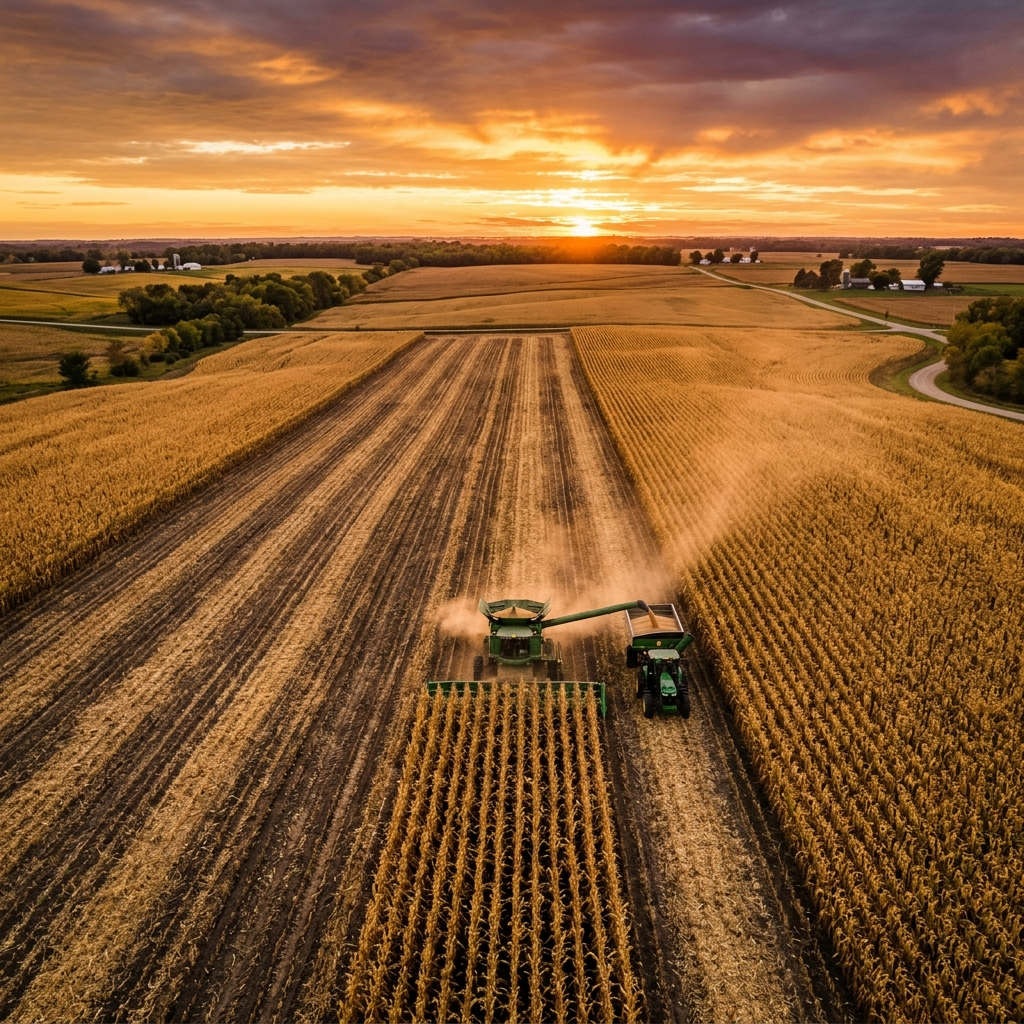
    Alexander, Iowa – Yield may be the number that gets the most attention at harvest, but Latham Hi-Tech Seeds says understanding why products perform the way they do can provide even greater value to farmers.

    Through research and demonstration trials, Latham studies how genetics interact with different environments and management practices to help farmers make more informed product placement and crop management decisions.

    “Yield is always important, but a yield number alone doesn’t tell the whole story,” said John Latham, third-generation seedsman with Latham Hi-Tech Seeds. “We want to understand why products respond differently and use what we learn to help farmers put the right genetics on the right acres.”

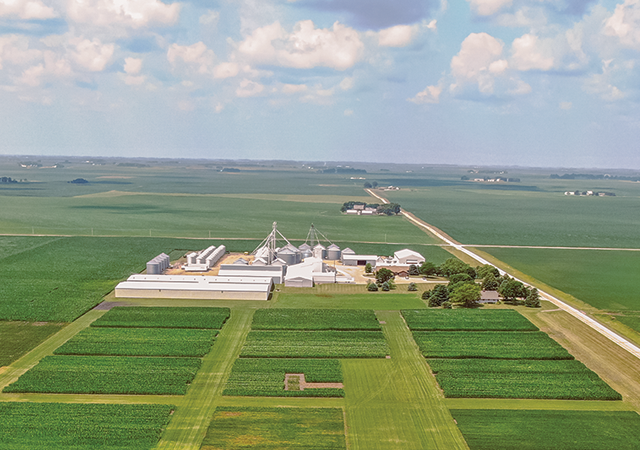
    Research at Latham’s Premier Agronomy Center has included studies and demonstrations involving hybrid response to population, planting depth, Iron Deficiency Chlorosis (IDC), biologicals, planting dates, cover crops, no-till and continuous corn.

    Latham also evaluates products across multiple locations and environments to better understand their strengths and determine where they may perform best.

    That approach is especially important as farmers manage increasingly complex product and management decisions.

    “Different fields have different challenges, and every growing season brings something we can’t predict,” Latham said. “Research helps us better understand those differences so we can provide farmers with more than a product. We can provide information that helps them make decisions with confidence.”

    Insights from Latham research are used to refine product placement recommendations, support agronomic education and identify new questions for future trials.

    For more information about Latham Hi-Tech Seeds research and agronomic resources, visit LathamSeeds.com.

    # # #

    Since 1947, Latham Seeds has been committed to delivering seed products in corn, soybeans and alfalfa that are field-tested, proven on the farm and trusted by farmers. By combining localized product research, personal service and a deep passion for rural communities, Latham Seeds helps farmers maximize their yield potential — one field at a time. Learn more at www.lathamseeds.com. Latham and Latham Hi-Tech Seeds are trademarks of M.S. Technologies, L.L.C.

    bonnie-harris

    September 14, 2026
    Agriculture, Corn, Corn Silage, Crop, General, Herbicide Technology, Industry News, News, Seed Technology, Soybeans
  • Latham Hi‑Tech Seeds

    80 Years Farmer-Focused: Explore Latham’s 2027 Product Lineup

    Eighty years ago, Latham Seeds began with one farmer trying to help other farmers.

    In 1947, Willard Latham saw oat smut reducing yields for farmers near Alexander, Iowa. He installed a grain cleaner in his granary to help improve the seed his neighbors were planting—and a family seed business was born.

    Agriculture has changed dramatically since then. Genetics have advanced. Trait technologies have expanded. Farming operations have grown more sophisticated.

    But one thing hasn’t changed at Latham: farmers remain at the center of what we do.

    That commitment comes to life in our new 2027 Product Guide, featuring what Latham President John Latham calls the strongest portfolio the company has ever offered.

    More Choices for Every Acre

    No two farms are exactly alike. Neither are the acres within them.

    That’s why Latham continues to build a diverse portfolio with multiple genetic backgrounds, trait technologies and maturity options. We believe farmers deserve choices—not one-size-fits-all recommendations.

    Our 2027 corn lineup includes products ranging from early to full-season maturities, with conventional and traited options designed for a wide variety of yield environments and management practices.

    The soybean lineup includes exciting new K-Class products selected for strong yield potential and defensive characteristics, along with proven technologies and maturities suited for farmers throughout Latham Country.

    Livestock producers will also find industry-leading alfalfa options designed to meet the demands of today’s forage production systems.

    Research That Starts at the Farm

    Products don’t earn a place in the Latham lineup based on a spreadsheet alone.

    Our research process includes replicated Elite Trials across different soil types and growing environments, farmer-planted Showcase Plots and Training in Excellence (T.I.E.) plots throughout Latham Country.

    Those trials help our product team evaluate performance, identify strengths and determine where each product fits best.

    Just as important is the feedback we receive from Latham Dealers and farmers. Their experience helps shape not only which products make the lineup, but how we recommend placing them.

    Because at Latham, research has always started at the farm.

    Farmer Focused Since 1947

    The release of the 2027 Product Guide begins an especially meaningful year for Latham.

    As America celebrates 250 years of independence, Latham is celebrating 80 years of serving farmers.

    Both milestones remind us of values that have shaped generations of American agriculture: hard work, perseverance, innovation and the freedom to choose your own path.

    Being Farmer Focused means giving farmers the options, information and support to make those choices with confidence.

    Products and technologies will continue to change. Farming practices will evolve. New challenges will emerge.

    But after 80 years, our commitment remains the same.

    Farmer Focused. Then. Now. Always.

    Ready to see what’s new for 2027?

    Explore the complete 2027 Latham Hi-Tech Seeds Product Guide.

    Team Latham

    September 7, 2026
    Agronomics, Corn, Crop, General, Soybeans
  • Latham Hi‑Tech Seeds

    Building a Seed Package That Fits Your Acres

    Protection is part of the package

    No two fields are exactly alike. Soil type, yield environment, cropping history and pest pressure can vary across an operation — which is why choosing seed shouldn’t necessarily mean choosing one product and planting it everywhere.

    A strong seed plan starts with matching the right products to the right acres.

    Latham’s corn and soybean lineups offer depth across a wide range of maturities, yield environments and productivity levels. That gives farmers and their Latham® Dealers the ability to build a package of products around the needs of an entire operation.

    For example, farmers planting corn in the 99- to 103-day maturity range have several options with different strengths. LH 4986 PCE RA offers versatility and the ability to perform in tougher yield environments. LH 5106 PCE RA is built for offensive acres, while proven LH 5226 PCE RA combines top-end yield potential with the ability to handle tougher soils.

    Fields with different management needs may call for another approach. For corn-on-corn acres where below-ground protection is important, Latham has added depth in the 101- to 105-day range with new LH 5128 SS PRO RIB, LH 5358 SS PRO RIB and LH 5418 SS PRO RIB, alongside LH 5578 SS PRO.

    Product selection is only the first step

    Product selection is only one part of building a plan for the season. Seed treatment can provide another layer of protection during the critical early stages of crop development.

    SoyShield ULTRA brings several components together in one treatment package. It includes an increased rate of mefenoxam over SoyShield Plus; HeadsUp for Sudden Death Syndrome (SDS) and Soybean White Mold (SWM) suppression; BIOST for nematode and insect protection; and Amplifyr, a biostimulant designed to support early-season plant growth.

    The goal is the same whether you’re selecting hybrids, soybean varieties or seed treatment: give each acre what it needs to get the season off to the strongest possible start.

    As harvest approaches and you begin evaluating this year’s results and planning for next season, talk with your local Latham Dealer about building a seed package around your fields, your challenges and your yield goals.

    Team Latham

    August 11, 2026
    Agronomics, Corn, Crop, Soybeans, Uncategorized
  • Latham Hi‑Tech Seeds

    Timing Your Spray for Maximum Yield

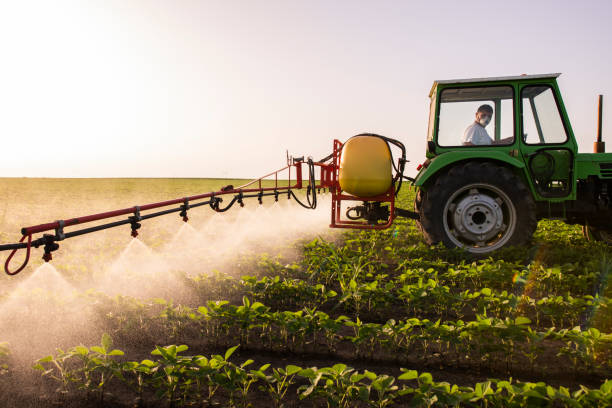
    Planting across Latham Country has moved along quickly, and it won’t be long before postemergence spraying begins. As applicators prepare to head to the field, familiar questions arise: When should I spray? What product should I use? Should I spray at all? 

    Of these, “when to spray” may be the most critical decision a grower makes. Injury or stress to a young plant can have lasting effects that aren’t always visible to the naked eye. Understanding crop growth stages—and how they align with product label requirements—is essential for making sound application decisions and protecting yield potential. Let’s start with corn.  

    Corn Growth Stages and Application Timing 

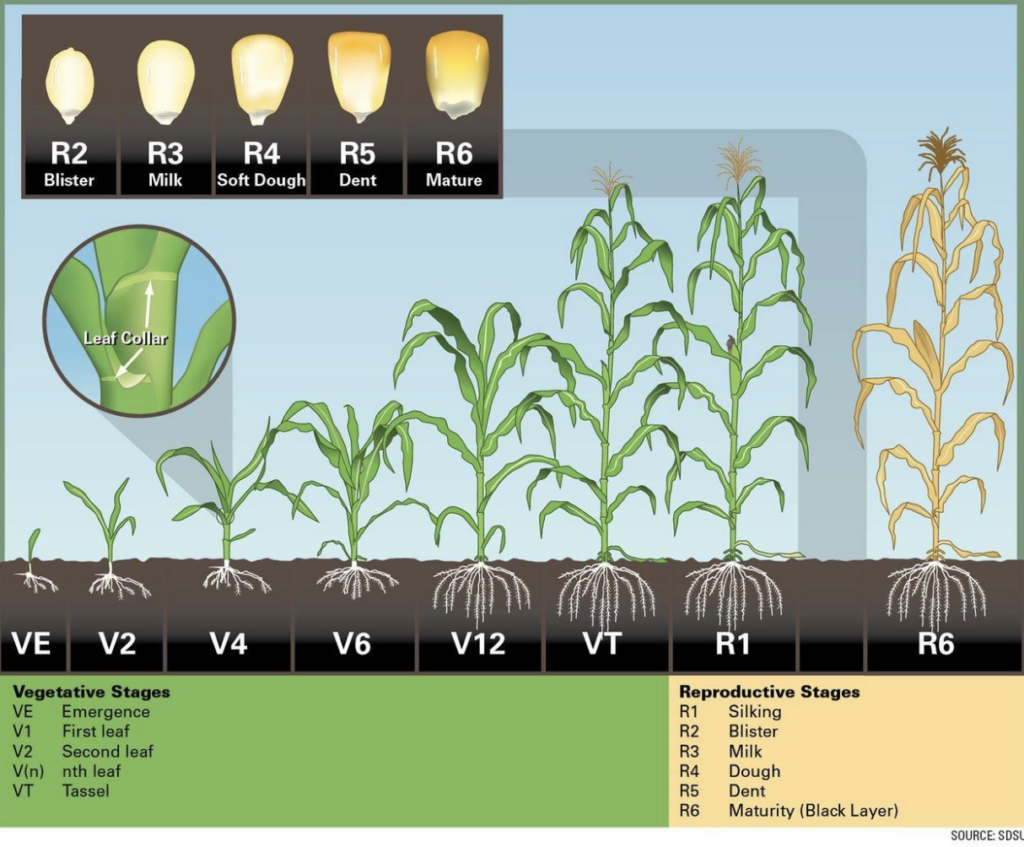
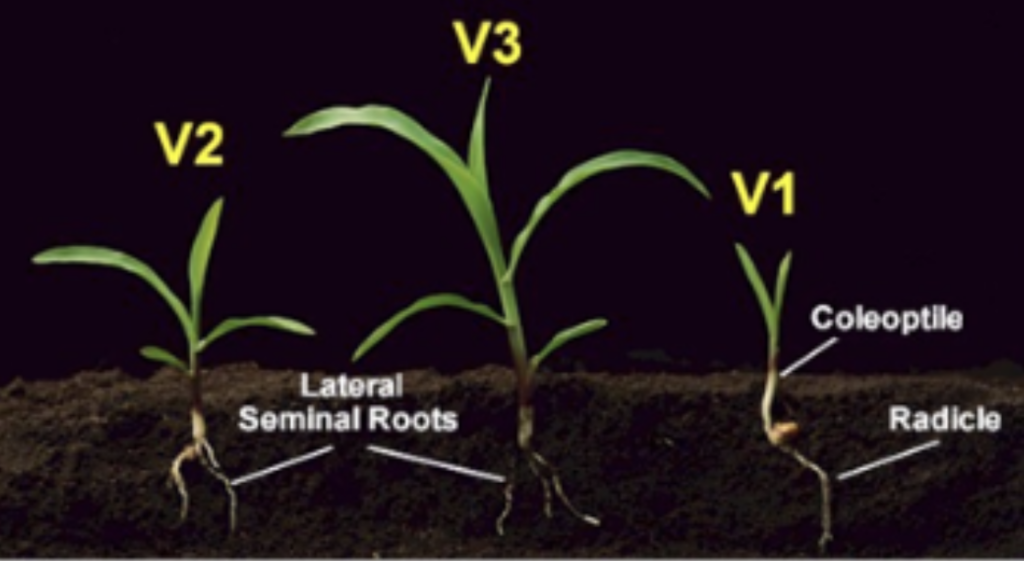
    Herbicide and crop protection labels typically reference growth stages when outlining application timing. The corn growth stage chart is an excellent resource for understanding these stages.  

    VE (Emergence) occurs when the coleoptile reaches and breaks through the soil surface. Corn generally requires about 100–200 growing degree units (GDUs) to emerge, which can take as little as four to five days after planting under warm, moist conditions. During this time, growth is also occurring below ground as the nodal root system begins to develop. 

    Emergence can be rapid in favorable soil conditions but may take three weeks or longer in cooler soils. Early in the season, a new leaf typically appears about every three days. As temperatures warm, leaf appearance can accelerate to one new leaf every one to two days. Full season hybrids grown in the central Corn Belt commonly produce 21–22 leaves, while earlier maturing hybrids produce fewer. 

    These numbers are important to keep in mind as you plan your spray program. Under favorable conditions, corn can move from planting to the V5–V7 stage within a month. Missing application windows can happen quickly if fields aren’t monitored closely. 

    Soybean Staging Considerations 

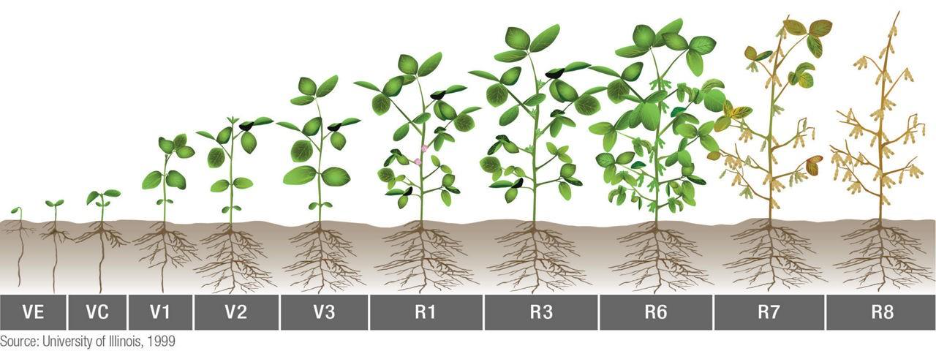
    Soybeans add another layer of complexity, as plants within the same field rarely develop at the same pace. A soybean field is considered to be at a specific V or R stage when 50% or more of the plants are at or beyond that stage. Because of this variability, understanding soybean staging is critical when determining application timing. The soybean growth stage chart is a valuable reference when evaluating field conditions. 

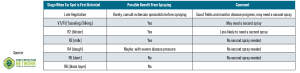
    A general rule of thumb is to expect about five days between soybean growth stages, although weather can speed this up or slow it down. One of the most critical stages to be aware of is R1, defined as one open flower at any node on the main stem. Soybean flowers are highly sensitive, and herbicide applications should be avoided at this stage whenever possible. 

    R1 can begin before full canopy closure, which can tempt growers to make a final post emergence application. However, the risk at this stage often outweighs the reward. A strong pre-plant and early post program can greatly reduce the need for late season spraying, and a handful of late weed escapes is rarely worth the potential consequences of applying herbicides after flowering begins. 

    Team Latham

    April 10, 2026
    Agronomics, Corn, Emergence, General
  • Latham Hi‑Tech Seeds

    Start Even, Finish Strong

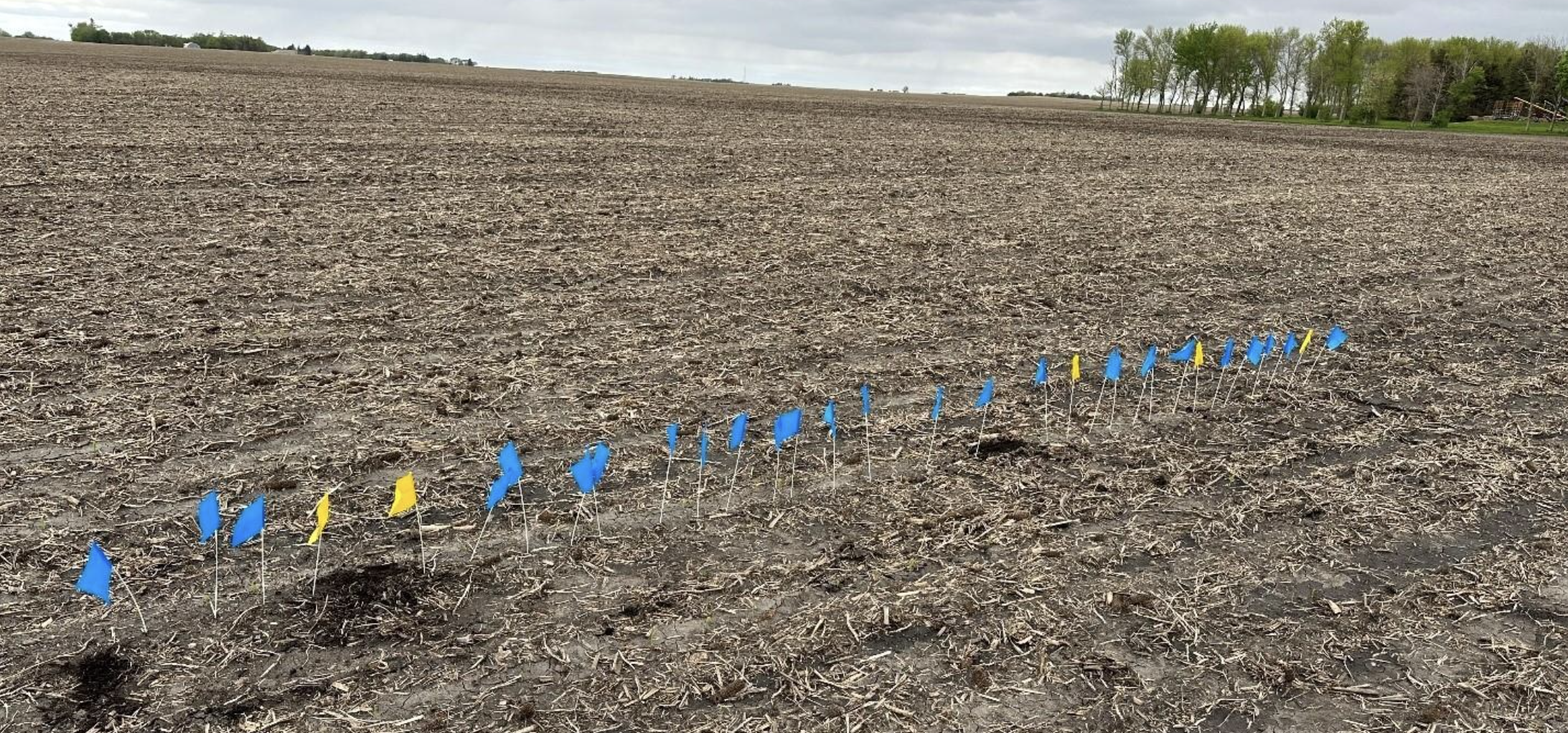
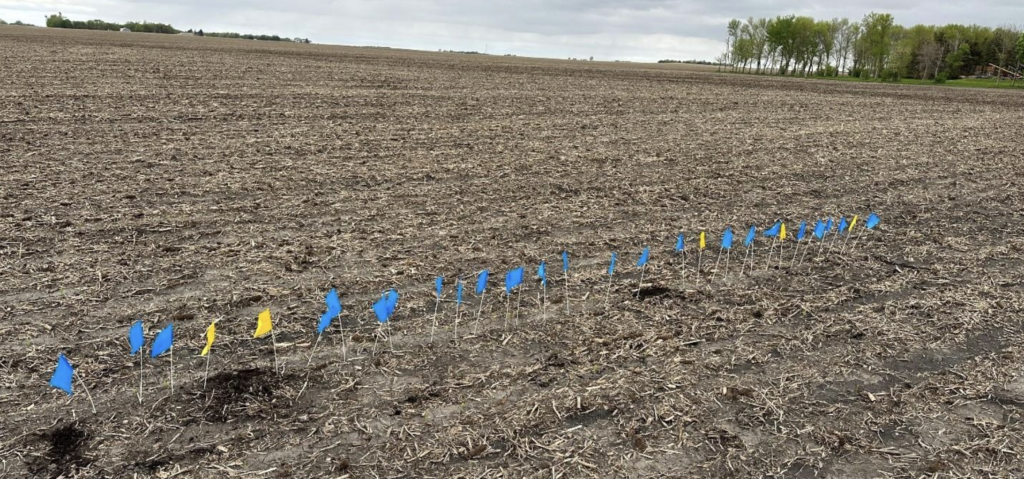
    It is that time of the year to start paying attention to our emergence of our corn. This year we will be doing flag tests again to mark out when specific plants emerge compared to others next to them. 

    We need to pay attention to emergence to maximize our yield that will be going into our bins this fall. We like to see everything come up within 24 hours of each other. Many studies have been conducted showing that plants that emerge on Day 2 of emergence can have a 10% yield loss compared to the first plants that emerged. Plants that come up on Day 3, the yield decrease can be close to 40% and those that emerge on Day 4 can have a yield loss of over 80%. The reason behind some of these yield losses is because those bigger brother corn plants will have the opportunity to take more water and nutrients away from the smaller brothers because they were able to get established sooner and they do not leave much for the runts to thrive on.  

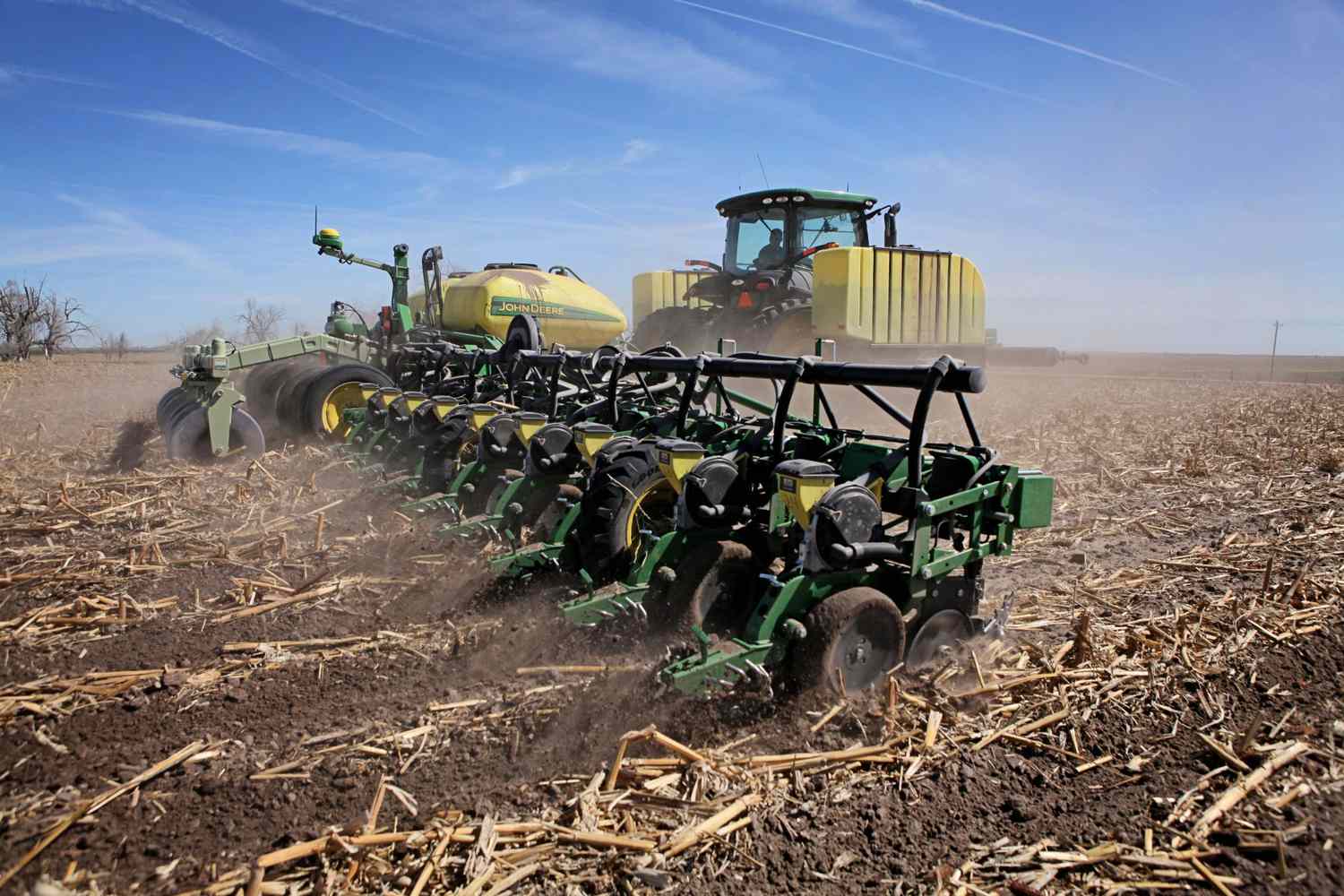
    It is so crucial that we make sure we are doing everything in our power to allow these corn plants to emerge at the same time. Are we going through our planters well before we hit the fields to make sure the disc openers and scrapers are in optimal condition? Are we making sure we are doing tillage and planting into optimal field conditions and not pushing soil moisture and soil temperature? Are we adding some sort of starter to help those plants get out of the ground easier? Are we looking at the closing systems on our planters to make sure we are closing the seed trench well? These are just a few things to be mindful of when we are thinking about emergence. Let’s get off to a good start and fill our bins with as many bushels as possible this fall.

    Make it a great spring and be safe! 

    Team Latham

    April 10, 2026
    Agriculture, Agronomics, Corn, Emergence, General, Growth Stages, Soil
  • Latham Hi‑Tech Seeds

    Answers to Your Planting Questions

    It’s hard to believe that spring is right around the corner, and planters will be rolling in two months’ time. There are many questions to consider before that first seed goes in the ground. Let’s take a closer look at three of them:

    1. How early is too early?
    2. Is the soil temperature warm enough to start planting?
    3. What depth should I be planting?

    Q1: Generally, farmers maximize corn yield when they plant in late April or early May.
    This holds true IF conditions are fit for planting. A mid-April planting date produces similar yield if young plants are not damaged by a freeze in May. In years with few growing degree days in late April and the first half of May, farmers can maximize corn yield when planting in mid-May.

    When spring arrives early, farmers should weigh the risks and benefits of planting earlier than usual. Farmers with federal crop insurance will lose replant coverage if they plant before the earliest allowable planting dates specified by the United States Department of Agriculture (USDA) Risk Management Agency — even if they must replant due to factors other than freeze damage or poor emergence.

    Seed treatments and planting high quality seed are a must with early planting.

    Q2: Before planting, check the weather forecast and soil temperatures for your area.

    It’s wise to check the soil temperature early in the morning of each field that you intend to plant. Wet soils and fields with more crop residue tend to have lower soil temperatures relative to drier soils or fields with less crop residue. Check the seed tag or talk to your seed dealer about the cold tolerance of your corn hybrids. Be aware that hybrids vary in cold tolerance.

    Certainly, plant hybrids that have more tolerance for colder temperatures first. However, be aware that “imbibitional chilling” is a physical phenomenon that can override genetics. Imbibitional water uptake occurs within the first 48 hours after a seed is planted.

    Once planted, corn seeds need a two-day (48-hour) window when the soil temperature at planting depth does not drop much below 50°F. When soil temperatures drop much lower than 50°F within that 48-hour time frame, chilling injury may affect seed germination and subsequent seedling growth.

    During the osmotic phase of water uptake, which starts about 48 hours after the initial imbibitional phase of water uptake ends, the risk of chilling injury approaches zero. Thereafter, temperatures below 50°F can slow germination and delay seedling emergence. This can result in a longer exposure to soil-borne pathogens, particularly in soggy wet soils. If you expect the latter, use fungicide seed treatment for at least your earliest planted corn fields.

    When corn seeds imbibe (take up) water, cell membranes stretch and cells expand. When a damaged cell membrane rehydrates, it may not return to its normal shape and size. This can create a “leaky” cell. Water is at its densest at about 39°F, so when cold water is imbibed additional membrane damage occurs. These ruptured membranes may occur in the cell walls and in the mitochondria. In the plant, this action may disrupt the embryo/endosperm enzymatic conversion to energy. It likely interferes with the emerging seedling’s development and reduces the plant’s growth rate.

    • Debate exists about what specific temperature and timing causes imbibitional chilling. However, corn seeds that imbibe cold water (in the low 40s) in the first 48 hours after planting undoubtedly are affected.
    • Planting when soil temperatures are above 50°F — and are not anticipated to drop much below this during the following 48 hours — alleviates concerns of imbibitional chilling affecting corn emergence.

    Q3: Check seed depth and seed depth consistency across your planter units.

    The “set it and forget it” approach to seed depth isn’t the best idea. To get corn off to the best start, it is important to achieve both rapid and consistent emergence following planting.

    Planting 4

    One aspect of achieving rapid and consistent plant emergence is by choosing the correct seeding depth and ensuring there is adequate and uniform moisture at the chosen seeding depth. The most common seeding depths recommended for corn range between 2.0 and 2.5 inches deep, and these planting depths can work very well within most conditions. However, certain soil moisture conditions at planting may warrant further examination/change in seeding depth.

    A corn seed imbibes soil moisture within the first 24 to 48 hours after planting, therefore maintaining both adequate and uniform moisture at seeding depth (not too wet and not too dry) within the first 48 hours is important. If the soil remains too dry, then the seed may be delayed in emergence until precipitation occurs. Furthermore, if the soil remains saturated after planting, the seed may rot and die.

    Contact your local Latham® representative to find out more information about ideal planting depth for your area, or call 1.877.GO.LATHAM.

    Team Latham

    January 8, 2026
    Agronomics, Corn, Crop, Emergence, General, Growth Stages, Soybeans, Spring
  • Latham Hi‑Tech Seeds

    The Value of Seed Treatment

    Seedware

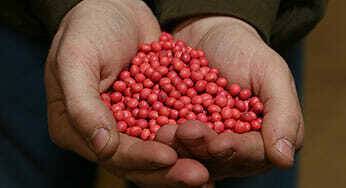
    Benefits of seed treatment include protecting seed from rot, seedling blights and insects, as well as improved germination. Seed treatments also help prevent the spread of plant diseases and reduce the risk of replant.

    Seed treatments are one of the most efficient crop protection technologies as they reduce farmers’ need for foliar spray applications. They also offer some certainty because field and weather conditions can prevent farmers from entering the field to apply fungicide and/or insecticide after seeding.

    Applying treatment directly on the seed before planting protects seeds and young plants, regardless of field conditions. Because seed treatment is a targeted, one-time application of pesticides to seeds, seedlings are protected during their most vulnerable stages of growth. Spraying fungicides or insecticides during these early growth stages is unlikely to be as effective because sprays are less targeted.

    Treated seeds carry a precise amount of pesticide that protects the seed during early growth, which is the critical growth period before and during germination. Seed treatments also are a “curative treatment,” protecting plants against seed-borne diseases.

    Research shows that seed treatments deliver more robust seedlings to farmers, protect plant stands and maximize yield potential. Conversely, farmers not using seed treatments in high pest pressure areas can see yield losses of 50% or more.

    Help secure a return on your seed investment with seed treatment! But don’t just take our word for it… take crop notes this growing season and compare data from multiple years. The Latham Team is here to answer your questions at 1-877-GO-LATHAM (877-465-2842).

    If you liked this article, watch this episode of Beyond the Bushel. John Latham and Justin Prokosch break down Latham’s three new soybean blends, what makes each unique, how they can help boost results this season and why they are exited to be apart of Victrato® with TYMIRIUM® technology, a new seed treatment from Syngenta. 


    Did you enjoy this article? We want to (TECH)talk with you! Sign up for our newsletter to receive agronomy article in your inbox! We’ll TALK soon.

    Victrato®, TYMIRIUM®, and the Syngenta logo are trademarks of a Syngenta Group Company. 

    Team Latham

    January 6, 2026
    Agronomics, Corn, Crop, Seed Treatment, Soybeans, Spring
  • Latham Hi‑Tech Seeds

    Tackle the Tar Spot Threat with Latham® Hybrids

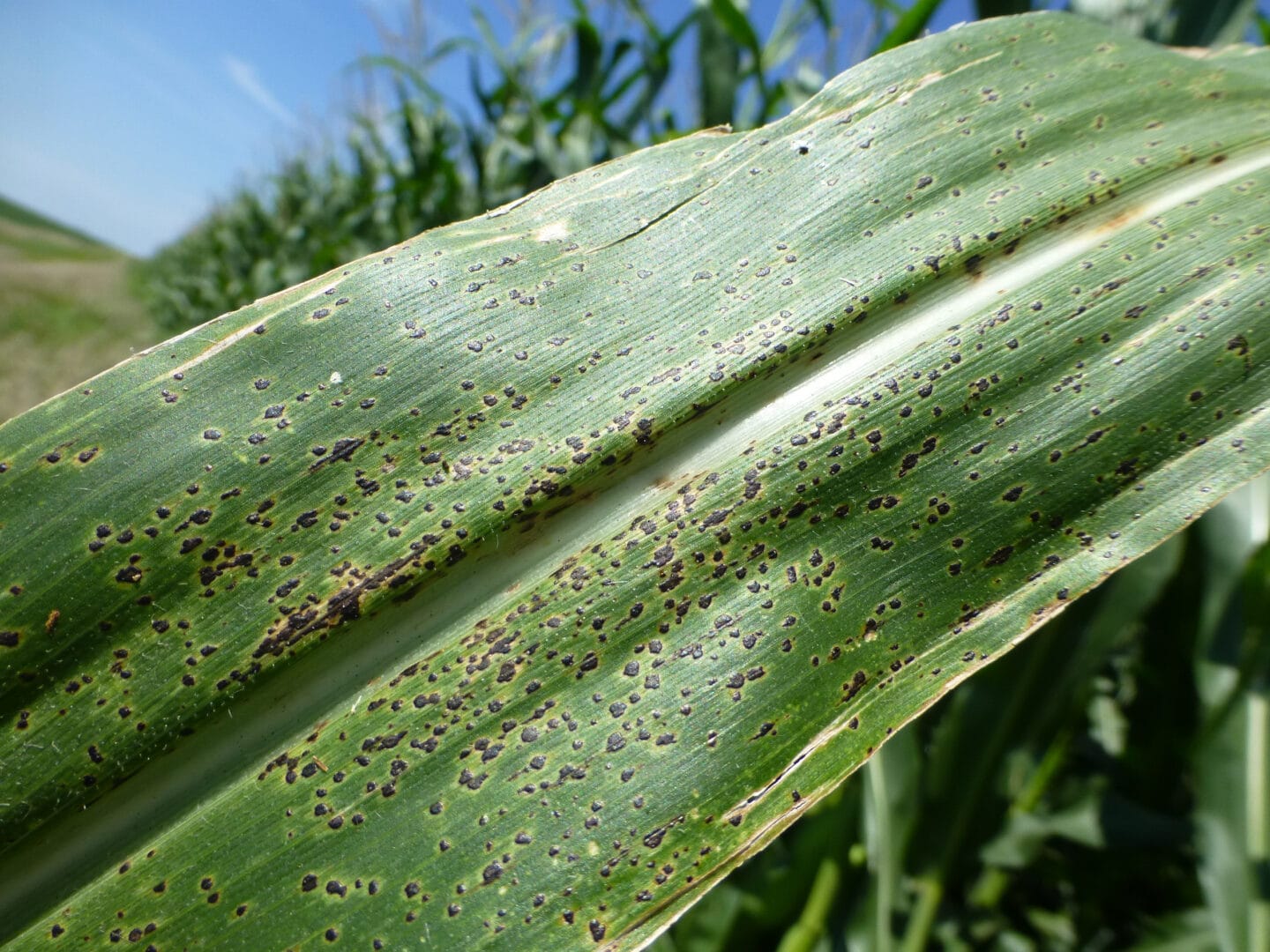
    TAR SPOT ON CORN

    Tar Spot is a fungal disease has rapidly become a significant concern for corn growers across the Midwest. As we all know, sometimes a great offense is your best defense. That’s why Latham Seeds has been placing a greater emphasis on developing hybrids with Tar Spot tolerance in recent years.

    Latham’s 2025 Corn Hybrids

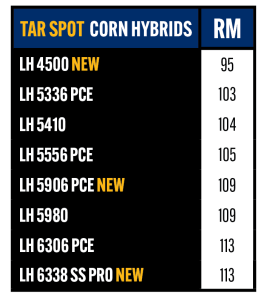
    Latham’s 2025 corn hybrid lineup includes three new hybrids with great Tar Spot scores. If you’re seeing Tar Spot in your fields this growing season, consider one of these for 2025 planting:

    Tar Spot Hybrids

    Early scouting and timely treatment are critical in managing this disease and protecting yield potential.

    Understanding Tar Spot

    Tar spot is caused by the fungus Phyllachora maydis and can be identified by its characteristic black, tar-like spots on corn leaves. These spots can merge, causing significant leaf damage, which leads to reduced photosynthesis, premature leaf senescence, and ultimately, lower yields. The disease thrives in cool, humid conditions and can spread quickly, making early detection essential.

    The Importance of Early Scouting

    Scouting early and often is your best defense against tar spot. Begin monitoring your fields as soon as conditions become favorable—typically in late spring or early summer when temperatures are cool, and humidity is high. Keep a close eye on the lower canopy, where the disease usually starts. Catching tar spot in its early stages allows you to make informed decisions about fungicide applications, which can help mitigate the disease’s impact.

    Treatment Strategies

    If tar spot is detected, a timely fungicide application is crucial. Choose fungicides with proven efficacy against tar spot and apply them at the right growth stage for maximum effectiveness. In some cases, a second application may be necessary, especially in high-risk environments or when conditions favor disease development.

    Top-Performing Latham Hybrids

    At Latham Seeds, we’ve been rigorously testing our hybrids in a variety of conditions to ensure they can withstand the challenges posed by tar spot. Learn more about how hybrids handle Tar Spot this fall during Training in Excellence (TIE) plots!

    Tar Spot Chart Table

    By prioritizing early scouting and timely treatment, and by choosing hybrids with strong disease resistance, you can minimize the impact of tar spot on your fields. As always, we’re here to support you with the best products and agronomic advice to help you succeed.

    Shannon Latham

    September 24, 2024
    Corn, Crop, General
  • Latham Hi‑Tech Seeds

    Crops and Cattle Are This Farm Family’s Business

    Family Photo

    As a kid in 4-H, Aaron Steenhoek got hooked on beef. Through 4-H projects, he kept pens of cattle and sold quarters, halves and wholes direct to consumers. He tracked how the cattle grew and how they gained. He remembers a local locker that sent a USDA inspector to show him how beef was graded and measured.

    “It was really interesting to me,” Aaron says. “Cattle have always been in my family, but I really got interested in the meat side of things.”

    Aaron Cattle

    So much so that he and his wife, Cory, decided six years ago to grow that side of their own family business. The couple live on the Steenhoek family’s Iowa Century Farm in Pella, where Aaron and his dad run a cow-calf operation. They also grow corn and soybeans, as well as summer forage, rye and alfalfa as feed for their herd.

    Now, Aaron and Cory also have a feedlot at Black Oak Acres. Aaron says they buy four or five groups throughout the year – feeding roughly 150 to 160 head annually —  in order to keep a constant flow of cattle on the farm. He’s particular about only buying cattle private treaty, or directly from a small number of trusted producers.

    “They don’t go through a sale barn or auction. We go and pick them up straight from the farm,” Aaron says. “It keeps the cattle from being exposed to other cattle, which keeps them healthier.”

    Aaron, who is also a regional sales manager for Latham Seeds, says he and Cory decided a few years ago to apply for a retail license to sell their farm-raised beef direct to consumers. Until then, they had been relying on local outlets to retail it for them. Now they have an inspected space right on the farm where they can sell cuts and bundles themselves.

    Aaron says the retail business has been nice because people can fill in with particular cuts even when Black Oak Acres might be a month or two out on product. Customers can buy in smaller amounts, too.

    “But what’s really great is that people know where their beef is coming from and how it’s been treated,” he says. “We never use growth hormones or antibiotics.”

    The Steenhoeks are careful stewards of the land — both for quality nutrition for their animals and conservation practices to protect it for generations to come.

    “Stewarding the land and the livestock is important to me,” Aaron says. “We really enjoying educating people about livestock and cattle in particular. There’s a lot of misconceptions and misinformation out there, because people are more removed from the farm life in general these days.”

    P Cattle

    Piedmontese Cattle

    Included in Aaron’s herd are four Piedmontese cattle, a rare breed that is known for being a leaner, premium-tasting but lower-calorie choice in beef. This is because Piedmontese are myostatin free, meaning they have a higher lean-to-fat ratio and do not develop the fatty marbling of traditional breeds. In addition, Piedmontese have lower levels of cholesterol, making it a healthier option for some people.

    Aaron says the texture of Piedmontese is different, and it needs to cook more slowly and at a lower temperature than more common cuts of beef.

    “But when it’s cooked right, you can almost cut it with a fork,” he says. “It’s that good.”

    Family Photo

    Aaron and Cory have four children: Emmett, Rhett, Klay and Quinn. They both graduated from Central College with degrees in exercise science and health promotion. When she’s not helping out on the farm, Cory is a personal fitness trainer. Today they’re sharing a family favorite recipe for National Beef Month.

    Shannon Latham

    May 17, 2024
    Beef, Corn, Crop, Food & Family, General, Recipes
  • Latham Hi‑Tech Seeds

    Unleash the “Madness” for Your Fields: Top Latham® Picks for 2024

    From the Field hero image

    Just like the excitement of March Madness grips basketball fans, spring brings a different kind of competition for farmers: the quest for maximum yield. But assembling a winning lineup for your field isn’t a matter of a lucky draft pick. It requires a strategic approach, and that’s where Latham Hi‑Tech Seeds steps in.

    Think of Latham’s R&D team as your expert recruiters, meticulously scouting and selecting the top-performing corn and soybean varieties for the Upper Midwest.

    Here’s a glimpse into Latham’s “bracketology” of seed picks for 2024:

    Starting Five for Latham Corn:

    1. 3937 VT Double PRO: The Point Guard. This early-maturing superstar gets your season off to a fast break. It is adaptive to all soil types and emerges quickly and strongly, setting the stage for a productive campaign.
    2. 4937 VT Double PRO: The Fan Favorite. Team Latham’s biggest seller the last couple of years, this hybrid has fast dry down and top-end yields. It’s a farm favorite in the north, delivering a winning shot even when the competition wilts.
    3. 4866 Tricepta®: The Power Forward. The high-yielding hybrid plays a critical role. With excellent standability and a multi-year track record, it’s ready to dominate even the most challenging fields.
    4. 5336 PowerCore®: The Quiet Leader. Exceptional disease ratings, impressive girth and high test-weight for this hybrid keeps the competition off guard to maximize harvest potential.
    5. 5815 VT Double PRO: The Clutch Performer. Known for its outstanding root strength, this beast stands tall even under harsh weather conditions — making it a reliable champion that delivers when the pressure’s on.

    Starting Five — Soybeans:

    • 0254 XtendFlex®: The MVP (Most Valuable Pod): One of the tallest in the market, this variety keeps the first pod higher off the ground, giving it champion rights against yield-robbing pathogens. Coupled with impressive IDC tolerance, it’s a must-have player in Team Latham’s portfolio.
    • 0888 XtendFlex: The Defensive Stopper. This showoff has excellent standability with good lateral branching, ensuring a harvest victory with consistent performance all season long.
    • 1881 Enlist E3®: The “And-One” Producer. It may be new to the lineup this year, but this Peking source SCN came to play. A new Ironclad® designation for the highest disease resistance makes it a high scorer across all soil types.
    • 2031 Enlist E3: The Fast Stealer: Another Peking source SCN, this variety flies out of the ground and moves easily north or south of zone. Its standability and solid IDC and SDS tolerances make it a high-yielding game changer.
    • 2551 Enlist E3: The “Moneyball” Choice. Latham coaches call this variety a “yield hog” that blew the doors off test trials last year. It’s a newly-crowned Ironclad® variety that’s itching to perform – and won’t disappoint.

    Beyond the Picks: Latham’s Coaching Advantage

    These are just a few of Latham’s all-star selections. Just like a strong coaching staff, the Latham Product Team is here to help you choose the perfect products for your specific field conditions and goals. They’ll guide you through Latham’s deep bench of options, ensuring you have the right variety for every position on your farm.

    Don’t settle for a mediocre “free agent” seed. Recruit Latham’s championship-caliber lineup and experience the satisfaction of a winning harvest. Let’s assemble your perfect plays for ultimate yield success! Learn more. 


    Team Latham

    April 3, 2024
    Corn, Crop, General, Soybeans, Tech Tuesday
1 2 3 … 36
Next Page

Latham Hi‑Tech Seeds

131 180th Street | Alexander, IA 50420

(641) 692-3258

SIGNUP FOR OUR NEWSLETTER
  • Contact
  • Legal
  • Seedware Login
  • Latham Gear

© 2026 Latham Hi‑Tech Seeds. All rights reserved. | Privacy Policy

Latham® Hi-Tech Seeds is a trademark of M.S. Technologies, L.L.C., 103 Avenue D, West Point, IA 52656.