Latham Hi-Tech Seeds

(641) 692-3258

  • Home
  • Performance
  • Products
    • Corn
    • Soybeans
    • Soybean Blends
    • Alfalfa
    • Corn Silage
    • Seed Guide
  • Find a Rep
  • Media
    • Blog
    • News
    • Videos
    • Podcasts
    • TECHTalk
  • About Us
    • Company History
    • Our Mission
    • Careers
    • Become a Rep
    • Sowing Seeds of Hope
  • Contact Us
  • Latham Hi‑Tech Seeds

    Timing Your Spray for Maximum Yield

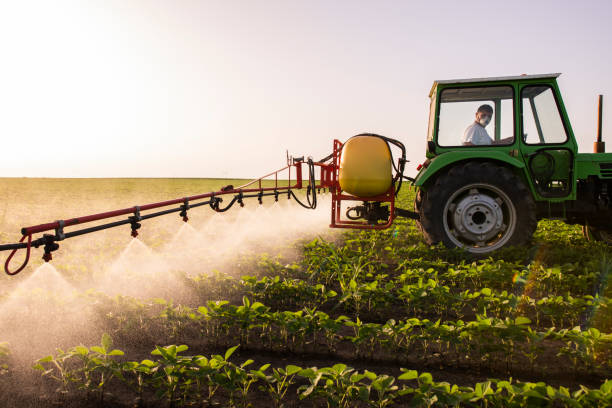
    Planting across Latham Country has moved along quickly, and it won’t be long before postemergence spraying begins. As applicators prepare to head to the field, familiar questions arise: When should I spray? What product should I use? Should I spray at all? 

    Of these, “when to spray” may be the most critical decision a grower makes. Injury or stress to a young plant can have lasting effects that aren’t always visible to the naked eye. Understanding crop growth stages—and how they align with product label requirements—is essential for making sound application decisions and protecting yield potential. Let’s start with corn.  

    Corn Growth Stages and Application Timing 

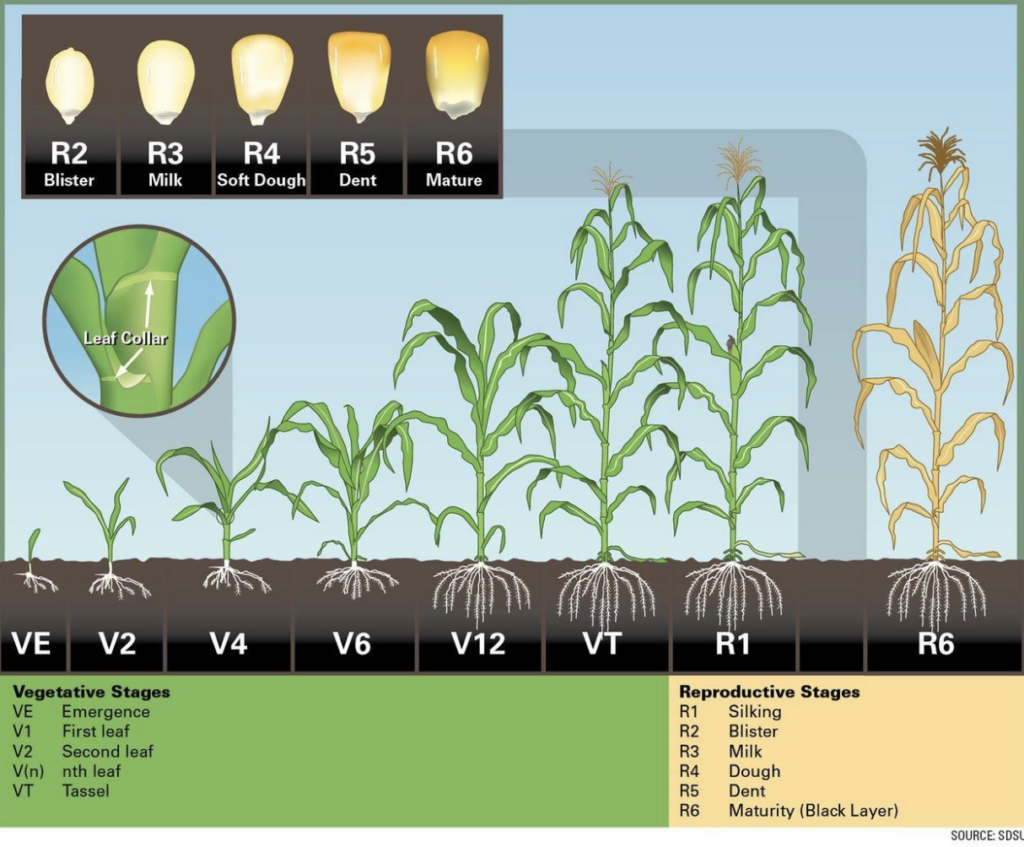
    Herbicide and crop protection labels typically reference growth stages when outlining application timing. The corn growth stage chart is an excellent resource for understanding these stages.  

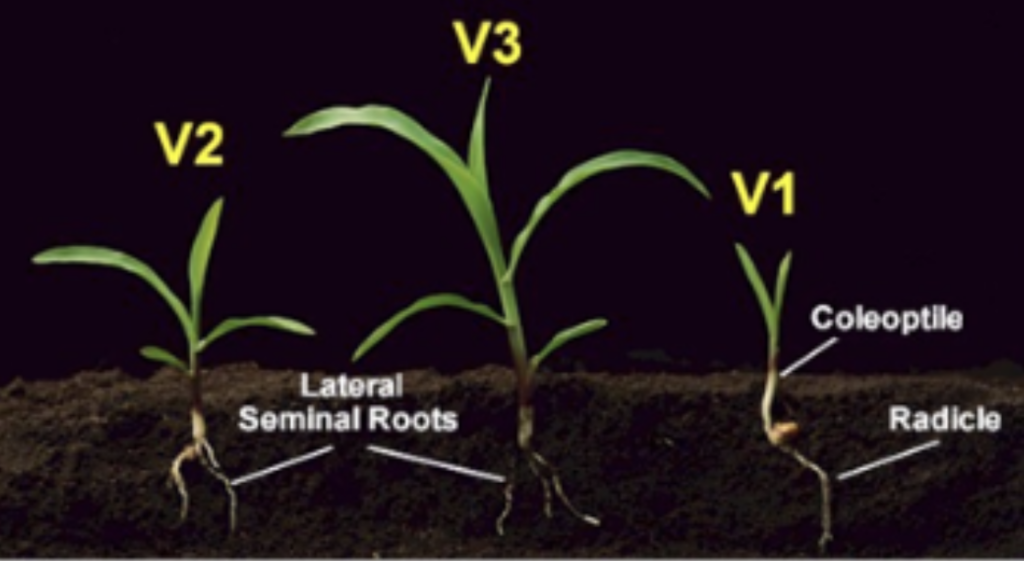
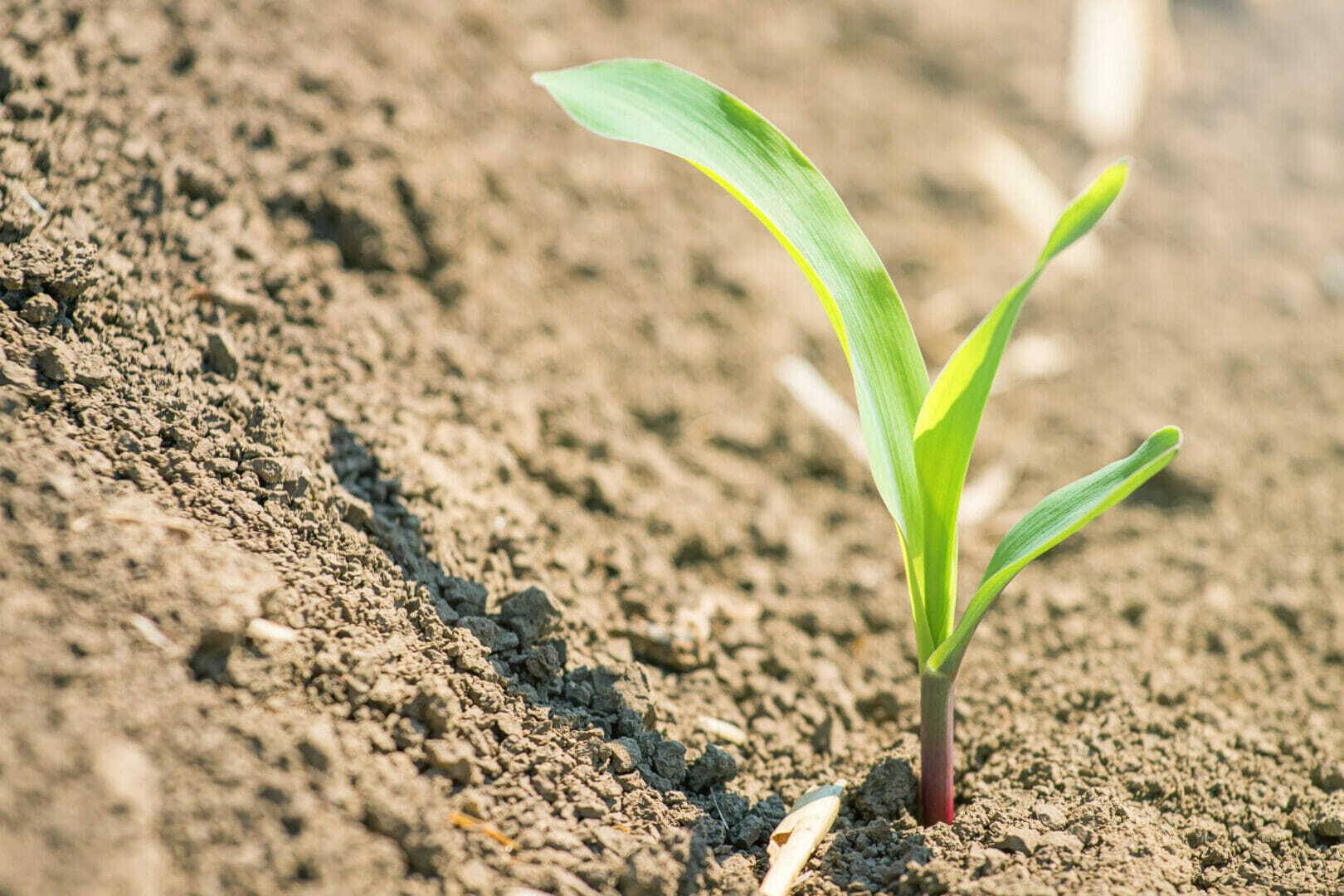
    VE (Emergence) occurs when the coleoptile reaches and breaks through the soil surface. Corn generally requires about 100–200 growing degree units (GDUs) to emerge, which can take as little as four to five days after planting under warm, moist conditions. During this time, growth is also occurring below ground as the nodal root system begins to develop. 

    Emergence can be rapid in favorable soil conditions but may take three weeks or longer in cooler soils. Early in the season, a new leaf typically appears about every three days. As temperatures warm, leaf appearance can accelerate to one new leaf every one to two days. Full season hybrids grown in the central Corn Belt commonly produce 21–22 leaves, while earlier maturing hybrids produce fewer. 

    These numbers are important to keep in mind as you plan your spray program. Under favorable conditions, corn can move from planting to the V5–V7 stage within a month. Missing application windows can happen quickly if fields aren’t monitored closely. 

    Soybean Staging Considerations 

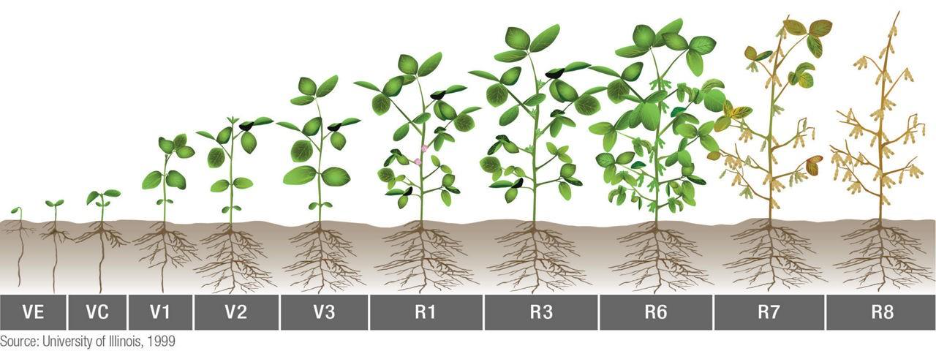
    Soybeans add another layer of complexity, as plants within the same field rarely develop at the same pace. A soybean field is considered to be at a specific V or R stage when 50% or more of the plants are at or beyond that stage. Because of this variability, understanding soybean staging is critical when determining application timing. The soybean growth stage chart is a valuable reference when evaluating field conditions. 

    A general rule of thumb is to expect about five days between soybean growth stages, although weather can speed this up or slow it down. One of the most critical stages to be aware of is R1, defined as one open flower at any node on the main stem. Soybean flowers are highly sensitive, and herbicide applications should be avoided at this stage whenever possible. 

    R1 can begin before full canopy closure, which can tempt growers to make a final post emergence application. However, the risk at this stage often outweighs the reward. A strong pre-plant and early post program can greatly reduce the need for late season spraying, and a handful of late weed escapes is rarely worth the potential consequences of applying herbicides after flowering begins. 

    Team Latham

    April 10, 2026
    Agronomics, Corn, Emergence, General
  • Latham Hi‑Tech Seeds

    Start Even, Finish Strong

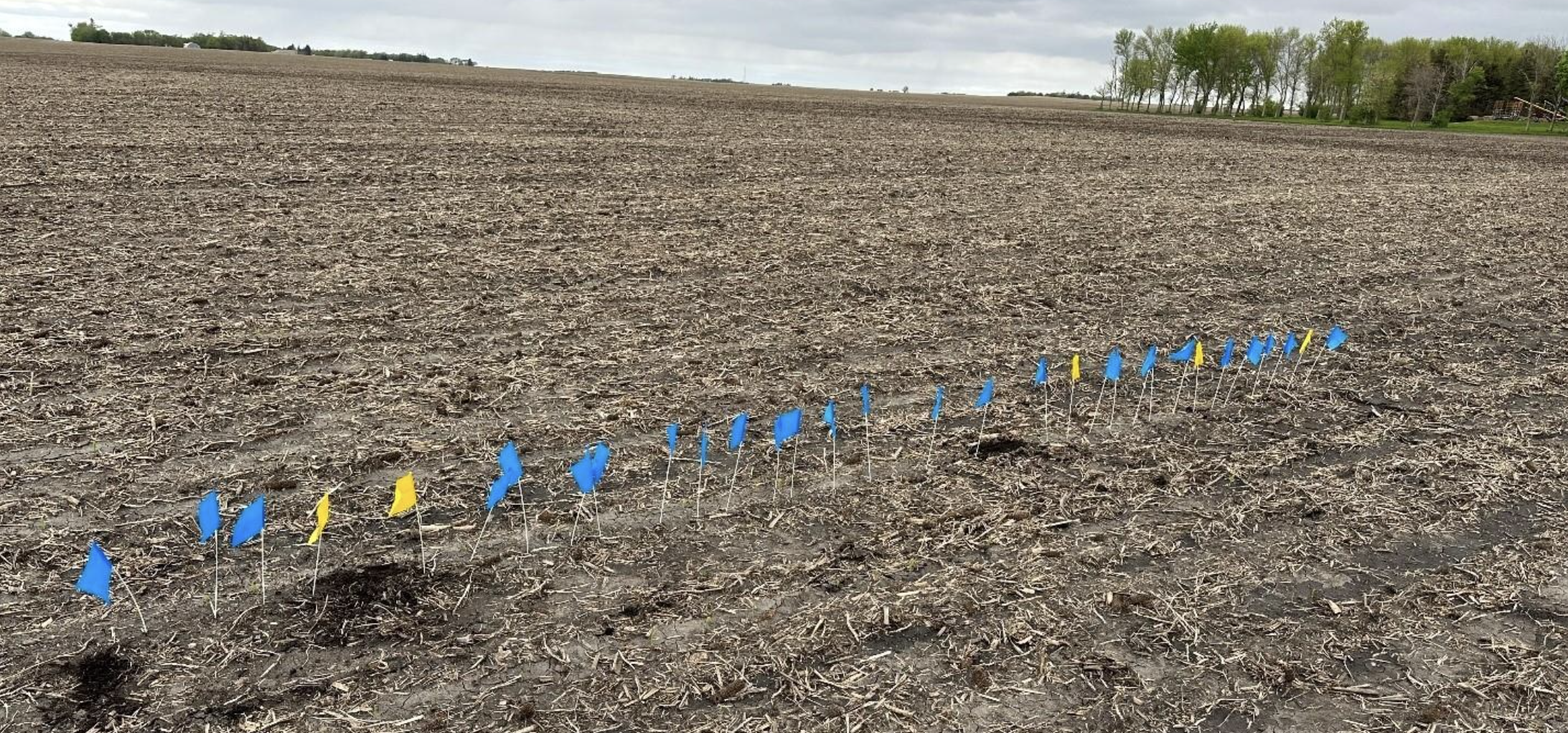
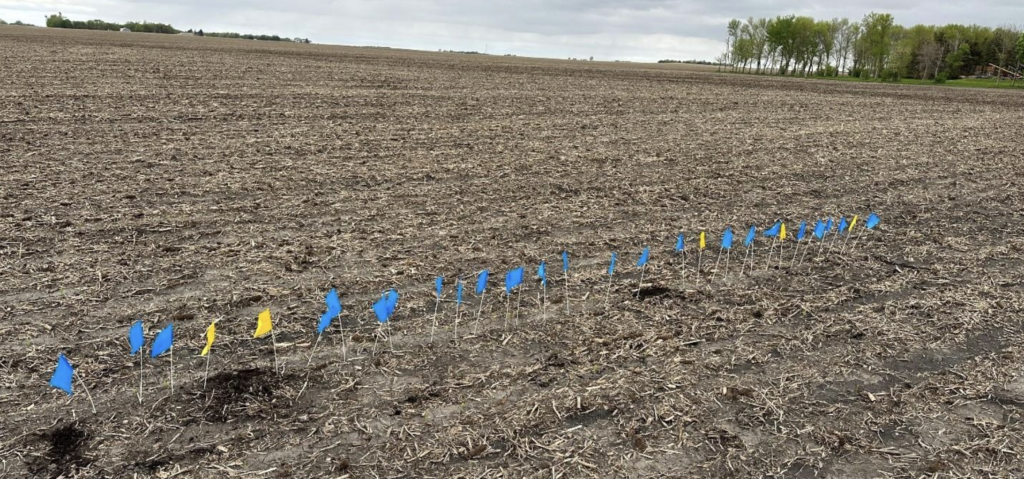
    It is that time of the year to start paying attention to our emergence of our corn. This year we will be doing flag tests again to mark out when specific plants emerge compared to others next to them. 

    We need to pay attention to emergence to maximize our yield that will be going into our bins this fall. We like to see everything come up within 24 hours of each other. Many studies have been conducted showing that plants that emerge on Day 2 of emergence can have a 10% yield loss compared to the first plants that emerged. Plants that come up on Day 3, the yield decrease can be close to 40% and those that emerge on Day 4 can have a yield loss of over 80%. The reason behind some of these yield losses is because those bigger brother corn plants will have the opportunity to take more water and nutrients away from the smaller brothers because they were able to get established sooner and they do not leave much for the runts to thrive on.  

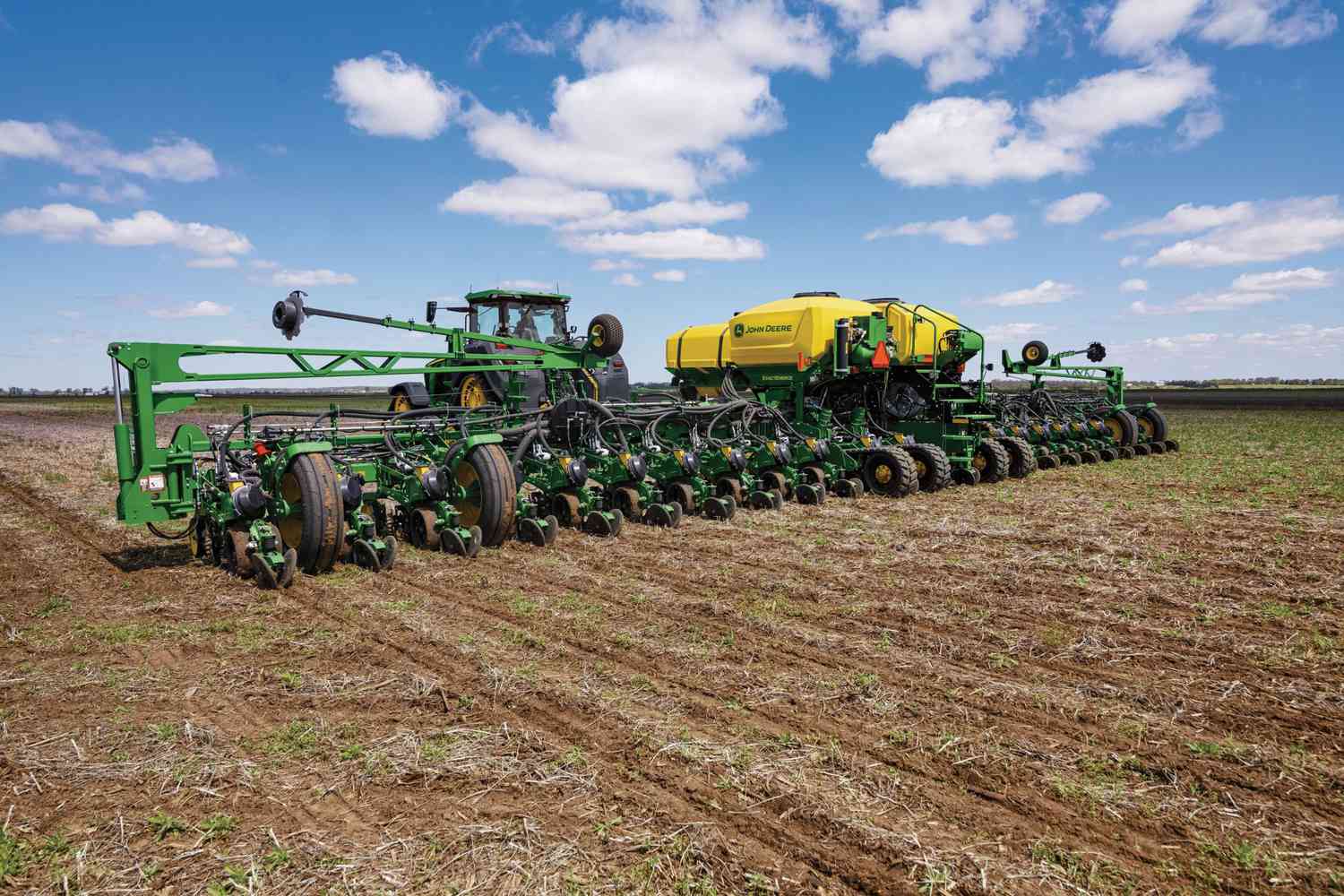
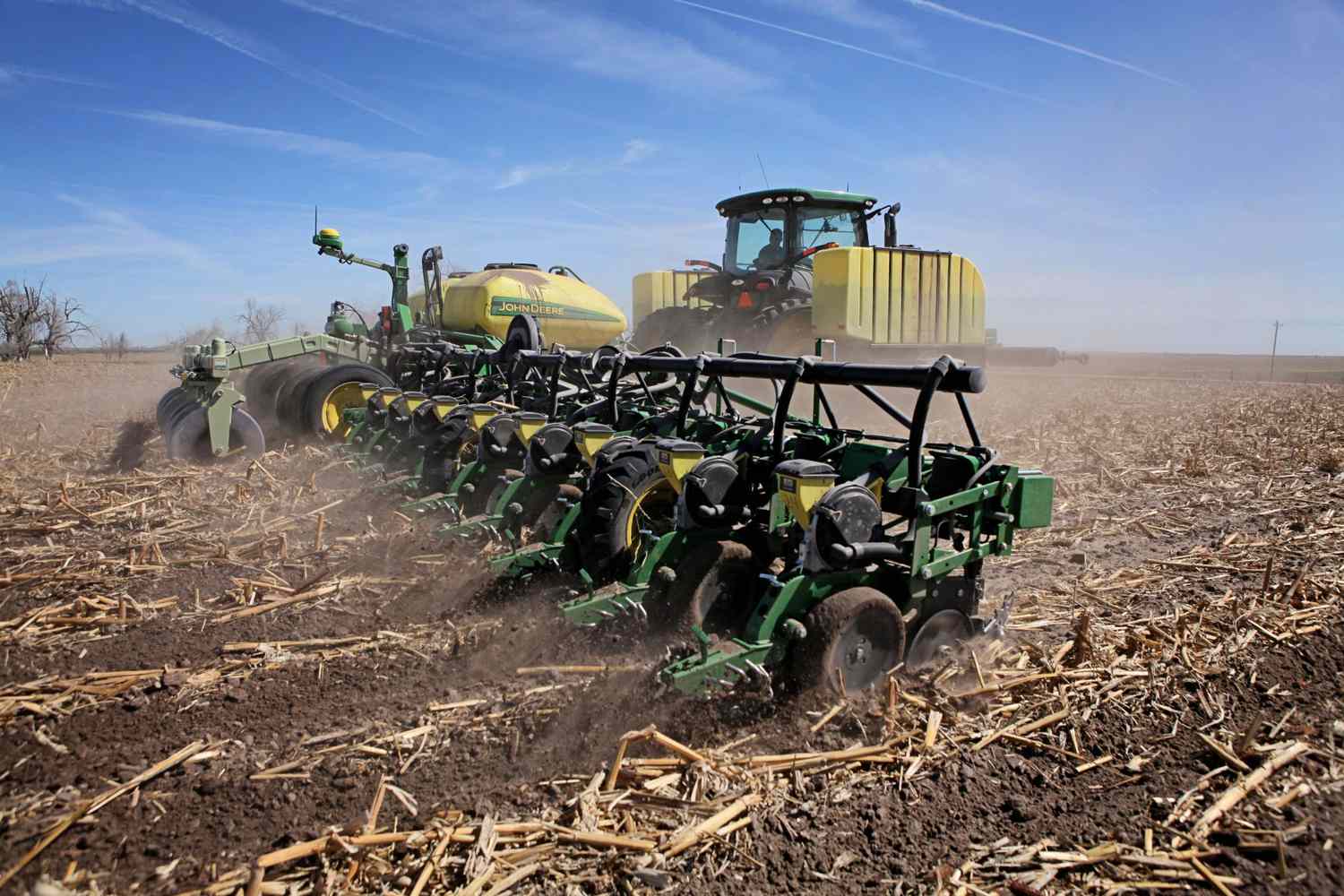
    It is so crucial that we make sure we are doing everything in our power to allow these corn plants to emerge at the same time. Are we going through our planters well before we hit the fields to make sure the disc openers and scrapers are in optimal condition? Are we making sure we are doing tillage and planting into optimal field conditions and not pushing soil moisture and soil temperature? Are we adding some sort of starter to help those plants get out of the ground easier? Are we looking at the closing systems on our planters to make sure we are closing the seed trench well? These are just a few things to be mindful of when we are thinking about emergence. Let’s get off to a good start and fill our bins with as many bushels as possible this fall.

    Make it a great spring and be safe! 

    Team Latham

    April 10, 2026
    Agriculture, Agronomics, Corn, Emergence, General, Growth Stages, Soil
  • Latham Hi‑Tech Seeds

    Planting Smart Starts with Soil Conditions

    Planting season is upon us, and every decision you make—from seed selection to deciding what soil conditions to plant into—can influence the final number on the yield monitor. When seeds are placed into cold, wet soils, early-season stress can develop and impact crop performance for the rest of the year. 

    While many factors affecting crop success are beyond our control, it’s important to manage the ones we can. Planting depth often gets a lot of attention, but it isn’t the only—or even the most important—factor in plant development. Soil conditions at planting are just as critical, if not more so. 

    For a successful growing season, consider the following: 
    Planting into wet soils or working ground that’s too wet can lead to sidewall smearing, compaction from disk openers, and seed trenches that don’t close properly. These issues can result in uneven emergence and seedling. Ideally, the top three to four inches of soil should be dry enough for proper planting conditions. 

    Cold weather after planting can also stress corn during emergence and early growth. Aim to plant as early as conditions allow, ensuring that the first few days in the soil support proper kernel imbibition. If the forecast shows temperatures that are continuing to decrease, it would be best to delay planting until our forecasted temperatures are getting warmer, 2-3 days out.  

    Finally, avoid reducing planting depth, as shallower placement often leads to lower yields and complications throughout the growing season and at harvest. In recent years, more growers have shifted toward planting fuller-season hybrids for their maturity zones and planting earlier to extend the growing season and maximize yield potential. Just be sure to prioritize optimal conditions when doing so. 

    Happy Spring and Happy Planting Season! Good luck to everyone and remember to be safe! 

    Team Latham

    April 10, 2026
    Agronomics, Crop, Emergence, General, Growth Stages
  • Latham Hi‑Tech Seeds

    Answers to Your Planting Questions

    It’s hard to believe that spring is right around the corner, and planters will be rolling in two months’ time. There are many questions to consider before that first seed goes in the ground. Let’s take a closer look at three of them:

    1. How early is too early?
    2. Is the soil temperature warm enough to start planting?
    3. What depth should I be planting?

    Q1: Generally, farmers maximize corn yield when they plant in late April or early May.
    This holds true IF conditions are fit for planting. A mid-April planting date produces similar yield if young plants are not damaged by a freeze in May. In years with few growing degree days in late April and the first half of May, farmers can maximize corn yield when planting in mid-May.

    When spring arrives early, farmers should weigh the risks and benefits of planting earlier than usual. Farmers with federal crop insurance will lose replant coverage if they plant before the earliest allowable planting dates specified by the United States Department of Agriculture (USDA) Risk Management Agency — even if they must replant due to factors other than freeze damage or poor emergence.

    Seed treatments and planting high quality seed are a must with early planting.

    Q2: Before planting, check the weather forecast and soil temperatures for your area.

    It’s wise to check the soil temperature early in the morning of each field that you intend to plant. Wet soils and fields with more crop residue tend to have lower soil temperatures relative to drier soils or fields with less crop residue. Check the seed tag or talk to your seed dealer about the cold tolerance of your corn hybrids. Be aware that hybrids vary in cold tolerance.

    Certainly, plant hybrids that have more tolerance for colder temperatures first. However, be aware that “imbibitional chilling” is a physical phenomenon that can override genetics. Imbibitional water uptake occurs within the first 48 hours after a seed is planted.

    Once planted, corn seeds need a two-day (48-hour) window when the soil temperature at planting depth does not drop much below 50°F. When soil temperatures drop much lower than 50°F within that 48-hour time frame, chilling injury may affect seed germination and subsequent seedling growth.

    During the osmotic phase of water uptake, which starts about 48 hours after the initial imbibitional phase of water uptake ends, the risk of chilling injury approaches zero. Thereafter, temperatures below 50°F can slow germination and delay seedling emergence. This can result in a longer exposure to soil-borne pathogens, particularly in soggy wet soils. If you expect the latter, use fungicide seed treatment for at least your earliest planted corn fields.

    When corn seeds imbibe (take up) water, cell membranes stretch and cells expand. When a damaged cell membrane rehydrates, it may not return to its normal shape and size. This can create a “leaky” cell. Water is at its densest at about 39°F, so when cold water is imbibed additional membrane damage occurs. These ruptured membranes may occur in the cell walls and in the mitochondria. In the plant, this action may disrupt the embryo/endosperm enzymatic conversion to energy. It likely interferes with the emerging seedling’s development and reduces the plant’s growth rate.

    • Debate exists about what specific temperature and timing causes imbibitional chilling. However, corn seeds that imbibe cold water (in the low 40s) in the first 48 hours after planting undoubtedly are affected.
    • Planting when soil temperatures are above 50°F — and are not anticipated to drop much below this during the following 48 hours — alleviates concerns of imbibitional chilling affecting corn emergence.

    Q3: Check seed depth and seed depth consistency across your planter units.

    The “set it and forget it” approach to seed depth isn’t the best idea. To get corn off to the best start, it is important to achieve both rapid and consistent emergence following planting.

    Planting 4

    One aspect of achieving rapid and consistent plant emergence is by choosing the correct seeding depth and ensuring there is adequate and uniform moisture at the chosen seeding depth. The most common seeding depths recommended for corn range between 2.0 and 2.5 inches deep, and these planting depths can work very well within most conditions. However, certain soil moisture conditions at planting may warrant further examination/change in seeding depth.

    A corn seed imbibes soil moisture within the first 24 to 48 hours after planting, therefore maintaining both adequate and uniform moisture at seeding depth (not too wet and not too dry) within the first 48 hours is important. If the soil remains too dry, then the seed may be delayed in emergence until precipitation occurs. Furthermore, if the soil remains saturated after planting, the seed may rot and die.

    Contact your local Latham® representative to find out more information about ideal planting depth for your area, or call 1.877.GO.LATHAM.

    Team Latham

    January 8, 2026
    Agronomics, Corn, Crop, Emergence, General, Growth Stages, Soybeans, Spring
  • Latham Hi‑Tech Seeds

    #FromtheField – Week of June 19, 2023

    June 22

    Take a look across Latham Country! We’re coming to you every week.

    Did you enjoy these videos? We want to (TECH)talk with you! Sign up for our newsletter to receive agronomy videos (and delicious recipes) in your inbox! We’ll TALK soon.

    Webspec Admin

    June 22, 2023
    #FromTheField Crop Reports, Corn, Crop, Disease, Emergence, From the Field, General, Growth Stages, Soybeans
  • Latham Hi‑Tech Seeds

    #FromtheField – Week of June 12, 2023

    Ramie from the field graphic

    Take a look across Latham Country! We’re coming to you every week.

    How important is planting depth? Aaron shows us first-hand from the field in Central Iowa.

    Ramie from the field graphic

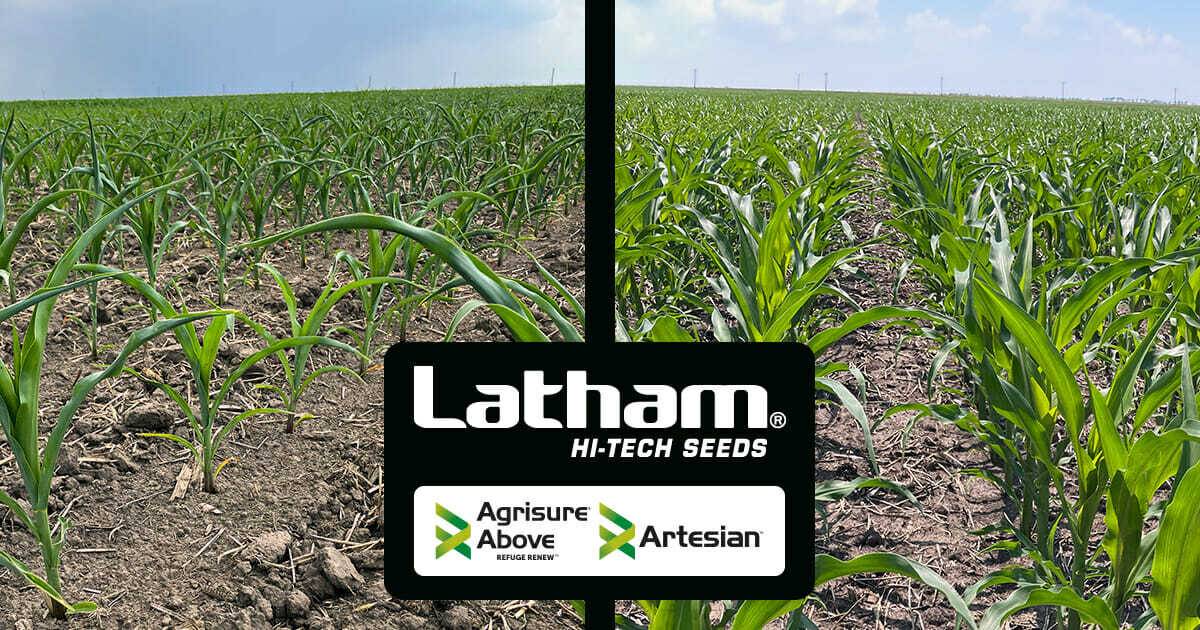
    See the difference! On the left is LH 5034 AA after getting no rain for 35 days in super-hot weather. On the right shows the same hybrid after 1.2” of rain. This product has impressive heat and drought resistance in South Dakota! Learn more about our unmatched lineup: https://www.lathamseeds.com/products/?crop=377

    Did you enjoy these videos? We want to (TECH)talk with you! Sign up for our newsletter to receive agronomy videos (and delicious recipes) in your inbox! We’ll TALK soon.


    Webspec Admin

    June 15, 2023
    #FromTheField Crop Reports, Agronomics, Corn, Crop, Emergence, From the Field, Growth Stages, Season, Soil, Summer
  • Latham Hi‑Tech Seeds

    Early Scouting For Prevention

    Young green corn growing on the field. Young Corn Plants.

    The first principle of crop scouting is to determine what is normal and what is not normal. Knowing what a healthy plant looks like is key to identifying seedling disease. When scouting for seedling diseases, look for yellowing, wilted, stunted, dead or missing plants.

    • In corn, look for discolored or rotten mesocotyls, seminal roots and nodal roots.
    • In soybeans, look for seedlings that pull easily from the soil, discolored or rotting root tissue, and lesions that form on the taproot or hypocotyl.

    Before you head out to the field, there are several tools that are must-haves for early-season crop scouting:

    • A tape measure to take stand counts
    • A seed digger, trowel, or spade to dig up seeds or plants to evaluate planting depth, seedling diseases and below-ground feeding insects, like seed corn maggots.

    Remember that certain weather and soil conditions favor specific pathogens. Cool and wet soils favor Fusarium and Pythium, warm and wet soils favor Phytophthora, and warm and moist soils favor Rhizoctonia.

    It should be noted that a lab diagnosis is needed to confirm what pathogen is causing the symptoms. Knowing what disease(s) are present can help you choose hybrids and varieties that have good disease scores in the future and can guide decisions on the use of fungicide treated seed.

    Did you enjoy this article? We want to (TECH)talk with you! Sign up for our newsletter to receive agronomy videos (and delicious recipes) in your inbox! We’ll TALK soon.

    Team Latham

    June 8, 2023
    Corn, Crop, Disease, Emergence, Growth Stages, Soybeans, Summer, Tech Tuesday
  • Latham Hi‑Tech Seeds

    #FromtheField – Week of June 5, 2023

    YouTube 1

    Take a look across Latham Country! We’re coming to you every week.

    Did you enjoy these videos? We want to (TECH)talk with you! Sign up for our newsletter to receive agronomy videos (and delicious recipes) in your inbox! We’ll TALK soon.

    Webspec Admin

    June 8, 2023
    #FromTheField Crop Reports, Corn, Crop, Emergence, From the Field, Growth Stages, Soil, Soybeans, Summer
  • Latham Hi‑Tech Seeds

    #FromtheField – Week of May 29, 2023

    Kody Snip

    Take a look across Latham Country! We’re coming to you every week.

    Did you enjoy these videos? We want to (TECH)talk with you! Sign up for our newsletter to receive agronomy videos (and delicious recipes) in your inbox! We’ll TALK soon.

    Webspec Admin

    June 1, 2023
    #FromTheField Crop Reports, Agronomics, Corn, Crop, Emergence, Growth Stages, Season, Soybeans, Spring, Summer, Weed Control
  • Latham Hi‑Tech Seeds

    #FromtheField – Week of May 22

    Minnesota


    Take a look across Latham Country! We’re coming to you every week.

    Did you enjoy these videos? We want to (TECH)talk with you! Sign up for our newsletter to receive agronomy videos (and delicious recipes) in your inbox! We’ll TALK soon.

    Webspec Admin

    May 25, 2023
    #FromTheField Crop Reports, Agronomics, Corn, Crop, Emergence, From the Field, Growth Stages, Soil
1 2 3 … 10
Next Page

Latham Hi‑Tech Seeds

131 180th Street | Alexander, IA 50420

(641) 692-3258

SIGNUP FOR OUR NEWSLETTER
  • Contact
  • Legal
  • Dealer Center
  • Seedware Login
  • Latham Gear

© 2025 Latham Hi‑Tech Seeds. All rights reserved. | Iowa Web Design by Webspec | Privacy Policy

Latham® Hi-Tech Seeds is a trademark of M.S. Technologies, L.L.C., 103 Avenue D, West Point, IA 52656.