
Latham Hi-Tech Seeds

(641) 692-3258

  • Home
  • Performance
  • Products
    • Corn
    • Soybeans
    • Soybean Blends
    • Alfalfa
    • Corn Silage
    • Seed Guide
  • Find a Rep
  • Media
    • Blog
    • News
    • Videos
    • Podcasts
    • TECHTalk
  • About Us
    • Company History
    • Our Mission
    • Careers
    • Become a Rep
    • Sowing Seeds of Hope
  • Contact Us
  • Latham Hi‑Tech Seeds

    Timing Your Spray for Maximum Yield

    Planting across Latham Country has moved along quickly, and it won’t be long before postemergence spraying begins. As applicators prepare to head to the field, familiar questions arise: When should I spray? What product should I use? Should I spray at all? 

    Of these, “when to spray” may be the most critical decision a grower makes. Injury or stress to a young plant can have lasting effects that aren’t always visible to the naked eye. Understanding crop growth stages—and how they align with product label requirements—is essential for making sound application decisions and protecting yield potential. Let’s start with corn.  

    Corn Growth Stages and Application Timing 

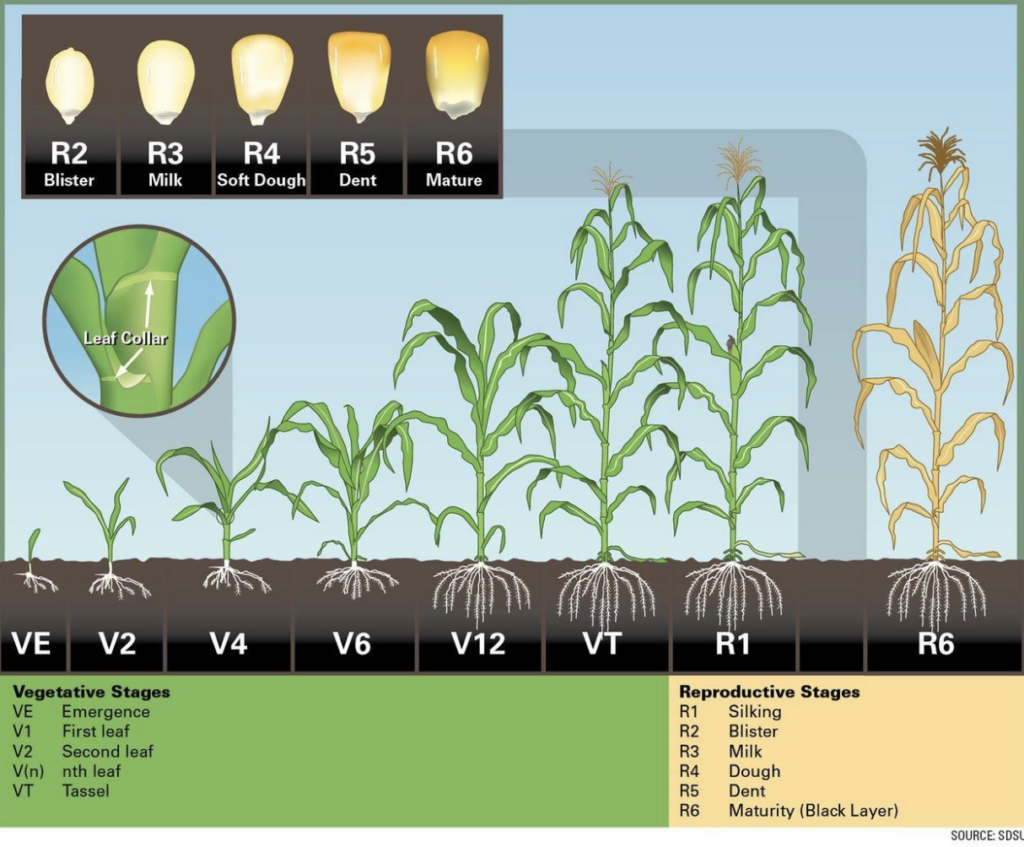
    Herbicide and crop protection labels typically reference growth stages when outlining application timing. The corn growth stage chart is an excellent resource for understanding these stages.  

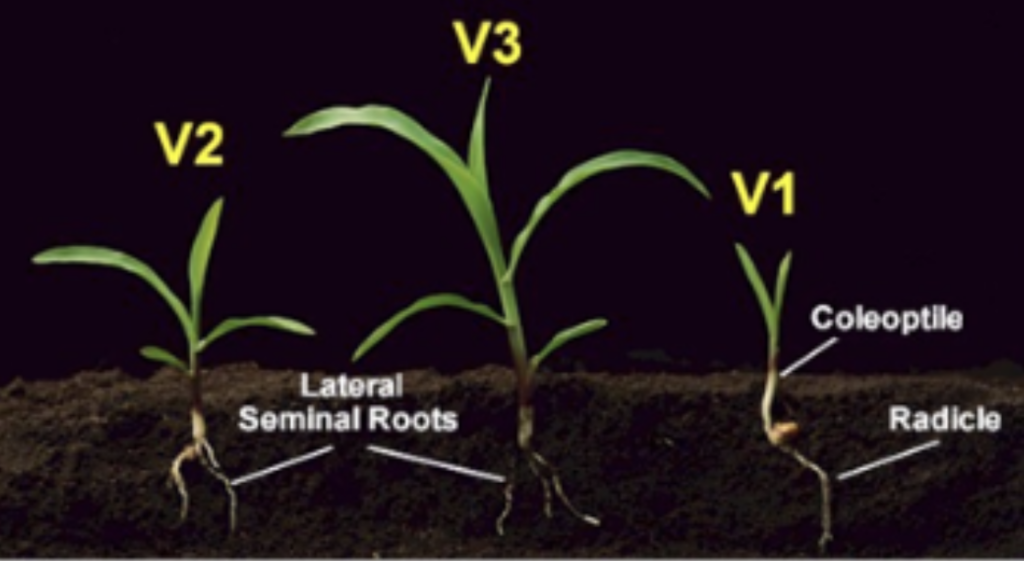
    VE (Emergence) occurs when the coleoptile reaches and breaks through the soil surface. Corn generally requires about 100–200 growing degree units (GDUs) to emerge, which can take as little as four to five days after planting under warm, moist conditions. During this time, growth is also occurring below ground as the nodal root system begins to develop. 

    Emergence can be rapid in favorable soil conditions but may take three weeks or longer in cooler soils. Early in the season, a new leaf typically appears about every three days. As temperatures warm, leaf appearance can accelerate to one new leaf every one to two days. Full season hybrids grown in the central Corn Belt commonly produce 21–22 leaves, while earlier maturing hybrids produce fewer. 

    These numbers are important to keep in mind as you plan your spray program. Under favorable conditions, corn can move from planting to the V5–V7 stage within a month. Missing application windows can happen quickly if fields aren’t monitored closely. 

    Soybean Staging Considerations 

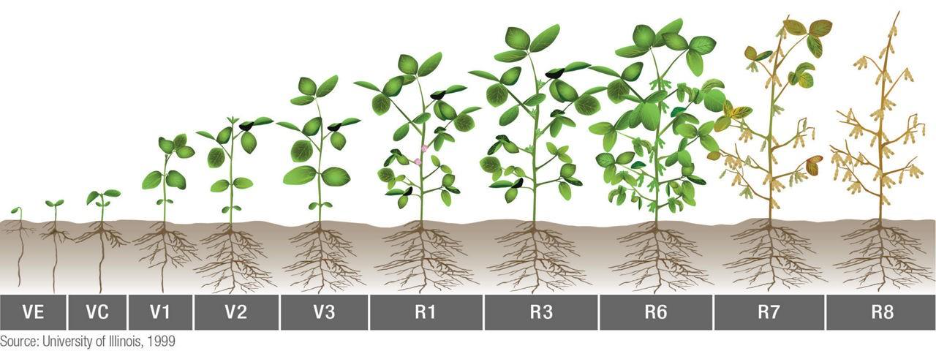
    Soybeans add another layer of complexity, as plants within the same field rarely develop at the same pace. A soybean field is considered to be at a specific V or R stage when 50% or more of the plants are at or beyond that stage. Because of this variability, understanding soybean staging is critical when determining application timing. The soybean growth stage chart is a valuable reference when evaluating field conditions. 

    A general rule of thumb is to expect about five days between soybean growth stages, although weather can speed this up or slow it down. One of the most critical stages to be aware of is R1, defined as one open flower at any node on the main stem. Soybean flowers are highly sensitive, and herbicide applications should be avoided at this stage whenever possible. 

    R1 can begin before full canopy closure, which can tempt growers to make a final post emergence application. However, the risk at this stage often outweighs the reward. A strong pre-plant and early post program can greatly reduce the need for late season spraying, and a handful of late weed escapes is rarely worth the potential consequences of applying herbicides after flowering begins. 

    Team Latham

    April 10, 2026
    Agronomics, Corn, Emergence, General
  • Latham Hi‑Tech Seeds

    Start Even, Finish Strong

    It is that time of the year to start paying attention to our emergence of our corn. This year we will be doing flag tests again to mark out when specific plants emerge compared to others next to them. 

    We need to pay attention to emergence to maximize our yield that will be going into our bins this fall. We like to see everything come up within 24 hours of each other. Many studies have been conducted showing that plants that emerge on Day 2 of emergence can have a 10% yield loss compared to the first plants that emerged. Plants that come up on Day 3, the yield decrease can be close to 40% and those that emerge on Day 4 can have a yield loss of over 80%. The reason behind some of these yield losses is because those bigger brother corn plants will have the opportunity to take more water and nutrients away from the smaller brothers because they were able to get established sooner and they do not leave much for the runts to thrive on.  

    It is so crucial that we make sure we are doing everything in our power to allow these corn plants to emerge at the same time. Are we going through our planters well before we hit the fields to make sure the disc openers and scrapers are in optimal condition? Are we making sure we are doing tillage and planting into optimal field conditions and not pushing soil moisture and soil temperature? Are we adding some sort of starter to help those plants get out of the ground easier? Are we looking at the closing systems on our planters to make sure we are closing the seed trench well? These are just a few things to be mindful of when we are thinking about emergence. Let’s get off to a good start and fill our bins with as many bushels as possible this fall.

    Make it a great spring and be safe! 

    Team Latham

    April 10, 2026
    Agriculture, Agronomics, Corn, Emergence, General, Growth Stages, Soil
  • Latham Hi‑Tech Seeds

    Planting Smart Starts with Soil Conditions

    Planting season is upon us, and every decision you make—from seed selection to deciding what soil conditions to plant into—can influence the final number on the yield monitor. When seeds are placed into cold, wet soils, early-season stress can develop and impact crop performance for the rest of the year. 

    While many factors affecting crop success are beyond our control, it’s important to manage the ones we can. Planting depth often gets a lot of attention, but it isn’t the only—or even the most important—factor in plant development. Soil conditions at planting are just as critical, if not more so. 

    For a successful growing season, consider the following: 
    Planting into wet soils or working ground that’s too wet can lead to sidewall smearing, compaction from disk openers, and seed trenches that don’t close properly. These issues can result in uneven emergence and seedling. Ideally, the top three to four inches of soil should be dry enough for proper planting conditions. 

    Cold weather after planting can also stress corn during emergence and early growth. Aim to plant as early as conditions allow, ensuring that the first few days in the soil support proper kernel imbibition. If the forecast shows temperatures that are continuing to decrease, it would be best to delay planting until our forecasted temperatures are getting warmer, 2-3 days out.  

    Finally, avoid reducing planting depth, as shallower placement often leads to lower yields and complications throughout the growing season and at harvest. In recent years, more growers have shifted toward planting fuller-season hybrids for their maturity zones and planting earlier to extend the growing season and maximize yield potential. Just be sure to prioritize optimal conditions when doing so. 

    Happy Spring and Happy Planting Season! Good luck to everyone and remember to be safe! 

    Team Latham

    April 10, 2026
    Agronomics, Crop, Emergence, General, Growth Stages
  • Latham Hi‑Tech Seeds

    Answers to Your Planting Questions

    It’s hard to believe that spring is right around the corner, and planters will be rolling in two months’ time. There are many questions to consider before that first seed goes in the ground. Let’s take a closer look at three of them:

    1. How early is too early?
    2. Is the soil temperature warm enough to start planting?
    3. What depth should I be planting?

    Q1: Generally, farmers maximize corn yield when they plant in late April or early May.
    This holds true IF conditions are fit for planting. A mid-April planting date produces similar yield if young plants are not damaged by a freeze in May. In years with few growing degree days in late April and the first half of May, farmers can maximize corn yield when planting in mid-May.

    When spring arrives early, farmers should weigh the risks and benefits of planting earlier than usual. Farmers with federal crop insurance will lose replant coverage if they plant before the earliest allowable planting dates specified by the United States Department of Agriculture (USDA) Risk Management Agency — even if they must replant due to factors other than freeze damage or poor emergence.

    Seed treatments and planting high quality seed are a must with early planting.

    Q2: Before planting, check the weather forecast and soil temperatures for your area.

    It’s wise to check the soil temperature early in the morning of each field that you intend to plant. Wet soils and fields with more crop residue tend to have lower soil temperatures relative to drier soils or fields with less crop residue. Check the seed tag or talk to your seed dealer about the cold tolerance of your corn hybrids. Be aware that hybrids vary in cold tolerance.

    Certainly, plant hybrids that have more tolerance for colder temperatures first. However, be aware that “imbibitional chilling” is a physical phenomenon that can override genetics. Imbibitional water uptake occurs within the first 48 hours after a seed is planted.

    Once planted, corn seeds need a two-day (48-hour) window when the soil temperature at planting depth does not drop much below 50°F. When soil temperatures drop much lower than 50°F within that 48-hour time frame, chilling injury may affect seed germination and subsequent seedling growth.

    During the osmotic phase of water uptake, which starts about 48 hours after the initial imbibitional phase of water uptake ends, the risk of chilling injury approaches zero. Thereafter, temperatures below 50°F can slow germination and delay seedling emergence. This can result in a longer exposure to soil-borne pathogens, particularly in soggy wet soils. If you expect the latter, use fungicide seed treatment for at least your earliest planted corn fields.

    When corn seeds imbibe (take up) water, cell membranes stretch and cells expand. When a damaged cell membrane rehydrates, it may not return to its normal shape and size. This can create a “leaky” cell. Water is at its densest at about 39°F, so when cold water is imbibed additional membrane damage occurs. These ruptured membranes may occur in the cell walls and in the mitochondria. In the plant, this action may disrupt the embryo/endosperm enzymatic conversion to energy. It likely interferes with the emerging seedling’s development and reduces the plant’s growth rate.

    • Debate exists about what specific temperature and timing causes imbibitional chilling. However, corn seeds that imbibe cold water (in the low 40s) in the first 48 hours after planting undoubtedly are affected.
    • Planting when soil temperatures are above 50°F — and are not anticipated to drop much below this during the following 48 hours — alleviates concerns of imbibitional chilling affecting corn emergence.

    Q3: Check seed depth and seed depth consistency across your planter units.

    The “set it and forget it” approach to seed depth isn’t the best idea. To get corn off to the best start, it is important to achieve both rapid and consistent emergence following planting.

    Planting 4

    One aspect of achieving rapid and consistent plant emergence is by choosing the correct seeding depth and ensuring there is adequate and uniform moisture at the chosen seeding depth. The most common seeding depths recommended for corn range between 2.0 and 2.5 inches deep, and these planting depths can work very well within most conditions. However, certain soil moisture conditions at planting may warrant further examination/change in seeding depth.

    A corn seed imbibes soil moisture within the first 24 to 48 hours after planting, therefore maintaining both adequate and uniform moisture at seeding depth (not too wet and not too dry) within the first 48 hours is important. If the soil remains too dry, then the seed may be delayed in emergence until precipitation occurs. Furthermore, if the soil remains saturated after planting, the seed may rot and die.

    Contact your local Latham® representative to find out more information about ideal planting depth for your area, or call 1.877.GO.LATHAM.

    Team Latham

    January 8, 2026
    Agronomics, Corn, Crop, Emergence, General, Growth Stages, Soybeans, Spring
  • Latham Hi‑Tech Seeds

    Deep Roots, Bright Future: Welcoming Dealer Ryan Knobbe

    For as long as he can remember, farming has been at the center of Ryan Knobbe’s life. Growing up on his family’s diversified operation, he spent his days around cattle, corn, soybeans and alfalfa — and watching his dad run a custom spraying business. Those early experiences shaped not just his work ethic, but his appreciation for the relationships and responsibilities that come with agriculture.

    “I’ve been around farming ever since I could walk,” Ryan says. “It’s always been my main priority.”

    After graduating from Kuemper Catholic School, where he was active in FFA and football, Ryan attended DMACC in Ankeny before returning home to build his future. Today, he and his wife, Taylor, are preparing to welcome their first child at the beginning of the new year — the start of a new chapter for their growing family.

    Family is also a big part of Ryan’s work life. One of five siblings, he now partners with his youngest brother, Ross, as a Latham dealer.

    “Working with my brother and watching us grow something we started from the ground up means a lot,” he says.

    Ryan’s connection to Latham Seeds goes back to childhood.

    “I’ve honestly known about Latham since I was a kid,” he said. “When (a Latham RSM) called and asked if I’d be interested in becoming a dealer, it just felt right.”

    What stood out most was the culture that feels more like family than corporate.

    “The family atmosphere with Latham is what attracted me,” Ryan says. “I’ve never heard a negative thing about them. It’s not big corporate, and that really stood out to me.”

    When he’s not helping farmers find the right products for their acres, Ryan enjoys spending time with family and friends or relaxing on the golf course. But whether he’s on the farm or off it, his passion for helping growers succeed remains constant.

    “Working with other farmers makes it easy to start conversations because we share the same challenges and goals,” he says. “At the end of the day, it’s about relationships and helping each other grow.”

    As Ryan and Ross continue building their seed business, they’re doing more than offering hybrids and varieties. They’re carrying forward the values their family has lived by for generations: hard work, commitment and the belief that farming is stronger when you grow together.

    Ham Balls

    Can be frozen!
    Print Recipe Pin Recipe
    Prep Time 25 minutes mins
    Cook Time 1 hour hr
    Course Main Course, Side Dish

    Equipment

    • 2 mixing bowls
    • 1 baking dish

    Ingredients
      

    Ham Balls

    • 5 lb ham loaf
    • 3 eggs
    • 3 cups graham crackers, crushed
    • 2 cups milk

    Sauce

    • 2 1/2 cups brown sugar
    • 2 tsp mustard
    • 2 cans tomato soup
    • 3/4 cup vinegar

    Instructions
     

    • Combine ham ball ingredients well and make into balls.
    • Place in baking dish
    • Pour sauce on top of ham balls
    • Bake for 1 hour at 325 degrees.

    Team Latham

    December 3, 2025
    Appetizers, Fall, Food & Family, General, Pork, Uncategorized, Winter
  • Latham Hi‑Tech Seeds

    Meet Jodi Lundt: Bringing Experience and Enthusiasm to Latham Hi-Tech Seeds

    Latham Hi-Tech Seeds is excited to welcome Jodi Lundt as the newest member of our accounting team. Jodi joins us as our accounts payable specialist, bringing more than a decade of experience in agriculture and a passion for helping others.

    Born and raised in Mason City, Jodi grew up as the youngest of three children. Her roots run deep in North Iowa, where family has always been a big part of her story.

    “My dad is one of 16 kids and my mom was an only child,” Jodi says. “So, family gatherings were always a mix of big and small!”

    An active athlete growing up, Jodi played volleyball and softball through high school and graduated from Newman Catholic High School. Today, she and her husband Doug live on a farm southeast of Rockwell, where they’re raising their two children, Kaylie and Cash. The Lundts stay busy on weekends, traveling to cattle shows or sports tournaments. Their farm is also home to two corgis, Ty and Trixie, who Jodi says are “definitely spoiled.”

    “Both of our kids are involved in showing cattle and love sports,” Jodi says. “We have a few cows, along with their show cattle, so there’s always something going on.”

    Although Jodi didn’t grow up in agriculture, she quickly found a love for the industry after meeting her husband.

    “I honestly had no ag background until I met Doug, who farms,” she says. “After a few years together, I started working at Five Star Cooperative in the agronomy department.”

    During her 12 years there, Jodi learned the ins and outs of fertilizer, chemicals and seed — and discovered her favorite part of the job was building relationships with growers, saying she loves getting to work with farmers and learning from them.

    Outside of work, Jodi enjoys spending time outdoors, especially when it involves the beach. She also loves traveling, side-by-side rides with family and friends, reading and relaxing with a good Netflix series.

    When asked what drew her to Latham Seeds, Jodi says it was the company’s reputation and culture.

    “I had heard good things after a friend of mine started working here. I was super excited to join a family-owned business where you’re more than just a number.”

    Now, Jodi looks forward to expanding her skill set in a new role.

    “I’ve always worked on the other side of things — doing billing and accounts receivable,” Jodi says. “I’m excited to learn more about accounts payable and keep growing.”

    Please join us in welcoming Jodi Lundt to the Latham Seeds family!

    Copycat Cracker Barrel Meatloaf

    This is a perfect replica of the original, with a tender meat mixture and flavorful topping the family will love!
    Print Recipe Pin Recipe
    Prep Time 15 minutes mins
    Cook Time 1 hour hr 10 minutes mins
    Rest Time 15 minutes mins
    Total Time 1 hour hr 40 minutes mins

    Equipment

    • 1 sauté pan
    • 1 whisk
    • 1 Large bowl
    • 1 Loaf pan
    • 1 sauce brush
    • 1 knife

    Ingredients
      

    • 1/2 tablespoon olive oil
    • 1/2 cup yellow onion finely diced
    • 1/2 cup bell pepper finely diced
    • 2 pounds 80% lean ground beef
    • 1 cup crushed Ritz crackers
    • 2 eggs whisked
    • 1 cup sharp cheddar cheese shredded
    • 1/2 cup whole milk
    • 1 tsp. salt
    • 1/4 tsp. black pepper

    For the topping:

    • 1/2-3/4 cup ketchup
    • 2 tbsp. brown sugar
    • 1 tsp. yellow mustard

    Instructions
     

    • Preheat oven 350 degrees F.
    • Sauté the diced peppers and onions in a small pan with the olive oil until softened, about 5 minutes. This gives them a more subtle flavor and texture. Set aside and let cool.
    • Combined the whisked eggs, crushed crackers, onions, bell peppers, cheese, milk, and salt/pepper in a large bowl.
    • Add ground beef and mix until just combined. Don’t overwork the meat, we want tender results.
    • Form it in a loaf and place it into a loaf pan. Not using a loaf pan can result in the loaf falling apart. It also takes much longer to cook, which causes it to dry out.
    • Bake for 30 minutes.
    • Combine the topping ingredients while it bakes and set aside.
    • Remove the meatloaf and brush on the topping. Bake for an additional 30-40 minutes. (Pull it once it reaches 155 degrees.)
    • Let it rest for 15 minutes in the loaf pan prior to slicing in. It will increase 8-10 degrees in temperature during this time. Slicing in too early also causes the juices to leak out. Ensure the middle is 160 degrees before you slice it.
    • Serve with creamy mashed potatoes and enjoy!

    Team Latham

    November 11, 2025
    Beef, Fall, Food & Family, General, Uncategorized
  • Latham Hi‑Tech Seeds

    Greg Jaacks Retires After 50 Years As Latham’s ‘Boy Next Door’

    The house where the Jaacks family lived next door to Willard Evelyn Latham.

    Greg Jaacks was literally the boy next door. He and his three siblings – Jeff, Kim and Steve – grew up in the little house beside Willard and Evelyn Latham, who employed Greg’s dad at Latham Seeds. 

    Marvin had moved his family to a larger house a few miles away and rented his own ground to farm. To accommodate the growing Jaacks (pronounced “Jakes”) family, Willard offered to add on two bedrooms to the small house next to his own. That was just the incentive Marvin needed to return to Latham Seeds.

    The connections run deep between the Jaacks and Latham families. 

    “Willard gave me my first haircut as a little boy in their basement,” Greg recalls. Willard and Evelyn’s oldest son, Bill, held baby Greg during the haircut. 

    Greg getting his first haircut by Willard Latham (Bill Latham is holding him).

    Greg helped at Latham Seeds as needed while he was in high school. Upon graduating in May 1975, Greg took a full-time job with a local farmer. He loved everything about the job from tilling soil and baling hay to shelling corn and feeding cattle. One thing he didn’t like was the pay. Greg worked 10 hours a day, six days a week for $75 flat. He wanted his own place but needed to make more money first. 

    “I asked my dad if I could get on his crew at the (Latham) plant,” Greg says. “He told me I’d have to find out for myself. He said I’d better go talk to Willard.”

    Greg mustered up the nerve to knock on Willard’s front door. Evelyn answered and welcomed him inside. Willard told Greg he could start work the following Monday if he got a haircut and shaved his beard — which he promptly did.

    Greg’s dad, Marvin, with Bill and Don Latham. Marvin worked for 43 years at Latham Seeds.

    “As long as you gave Willard what he was expecting, as long as you kept your promise and did your job, he was good to you,” Greg says. 

    Greg is grateful he got to work beside his dad for nearly 22 years at Latham Seeds. 

    “He really was my best friend,” Greg says of his dad. “It’s been a good, solid job here at Latham. When I started here, that’s what my grandpa said: Latham’s a good solid place to work.” Greg’s grandpa was a local farmer, who also worked on Marvin’s crew during the winter months.

    Greg and his wife, Donna, have two daughters, Trisha and Sandy. They enjoy attending their two grandchildren’s activities and watching them play sports. In his spare time, Greg likes to fish, ride his Harley and watch NASCAR. 

    Ham Loaf

    Greg also enjoys his mom’s Ham Loaf recipe, which reminds him of his childhood on the farm. He is sharing that cherished recipe here.
    Print Recipe Pin Recipe
    Prep Time 15 minutes mins
    Cook Time 1 hour hr
    Resting Time 7 minutes mins
    Total Time 1 hour hr 22 minutes mins
    Course Main Course

    Equipment

    • 1 knife
    • 1 mixing bowl
    • 1 Baking Sheet
    • Parchment Paper

    Ingredients
      

    Meat Loaf

    • 1-1/4 pounds ham
    • 1 pound fresh pork burger
    • 1/2 pound ground beef
    • 2 eggs beaten
    • 1 cup milk
    • 1/2 cups graham cracker crumbs

    Sauce

    • 1 can tomato soup
    • 1-3/4 cup brown sugar
    • ½ cup vinegar scant
    • 1 teaspoon dry mustard

    Optional

    • ½ onion finely diced
    • ⅛ teaspoon black pepper

    Instructions
     

    • Preheat oven to 350 degrees.
    • Combine all meat ingredients; form into loaf.
    • Line baking sheet with parchment paper or use loaf pan.
    • Pour sauce over meat and bake for 1 hour, or until the inside of loaf reaches 160.
    • Rest for 5 to 7 minutes before slicing.

    Cook's Tip

    • To freeze leftovers, slice into individual portions and tightly wrap with plastic. Place in an airtight container or Ziploc® freezer bag. Leftovers can easily be made into “do-over” sandwiches.

    Team Latham

    October 22, 2025
    Fall, Food & Family, General, Pork, Uncategorized
  • Latham Hi‑Tech Seeds

    Cranberries, Careers and Community: A Wisconsin Legacy in Action

    Cranberries may be small, but in Wisconsin, they carry a big legacy. For Heidi Slinkman, a generational grower and Business Manager at Gaynor Cranberry Company, cranberries are more than a crop. They’re a calling rooted in family, heritage and community.

    Roots in Cranberry Country 

    Heidi grew up in Wisconsin Rapids, a town tied to agriculture and papermaking. Competitive and active, she and her twin sister spent their youth in sports and leadership activities. Student Council and the Badger Girls State program sharpened her confidence, but it was her grandfather’s wisdom about travel and land stewardship that truly shaped her outlook on farming. Today, Heidi and her husband, Brian, are raising two children who keep life busy and joyful.  

    Wisconsin: The Heart of Cranberries 

    Wisconsin grows more than 60% of the U.S. cranberry crop. With sandy soils, marshlands and generations of family farms, the state is uniquely suited for cultivation. Contrary to myth, cranberries don’t grow in water. They grow on woody vines and are flooded at harvest, when ripe berries float for collection. The industry contributes nearly $1 billion annually to Wisconsin’s economy and supports over 4,000 jobs. Through Ocean Spray Cooperative, Heidi has shared her farm’s story from New York to London. 

    A Family Story Woven into Cranberries 

    The Slinkman story is inseparable from cranberries. Heidi’s great-great-grandmother, Caroline Dempze, emigrated from Germany. Widowed, she and her children worked for the Gaynor brothers, who owned a cranberry marsh. Her son Charles began there at age 10 and later took over the farm when the Gaynor’s passed without heirs. Today, that farm is Gaynor Cranberry Company. 

    This fall marks the family’s 149th harvest. Heidi’s parents, Gary and Susan Dempze, raised their children with the expectation that they pursue education and careers off the farm before returning. That test of passion ultimately grounded Heidi in agriculture. 

    From Business to “Farm HR” 

    Now, Heidi and her sister Jenna manage the farm alongside their parents and crew. Jenna oversees crop production, while Heidi focuses on finance, HR and property management — what she calls “Farm HR.” Together, they lead eight full-time employees while carrying forward a culture of innovation and teamwork. 

    Beyond the farm, Heidi co-founded Cranberry Learning, Inc., a nonprofit creating STEAM-based resources for K–12 classrooms.  

    “We want students to see agriculture not just as farming, but as a world of opportunity,” Heidi says. 

    Looking Ahead 

    For Heidi, farming is about resilience and community. Whether mentoring students, advocating for agriculture, or supporting women’s soccer, she embodies stewardship. 

    Her message is simple: “Eat more cranberries and consider a Cran Career. Agriculture needs the next generation of leaders, which she calls “Ag-Force.”

    Fresh Cranberry Salsa

    Recipe from Cranberry Learning.
    Print Recipe Pin Recipe
    Prep Time 10 minutes mins
    Resting Time 3 hours hrs
    Total Time 3 hours hrs 10 minutes mins

    Equipment

    • 1 Food processor
    • 1 small bowl

    Ingredients
      

    • 1 package (12 ounces) fresh or frozen cranberries
    • 1 cup sugar
    • 6 green onions chopped
    • ½ cup fresh cilantro leaves chopped
    • 1 jalapeño pepper; halved seeded and finely chopped.
    • Tortilla Chips or Crackers
    • Optional 8oz. Cream Cheese

    Instructions
     

    • Pulse cranberries and sugar in a food processor until coarsely chopped.
    • Transfer to a small bowl.
    • Stir in the green onions, cilantro and jalapeno pepper.
    • Modify to your preferred taste for tartness with less sugar and spiciness with peppers.
    • Cover and refrigerate for several hours or overnight.
    • Serve with crackers, tortilla chips, etc.
    • Or, spread cream cheese on a serving tray, drain salsa and spoon over cream cheese.

    Team Latham

    October 17, 2025
    Appetizers, Fall, Food & Family, General, Recipes, Uncategorized
  • Latham Hi‑Tech Seeds

    Meet Our New RSM for North Central Iowa: Kolton Ricklefs

    Latham Hi-Tech Seeds is excited to welcome Kolton Ricklefs as our new Regional Sales Manager for North Central Iowa. With deep roots in agriculture, a strong work ethic and a passion for helping growers succeed, Kolton brings a wealth of hands-on experience and enthusiasm to the Latham team.

    Growing Up in Rural Iowa

    Kolton grew up in Knierim, Iowa, a small rural community where agriculture has alwaysbeen a way of life. Throughout high school, he stayed active in football, track, golf andFFA. All activities that helped him develop teamwork, discipline and leadership skillsthat continue to serve him today.

    “I started working for a local grower when I was just 11,” Kolton says. “That experience really sparked my interest in agronomy and set me on the path to where I am now.”

    Kolton went on to take every agricultural class available in high school before continuinghis education at Iowa Central Community College, where he earned an Associate of Applied Science degree in Agronomy.

    A Passion for Helping Farmers Succeed

    After college, Kolton built his career as a sales agronomist, working for cooperatives across north-central Iowa. His hands-on experience in crop protection, fertilizer recommendations and precision agriculture has given him great insight into the challenges and opportunities growers face each season.

    Kolton says he was drawn to Latham because of the company’s strong reputation for quality and its commitment to helping farmers reach their full potential.

    “I chose Latham because I want my customers to have the best quality seed available,” Kolton says. “It’s all about helping them find success on their farms.”

    Building Relationships and Sharing Knowledge

    In his new role, Kolton looks forward to meeting customers, fellow RSMs and team members while building long-term relationships throughout the region.

    “I’m excited to get out in the field, connect with growers, and provide agronomic recommendations that really make a difference,” he says.

    Kolton’s years of experience — combined with his background in agronomy and dedication to customer success — will help him deliver the trusted service and expertise that Latham customers count on.

    Outdoorsman at Heart

    When he’s not working with growers, Kolton enjoys spending time outdoors. An avid waterfowl hunter and fisherman, he makes the most of every season Iowa has to offer. He also enjoys time with his Irish and Italian family, where good food and laughter are never in short supply.

    Welcome to the Latham family, Kolton! We’re excited to see how your agronomy background and passion for helping farmers thrive will make a lasting impact in North Central Iowa.

    Spicy Pretzels

    Today Kolton is sharing one of his family’s go-to snacks that’s perfect for gatherings — or a long day in the combine.
    Print Recipe Pin Recipe
    Prep Time 5 minutes mins
    Cook Time 2 hours hrs

    Equipment

    • 1 mixing bowl
    • 1 Baking Sheet
    • 1 pair of gloves (recommended)

    Ingredients
      

    • 2 (10 oz) bags of pretzels and corn chips
    • 1 pkg or 3 Tbsp ranch dressing mix
    • 1 tsp garlic powder
    • 3 tsp cayenne pepper
    • 1 cup vegetable oil
    • 1 Tbsp hot sauce

    Instructions
     

    • Mix all ingredients together (gloves recommended).
    • Spread on a baking sheet and bake at 200°F for 1 hour and 15 minutes, stirring occasionally.

    Team Latham

    October 9, 2025
    Appetizers, Fall, Food & Family, General, Recipes, Sides, Uncategorized
  • Latham Hi‑Tech Seeds

    Growing a Family Business Rooted in Service

    When you stop by Raddatz’s self-serve farm store, don’t be surprised if you’re greeted by Easton, the Raddatzs’ four-year-old son. Known for welcoming families who stop in, he’s part of what makes this 24/7 business truly feel like a family operation.

    Randy Raddatz started the store to serve his local community with feed, seed and supplies around the clock. 

    “It’s amazing how many families come through,” Randy says. His daughter even pitched in last season, bagging all the food plot seed herself at just 11 years old.

    Farming Roots Run Deep

    Randy is a fourth-generation farmer who started farming right out of high school with his dad, Dennis. Together with longtime family friend Marv — who’s worked alongside Dennis for more than 35 years — they keep the farming and custom combining side of the business running smoothly. From feed crops to cover crops and food plots, the team takes pride in supporting both customers and neighbors.

    Randy’s wife, Mikala, complements the operation with her business background. A former accounting professional, she now runs all the marketing, online ordering, and internet systems. 

    “Her skills really round out what we’re able to do,” Randy says.

    Growing with Latham

    Randy and Mikala were introduced to Latham Seeds when a local sales representative stopped by their store. 

    “By then, we had already purchased most of our seed for the year, but we were impressed with what we heard,” Randy recalls. Until then, they hadn’t been interested in other dealer opportunities presented to them, but the family-first mentality and quality products from Latham stood out.

    Today, they enjoy seeing strong performance in local fields. 

    “The beans look really good,” Randy says. “It’s easy to recommend products that perform.”

    A Family That Plays Together

    Outside of farming and running the store, the Raddatz family enjoys camping every August with the same group of family and friends — nearly 50 people strong. Randy and Mikala also enjoy gardening, with 40 tomato plants producing an ice cream pail of cherry tomatoes each day in the summer.

    Whether it’s bagging seed, greeting customers or running combines, the Raddatz family is building a business that’s as much about relationships as it is about farming. With deep roots in agriculture and a commitment to serving their neighbors, Randy and Mikala embody the Latham Seeds spirit of independence and family.

    Creamy Italian Sausage Tortellini

    A Raddatz Family Favorite
    Print Recipe Pin Recipe
    Prep Time 10 minutes mins
    Cook Time 30 minutes mins

    Ingredients
      

    • 16 ounces Italian sausage we use farm fresh pork
    • 1/2 medium onion chopped finely
    • 2 sticks sticks celery chopped finely
    • 2 tablespoons flour
    • 3-4 cloves garlic minced
    • 4 cups chicken broth
    • 1 (28 ounce can) diced tomatoes with juices
    • 1/4 teaspoon Italian seasoning
    • 2 cups refrigerated cheese tortellini
    • 1 cup heavy/whipping cream
    • 2 cups packed fresh baby spinach
    • Salt & pepper to taste

    Instructions
     

    • Add the sausage meat to a large soup pot. Sauté over medium-high heat, stirring occasionally, for 7-10 minutes, or until the sausage is browned all over.
    • Take the sausage out of the pot and set it aside on a paper towel lined plate. Leave about a tablespoon of the fat in the pot (drain any excess)
    • Add the onion and celery to the pot and cook for 4-5 minutes.
    • Add the flour and garlic and cook for a minute, stirring constantly.
    • Slowly add the chicken broth and stir until the flour has completely dissolved.
    • Add the canned tomatoes and Italian seasoning to the pot. Also add the sausage back in. Increase the heat to high and bring the soup to a gentle boil.
    • Once it’s boiling, add the tortellini and reduce the heat so it’s gently simmering. Cook for 5 minutes.
    • Stir in the cream and cook for another 5 minutes.
    • Stir in the spinach and season with salt & pepper to taste.

    Shannon Latham

    September 11, 2025
    Food & Family, General, Pork, Recipes, Soups
1 2 3 … 160
Next Page

Latham Hi‑Tech Seeds

131 180th Street | Alexander, IA 50420

(641) 692-3258

SIGNUP FOR OUR NEWSLETTER
  • Contact
  • Legal
  • Dealer Center
  • Seedware Login
  • Latham Gear

© 2025 Latham Hi‑Tech Seeds. All rights reserved. | Iowa Web Design by Webspec | Privacy Policy

Latham® Hi-Tech Seeds is a trademark of M.S. Technologies, L.L.C., 103 Avenue D, West Point, IA 52656.