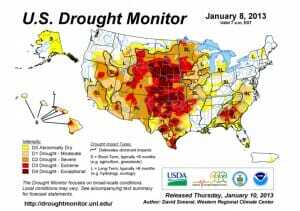
The Iowa Legislature convened last week, and along with that, came talk that Iowa’s drought law may get a closer look this year. “Water restrictions” isn’t a typical topic of conversation in the north, but it looks as though it might become commonplace across the Upper Midwest in 2013 if weather patterns don’t change.
It’s safe to say we’ll be planting the 2013 crop in dry soils. The 2012 drought caused most soils here to be depleted of moisture in the upper 7 to 8 feet, so it will take at least two growing seasons to recharge those soils.
Seed selection will certainly be critical for 2013 due to the extremely dry conditions. That’s why we’re recommending that most of our corn customers plant hybrids at least double- or triple-stack hybrids this spring.
A hybrid’s genetics will be the biggest factor in whether a hybrid can handle drought. Plot data shows that multiple-trait stacks, like Latham® hybrids with the Genuity® SmartStax® technology, can really help protect yield. REMEMBER: Traits protect yield. Genetics make yield. Seed products carrying the Latham brand name combine the industry’s best genetics with the latest traits and technologies.
While corn genetics have come a long ways over the past decade and are much better at handling drought stress than ever, soybeans historically perform even better in dry weather. Farmers will need to consider whether they can manage corn-on-corn in another extremely dry year or whether the economics favor soybeans. Other factors to consider when finalizing your 2013 crop plans are outlined in this recent article posted on agriculture.com: Six Take-Home Lessons from the 2012 Drought.
Regardless of whether you choose to plant corn, soybeans or alfalfa, Latham has the products you need! Our seed portfolio contains products that were bred specifically to thrive in specific areas of the Upper Midwest. Call your local Latham rep to learn more about the products best suited for your growing conditions, or feel free to call our office directly at 1.877.GO.LATHAM (1.877.465.2842).
U.S. Secretary of Agriculture Tom Vilsack, during a speech Jan. 14 at the American Farm Bureau Federation’s annual meeting, encouraged farm leaders to create strategic alliances and reach out to groups that might have differing opinions. Here’s an excerpt from that speech:
Now I know that there are not too many fans of the Humane Society in this room. But egg producers thought it was in their best interest to avoid 50 different referendums, 50 different sets of rules. So they sat down with folks and they reached common ground. After all, isn’t that what we’re asking our Congress to do? Isn’t that what we’re asking our political leaders to do – to sit down and make common cause? I think the egg producers have the right idea. Now, the issues may be different for different types of producers but we need to be constructively engaged at all times and conversations. We may not find agreement. But I think we will substantially reduce those who oppose farming and substantially reduce the reach of those and hopefully be able to get enough proactive activity that results in a five year bill.
If you follow what I preach, you know that I insist we listen to all sides. As much as I agree that farmers must engage in conversation with non-farm groups, I honestly don’t believe sitting down with the Humane Society of the United States would be constructive.
Vilsack sites the chicken and egg folks as a textbook example of how ag groups can find “common ground” with HSUS. Say what? How can we find “common ground” with a special interest group that wants to put livestock producers out of business? Animal rights activities don’t really care what we do because they’re only concerned with pushing their twisted agendas.
HSUS has teamed with some cattle producers to file suit against the Beef Checkoff, and now HSUS is going after the National Pork Checkoff. Here’s where I’m going with this: the U.S. Secretary of Ag oversees all checkoff programs. As a pork producer, I vote on whom I want on the commodity checkoff board but Secretary Vilsack actually decides who gets a seat on that board. Now Vilsack says we must listen to extreme animal right group, and herein lies the problem!
A few of this administration’s moves in recent months cause me great concern:
Because some farmers and advocates of the agricultural community made their voices heard, the USDA retracted its memo in support of Meatless Mondays. The new school lunch rules have been relaxed, and the U.S. Department of Labor put new child labor laws on hold. That doesn’t mean these issues won’t resurface sometime over the next four years, so we must remain vigilant in our agvocating efforts.
The U.S. agriculture community must spend as much time advocating for agriculture within the U.S. Department of Agriculture – which should be a natural ally – as it does with consumers and anti-farming groups. Now the U.S. Secretary of Ag is trying to convince the mainstream that groups like HSUS are best buds with the small farmer—it’ more than I can handle!
I must admit that I’m extremely concerned about our new administration, and some of the people who are serving and their beliefs. We already know there are former HSUS employees high in the ranks of the USDA. Now I’m reading that Raú Grijalva is being considered for U.S. Secretary of the Interior, and he’s being heavily backed by groups that want to eliminate animal ag!
When governmental agencies are infiltrated by this type of fanatics, they’re in place to make policy. We can’t afford to let this happen! Speak up. Write emails. Contact your elected officials. It’s important that people in office understand what we do on the farm.
Visit our “Super Bowl Party” board on Pinterest for inspiring ideas like these chocolate-covered strawberries. Picture from Sharis Berries.
“Field position” is commonly used to describe a team’s position on the gridiron, so it seems only fitting for TheFieldPosition.com to celebrate the Super Bowl by hosting a competition. All you have to do is “pin it to win it.”
There are so many ways to play! Be sure to tell your family and farming friends to “like” Latham Hi‑Tech Seeds on Facebook, too. Contest entries are due on or before Friday, Jan. 25, 2013.
To help kickoff this contest, today I’m sharing a few recipes that I recently pinned from the January/February 2013 issue of Midwest Living magazine. The Lemon Rosemary Pork Loin calls for a roasting pan, but you can bet I’ll be placing mine in a crock pot instead. I’ll spread spices over the pork in the morning, pour a little water into the bottom of the crock, and forget it about it until it’s time to make the sauce and set the table for supper.
What are your favorite crock pot and soup recipes? Share them with me for a chance to win!
This little piggy is going to market, and you could take it home! Visit booth #100 at Iowa Pork Congress on Wed., Jan. 23.
Iowa State University NAMA, challenge accepted!
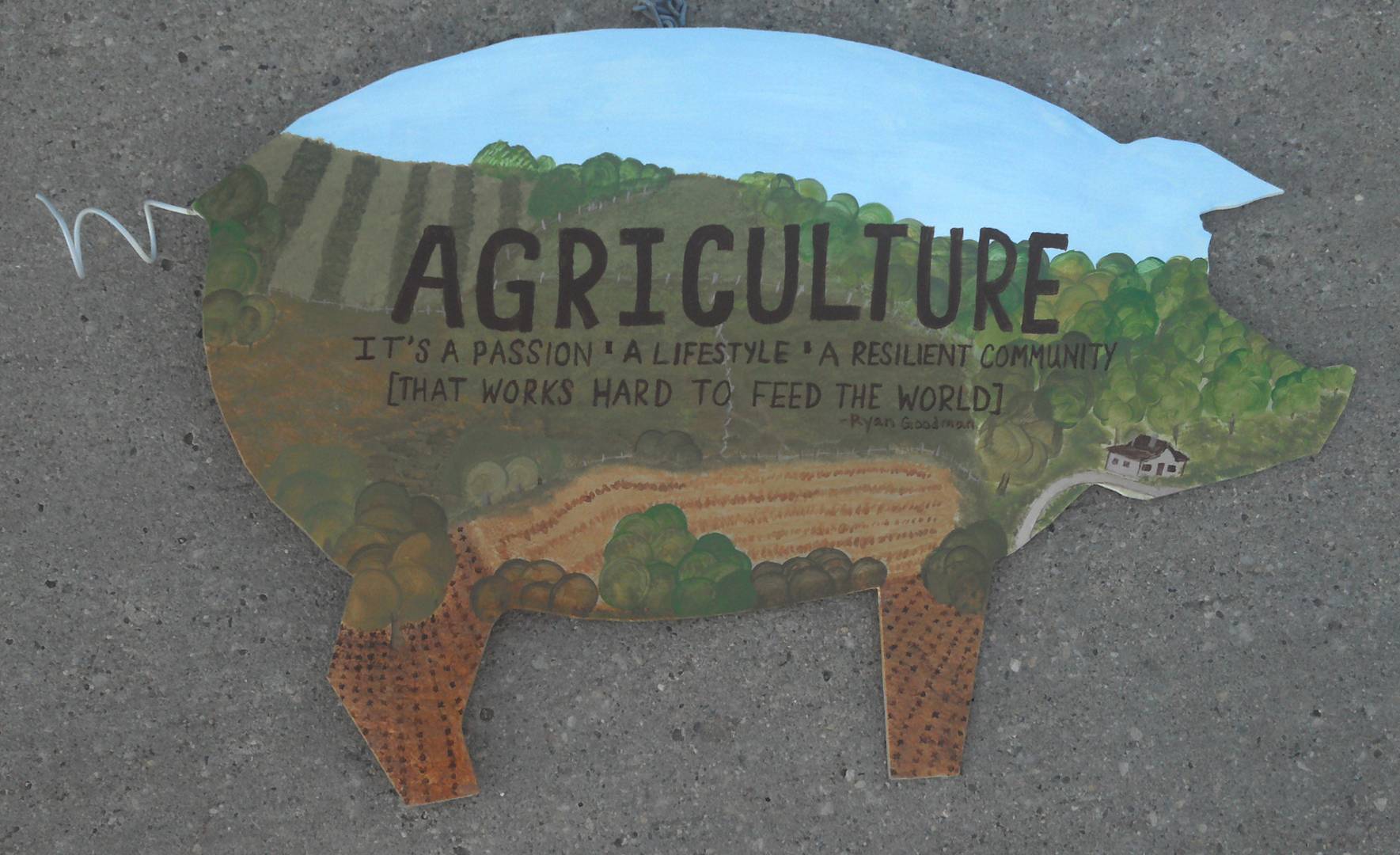
Latham Hi‑Tech Seeds is excited to announce that our entry for the ISU NAMA Paint-A-Pig Fundraiser is complete! This 2’X2’ metal pig will travel to Des Moines, Iowa, on Wednesday, January 23, for the Iowa Pork Congress where it will compete for top bid against entries from across the agriculture industry in a silent auction.
Our theme for this year’s entry features a Grant Wood-inspired painting by one of Latham’s own employees and ISU NAMA Marketing team alum, Laura Cunningham. Our entry also includes a quote by Ryan Goodman of the I Am Agriculture Proud website and blog: “AGRICULTURE. It’s a passion, a lifestyle, a resilient community that works hard to feed the world.”
This quote attests to a shared goal we have as agriculturists. Be it a seed company or a pork producer, we all work together to feed the world.
We invite all Iowa Pork Congress attendees to visit the auction and check out our entry in booth 100. Thank you ISU NAMA for the opportunity to participate!
1/15 – Lancaster County, Nebraska: Still dry with a little moisture in the top foot from 1ft to 6ft not any moisture. We will need some terrific rain events this spring to recharge subsoil, one of those events were you get 1/4 to 1/2 inch every day for 2 weeks (like that ever happens?)
1/15 – Palo Alto County, Iowa: First year I can recall without any ice in the drainage ditches in the area. We have had a little snow and maybe a tenth of an inch of rain a few days ago. Never gone into spring as dry as we are right now. If this is a sign of what’s to come this next growing season id be crazy to sell the remainder of the 2012 crop and even consider selling for 2013. Lots of new irrigation equipment being put up this winter even in areas where on a normal year it’s not necessary.
1/9 – Trempealeau, Wisconsin: If the Mississippi level any is an indicator of potential yield with average moisture, certainly areas that depend on subsoil moisture to get average crop will suffer. It seems to me that we will need an inordinate amount of moisture to compensate to get yield up to average, but what is average?
Drought-related topics also grabbed the attention of farmers attending the American Farm Bureau Federation’s annual meeting last Sunday in Nashville. During that meeting, a representative from Monsanto talked in details about the 2013 introduction of Genuity® DroughtGard TM hybrids in western states like Kansas, Colorado and Nebraska.
Since it will be another year or two before farmers in the Upper Midwest will be able to purchase DroughtGard hybrids, there are steps you can take to help conserve soil moisture and a few things to consider when choosing seed for 2013 planting. Click on the articles below for additional resources:
HSUS or AFBF: Which Would You Consider a Front Group?
“Musings of a Pig Farmer” by Larry Sailer
Every cloud has a silver lining or so the saying goes. Last week I had a cloud over my head. I was literally “down and out” with a torn ligament in my foot. Fortunately, the silver lining was that my grandson Devin was still on winter break from college and was able to do chores. That left me with idle time, which I used to catch up with some reading.
Today I’d like to share some of the information I read from a particular site called sourcewatch.com. That site talks about Front Groups, or a group that claims to support a public cause while actually serving a special interest or another group that’s objective might be obscured or concealed. It shocked me to see Source Watch call the American Farm Bureau (AFBF) a front group!
Here’s the first sentence: The American Farm Bureau Federation is a right-wing lobbying front for big agribusiness and agribusiness-related industries that works to defeat labor and environmental initiatives, including climate change legislation. A side box on the Source Watch website reads: Front Groups…Appearances may be deceptive.
WOW… talk about deceptive! This Source Watch website is truly deceiving readers about the AFBF. I’m very involved in the workings of the Farm Bureau, and I can tell you that Source Watch is way wrong here.
While farmers in general tend to be a little conservative, the Farm Bureau does not represent huge agribusiness corporations. I’m a small farmer, and I’ve been involved in the process of choosing candidates we believe will support our position. During this selection process, we very much keep the candidates political affiliation out of the picture. We analyze their positions and interview them to find out their current stance. Yet, sourcewatch.org makes it look like the entire agriculture community is made of big corporations out to make a quick buck at the expense of the environment and its citizens.
More than 90% of farms are family owned and managed. Family farm come in all sizes, and yes, some are even incorporated. I own an LLC myself. An LLC is a business structure, and I use it just like any Main Street business would.
I’ve often said that urban and rural residents “speak different languages, and this is another example of that. Some of the other things that Source Watch accuses AFBF of are completely hog wash! (Yep, I’m using old hog farmer term because it’s fitting.)
We must communicate with one another. I urge consumers to talk with and listen to the people who raise your food. Ask questions. Listen to the answers from someone who farms. I’m always willing to listen to your concerns, too.
As New Year’s parties become mere memories, my focus shifts to the next big reason Americans have to gather together and celebrate with great food – Super Bowl Sunday.
I’ve learned that massive quantities of hot food and cold drinks are paramount for hosting a successful party. That’s why I’ve asked Latham employees to share some of their favorite recipes for comfort foods and appetizers. What I really enjoy about these recipes is that you can “fix ‘em and forget ‘em.” There’s no need to spend your time in the kitchen when there’s a party going on!
What are your favorite party or potluck recipes? Email them to me at shannonl@lathamseeds.com or submit your recipe via our Latham Hi‑Tech Seeds Facebook page. We’ll post recipes on our blog in advance of the Super Bowl. It’s a win-win: readers will get to enjoy your recipe, and you’ll be entered into a drawing for a 6-quart locking crock pot!
We’re also gathering ideas on Latham’s Pinterest account, so feel free to follow our “Super Bowl Party” board. If you have any great Idea’s make sure to tag us in your pin. (@Latham Seeds #LathamSuperBowl)
Email your favorite party or potluck recipe to shannonl@lathamseeds.com and be entered into a drawing for this Locking Crock-Pot. Submit your favorite recipe via our Latham Hi‑Tech Seeds Facebook page for a double entry into the drawing!
Entries due January 25, 2013.
BEEF STEW
from Joy Bonin, Latham Office Manager
Ingredients:
1 lb. cubed stew meat
2 cans beef broth
½ package dry onion soup mix
1 lb. carrots
2 small onions, chopped
1 stalk celery chopped
8 potatoes chopped
Directions:
Combine stew meat, beef broth and onion soup mix in a Dutch oven.
Bake at 350° for 1 hour.
Then add vegetables to pan and bake at 350° for another hour.
I make and serve with a loaf of homemade bread. I make it in the fall for our extra hired help, and we also like it on a cold winter evening in the winter.
4-H & Farming Are Hallmarks of this Franklin County Family
April Hemmes & her daughter. Photo credited to AmericasFarmers.com
April Hemmes of Hampton, Iowa, is a fourth generation farmer in Franklin County. She’s been farming since 1985 on land that has been in her family since 1901, but her operation is a little different from what one might expect. April’s husband, Tom Kazmerzak, has a job in town and doesn’t work on the farm. April is the primary farm operator, and she was named “Midwest Farm Mom of the Year” in 2011.
“One of my fondest childhood memories is riding in the combine with my grandpa, and I learned a lot from him through the years,” says April. “I love that my daughter and my son grew up on the same farm and had some of the same farm experiences that I had,” adds April. “There’s nothing like being a farm kid.”
April Hemmes Combining
Many farm experiences are intertwined with 4-H experiences for April’s children. Her son, Ethan, was a 9-year 4-H member and was a member of the Franklin County 4-H Council. He was active in the Writers Club where he learned to express himself through short and poems. Active in jazz, marching and concert bands, Ethan explored his passion for music through a 4-H self-determined project. He went onto pursue music and English at the University of Iowa.
uth Hemmes was crowned the 2012 Franklin County Fair Queen.
April’s daughter, Ruth, also was active in 4-H for nine years. She earned the State Photography Award and completed agronomy projects and showed beef. Ruth served as president, vice president and secretary of her 4-H club. She also was selected to serve on the Franklin County 4-H Council and participated in the Iowa 4-H Youth Conference. In addition, Ruth was named the 2012 Franklin County Fair Queen.
“Throughout my years as a 4-H member, I learned many things from basic leadership skills in meetings, to club field trips, and a variety of projects. Showing cattle taught me responsibility: I fed my cattle in the morning and evening plus worked with them and bathed them once or twice a week. While I enjoyed all of my 4-H projects, I was especially interested in photography,” says Ruth Kazmerzak, who’s currently a freshman at University of Washington in Seattle where she’s studying Aquatic and Fishery Sciences and Photography.
Hemmes Farm History
Picking Corn
The Koch-Hemmes home farm was established in 1901 by J.P. Koch. His mother’s family had emigrated in 1738 from Bignen, Germany, to Pennsylvania where they bought a farm. While other family members remained in Pennsylvania, J.P. came to Iowa because his aunt had written to him about the “riches of the land.” J.P. found more than land upon his arrival; he also took a bride in 1890.
Newlyweds J.P. and Lavina moved to an acreage about 10 miles north of Iowa Falls. Their marriage was blessed with five children: Harold, Gerald, Ralph, Kenneth and Velma. Velma Koch married Bert Hemmes in 1925, and a few short years later, they purchased the farm from J.P. and Lavina.
Bert Hemmes, combining at age 100
Velma gave birth to their first son, Harlan, in 1929 and another, Jerry, in 1934. In the coming years, Bert had to work with his banker to keep the farm running. The Depression years were especially challenging, but Bert took great pride in saving the farm from the “big shot” from Des Moines who traveled north to buy up all the loans. Advised by a local banker to “let things go,” Bert let the weeds grow and the barn door fall off. Mr. Big Shot ended up driving right past the Koch-Hemmes farm, dust rising all the way as he sped back to Des Moines. The next year Bert made his payment, and his farm stayed in the family.
As these hard years passed, Bert and Velma added many more acres to the land they owned. Harlan came home from WWII and then school in the mid-1950s to farm with his father. The two ran a diversified farm of corn, soybeans, hay, cattle, hogs, sheep and chickens.
Harlan married Sally Peterson in 1957, and they had four children: Sarah, April, Harlan II and Heather. April presently resides and farms the land, which she and her husband purchased. In 2001, the U.S. Secretary of Agriculture recognized the Hemmes family at the Iowa State Fair with a Century Farm Award.
As a tribute to her German ancestry, today April shares with us an old family recipe for Molasses Cookies. Molasses was first used to sweeten foods because it was more affordable than sugar. The aroma of cinnamon, cloves and ginger mingled with molasses evokes warm memories of grandma’s house. Mix up a batch and bake someone happy!
“Rewriting History” to Benefit Franklin County 4-H
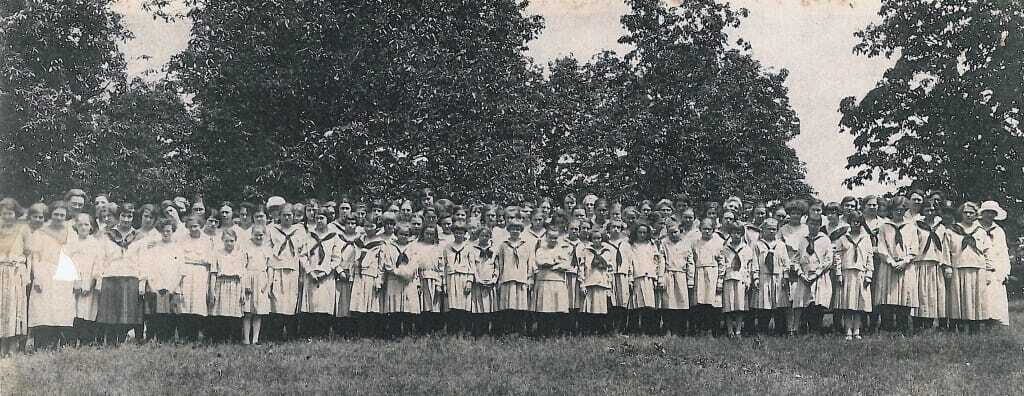
Iowa’s first 4-H camp for girls was held in Mayne’s Grove in June 1923. It was attended by 135 girls and 28 leaders from 18 clubs.
At the start of a new year, Americans often reflect upon the past and prepare for the future. One of my 2013 resolutions is to print a coffee table book that provides interesting stories about Franklin County farm families, as well as historical accounts of the 4-H organization. Proceeds from this book will go toward a permanent scholarship for county 4-H’ers who are interested in pursuing higher education.
Getting this book to print is going to be a “project,” no doubt! I put skill that I gained through 4-H to use in early 2013 by developing this project outline:
Goal: Print a coffee table book by December 2013 that will benefit the Franklin County 4-H Scholarship
Objective: Collect stories from 25 county farm / 4-H families
Tactics:
Conduct a communications workshop
Feature 12 county farm families on TheFieldPosition.com
Feature “Franklin County 4-H Facts” each Friday this year
Recruit each county 4-H club reporter to submit one story
Invite residents to submit stories about their Century Farms or in honor of their loved ones.
A team of Franklin County farm boys, coached by V. B. Hamilton, was named the 1930 Iowa Champion Judging Team. Team members were Wilbur and Willard Latham, Earl Shaull and J. Verald Brown.
Tactic #1 will take place on Saturday, Jan. 12. 4-H club reporters and anyone interested in exploring communications careers are invited to attend this workshop, from 10 AM to 2:30 PM, at the Franklin County Extension Office in Hampton.
Tactic #2 begins tomorrow when feature April Hemmes and Ruth Kazmerzak on TheFieldPosition.com. Be sure to “tune into tomorrow” for their story.
Tactic #3 involves sharing 4-H facts. Although it’s only Thursday, I couldn’t resist sharing a few facts today:
Cooperative Extension in Franklin County began with the organization of the Franklin County Farm Bureau in 1918. Extension work was a service offered through Farm Bureau.
The first 4-H club formed was a countywide Purebred Sow and Litter Club.
Because of the success of the first club, the next year they started a Pure Bred Short Horn Calf Club.
Girls clubs were organized with an emphasis on home furnishings, music appreciation and health.
Until 1955, girls who wanted to raise and show livestock could only do so by belonging to a boys’ club. This was also the year they began a county girls livestock 4H club and the Livestock Queens were formed.
We hope you’ll join our efforts, too! “Like” Franklin County Extension on Facebook and watch for “Fun Fact Friday.” Watch for “Friday Farm Family Features” on TheFieldPosition.com. Share your own family’s farm and/or 4-H story. Click here to download a form and to learn more about the donor levels. Feel free to contact me directly to see how I might help tell your story.
Twenty-eight baby beeves were exhibited at the 1925 Franklin County Fair. 4-H members sold each for $150 and netted $30/animal.
Following the 2012 growing season, researchers from across the Upper Midwest gathered to present data and opinions on a wide variety of topics pertinent to agriculture in our marketing area. Today I’m summarizing some of their findings for you to consider as you prepare to plant the 2013 crop.
SEEDLING DISEASES: University researchers are “dialing down” on the four main families of pathogens typically associated with soybean seedling diseases: Pythium, Fusarium, Rhizoctonia and Phytophthora. They have found more than 50 different species of Pythium that affect soybeans in our area. For many years, we believed this pathogen preferred cool, wet soils. Now we know that several of these species actually prefer warm soils! It was also discovered that some “new” species are not affected at all by fungicides currently available.
OTHER DISEASES & PESTS: Extremely dry weather throughout the Upper Midwest was responsible for the presence of Charcoal Rot, from as far north as southern Minnesota and as far east as the Mississippi River Basin. Damage from Soybean Cyst Nematode and Two-Spotted Spider Mite infestations were also widely reported. Be aware that many common insecticides don’t have much of an effect on Spider Mites, so carefully read the labels of any products you intend to use.
WEATHER: Dr. Elwynn Taylor said we’ve just finished a 19-year cycle of reasonably mild weather patterns and are now headed into a 25-year period where weather patterns are apt to be volatile. The 2012 drought caused most soils here to be depleted of moisture in the upper 7 to 8 feet. It will take a minimum of 16 –18 inches of rainfall (or equivalent in snow) to recharge those soils to their normal level. It will probably take at least two growing seasons to recharge.
TILLAGE: This was one of the “hottest” topics of the ICM conference. Most of the researchers were extremely surprised to see the amount of fall tillage completed because minimizing tillage helps conserve soil moisture. Soil is our greatest natural resource, so we must protect and conserve it or our children and grandchildren will surely suffer the consequences.