Latham Hi-Tech Seeds

(641) 692-3258

  • Home
  • Products
    • Corn
    • Soybeans
    • Soybean Blends
    • Alfalfa
    • Corn Silage
    • Seed Guide
  • Performance
  • Find a Rep
  • Media
    • Blog
    • News
    • Videos
    • Podcasts
    • TECHTalk
  • About Us
    • Company History
    • Our Mission
    • Careers
    • Become a Rep
    • Sowing Seeds of Hope
  • Contact Us
  • Latham Hi‑Tech Seeds

    Ease Your Worries with Pre-Harvest Prep

    Harvest Checklist1

    Ever since the cicadas began to sing in mass, folks have been predicting when the first frost will hit. More than one Midwest farmer is worried about how frost will impact late developing corn.  While it may give us something to talk about, the first frost is beyond our control.

    “Worry is not preparation,” so let’s instead channel our energies into preparing for harvest.  Make a pre-harvest check list to ensure you’re ready, regardless of when harvest begins.  To preserve maximum yield, you may need to harvest at higher moisture levels this fall.  In addition to having combines and other equipment in tip-top condition, it’s important that drying facilities are clean and ready for use.

    You can also prepare now by prioritizing corn fields for harvest.  Fields under stress from either too much water this spring or a lack of rain this summer will warrant special harvest considerations.  Closely watch those fields that show nitrogen deficiencies as the potential for stalk rot increases when nitrogen leaches.  Plants need enough nitrogen to fill the kernels plus maintain plant health.

    Check stalk strengHarvest_Checklistth by pinching the lower internodes on the plant and feel for weakness.  The root mass can affect the plant’s ability to stand up against late-season winds.  Late-season heat may also affect the ear shank.  If the shank gets weak from heat, it usually kinks or has a sharp bend.  A high-yielding hybrid may also cannibalize itself to maximize yield.  To check for these issues, walk into a field and shake the plants.  Watch to see if ears fall.

    Roots can be more of an issue than stalks in a wet spring like we experienced.  Saturated soils limit the growth of root hairs and brace roots, making the total root mass much smaller.  If those plants grow close to full size, that puts a lot of stress on the plant later in the year –either it may not have the ability to take up enough nutrients or the plants may lodge if there is a late-season wind or wind and rain event.

    Plan for the worst and hope for the best, as the old saying goes.  With so many consecutive days of excessively high temperatures, it’s hard to imagine it being cool enough frost anytime soon.  Hopefully mild temperatures are on their way – and will last well into October.  If the weather should take a turn for the worse, however, at least you won’t be caught off guard.
    Webspec Admin

    August 29, 2013
    Fall, General, Season
  • Latham Hi‑Tech Seeds

    Sharpen Those Pencils & Get to Work on the Farm Bill!

    Political advisor1

    Soon summer vacation will end and all classes will resume at all of our local schools.  The same goes for the United States Congress.  Their August recess ends soon, and there’s a real need for them to sharpen their pencils and get to work!

    Our Federal elected officials have been home (hopefully) talking to us, the people whom they represent.  This past month provided constituents with an opportunity to visit U.S. senators and congressmen about topics that matter most to us.  Now that our elected officials are returning to Washington, D.C., it’s time to stop talking to them.  Instead, send them an email or drop them a letter.  I was told by a state representative that one time he voted on the opinion of one email – just one!  Letters and emails are so important, and that’s why I’m once again writing about the Food Security Act.

    political advisorHouse Speaker John Boehner expects to bring up the Farm Bill “immediately” when the House returns Sept. 9.  He expects to appoint conferees the next day and finish the bill before Sept. 30 when the current farm bill expires.  However, House Agriculture Committee ranking member Collin Peterson is not optimistic.  Peterson says it’s more likely the current Farm Bill will be extended – again.
    We don’t need an extension.  We need a bill!  And I mean “need.”

    “I don’t care which side of the aisle you align yourself with – no one can be proud of what is going on, or more accurately, not going in our nation’s capital,” writes farmer and rancher Glenn Brunkow in his blog “Dust on the Dashboard.”  He makes a compelling case for why the Farm Bill is so desperately needed:

    1. Food security must be established to insure that a society will grow and flourish. Nowhere in history will you find an enduring world power without a strong agricultural foundation.
    2. World powers have always been food secure. Wars are started by hungry people!
    3. A strong food and fiber production system was undeniably a matter of national security.  Think how the price of crude oil fluctuates based on the whims of other nations that don’t have our best interests in mind; now think about how that would be if that was your food we were talking about. We can’t become dependent on foreign nations for our food!

    The Food Security Act goes much further than the production of food and fiber.  And, it’s extremely complicated.  There are parts of the Farm Bill that deal with everything from how we conserve our soils, to export our farm products.  It even includes food assistance programs.  In fact, the Supplemental Nutrition Assistance Program (SNAP) funding now accounts for 80% of the Farm Bill.

    The SNAP program has been a part of the bill for years, but it’s become an increasingly large budget item.  SNAP cost almost $80 billion last year – twice the amount it cost just five years ago!  Our federal budget must be considered in any legislation that is passed.  I know this is not always done, which has resulted in the deficit with which we now labor.

    On a side note, the U.S. Deficit is a huge national security risk!  We must trim funding.  We must address the waste in the SNAP program.  I know that U.S. Secretary of Agriculture Tom Vilsack says he’s working on it, but honestly, a lot of money is being spent on a lifestyle and not on food.  (I know it’s not politically correct for me to say this.  Everyone “needs” a cell phone, cable TV and the Internet.)

    The reality is that North Americans aren’t naked and starving, so food security is secondary.  On the Doc ‘n Lefty show last week, Doc talked about how wealthy Americans pocketed millions of funds for farms they had never even been on.  We’re willing to fix that, but remember, this type of fix almost always hurts the small and beginning farmers most.

    The Food Security Act is needed whether you live in a city, on a farm, or are in need.  This is one bill that should be non-partisan.  Contact your U.S. congressman and senators.  Let them know what you think.  It’s time to mind your own business!

    Larry Sailer, Musings of a Pig Farmer

    August 27, 2013
    Agriculture, General, Industry News
  • Latham Hi‑Tech Seeds

    Riders Embraced Their “Spirit of Adventure” on Freedom Ride V

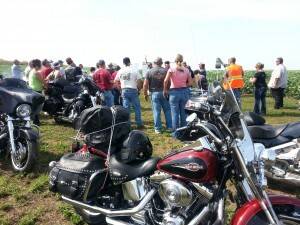
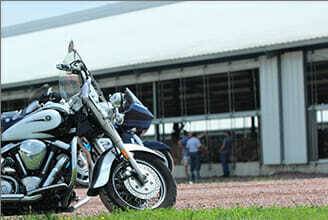
    20130824_154333Nearly 100 people, driving or riding motorcycles and muscle cars, channeled famous Iowa explorers as they traveled through Lewis & Clark Country on Saturday, Aug. 24, for the 5th Annual Latham Freedom of Independence Ride.  The 134-mile route took drivers down the Lewis & Clark Trail.

    One highlight of this adventure was a ride across Blue Lake on an historic keelboat similar to the one Lewis & Clark, along with 26 men, traveled up the Mississippi River from St. Louis. Army Captain Meriwether Lewis and his former commanding officer William Clark were commissioned by President Thomas Jefferson in 1804 to explore the vast western territory purchased from France as part of the Louisiana Purchase.  Lewis & Clark embodied the nationalistic vision and patriotism that formed the spirit and richness of American history.

    IMG_3848

    Another fun stop along the way was Sioux Jerseys LLP, a state-of-the-art dairy where cows are milked 24/7 using two, double Mag 90i parallel parlors.  Because Sioux Jerseys contracts with Well’s Blue Bunny, following the tour, riders were treated to Blue Bunny® ice cream.  One bite into a sweet treat makes it clear why Wells – the largest, family-owned and operated ice cream manufacturer in the United State – is celebrating its 100th year of business in 2013.

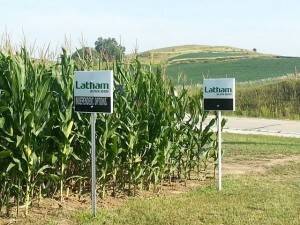
    BeanPlotOne of the crop stops included a Latham® Hi‑Tech Soybean showcase, where Latham Product Manager Mark Grundmeier gave an overview of three exciting technologies in the pipeline.  Latham Forage Products Manager Corey Catt also talked about the importance of micronutrients to increase corn yield, forage production and alfalfa tonnage.

    loess hillsOf course, no field day – even one on two wheels – would be complete without a corn technologies showcase.  Riders had a chance to learn more about Agrisure Artesian corn products, which provide season-long drought protection to increase yield in moisture-stressed fields.  Two Latham Hi‑Tech Hybrids for 2014 planting, LH 4974 3011A and LH 6412 GTA, will feature this fascinating new trait.

    Agrisure Duracade™ is a brand new mode of action for corn rootworm control and will be combined with Agrisure RW to give two modes of action. Agrisure E-Z Refuge™ offer performance, ease-of-handling and reduced.  We’ll begin with LH 5495 3122 and plan to add other trait packages like Duracade as they gain regulatory approval.

    Watch for exciting new announcements soon from Latham Hi‑Tech Seeds!  Be part of the journey every day at www.thefieldposition.com .  We also post agronomic tips and news of interest daily on our company’s Facebook page at www.facebook.com/LathamSeeds.  You can also follow @LathamSeeds on Twitter.

    For a recap of Latham’s first four Freedom of Independence Rides, click on the links below:

    • Good Times Roll at Inaugural Freedom Ride
    • Freedom Riders Join Drivers in the Seed Industry
    • Picture Perfect Ride Conditions for 3rd Annual Freedom Ride
    • Going Hog Wild for Latham’s 65th Anniversary

    Team Latham

    August 26, 2013
    Agriculture, General, Industry News
  • Latham Hi‑Tech Seeds

    Got Beef? Whip up Runza!

    pic2

    Running through wide, open spaces.  Building forts.  Playing in the hay.  Bottle feeding calves.  There’s so much to see and do when you’re a farm kid, and that’s just the way the Siecke family likes it.

    “Our children enjoy many freedoms because we live in the country,” says Shane Siecke of Madison, Nebraska.  He and his wife, Amanda, are the proud parents of three:  Aaron, 13; Jacie, 7; and Tate, 2.  “There is plenty to do.  Each child has a calf, and our older two kids have been raising their own bottle calves.  They learn to take responsibility as they care for their animals.”

    pic1Farming is a family tradition.  The Siecke farm has been in the family for nearly 90 years.  Shane farms with his father, Doug.  Together they raise corn and soybeans, plus Shane has a 60-head cow/calf operation.
    Because family is so important to them, the Sieckes say they enjoy working with family-owned Latham Hi‑Tech Seeds.  Shane has been a Latham® dealer for 15 years.  He’s especially excited about these new corn technologies that Latham Hi‑Tech Seeds will offer for 2014 planting:

    • Agrisure Artesian™ – Developed by Syngenta, Artesian products exhibit season-long drought protection to increase yield in moisture-stressed fields.  For 2014, Latham will offer LH 6412 GTA in the Nebraska market.
    • Genuity® DroughtGard™ – This is the seed industry’s first biotech trait offering drought tolerance for fields where lack of rainfall would normally limit yields to 70 – 130 bushels per acre.  LH 6444 VT2Pro DG is the first Latham product with this added protection.
    • Agrisure E-Z Refuge™ – More than 2/3 of the Latham Hi‑Tech Hybrids planted in 2013 carried the refuge-in-the-bag (RIB Complete) option.  The performance, ease-of-handling and reduced risk for farmers speaks for itself.  In 2014, Latham will offer Agrisure products with the E-Z Refuge brand and the Duracade trait package.  Specific corn product numbers are still being considered since approval was just granted last week.

    Exciting, new soybean technologies will also be part of the 2014 Latham Hi‑Tech Soybean lineup.  Earlier this week it was announced the U.S. Environmental Protection Agency (EPA) has approved Balance GT soybeans from Bayer Cropscience and MS Technologies.  These soybeans will carry tolerance to glyphosate herbicides, as well as Balance Bean, an HPPD-based herbicide similar to Balance used on corn acres.  Two other exciting soybean technologies in the pipeline include Dicamba-tolerant soybeans (Roundup Ready Xtend) and the 2,4-D tolerance (Enlist).

    “One of the advantages of working with an independent, family-owned seed company is that Latham offers one of the industry’s broadest and deepest lineups,” says Shane.  “Latham does the legwork of testing products by region, which helps assure farmers like me that we’re getting the best products for our growing conditions.”

    In his free time, Shane enjoys tractor pulls and hunting.  Amanda is a registered nurse at Faith Regional in Norfolk, working in Cardiology.  She enjoys reading, traveling and spending time with family and friends.  Aaron is playing Jr. High football.  He also will play basketball this winter and will run track in the spring.  Jacie is in her second year of dance lessons and plans to play soccer this fall.

    As a working mom with active children, Amanda enjoys no-hassle entertaining.  That’s why when friends or family call, she’s likely to whip up a batch of Runza casserole.  Runza, a stuffed beef sandwich that originated in Russia and became popular in Germany, is as popular in Nebraska as hot dish is in North Dakota.  Today Amanda is sharing her time-tested recipe with us on TheFieldPosition.

    Team Latham

    August 23, 2013
    Beef, General, Recipes
  • Latham Hi‑Tech Seeds

    Tips to Assess Rootworm Activity

    CRW beetle

    Two months ago I posted a blog, encouraging farmers to scout every field for rootworm.  Because of the wide variance in planting dates in 2013, it’s important to continually inspect every field – regardless of seed selection – for insect pressure.

    With adult corn rootworm becoming active during silking this year, we highly recommend keeping an eye on fields in order to protect yield.  Now it is a good time to assess corn rootworm activity: score injury caused by larvae, and monitor adult activity in corn.  Late-planted fields or late-flowering hybrids are generally attractive to adult corn rootworm beetles.  Silks will still be developing in these fields when older fields have brown or drying silks.  Adults may migrate and aggregate in this later-maturing fields.

    Also evaluate root injury to better understand the efficacy of your management program.  Monitoring over several years will help establish a historical record of how larvae respond to management tactics (e.g., crop rotation, Bt corn, soil insecticides, etc.). One common outcome of severe larval feeding is lodging of corn plants.  However, it is important to confirm that feeding from corn rootworm was the cause of lodging and that it did not results from other factors such as strong winds.

    To help assess injury, ISU Entomologist Aaron J. Gassmann developed an Interactive Node Injury Scale.  Injury assessment made now and field notes taken will help you select seed products for 2014.  To prevent corn rootworm damage from reaching devastating levels, plant a portfolio of products.

    Continued use of the same rootworm-resistant trait in corn hybrids, an increase of corn-on-corn areas, plus a lack of refuge acres, has caused rootworm resistance to become an issue in some areas.  Best management practices to reduce corn rootworm pressure in the future include: crop rotation, trait rotation and respecting the refuge.

    Respecting the refuge just got easier thanks to the EPA last week granting approval of Agrisure Duracade E-Z Refuge trait stacks.  New, for 2014 planting, Latham® Hi‑Tech Hybrids is offering Agrisure DuracadeTM as another option in the fight against corn rootworm.  

    Farmers have a chance to see Latham’s new 2014 products this Saturday, Aug. 24, when we host the 5th Annual Latham Freedom of Independence Ride.  This year’s ride begins and ends in Lewis & Clark State Park in Onawa.  It’s free and open to motorcycles, classic cars and even pickup trucks.  For more details, visit our company website lathamseeds.com.  Then click on the Freedom Ride icon.  Pre-register today, and we’ll see you Saturday on the open road!

    Webspec Admin

    August 22, 2013
    Agronomics, Corn, Crop, General, Insects
  • Latham Hi‑Tech Seeds

    I’m Minding My Own Business, Thank You Very Much!

    In the past, I was a pig farmer who preferred to stay on my farm and mind my own business.  It was easy to stick my head in the proverbial sand in the 1970s when I was a beginning farmer: land was cheap; commodity prices were good; and I didn’t have a family.

    Then the 1980s hit… with a thud!  Prices of land and farm rent skyrocketed.  Meanwhile, the prices for which I could sell my farm products dropped like a rock.  Interest rates hit well over 20%, and I acquired an instant family of four kids.  It was then I realized that I didn’t have a choice but to get involved with government agencies.

    Someone decides how the government is run.  While we often like to blame elected officials for making rules or laws they don’t have to follow, someone is influencing HOW they make their decisions.  Now if that isn’t you, just who do you think it will be?  Many groups are pushing their agendas and lobbying elected officials to vote in their favor.  If you agree with that group’s agenda, then all is well.  But what happens when the laws and regulations passed affect my farming operation and your food supply?

    Laws and regulations always drive up the cost of any business.  Some of that cost is needed, but often times it’s excessive and wasteful.  Let’s look at soil conservation, for example.  I have written several blogs on this topic already:

    • Why use Hammer if the Carrot Works?
    • Threats of New Soil Conservation Rules
    • Conservation and Compliance

    In addition, I’ve had a few of my Letters to the Editor published about soil conservation.  I’ve even received some hate mail in return… thank you very much!!  While I won’t repeat what my hate mail actually said, let’s just say that some folks don’t believe that farmers like me should help decide how soil conservation work.  In so many words, they told me to “mind my own business.”  I find that ironic since that’s exactly what I’m trying to do by getting involved in the rules-making and lawmaking processes!

    When things are as valuable as one’s land – and livelihood – our voices deserve to be heard.  I’m a small farmer, but even my farmland is worth millions.  The average farm size in Iowa is approximately 333 acres, and the statewide farmland value posted in March 2013 was $11,515 per acre.  That means the average Iowa farm is valued at nearly $4 million ($3,834,495).  It’s not uncommon for a sole proprietor to farm 1,000 acres, which equates to a land value of $11.5 million.  That’s big money!

    Because there is so much at stake, farmers are on the front line of the soil conservation issue.  We have no choice.  How silly it would be to throw away our most expensive tool and asset!  Soil is our main tool and resource.  That’s why I believe it’s so important for farmers to get involved with soil conservation and nutrient management.

    The Iowa Nutrient Reduction Strategy is in place and looks like it will work if given a chance.  Dean Lemke, a Natural Resources Engineer for the Iowa Department of Agriculture and Land Stewardship (IDALS), said criticism of the Nutrient Strategy’s voluntary implementation has been premature.

    Iowa’s new nutrient reduction plan has been endorsed by the new head of the EPA, Gina McCarthy.  The Iowa Farm Bureau, the Iowa Department of Agriculture and Land Stewardship (IDALS), and the Iowa State Extension Service are all encouraging farmers to improve the management of their land.

    Yet, I recently read an article in the opinion section of The Des Moines Register about how current laws must be enforced and farmers should be penalized.  Take a look and talk to farmers about what they are doing before you write that letter to the editor!  Ask questions.  Listen and learn.  We must be informed on both sides of this issue!

    Larry Sailer, Musings of a Pig Farmer

    August 20, 2013
    Agriculture, General, Industry News
  • Latham Hi‑Tech Seeds

    Welcome to the Houses that Beef Helped Build

    RMHC logo Color

    RMHC_logo_Color_R“The power of love is a curious thing,” croons musician Huey Lewis.  “It makes one man weep, another man sing.”  And in Iowa, love helps build Ronald McDonald Houses.
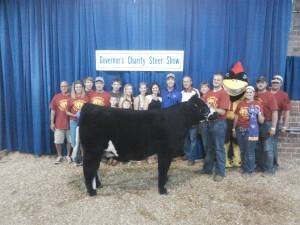
    Welcome to the House that Love Built.  The Ronald McDonald House is a warm, safe and comfortable place where family members of seriously ill children can stay while their children are being treated at area hospitals in Des Moines, Iowa City or Sioux City.

    Ronald McDonald Houses rely on the love, sharing and caring of generous donors to accomplish its mission.  Last Saturday, during the 2013 Iowa State Fair, a record-setting $183,000 was raised from livestock sales held after the 31st Annual Governor’s Charity Steer Show.  More than $2 million has been raised for Ronald McDonald Houses of Iowa since 1983 when Gov. Terry E. Branstad first joined forces with the Iowa Beef Industry Council to sponsor the Governor’s Charity Steer Show.

    NCM_0004It’s an honor to be asked to participate in the Charity Steer Show, whether you’re a 4-H or FFA member whose animal gets selected or whether you’re the celebrity who’s been invited to lead one of the 1,000+ pound-animals around the ring.  It’s an opportunity for Iowans of all backgrounds to come together to support a worthy cause.
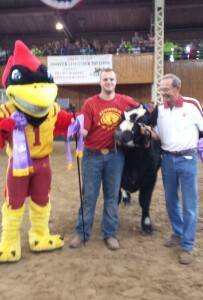

    “It was certainly an honor to be asked.  My family has used the Ronald McDonald House in the past, so it was a great chance to give back.  But I have to admit, I was a little nervous,” said 1040 WHO Radio farm broadcaster Mark Dorenkamp.  “The pavilion was packed full of people, and I’d never shown a steer before.  There were a few moments when I didn’t know if I’d be able to keep Beef Wellington from taking off, but I had a great young man from Madison County helping me.  Brock Johnson was with me every step of the way, and getting to know the Johnson family was a real highlight for me.”

    “What a fun event!” said Story County 4-H and FFA member Cory Sampson of Nevada, who also participated in the charity show for the first time this year.  “We helped raise money for an awesome cause.”

     Cy, Cory Sampson and Coach Cecil Rhoads received the People’s Choice Award last Saturday during the 31st Governor’s Charity Steer Show at the Iowa State Fair.  Curran Cattle Co. purchased Cory’s steer, and proceeds benefited Ronald McDonald Houses of Iowa.
    Cy, Cory Sampson and Coach Cecil Rhoads received the People’s Choice Award last Saturday during the 31st Governor’s Charity Steer Show at the Iowa State Fair.  Curran Cattle Co. purchased Cory’s steer, and proceeds benefited Ronald McDonald Houses of Iowa.

    Cory teamed up last Saturday with Coach Cecil Rhoads in memory of Brayton Shill, who would’ve turned 8 on July 29.  Brayton lost his battle with cancer last November, and his family stayed in a Ronald McDonald house while he underwent treatment.  The team spirit exhibited by Cyclone the steer, Coach Rhoads and Cory made them the People’s Choice Award Winner.

    Teamwork is second nature to Cory, 19, who was raised on a family farm near Nevada.  He’s the youngest son of Doug and Diana Sampson, who are also the proud parents of 25-year-old Todd and 22-year-old Amy.  All three of the Sampson’s children have been active in 4-H and FFA.  Doug and Diana were both 9-year 4-H members.

    “There isn’t a better way to learn life skills or make new friends than through 4-H and the FFA,” says Diana.  “Our kids have developed leadership and communication skills.  They held multiple offices within their local 4-H Club and the Iowa Junior Maine-Anjou Association.  Each of our kids took part in the annual FFA contests.  Plus, they’ve exhibited livestock through both 4-H and FFA.”

    “Our kids have enjoyed success in the show ring, but the neatest thing to see is the endless friendships they have made and will have for years to come,” says Doug, who began farming full time in 1977 with his father, Glen.

    Cory, Ceil, Doug
    Cory, Ceil, Doug

    Now that Glen is retired, Doug, Diana and their kids raise corn and soybeans.  They have a 25-head cow/calf herd of Maine-Anjou cattle.  They also partner with Diana’s cousin to farrow 60 head of sows mainly to be sold as show pigs.

    To promote the quality meat products they help produce, today the Sampsons are sharing a family-favorite recipe for meatballs.  Form small meatballs and serve them on a stick if you want to enjoy them “state fair style.”  Otherwise, follow the recipe below to make 15 large meatballs.

    FridaySidebar

    Team Latham

    August 16, 2013
    Beef, General, Recipes
  • Latham Hi‑Tech Seeds

    Cool, Damp Weather Creates Ideal Conditions for White Mold

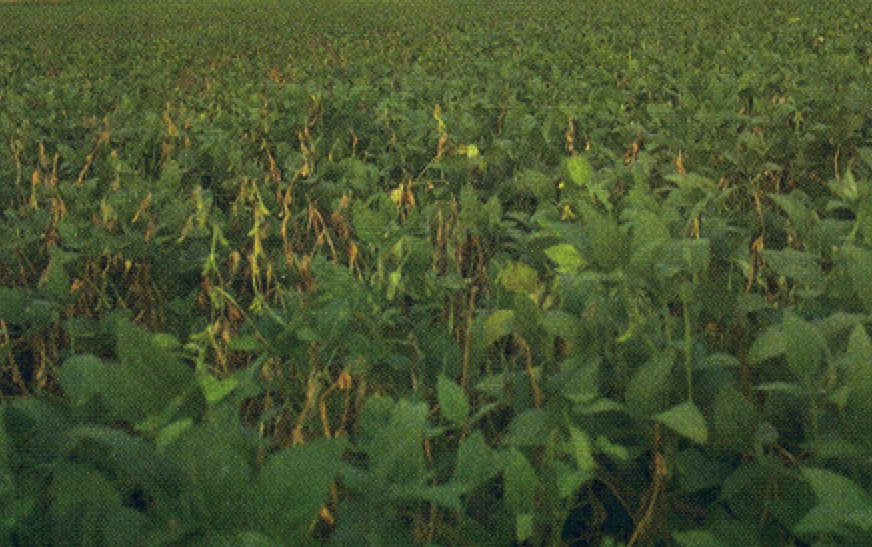
    Photo from the Iowa State University Extension White Mold, or Sclerotinia Stem Rot, is becoming evident now in many soybean fields across the Upper Midwest.  Like weed seeds, sclerotia can lay dormant for years and then grow when the conditions are suitable.  Cooler than normal temperatures, combined with ample moisture in fields, has created a favorable environment for the fungus in recent weeks.

    Today we’re providing tips to help you prevent the fungus from spreading this season and remedying it for the future.

    White Mold starts to show when soybean plants are in the early reproductive stages and there is moisture in the crop canopy.  This usually happens in July and August, but we’re just starting to notice it now since it took longer for soybean crops to reach the reproductive stage due to later planting dates.

    In addition to the fluffy white mycelium of the fungus, a closer inspection of the plant will turn up sclerotia.  These black, oblong structures resemble rat droppings.  Sclerotia form in the center of the bleached plant stem and also develop inside the stem, so they can be easily seen when the stem is split.

    Sclerotia are the fungus’ survival structures. Although they are initially soft, sclerotia harden with age and basically encapsulate the fungus.  Deep tillage can bring sclerotia to the surface, causing White Mold to be found in areas where it hadn’t been seen for a decade or more.

    Preventing the Spread

    Because infected soybean plants may not produce seed, a little White Mold can have a big impact on yield.  Most likely, you won’t be able to do anything for the plants already infected with the fungus but you can protect the rest of the field.  Certain foliar fungicides may be applied when you see White Mold starting to attack, so contact your local Ag Retailer or Crop Consultant for specific recommendations.

    There are also Best Management Practices to help prevent White Mold from surfacing in future years.  In fields with a history of White Mold, be sure to select soybean seed with resistance to White Mold.  Research shows that it also helps to lower the plant population in these fields; avoid planting 200,000 plants per acre regardless of row width.

    The most effective defense against White Mold is to keep the fungus out of a field, but this is easier said than done.  To prevent White Mold from spreading:

    • Avoid harvesting disease-infested fields before harvesting healthy fields
    • Clean your combine thoroughly after a field with White Mold is harvested. It’s important to clean the combine before moving to a field with no history of the disease.
    • If White Mold is restricted to a portion of the field, that restricted area should be harvested last and independently from the rest of the field.
    • If White Mold is already present in a field, keep sclerotia out of the upper layer of the soil, and prevent the sclerotia from distributing over a wider area

    Soybeans with very good to excellent White Mold tolerance:

    L1568R2
    L1783R2
    L1868L
    L1948R2
    L1985R2
    L2083L
    L2084R2
    L2183R2
    L21B53R2
    L2253R2
    L2440R2
    L2483R2
    L2648R2
    L2758R2
    L2780R2
    L2883L
    L3158L

    Webspec Admin

    August 15, 2013
    Agronomics, Crop, Disease, Fungicide, General, Soybeans
  • Latham Hi‑Tech Seeds

    Freedom Ride V: Register by Aug. 15 for Do-Rag or T-Shirt

    Byway21

    Byway2Bring out your inner explorer as you travel western Iowa for the 5th Annual Latham Freedom of Independence Ride on Saturday, Aug. 24.
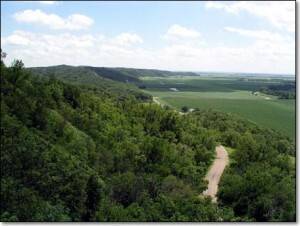
    This year we’ll be traveling the Lewis & Clark Byway throughout the Loess Hills, one of the most beautiful drives this state has to offer.  The 120-mile route will take us into two farm fields, through a dairy and across a lake in a historic keel boat.

    Loess Hills: View from Murray Hill between Pisgah & Little Sioux
    Loess Hills: View from Murray Hill between Pisgah & Little Sioux

    Our corn stop will showcase new Latham® Hi‑Tech Hybrids in our 2014 corn product lineup including Genuity® DroughtGard™, Agrisure E-Z Refuge™ and Agrisure Duracade™.  Our soybean stop will feature two new technologies that are in the pipeline: Dicamba-tolerant soybeans (Roundup Ready® Xtend) and those with 2,4-D tolerance (Enlist E3).

    Get ready for the seed industry’s fastest field day!  Motorcycles of any make and vehicles of any model – as long as they can travel 55 mph – are welcome.  However, pre-registration is required as space is limited.  Click here to register now!

    Check out the fun we’ve had in years past:

    • Freedom Ride IV – Latham Hi‑Tech Seeds’ 65th anniversary celebration
    • Freedom Ride III – the Great River Ride
    • Freedom Ride II – Central Iowa (recap with video)
    • Freedom Ride I – Okoboji, Iowa’s Great Lakes

    Team Latham

    August 12, 2013
    Agriculture, General, Industry News
  • Latham Hi‑Tech Seeds

    Happiness is the 2013 Iowa State Fair

    Happiness is the theme of the 2013 Iowa State Fair, Aug. 8-18.  Cynthia Foder from KCCI News 8 filed a story yesterday, asking fair-goers how they would define “happiness” at the Iowa State Fair.  Since I wasn’t able to provide my comment then, I’ve decided to blog about it today.  Why?  Because I truly believe happiness is the Iowa State Fair! Happiness is…

    • Biting into a bacon wrapped corn dog or one of 18 new foods to debut at the 2013 fair.
    • Seeing sheep, pigs, goats, horses and cattle – it’s the next best thing to showing your own!
    • Spending a picture perfect Friday at the Iowa State Fair, making new acquaintances and visiting with dear friends.

    Today I have the pleasure of joining Mark Dorenkamp and Bob Quinn for a live broadcast of “The Big Show.” You can join the fun by tuning in between 11:30 a.m. and 1:00 p.m.  We’ll be talking about the 5th Annual Latham Freedom of Independence Ride, which is sure to be the most unique field day a farmer has ever attended!

    Iowa Ag Secretary Bill Northey and Iowa Lottery CEO Terry Rich help build connections between rural and urban Iowans
    Iowa Ag Secretary Bill Northey and Iowa Lottery CEO Terry Rich help build connections between rural and urban Iowans

    Speaking of unique events, I can’t wait to stop inside the south atrium of the Varied Industries Building where the “Get Connected to Farming” exhibit is being built by the Iowa Food & Family Project.  The centerpiece of this exhibit is an amazing sculpture created by Sean Kenney, a LEGO® Certified Professional. (I’m envisioning LEGOLAND at the Iowa State Fair.)

    At 2 p.m. daily, the Iowa FFP hosts a LEGO brick building contest between a celebrity and youth.  Yesterday Iowa Secretary of Agriculture Bill Northey took part.  I’m looking forward to a friendly competition today with Duane Murley, farm/news broadcaster, with KWMT in Fort Dodge.

    My final “must make stop” on the fairgrounds is the Agriculture Building to see the butter cow, of course! This year’s companion butter sculpture celebrates the Lincoln Highway Bridge in Tama in celebration of the 100th anniversary of the Lincoln Highway.  This year also marks the 150th anniversary of Lincoln’s Emancipation Proclamation and Gettysburg Address. There’s so much to see and do!  Happiness is…

    • Seeing the butter sculptures.
    • Smelling fresh wood shavings as you walk through the livestock barns.
    • Dipping into a Hot Beef Sundae at the Cattlemen’s Beef Quarters.

    Yes, indeed, happiness is the Iowa State Fair! As a tribute the fair, I’m sharing one of my favorite cake recipes from Kaitlyn Bartling.  She’s not only a good friend but one of the best farm cooks I know! Bake a cake from scratch, mix up some homemade frosting and then decorate it beautifully like the cake pictured here.  This cake was decorated by Franklin County 4-H member Jenna Borcherding.  Jenna’s cake, which was Pinterest-inspired, is a 2013 Iowa State Fair entry. Happiness is… homemade cake topped with fresh berries.

    Bake someone happy this weekend!

    Here are 2 more recipes from Kaitlyn Bartling:

    1. Shredded Beef French Dip
    2. Stuffed Meatballs

    Team Latham

    August 9, 2013
    Desserts, General, Recipes
Previous Page
1 … 82 83 84 85 86 … 159
Next Page

Latham Hi‑Tech Seeds

131 180th Street | Alexander, IA 50420

(641) 692-3258

SIGNUP FOR OUR NEWSLETTER
  • Contact
  • Legal
  • Dealer Center
  • Seedware Login
  • Latham Gear

© 2025 Latham Hi‑Tech Seeds. All rights reserved. | Iowa Web Design by Webspec | Privacy Policy

Latham® Hi-Tech Seeds is a trademark of M.S. Technologies, L.L.C., 103 Avenue D, West Point, IA 52656.