- Rhubarb-Black Raspberry Pie by Jamie Reinke
- Cherry Topped Cheese Pie by Sandie Worner
- Pecan Cream Cheese Pie by Janie Meyers
- Red Raspberry Cream Cheese Pie by Janie Meyers
- Peach Pie by Bonnie & Karl Frederickson
- Peanut Butter Pie by Nancy Ruesink Schad
- Chicken Pot Pie by Meg Benson
- BBQ Chicken Pie by Sarah Mumm
- Creamy Strawberry Pie by Sarah Mumm
- Sour Cream Raisin Pie by Deb Lizer
-
Latham Hi‑Tech Seeds
Pi Day Recipe Submissions
-
Latham Hi‑Tech Seeds
Seed Dealership Offers Opportunity to Come Home
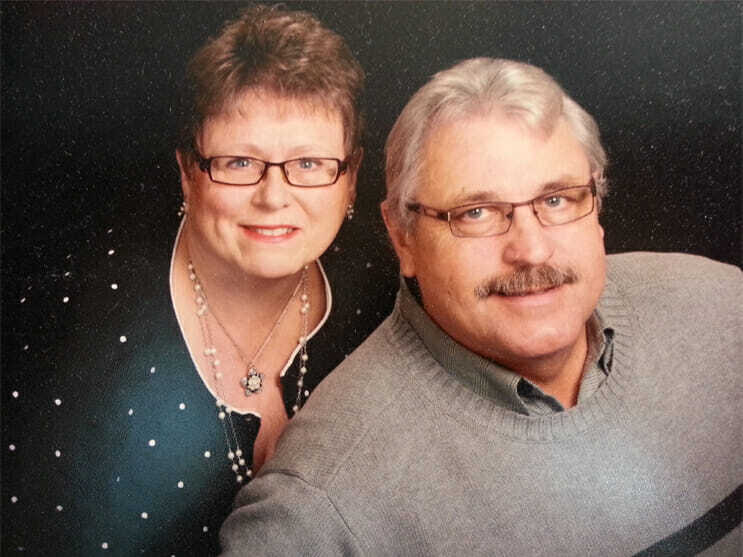

Marcia & Ed Arndorfer From the time he was a youngster growing up on his family’s farm, Ed Arndorfer dreamed of being a Minnesota farmer. He graduated from Willmar High School in 1972 and, at the urging of his parents, Ed studied Diesel Mechanics at Willmar Vo-Tech.
Ed worked full time as a mechanic for two decades, yet his heart still yearned for farming. When his father decided to retire in 1993, Ed moved onto the home place and rented his father’s machinery and equipment. His also took on a Nu-Tech® dealership to supplement his farming income, as well as help reduce his input expenses. When Nu-Tech sold to DuPont Pioneer, Ed desired to again work with a family-owned seed company and took on a Latham® seed dealership.
“I really like working with a family-owned seed company,” says Ed. “I feel like everyone at Latham is as concerned about the success of my business as I am. They know me by name and treat me like family.”
In addition to operating a seed dealership, Ed also still plants and harvest soybeans and corn every year. One of his sons, who serves as a physical therapist’s assistant full time, adjust his work schedule to help during the busy times. Others help part-time on the farm, as well.
Ed’s wife, Marcia, has worked as a medical assistant at the Affiliated Community Medical Center (ACMC) in Willmar since 1991. In their free time, the couple enjoys traveling, fishing and boating. Last summer they had a boatload of fun when they spent one week at Lake Koronius. Their seven children and 12 grandchildren, ranging in age from 1 to 22, were able to join the Arndorfers as their schedules allowed.
The family also enjoys getting together throughout the year. Marcia always bakes pies on the holidays, adapting recipes to fit special dietary needs. One of their grandsons is lactose intolerant, so she today she is sharing her adapted recipe for Pumpkin Pie. She’s also sharing one of her diabetic-friendly recipes for Garden Vegetable Brunch Cake.

-
Latham Hi‑Tech Seeds
Nominations Underway for “2014 Farm Mom of the Year”
 Today’s woman doesn’t just bring home the bacon and fry it up in a pan. Chances are, she’s managing that feeder-to-finish operation. And if she’s like Jenny Dewey Rohrich, she turned that pork into bacon.
Farm women are changing the ag landscape. As farming becomes more technologically advanced, farm women are becoming increasing involved in data analysis, site-specific farming, regulatory compliance, commodity marketing, public relations and social marketing. Today’s farm woman works every aspect of the farm, keeps everyone on task, and even advocates for the industry she loves.
That’s why Monsanto Company recognizes farm moms for the important roles they play within their families, their farming operations and their communities. Anyone can nominate his or her favorite farm mom – whether it’s their own mom, sister, aunt, daughter, friend or community member – for a chance to win up to $10,000!
Nominations for the Farm Mom of the Year contest are open through March 31, 2014. To nominate a favorite farm mom, visit AmericasFarmers.com and submit a brief essay online or by mail that explains how the nominated farm mom contributes to her family, farm, community and agriculture. Each nomination will be judged based on published criteria by a panel of judges from American Agri-Women.
Monsanto will select five regional winners based on the judges’ decisions. Each regional winner will receive a $5,000 cash prize. Profiles of the regional winners will then be posted to AmericasFarmers.com, where the public can vote for one national farm mom winner. Announced just prior to Mother’s Day, the national winner will receive an additional $5,000 cash prize above and beyond her regional prize.
Farm Moms are truly inspiring women like Iowa farmer April Hemmes, who lives in our home county, and Kansas rancher Debbie Lyons-Blythe, whose family was featured in a Super Bowl ad. April traveled to Uganda to help women farmers get their grain to market and also helped raise money for much needed equipment and infrastructure including bicycles and wells. Debbie is a great advocate for agriculture and works tirelessly to help bridge the gap between producers and consumers. Check out her blog, Life on a Kansas Cattle Ranch, where she writes about the Flint Hills and shares delicious ranch recipes. (I’ve certainly downloaded my fair share of her recipes!)
Chances are, you know of some equally amazing farm woman. Be sure to submit a nomination on her behalf for Farm Mom of the Year by March 31!
-
Latham Hi‑Tech Seeds
Blind Sided
Learning is a life-long process. Last week, I certainly learned a lesson the hard way last Thursday while presenting – or at least trying to present – during a webinar hosted by Iowa State University Extension on Genetically Modified Organisms (GMOs).
#EpicFail is probably how my grandkids would’ve describe this event. Why? Because I didn’t understand the folks were involved in this webinar! I have always said farmers need to listen to understand. Learn where an audience stands, and then talk in a way that leads to greater understanding. Sounds simple, right?
 What I learned through this experience is that there’s more to listening than it sounds! I should have investigated how the webinar would be run. I should’ve asked to see, in advance, the outline that would be followed. If I had done due diligence, I would have been much better prepared.
Don’t misunderstand me… I went into last week’s webinar armed with facts and prepared with science, including a few emotion-laced nuggets about the fear of food. I had an hour’s worth of information, which I trimmed down from what I thought would probably have taken a month to present. I also knew from a blog entitled “OMG GMO”, which was posted on the ISUE website, that there would probably be a participant or two that was anti-GMO.
What I hadn’t expected, however, was the vast amount of information that I should’ve studied in advance like the rules of engagement. Slide 1 of the ISUE deck outlined these rules, and I started getting a little nervous! It’s been years since I’ve sat in a classroom, but I still felt like the student who showed up without his homework done. The next slide (more like lecture) was on being nice! More rules were given about talking and listening. All in all, it took about 15 minutes of the webinar just to set the ground rules.
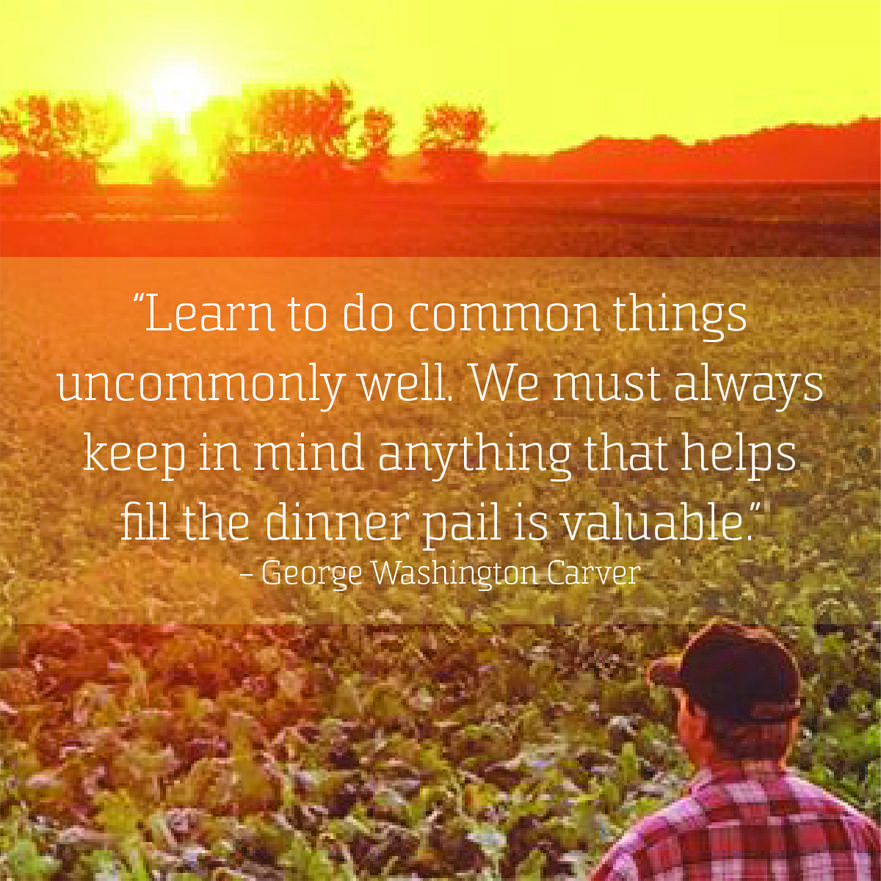
Knowing there was little more than an hour left for the webinar, I expected there would be little time left at the end for questions. I started going through my scientific-themed information. Now I know, emotion trumps science every time but facts are needed to set the stage. About 10 minutes into my presentation, the moderator told me to wrap up. I was only on my fifth slide, expelling what GMOs are and my time was nearly up! Trying to think quickly, I jumped ahead to explain how GE plants use fewer inputs. I then finished with this very short quote from George Washington Carver, “Learn to do common things uncommonly well. We must always keep in mind anything that helps fill the dinner pail is valuable.”
With that said, I was done. From here, we went into a structured question and answer session. Every question asked by participants was based on emotion, and the questions “asked” were really more stated opinions than true questions. Honestly, I didn’t know at this point what my role was so I waited for others in the group to chime in. Finally, I started giving a few answers but the discussion stayed very anti-GMO.
After the webinar, ISU Extension sent me information that was provided the participants. I have been very surprised at the good information they were provided. One site was “protecting and promoting your health” by the U.S. Food and Drug Administration. It explains what GMOs are and the process a new trait must go through before being approved. It also explains that USDA is not the only government agency that examines a new trait; it must also go through the EPA and APHIS.
Because the information on this site is so factual, I’m guessing few participants read it before the webinar. It didn’t support their fears or help confirm their beliefs. Somehow we must learn how to use science-based information with emotion!
-
Latham Hi‑Tech Seeds
Take Root: 10 Steps to Begin Your Legacy Planning Journey
 “Before you take root, you must plant a seed,” said Nathan Katzer, business development manager for the Iowa Farm Bureau Federation, as he addressed a crowd of family farmers including my husband and me. What an appropriate send-off to wrap up the series of three Take Root seminars, designed to help families start the conversation to transition their farms to the next generation!
History shows us that only 10% of family farm businesses successfully transition to the third generation. In addition to transferring financial wealth, farm families strive to pass on their emotional wealth: values, life lessons, talents and experiences. Nearly every young person, who grew up on a farm, knows the values of hard work, helping neighbors and striving to care for the land we farm. So why do farms still fail to transition to the next generation for so many families
 Lack of communication and not knowing where to begin are the two most common reasons a farm transition fails to transition. No wonder session one of Take Root was titled, “Strengthen Your Family Farm Legacy.” This presentation challenged each of us to really define what it was we were passing on. It provided strategies to help work through emotional obstacles together as a family and ideas on how to answer the tough questions like how to value sweat equity, determine fair versus equal among heirs and transition management early to allow for proper training.
In session two, the focus was the importance of taking time to work “on” the business instead of just “in” the business. We dove deeper into how to transfer responsibilities and build a farm business plan that includes business successors. We discussed ways to build, grow, diversify and specialize our operations all while preparing the operation for the next step.
The final session of the Take Root series featured a panel of experts prepared to answer the tough questions. This panel was made up of professionals in business planning, ag lenders, lawyers and estate planners. We had the opportunity to get some of our own questions answered while discussing financial planning and analysis and employee compensation.
While no succession plan will be identical to another, after going through this workshop series, the process as a whole can be summarized in 10 main steps:
- Set goals, identify common succession objectives with all active family members.
- Prioritize these goals and agree on a timeline for completing your succession plan.
- Collect qualitative and quantitative information including: family relationships, business structure, financial information and estate planning documents.
- Complete a cash flow and financial analysis for each family member.
- Compile all information into a preliminary plan.
- Seek outside advisors to evaluate the collected information and provide recommendations on ownership transition, leadership development, estate planning and financial security.
- Seek input from all active family members concerning the preliminary plan and outside recommendations.
- Revise the preliminary plan to include agreed upon recommendations and supporting explanations for each section.
- Implement your plan by creating the necessary legal support documents, adopting the financial tools and accounting processes needed to accomplish your goals, and beginning the necessary leadership development for the succeeding generation.
- Review this plan with all active family members on a yearly basis.
Involvement in the Take Root series was a great first step to helping my family progress through the legacy planning process. One common theme I did take away from the workshop is that families can never start planning soon enough, but they can start too late.
Communication is key. Have you started the conversation with your farm family? Your future farm legacy depends on it!
-
Latham Hi‑Tech Seeds
Farmers Grow Communities Grant Benefits Sibley Co. FoodShare
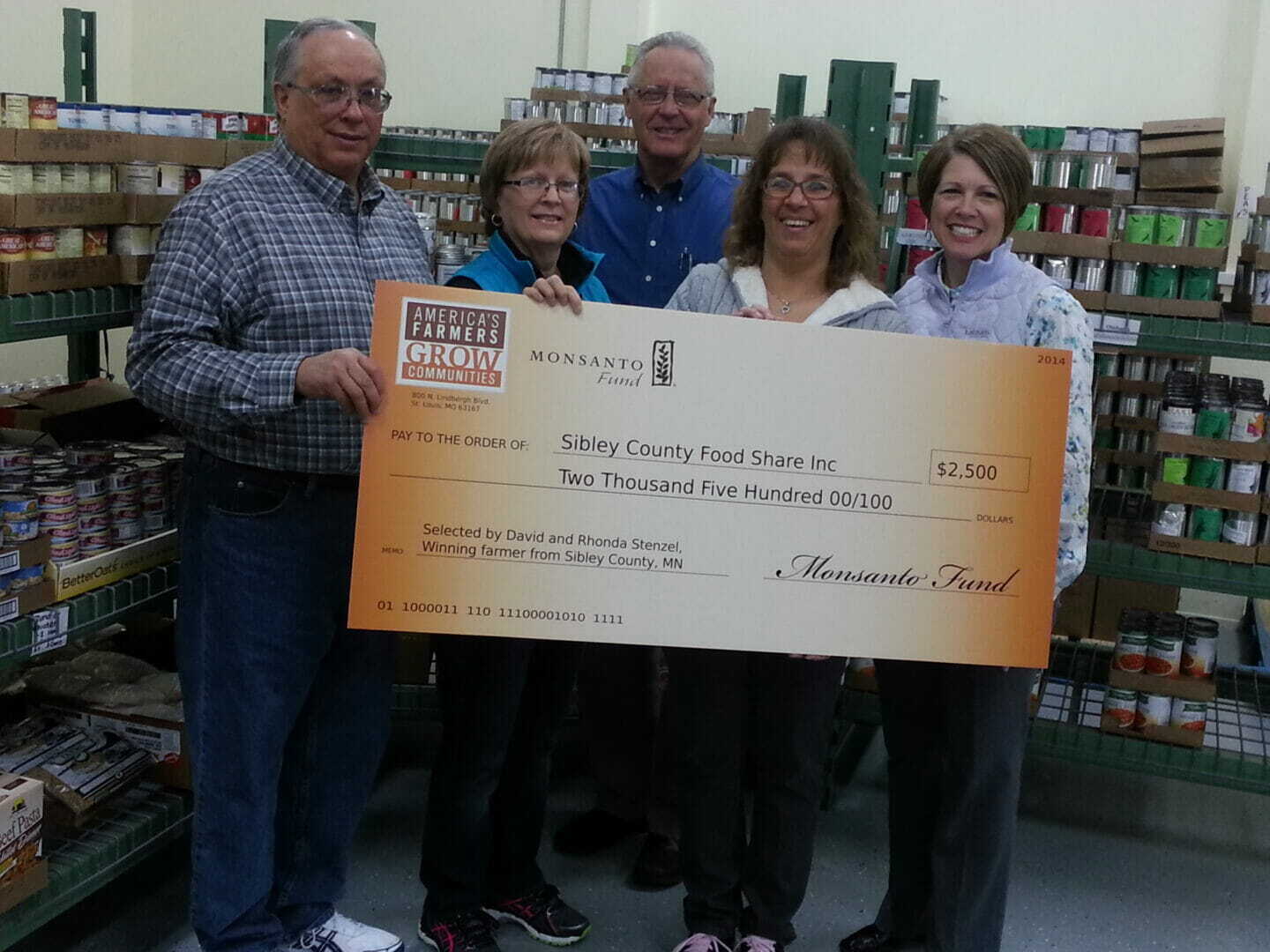
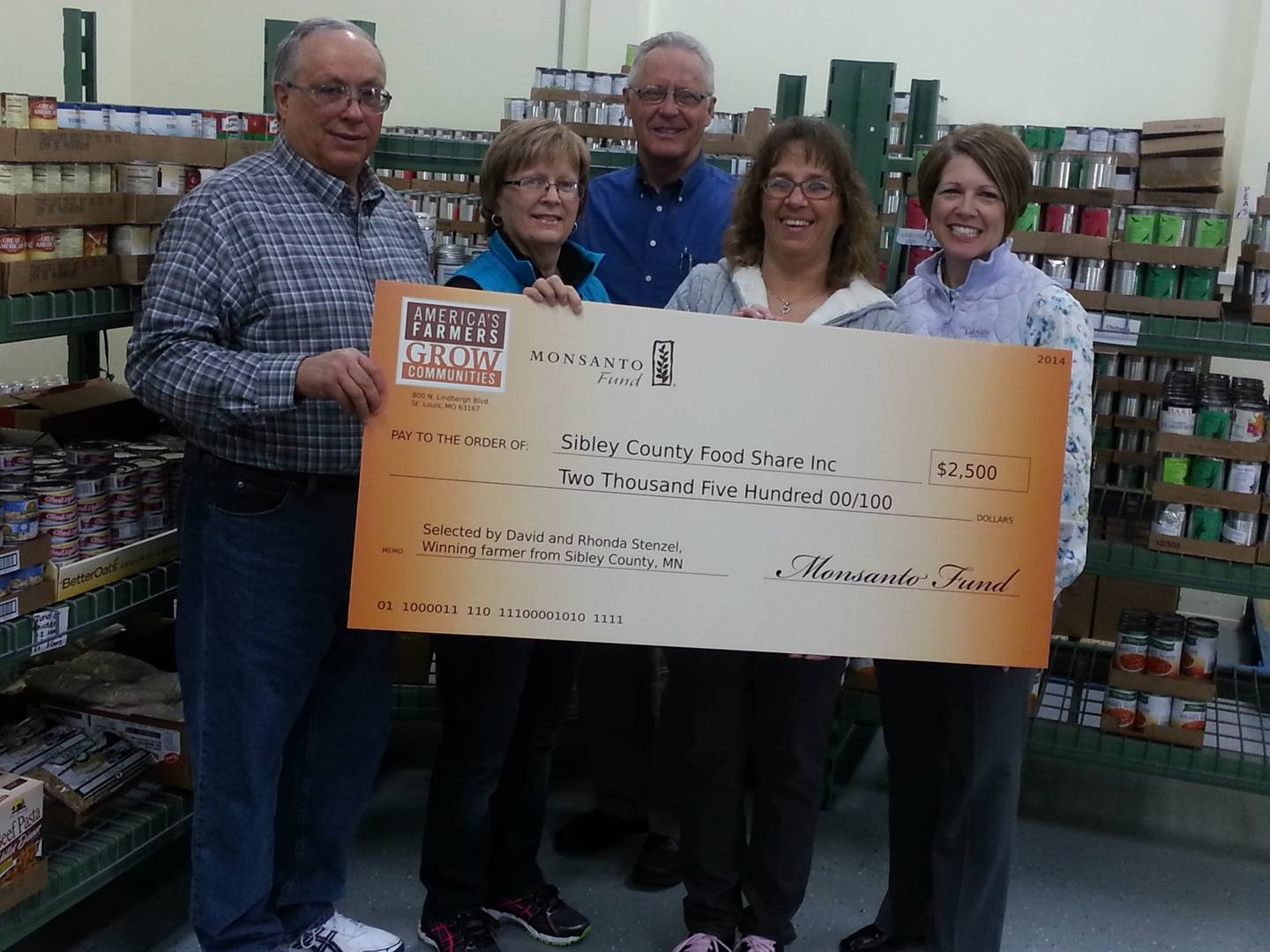
From left to right: Farmers David and Rhonda Stenzel, Latham® seed dealer Tom Maiers of Stewart, FoodShare coordinator Jacki Kruggel and ShannonLatham David and Rhonda Stenzel, who farm in rural Winthrop, Minnesota, were selected as winners in Sibley County for America’s Farmers Grow Communities. Sponsored by the Monsanto Fund, the America’s Farmers Grow Communities program helps farmers support local organizations that are important to them.
The Stenzels chose to direct this $2,500 donation to Sibley County FoodShare because they know there are residents in their home county struggling to put food on their tables. A report issued last fall by the U.S. Department of Agriculture shows one in 10 Minnesota households doesn’t have access to enough food for healthy living.
While Minnesota is doing better than the national average of 14.5 percent, the state’s numbers for food insecure families are at an all-time high. The statewide trend is evident in Sibley County where FoodShare coordinator Jacki Kruggel says there is high demand for emergency and supplemental food supplies.
“We serve about 200 families each month through FoodShare,” says Kruggel. “Demand is especially high from November through the winter months. Then we’ll see demand spike again from July through October.”
Sibley County FoodShare is a non-profit organization that has been helping people for more than 25 years. It’s made possible through generous support from communities, churches, businesses and civic organizations. Additional assistance for local families in need are provided by Minnesota Valley Action Council, Sibley County Public Health and Sibley County Human Services.
Shelves at the Sibley County FoodShare are stocked with staples like butter, milk, eggs, flour, sugar, and vegetables like onions and potatoes to cover a family’s basic needs for three or four days. So today on TheFieldPosition, the Stenzels are sharing one of their favorite recipes that uses ingredient that nearly every kitchen has on hand. Warm up this winter with a hearty bowl of Ham & Potato Chowder!
-
Latham Hi‑Tech Seeds
Face Down Food Fears!
The journalist in me appreciated this clever headline. The agriculturist in me, however, saw a red flag and decided to read the opening paragraph of this blog by Kristi Cooper, Family Life Specialist with Iowa State University Extension and Outreach:
Oh My Goodness! I am amazed at the flurry of GMO conversation in social and news media. If you are blissfully unaware of what I am talking about, GMO stands for Genetically Modified Organisms. GMO, my definition, is the code word for everything that is bad in the food chain right now.
“GMO, my definition, is the code word for everything that is bad in the food chain right now.” Fortunately, I didn’t take offense at this statement and chose instead to read further into the article where Cooper writes:
I don’t want to be afraid of my food. I don’t want to be afraid of my social media ‘friends’. I don’t want to be afraid of asking questions about GMO for fear someone will ‘peg’ me in one ‘camp’ or the other. Food is critical to our survival so anything that seems threatens the safety, quality or supply triggers strong emotion in people.
GMOs certainly trigger emotions from people on both sides of the issue, but it’s unfortunate that fear is one of the emotions often experienced. Food should not be feared. Fear causes people to make decisions and act in ways that defy common sense and common decency.
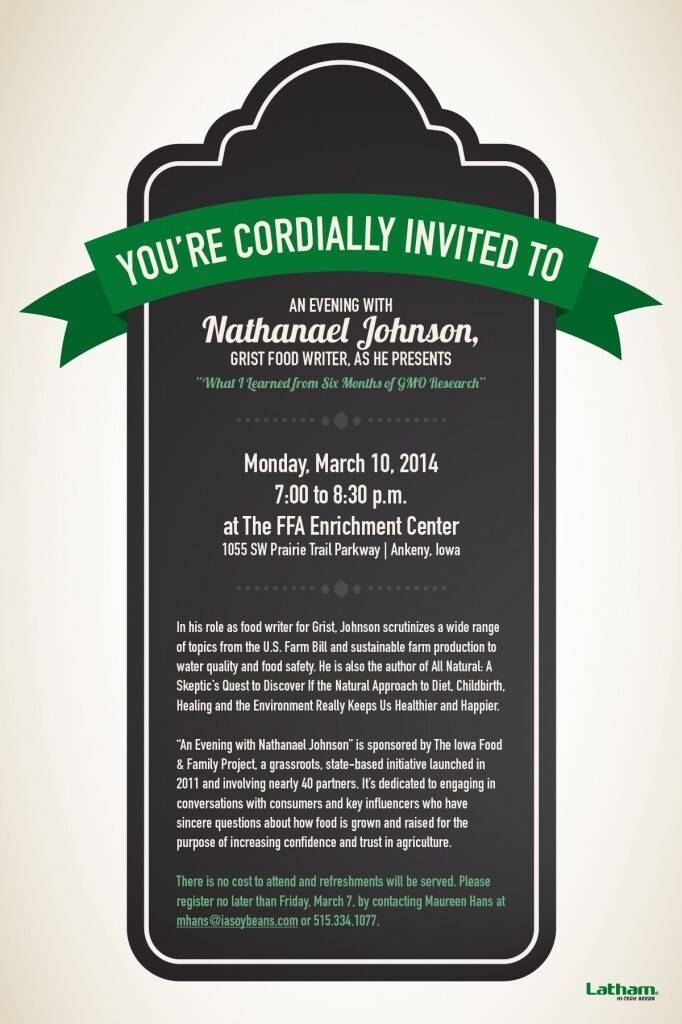
Click Here for Facebook Event. Here’s an example of how fear clouds judgment…
When our young daughter had problems sleeping during thunderstorms, we were told by experts that she needed to “face her fears.” We sat at the kitchen table and watched lightning outside the window. We talked about rain provides much needed drinks for crops, flowers and trees. We explained how rain replenishes water supplies for humans, livestock and animals. We watched YouTube videos of storms. We practiced emergency drills and talked about the safest places to be inside our home should a storm occur.
After years (yes, years) of us “educating” and arming our daughter with the facts, she no longer bites her nails down to the quick during a thunderstorm. She no longer comes running into our bedroom during the middle of the night. Why? Because she has the confidence to deal with her fears.
At the end of the day, confidence is what we all need. Nothing is more important than making the choice we believe is best for our bodies – and our families (sometimes these two are one in the same). Greater understanding happens when consumers understand the facts of food production. That’s why I advocate for food dialogues that allow producers and consumers to truly engage in healthy conversation, leading to greater understanding.
Here’s hoping that tonight’s Eco Family Virtual Conference on Food and Genetic Engineering provides a healthy food dialogue! Larry Sailer, who blogs every Tuesday on TheFieldPosition.com, will be one of the presenters. Click here to register as a guest.
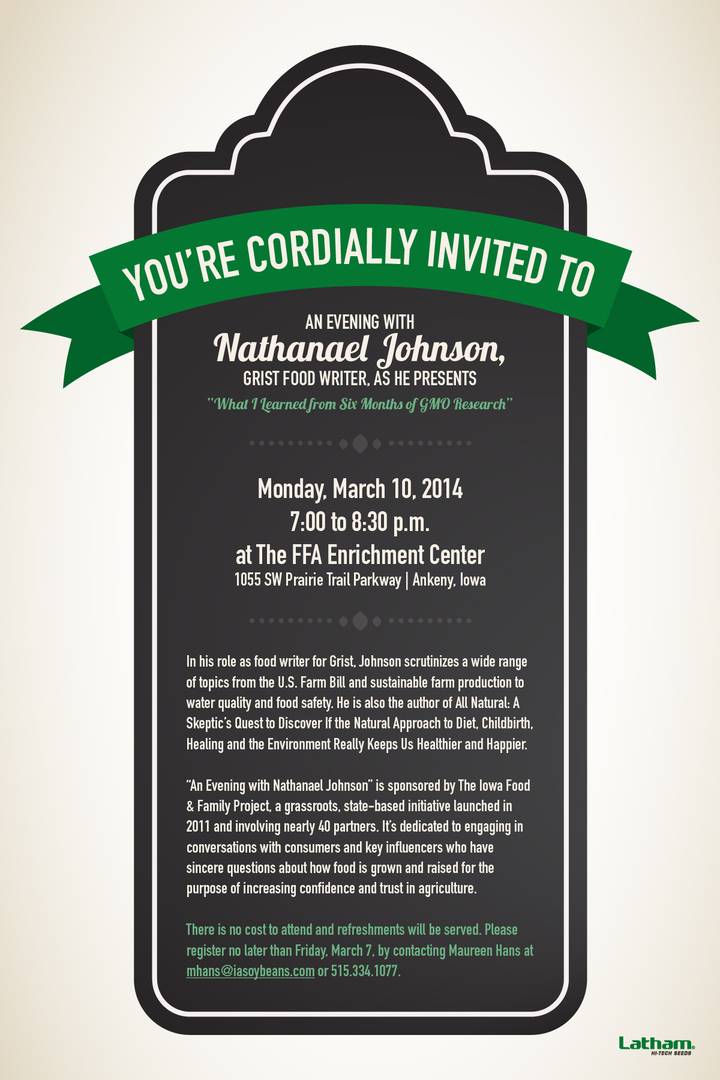
Another opportunity to engage in a conversation about GMOs will be Monday when the Iowa Food & Family Project, presents an evening with Nathanael Johnson, Grist food writer. There is no cost but pre-registration is required by Friday, March 7. Contact Maureen Hans at mhans@iasoybeans.com or 515.334.1077.
Start a conversation about food production with someone, anyone!
-
Latham Hi‑Tech Seeds
Put Americans Back to Work
 This week I’ve been spending lots of time doing research and writing about GMOs for a presentation I’ll be giving Thursday at the request of Iowa State University Extension (ISUE). One might think I’d decide to write about GMO’s in today’s blog post, but I’ve decided to instead cover a topic that’s been bugging me for a long time. Yep, it’s political!
The current Administration claims that rebuilding “the middle class” is one of its highest priorities. In actuality, the middle class has been shrinking… Or so we’ve been told. Millions more people have been added to some type of welfare rolls during the Obama presidency. I’ve read reports stating as much as 50% of our population is collecting some type of aid!
One reason this figure is cloudy is because it’s hard to consistently define “aid.” Regardless of how its defined, entitlements are holding back job creation. Contracts negotiated by unions when the economy was expanding and workers could demand whatever they wanted has come home to roost! Money was not put away as it should have been to fund the future draw of the retirees. The current workforce is being made to fund the retirements.
Yet, our current administration claims “putting Americans to work” is one of its highest priorities! The stated goal is to create more jobs and get our workforce strong and growing. I want to examine where our president thinks we should go and why I don’t think that’s the direction needed:
- Close tax loop holes and keep our jobs from going overseas. Now, being trained as a farmer and not an economist (although that is part of my job), I don’t see how more taxes creates new jobs.
- Build and improve infrastructure to increase jobs. Here again, more taxes are needed to fund the building. Taxes stymie business growth.
- Fund energy-saving, “green” jobs. Solar panel fields, wind turbines and new ways to fuel our transportation needs will certainly stimulate the economy from new energy efficiency, right? Here again, more taxes are needed to fund them. Unfortunately, America has taxed its cheapest types of energy out of existence. We’re losing cheap energy from coal, nuclear and oil, but cheap energy makes jobs – period!
Speaking of creating jobs… we have a major shortage of semi-skilled workers in Iowa. Folks with a trade school education are needed as welders, electricians and assembly folks. Almost anyone with some type of computer skills can be trained and these types of candidates are in high demand.
When I was trying to hire for my construction company, it was tough to find someone willing to run a cordless drill or operate an air nailer. It didn’t matter what I paid. Honestly, it was hard to motivate people to come to work when they can stay at home and make the same amount of money with better benefits!
Now, I have no problem with someone being on temporary unemployment. It happens. Believe me, I know! Some jobs come and go. Jobs get finished and sometimes the next project doesn’t start right away. But unemployment was never meant to replace employment. After a certain period, say three or six months, something needs to change.
Let’s implement a training program instead. Line up jobs that serve a public purpose, so American taxpayers see some benefit and “underemployed” Americans can regain pride in having a purpose. Not everyone can work just any job, as we all know, but some type of service can be done by a lot of the people “looking” for work. Plus, a training program will help equip people with skills they’ll need to hold full-time employment. Win-win.
Notice that I’m not advocating for a higher minimum wage because honestly, that’s a double whammy: (1) People are less incented to work; and (2) Small businesses can’t afford to pay what the government programs do. I’ve heard those who know how to “work the system” are drawing upwards of $50,000. Minimum wage in Iowa is $7.25, so this person is going to need overtime to make $50K. Why work that hard? Our current system leads to a disincentive to work.
Healthcare is a whole other story. Requiring young workers who don’t need health insurance to have it, or a potential employer to buy it for them, is a serious financial drag. Young, healthy workers should be in huge demand! Let’s not shut them out of the job market. There’s more that I could go into on this topic, like paperwork, but I’m going to keep it simple today.
Let’s keep job creation simple:
- Seek low-cost energy options.
- Eliminate costly regulations that hamper business.
- Provide training rather than entitlements.
- Practice fair trade and supply the world, rather than buying from the world.
- Keep the government out of jobs that private enterprise can do!
-
Latham Hi‑Tech Seeds
Celebrate March with Pi(e)

Math has never my favorite subject. Honestly, the only way I’ve ever really enjoyed working with fractions is by measuring ingredients in my kitchen. Yet there is a group of math-loving Americans who celebrate Pi Day in commemoration of the mathematical constant of a circle’s circumference to its diameter, known as π (pi), 3.14 or 3/14.
When I think of a circle’s circumference, I think of a pie plate. Pie plates make me think of…
Shepherd’s Pie. Spaghetti Pie. Chicken Pot Pie. Sour Cream Raisin Pie. Quiche.
Strawberry Cream Pie. Apple Pie. Colorado Peach Pie.There are just so many ways to enjoy pie! That’s why, at Latham Hi‑Tech Seeds, we’ll be celebrating the 14th of March as “Pi(e) Day.” Join our celebration by sharing your favorite pie recipes with us!
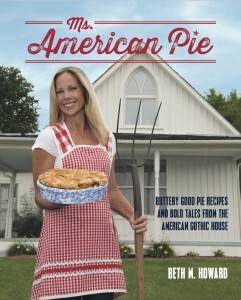 Use our NEW recipe submission app on the right hand column of TheFieldPosition.com. Each person, who submits a recipe by March 13, will be entered into a drawing for an autographed copy of Beth Howard’s new cookbook, Ms. American Pie: Buttery Good Pie Recipes and Bold Tales from the American Gothic House. This cookbook is so new that it doesn’t become available until April 1. Get it while it’s hot!
What’s better than muffins hot from the oven on a cold, winter’s day? I adore muffins, so today I’m sharing with you a recipe that I’ve been wanting to try since last fall. Perhaps I’ll get around to it this weekend!