Latham Hi-Tech Seeds

(641) 692-3258

  • Home
  • Products
    • Corn
    • Soybeans
    • Soybean Blends
    • Alfalfa
    • Corn Silage
    • Seed Guide
  • Performance
  • Find a Rep
  • Media
    • Blog
    • News
    • Videos
    • Podcasts
    • TECHTalk
  • About Us
    • Company History
    • Our Mission
    • Careers
    • Become a Rep
    • Sowing Seeds of Hope
  • Contact Us
  • Latham Hi‑Tech Seeds

    Evaluating Foliar Fungicide on Soybeans

    Many Midwest farmers are asking questions about the benefits of spraying foliar fungicides on their soybean fields.  The simple truth is… there are a lot of opinions.

    Be very leery when they are bombarded by claims of yield increases due to improved overall plant health.  Do some of your own testing before deciding to make large-scale applications of these products.  It may very well prove that fungicides of this type will pay great dividends on certain farms and pay zero dividends on others!

    There is one very important thing to remember when conducting trials of this kind:  leave some areas in the field unsprayed to “check” the actual value of the products.  As you make plans for the 2014 crop, keep these three things in mind:

    1. Be sure you’re making an apples-to-apples comparison.  For example, I’ve received reports from farmers who advocate the use of foliar fungicides on soybeans.  However, the fields they compared were several miles away and some were not even the same soybean variety!
    2. There are people out there who want to sell you something, regardless of whether you need it.
    3. If it sounds too good to be true, it usually is.

    One of our brand promises at Latham Hi‑Tech Seeds is to help farmers save time.  Another promise is to help farmers reduce risk.  That’s why I’m being as honest as possible by questioning the investment in foliar fungicide on soybeans.  Seed treatments, on the other hand, are worth the investment.  Seed treatments are one key to achieving higher soybean yields; click here for others.

    Webspec Admin

    January 22, 2014
    Agronomics, Crop, Fungicide, General, Soybeans
  • Latham Hi‑Tech Seeds

    Differentiating Between “Challenges” and “Problems”

    Churchill Quote

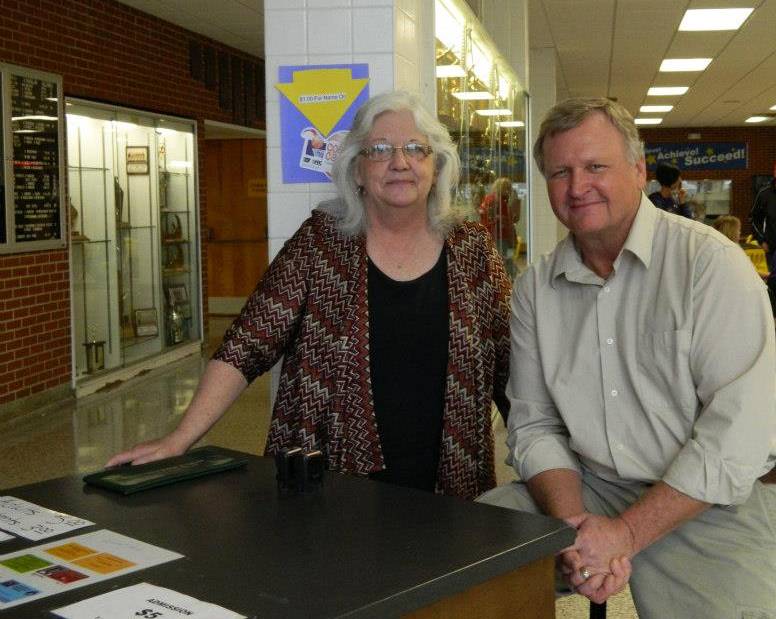
    Larry JaniceMy wife, Janice, and I were having a discussion last week about the time of our lives when we will no longer be working.  With us being in our sixties, Janice thinks retirement planning is a problem that needs to be solved immediately.  Feeling like I’m not much over 40, I believe retirement is a challenge that I still have time to address.  After all, I’m still making career plans.  I’m opening a seed dealership for Latham Hi‑Tech Seeds, and I’d like to actually build a new set of hog buildings for myself.  I built hundreds of modern hog buildings when I operated my own construction business, but the last one I built on my own property was in the 1970s – and I haven’t used it in 20 years.

    Because I’m making future plans for my farm, last week I attended the Coalition to Support Iowa Farmers’ annual “Farming for the Future” conference with the theme of “Doing Things Right.”  We all  know farming for the future can be a real challenge, especially given our current political and regulatory climate.  The real problem, in my opinion, is the last few years have been profitable for farmers.

    “Often, the worst decisions are made during the best of times,” said Dr. David Kohl, professor emeritus at Virginia Tech, who was serving as the keynote speaker at last week’s conference.  “When you’re rolling along, you get complacent and forget about the basics.  But always remember that you can’t simply grow your way to wealth.”

    Dr. Kohl reminds us that farming has always been a game of cycles: Good weather, bad weather. Good prices, bad prices.  The cycle will continue, he said.  But for the farmers who can channel their emotions while managing their operations, there will be more opportunities than ever in the years ahead!

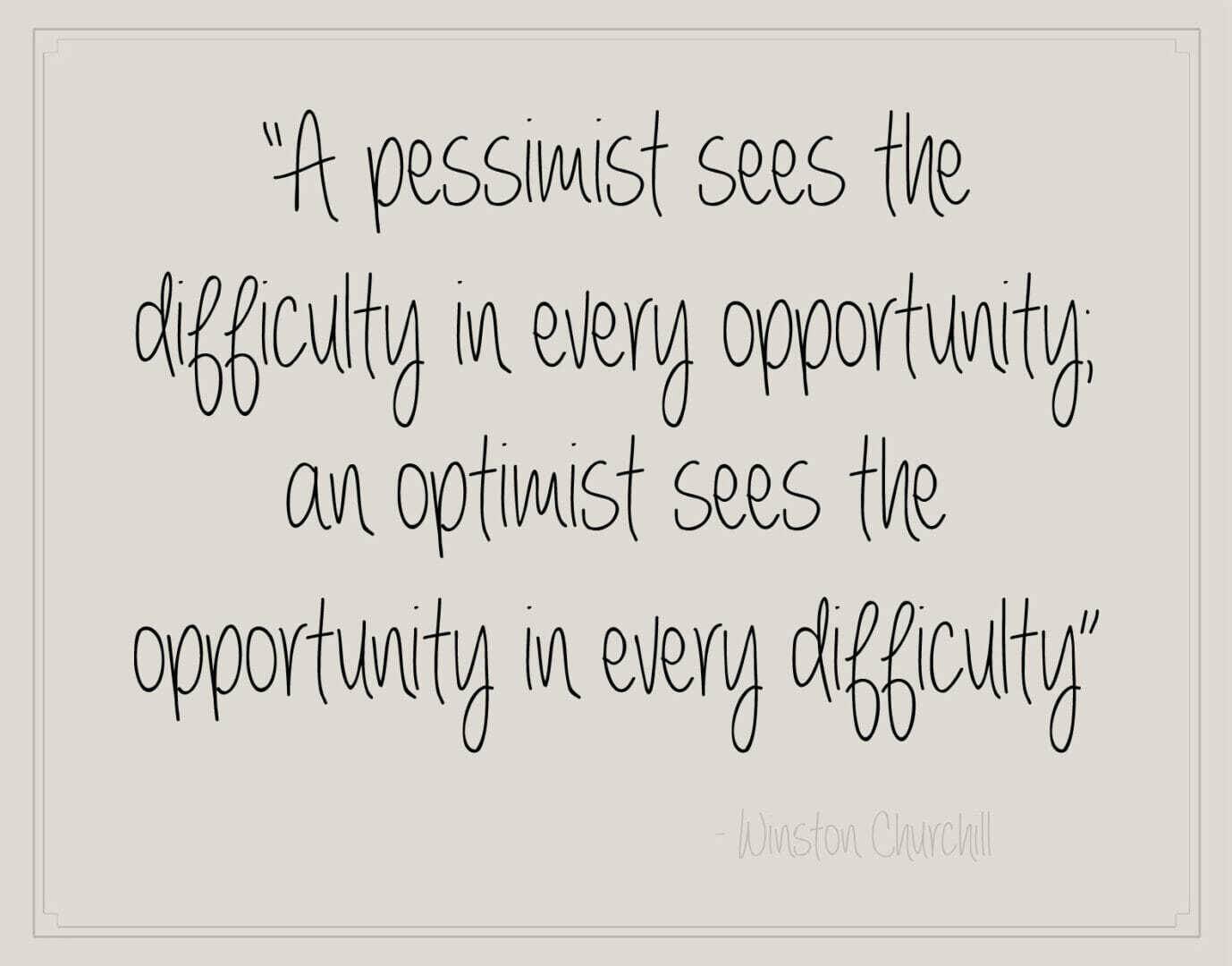
    Churchill_QuoteWhile farming is very competitive, capital intensive and risky, it’s also enjoyable.  There is so much to be made… and long as you’re looking for a challenge and enjoy solving problems.  Farming reminds me of this quote by Winston Churchill, “A pessimist sees the difficulty in every opportunity; an optimist sees the opportunity in every difficulty.”The hope of future opportunities in agriculture led to a sold-out crowd last week inside the Scheman Building on the Iowa State University campus.  Farmers packed the room to listen to a panel discussion on “Emerging Opportunities in Iowa Agriculture.” On-farm dairy processing, calving under roof and niche pork production.  There was even talk about raising fish in Iowa.  If you are interested in the content but weren’t able to attend, video from the conference will be available soon. You can also sign up for an e-newsletter.

    Challenges keep me going.  But as much I hate to admit it, Janice makes a good point about my age!

    Larry Sailer, Musings of a Pig Farmer

    January 21, 2014
    Agriculture, General, Industry News
  • Latham Hi‑Tech Seeds

    “Cold Run for Warm Meals” to Benefit Food Bank

    Race6485 logo.bsZUbV

    Guest blog post by Lindsay Pingel
    Communications Manager, Food Bank of Iowa

    race6485-logo.bsZUbV

    Recently, I was doing my weekly grocery run on a busy Saturday afternoon. I weaved my cart up and down the aisles, fought my way through the crowd and finally made it to the checkout line. As I was waiting in line and flipping through the latest magazine selections, something caught my eye.

    The family in front of me was taking items out of the cart because they didn’t have enough money. “The car repair made us extra short this month,” said the man, red with embarrassment and shame, as he repeatedly ran his debit card through the machine until finally it worked.

    When they left, the cashier was shaking her head and said to me, “I just wish there was something I could do to help them.” My thoughts exactly!

    What I witnessed is not uncommon for many Iowans today. One in eight Iowans – approximately 400,000 – is food insecure, meaning they lack the resources to live an active and healthy lifestyle. One out of 5 Iowa children does not know where his next meal will come from. Many of these individuals have been faced with a job loss or unforeseen expense that has brought on the burden of wondering how they will put food on their tables.

    FoodBankIowaDuring my time at the Food Bank of Iowa, I have wondered what more can be done to help those in need. What am I not doing to make this problem go away? Thankfully, I am reminded and inspired by the compassion and support I see each day. Individuals, businesses, organizations and civic groups show support through monetary donations and food drives; volunteers generously donate their time; and advocates speak about the issue of hunger and its impact on struggling Iowans.

    NAMA-IAToday especially I’m excited to announce a partnership with the Iowa National Agri-Marketing Association (NAMA) on the Cold Run for Warm Meals, a 2.5-mile run with all proceeds benefitting the Food Bank of Iowa.  The fun begins at 9 AM on Saturday, March 29, when Confluence Brewery opens for non-runners.  (That’s right!  It’s just as fun to be part of the cheer squad!)  The race beings at 9:30 with awards to be presented at 10:30 AM.  Create a team or register individually.

    Together, we can help their neighbors, colleagues, friends and family members struggling with food insecurity!

    Gary Geske

    January 20, 2014
    Agriculture, General, Industry News
  • Latham Hi‑Tech Seeds

    Preserving Her Family’s Legacy Led to “Wag’n Tales”

    WagBoys
    Val Wagner and her husband, Mark, at the North Dakota Stockman’s Convention on Dec. 26, 2013.
    Val Wagner and her husband, Mark, at the North Dakota Stockman’s Convention on Dec. 26, 2013.

    As a young girl growing up in rural North Dakota, Val Wagner dreamed of becoming a big-shot lawyer and living in a metropolis.  Then she met a farmer (aka “Boss Man” on her Wag’n Tales blog) at the county fair, and well, her dreams changed.

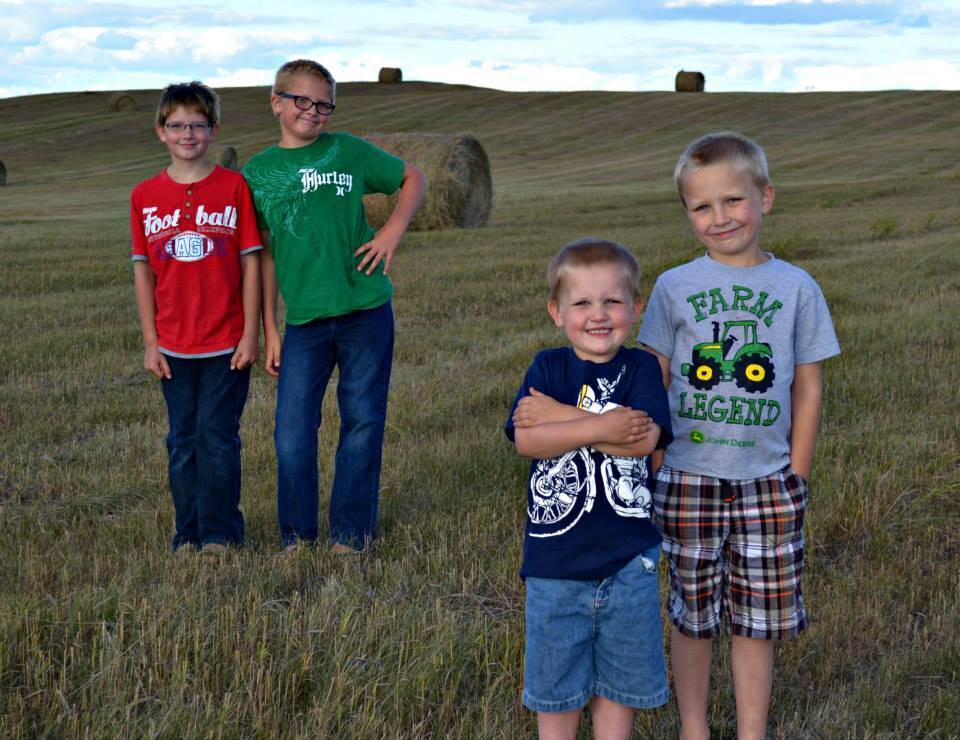
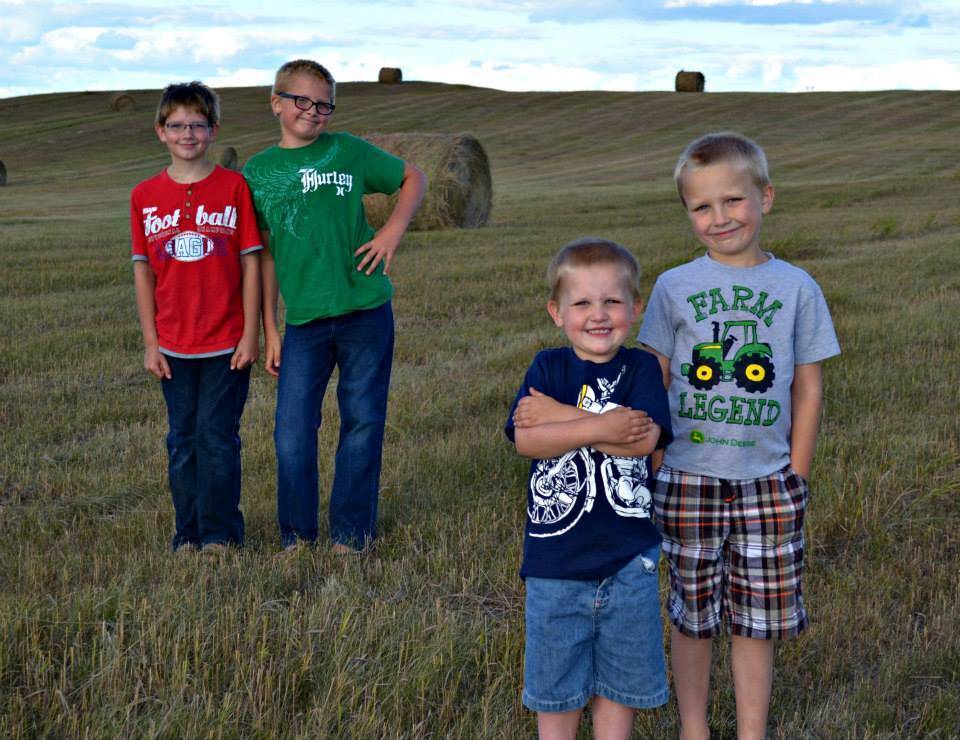
    Val and her husband, Mark, make their home in very rural southeast North Dakota on the land that has been in her husband’s family for more than 50 years.  Together, they’re caring for the land and livestock, raising their four sons and ensuring that farming will be their legacy.

    WagBoys
    Helping ensure a farming legacy for their four sons is why Val Wagner started her Wag’n Tales blog. “One of the things I enjoy most about living on our farm is being able to show my boys nature first-hand,” she says. “They learn about life, have the chance to create their own theories and dream of the future.”

    “These four boys are the reasons I do what I do,” says Val, while addressing a group of seed company executives Thursday during the 25th anniversary of the Independent Professional Seed Association (IPSA).  “Their opportunity to farm this land isn’t going to be lost on my watch.”

    Val saw how times were changing. Ag literacy is a real concern, so she started Wag’n Tales to help create a better understanding of modern agriculture.  Her blog has allowed her to virtually “open the farm to everyone.”  She believes the most important things she does is answer questions that non-farmers have like: What are cows fed? How are cattle taken care of during the winter? What is it like when a calf is born?

    “I usually don’t travel an hour past my farm yet my blog has been read around the world,” says Val.  Readers live in all 50 states plus 163 countries.  She literally has a world-wide platform to discuss topics ranging from “the Science behind Crop Technology” to “School Lunch Rules” and “Corporate Farming.”  Her tongue-and-cheek blog post about “How to Spend 10 Years Married to a Farmer” went viral with more than 10,000 hits on Facebook.

    “I have a story to tell, and my story is unique to me,” she says.  “But like my fellow North Dakota prairie farm wife Jenny Dewey Rohrich says, ‘Your story may seem ordinary to you, but it’s extraordinary to someone else’.  The same is true for everyone else. Tell your story and become an advocate for agriculture!“

    Recipes are another way Val connects with non-farm moms and others on her blog.  In honor of January Soup Month and as a tribute to the German-Russian Country in which her family resides, today she’s sharing a recipe for Knephla Soup.

    Team Latham

    January 17, 2014
    General, Recipes, Sides
  • Latham Hi‑Tech Seeds

    Staying Independent, the American Way

    Joseph Charles Plumb

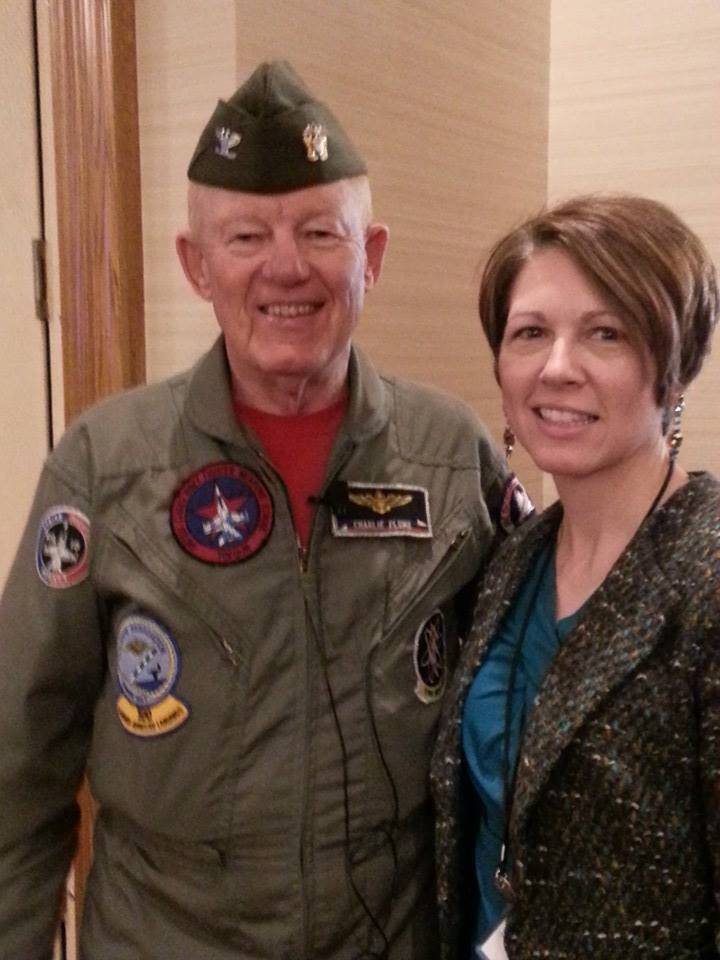
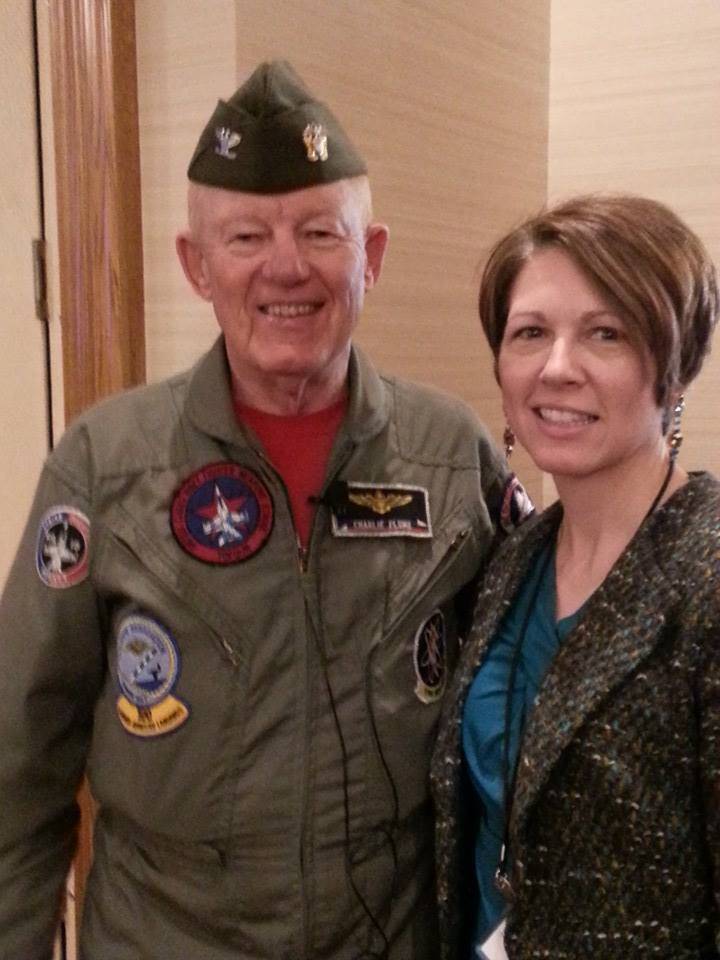
    Joseph Charles PlumbWhen Captain Charlie Plumb took the stage yesterday for the opening general session of the Independent Professional Seed Association 25th Annual Conference in St. Louis, the only noise in the room was the sound of a soldier’s footsteps in the dark.  When he began to speak, you could have heard a pin drop.

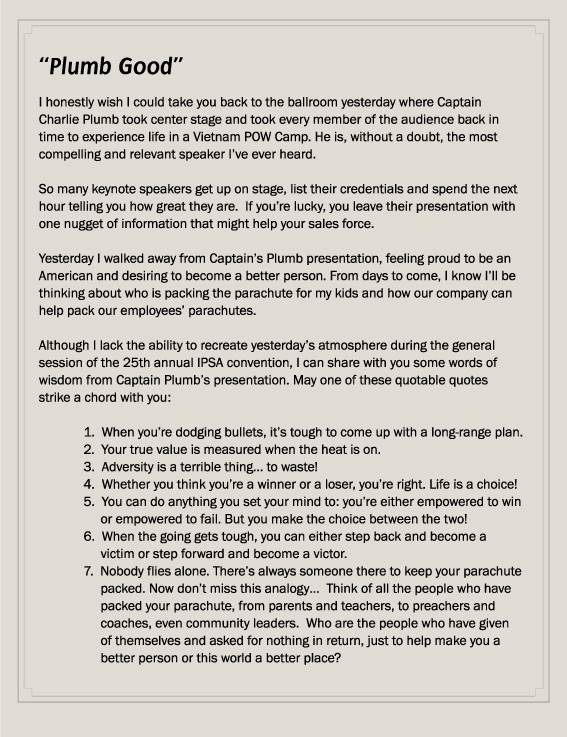
    “Today I want to take you back to a Prisoner of War camp in Vietnam where you can feel the intense heat baking on the tin roof of your 8 by 8 cell,” said the man, who lived as a POW from ages 24 to 30.  Just five days before his tour of duty was to end, he was shot down and spent the next 2,103 days in a prison.  “It’s important that you get a vivid mental picture. Try your best to smell the stench in the bucket I called my toilet, and taste the salt in the corners of my mouth from my sweat, my tears and my blood.

    If I am effective in these few moments we spend together today, you’ll see that the same kind of challenges you face, are the same basic challenges I faced in a prison cell: feelings of fear, loneliness, failure and a breakdown of communication. More importantly, your response to those challenges will be the same response I had to have in the prison camp just to survive.”

    “Even though I’m telling a story about myself, the real story is not about me,” he continued. “It’s about you… You won’t face the 8-foot walls that I did, but you will encounter the 8-inch ones.  Those eight inches between your ears can become your biggest barrier.  That’s why it’s important to remember that you can do anything you set your mind on.”

    Captain Plumb went on to tell the room full of independent seed company executives how honored he was to be with us because, as the son of a Kansas farmer, he knows we’re the first link in the chain that produces the world’s safest and most abundant food supply.

    “This great nation wasn’t built on fairness.  It was built on independence,” he says.  ‘As independent business owners, you have the freedom to go and be!  You also have the freedom to fail.”

    If you blame others for your problems, Captain Plumb says you’re giving them control over you– and your life.  He shared tips on he prevented the enemy from having total control over him inside the POW Camp and made them relevant to our lives as civilians:

    1. Believe.  Tap into sources of strength that are larger than you.
    2. Courage. Have courage to face the day and step up to the plate.
    3. Integrity. Be honest. Have moral principles.
    4. Humor. Have fun. Laugh. Prank.
    5. Return with honor.  Thanks to leadership inside the POW Camp, Plumb says this became their new mantra.

    Life is about taking choices, taking risks.  Captain Plumb’s time in the POW camp taught him that sometimes the solution is take another risk.  “The last thing you want to do is get further outside your comfort zone, to get into deeper water, to hurt more,” he’s quoted as saying in a Juneau Empire article.  “The human response is to fall back and seek safety.”

    Captain Plumb said he learned in that POW camp that he could still control his attitude.  He could choose to laugh or to cry; he could choose to be positive or negative… but choosing to be negative gave the enemy control over his destiny.

    We can all chose to make a positive difference, whether we make a living as a farmer or a seed company owner.  We’re Americans and we enjoy the freedom of independence!

    PlumGood2

    Team Latham

    January 16, 2014
    Agriculture, General, Industry News
  • Latham Hi‑Tech Seeds

    Resolving to Obtain Higher Corn Yields in 2014

    Weather ranks as the most important factor affecting corn yield, says Dr. Fred Below, Professor of Plant Physiology at the University of Illinois.  Research he’s conducted show that weather accounts for 70 bushels per acre, or 27 percent, of total yield!

    Although we’re all hoping for better growing conditions in 2014, it’s unrealistic to think we can control the weather.  That’s why it’s important to focus on the things we can do better in our quest to raise 300-bushel corn consistently.

    Planting a portfolio of Latham® corn hybrids is one way to manage risk and improve your chances of achieving record-setting yields.  Last season we saw how different genetics handle stress from drought and wind.  That’s why genetic diversity is so important.

    You can also protect the 2014 corn crop with new technologies.  Latham’s 2014 product lineup includes 36 hybrid seed corn products, offering six different trait combinations in various maturities, for rootworm (RW) control.  In addition to corn rootworm, be sure to factor in management options to control nematodes that feed on corn.

    Nematodes are a growing problem across the Midwest, most likely due to trends of no-till farming.  Nematodes are sensitive to soil disturbance, so they tend to thrive in no-till situations.  Crop rotation isn’t an effective form of management, however, seed treatments can prevent nematodes from attaching to corn roots.  Applied directly to the seed, these treatments help prevent damage to early-season seedlings and roots before pests can strike.

    When finalizing your 2014 seed purchases, consider these Latham® Hi‑Tech Hybrids with Genuity® SmartStax® technology and the Poncho/VOTiVO plus Acceleron seed treatment:

    • LH 4579 SS
    • LH 4679 SS
    • LH 4819 SS
    • LH 4959 SS
    • LH 5088 SS
    • LH 5219 SS
    • LH 5349 SS
    • LH 5689 SS
    • LH 5779 SS
    • LH 5829 SS
    • LH 6089 SS
    • LH 6239 SS
    • LH 6359 SS

    Webspec Admin

    January 15, 2014
    Corn, Crop, General
  • Latham Hi‑Tech Seeds

    Non-Farmers Need a Little “Conventional” Wisdom

    Headlines are written to grab attention, as we all know.  But the sensationalism of the headline, “Large-scale farming is Iowa’s ‘Breaking Bad’,” in The Des Moines Register last Sunday nearly caused me to spew my morning coffee.  By the time I finished reading this Op-Ed by Kamyar Enshayan, I practically needed to breathe into a paper bag.

    “The TV series ‘Breaking Bad’ has ended, but the real thing goes on in Iowa just as bad or much worse,” writes Enshayagn.  At this point, I google “Breaking Bad” and learn it’s a about a struggling high school chemistry teacher diagnosed with inoperable lung cancer.  To secure his family’s financial future before he dies, the teacher begins producing and selling methamphetamine.

    Now I’m curious to learn how Enshayagn relates this to farming, so I go on to read: “Meth is indeed uniquely suited to Middle America, though this is only tangentially related to the idea that it can be made in the sink. Meth’s basic components lie equally in the action of government lobbyists, long-term trends in agricultural and pharmaceutical industries, and the effects of globalization and free trade.”

    I read this statement a second time, trying to gain a better understanding. I know he’s making the connection between agriculture and meth but I can’t quite understand it.  Is Enshayan really making the connection that large farming is the same as manufacturing an illegal drug?  WOW!

    It’s time to stop reading and start googling “Kamyar.”  I learn that he’s director for the University of Northern Iowa’s Center for Energy and Environmental Education.  This tells me he is a major influence on a significant amount of young people in our state… Anybody see a problem?

    Without further ado, Enshayan outlines what he believes is bad with “Industrial Commodity Agriculture.” He cleverly uses key words for emotion as he write, “Industrial commodity agriculture is entirely based on acres. It does not need stable communities. All that is needed are land, machinery, energy and chemical inputs to produce one or two products for distant markets. Civic organizations, schools, churches, libraries, rural businesses are all unnecessary to “feed the world” or to fuel ethanol plants. Long-term anthropological studies in many rural communities in the U.S. have confirmed these realities.”

    Realities? His reality is certainly different from mine!

    Enshayan goes on to explain that this has set up our rural areas as desperate situations that are the habitat for meth!  He shares many more of his “ideas” on why modern farming is ruining Iowa and gives credit to those Iowans, who are striving to change, like those who are producing for small niche markets or selling produce at Farmers Markets.

    Honestly, I have nothing against these types of operations as I believe we should relish our food choices.  However, I have a problem when advocates for these production practices attack how I farm!  I am a conventional, and conventional farming is the main type because it’s successful.  Conventional farming has evolved to where we are today because it works!  Conventional farming today does do a good job of taking care of the environment and our soil, using less inputs and energy to produce more crops.  Conventional is sustainable.  Conventional uses new technology (yes, GMOs) to get even better!

    Yet so many folks, who don’t live near farms feel, entitled to advise farmers – especially on environmental matters.  “There is a romantic notion of environmentalism, and then there is actual environmentalism,” Walter De Jong, a potato breeder and geneticist at Cornell University in Ithaca, New York, is quoted as saying in an article entitled, “GMOs May Feed the World Using Fewer Pesticides.”  He continues by saying, “Farmers are very conscious of the environment. They want to hand off their operation to their kids and their kids’ kids, so they maintain the land the best they can while doing what they need to do in order to sell their harvest.  My guess is that the majority of people who are anti-GMO live in cities and have no idea what stewardship of the land entails.”

    Most farmers I know are very proud of their local communities, including their schools and churches. In fact, farmers very much are a part of helping local to keep going. The loss of business on Main Street, I believe has more to do with the loss of manufacturing and the consolidation of retail business and more cheap imports. Smaller margins and stiff competition make it tough for stores on Main Street to survive without having some niche type of market.

    Naysayers need to get off the university campus and find out what’s happening out here on the farm.  There is a revival going on right now with the huge demand in agriculture for young people to fill jobs that require training and pay a very good “starting” wage. The need for more brains than brawn is also prompting more women than ever to return to farming.

    In Iowa, we have much more demand for skilled labor than we have people. Agricultural colleges and high school FFA programs are experiencing record enrollment. If we can keep our government from ruining business with regulations that stifle jobs (ethanol), we can have a bright future!

    Larry Sailer, Musings of a Pig Farmer

    January 14, 2014
    Agriculture, General, Industry News
  • Latham Hi‑Tech Seeds

    Protect Your Hearing, Reduce Your Risk!

    Hearing loss2

    Guest Blog from Farm Safety For Just Kids

    Photo courtesy of The Great Plains Center For Agriculture Health
    Photo courtesy of The Great Plains Center For Agriculture Health

    Hazardous levels of noise are produced by many things on the farm, including grain dryers, tractors, combines, livestock, chainsaws, and firearms. Any noise that leaves you with ringing in the ears or you are in a noisy location and you have to raise your voice to be heard, the noise is too loud!

    Protect your hearing by doing the following:

    • Reduce sound levels – When selecting new equipment, ask about sound levels and pick the quietest option.
    • Perform routine equipment maintenance – For example, fixing mufflers on engines, lubricating bearings, and replacing worn parts will reduce noise levels and improve farming operations.
    • Isolate yourself from noise – Working in motorized equipment equipped with cabs or enclosures will reduce noise exposure.
    • Use personal protective equipment – Since purchasing newer, quieter equipment is not always an option, use hearing protection when working in noisy settings. The earmuff style offers the best protection and is easy to use. Expandable ear plugs are the next best option but these require proper insertion to be effective: roll them up, insert into the ear, and hold in place while they expand to fill the ear canal.
    • Mark “High Noise Zones” – anywhere there is risk of excessive noise exposure. Have a set of earmuffs or earplugs in or near every high noise setting on the farm.
    • Choose the highest Noise Reduction Rating (NRR) – This is usually between 15 and 30 decibels. Chose the hearing protection with the highest NRR value.
    • Limit daily exposure duration – Reducing the amount of time you are exposed to noise can limit its harmful effects.

    Check out the Great Plains Center For Agriculture Health for more information about preventing hearing loss among our nation’s farmers and agriculture workers.

    Gary Geske

    January 13, 2014
    Agriculture, General, Industry News
  • Latham Hi‑Tech Seeds

    Get Healthier in 2014 with “Iowa Girl Eats”

    KristinPorter Headshot Small
    Photo courtesy of Iowa Girl Eats
    Kristin Porter of Iowa Girl Eats.
    Photo courtesy of Iowa Girl Eats

    Eat healthier. Get in shape. Spend more time with the family.

    It comes as no surprise that these three are among the top resolutions made in 2014 by Americans.  Newly released results from a study conducted by the Iowa Food & Family Project confirms that interest in food among Iowans continues to spike, mirroring national trends.

    Americans today have more food choices than ever, from locally grown to organic.  U.S. supermarkets are stocked with thousands of easy-to-fix meals, yet two-thirds of our population is obese.  Contrast today’s stats with the 1950s when food production and meal production were more labor intensive, yet only 9.7 Americans were obese.

    Photo courtesy of Iowa Girl Eats
    Photo courtesy of
    Iowa Girl Eats
    [Click Here for Recipe]
    As fewer people are directly involved in the business of growing food, there is a growing need to create understanding between producers and consumers.  That’s why last spring the Iowa Food and Families Project launched the “Join My Journey” campaign featuring Iowa Girl Eats blogger Kristin Porter.  Kristin describes herself by saying, “I eat as well as my sweet tooth allows, run as often as possible despite the crazy Iowa weather, and am usually dreaming about the next place I want to travel to!”

    Her travels in 2013 took her to several Iowa farms and points of interest where she milked a cow, saw first-hand how pigs, cattle, turkeys and poultry are raised and how farmers grow corn and soybeans.  A native Iowan who wasn’t reared on a farm, Kristin took the wheel of a tractor during the 2013 planting season and drove a combine during #harvest13.  She met several farm families, who raise and care for livestock and crops.  Rather than google for answers, she had the opportunity to ask Iowa farmers the questions that she and other consumers had about modern production practices.

    Photo courtesy of Iowa Girl Eats
    Photo courtesy of
    Iowa Girl Eats
    [Click Here for Recipe]
    Now you can embark on a journey of your own!  To help you take a step toward eating healthier and spending more time with your family, today we’re sharing two Iowa Girl Eats’ recipes that will put a new twist on fruits and vegetables.  This recipe for Pineapple Mango & Orange Smoothie looks simple enough for my sixth grade Girl Scouts to make, plus I’m hoping this tropical concoction will help warm up our January troop meeting.  (Doesn’t a trip to Maui sound fabulous now? Since I’m not headed there, I’ll enjoy a taste of it from the comforts of Iowa.)

    The second recipe of Kristin’s that we’re featuring is for Thai Peanut Chicken Quinoa Bowls.  Quite frankly, I’m intrigued with this one because it makes use edamame (a soyfood) but it’s unlike anything I’ve ever tried making at home.  Guess it’s time I step outside my own comfort zone and try something new!

    What new foods do you plan to try in 2014?

    Team Latham

    January 10, 2014
    General, Recipes
  • Latham Hi‑Tech Seeds

    2014 Resolution: Increase Soybean Yields

    Stop smoking. Start exercising. Spend more time with family.  Even though “increasing bushels per acre” doesn’t make the nation’s Top 10 List for New Year’s Resolutions for 2014, we know it’s on every farmer’s mind.  That’s why today we’re sharing tips to help you do just that!

    Mother Nature obviously played a large role in yield potential last year, but as Latham® dealer Larry Sailer says, “It’s my hope that 2014 finds us with more favorable growing conditions.”  Following are keys to achieving higher soybean yields:

    1. Variety Selection: In my opinion, this is THE most important factor to achieving higher soybean yields.  Farmers need to manage a number of stress factors: disease, insects, Soybean Cyst Nematodes, etc. Fortunately, many of these stress factors can be managed through careful variety selection. Soybean Aphids can now be managed with Aphid-Resistant soybean cultivars. In the past, too many decisions have been based on cost per bag and the size of the seed in the bag. Those two factors won’t add a single bushel to your overall yield.
    2. Early planting: Soybeans are a light-sensitive crop, so yields are strongly influenced by the amount of solar radiation the crop receives throughout the growing season. It stands to reason that the earlier-planted crop will have more potential for yield since it will have greater access to sunlight. However, there are risks associated with early planting. Farmers must be careful to protect early-planted soybeans from seedling diseases and insects. We recommend the use of seed treatments containing either a fungicide or a fungicide-insecticide combination.
    3. Weed Management: Soybeans are very sensitive to early season competition from grass and broadleaf weeds. Using a weed control program that includes a pre-emergence herbicide and a post-applied product will reduce the stress from weed pressure and allow for early canopy closure. An early complete canopy is important to intercept as much sunlight as possible throughout the growing season.
    4. Narrow Row Spacing: Again, getting back to the theory that enhanced yields are tied directly to the amount of light that can be intercepted by the soybean crop, then narrow row spacing will help greatly in closing the canopy and allowing for increased light interception. I strongly recommend that farmers take a look at row spacings in the 15 – 20 inch range. Over many years of field observations, this seems to be the range that affords the greatest amount of yield potential while also mitigating risks associated with drilled soybeans in the 7 – 10 inch range.
    5. Soil Fertility: When striving for higher yields, soybean farmers need to ensure they have the available soil nutrients to achieve those yields or else all their careful planning and cultural practices will be for naught. Latham’s hallmark Seed-2-Soil program is invaluable in helping farmers achieve these goals. Soil sampling, field mapping and nutrient recommendations are just three of the many benefits members of this exclusive club can take advantage of.
    6. Soybean Cyst Nematode: SCN is the number one pest of soybean fields in the United States.  You really can’t even begin to think about raising 80 bu/A or even 60 bu/A soybeans until you know exactly where your SCN populations are in each field.  Nematodes tend to cause the most damage in drier years where soil moisture is lacking and plants are already under severe stress. Here again, soil sampling and careful variety selection are critical.
    7. Crop Rotation: Many will argue this comment, but in my opinion, the corn-soybean crop rotation is still the most profitable practice for farmers over time. The long-term benefits of this rotation far outweigh the short-term successes of corn-on-corn or even beans-on-beans.
    8. Scouting: Scouting your fields at least once a week is crucial. There will be times during the year when once a week isn’t often enough, and you might find yourself scouting fields every other day!

    Larry Sailer, Musings of a Pig Farmer

    January 9, 2014
    Agriculture, General, Industry News
Previous Page
1 … 73 74 75 76 77 … 159
Next Page

Latham Hi‑Tech Seeds

131 180th Street | Alexander, IA 50420

(641) 692-3258

SIGNUP FOR OUR NEWSLETTER
  • Contact
  • Legal
  • Dealer Center
  • Seedware Login
  • Latham Gear

© 2025 Latham Hi‑Tech Seeds. All rights reserved. | Iowa Web Design by Webspec | Privacy Policy

Latham® Hi-Tech Seeds is a trademark of M.S. Technologies, L.L.C., 103 Avenue D, West Point, IA 52656.