Latham Hi-Tech Seeds

(641) 692-3258

  • Home
  • Products
    • Corn
    • Soybeans
    • Alfalfa
    • Corn Silage
    • Seed Guide
  • Performance
  • Find a Rep
  • Media
    • Blog
    • News
    • Videos
    • Podcasts
    • TECHTalk
  • About Us
    • Company History
    • Our Mission
    • Careers
    • Become a Rep
    • Sowing Seeds of Hope
  • Contact Us
  • Latham Hi‑Tech Seeds

    Follow the Money & Find the Motive

    LarrySailer Kickoff

    LarrySailer_KickoffThe fight over food this past week seems to have stepped it up a notch! The Food Babe is all over my news feed for her views on some type of food or another. Last week she posted her findings from an “investigation” into Starbucks Pumpkin Spice Latte. That post went viral and continues to be a hot topic.

    Food fights have reached a new level, which brings to mind why I try so hard to listen and bridge the communication gap between consumers and producers. In Michele Payn-Knoper’s (pronounced “Pain – Ka-nope-r”) book, No More Food Fights, I’m quoted as saying, “A conversation must include listening. I need to know the concerns of people and to learn how they view what I do.”

    While I listen to promote greater understanding of farming to consumers, many celebrities and well-known “experts” like Dr. Oz and influential businesses don’t. They knock different foods to promote ideas that get attention. The Food Babe would lose her fan base if she actually listened and understood. Stores like Whole Foods wouldn’t be in business unless some consumers could be persuaded to believe that ” mainstream products are bad for you.

    The food conversation is no longer about the truth. It is about making money!

    Wayne Pacelle, President and Chief Executive Officer (CEO) of the Humane Society of the United States (HSUS), is another good example of someone who uses emotions to sway others’ thoughts and actions. His organization shows pictures of scared little kitties and abused dogs on late-night TV, and then asks you to donate $19/month. The truth is, HSUS uses emotion to raise money to pad retirement funds and to hire lobbyists.  Only one half of one percent of funds raised by HSUS goes toward animal care!

    Now Pacelle is trying to impact how I raise pigs. He’s painting a picture of how horrible farmers like me treat pigs just so his organization is able to raise funds. For 50 years, I have continually tried to improve how I raise pigs. If it were as bad as Pacelle claims, I’d be out of business!

    GMO is another buzzword. How many people have ever been harmed by GMOs? None! How many people are harmed every day because they don’t have access to GMOs? Literally millions… People who live in poverty suffer from Vitamin A deficiency resulting in compromised immune systems. Yet activists have let “fear of the unknown” trump pure facts. Somehow we must learn how to use science-based information with emotion!

    We also must uncover scams. If we follow the money trail, we’ll find the activists’ motives. Not only is this true as it relates to food, but it also applies to the environment. There is so much misinformation about conservation and water quality. For example, CEO and General Manager of the Des Moines Water Works Bill Stowe seems to know all about how farmers are polluting the drinking water for Greater Des Moines. Just ask him! He can show you “proof” with all kinds of charts and graphs. Why? His objective is to secure more money for his operations. The worse he can make the water quality look, the more funds he can acquire!

    Americans must read, listen and analyze. Question the “experts.” Examine multiple sources. Uncover the truth.  Don’t assume something you read on the internet is actually true. Consider the source — and the motive behind the source. Follow the money trail!

    P.S. Farmers must enter the food conversation.

    Larry Sailer, Musings of a Pig Farmer

    September 9, 2014
    Agriculture, General, Industry News
  • Latham Hi‑Tech Seeds

    Breaking Down Walls in China

    Welcome
    April Hemmes in China
    April Hemmes in China

    Guest blog by April Hemmes, who farms south of Hampton in Franklin County Iowa

    World traveling farmer reporting in to The Field Position! My latest adventure took me to China.

    It all started back in January when my husband brought me the Farm Bureau Spokesman and said, “They’re taking a trip to China, and you need to apply for it. All they want you to do is talk about the trip when you get home. I think they would get their money’s worth out of you!”

    I applied, never thinking in a million years they would pick me. Then in late February, I got the news that I was one of 18 farmers chosen! The trip was sponsored by Iowa Farm Bureau, and we paid a portion of our own way.

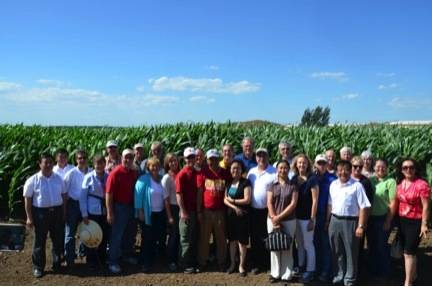
    In late June, 11 men, 7 women and 2 Farm Bureau staff members took off for China. We ranged in age from 26 – 74. It was a pretty diverse group, but like I say, when you put a bunch of farmers together you always have a good time.

    Group_China

    We flew into Beijing with stops at a wholesale produce and a meat market, plus the U.S. Embassy, U.S. Grains Council and Meats Council. Our last day in Beijing started with a meeting at the Ministry of Science and Technology. Teachers and researchers of Agricultural subjects met with us and we spoke about agriculture in China and how they inform farmers of research they have done. The quote I came away with was that they don’t tell farmers what to plant but they “ spare no effort” to suggest what crops would be best for the farmers to plant. I know what I would think if anyone “strongly suggested” what I should plant!

    A few take-away from our visit include:

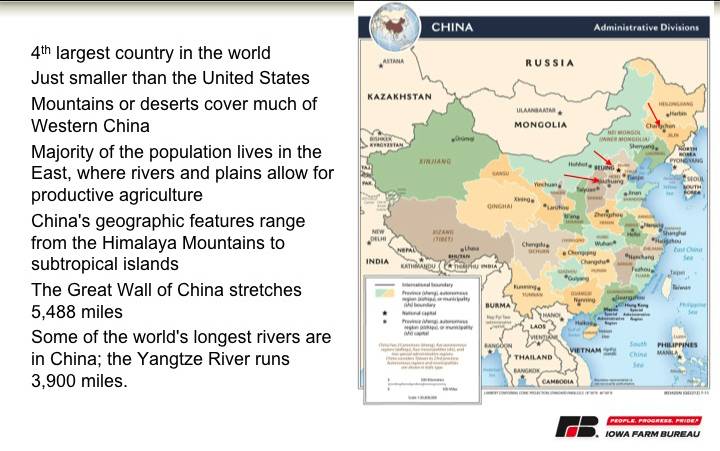
    • Nearly 90% of the crops are still grown on small farms. A little more than half an acre is the average farm size.
    • A large farm is thought to be 25 acres. The Chinese Government wants to increase the size of farms, so there is a need to move the farmers into the city. We saw high-rise apartment complexes being built in the middle of nowhere. I had heard about this but seeing it with my own eyes just confirmed it for me.

    ChinaFacts1

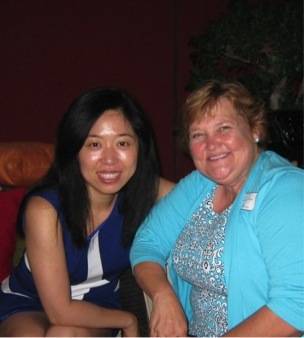
    Good to see family that lives far away!  With my sister in law Jackie!
    Good to see family that lives far away! With my sister in law
    Jackie!

    My favorite part of visiting Beijing was getting to see my brother-in-law and sister-in-law! My husbands’ brother, Jim, lives in Beijing and has for 7 years. His wife, Jackie, was born in Shanghai. She went to school at Arizona State University and is now an American citizen. Jackie works in finance and is very involved in a group of women leaders in China. They organized a night where we had a panel of Americans and others doing business in China, telling us what that involved. We also had a panel of women leaders in different areas telling about their experiences and what it was like for women working in China. I was very fortunate to be involved in that panel!

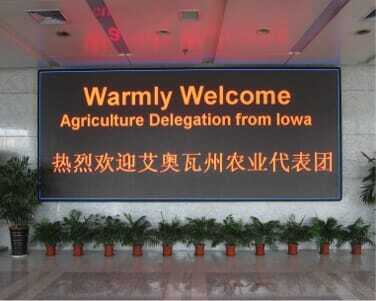
    From Beijing, we set off for Heibei Province. Heibei is the sister state to Iowa. Our final destination in the province is Shijiazhuang, which is the sister city of Des Moines. Iowa and Heibei Province have had leaders visiting for over 30 years. The President of China , Xi Jinping, has been to Iowa several times. We were treated like dignitaries here and had several interesting stops including a corn processing plant, dairy and milk processing plant along with the local agriculture college.

    One of our formal dinners in the Sister State of Iowa.  Hebei Province.
    One of our formal dinners in the Sister State of Iowa. Hebei Province.

    Our last stop was the province of Jilin. It is in the North East part of China, but it reminded us all of home with a lot of cornfields and a climate much like ours. Local dignitaries met us here, too, and followed us throughout our stay. One of our visits was to a farm where 5 producers went together and farm 1,500 acres.


    Remember, each landowner has around a ½ to 1 acre of ground, so they worked with a lot of owners! They also hire 36 employees for the farm. They couldn’t believe it when we said we would have about 2 or three people to work that amount of ground. They still pick in ear corn and store it that way. The government pays them $9.50 a bushel for their corn. This is a communist state, so there is no open market for grain trading. It is $2/bushel cheaper for the livestock feeders there to import corn from America than it is to feed the lower quality corn stored in China.

    Because it is a communist state, we only saw what they wanted us to see. No random stops were made along the way. Our group quickly realized that the nature of the trip was a market study tour and had changed to a networking /diplomatic trip. But that was just fine with all of us and we made the best of it.

    There was never a dull moment or lack of discussion during our meetings and banquets. As a result of the contact we made, three Chinese groups have contacted the Iowa Farm Bureau about visiting our state! This is great news and makes for a successful trip.

    It wasn’t all work on our trip, however. We did some cultural sightseeing: Tiananmen Square, Forbidden City, the Great Wall, Olympic Table Tennis center, ancient monasteries, silk and pearl markets and one of the largest shopping malls in the world. All of which were amazing and wonderful to experience!


    It was truly an honor to go on this trip and I would highly recommend anyone to apply for this trip next year. Look in your Farm Bureau Spokesman around January for details. I made life-long friends, not only with the Iowa farmers with whom I shared this wonderful adventure, but in China as well.

    Team Latham

    September 8, 2014
    Agriculture, General, Industry News
  • Latham Hi‑Tech Seeds

    Threshing Days are Stark Contrast to Today’s Harvest

    20140830 145823

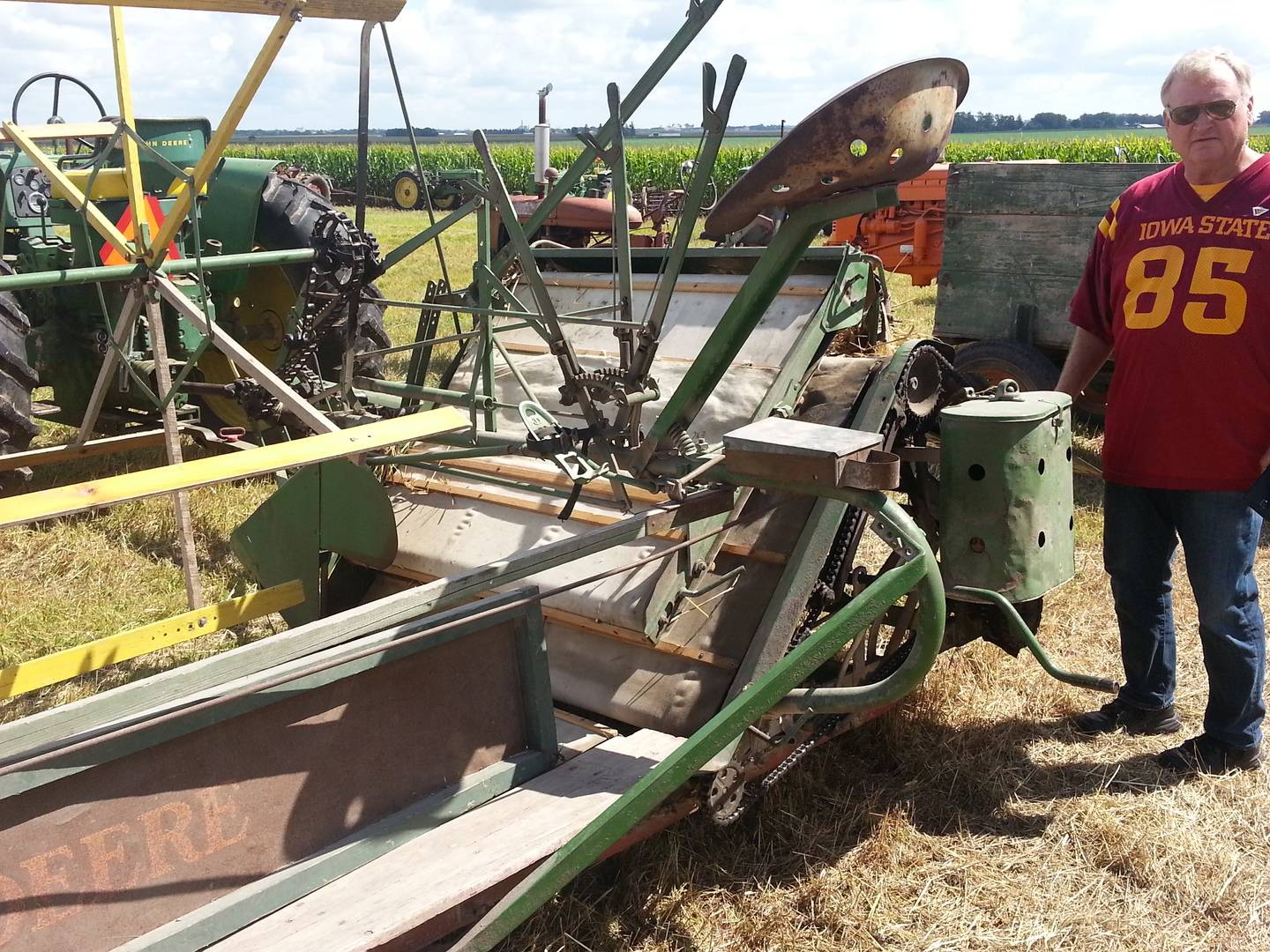
    20140830_144039“To appreciate farming today, one must understand history” was the main point I made in last week’s blog post. A few days after I posted that blog, I had the opportunity for a hands-on history lesson at the 3rd Annual Norris Threshing Day northwest of Mason City, Iowa.

    It was a beautiful, late summer, Saturday afternoon. Some clouds floated by, giving a little shade once in a while, and a nice breeze was blowing. It was just one of those days when you’re thankful to be alive and able to enjoy the great outdoors.

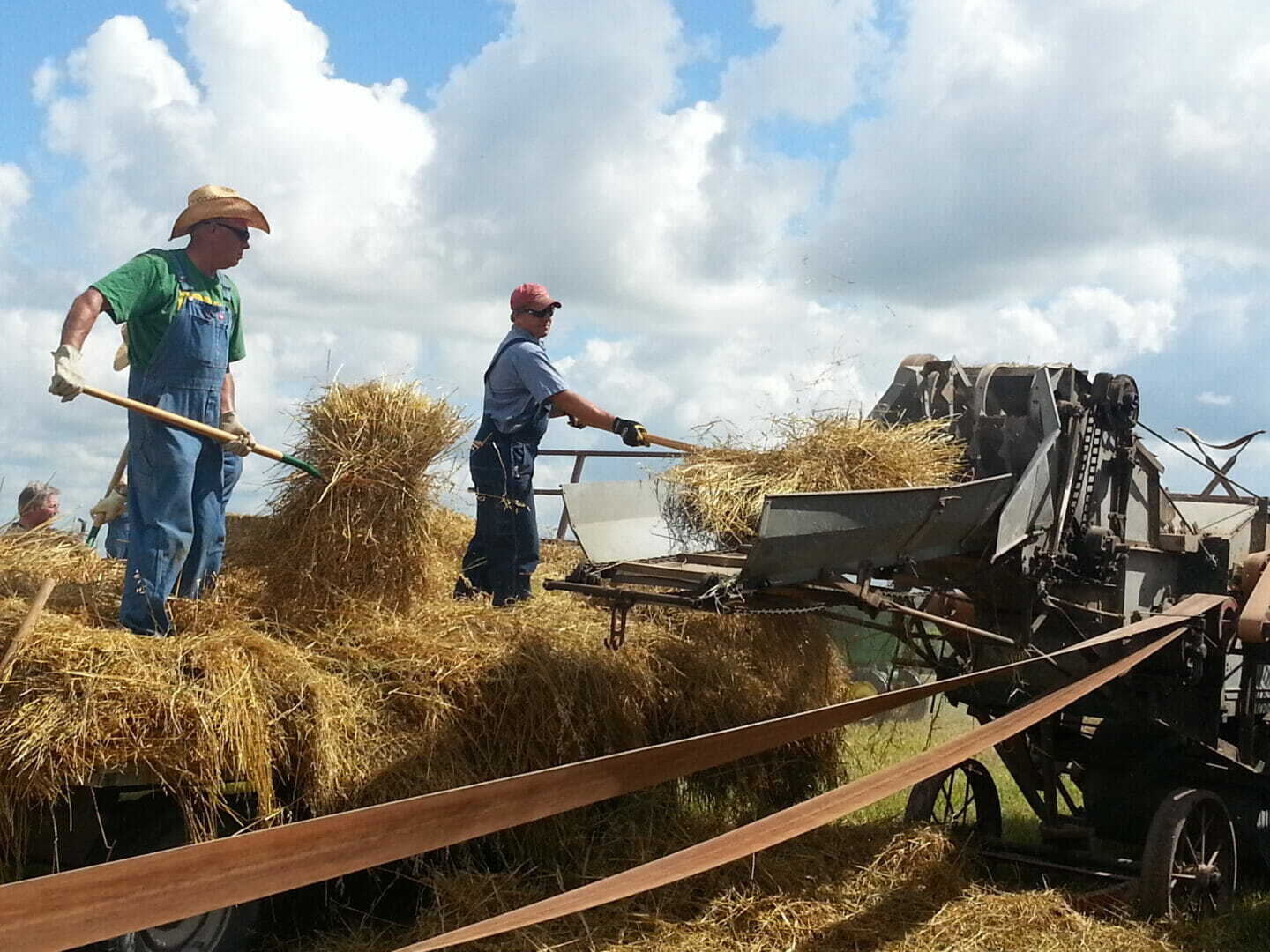
    As my wife, Janice, and I drove to into the lane, a nice A John Deere was popping away and singing on two cylinders. It was attached by a long belt to a threshing machine. This machine is like a stationary combine, separating the grain from the rest of the oat plant. The difference is that oats must be fed into the threshing machine, by hand, from a flat rack.

    20140830_145823

    Preparing for threshing requires advanced preparation. The oats are first cut and put into shocks, which are bundles of plants tied together, days before. The shocks are then picked up by hand and put on flat racks, which are four-wheeled wagons that are pulled beside the thresher. The bundles are then thrown onto a conveyer with a pitch fork and conveyed into the thresher to be separated.

    In the three hours that I was watching the threshers, less than 100 bushels of oats went into the wagon. Remember, this was just the threshing part. Hours were spent in advance, cutting and shocking the oats. Consider this… A modern combine can do ALL of these steps and harvest about the same amount of grain in 10 minutes!

    Charlie Norris and his family had some other older machinery lined up around the field. Janice and I took a nice trip down memory lane, reminiscing about the “good old days.” We looked at outdated equipment like moldboard plows and small field cultivators, which were used to turn the soil black when I was a kid. (Today we leave crop residue on top of the soil to keep it from blowing away or washing away.)

    I also saw many older John Deere tractors like the ones I used when I started farming in the 1970s and couldn’t help but think of all the advancements that have been made. The technology we use today has made farming so much less labor intensive – and safer. The hard labor and dangerous equipment used in the “good old days” played a large role in many farm kids getting an education and moving to the city for better pay, better hours, and not all the manual labor!

    Thanks to new technology, many 30- to 45-years-old and are either returning to their rural roots or moving to rural areas for the first time. They’re bring high skill sets, such as college degrees and master’s degrees, and have a career path in place with outside connections.

    Why the rural rebirth? Come see for yourself! A fall harvest bloggers tour, like we host in Franklin County, is a great way to see modern day farming in action. I’m on the planning committee for it this fall, so let me know if you’re interested in attending, even if you don’t blog. You can also learn more about modern farming by following along daily with the Iowa Food & Family Project. And, of course, you can always ask me questions!

    Larry Sailer, Musings of a Pig Farmer

    September 2, 2014
    Agriculture, General, Industry News
  • Latham Hi‑Tech Seeds

    To Appreciate Farming Today, You Must Know History

    Loaded corn 1939
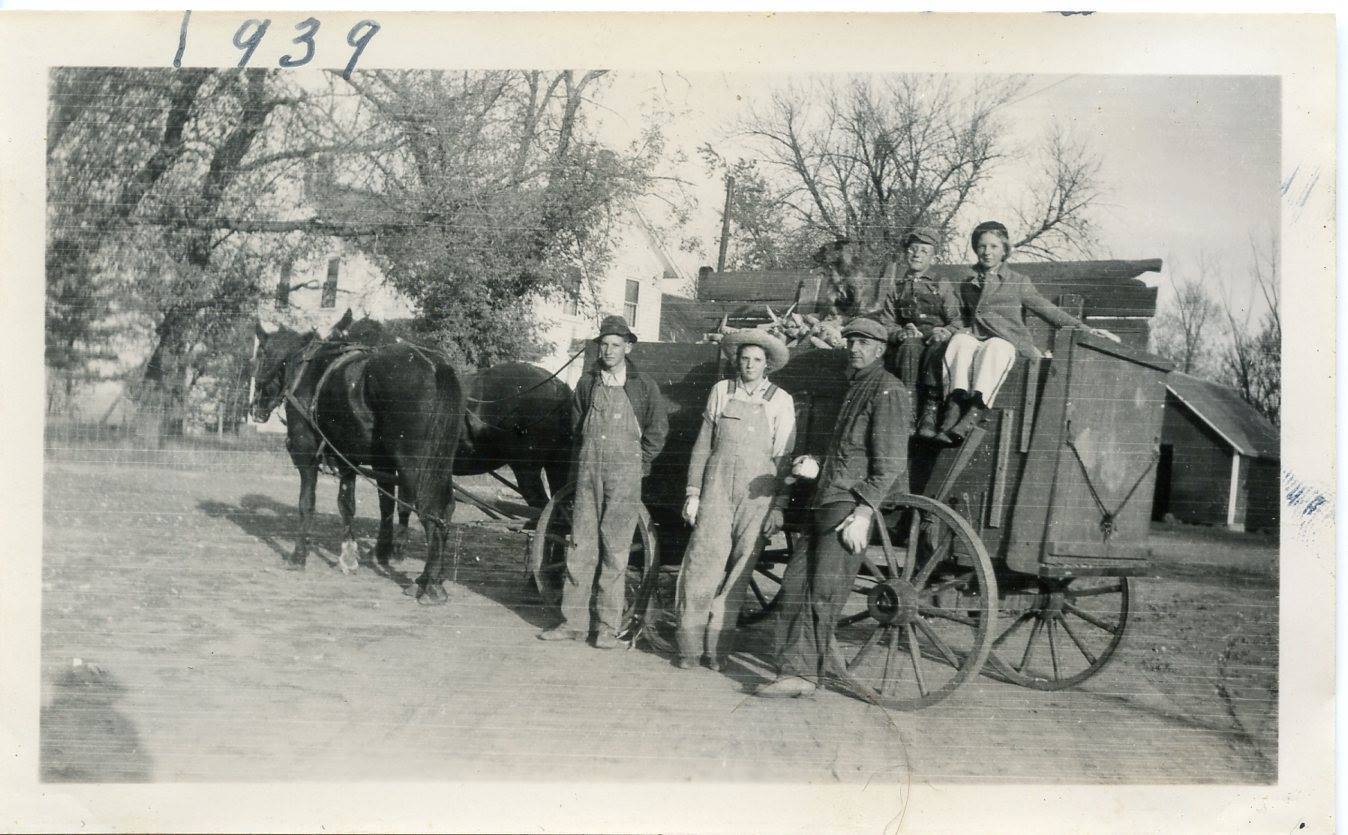
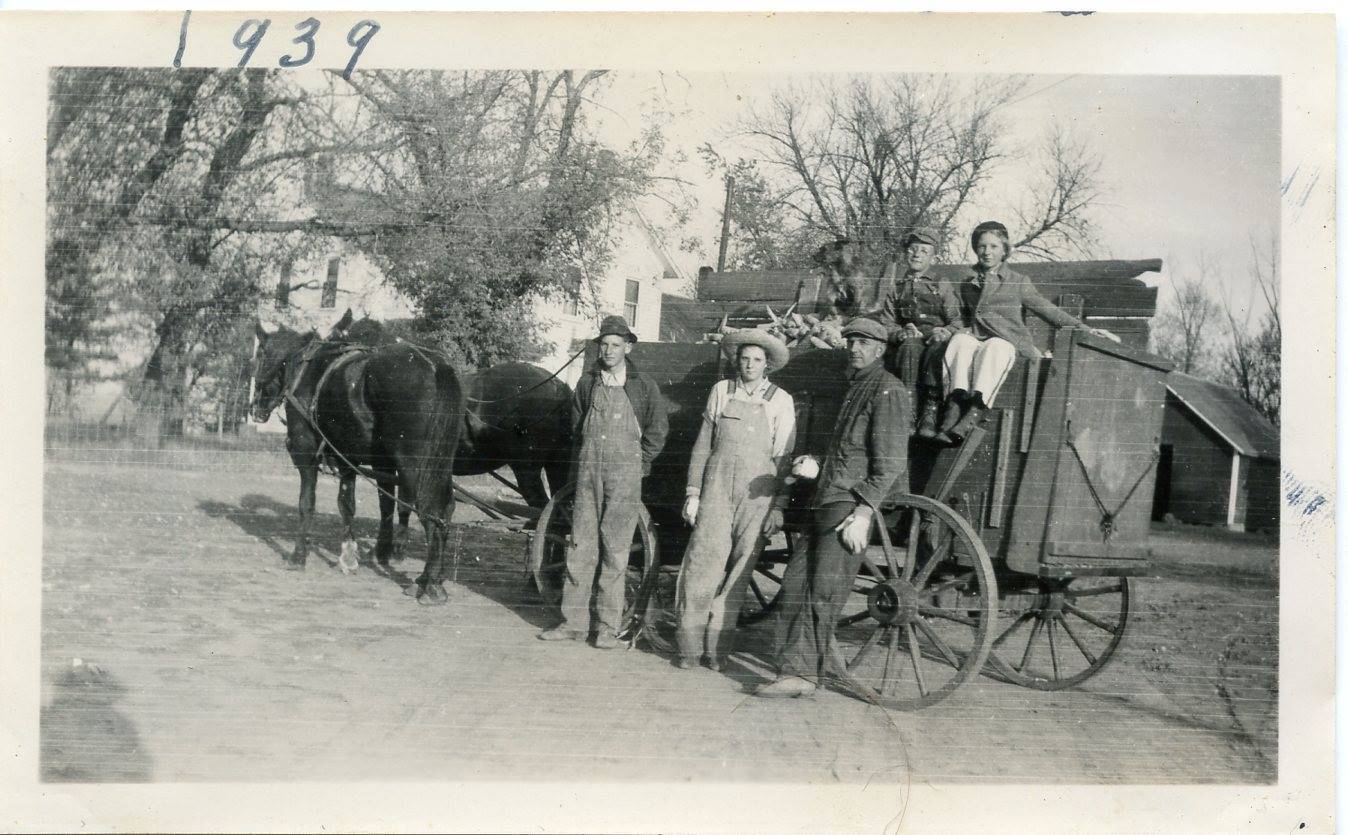
    It took an entire family to bring in a load of corn back in 1939. Janice’s grandpa, Fred, is leaning against wheel. Her father is pictured next to him. Just imagine the manual labor involved!
    It took an entire family to bring in a load of corn back in 1939. Janice’s grandpa, Fred, is leaning against wheel. Her father is pictured next to him. Just imagine the manual labor involved!

    Have you ever wondered what farming and our food system would look like if we farmed the way we did in “the good old days“? I found myself thinking about this topic as I had lots of windshield time to reflect while driving to the 7 meetings I attended last week. (So much for winter being the farmers’ meeting season!)

    Every time I tried to decide how others would perceive farming in the good old days, I got hung up. When were the good old days?

    Many folks believe farming was simpler before technology… but which technology? Technology has a different definition, depending on a person’s occupation or personal experience. Some might define the “good old days” as the time before we planted genetically modified crops. Others might define it before the advent of equipment like GPS and tractors with tracks instead of tires.

    no-tillYet today’s equipment allows us to better manage our land, reduce soil compaction and implement practices like minimum tillage. Today’s farming advances, such as herbicide application and genetically modified seeds, are the most talked about today. But why? What people do not understand, they often fear. Those oppose new technology capitalize on “fear of the unknown.” Fear is used to discredit new technology.

    To understand agriculture today, we must know where it has evolved from. In 1790, 93% of the population of the United States was rural, most of them farmers. By 1990, barely 2% of our population farmed.

    “The agriculture we have today in the United States is unique,” writes J. Paul Lilly, Associate Professor Emeritus, Department of Soil Science, North Carolina State University. “No nation has ever had so few people actively farming. This is a profound social change that has isolated most people from rural life and from an appreciation of the complexities and uncertainties of food production.”

    As a young farm boy, I remember the many different types of crops and livestock we raised that provided food for our own family. We had dairy cows, beef cattle, hogs and chickens. I’ll never forget that goose that chased me and bit me in the belly or the sheep buck that nailed me in the rear as I carried two, 5-gallon pails of feed!

    I remember farrowing pigs under flat racks in the pasture. (I could have been a track star because I had plenty of “training” as I ran to jump on the hay rack before a sow, protecting her baby pigs, could catch me!) I trekked several miles, walking soybean through fields and pulling weeds before the advent of Roundup Ready Soybeans. I learned to drive the “70” John Deere on the hay baler when I was six!

    I could go on and on about “the good old days,” but I think you get the picture. Farming was a lot of hard, manual work back then. I’m still not sure how or why I survived, except maybe I was still needed to write this blog! I’m not saying that farming is not hard work today, but it’s a different type of work. We farm in a way that is safer and smarter. We also know a lot more about the need to fertilize (feed) plants, as well as protect the water and soil.

    In the “good old days,” we plowed the fields until they were black. Farmers took pride in the fact that you couldn’t see a corn stalk when they had finished field work. Why was this a source of pride? The herbicides available then didn’t work if they were diluted by organic matter, or corn stalks. The equipment used then to make a seedbed plugged if the corn stalks were not completely buried. Planters at that time couldn’t plant uniformly if there were stalks, dirt clods or if the ground was uneven. We plowed, disked and field cultivated until that ground was powder.

    This was back before we had terraces, buffer strips, or practiced contour farming. As a result, it was common to see road ditches full of black soil and streams full of silt. With black tillage, there wasn’t much room for wildlife to hide. I remember only seeing a deer one time as a young boy. That’s not the case today as wildlife has made a huge comeback. Every time I drive home after dark now, I’m watching for the next deer on the road. It’s not uncommon to see eagles soaring either.

    The chemicals we use today are so much more environment friendly, too. When I started farming, it was a problem getting rid of all the pails the chemicals came in because we measured chemicals in gallons. Now we measure in ounces!

    Minimum tillage and no till, made possible by new technology including Roundup Ready corn and soybeans, have made this comeback possible. New seed genetics allow crops to withstand conditions that the crops of my youth wouldn’t survive. They have better stalks and better roots. Today’s crops can withstand dry weather, insects, disease and just plain yield better.

    When I think of all the new technology being developed today (drones, GPS, crop genetics), I’m even more confused about how to define “good old days.” Perhaps the best answer is the original garden… but even then, there was that darned old apple tree!

    Larry Sailer, Musings of a Pig Farmer

    August 26, 2014
    Agriculture, General, Industry News
  • Latham Hi‑Tech Seeds

    Curious about #RealPigFarming?

    Image001

    Consumers continue to have questions about how pigs are raised, and no one knows the answers better than real pig farmers, says Claire Masker.

    Claire Masker
    Claire Masker

    As public relations manager for the National Pork Board, Claire’s main responsibilities are to create positive outreach materials for the U.S. Pork Industry and Pork Checkoff programs. Last month Claire invited me to talk about #agvocacy with a pioneering group of pig farmers from across the nation, who are participating in The Pork Checkoff’s new social media outreach program through #RealPigFarming.

    “We want to empower producers to have meaningful, impactful conversations on social media with consumers about what happens on their farms,” explains Claire. “The hashtag (#) before Real Pig Farming helps people search social media posts with the same phrase, making it easier for them to follow conversations.”

    #RealPigFarming brings together pig farmers, academics, youth, veterinarians and allied industry members to discuss key topics in modern pork production. Everyone with a passion for agriculture or a positive story to share about real pig farming is invited to use the #RealPigFarming in status updates, tweets, Instagram photos, blogs, vlogs and other social media updates. Visit www.facebook.com/RealPigFarming, or follow @RealPigFarming on Twitter.

    Claire, showing at the fair.
    Claire, showing at the fair.

    “I have a passion for helping farmers and those involved in the food and agriculture industries tell their story,” says Claire. “We have a great story to tell about what farmers are doing to raise food for neighbors. As Kid President says ‘Create something that will make the world awesome,’ and I like helping farmers show the world all the awesomeness they create every day on their farms.”

    Claire also puts #RealPigFarming into action. You can follow her on Twitter @ClaireMasker and on Instagram @ClaireMasker. Growing up the second of five kids on her family’s farm in Neola, Iowa, she always has a story to tell.

    “My siblings and I had the ‘opportunity’ to work on our family farm. We raised row crops, cattle, hogs and sometimes had chicken and turkeys.I’ve done just about every job on the farm from walking beans and scooping out bunks to feeding livestock. I’ve also tried my best to operate a tractor and grain cart. There were times that I was jealous of all my ‘city’ friends. Now I look back at everything I learned and realize how blessed I am. I learned about hard work, as well as learned to respect animals and the land.”

    After graduating from high school, Claire attended Iowa State University where she earned a bachelor’s degree in Agriculture Education – Communications Option and Animal Science. She also earned a Masters of Science in Agriculture Education. While earning her masters, Claire worked for the U.S. Pork Center of Excellence. She then went to work for the Iowa Corn Growers Association and the Iowa Corn Promotion Board as the communications manager where she managed the I-LEAD program and assisted with the Collegiate Advisory Team.

    Today Claire is promoting the industry she loves by sharing one of her family’s favorite #pork recipes with us. Enjoy this recipe and remember to #ThankAFarmer! If you’d like to learn more about #RealPigFarming, here are links to a few blogs that I enjoy following:

    • Musings of a Pig Farmer
    • Corn, Bean, Pigs & Kids
    • Food & Swine

    Larry Sailer, Musings of a Pig Farmer

    August 22, 2014
    Agriculture, General, Industry News
  • Latham Hi‑Tech Seeds

    Regardless of Perception, Do What’s Right

    Sick pen

    In the past, I’ve written before about how people have different perceptions of farming based on their background and experiences. I’m bringing it up again because perception is becoming a very important word in the food debate. Just the other night, I heard someone say that our food is too cheap and that’s causing us to make poor food choices. The last I heard, 6.6% of American’s disposable income is used to buy food. That is much cheaper than any other country, but is food really too cheap? I’m sure a young, single mother trying to feed her kids will have a different perception of food costs!

    Animal welfare is another area where perceptions often vary. The group of pigs I am now taking care of, are not the healthiest pigs I’ve had. Because of PEDV virus, it has taken an entire month – and 8 semi loads – to fill the barns. The first two deliveries brought me pigs that were very uneven in size, but the pigs appeared healthy enough. When I unloaded the last bunch of pigs, however, I knew immediately that I was going to have problems because I recognized symptoms of the PEDV virus.

    After spotting symptoms of the PEDV virus, I moved this one to the sick pen for individual treatment.
    After spotting symptoms of the PEDV virus, I moved this one to the sick pen for individual treatment.

    This is a bad situation for so many reasons. First of all, receiving three different loads of pigs makes it difficult to reach of goal of being “all in, all out.” This means all the pigs from the same source come to us at the same time, at the same age, at approximately the same size, with the same disease pressures. Because they basically have the same needs, they’re ready for market at the same time.

    The last two weeks have been rough because that third shipment of pigs brought sickness into my barns. I’ve been busy treating pigs individually with a syringe. With some extra care – combined with all the feed they want, plus fresh water, and the ideal temperature and fresh air – these pigs are getting healthy again.

    Now there is a perception that raising pig indoors isn’t the best way. Some folks believe pigs should be rooting around outside, but I can tell you from experience that my hog barns have kept these little pigs very comfortable as I treat them. Regardless of how or where a pig is raised, there are always going to be some that get sick and die. It’s just a fact.

    Ever since I’ve been raising pigs, I have tried my best to save every one. Sometimes no amount of treatment will ever heal an animal, so farmers must decide how we’re going to handle the situation. Should we let the poor animal suffer until it dies a natural death, or should we take it out of its misery?

    It’s very difficult to watch an animal suffer, knowing there’s nothing you can do to help it. That’s why I don’t! When a pig is suffering and has not shown any improvement within 48 hours, I do euthanize that pig in the most “humane” way possible. I believe I must do what’s best for the animals in my care – regardless of others’ perception.

    Larry Sailer, Musings of a Pig Farmer

    August 19, 2014
    Agriculture, General, Industry News
  • Latham Hi‑Tech Seeds

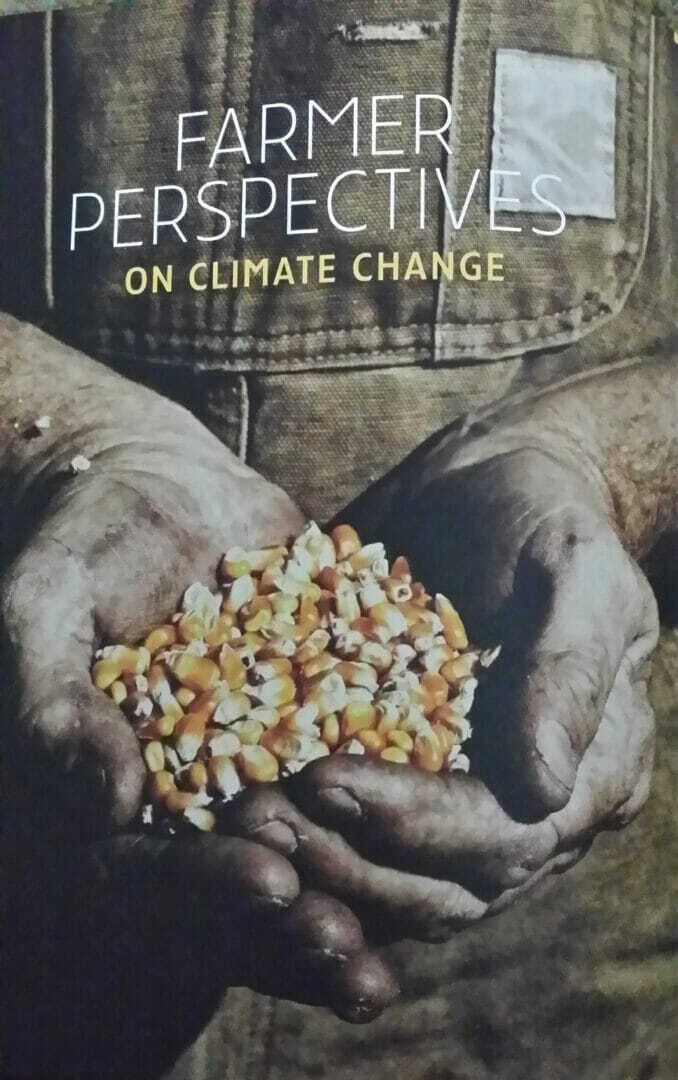
    Sustainable Corn Project

    20140811 230958

    20140811_230958Sustainable and sustainable agriculture can mean different things to different people. So can “climate change.”

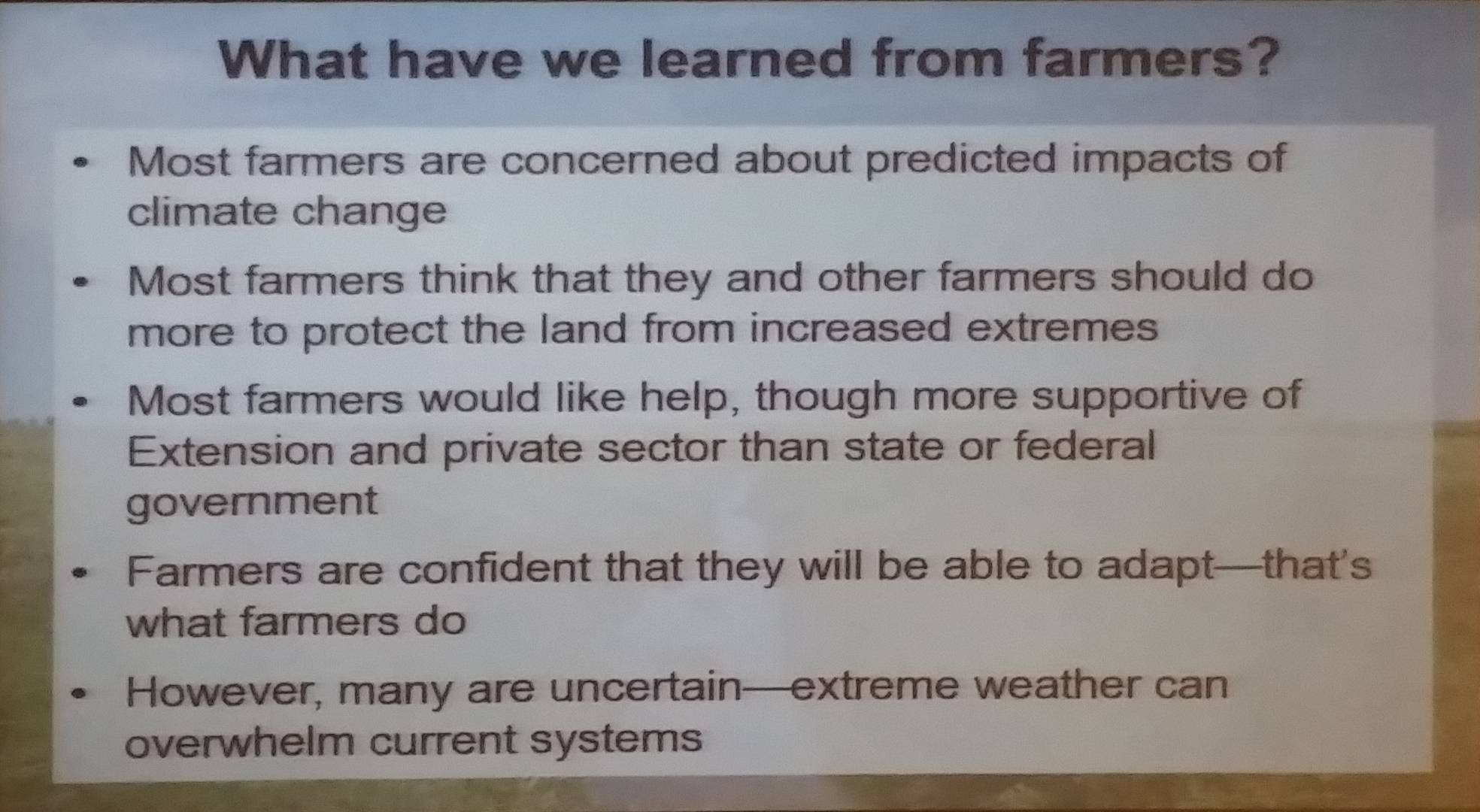
    Last week I was invited to a three-day conference entitled, “Resilient Agriculture: Adapting to a Changing Climate.” Honestly, my shackles went up when I read “changing climate.” I believe the climate is always changing, but unlike the opinion column printed Aug. 9 in The Des Moines Register, I don’t believe agriculture is destroying our environment.

    The Register’s opinion page makes it sound like nothing is being done to protect our air and water, as well as prevent our top soil from washing away. Anyone who attended last week’s conference, however, can tell you that’s simply not the case. Massive amounts of research is underway to raise corn more efficiently, which will be a huge benefit as we strive to feed a growing world.

    The Sustainable Corn Project is moving new technology forward at an amazing pace. I compared this type of research to the space program. I’m not sure going to the moon helped mankind much, but the technology from the race to the moon certainly did.

    20140806_103202Likewise, researchers are studying ways to apply nitrogen and other fertilizer so nutrients are applied when the plants need it. I learned about an app has been developed to tell me when and how much nitrogen my crop needs. This will result in plants getting more “food” and less fertilizer will up in the Gulf. Win-win.

    New computer apps, as well as new machinery and new plant genetics, will make huge changes in how we farm. Drones and powerful cameras will give farmers tools to see what’s happening in fields, and tell us when and how much water or plant food or treatments the crops will need.

    It took three days to present all of the new technology during this conference, so I don’t have the time or space to go into in today’s blog. Fortunately, the conference was recorded and should be accessible online soon at sustainablecorn.org.

    20140811_230854 I listened during last week’s conference and came away with some outstanding information. I wasn’t alone. Researchers and scientists from most land grant universities, research companies, conservation groups, and new startup companies also were in attendance. Even companies like Pioneer, Monsanto, John Deere and groups like the United Soybean Board were involved in last week’s conference. It appears this USDA project is meeting its goal of working with farmers, teachers and students to find agricultural practices that:

      • are resilient in times of drought;
      • reduce soil and nutrient losses under saturated soil conditions;
      • reduce farm field nitrogen losses;
      • retain carbon in the soil; and
      • ensure crop and soil productivity.

    Whether or not I agree with global warming, I can find common ground with these stated objectives. It’s going to take an industry coming together to meet them.

    Larry Sailer, Musings of a Pig Farmer

    August 13, 2014
    Agriculture, General, Industry News
  • Latham Hi‑Tech Seeds

    Charity Steer Show Sets Fund-Raising Record

    Steer
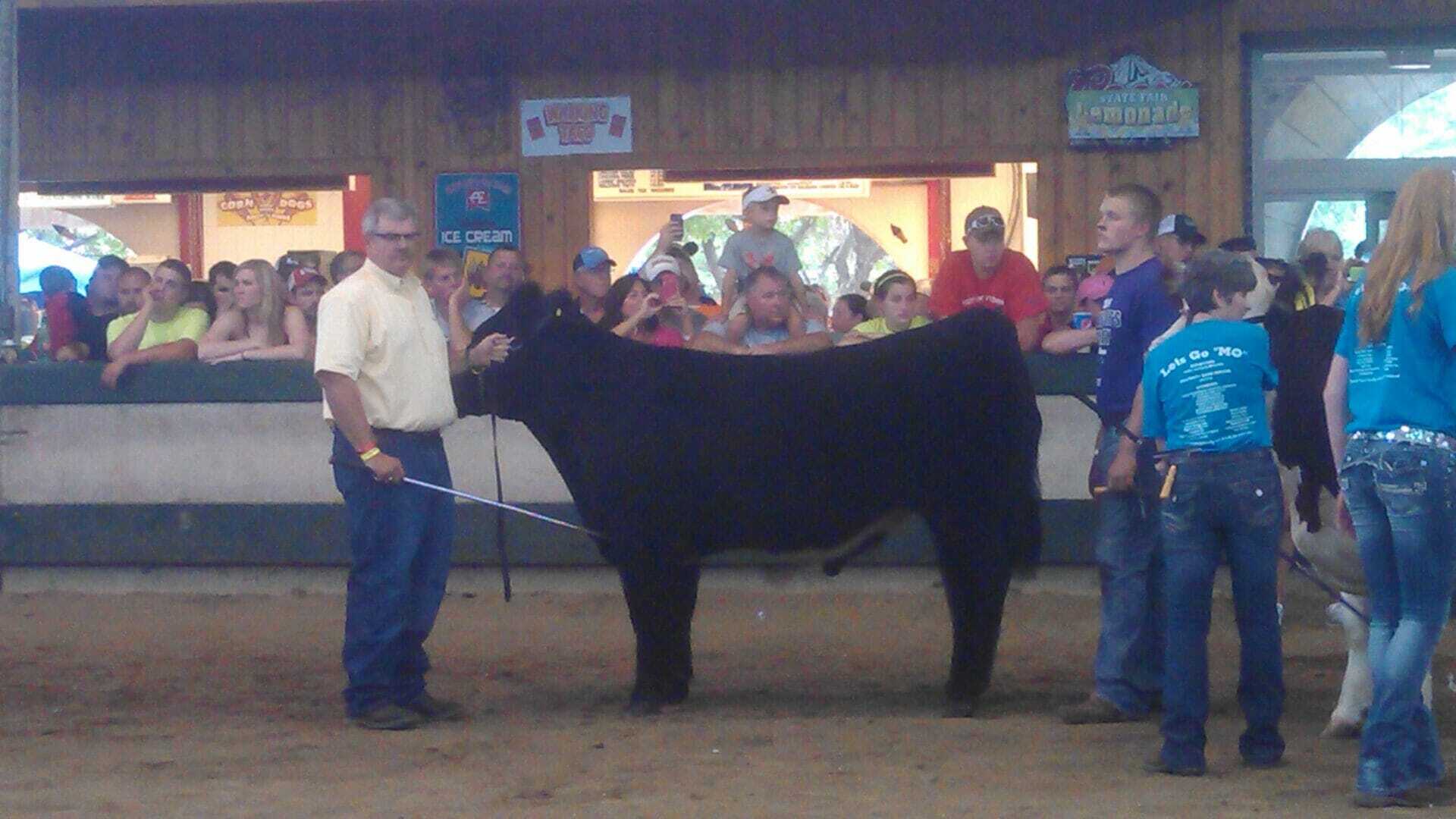
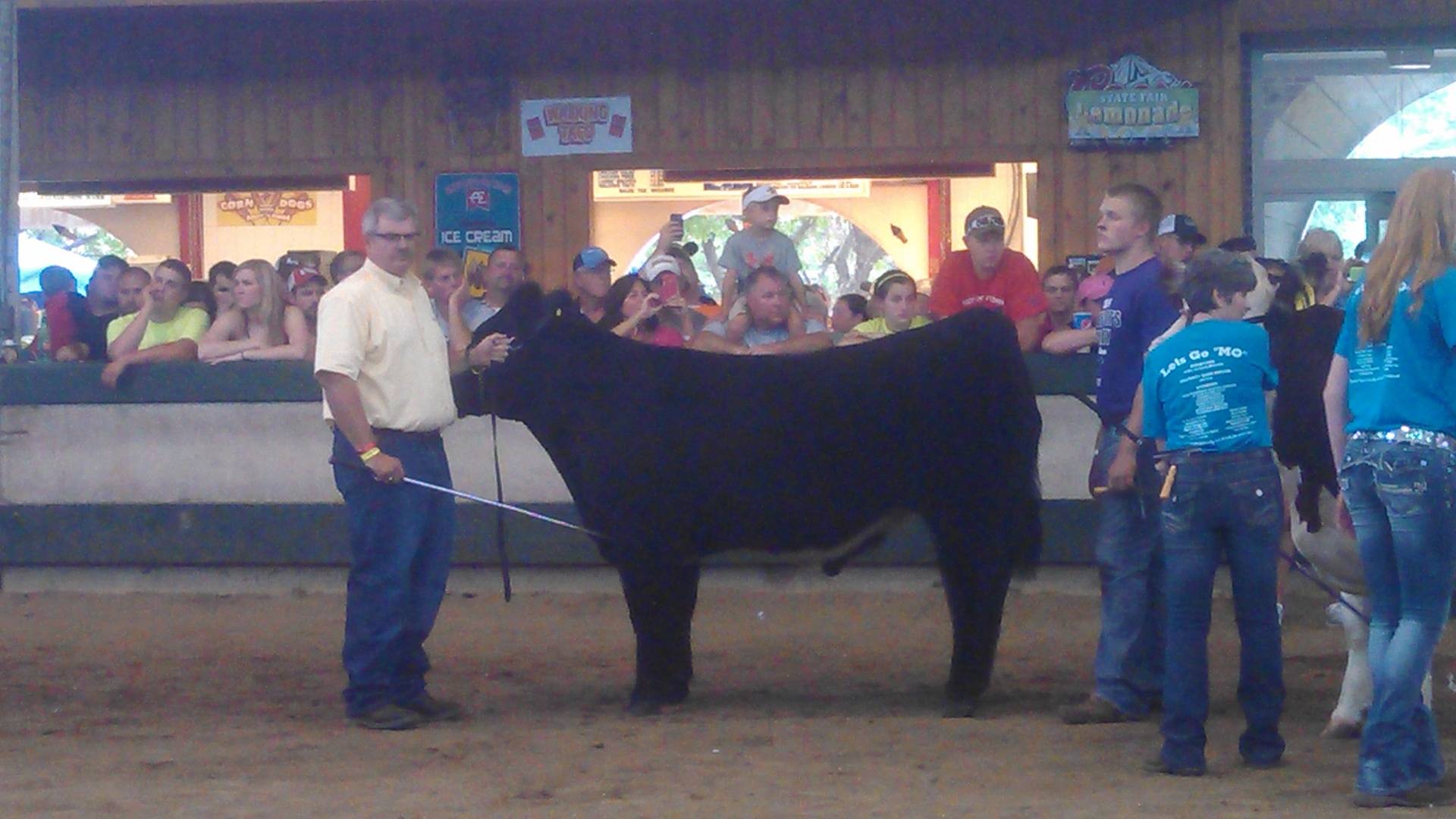
    The Iowa Governor's Charity Steer Show set a money-raising record Saturday for Ronald McDonald House Charities, which serves families whose children are hospitalized with serious health issues in one of these three Iowa cities: Sioux City, Des Moines and Iowa City.
    Photo Courtesy of: Iowa Cattlemen’s Association & the Iowa Beef Industry Council.

    Records were made to be broken, and a fund-raising record set last year was shattered Saturday during the Iowa State Fair.

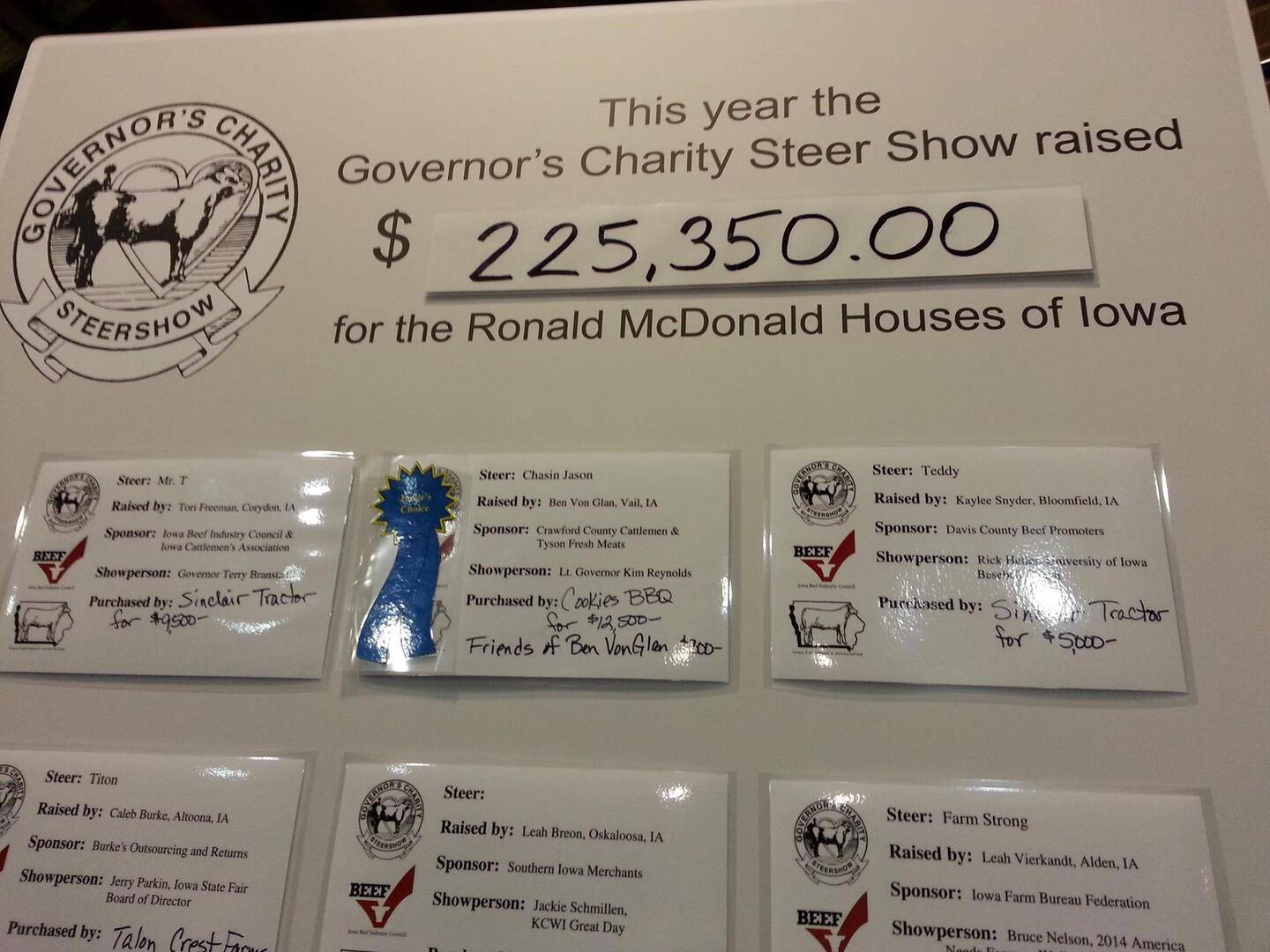
    The 2014 Iowa Governor’s Charity Steer Show raised $225,350.00 for Ronald McDonald House Charities, which serves families whose children are hospitalized with serious health issues in one of these three Iowa cities: Sioux City, Des Moines and Iowa City. Money raised at 2014 show and sale bested last year’s record of $183,000. More than $2.2 million has been raised for Ronald McDonald Houses of Iowa since 1983 when Gov. Terry E. Branstad first joined forces with the Iowa Beef Industry Council to sponsor the Governor’s Charity Steer Show.

    Youth and celebrity participants for the 2014 show follow:

    Steer Owners Shown By
    Tori Freeman, Corydon Governor Terry E. Branstad
    Ben Von Glan, Vail Lt. Governor Kim Reynolds
    Kaylee Snyder, Bloomfield Rick Heller, University of Iowa Baseball Coach
    Caleb Burke, Altoona Jerry Parkin, Iowa State Fair Board of Directors
    Leah Breon, Oskaloosa Jackie Schmillen, KCWI Great Day
    Leah Vierkandt, Alden Bruce Nelson, 2014 ANF Wall of Honor Recipient
    Garrett Longnecker, Ames Dr. Rob Denson, President, DMACC
    Kole Kimberley, Maxwell Sandy Hatfield-Clubb, Director of Athletics, Drake University
    Tanner Knupp, Washington Mike Pearson, host of Market to Market
    Taylor Lekin, Toledo Scott and Cora Lahr family
    Libby Janssen, Wellsburg Dr. Bill Ruud, President, University of Northern Iowa
    Bailey Christensen, Adel Dr. Steven Leath, President, Iowa State University
    Landra McClellan, Armstrong Suzy Fife, Miss Rodeo Iowa 2014
    Kelli Wicks, Rockford Bill Northey, Iowa Secretary of Agriculture
    Max Teno, Albia Jessica VerSteeg, 2014 Miss Iowa United States
    Jacob Donohoe, Parnell Bob Sinclair, CEO, Sinclair Tractor
    Kendrick Suntken, Belmond Alan Brown, President, Iowa State Fair Board
    Kaitlyn & Kasidy Mohwinkle, Aplington Joni Ernst, U.S. Senate Candidate
    Carlee Ewoldt, Dysart Chris Soules, As Seen on the Bachelorette
    Katie Morris, Centerville Pete Miller, VP of Co-Product Sales, Grain Processing Corp
    Nicole Lange, Harlan Bob Bowman, President, Iowa Corn Promotion Board
    Taylor Noonan, Solon John Burchert, Owner, Iowa Chop House
    Dylan Madden, Alden Erik Wheater, WHO-TV Channel 13 News
    Korey Vogel, Granger Dr. Tim Collision, Collison Embryo
    Austin Waller, Bernard Carlee Kelly, Miss Teen Rodeo Iowa 2014


    Congratulations to Kendrick Suntken of Belmond, whose steer was selected during the 2014 Franklin County Fair for the Governor’s Celebrity Steer Show at the Iowa State Fair. Kendrick, wearing the purple shirt, is pictured here with Alan Brown, president of the Iowa State Fair Board, who showed his steer in last Saturday’s show.
    Congratulations to Kendrick Suntken of Belmond, whose steer was selected during the 2014 Franklin County Fair for the Governor’s Celebrity Steer Show at the Iowa State Fair. Kendrick, wearing the purple shirt, is pictured here with Alan Brown, president of the Iowa State Fair Board, who showed his steer in last Saturday’s show.

    Congratulations to all of the Iowa youth whose steers were selected for this year’s show! It takes a partnership between the youth, who raise and show these cattle, sponsors and buyers to contribute to such a worthy cause. Latham Hi‑Tech Seeds is proud to help sponsor the steer owned by Kenderick Suntken.


    RELATED ARTICLES:

    • 4-H Brought the Suntken Family Together
    • Welcome to the House that Love Built

    Team Latham

    August 11, 2014
    Agriculture, General, Industry News
  • Latham Hi‑Tech Seeds

    “Nothing Compares” to the Iowa State Fair

    IAStateFair3

    IowaStateFair_Header14Interested in learning where your food comes from? Visit the 2014 Iowa State Fair in Des Moines from August 7-17. Nothing else compares!

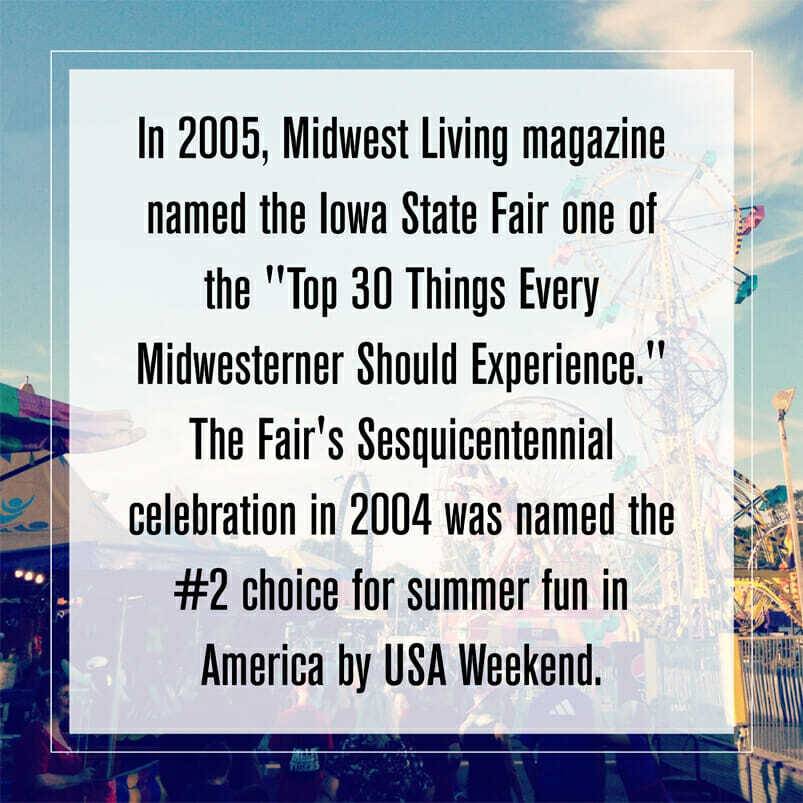
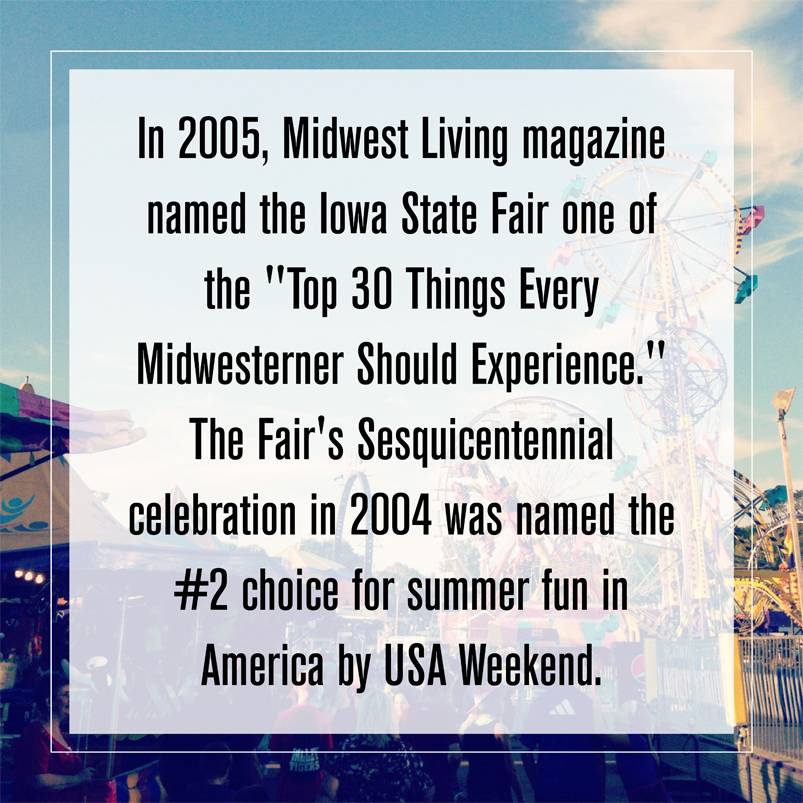
    Started in 1854, the Iowa State Fair hosts about a million visitors a year. It’s the single largest event held in Iowa each year. This event is well worth a google search… I learned things about “America’s classic state fair” that I did not know – and I’ve lived in Iowa for more than 60 years! There are so many things to see and do. If they held the fair every weekend of the year, you couldn’t see it all.

    Three movies, a novel plus a Broadway musical have been written about the Iowa State Fair. But the main reason I believe it’s so important to attend is because there are “real” farmers there! You can eat a pork chop on a stick, prepared and cooked by pig farmers, and then talk to them as you stand in line. These Iowa pork producers are willing to take time away from their farms to appear in public and talk with consumers about how they farm. Feel free to ask them how and why they raise livestock the way they do.

    What Farmers Grow, Makes Iowa Grow. Walk through the livestock barns and see how our young farmers are taking care of their animals. Stop and ask them questions because this is an opportunity to learn where your food comes from and how it’s raised.

    But if you’re looking for a farmer on the fairgrounds, just don’t look for an old man wearing bib overalls and a straw hat. Look for a young lady, who’s feeding her cattle. Walk through the aisles of goats to find out why show numbers are on the rise. Look for a young college student, studying the new machinery and technology on display. These are the people that will most likely be raising the food we will eat.

    Take a look at the machinery displays yourself and imagine – or better yet, ask – what these huge machines cost. Find out what these machines are used for and gain a better understanding of the decisions farmers face every day to remain competitive and to stay in business.

    IAStateFair3There are many informational displays about farming. Horticulture exhibits are on display inside the John Deere Agriculture Building. (Yes, raising flowers is farming.) Look at the veggies on display. Learn about honey and the bees that make it.

    New this year in this building is an interactive display called Farm with Us. Located in the John Deere Agricultural Building, Farm with Us will allow visitors to see growth stages of the plants and experience what a bushel of corn and soybeans looks and feels like.

    While browsing through the Agriculture building, be sure to view the butter cow. Each year approximately 600 pounds of pure cream Iowa butter are used to sculpt a life-size butter cow, measuring about 5 ½ tall and 8 feet long. Sculptor Sarah Pratt is also creating a sculpture this year to recognize the 25th anniversary of the Field of Dreams movie.

    Kids of all ages will enjoy the sights and sounds of the Iowa State Fair. Feel the squish of grapes between your toes during the Grape Stomp, which is held daily at 11 a.m., plus 2, 3 and 6 p.m. More Grape Getaway Kids’ Activities are held daily at 9 a.m. and 2 p.m. in a tent north of Grandfather’s Barn.

    In the Paul Knapp Animal Learning Center and Christensen Farms Hall, you can see real animals. Baby animals are born daily. Plus you can watch shows on stage, including my friend Rhonda Ross who performs her “Thank a Farmer” magic show that teaches young folks about farming and ag products. Did you know lipstick is made with by-products of pigs?

    You can even find me, working in Farm Bureau Park, if you visit the fair on Tuesday, August 12. I’ll be there all morning, sharing what I have spent my whole life learning and doing… farming! Farm Bureau Park is daily, and each day, different farmers volunteer to talk about their operations. You can learn about many different types of farming, so be sure to ask lots of questions.

    Another good place to ask questions about farming is the interactive exhibit hosted by the Iowa Food & Family Project inside the south atrium of the Varied Industries Building. Shannon Latham will be working at that exhibit on Friday, August 8, when the “Iowa Girl Eats” Kristin Porter autographs the popular “Let’s Cook” cookbook. You can meet Kristin this Friday from 1-3 p.m. and on Saturday, Aug. 16, from 10 a.m. to noon.

    There is so much to see and do at the Iowa State Fair. I hope to see you there!

    Larry Sailer, Musings of a Pig Farmer

    August 5, 2014
    Agriculture, General, Industry News
  • Latham Hi‑Tech Seeds

    What Farmers Grow, Makes Iowa Go! (Part II)

    Aaron-PutzeGuest blog post by Aaron Putze,
    Director of External Relations & Coordinator
    Iowa Food & Family Project, Iowa Soybean Association


    Few locations are more prominent and effective to engage the 98% of Iowans who don’t farm than the Iowa State Fair, which will be held Aug. 7-17 in Des Moines. For the fourth consecutive year, Iowa Food & Family Project, with a helping hand from the Iowa State Fair and nearly a dozen partners including Latham Hi‑Tech Seeds, will showcase the spirit of today’s agriculture and its daily relevance.

    “What Farmers Grow Makes Iowa Go!” is the theme of this year’s IFFP exhibit, located in the south atrium of the Varied Industries Building. It will feature the work of Greg and Brandi Glenn, 26-year veterans of sand sculpting and co-owners of Sandscapes®. The work of art will measure 20-by-24 feet, stand more than 12 feet tall, and showcase how food is grown and where it’s enjoyed.

    Many activities will reinforce these key themes including:

    • Watch the Glenns in action as they sculpt their farm and foodscape literally from the ground up. You’ll marvel at their creativity and skills.
    • Children will be invited to color and illustrate what farming means to them and receive a complimentary ice cream cone coupon redeemable at McDonald’s.
    • People of all ages can test their food and farming IQ courtesy of our ag spin game (every participant wins!).
    • Adults ages 18 and older who register to receive the Iowa Food & Family Project’s “Fresh Pickings” e-newsletter will be eligible to win great prizes including:
      • Casey’s Pizza for a Year
      • $500 Hy-Vee grocery gift card
      • Subway® sandwiches for a year
      • Farm-fresh pork, beef and turkey (valued at $1,000)
    • Finally, the Iowa FFP will join the Iowa State Fair and U.S. Department of Agriculture in sending fairgoers on a scavenger hunt throughout the fairgrounds to learn more about agriculture. “AgVenture” trail maps will be available at information stands located throughout the fair. Once completed, they can be redeemed for a special gift at the Iowa FFP exhibit.

    We look forward to engaging hundreds of thousands of fairgoers that will pass through the south atrium of the Varied Industries Building about how what farmers grow makes Iowa go. Be sure to stop by and say “hello.”

    Also remember that “Iowa Girl Eats” Kristin Porter and host of “Join My Journey,” will meet and greet fairgoers. She’ll be inside the south atrium of the Varied Industries Building to autograph the popular “Let’s Cook” cookbook. You can meet Kristin on Friday, Aug. 8, from 1-3 p.m. and on Saturday, Aug. 16, from 10 a.m. to noon.

    Other State Fair-Related Blog Posts:

    • State Fair Time, Time to Pat the Butter
    • Breakfast, Lunch & Dinner on a Stick
    • Get a First-Hand Look Where Food Comes From

    Team Latham

    August 4, 2014
    Agriculture, General, Industry News
Previous Page
1 … 40 41 42 43 44 … 95
Next Page

Latham Hi‑Tech Seeds

131 180th Street | Alexander, IA 50420

(641) 692-3258

SIGNUP FOR OUR NEWSLETTER
  • Contact
  • Legal
  • Dealer Center
  • Seedware Login
  • Latham Gear

© 2025 Latham Hi‑Tech Seeds. All rights reserved. | Iowa Web Design by Webspec | Privacy Policy

Latham® Hi-Tech Seeds is a trademark of M.S. Technologies, L.L.C., 103 Avenue D, West Point, IA 52656.