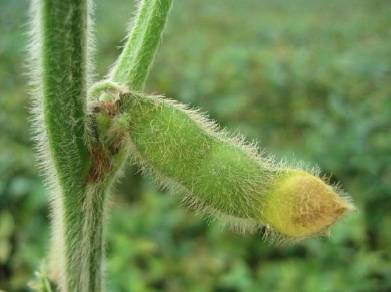
Through a series of weekly video blogs, Latham Forage Products Manager Corey Catt shows how corn has evolved through time. This week Corey shares how crossing dent and flint varieties has increased plant health over time. He shows how corn with purple husks and stalks is used as a marker in breeding plots, too.
Keep the grill fired up during football season. Whether you’re filling up the stadium parking lot with the aromas of grilled burgers and steaks or tempting guests with smoked beef brisket at home, beef is the perfect way to celebrate your team to victory!
Tailgating Tips:
Grill like a master:
Grill burgers and steaks over medium heat.
Check for medium heat by cautiously holding the palm of your hand above the grate at cooking height. Count the number of seconds you can hold your hand in that position before the heat forces you to pull it away; it’s approximately four seconds for medium heat.
Use a long-handled spatula to turn burgers and tongs to turn steaks.
Don’t press, flatten or pierce the meat as flavorful juices will be lost.
Remove beef from grill when temperature reaches 10° below desired doneness.
Beef continues to cook when removed from grill; allow beef to “rest” by tenting loosely with foil for 10 minutes.
Never leave food out of refrigeration for more than 2 hours. If the temperature is above 90 °F, food should not be left out more than 1 hour.
Keep hot food hot — at or above 140 °F. Place cooked food in chafing dishes, preheated steam tables, warming trays, and/or slow cookers.
Keep cold food cold — at or below 40 °F. Place food in containers on ice.
Plan your menu early. Do prep work a day or two before the game.
Chili, stew, meatballs, taco meat or brisket can be prepared the day before the game giving you more time to enjoy the tailgating festivities!
If you don’t want to haul the grill, make these quick and easy Beef Rollups the night before. They work great as an appetizer before or after the game or as a no-mess lunch. For added flavor, stir in ranch dressing, blue cheese or horseradish to the cream cheese.
Since you can’t predict the weather, do what you can to minimize your risk. Planting corn hybrids with a corn rootworm trait protect the corn plant’s root system better than soil insecticides do, particularly in a dry year. It’s like having an extra insurance policy in place. Beware, however, because not all traited hybrids are created equally!
Genetics make yield but traits protect yield. This season we certainly saw how different genetics handled stress from drought and wind. Roots and stalk strength were put to the test. That’s why genetic diversity is so important. Plant a portfolio of 4 to 6 different Latham® numbers for added protection.
As an independent, family-owned company, Latham Hi‑Tech Seeds is able to guarantee genetic diversity. Our independence allows us to provide farmers with an industry-leading number of product choices from provides including: Monsanto, Bayer, BASF, Syngenta, Dow AgroSciences and more. In addition to planting different genetics, you can further minimize their risk by planting various maturities.
In our 2013 product lineup, Latham Hi‑Tech Seeds offers 33 hybrid seed corn products with 6 different trait combinations for rootworm control in various maturities:
SmartStax, leading the industry with 2 modes of action against rootworm
VT Triple Pro
VT3
Herculex Xtra
Agrisure 3111 Viptera
Agrisure 3000 GT
Not all traited products offer rootworm protection. Herculex I, for example, has resistance/tolerance to Liberty, Roundup and corn borer. Herc 1, however, does not protect against corn rootworm. A person can’t just assume that a “Bt hybrid” will have rootworm protection.
Rootworm control is a must in corn-on-corn protection. You’ll see extended diapause in ground that has been rotated. In an area with heavy rootworm pressure, plant Latham hybrids with Genuity® SmartStax® technology. Look at dual modes of action and consider rotating crops in areas where rootworm pressure is extreme.
Because corn-on-corn acres are more susceptible to challenges presented by weather, soil and pest pressure, Latham has introduced the Gladiator designation to help with 2013 seed selection. They have the industry’s most advanced genetic foundation, offering powerful root and stalk strength and superior above- and below-ground insect protection. Latham’s Gladiator hybrids are developed to battle your field’s continuous corn challenges and win. Give them a try as part of your diversified 2013 crop plan!
Larry Sailer is constantly connected to ag news and market information via his smartphone, iPad, office laptop and piles of newspapers at home near Iowa Falls. Photo Courtesy of IFT Photo by Zoe Martin
AgriBabe… it’s a term I did not create. I’m even questioning whether I should even use it. Since I’m not one to turn tail, I’ll go ahead and explain why this term is even in my vocabulary now.
State Senator Sandy Greiner recently used AgriBabe in reference to an agricultural conference for women. She said, “I think Larry Sailer should come along to meet all the Agri-Babes!” Then she invited me to attend the American Agri-Women Convention in Denver, Nov. 8-10.
I’m seriously thinking about heading West after harvest! But it might be not for the reasons you think. After all, I’m happily married to a great Agri-Babe. [Love you, Babe! :)] The reason this particular conference intrigues me is because I try to learn all that I can to carry on conversations about agriculture with difference audiences. I believe the women at this conference will be able to provide a wealth of information and insight. Let me explain…
While traveling in various social media circles during the past three years, I’ve learned the vast majority of social media users are ladies in their twenties and thirties. I’m not sure why more of us old farmers don’t use social media more, but for one reason or other, Facebook and Twitter appear to be dominated now by women. I’ve become an active social media user because women, mainly urban consumers, are a target I’d like to reach with a pro-agriculture message. I’m trying to gain a better understanding of what’s important to them and how we as farmers can appeal to their emotions.
Emotions and perceptions often cloud common sense. What I think is “just plain common sense” is Greek to someone else. Even though most Americans speak English, it’s often challenging for us to be understood AND to understand what others are telling or asking. Watching online conversations can be intriguing because certain words have different meanings, depending on the region of the country in which a person lives. Sometimes these colloquialisms cause others to take offense, even when they weren’t meant to be offensive. Other times words have different meanings, depending on one’s religion.
I’ve witnessed misunderstandings as a result of miscommunication. It’s easy to see how this can happen online when people “sip” at conservations. Online communications, for the most part, can’t benefit from verbal intonation or facial expression. Emoticons may help, but they can’t replace the real thing. 😉
While I admit that more political correctness could be used in some cases, other times people us “PC” as a crutch. It seems to me a little common sense could go a long way to solving many of today’s problems. But common sense seems to be in very short supply these days, especially when people have an agenda to push or an office to be elected to! That’s why I believe it’s our civic duty as American farmers to engage in conversations that will help educate those running for office and those who are trying to influence public officials about our livelihoods. Agvocate!
Through a series of weekly video blogs, Latham Forage Products Manager, Corey Catt shows how corn has evolved through time. Last week Corey introduced us to wild teosinte, which originated in Mexico and dates back to 5,000 B.C.
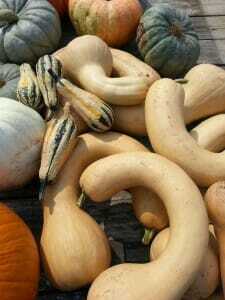
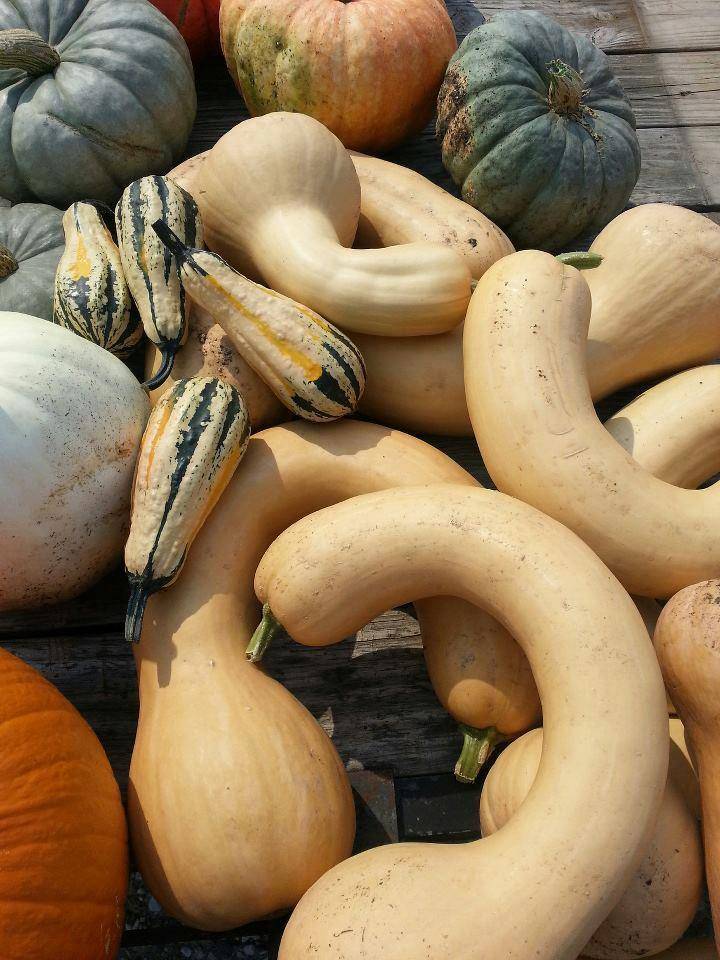
This week Corey continues his walk through time, showing how early corn varieties have been refined through many years of good breeding. Take a look – you might be surprised to hear him mention “gourd seed.”
September 16-22 is National Farm Safety and Health Week, which provides a great opportunity to talk with your family members and employees about what should be done if the “unthinkable” happens on your farm.
Every farm needs a “what if” plan that outline expectations and a protocol for people to follow should something go wrong. Here are a few tips to develop such a plan:
Establish a check-in procedure for workers in remote areas.
Have an up-to-date layout of your farm, including locations of any potential hazard to serve as a resource for first responders.
Train your family and employees on CPR and first aid.
Put address markers at field drives to help first responders find you.
Include the address of each field and farm site in every driveable piece of machinery, along with emergency phone numbers.
All family members, including children, can play a big role in knowing what to do in a rescue situation. By working together with your local emergency agencies, your neighbors, family members and farm employees, you can assure the best chance of survival and recovery from farm tragedies.
Last week Iowa House Ag Chair Annette Sweeney asked me to meet with her in preparation for meetings she has this week in Washington, D.C. To our meeting, she brought two coffee table books about Concentrated Animal Feeding Operations (CAFO). One of these books, simply titled CAFO, has been widely distributed to public officials. The other book, Welfare Ranching: The Subsidized Destruction of the American West, is a seven-pound book featuring 346 pages of articles and photographs by so-called expert authors and photographers.
Both books are extremely critical of modern day methods of farming and ranching. These books are so full of misinformation that I couldn’t even force myself to finish reading them! I was horrified by all of the misinformation that I was reading, and now I’m worried about the influence these books will have on uninformed individuals. People removed from the farm might take these books for fact.
One chapter the CAFO book is titled, “Old McDonald Had Diversity.” This chapter references the “diversified farms” of the 1950s and 1960s – it’s the image people have of farming by reading children’s books and watching movies. Old McDonald’s Farm and Disney productions, however, don’t portray modern farmers.
Unfortunately, people without a direct connection to farming often don’t see just how many improvements have been made. Most folks only know what they hear and see through the “mainstream media,” which typically doesn’t cover the whole truth.
The truth is I grew up on a diversified farm back in the fifties and sixties. Farming then wasn’t as “romantic” as some make it out to be. We raised lots of different animals, most of them outside. I remember the hardship those animals suffered during harsh Iowa winters, and we farmers worked to keep them from literally freezing to death. It was a real challenge to keep fresh, unfrozen water and feed for available for them.
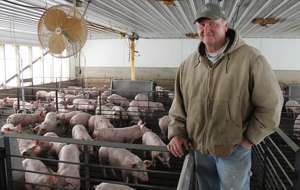
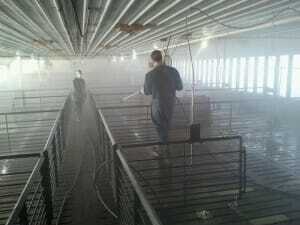
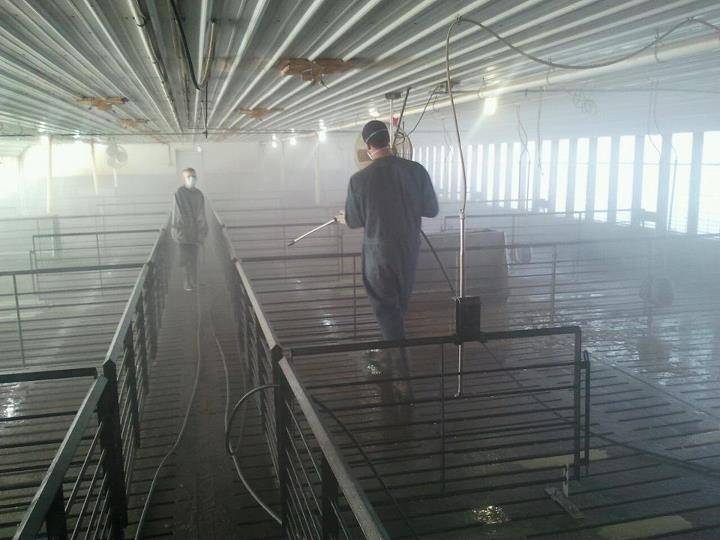
Fast forward that 50 to 60 years, and the hogs in my care are warm during the winter and cool during the summer. The temperatures inside my building do not vary more than five degrees, regardless of the outside temperatures. My pigs have all the fresh water they can drink and a diet that’s designed to be just what they need for their size. (Unlike the school lunch program!) My pigs are very content. When I do chores, they run around and bark. When I get close to a pen, they come up to greet me.
But, I don’t expect you to take my word for it. I’ll let you see for yourself! I’m starting a blog series that will follow a group of pigs from the time I get them, about 50 pounds, to when they are market ready around 290 pounds. I’lltry to show just what these pigs have for shelter and what it takes for me to take care of them. I do realize some may think I am doctoring up video to show a good side of farming, but I guess if the animal welfare people can show you what they want you to see, so can I. The difference is that I’m not sneaking around. You’re all welcome to come and see for yourself!
Whether you’re preparing to eat lunch in the field – like a corn field – or lunch in the parking lot – adjacent to a football field – preparations are much the same. With a little planning, you can enjoy a delicious meal in the great outdoors with family members and friends.
Coach Rhoads visited Latham Hi‑Tech Seeds in 2010 during our Freedom of Independence Ride in Ames. Here he is with Chris, Bill, Shannon and John Latham.
This Saturday will be “the main event” for many Iowans, who look forward to the annual matchup between the Iowa Hawkeyes and the Iowa State Cyclones. Kickoff is 2:30 p.m. on Saturday, Sept. 8. If harvest keeps you away from Saturday’s Cy-Hawk game in Iowa City, you can hear the play-by-play action from a local station or Cyclone Radio Network. Remember to stay tuned following the game coverage for theLatham Hi‑Tech Seeds Locker Room Show, where analysts, players and coaches share their thoughts after the day’s game.
In a state without a professional sports team, the Cy-Hawk Series is almost as important as the Super Bowl. It is the Super Bowl of Iowa!
Shannon Latham, Jim Heckman and Amy Rohe pose with Cy at the 2010 Freedom of Independence Ride.
Choosing which team a person will cheer for even divides families. During last night’s television news coverage, I heard about a household so divided that a couple named its firstborn Kinnick Trice. I’m guessing the lady of that house doesn’t serve up Cardinal and Gold Cheeseburgers. 🙂
Regardless of whether you’re cheering for the Cardinal & Gold or the Black & Gold, we’d like to help simplify your tailgating plans. Today we’ve compiled our best tailgating recipes:
I’m also including a new recipe for Tailgating Eggs, which I picked up at the Iowa State Fair. What’s your favorite tailgating fare? Please send your recipe to shannonl@lathamseeds.com.
More than 100 people donned rain suits and motorcycle boots for Latham’s Fourth Freedom of Independence on Saturday, Aug. 25. Rain began to fall as the first group of riders left for Latham’s atypical field day on wheels, but no one complained after a growing season plagued by drought.
The five-hour tour took riders across 90-miles through North Central Iowa where they visited three Latham® corn and soybean showcase plots. A walk through Latham’s “living museum of corn” demonstrated the differences between corn managed as it was in the 1930s compared to modern-day hybrids. Tour-goers also had a chance to see kernels of all sizes and colors, plus one ear as big as a Pringle® potato chips!
A highlight of the days was a stop at Hagie Manufacturing in Clarion where riders got a hands-on look at advanced manufacturing in Iowa. Interestingly enough, the Hagie’s family business got its start as a hybrid corn company and made history when Ray Hagie invented the world’s first self-propelled sprayer in 1947.
The ride ended with a complimentary hog roast catered by Wholly SmokeBBQ of Dows, Iowa. Thanks to all of the “die-hards” who made the 4th Annual Latham Freedom of Independence Ride another roaring success!
Remember to mark your calendars for the last Saturday of August 2013. Help us celebrate Latham’s milestone 5th Annual Freedom of Independence Ride in Loess Hills, voted one of Iowa’s most scenic motorcycle routes.
Larry Sailer is constantly connected to ag news and market information via his smartphone, iPad, office laptop and piles of newspapers at home near Iowa Falls. Photo Courtesy of IFT Photo by Zoe Martin
“Musings of a Pig Farmer” by Larry Sailer
Back in the 1980s, I became an agvocate. The term “agvocate” had not yet been invented, and I really had no idea what I was getting into at the time. I joined the Franklin County Pork Producers and the Franklin County Farm Bureau.
It wasn’t long before the Farm Crisis of the 1980s hit, and I knew farmers like me needed to tell our story. Unfortunately, I had no clue how to go about it! My first media interview was with farm broadcaster Von Ketelsen, and in hindsight, it’s a good thing it was with someone who is so “farmer friendly.” Most of my answers were either “yes” or “no.”
Over the past 30+ years, I have attended as many media training sessions as time allows. I joined the Farm Bureau Speaker Corps and Operation Main Street, a speakers’ corps for the National Pork Board. During a Farm Bureau training session about four years ago, I was introduced to Social Media. Our trainer, Zach Bader, explained how Twitter and Facebook could expand the number of people we could reach with our message.
Then I discovered AgChat! AgChat is a virtual chat room. This is a place where you can “attend” a meeting – unlimited by chair space. It allows you to connect with people from virtually anywhere and discuss ag issues. You can ask questions and get everyone’s opinion. (Take notice: I used the word “opinion” instead of “answers”!) If there’s one thing I’ve learned over the last 30 years it’s that there are a lot of opinions and not every question has a right or wrong answer. That’s why I firmly believe those of us in agriculture must be willing to listen, too.
The founding members of AgChat did what I think was an amazing thing. They started having seminars to help people like me learn how to use social media to have a conversation with the people, who either are no longer connected to the farm or never have been.
I attended the first agvocacy training session in Chicago in 2010 and was overwhelmed. Speakers were so passionate about sharing the great message of what we have attained on the farm. On Aug. 23-24, I attended the third AgChat training session in Kansas City. It’s amazing how far social media has come! This time I attended sessions on blogging, making videos (and even met the Petersen brothers) and using Pinterest. There is really no limit to spreading your message. Go ahead and give it a try… our livelihood needs more agvocates!