Latham Hi-Tech Seeds

(641) 692-3258

  • Home
  • Products
    • Corn
    • Soybeans
    • Alfalfa
    • Corn Silage
    • Seed Guide
  • Performance
  • Find a Rep
  • Media
    • Blog
    • News
    • Videos
    • Podcasts
    • TECHTalk
  • About Us
    • Company History
    • Our Mission
    • Careers
    • Become a Rep
    • Sowing Seeds of Hope
  • Contact Us
  • Latham Hi‑Tech Seeds

    Livestock Producers Demonstrate Effectiveness of Quarantine

    October is coming to an end, and I must talk about pork before it’s over!

    The last few weeks I have written how my mother-in-law’s 90th birthday celebration gave us a reason to look through old family albums and reflect upon the good old days. The Iowa DNR (Department of Natural Resources) recently released an historical aerial map photo project, dating to the 1930s.

    As I looked through these maps of old farmsteads, I noticed a difference in buildings. What an amazing look through history of farming! The buildings, like our equipment, have completely changed. We have gone from hand labor cleaning the barns to mechanization, from pitch fork to pumps to for manure removal. I can see how this natural fertilizer was applied to the fields by looking at these maps.

    In the past, manure was moved with horses so it most often got applied close to the building site. The soil tests taken when I started farming in the early 1970s proved this as the fertility around the buildings was sky high; the fields farthest away from the building site were very low in fertility. The manure was valued but not scientifically applied.

    Today’s pork producers understand the value in applying this natural fertilizer where it’s needed. Producers keep records of manure application, such as the method (injection, incorporation, etc.), date of application, field location, number of acres, and application rate.

    Just as we’ve developed more scientific ways of applying natural fertilizer and modern equipment technology now allows us to inject or incorporate the manure right into the soil, today’s pig farmers also have made great strides in controlling disease outbreaks.

    In the late 1980s, I was on the Iowa Pork board as chairman of the Feeder Pig Committee. It was decided that the pork industry would eradicate pseudorabies. Pseudorabies is an extremely contagious disease that causes reproductive problems, including spontaneous abortion, stillbirths and death losses in breeding and finishing hogs. While the disease is not a threat to humans and the meat from infected animals is not contaminated, pseudorabies can wipe out a herd. The financial impact from pseudorabies was huge for farmers, as well as for the state.

    Pork production generates billions of dollars annually for Iowa’s economy. Iowa pork producers raise more than 17 million pigs, or 28% of the nation’s pork supply. It goes without saying that eradicating pseudorabies was a huge undertaking!

    Veterinarians developed an eradication plan that was put into action. Because some areas of Iowa’s pork production were completely shut down, it was devastating to many pork producers. Feeder pig shows were especially hit hard, but it worked! A press conference was held in July 2004, declaring our state free of pseudorabies.

    Today Ebola is making the headline news. We know quarantines can be effective in stopping the spread of this disease, they cause hardships for medical professionals. In fact, some medical professionals might even avoid volunteering to help fight Ebola due to the quarantine.

    While it may not be fun or convenient, being quarantined for 21 days is an extremely small price to pay when you think about it! Livestock production has proved time and again that quarantine is an effective way of stopping the spread of deadly disease.

    Stopping the spread of Ebola is certainly a concern, and we don’t want it to become an epidemic. However, there are so many other problems this world: starvation, political unrest, terrorism, the right to life… Is anyone making a list and trying to put things in order of importance?

    Next week’s election is a good place to start showing your priorities! Then after the election, let’s keep the official’s feet to the fire. Talk to your elected officials at all levels, and let them know what you expect. Then remember to keep talking to them because bills get passed and regulations get made all year long.
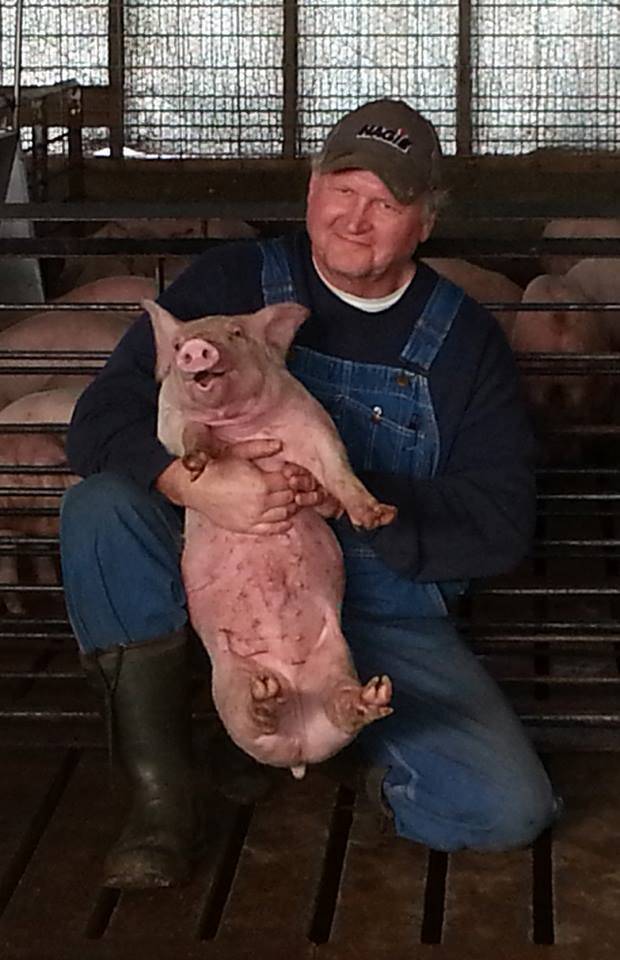
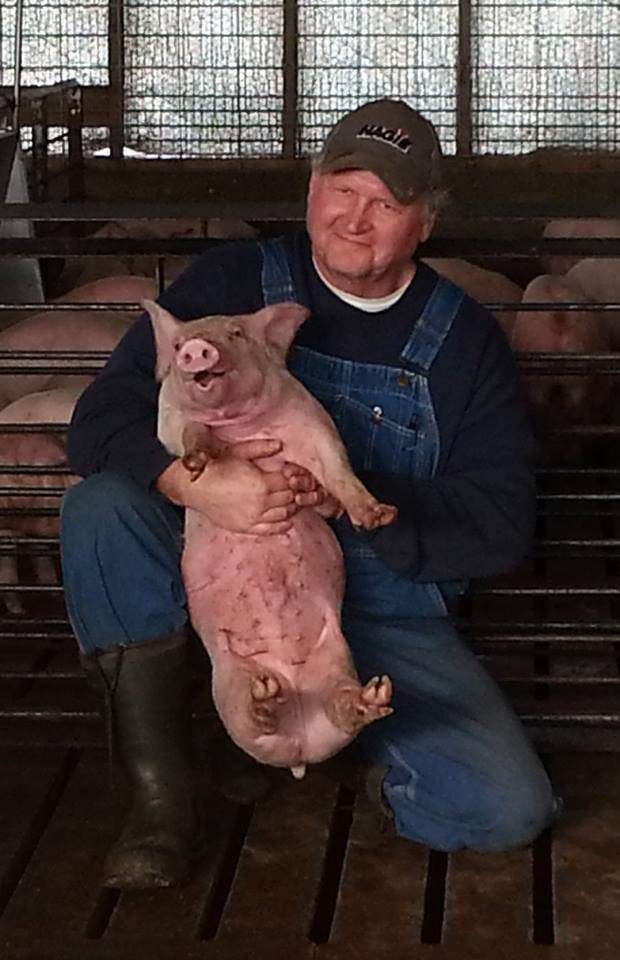
    Larry Sailer, Musings of a Pig Farmer

    October 28, 2014
    Agriculture, General, Industry News
  • Latham Hi‑Tech Seeds

    Revisit the Past, Gain Appreciation for the Present

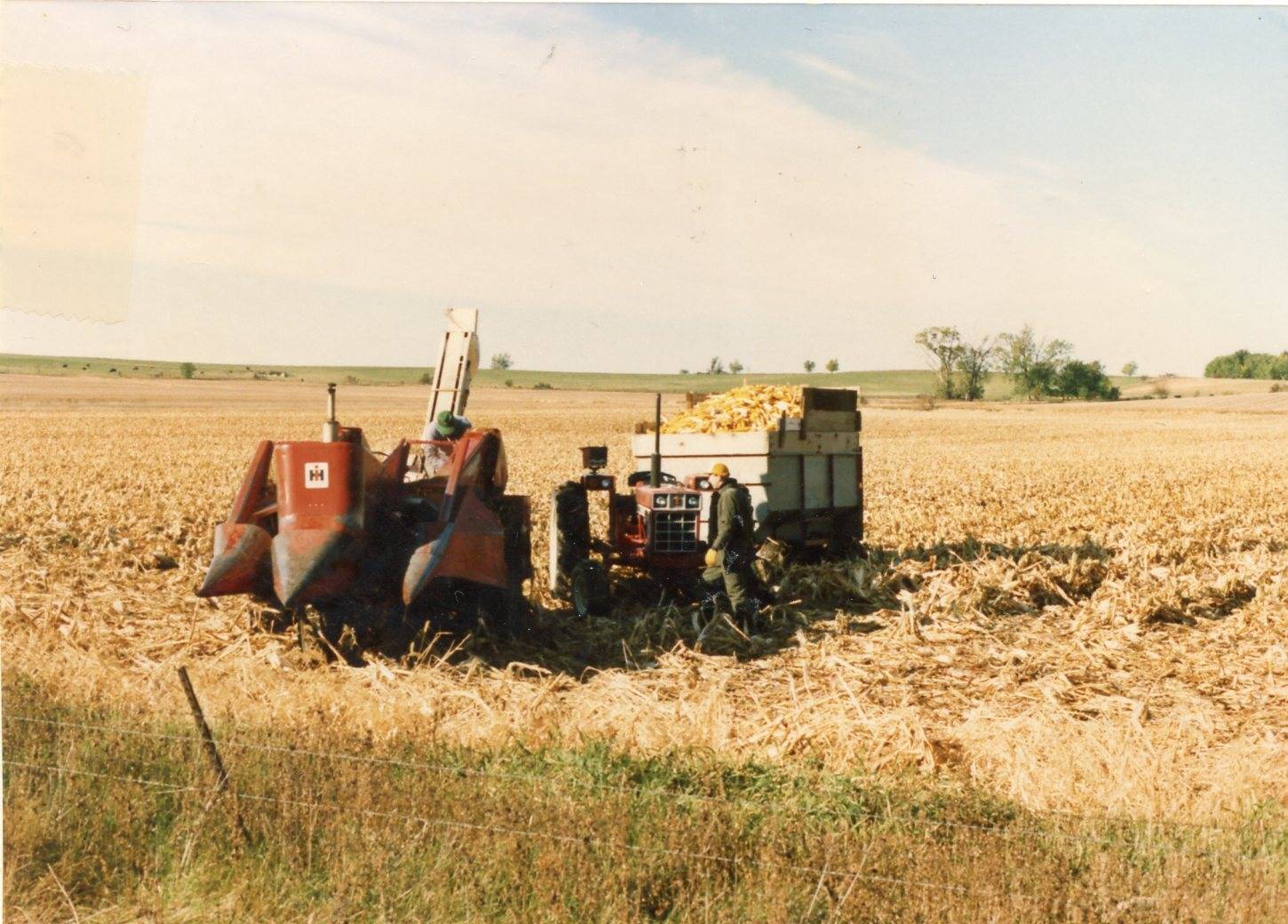
    LarryS PickingCorn Old

    This past week we celebrated my mother-in-law’s 90th birthday! My wife, Janice, conducted research and gathered photos to make a 22-minute video that showcased her parents’ lives – as well as told the story of farming – during the past nine decades.

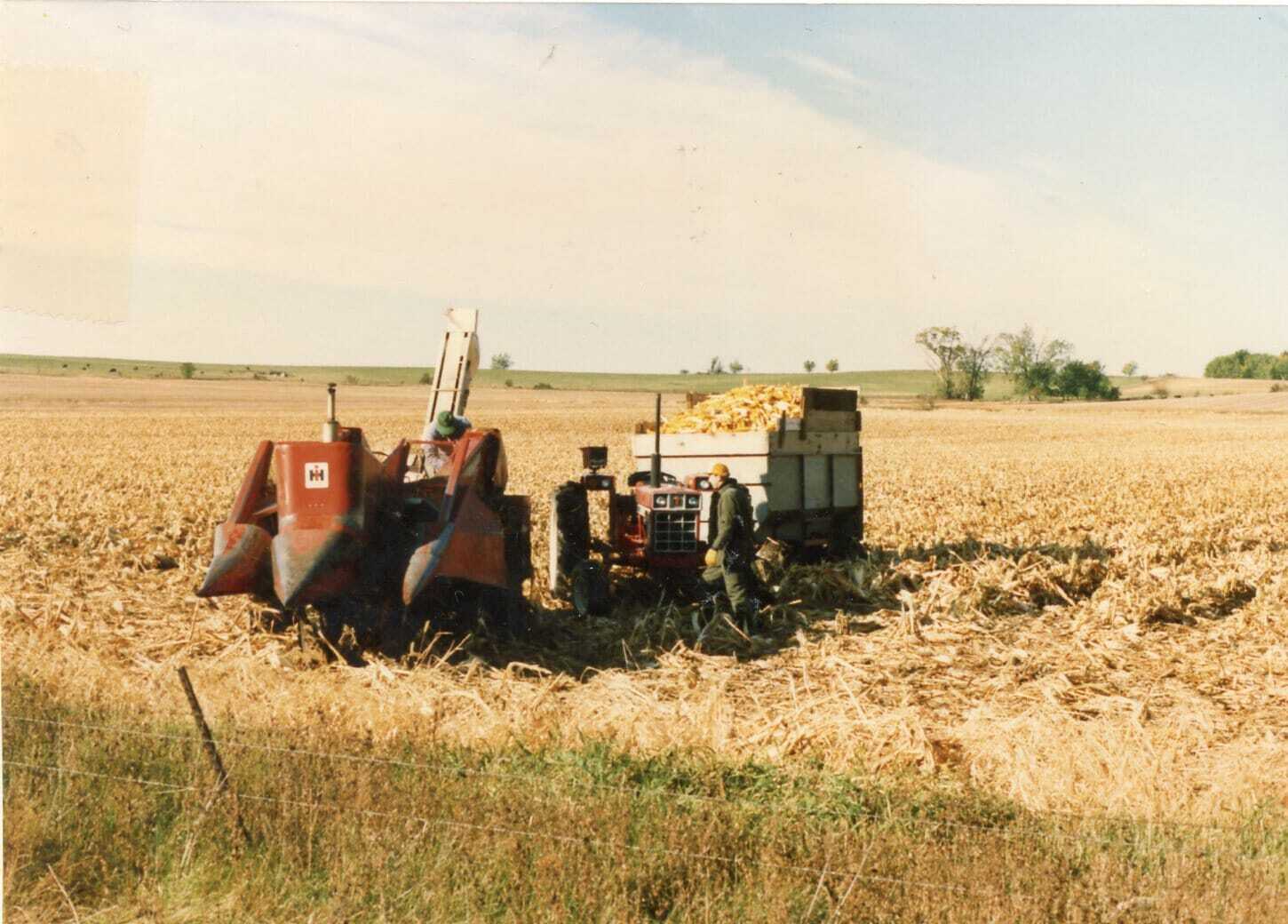
    Honestly, many of those photos from the family album showed the hardships of farm life. Just imagine farming before tractors and electricity! Yet, year after year the Rewerts family kept farming. You can see how everyone in the family pitched in: planting crops, taking care of those crops including pulling weeds by hand, picking ears of corn, storing those ears until they were dry and then shelling corn in July. I remember those hot, dusty days! I also remember cold, winter days when we had to go outside to do chores in snow so deep that it almost went over the barn!

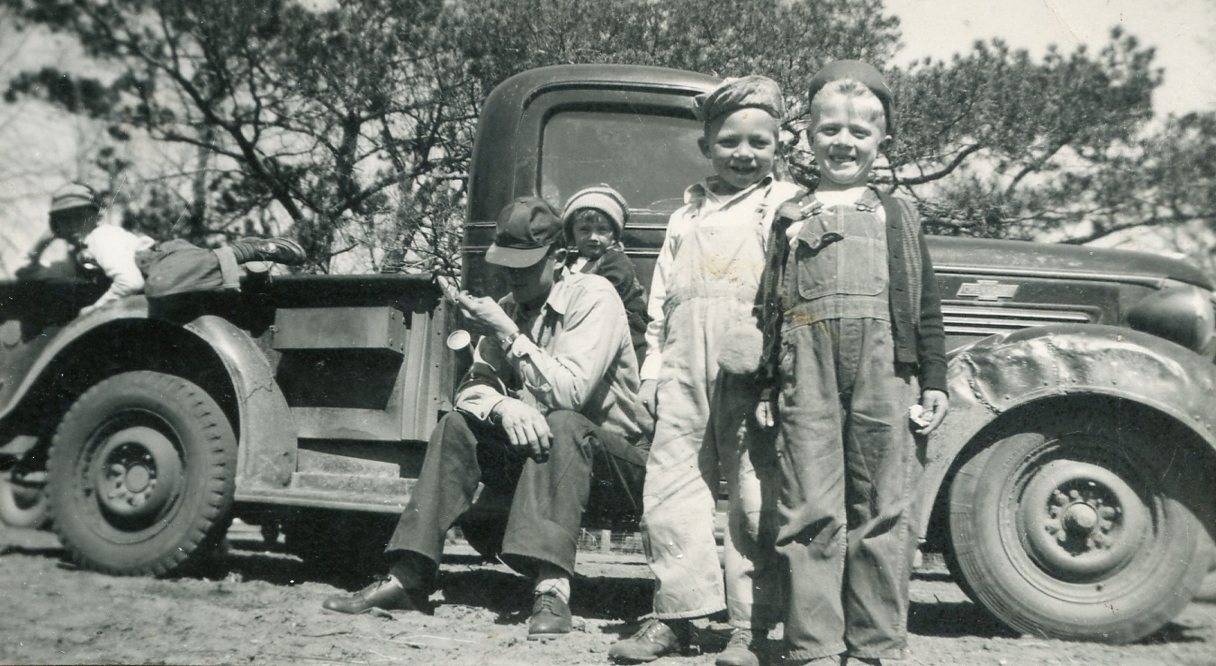
    It was fun to journey down Memory Lane. After looking at photos of those old cars and trucks, I’m truly amazed at how those old trucks got the job done. Those first vehicles didn’t have radios either. Speaking of radios, notice how big those first radios were. They took up a great deal of space in a house, so there was no way they would’ve fit in a dash. Of course, there weren’t computers, cell phones, video games or GPS systems then either.

    Yesteryear’s farm truck… somehow it got the job done!
    Yesteryear’s farm truck… somehow it got the job done!

    What a contrast between those first tractors without even power steering to today’s tractors that can actually steer themselves! Combines now can harvest the same amount in minutes that was harvested in hours when my mother-in-law was young.

    Not only has farm machinery and equipment changed, but even the crops have changed. Honestly, farming has changed drastically just within the last 20-25 years due to the introduction of first Roundup Ready® soybeans and then traited corn products. Now we have corn hybrids that fight weeds and bugs on their own.

    Picking corn that would be dried in a corn crib and then ground for livestock feed
    Picking corn that would be dried in a corn crib and then ground for livestock feed

    Even the food on our tables has changed in the last 90 years. When Grandma was young, everything was made from scratch. No one worried about how many calories were consumed because it was all worked off by the enormous amounts of manual labor that was done. Today’s society is not only concerned with calories and nutritional content, but many consumers want to know how the food was produced.

    So much has changed! I’ve had a great time the last couple weeks reminiscing about the good ol’ days, but I’ll be the first to admit that I’m glad to be farming today. Earlier this fall I attended a Threshing Day where I saw them harvest the same amount of oats in three hours that could be harvested by a combine in just 10 minutes! Earlier this month I participated in the 4th Annual Franklin County Harvest Blogger’s Tour where we visited our county’s agricultural museum and then gave non-farmers rides in combines.

    My understanding of farming history helps me appreciate farming today! It’s great to be able to use today’s technology to grow my crops, raise my pigs, and even be able to communicate with all of you!

    Larry Sailer, Musings of a Pig Farmer

    October 21, 2014
    Agriculture, General, Industry News
  • Latham Hi‑Tech Seeds

    Escape the “Spiral of Silence” with a Story

    Monday2

    Guest Blog by April Hemmes,

    On Wednesday, October 15, I shut down harvest and headed to Des Moines Iowa for a 7 am breakfast. Not an everyday event for the middle of October for this farm girl! I was fortunate enough to be invited to the Council for Agricultural Science and Technology (CAST) Communication Award Ceremony.

    My good friend Annette Sweeney invited me, knowing it wasn’t going to be easy for me to get away. She lured me with a panel of discussion on GMOs after the presentation, and I couldn’t say “no” to that!

    But first I want to explain a little more about this CAST award, which is presented annually to a scientist who has shown leadership and passion for communicating agriculture technology. The recipient was Alison Van Eenennaam, an Animal Genomics and Biotechnology Cooperative Extension Specialist in the Department of Animal Science at the University of California—Davis. She has an active research and extension program but also works tirelessly and creatively to relay important information about agriculture and food production.

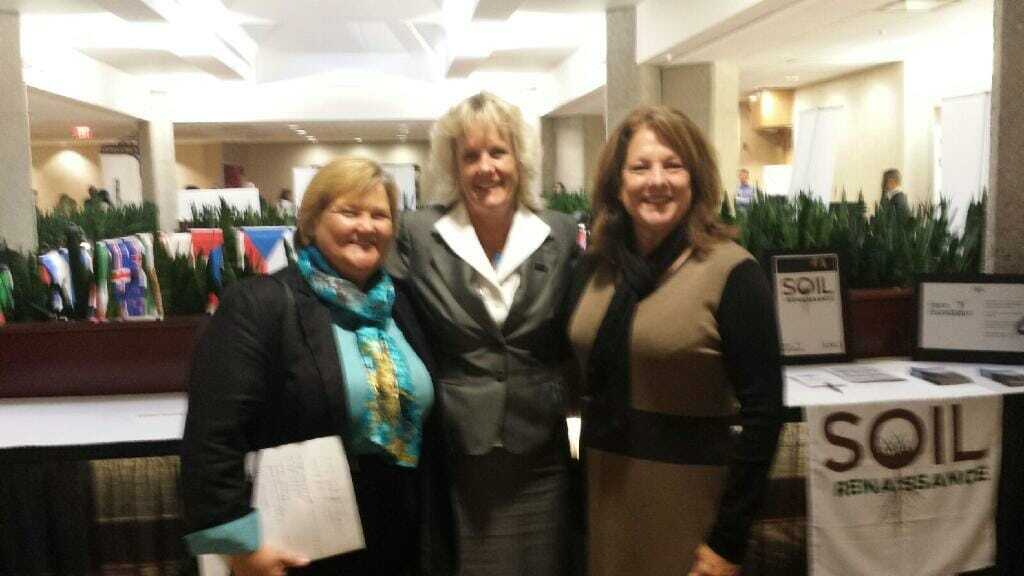
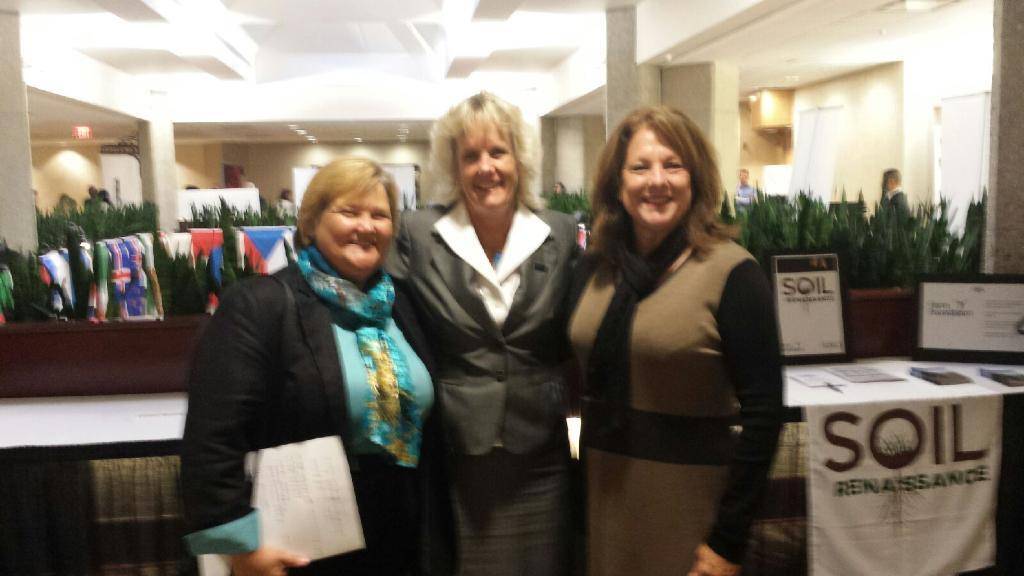
    April Hemmes (left) and Annette Sweeney (right) met with CAST Communications Award recipient Dr. Alison Van Eenennaam, an Animal Genomics and Biotechnology Cooperative Extension Specialist in the Department of Animal Science at the University of California—Davis, received. She has an active research and extension program but also works tirelessly and creatively to relay important information about agriculture and food production.
    April Hemmes (left) and Annette Sweeney (right) met with CAST Communications Award recipient Dr. Alison Van Eenennaam, an Animal Genomics and Biotechnology Cooperative Extension Specialist in the Department of Animal Science at the University of California—Davis, received. She has an active research and extension program but also works tirelessly and creatively to relay important information about agriculture and food production.

    Annette and I got to meet Dr. Van Eenennaam, and we had a great discussion about how more farm women are needed to speech publicly. More women are needed to get the truth disseminated about what farmers are doing. In Alison’s statements (since I met her, I feel like I’m on a first-name basis with her now), she pointed out that there are 16 million fewer dairy cattle than in the 1940s yet we’re producing 60% more milk! How? Mainly through genetic selection. Then she talked about the “spiral of silence,” meaning that even though someone might think GMO’s are acceptable, he or she won’t say anything due to the people who are speaking out against it.

    My favorite quote from Alison’s acceptance speech was a true story she told about her experience on Twitter. People were smack talking a peer-reviewed paper she had written, and she said, “It’s very difficult to defend a scientific paper in 140 characters or less!”

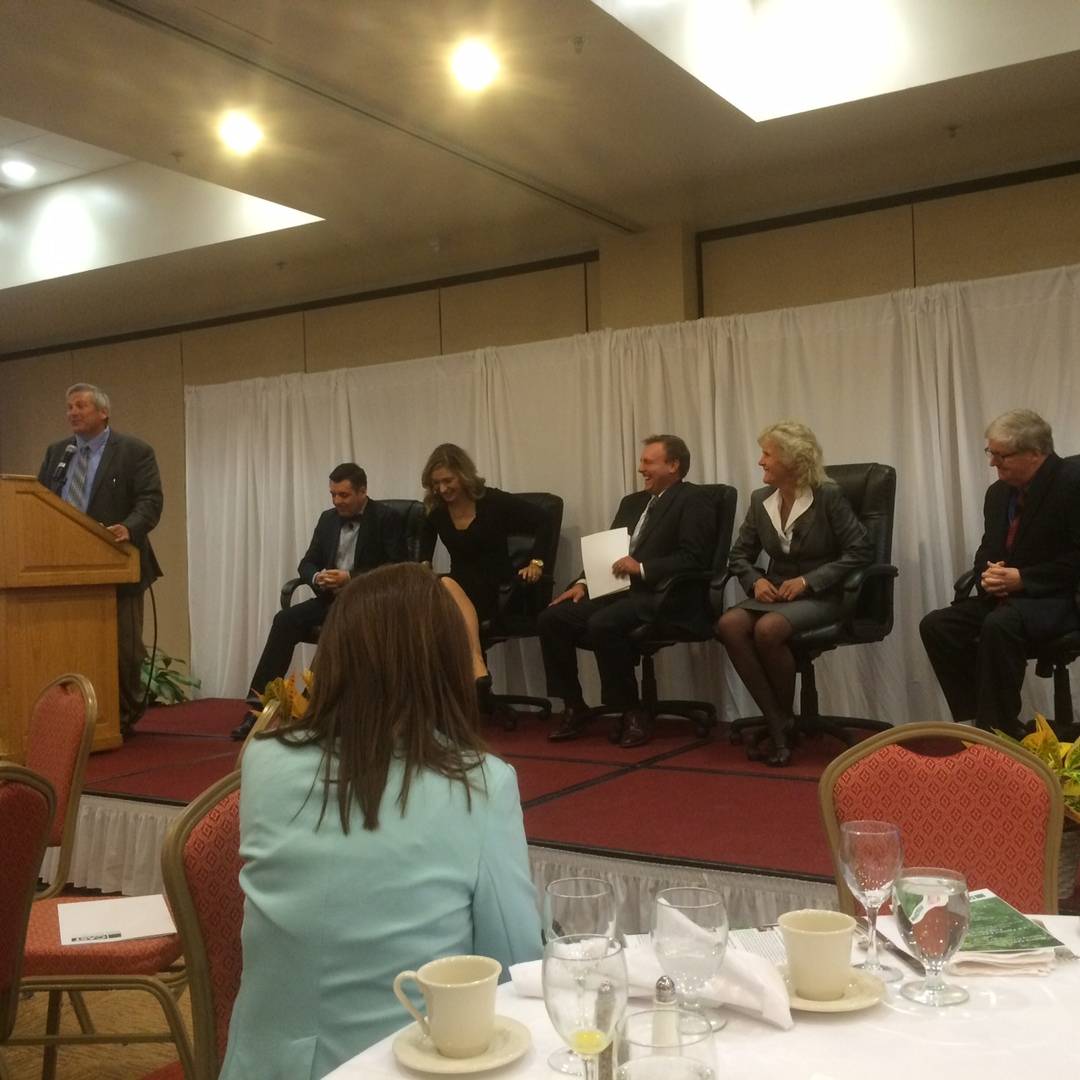
    Now about the GMO panel… This panel was part of the Borlaug Dialog at the World Food Prize. What a great group of people! The moderator was Mike Pearson, Host of Market to Market. Panelists were: Jay Byrne, president of v-Fluence Interactive, company that does research for public affairs and issue management; Julie Kenney, a farmer involved with CommonGround, a group of farm women who talk with other women (consumers) about what they do on the farm; and David Sutherland, a blogger and activist who is a Vegan but has no problems with GMO’s.

    Iowa Secretary of Agriculture Bill Northey has the honor of introducing a distinguished panel addressing GMOs and how to communicate with the public.
    Iowa Secretary of Agriculture Bill Northey has the honor of introducing a distinguished panel addressing GMOs and how to communicate with the public.

    This panel discussion provided some great tips on how to best communicate with the public about GMOs. First of all, we must realize that the Anti-GMO people are “story tellers.” While they have no facts to back up what they say, they are very well funded. They use those funds to spew untruths about those of us who farm or whose jobs are related to agriculture. We have “real jobs,” need to make a living plus defend what we do!

    So what do consumers want to hear? Honestly, those involved with farming are proud to help feed the world. Consumers don’t care! They also don’t care that the science is sound and safe. Consumers just want to know that there isn’t going to be a problem with eating food. Basically the take away is something that I have heard over and over: “We must keep telling our family’s farming story, so the truth gets made public.”

    Team Latham

    October 20, 2014
    Agriculture, General, Industry News
  • Latham Hi‑Tech Seeds

    National Focus on Food during World Food Prize Week

    World Food Prize

    There are many different topics I want to cover yet this month, but I’m running short on weeks!

    World Food PrizeOctober is National Pork Month, and as a pork producer, I like to do all that I can to promote the product I raise. Then there’s that nasty land grab on the ballot in New Jersey. But this week the World Food Prize is being awarded in Des Moines, so a story about food will take priority.

    “Food” has become such a broad subject, and there seems to be almost an obsession with food labels such as locally grown and organically produced. Recently, I’ve read too many articles proclaiming that small farms are the best way to feed the world.

    Say what? I’m under the impression that our society had moved beyond subsistence living thanks to advancements in agriculture. Innovation and technology helped free up labor, so people could pursue something other than raising food. Advances we’ve made in the last 100 years have allowed us to go from farming with horses to tractors that drive themselves! As a result, Americans’ standard of living has increased exponentially.

    Don’t blame farmers for the “system” that may not be getting food to the mouths of those whom need it! Politics, regulations, weather, war, incomes… so many factors are involved with feeding the world. In China, for example, the government is moving millions of people to big new cities. The purpose is two-fold: (1) those living in the city will have a better standard of living, and (2) the farm ground can be utilized to grow more food.

    China needs to grow more food to feed its population. They’re looking at way to increase efficiency. One innovation that has led to the increased efficiency of food production is biotechnology. Yet, stories are circulating that new technologies, such as GMOs, are putting small farmers out of business.

    Speaking from personal experience as a small farmer, I’m not being forced to buy any technology I don’t want. I could save back my own seed. I could pull all the weeds by hand. And I’m sure my yields and profit wouldn’t suffer… yeah, right! (I know my yields would suffer, and I don’t want to pull any weeds by hand if I can help it!)

    Truth is, GMOs have led to increased soil conservation and better water quality. My favorite newspaper (insert sarcasm) recently reported that GMOs have falsely taken the credit for moving conservation forward. Of course, the GMOs aren’t holding the soil themselves! But this headline that ran in last week’s newspaper is simply misleading: “Study: Biotech crops not reducing soil erosion.” (Read a bit further and you’ll see that the “study” was funded by an environmental group. It’s just one more example of why we must consider the source and use critical thinking skills.)

    Speaking from personal experience, GMOs allow me to farm differently. Forty years ago, I tried no-till farming. It flat out didn’t work with my soils! Technology evolved during the last decade – redesigned equipment, new seeds and reformulated pesticides – came together to make no-till work now.

    Better seeds and better equipment will help farmers of any size. That’s how farmers in this country have advanced; it’s how farmers in other countries like Ukraine and Uganda want to advance. But that doesn’t mean that we all must farm alike. After all, farmers grow different crops and raise different livestock based largely on where they live in addition to personal interests. I raise food primarily through animals here in Iowa, which is America’s number one pork-producing state. The way Tyson Roberts raises food in Utah is much more direct, right to the consumer. Yet, we’re both farmers trying to make a living.

    It’s going to take farmers of all sizes to feed this world, and this week the World Food Prize will highlight some great people doing amazing, innovative things to help feed our growing world. In fact, Dr. Norman Borlaug of Iowa founded the World Food Prize to recognize people for their contributions to ending famine and starvation. Borlaug, a Nobel Peace Prize winner, has been called “the man who saved more lives than anyone who has ever lived.” His legacy lives on as other agricultural researchers around the world work to integrate viable technologies into today’s food systems.

    Stay tuned to the Borlaug Dialogues, which focused around “The Greatest Challenge in Human History: Can We Sustainably Feed the 9 Billion People on our Planet by the Year 2050?”

    RELATED BLOG POSTS:

    • Be an Advocate during World Food Prize Week
    • Celebrate Ag in a Big Borlaug Way
    • Recognizing People for Improving the Environment

    Larry Sailer, Musings of a Pig Farmer

    October 14, 2014
    Agriculture, General, Industry News
  • Latham Hi‑Tech Seeds

    Harvest Tour is Learning Opportunity for Farmers & Consumers Alike

    DCIM102GOPRO

    Harvest is underway in North Central Iowa, however, I’ve been spending as much talking about combining as I have actually spent in the field during the past two weeks.

    In last week’s blog, I wrote about the opportunity I had to visit Mason City schools and answer some great questions from sixth graders about #RealPigFarming and crops. My main message was to remind these middle school students, who are like sponges absorbing information, to keep an open mind when reading information. I reminded them to consider the source of information and to not take all printed material as fact.

    Over the weekend, I had the opportunity to spend time hosting a group of bloggers on our 4th Annual Franklin County Harvest Blogger’s Tour. Honestly, this is one event that I always look forward to as its main purpose is to showcase our county’s rich agricultural heritage and to help bridge the gap between farmers and consumers.

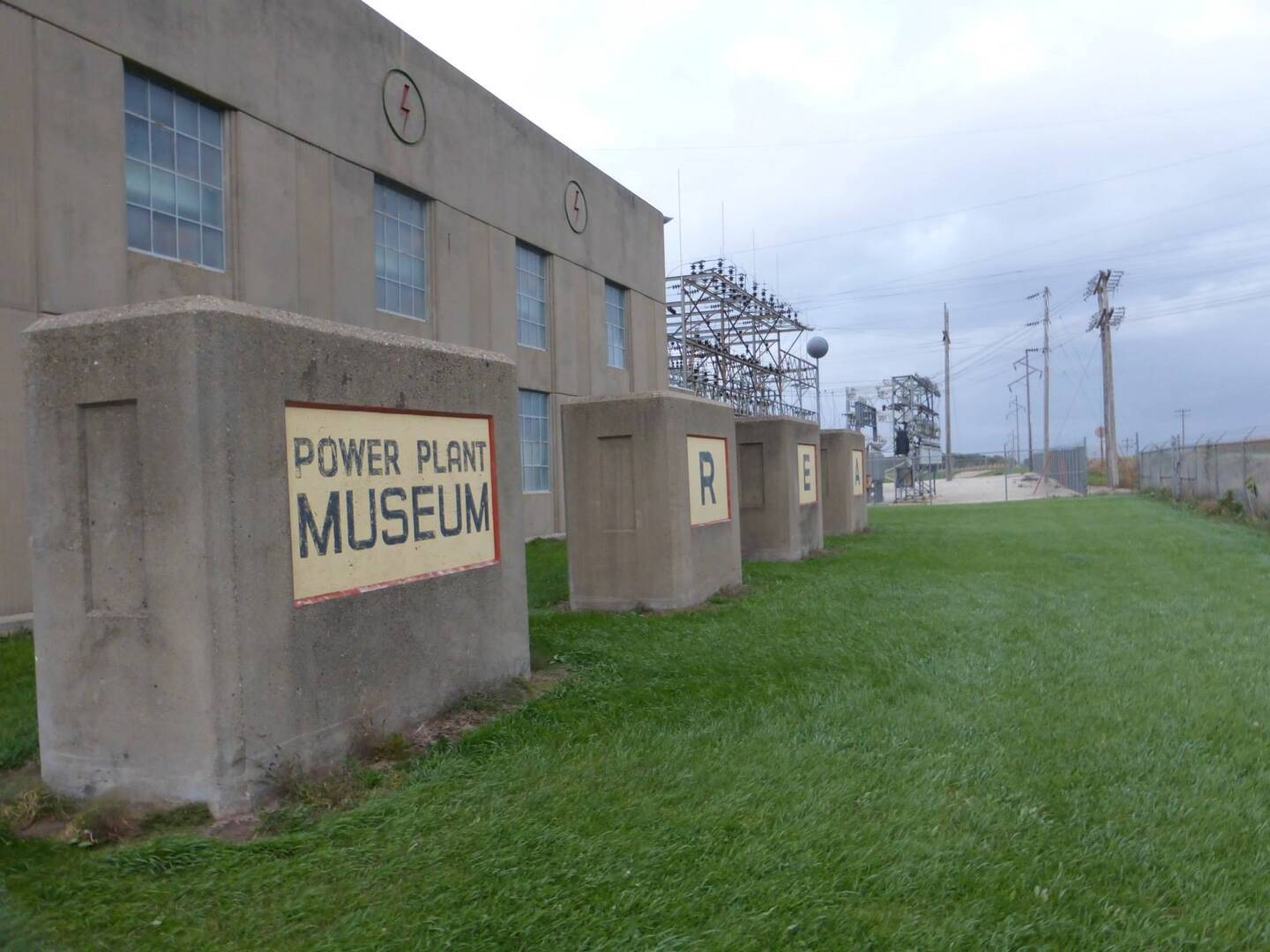
    This event has been held the first weekend of October since 2011. This year, bloggers begin arriving at the Country Heritage B&B on Friday afternoon. We then took them on a tour of the first farmer-owned, rural electricity generating plant. In the 1930s, only 10 percent of U.S. farms had electricity. Interestingly enough, this electric utility plant in rural Hampton was the first rural electric utility plant west of the Mississippi. We made history right here in our own backyard – and this was the first time I’d actually visited the museum myself! I had a great time walking through the REA Museum, which is full of fascinating things from the beginnings of electricity.

    Photo Credit to: BethAnnChiles.com
    Photo Credit to: BethAnnChiles.com

    From the REA Museum, the bloggers toured Beeds Lake State Park. This lake was constructed by manual labor during the Great Depression. One focal point of the park is the 170 foot-long spillway – built by the Civilian Conservation Corps in the 1930s – that consists of horizontal layers of limestone that abruptly drops 40 feet. Another unique feature of Beeds Lake is the causeway near the lodge, providing more than one-third mile of shoreline fishing, as well as a convenient pathway for hikers and joggers.

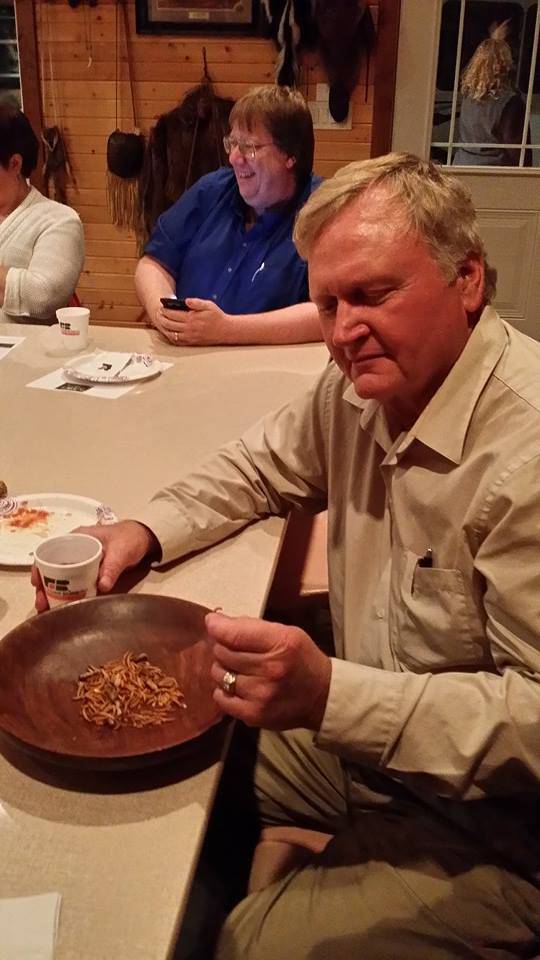
    Larry_CarlsonTreeOur final stop on Friday evening was the Learning Tree Lodge at the Carlson Tree Farm. The Carlsons have built a very nice retreat in rural Franklin County, and there is no charge to use their comfortable learning center. Great food and wine tasting was combined with the entertainment Dennis has a reputation of providing. As a former county conservation officer, he always teaches us something new about nature. We had the the opportunity to taste roasted meal worms… did I mention the wine tasting? Yes, Franklin County is home to Townsend Winery!

    Saturday morning started early. We arrived on the Franklin County Fairgrounds at 8 AM where we toured our county’s farm museum. Many questions were asked and answered about the history of farming while we looked at old farm equipment. Every time I go through this building, I see something I had not noticed before. There’s such so much to see! It was a great stop.

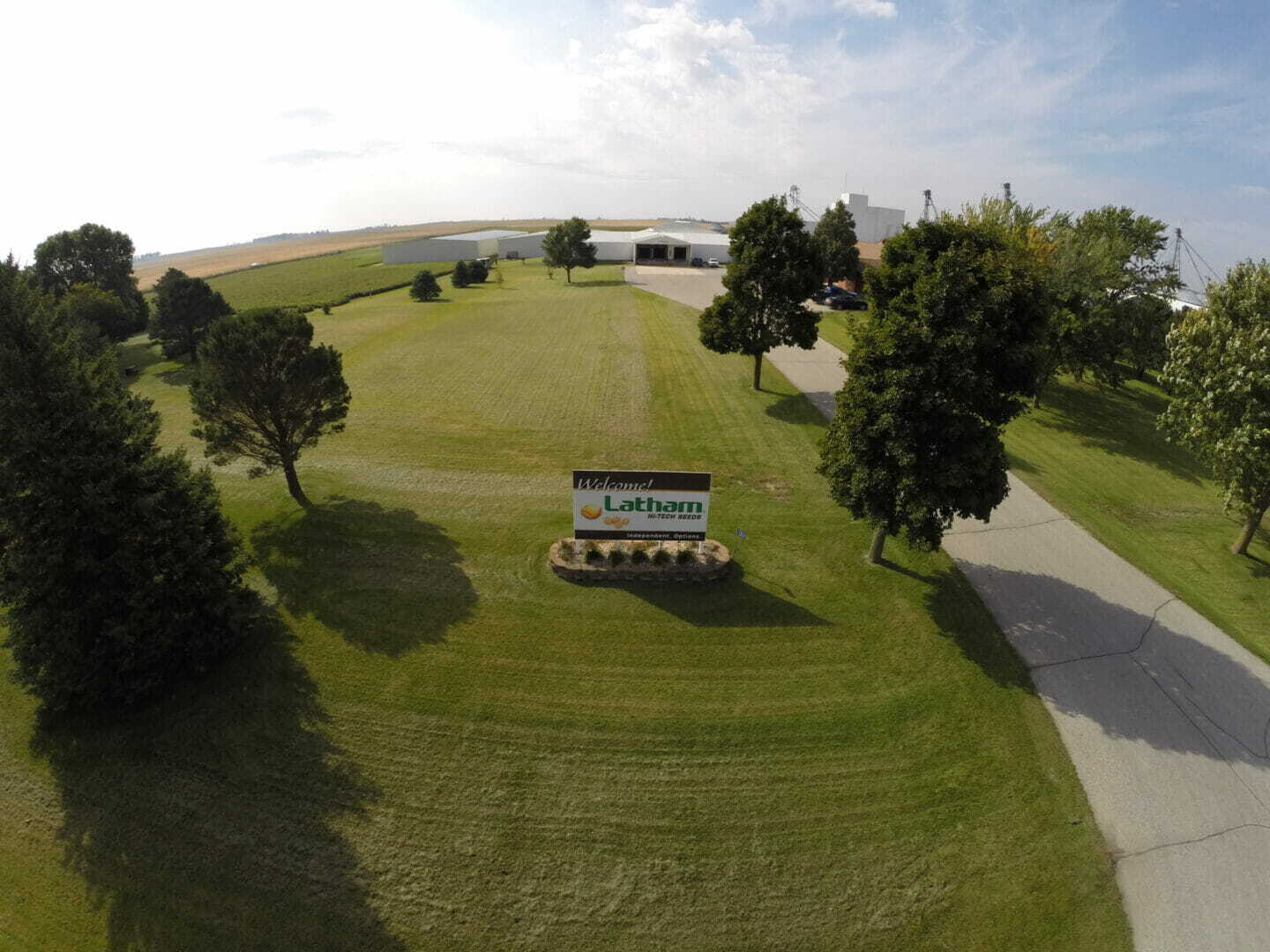
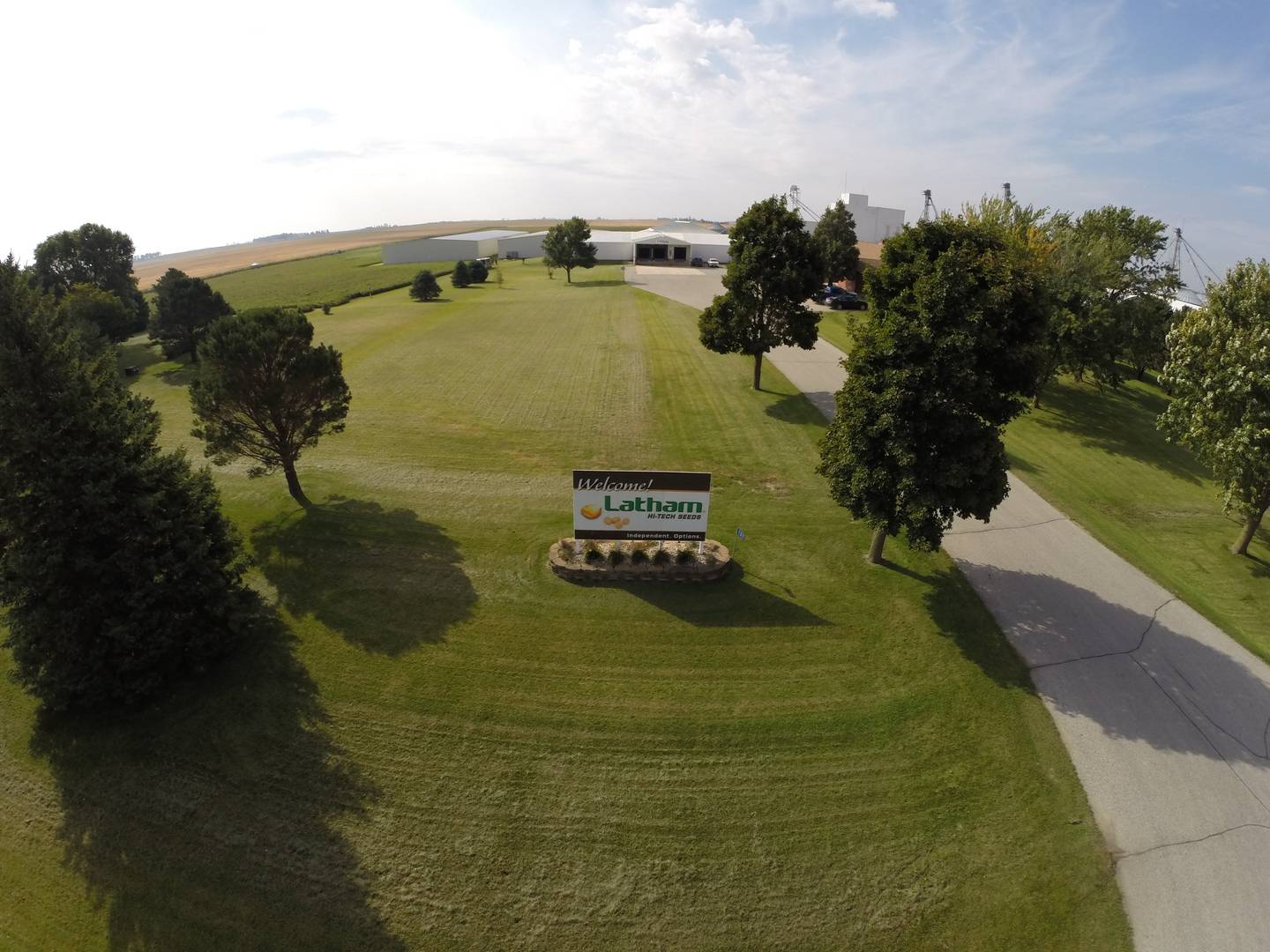
    From the fairgrounds, our busload of bloggers went downtown to shop the Hampton specialty stores. I had to head out to do my chores, but from the pictures posted, it looks like the shoppers had a good time. With shopping bags in hand, they boarded the buses for a trip to Latham Hi‑Tech Seeds, with headquarters on a Franklin County Century Farm.

    DCIM102GOPRO

    John and Shannon are the third generation of Lathams to manage the family-owned seed business. They have added hybrid seed corn and Hi‑Tech forage to the product lineup, providing farmers with even more choices for their fields. Bloggers enjoyed learning how the Lathams contract with local farmers to produce seed beans, which are then brought to their plant in Alexander upon harvest. Controlling the handling of the soybeans from harvest through conditioning and bagging is what the Latham believes is key to their reputation for quality seed.

    Following a soybean facility tour, we all enjoyed celebrating October #Pork Month with succulent loin sandwiches and Val Plagge’s Sweet & Spicy Hog Wild Baked Beans. While we enjoyed our delicious lunch, we also enjoyed a presentation about the North Iowa Ag in the Classroom group. Just four women talk to 10,000 kids a year about farming! Even though we live in a rural state, we learned that some North Iowa school kids believe corn stalks are bamboo. These ladies provide classroom materials about #RealPigFarming, ethanol production and soil conservation to name a few. All are important topics – topics that are greatly misunderstood by many adults.

    Photo Credit to DonnaHup.com
    Photo Credit to DonnaHup.com

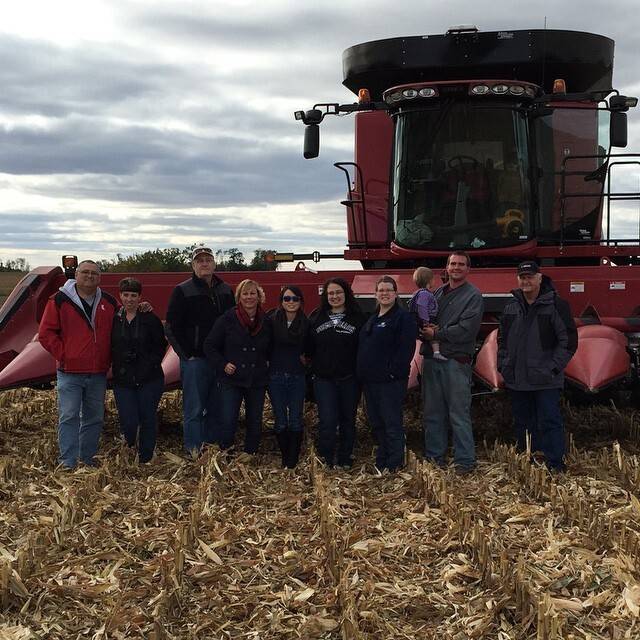
    As enjoyable as all of these tours were, the highlight of the weekend was definitely the combine rides! Saturday afternoon we traveled to Roy and Jeanie Arends’ farm. Although the soybeans were a little wet from all the rain we’ve had, Roy used it as an opportunity to explain why his ground needed to be tiled. This turned in to quite a question and answer session! Roy’s son, Andrew, even explained about GMOs.

    Half of the blogger group stayed at the Arend’s farmer and half went to Ian and Val Plagge’s farm to combine some corn. Val even gave bloggers the chance to visit their pigs.

    All of these tours and visits led to great understanding and some really interesting blog posts! Follow along with the hashtag #FranklinCoHarvest on Twitter and Facebook for a great recap from these bloggers:

    • Corn, Beans, Pigs and Kids
    • Donna Hup
    • It’s Just Life – Finding the Extraordinary in the Ordinary
    • Jeni Eats
    • Sawdust and Embryos
    • The Walking Tourists

    Thanks to everyone who participated this year! It was an honor to help host this group of enthusiastic bloggers. Not only do they share their experiences here in Franklin County with many more people, but we have an opportunity to learn from them, too. It was another successful weekend, and I’m proud to have been a part of it.

    Related Links:

    • Field Fare & Family Fun Abound in Franklin County
    • Bloggers Tour Proves the Power of Internet
    • Small Steps Lead to Amazing Journey

    Larry Sailer, Musings of a Pig Farmer

    October 7, 2014
    Agriculture, General, Industry News
  • Latham Hi‑Tech Seeds

    Brown Bag Lunch Funds County 4-H Scholarships

    4Hmeal flyer

    October 5-11 is National 4-H Week, so club members and alumni across the U.S. will be sharing their success stories and encouraging others to “join the club.” Even if you were never in 4-H – and you’re past the age of joining – you can still get involved locally.

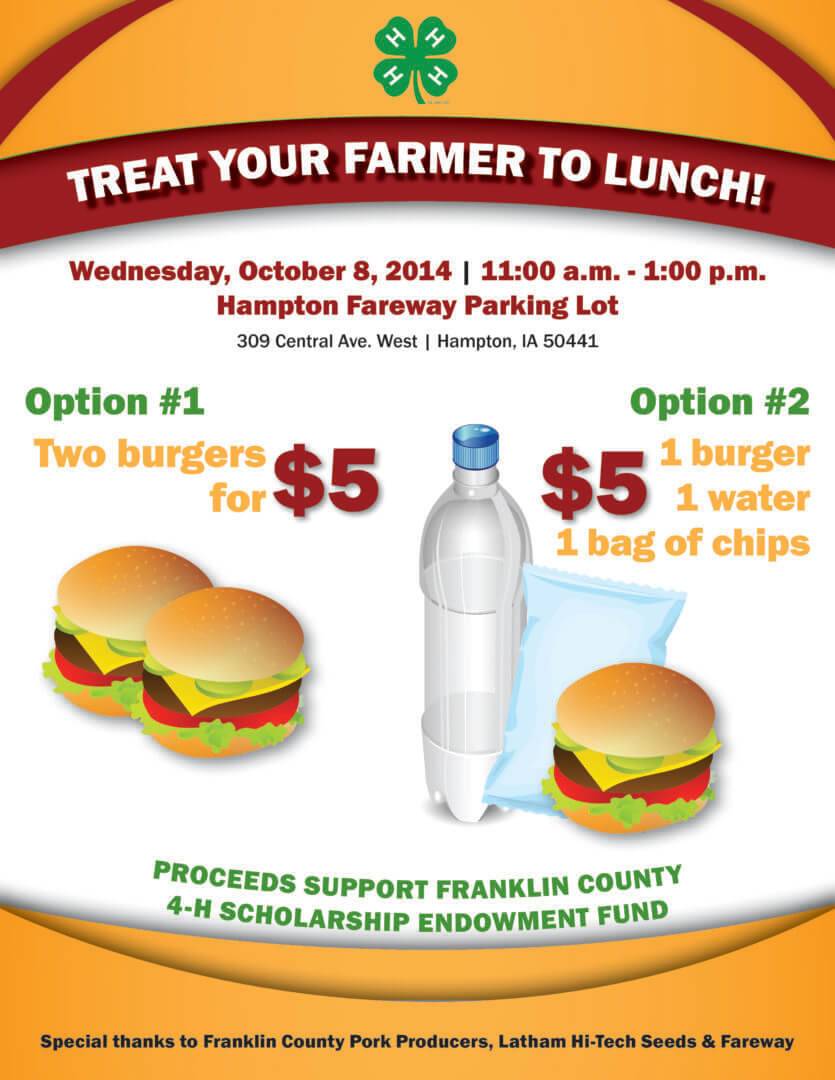
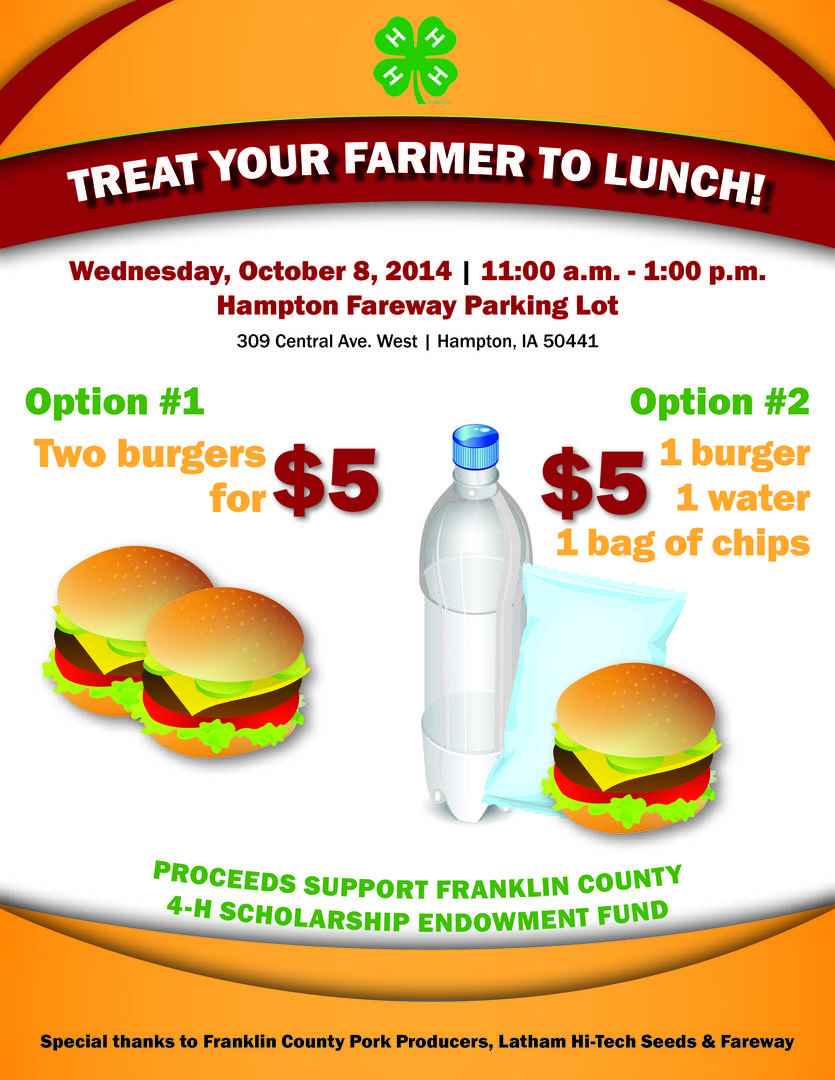
    Join us Wednesday, Oct. 8, for a $5 lunch at the Fareway parking lot. Our goal is to have burgers grilled and ready for pickup almost as fast as any fast food drive-thru! Special thanks to the Franklin County Pork Producers and Latham Hi‑Tech Seeds, as well as Fareway grocery store, for their support of this fundraising event that supports scholarships in our county. We’ll start serving at 11 AM and will serve until 1 PM – or until we run out!

    We’ve guaranteed 600 burgers with the option to purchase more, so I’m praying that Mother Nature cooperates and we have another strong turnout to support this important cause.

    While there are many important causes being celebrated this month, 4-H is near and dear to my heart. (Yes, I’m still pledging my hands to larger service for my community and my world.) I have first-hand experience with the program as a 10-year member of the Coldwater Country Cousins 4-H Club in Butler County; as a state 4-H award winner; as a former member of the Iowa 4-H Council; as a former trustee for the Iowa 4-H Foundation; and as a current member of the Franklin County 4-H Foundation.

    Through 4-H, I made friends with other 4-Hers who shared my same interests. Twenty-five years later, I’m still networking with 4-H friends from across the state! 4-H made a positive impact on my life and help me discover my love for journalism. Because of that, I’ve been lucky enough to enjoy every job I’ve ever held.

    I want others to have the opportunity to discover their passions through 4-H. I also want them to let 4-H lead them to career success. For example, recently I had the opportunity to serve on a panel with other distinguished 4-H alumni and area business owners. We talked about how 4-H helps you prepare for the future. Business owners shared what they’re looking for in employees, and students were encouraged to ask questions. Following our discussion, students participated in mock interviews. Putting yourself in an interview situation takes you out of your comfort zone, so I commend the students who participated in this event. Experiences like this are also why I’m proud that both of our children are 4-H members, too.

    Join @LathamSeeds in showing pride and support of the 4-H program this week through social media using the hash tags #Iam4H and #4HWeek.

    4Hmeal-flyer

    Team Latham

    October 6, 2014
    Agriculture, General, Industry News
  • Latham Hi‑Tech Seeds

    Today’s Kids Must Develop Critical Thinking Skills

    Larry in the classroom.jpg
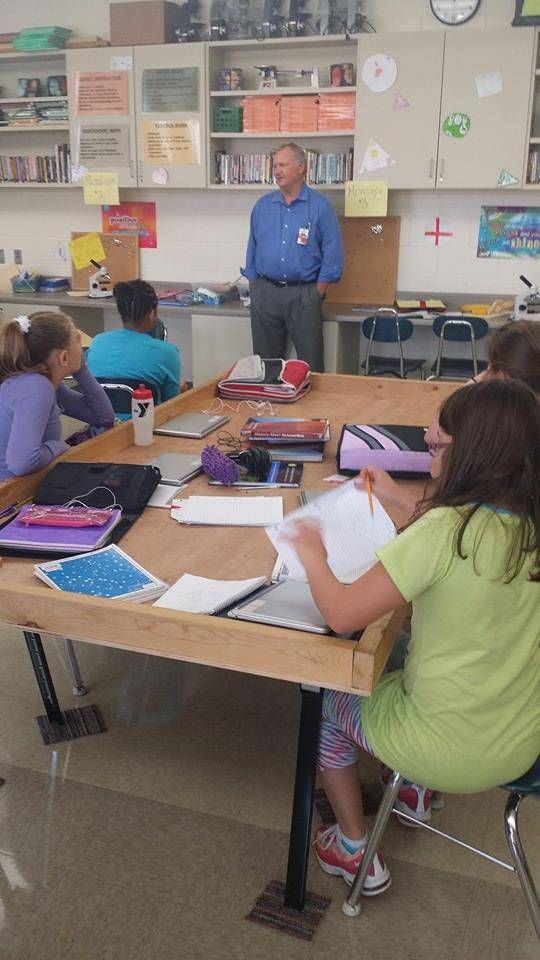
    Yesterday Larry Sailer shared his farm story with 6 classes of sixth graders. Today he’s heading back into the classroom!
    Yesterday Larry Sailer shared his farm story with 6 classes of sixth graders. Today he’s heading back into the classroom!

    Late last week I was contacted by our Ag in the Classroom staff from North Iowa Ag in the Classroom about a book being used in the Mason City sixth grade as a textbook. This nonfiction book by Micheal Pollan, entitled Omnivore’s Dilemma, is being used for every class – even art!

    At first blush, it sounds like this book would be about all the food choices available in America. But that’s not the case! Omnivore’s Dilemma is filled with half-truths and misinformation. For example, Pollan implies that government subsidies force farmers to grow corn and Americans are becoming obese because corn is “hidden” in so many food products.

    Pollen’s book also states that people are half made up of corn. Now this simply isn’t true! Using basic math, one can deduce this isn’t possible since the average human body is composed 60 percent of water. And that’s a fact! (Let fact, no fear, determine food acceptance. I support agriculture that improves the quality and quantity of food available.)

    Thanks to Pollan’s nonfiction writing and the concern this “textbook” has caused among farmers and those who work with North Iowa’s Ag in the Classroom program, I found myself facing a dilemma… Should I combine my soybeans or head into the classroom?

    Because I whole-heartedly believe we must connect farming and food to the classroomx, yesterday I found myself getting behind the wheel of my pickup rather than my combine. It honestly felt privileged to talk with six classes of sixth graders yesterday. My main message was to remind these middle school students, who are like a sponge absorbing information, to keep an open mind when reading information. I reminded them to consider the source of information and to not take all printed material as fact.

    I also encouraged them to ask farmers question about why they do what they do. As you might expect, I got a lot of questions from them! These kids asked really thoughtful and engaging questions.

    One young person asked, “If you think you’re going to lose money, why do you go ahead and plant your crops?”

    “How do farmers get such big equipment?”

    What kind of education does it take to become a farmer?

    These kids had so many good questions! Another girl asked if I name my pigs. That opened up a conversation about the difference between pets and food production. We talk about the cycle of life and how some animal’s purpose in life is to become food. That’s natural. It happens in nature, too.

    Conversations like this with non-farmers help us find common ground. I consider telling my farm’s story and educating consumers – even future consumers – to be a very important part of my operation. That’s why today I’ll be getting my pickup truck again, driving about 45 minutes north, and spending another full day talking to more students.

    We all must keep sharing our farm story. It’s quite apparent other sources of information are getting into our schools, and that information might not be accurate!

    Larry Sailer, Musings of a Pig Farmer

    September 30, 2014
    Agriculture, General, Industry News
  • Latham Hi‑Tech Seeds

    What’s the Price of Income Equality?

    Larrypigfarmer

    LarrypigfarmerI’ve been reading articles about income inequality, covering a wide array of topics, since the economy crashed in 2008. Wall Street has been picketed. The minimum wage is too low. Rich people are simply hoarding all the money. But in The Des Moines Register on Tuesday, Sept. 16, a front page-article by Mike Kilen explained how the Ag economy has contributed to growth in the rich-poor gap.

    The story doesn’t out right blame farmers for causing this gap, but I did take it to be the underlying theme of the story. Admittedly, that’s my perception of the article. Kilen includes information from Iowa State University sociologist David Peters that three Iowa counties are in the nation’s top 10 for inequality of income growth. That’s not surprising as farming had a pretty good run from 2000-2012 while the economy, as a whole, did not. Logic tells me that this would make a spread.

    Is it the farmers’ fault? Should the farmers be “fair” and share the gains made?

    Before you answer “yes,” remember that farming goes in cycles. Farming was great in the 1970s, and then in the 1980s, we experienced a farm depression that took out many farmers. Those who survived were usually ended up farming more ground. Do the math: There are fewer farmers but the same amount of land is being farmed. Of course, the farmers are “bigger.” Is it their fault? Of course not! That’s how a capitalistic society functions.

    These farmers took a risk by taking on more land, and they’ve enjoyed some good times. The last five years have been probably some of the best ever for farmers who were raising crops or livestock with strong market prices and were doing a decent job of controlling their business expenses.

    Now, however, the cycle has turned. The price I can sell my soybeans and field corn for today is below the cost of production. My income this year will be well below minimum wage. It probably will be a negative income! Does anyone who stands to make a profit this year want to share his income with me? I’m sure there will be people standing in line, waiting to give their money to me, right? Not!

    “It’s difficult to imagine the economic mindset of those who consider that government forcing an increase in the minimum wage can bring about improved prosperity,” was posted today on one of my friend’s Facebook pages yesterday.

    Let’s ask ourselves if question: If economic prosperity through minimum wage levels promises such an advantage, why not mandate a minimum wage of $100 per hour or higher?

    Those who see government as the great provider can’t seem to grasp the emptiness of their vision! Numerous attempts have been made to for the U.S. government to become all-powerful, the end-all and be-all. The results have been devastating, yet so many Americans continue to promote these failed beliefs.

    Our country is headed in the direction of socialism. We want everyone to be equal… I see this in kids’ contests where every kid gets a ribbon or prize. I see it in this article in The Register article, indicating that all Iowans should have equal net worth.

    Let’s examine why the net worth gap is spreading in Iowa. First of all, land values have increased significantly. The incomes of some farmers have followed, but not nearly as much as one might think because a lot of this value is only on paper.

    Commodity prices, on the other hand, greatly impact the amount of disposable income farmers have to purchase new machinery and equipment and to build buildings or buy land. The more money there is made in farming, the more money gets released into the U.S. economy. But it takes more than that.

    We must find the will for everyone to achieve. We need better jobs. We need to get people trained and educated to do those jobs! When I was running my construction business, one of my biggest constraints was finding people with the skills and “will” to work. Even the social fabric of our society played a role. Many employees would work until the state paperwork for child support caught up with them, and then they did not show up to work. I visited with a friend last week who is still involved in the construction, and his biggest challenge is finding people willing to do the work.

    The spread in wealth brings to mind the story of Jack Ma, an entrepreneur from China. His company, Alibaba, went public last week. He worked hard and took a chance. He also had the knowledge and talent. Jack is now worth billions. Should we take away his incentive to dream big?

    I know… Let’s allow tax policy to level the playing field as Senator Tom Harkin likes to say. After all, the Government is here to help you! I keep reading about all the programs USDA has to help the disadvantaged farmers get started.

    Half of the people in this country are being subsidized by the other half! Keep this up, and we will take away even the most energetic worker’s will to succeed. If you take from one who is working and give to the one who isn’t working, doesn’t that limit the amount of work being done by both groups?

    “When everybody owns something, nobody owns it, and nobody has a direct interest in maintaining or improving its condition. That is why buildings in the Soviet Union — like public housing in the United States — look decrepit within a year or two of their construction.”

    Larry Sailer, Musings of a Pig Farmer

    September 23, 2014
    Agriculture, General, Industry News
  • Latham Hi‑Tech Seeds

    Does Food Come Too Cheaply in America?

    Larrypigfarmer

    LarrypigfarmerThough Americans are famous for their healthy appetites, their food bill is proportionally low. In fact, Americans spend less for groceries than any other country in the world. The main reason food is so inexpensive here is because U.S. farmers are so productive.

    Think of all the agricultural innovations in this country that have allowed 98% of our people to move off the farm and creating all creature comforts we enjoy in this modern age. If 70 or 80% of the populace were still needed to grow food, what would this country look like? Look no further than Uganda, Ukraine or any number of third world countries and you’d have an idea!

    Not only do U.S. farmers grow enough food to make the USA the cheapest place to eat, we also grow energy and fiber. Without agriculture, everyone would be naked and hungry. Farming and ranching goes beyond providing food… It also provides more than ¼ of our workforce with steady employment. Twenty-three million jobs are associated with modern day agriculture.

    So why is there almost this romantic back-to-nature obsession with organic farming? It all goes back to money. That’s why I’m beginning to wonder if our food in this country has become too cheap. Organic has long since become an ideology… it’s almost as though the food movement become a cult. A reported $63 billion is spent worldwide on organic foods.

    There are those in the upper middle class that can obviously afford to pay for organic foods, but what about those who can’t? Think of those with lower incomes and the poor, who can get a lot more nutrients in their body from buying two regular carrots than they can for the price of one organic carrot. This is the type of challenge we face to feed planet that’s population will surge to 9 billion before the middle of the century!

    Literally millions of people in poverty are starving to death or have serious health problems, yet some solutions are so simple. Severe Vitamin A deficiency results in blindness, and nearly 50% of the half-million children who are blinded by it die within a year. A new variety of rice can cure many of these problems, yet we’re letting fear of the unknown prohibit us from helping these poor people.

    I know most people don’t give a rip whether people are starving in Africa because the American public has become so self-centered with little concern for anyone else. One in six Americans goes to bed, worrying if they’ll have enough to eat tomorrow.

    People go hungry because abundant food, which has been proven over and over again to be safe, gets the same old fears thrown at it. There are no real real health benefits to organic and non-GMO foods. Studies prove it. A Stanford study found that organic foods were considerably less likely than conventional foods to have pesticide residues, although organic foods were higher in e. coli. Shouldn’t we be just as concerned by that?

    Maybe I’m getting to emotionally involved, but I’m starting to get offended every time GMOs and “normal” agriculture. I’m not even sure what “normal” is anymore! And if I’m getting confused, what about people not involved in farming?

    Larrys-NewsClipBut back to my point… I read an article September 13 in my local newspaper about a local produce company. Locally grown. Certified organic. But the locally producer is quoted as saying, “When you see certified organic, that means no chemicals, no pesticides and no GMOs are used.”

    I have a hard time believing this producer can make that statement. Plus, she’s asking for special treatment to be allowed to sell her produce in a city park on Main Street instead of at the local farmer’s market. Maybe my skin is just getting to thin, but I don’t understand why this producer should have special treatment.

    As Rob Wallbridge, an organic farmer and consultant based in Western Quebec says, “If we haven’t already, we’re about to split into sects and factions, driven apart by ideological dogmas that have nothing to do with reality.”

    Reality is that it’s going to take every farmer to feed the world by 2030. I’m in support of agriculture that improves the quality and quantity of food available throughout the world. Instead of splitting into factions and calling names, why not let the free market – instead of government regulations – decide what people want to buy?

    Larry Sailer, Musings of a Pig Farmer

    September 16, 2014
    Agriculture, General, Industry News
  • Latham Hi‑Tech Seeds

    High Tech Will Go “Sky High” on Sept. 19

    Drone

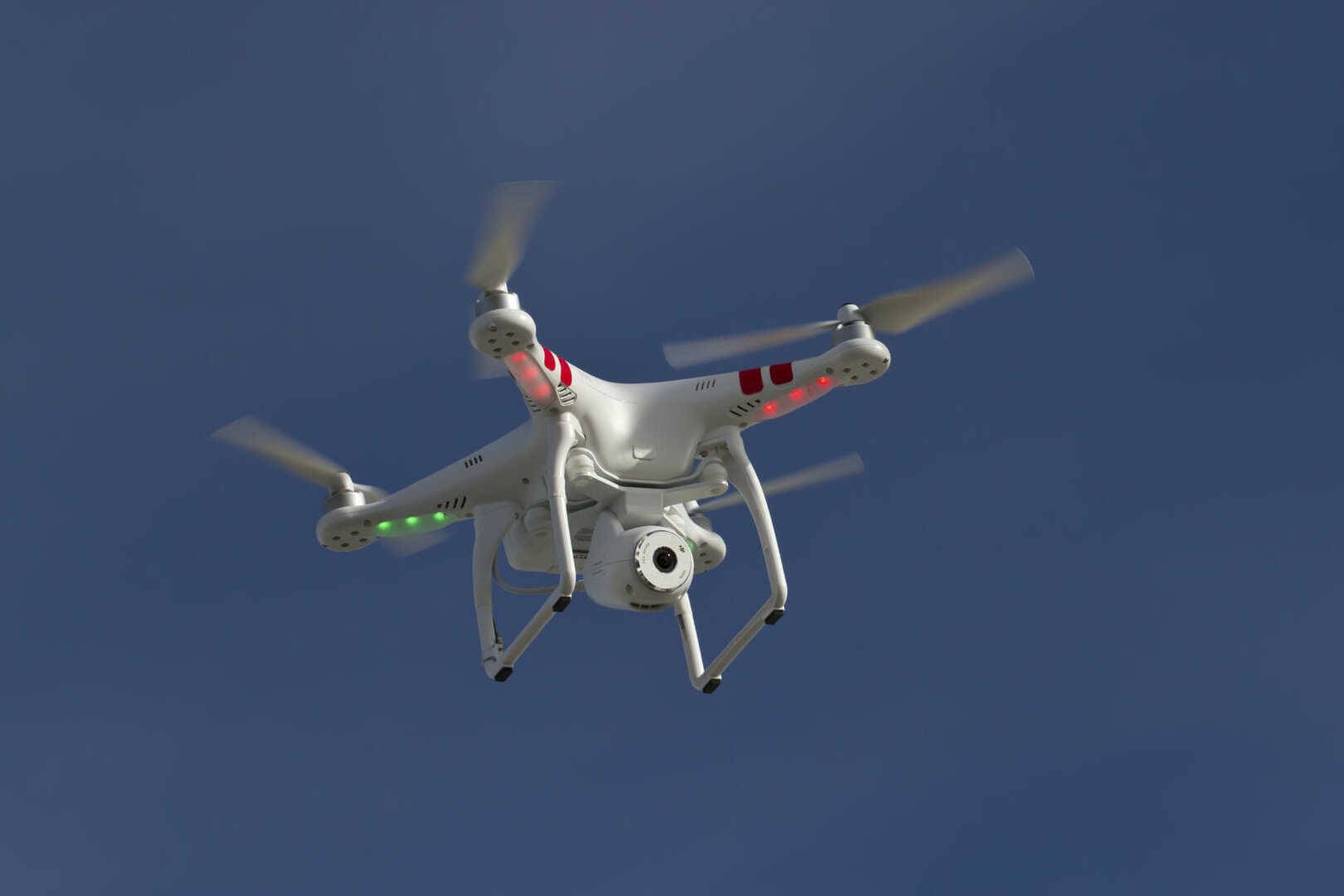
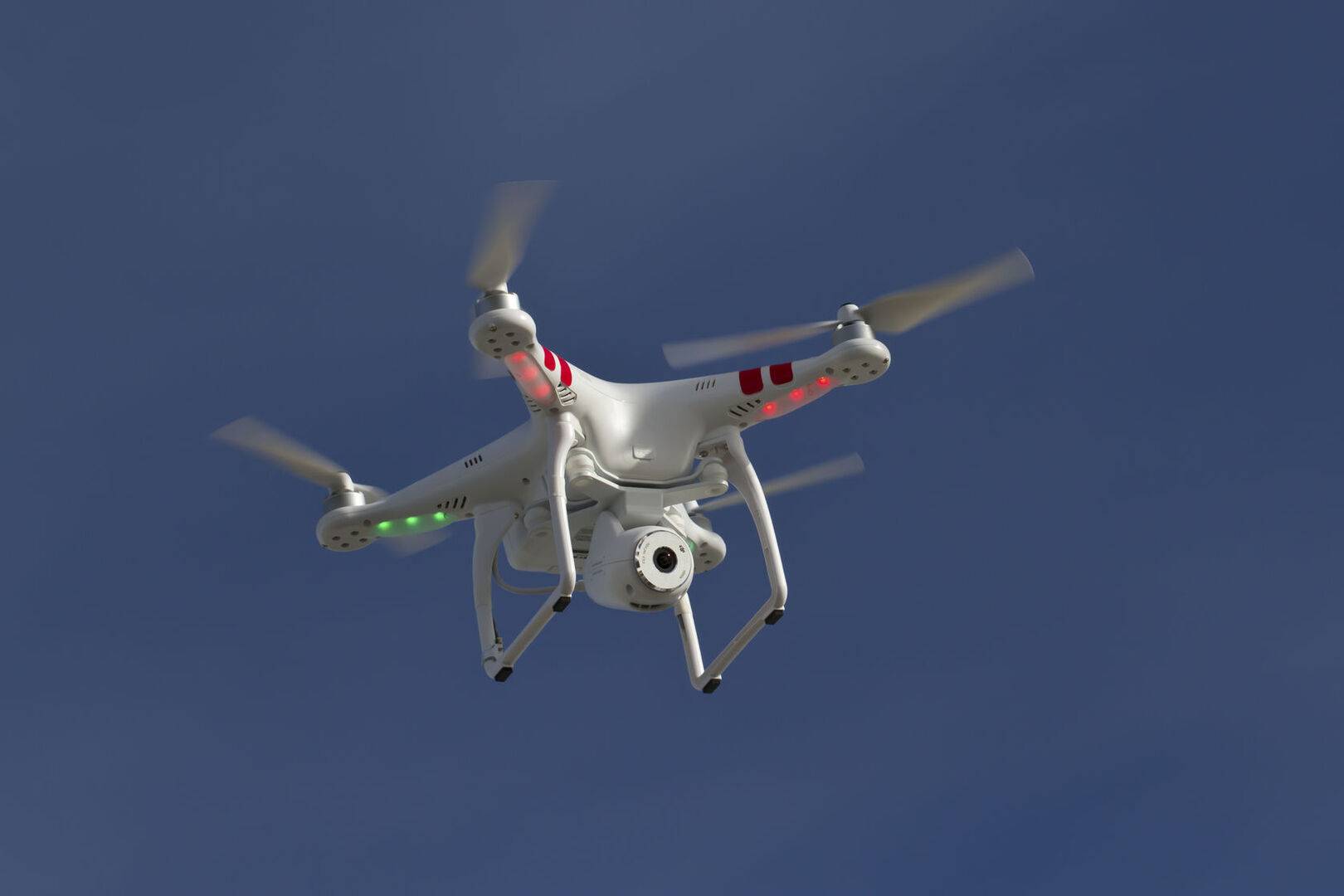
    DroneTo fully appreciate the capabilities of today’s 8-stack hybrids, we believe you must see how far corn breeding has come. The story of corn starts with wild teosinte, which doesn’t resemble today’s plants. Come see for yourself! At Latham’s Seed-2-Soil® Field Day in Alexander on Friday, September 19, you can walk through the history of corn, get a sneak peek of our 2015 product lineup plus watch a high-flying drone demonstration.

    The Seed-to-Soil field day begins at 9 AM with field tours including a technology showcase plot with 40+ of the industry’s most innovative hybrids and varieties. See the unique interactions of 30+ corn hybrids with row spacing, population and stress wheel studies.

    Chad Colby of AgTechTalk, one of the most respected and well-versed individuals in the UAV field, will demonstrate several types of drone technology. He will also share his experiences applying the technology to the farm.  Following the high-flying drone presentation, a drone sponsored by Greenleaf Genetics will be awarded to one lucky attendee.

    Also at our field day on September 19, you’ll see how you can benefit from the 4 main components of Latham’s Seed-2-Soil program: (1) Crop Planning; (2) Nutrient Management; (3) Agronomic support; and (4) Seed Treatments.

    Put September 19th on your calendar for the Latham Hi‑Tech Seeds Field Day in Alexander, beginning at 9 AM. To RSVP, call your local Latham® representative or dial 1-877-GO-LATHAM (1-877-465-2842).

    Team Latham

    September 15, 2014
    Agriculture, General, Industry News
Previous Page
1 … 39 40 41 42 43 … 95
Next Page

Latham Hi‑Tech Seeds

131 180th Street | Alexander, IA 50420

(641) 692-3258

SIGNUP FOR OUR NEWSLETTER
  • Contact
  • Legal
  • Dealer Center
  • Seedware Login
  • Latham Gear

© 2025 Latham Hi‑Tech Seeds. All rights reserved. | Iowa Web Design by Webspec | Privacy Policy

Latham® Hi-Tech Seeds is a trademark of M.S. Technologies, L.L.C., 103 Avenue D, West Point, IA 52656.