China’s approval of Viptera is great news for several reasons. First of all, this approval has the potential to increase demand for U.S. corn. China was the third-largest market for U.S. corn in 2012, but corn trading between the two countries essentially shut down in November 2013 when Beijing began turning away cargoes containing the Syngenta AG strain.
Not only has China’s trade been unreliable in recent years, but its trait approval process has been unreliable. Syngenta originally submitted the import approval dossier in March 2010 to Chinese authorities and approval was just now granted. Hopefully, this signals a more consistent Chinese regulatory process that bodes well for future approvals of traits like Agrisure Duracade, Roundup Ready® Xtend Crop System, Enlist and Balance GT.
Approval of Viptera by China comes at a good time for those of us in the seed industry. At Latham Hi‑Tech Seeds, we’re planning our 2015 seed production acres now. We expect to have our 2015 production plan complete in February. Then we’ll announce our new product lineup to our dealers mid-summer as our 2015 crop becomes Latham’s 2016 corn product lineup.
Only a limited amount of Agrisure Viptera 3111 trait stack had been in Latham’s corn product lineup since it wasn’t approved for import by China. It was, however, already approved for import by these countries: Australia/New Zealand, Belarus, the European Union, Indonesia, Japan, Kazakhstan, Korea, Mexico, Philippines, Russia, South Africa, Taiwan and Vietnam. Viptera, which offers broad-spectrum control of 14 yield- and quality-robbing insects, as well as tolerance to glyphosate and glufosinate herbicides .has been approved for cultivation since 2010 in these countries: Argentina, Brazil, Canada, Colombia, Paraguay, Uruguay and the USA.
Help Freedom Ring for Those Who Fought to Defend Ours
It’s customary this time of year to reflect upon the past year and set new goals. The New Year is a time for hopes and dreams. But not everyone looks forward to loud parties or even rooms filled with people…
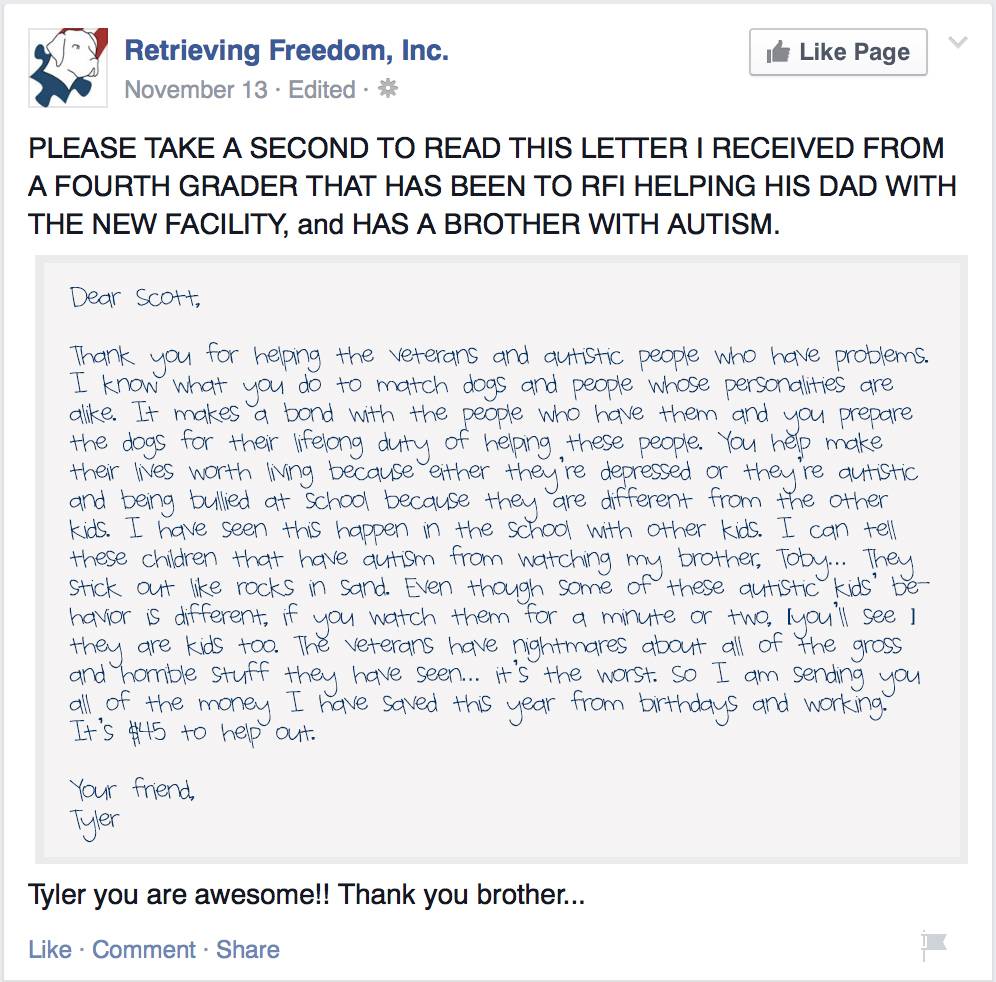
That’s why Retrieving Freedom Inc. (RF) established itself as a nonprofit in 2011 to assist Veterans, children with autism and diabetics. “These dogs don’t just help the person. In the end, they help the whole community,” said Scott Dewey in an April 2013 interview with KWWL. Dogs in training reach thousands of individuals who will benefit on many levels.
The New Year is bringing about new services for RFI as it moves into its new “Thrive Again” facility in Waverly, Iowa. This facility was designed to provide animal-assisted activities with help from local Veterans, schools, troubled teenagers, college students, and community volunteers like Chad Johnson. Johnson served 13 years in the Iowa Army National Guard, through deployments in Egypt, Iraq and Afghanistan. He says helping at RFI gives him a sense of purpose and also allows him give back since he also received, Copper, a service dog from RFI.
“If I’m flashing back, processing different situations I’ve been in and anxiety’s building up, he’ll sense it automatically and just do ‘paws up’ right on me,” said Johnson in a Dec. 1, 2013, WCF Courier article. Copper will get in Johnson’s lap, lick his face, tug his sleeve and calm him by getting Johnson to play catch with a ball or go for a walk.
Another RFI volunteer is Jenna Kyhl, who is currently fostering two puppies for RFI. She says the puppies receive her care from the time they’re weaned until they’re about 8 months old. During this time, the Labradors learn to work and play. She potty trains the pups and teaches them basic commands like sit, stand and lay down. She also teaches them to lead from a person’s left side.
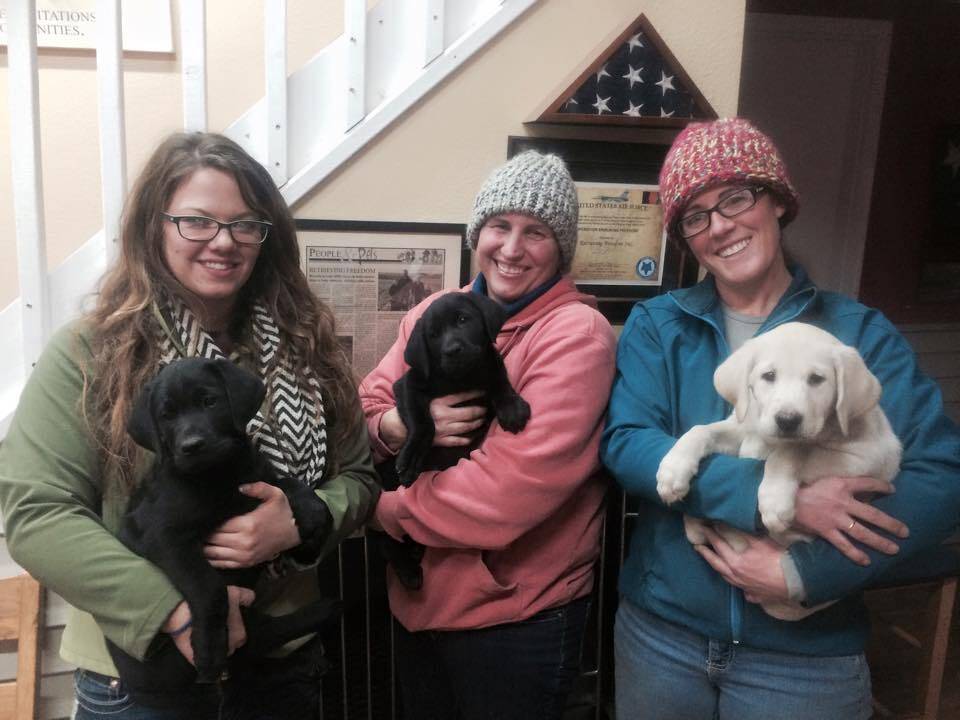
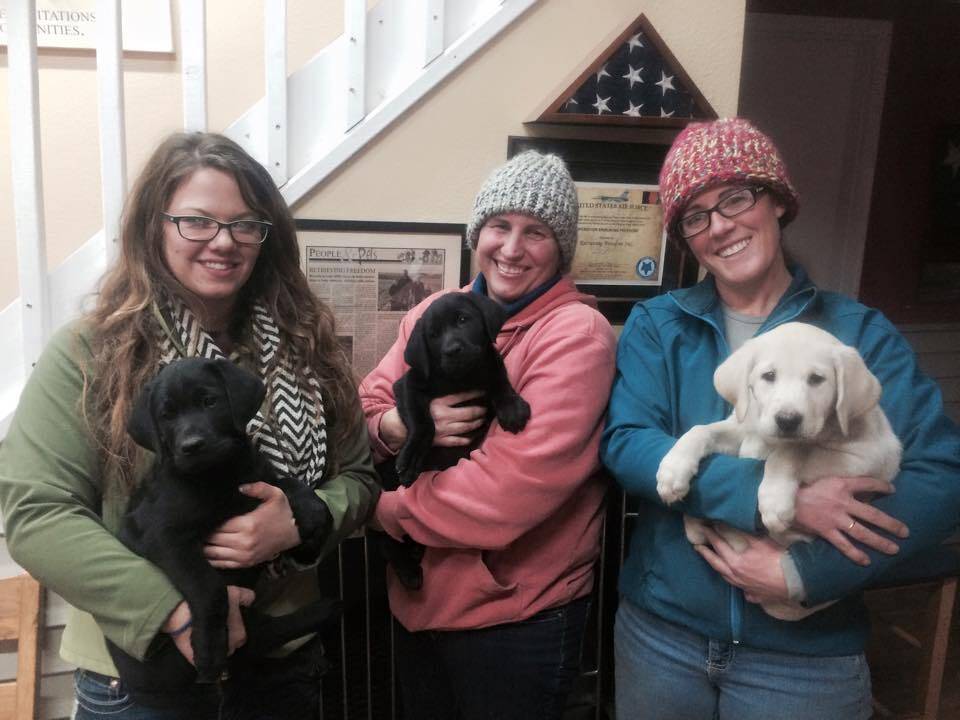
A new group of recruits arrived December 17! These puppies came from Kerrybrook kennels and were donated by Craig Christians and Chris Wincek. “Craig has been working overtime helping RFI to build a future breeding program through some wonderful bloodlines,” says Scott Dewey, co-president of RFI. Follow Retrieving Freedom one for updates on these puppies named Annie, Latham and Hellen.
“I take the dogs everywhere I go from the time they arrive,” explains Khyl. “It’s important for them to get exposed to situations like shopping in Wal-Mart and eating in restaurants.” They learn they’re “working” when they’re wearing their vest. When they’re not wearing the vests, they get to explore the yard, walk trails and play. The pups also get lots of exposure to other animals and children as Jenna takes them to work with her as riding instructor and horse trainer at Hilltop Equestrian Center.
In a recent Facebook post, Kyhl gives a look into what it means to foster a RFI puppy:
I wanted to share this with my family and friends. I know that sometimes it may not be convenient for me to have Ada, Topper or Latham with me. I do understand that having them in your homes or sitting under the table while we are out to dinner or laying on your feet in a movie may not be in your comfort zone. I understand that you are not used to the looks and questions from strangers. I understand that the extra 5 minutes it takes me to walk anywhere because of people asking questions might irritate you.
I want to say thank you for being supportive in my choice to continue fostering. Please understand that I truly believe in what I am doing, and I truly believe I am helping to make a child or veterans life a little easier. This link may allow you to put names, faces and stories with my reasons for wanting to be a foster. (http://retrievingfreedom.org/recipients-and-dogs/)
Thank you for being so understanding and supportive! Especially when the dogs may not be acting like perfect little citizens they will get there! They need to make their mistakes with me so that they are successful in making someone’s life better when it is time for them to move on to the next step.
Thank you again! Ada, Top and Latham thank you as well!
Jenna with puppies, Latham and Topper
Ada is the name of the first female Lab that Khyl fostered for RFI. In a few weeks, Top (short for “Topper”) will move to his next level of training at the RFI facility. The latest puppy, named “Latham,” arrived on December 18.
Donated by Craig Christians, Territory Sales Manager for Latham Hi‑Tech Seeds, our namesake puppy will become part of the RFI’s breeding program. Watch for updates on these dogs by following Retrieving Freedom’s Facebook page or on Twitter as @RFI_dogs.
“Latham” the pup was purchased from Kerrybrook Labrador Retrievers of Chardon in Northeast Ohio, which has developed a reputation for breeding dogs for soundness, temperament, working ability and confirmation – all important traits for service dogs.
My son and I had the opportunity to meet “Latham” on Tuesday, Dec. 23. What a sweetheart! Like any baby, he sleeps most of the day. He also needs to eat good quality foods to maintain a healthy diet during periods of rapid growth, so today we’re sharing a recipe for dog treats that won’t break your own dog’s diet.
The holidays should be a time of love and joy. Unfortunately for many folks, it’s a time of loneliness and anxiety. Today I want to explore ways to help those who are suffering from more than seasonal depression.
Disclaimer: This blog is my opinion, and the topic covered today is one that’s very personal as someone dear to me committed suicide. I chose to write about this topic because I’m raising the mental health issue with my local Farm Bureau Board and want this subject to be thoroughly vetted.
Mental healthcare is not largely understood, and there are tough questions that must be explored:
How it is funded?
How are services implemented?
Are the services accessed by the people who need it most?
How does someone even know if he or she needs services?
Will he or she admit help is needed?
While researching mental health service in North Central Iowa, I came across the Mental Health Center of North Iowa Inc. There is a lot of information available on the MHCONI website, and I read with interest a list of topics available in the center’s user-friendly library of audio tapes, video tapes, and pamphlets. I expected to find information on conditions like schizophrenia, bipolar disorder, stress, anxiety and depression. But one topic really took me by surprise…. parenting skills! Parenting must be the guiding light in any person’s mental health, but is this the right place for parenting skills to be taught?
Back to the money part… How is mental health financed? The Mental Health Center of North Iowa has had a history of deficit budgets. In the past, the counties served were responsible to cover costs. It’s difficult to determine from this website how funding is currently supplied, and the most recent strategic plan posted is for the years 2007 to 2012. (Side bar: I’m disappointed with the age of the information. This morning I received a call from the IT administrator for MHCONI, and he told me the current map showing that Franklin County is served by MHCONI is not current. This organization is restructuring and will soon launch a new website. Guess this means I have more research to do!)
I believe mental health is a local issue, just as gun control is. The person controlling the weapon – whether it’s a knife, a car or a hammer – is the problem. A very popular football coach was killed five years ago in Parkersburg, which is only 30 miles from my house. Coach Ed Thomas died because a former student, who suffered from mental illness, wasn’t getting the help he needed even though the young man’s parents had tried desperately to help him.
There is need to end the stigma around mental illness, as Arianna Huffington wrote in an August 18 article published by the Huffington Post after actor/comedian Robin Williams took his own life. Check out these statistics cited in her article:
In 2011 (the last year for which we have the data) there were 39,518 suicides, making it the 10th leading cause of death.
An estimated 1 million people attempt suicide each year, which, beyond the obvious tragic human toll, is estimated to cost the U.S. economy $34 billion each year.
Since World War II worldwide rates of suicide have gone up by an estimated 60 percent.
Perhaps mental health issues will appear in the spotlight again this season as the third “The Night at the Museum” movie, in which Robin Williams stars as Teddy Roosevelt, opens in theatres this weekend. Our nation’s mental health services systems needs to be updated, as much as the MHCONI website does! It appears that most organizations, in most states, are struggling to figure out how to meet today’s needs.
I truly believe that returning to our religious values and letting God opening guide us – without worrying about all the “politically correct” overtones – is key to restoring balance and health in this country. Please don’t misunderstand what I’m saying because I do not mean to downplay some of the very serious mental problems. From the beginning of time, there have been mental problems. We shouldn’t avoid the very deep dark mystery of mental health! It will continue to destroy lives and families, so we should work together to develop viable solutions.
Let us enjoy this time of Christmas and remember why we are celebrating the birth of Jesus! Reduce your stress and celebrate with joy!
The small town near where Soules grew up wants the world to know he’s not the only eligible bachelor. Twelve single men, who live within a 20-mile radius of Arlington, are on a mission. They posed for portraits that are being featured in a 2015 calendar that’s bringing the community together. A local photographer provided her services, and a local printer finished the job in time for last-minute Christmas gifts.
“The calendar is really helping boost fundraising efforts underway for the Arlington Community Center,” says John Fedeler, the Community Center Capital Campaign Committee member, who conceived the idea for the calendar. Approximately $750,000 has been raised and another $150,000 is needed.
Helping raise the remaining funds is something the Fedeler family is taking “personally.” One of John and Jackie Fedeler’s daughters helped develop the list of bachelors for the calendar. Their oldest son, 22-year-old Jake, is Mr. June. After attending Kirkwood Community College, he returned home to the family’s row crop and beef operation.
Agriculture is the backbone of Fayette County, so it’s no wonder that all 12 of the “other bachelors” either grew up on a farm, are engaged in farming or are employed in an ag-related field. Mr. July is currently a football player at the University of Wisconsin-Platteville. Mr. August was the second generation to be raised on the farm his grandfather purchased just Northeast of Arlington. He graduated from Upper Iowa University in Fayette, and teaches business at Starmont High School.
Each of the bachelors agreed to participate to help raise funds for the Arlington Community Center. Calendars sell for $14.99 and there are two options for ordering: (1) send an email to: arlingtonbachelorcalendar@gmail.com or (2) pay through PayPal using an order tab on “The Other Bachelors of Arlington” Facebook page.
In just one week, 500 calendars have been sold. The group has a goal of selling a total of 1,000. Get yours ordered today while supplies last!
In response to a post by Latham Hi‑Tech Seeds on Facebook, customers and friends shared with us some of their family’s favorite holiday foods including: potato soup, squash casserole, cheesy creamed corn and spaghetti with homemade sauce. We definitely connote certain foods with special occasions. The taste and smell of certain foods can bring back beautiful memories and help us remember special people.
Dried fruits and nuts reminds me of my late grandma baking stollen on a few occasions while visiting me and my parents. My husband associates the smell of popcorn with his grandmother. Each year Evelyn Latham, wife of company founder Willard Latham, was known for making Christmas special for her 12 grandchildren with homemade popcorn balls and ice cream dessert.
As a family-owned company, Latham Hi‑Tech Seeds’ is rooted in tradition. Right after Thanksgiving we put up the company tree in the lobby of our office, and each employee hangs the ornament with his/her name on it. We also enjoy a holiday potluck, and this potluck is like no other! Of course, we have to find new ways to celebrate Christmas in 2020 due to COVID-19, but we hope the potluck will be able to pick back up next year!
Each year there is such an abundance of food that we set up separate “buffet” tables for desserts, salads and hot dishes including pork loin, meatballs and cheeseburger soup. We were joking (at least I think we were) that it needs to become a two-day affair just so we have a chance to sample it all!
No matter how full we are, we still find room for sweets. Two of the most popular desserts we’ve had are mini Christmas Tree Cakes, which is the perfect size when you just want a little something sweet, and a beautifully decorated Yule Log.
The level of detail put into the frosting “bark” was impressive, and it certainly sparked an interesting dinnertime conversation. Some of our younger team members hadn’t heard of the word, “Yule.” Others weren’t familiar with the term “yule log.” Because I was a little curious about the history of the yule log, I did a little research and decided to share my findings on today’s blog.
“Yule” has several suggested origins, dating back to pagan religious festivals. The Old English word was geõla. The Old Norse word jõl. The Anglo-Saxon word for the Winter Solstice festival was lul, meaning “wheel” since old almanacs represented the Yule with a wheel. An important “turning point” in each year is Winter Solstice, which is the shortest day of the year and also the beginning of more daylight hours.
The Yule Log was originally an entire tree that was carefully chosen and brought into the house with great ceremony. The largest end of the log was placed into the hearth, while the rest of the tree stuck out into the room and was slowly fed into the fire throughout the Twelve Days of Christmas.
The Yule log tradition had been adapted throughout the years and varies by region. In parts of France, the whole family helps cut the log and a little bit is burned each night. If any of the log is left after Twelfth Night, it is kept safe until the next year. In some parts of Holland, the “leftover” log had to be stored under a bed until the following Winter Solstice. In some eastern European countries, the tree was cut down Christmas Eve morning and lit that evening. In the United Kingdom, the log was dried out and the bark was removed before it was brought into the house for burning.
Now that many homes have central heat, few people have wood-burning fireplaces. I’m guessing the Yule log is one holiday tradition that isn’t widely practiced anymore. After reading about its history, however, I’m inclined to adapt a new tradition for our family. We have a real Christmas tree, which could be chopped up in January and then enjoyed throughout the summer as a campfire. I learned that sprinkling different chemicals on a log will create different colored flames:
Potassium Nitrate
Violet
Barium Nitrate
Apple Green
Borax
Vivid Green
Copper Sulphate
Blue
Table Salt
Bright Yellow
In honor of the Yule Log tradition, we are sharing a treasured recipe for the festive sponge cake.
Sometimes the truth hurts… but it doesn’t have to! Sometimes you find yourself laughing while listening to ridiculous situations being dramatized by a funny motivational speaker and think, “Yes, I do resemble that comment!” The latter is the situation I found myself in earlier this month while listening to Colette Carlson deliver her presentation, “3 Truths Female Business Leaders Need to Know,” during the 4th Annual Executive Women in Agriculture conference hosted by Top Producer magazine and Farm Journal companies.
“Leadership is not a job title,” said Carlson. “Leadership is a state of mind. Be the kind of leaders others need.” Since the number one characteristic people want from a leader is trustworthiness, it’s time to “speak your truth.”
CAUTION: Speaking your truth is not the same as speaking your mind, says Carlson. Speaking the truth means you say what needs to be said with tact and diplomacy. Respect yourself enough to speak up; respect someone else enough to tell them what you need.
“We teach others how to treat us,” says Carlson. “Most likely, you’re teaching your company, your boss, your kids, and your family that you will keep taking on more and more responsibility to make their life easier. By saying ‘yes’ to everyone else you are saying ‘no’ to yourself. It’s time to speak your truth.”
Literally speaking of “standing in the truth,” remember that body language shapes who you are. Body language affects how others see us, and it also affects how we see ourselves. Social psychologist Amy Cuddy has shown that power posing — standing in a posture of confidence, even when we don’t feel confident — can affect testosterone and cortisol levels in the brain. A “power pose” might even have an impact on our chances for success!
“The Wonder Woman power pose – legs wide, fists on hips – has been proven scientifically to boost self-confidence by increasing testosterone and decreasing cortisol,” writes Carlson in a blog post entitled, Do You Know the Wonder Woman Truths? “…Try this effective hormone manipulation next time you’re faced with speaking up for yourself. Take two minutes in a private place (bathroom stalls work great), strike the Wonder Woman pose, and notice how much easier it is to face your fears.”
Keep in mind that not even Wonder Woman depended on herself alone. The ruby in her tiara allowed her to connect with colleagues and loved ones back home. Who’s there to support you when you have tough decisions to make? If you haven’t already done so, Carlson recommends cultivating a mentor, sponsor, friend, or coach to help you meet your goals. Also be accountable to yourself.
Hold up the mirror and be honest, challenges Carlson. Are you doing what YOU want to do? Stop the “lies”! Limiting Ideas Eliminate Success. Be honest about yourself or your choices.
“Avoiding the truth limits your potential,” says Carlson. “What is not speaking your truth costing you? Risk being real!”
Sometimes a woman is her own worst enemy! We find ourselves saying “yes” to one more thing, especially during the holidays.
“Do less. Be More. That’s my goal this Christmas season,” Lysa TerKeurst, author of The Best Yes: Making Wise Decisions in the Midst of Endless Demands,” posted last Saturday on Facebook. Limiting items on the to-do list is one sure fire tactic to reduce stress during this season and always.
We end up stressing because we try to put too much into our day, said certified professional speaker and human behaviorist Colette Carlson December 5 to a group of about 300 women in attendance at the Executive Women in Ag (#EWA14) in Chicago. “The truth is you’re never going to get it all done,” she said. “What you really need to do is create a Not-To-Do List.”
Items that bog you down should be moved from the “To-Do” to the “Not-To-Do” list. Some tasks currently identified as Not-To-Do’s may someday make your To-Do List, says Carlson, but right now other values and goals take priority.
So why do women agree to take on more when we really want to say “no”? Most of us are afraid of disappointing or angering someone we love or respect. We don’t want to be criticized, talked-about or judged. (Hmmm… Isn’t it ironic that women tend to be more critical and judgmental of other women?)
To help determine whether accepting a request to help is worth your time and effort, Carlson recommends asking yourself these questions:
Will this task give you access to, or recognition or respect from, a connection you’re cultivating?
Will it simply take energy, focus and time away from other vital deliverables?
Or will it develop a skill set you’re looking to grow?
Recent research by Lise Vesterlund, economics professor at the University of Pittsburgh, reveals that women in the workforce are more likely than men to: (1) Volunteer to do non-promotable tasks; (2) Be asked to do non-promotable tasks; and (3) Agree to do these tasks.
“No” just may be your password to the next level. The second “truth” that Carlson shared during her presentation to Executive Women in Ag is “To go to the next level, you must grow to the next level.”
No matter your position or career goals, you can benefit from adapt these truths to fit your situation. “Leadership is a state of mind, not a job title,” says Carlson. Whether we’re managing our own household or leading a Fortune 500 company, all women know what it’s like to feel overcommitted. That’s why it’s so important to know when to take control and when to let go. “Let it go, let it go!”
Mechanization Transforms Everything from Household Chores to Exercise
I was listening to NewsRadio 1040 WHO early one morning last week as talk show hosts Van & Bonnie were broadcasting live from a Des Moines-area mall. Van mentioned how the “mall walkers” were surprised by the station’s early morning activities. My first thought was, “Why would anyone be in the mall that early to walk?
That thought prompted me to consider how physical activity has changed during the last century. We all know that our eating habits have changed throughout the years. We consume far more calories today than we ever have, but these calories come from different foods than those that graced our ancestors’ tables. Many foods today are processed, unlike a generation or two ago when homegrown foods were eaten fresh or canned to last throughout the winter months.
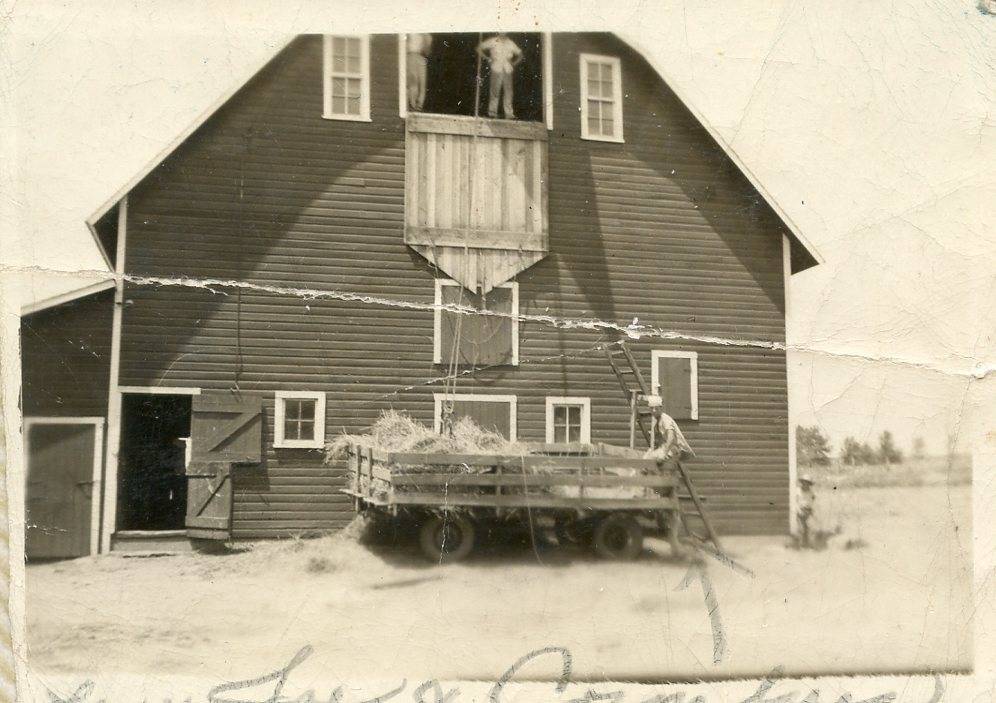
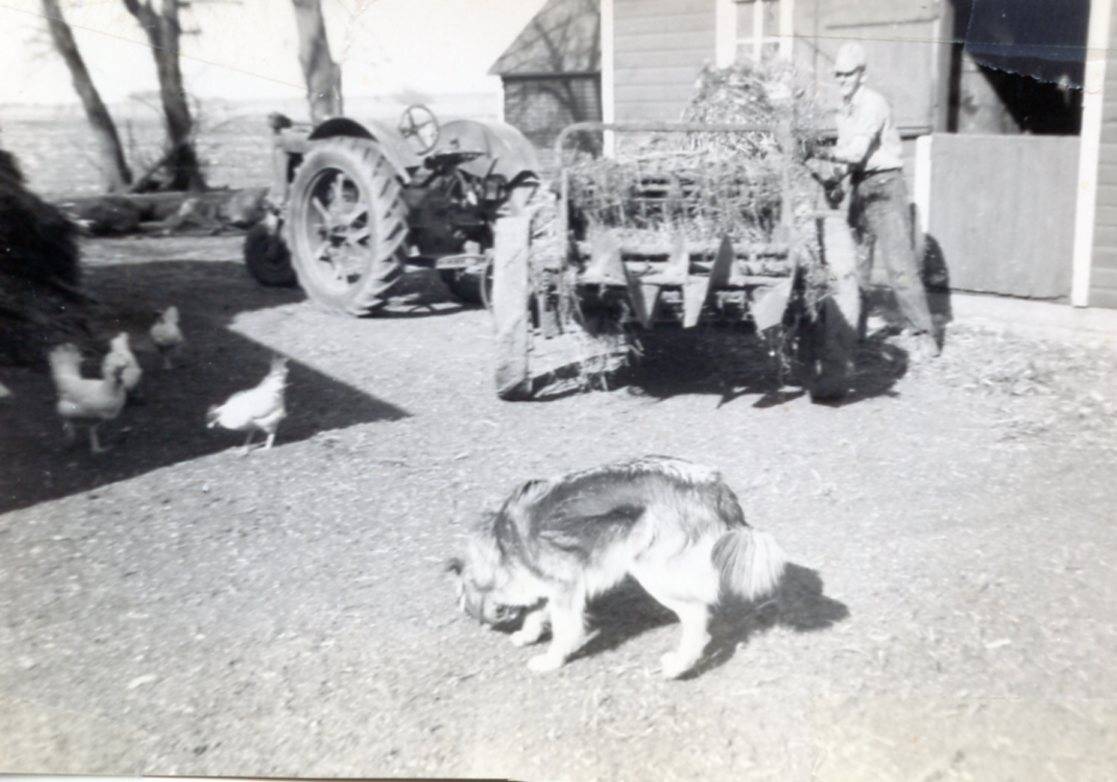
Putting hay in the barn
In the old farm house where I grew up, there was a “potato room” in the basement that was like a root cellar. There also was a “fruit room” where home canned goods were kept. A dumb waiter, or manual elevator, lowered food onto the basement floor where it was keep it cool since there wasn’t any refrigeration at the time this house was built.
Now back to the mall walkers… When I was young, walking was something we did to get to the barn or to a field. Chores on Saturdays involved a pitchfork and a shovel. Three or four times during the summer months, we baled and stacked hay. No wonder farm kids were in pretty good shape for sports!
Pitching manure
In “the good old days,” cows were milked by hand. Barns were cleaned by hand. Even corn was picked by hand. This has changed to where today many farmers do not even need to steer their tractors across the field! In fact, 41% of the U.S. workforce in in 1900 was needed to grow food. As of 2000, only 1.9% of Americans farmed.
It stands to reason that just as farm chores transformed in the 20th Century, off-farm jobs also have become more mechanized during the past 100 years. A pallet of seed that I plant is now stacked neatly by a robot. Much of the welding in a factory is done by robots. I toured a factory where my hog feeders were built, and the steel is cut and placed by robots!
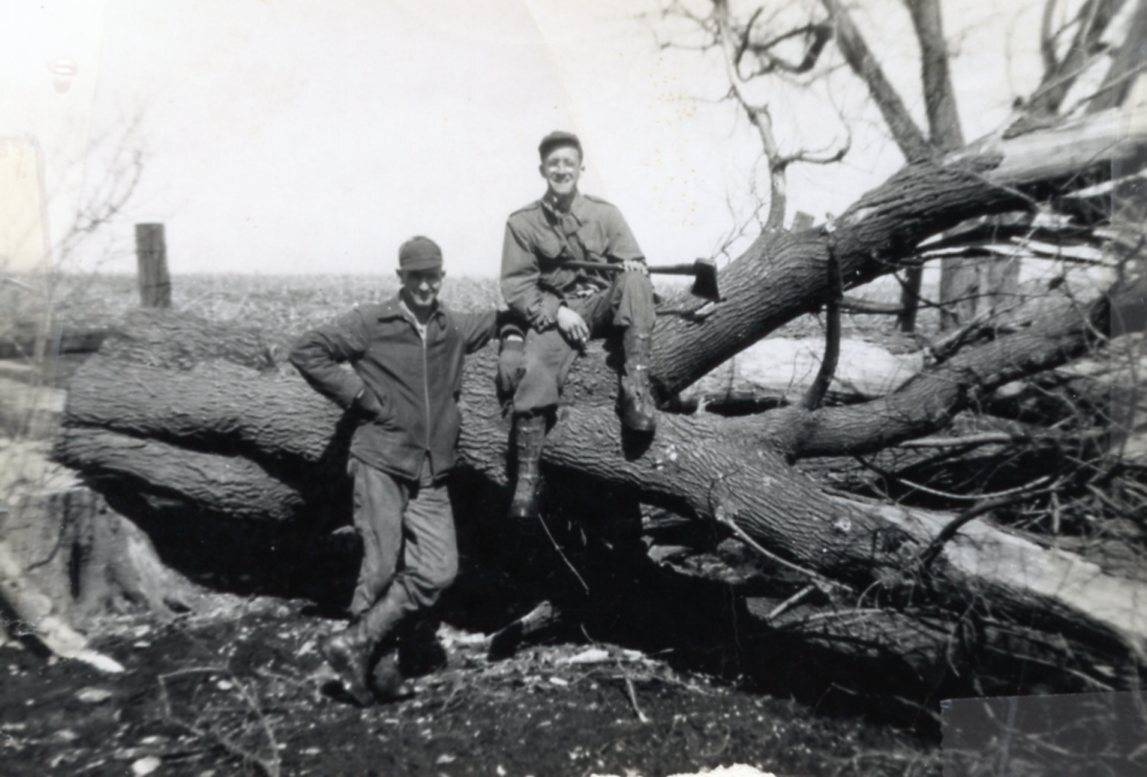
Chopping down a tree with an axe
Even households chores are different today. Central vacuums have eliminated the need to pull around a big vacuum, and coming on strong is the Roomba… you guessed it, a robot vacuum!
Entertainment has changed through the years, as well. When I was young – after chores, of course – neighborhood kids would get together to play football or basketball. I either rode my bicycle or my horse to get to the neighbors. Going outside to play was the most entertaining “option” as we only had three TV channels, and cartoons only aired on Saturday mornings. Video games were nonexistent.
The mechanization of American has created a new industry. Instead of “working off” calories, today we must “work out” to stay fit. Don’t get me wrong – I admire those early morning walkers in the shopping mall. But I can only imagine
Plowing
what my grandmother, who milked cows by hand, would think of someone driving to the shopping mall to go walking. Come to think of it, I wonder what she would think of an actual shopping mall. Times have certainly changed!
“The most peaceful thing in the world is plowing a field. Chances are you’ll do your best thinking that way.” – Harry S. Truman
Since I practice minimum tillageand no longer plow, I do my best thinking early in the morning while listening to the radio. Thanks for allowing me to share my thoughts with you today!
Women tend to look at themselves in the mirror and think, “Today is not a good hair day.” (Yes, some women actually begin the day with a personal put down! I just may be speaking from personal experience.) When someone offers us a compliment, we downplay it. For example, someone might say to me, “I love your scarf.” I might respond, “This old thing? I got it on clearance last year for $9.99.” Sound familiar?
The truth is that every woman has incredible strengths, said motivational speaker and author Colette Carlson as she addressed a group of about 300 U.S. farm women, who gathered Dec. 5 in Chicago for the 4th annual Executive Women in Ag conference.
“Learn to express your success” is one “truth” Carlson shared during her breakout session entitled, “3 Truths Female Business Leaders Need to Know.” Start playing to your strengths by taking three relatively simple steps:
Milk a compliment. Humbly accept kind words rather than diluting a compliment. When you devalue a compliment, you send the message that you either aren’t confident in your work or that you don’t respect the opinion of the person who gave you the praise. Learn 7 ways to accept compliments graciously – and then make the most of them!
Be a human highlighter. It’s much easier to compliment someone else; highlight the accomplishments of a professional ally, who will in turn, make others aware of your achievements. If you’re a business leader, be sure to champion the strengths of every individual on your team, advises Carlson.
Talk yourself into, rather than out of, opportunities. Studies show that women’s lack of confidence consistently holds them back. Whether speaking your truth, delivering a presentation, requesting a promotion, or undertaking some other fear-inducing endeavor, Carlson says confidence is the catalyst propelling us forward.
Clear and direct communication is necessary whether we’re dealing with customers, employers or employees. Employees stay more engaged in work environments with sincere communication and clear expectations.However, when women are too direct, Carlson says it’s mistaken for arrogance. When they’re too succinct, they sound abrupt.
To avoid sounding *itchy, match your tone and body language to the words you’re saying. Carlson demonstrated this by asking the ladies in her #EWA14 workshop to say the word “oh.” This simple two-letter word can convey a host of meanings, depending on tone: curiosity, understanding, disappointment, surprise and affection.
The same hold true when saying “no.” The meaning of this two-letter word also takes on different meanings depending on the tone used. Quite honestly, I have a hard time saying “no” because I don’t want to disappoint anyone. (After all, I grew up providing customer service and made a living providing client service!) But as Carlson points out, we don’t have to be mean when we’re saying what we mean. It’s all about the words we chose and the tone we use, so I’m going to practice saying “no” with clarity.
Saying “yes” all the time can be a career-limiting factor, adds Carlson. Plus saying “yes” adds to our stress levels. This holiday season – and all year long – I’m resolving to practice ways that take off stress. If this sounds like something you want to try, be sure to read Part II of my “The Truths Every Female Needs to Hear” series where I explain how (and why) “No is your password to the next level.”
P.S. My husband and children had been watch out because I’m “getting my ask in order” as Colette Carlson would say!
Meet Steph Essick, 2014 Midwest Farm Mom of the Year
Traveling to the Windy City during the first week of December for the annual Executive Women in Ag (#EWA14) conference is my favorite getaway of the year – and it’s not just because we’re within walking distance of some of the best shopping in America. Honestly, I’ll bet more conference attendees tour the Chicago Board of Trade than visit the Miracle Mile as these female farm leaders are more concerned with financial statements than with fashion statements.
“Stephanie exemplifies today’s farm mom!” wrote Sally Hollis in her nomination of Stephanie Essick as 2014 Farm Mom of the Year. “We’ve been family friends since birth, and Stephanie’s passion for farming excited me to join our family farm. She shares this passion with her Facebook page called ‘Life on an Iowa Farm’ and on Twitter @IAFarmLife. She educates the public, answers questions, addresses misconceptions from consumers, and shares amazing photos of daily family and farming life.”
A fourth generation farmer from Dickens in Northwest Iowa, Stephanie began farming full-time with her father upon earning her bachelor’s degree in 1999 from Iowa State University in Ag Business. Stephanie is key to her family farm’s success. In addition to managing the technology and doing the farm accounting, she plants and harvests corn and soybeans plus bales hay. Once the fall tillage is complete, Stephanie finalizes her input purchases for the following year’s crop.
“December is busy with bookwork and meetings plus delivering grain and hay,” says Stephanie. “We’re also planning for 2015 by buying inputs such as seed. The calendar fills up fast!”
In addition to being a full time farmer, Stephanie is active in the agriculture community. She is a volunteer spokesperson for CommonGround and communicates online to help others understand the importance of a healthy, abundant food supply. She also serves on the Iowa Soybean Association board of directors and has traveled to Mexico with ISA on a fact finding promotional mission. As a member of an Iowa Corn leadership group called I-Lead, Stephanie traveled to Japan and Taiwan on a market development and fact finding mission.
Stephanie also is involved in her local community. She and her husband chair the fellowship committee for their local church. She also volunteers to help with the Clay County Agricultural Breakfast and with commodity groups’ activities at the Clay County Fair.
“I make time to volunteer because I know how important it is for consumers to understand how their food is raised,” says Stephanie. “I want them to meet farmers like me who are proud of the crops they raise. I also want consumers to know that, just like them, I’m a wife and mother, too.”
Stephanie’s husband, Matt, works full time as an agronomist. Their son, who will turn 8 later this month, wants to grow up and become a farmer like his mom. In honor of his birthday, today Stephanie is sharing the recipe her son requested to take to school as birthday treats. This Iowa farm boy loves his Dirt Cups… with worms. After all, worms are a sign of healthy soils!


 Even though it wasn’t gift wrapped and placed under a tree, U.S. seed companies and farmers alike were handed a gift last week when China officially announced it will approve imports of hybrids with the Agrisure Viptera® corn trait. This approval covers grain and corn processing byproducts, such as dried distillers grains (DDGs), for food and feed use.