Latham Hi-Tech Seeds

(641) 692-3258

  • Home
  • Products
    • Corn
    • Soybeans
    • Alfalfa
    • Corn Silage
    • Seed Guide
  • Performance
  • Find a Rep
  • Media
    • Blog
    • News
    • Videos
    • Podcasts
    • TECHTalk
  • About Us
    • Company History
    • Our Mission
    • Careers
    • Become a Rep
    • Sowing Seeds of Hope
  • Contact Us
  • Latham Hi‑Tech Seeds

    Corn Borer Pressure Escalates in Latham Country

    Latham Corn Product Specialist Nick Benson is seeing above-average pressures of corn borer in his northeast Iowa territory. If your acres aren’t protected by a corn borer trait, Nick advises you to check fields as soon as possible for corn borer larvae and consult with an agronomist about treatment if thresholds are met. 

    Click the video below for information on how to scout your fields for corn borer. 

    [youtube]http://www.youtube.com/watch?v=4YbFHunRgSY&feature=channel_video_title[/youtube] 

    Trio of late-stage larvae showing dark and light color phases

    According to Iowa State University’s Pest Management website, corn borers are often misidentified. This link provides their suggestions for identification and scouting based on the growing season. 

    Female moths have dull, buff colored wings while males have brown colored wings.

    Corn Borers damage plants when their “boring” tendencies disrupt the plant tissues and interfere with water and nutrient uptake and transfer. Boring into plants creates a wound providing opportunity for infectious disease to enter the plant. Lastly, corn borers can cause weakened stalk and ear strength leading to lodging or ear drop. It’s important to catch these pests early on in the infestation stages to prevent severe damage to the integrity of your plants. 

    Late-stage larvae commonly tunnel into the earshank of corn.

    Management approaches differ according to generation of corn borer, stage of growth in the corn plants and the cost analysis in your field. Iowa State provides these guidelines, but it’s advisable to run an individual analysis and consult with your agronomist for recommendations to suit your unique situation. 

    For more information on corn borer or management approaches, don’t hesitate to ask questions in the comment box below, or contact us directly.

    Gary Geske

    July 11, 2011
    Agronomics, Corn, Crop, General, Insects
  • Latham Hi‑Tech Seeds

    Seeing Twisted Whorls and Yellowing Corn?

    Nick Benson, Latham’s corn product specialist for the east, has been seeing Twisted Whorl Syndrome in fields.

    Corn plant with signs of Twisted Whorl Syndrome

    This syndrome is most evident in the late V5 to early V6 stages, when corn has five to six visible leaf collars and is about knee-high.  The lowermost leaves appear normal although some may exhibit some crinkled tissue near the base of the leaf blade, according to a newsletter article by Purdue University.  Beginning with the sixth or seventh leaf, the whorl is tightly wrapped and bent over at right angles to the ground.

    While the cause of Twisted Whorl Syndrome is not fully understood, there are some correlations between weather.  This phenomenon is more often

    Ribbing on lower leaf results from Twisted Whorl Syndrome.

    present when there has been a sharp transition from periods of slow corn development (typically, cool cloudy weather) to periods of rapid corn development (typically, warm sunny weather plus ample moisture).

    There is little or no effect on yield from periods of twisted growth. By the time the affected plants reach waist to chest-high, the only evidence that remains of the previous twisted whorls is the crinkled appearance of the most-affected leaves.

    Click the video link below for a short “How To” from Nick Benson on identifying Twisted Whorl Syndrome in your fields.

    [youtube]http://www.youtube.com/watch?v=rLUfOiTVCQM&feature=channel_video_title[/youtube]

    Gary Geske

    June 23, 2011
    Agronomics, Corn, Crop, Disease, General
  • Latham Hi‑Tech Seeds

    Straight from Corn to Soybeans

    What a difference one week makes!  A weekly survey shows 69% of Iowa’s 2011 corn crop was planted as of May 8 compared to only 8% on May 1.

    Yesterday, while being interviewed as part of Latham’s Crop Tour, Latham® dealer Mike Aldinger said he finally started planting his corn on Monday, May 2.  He finished planting the last of his corn acres Monday, May 9, on his farm near Iowa Falls, Iowa, in the North Central part of this state.

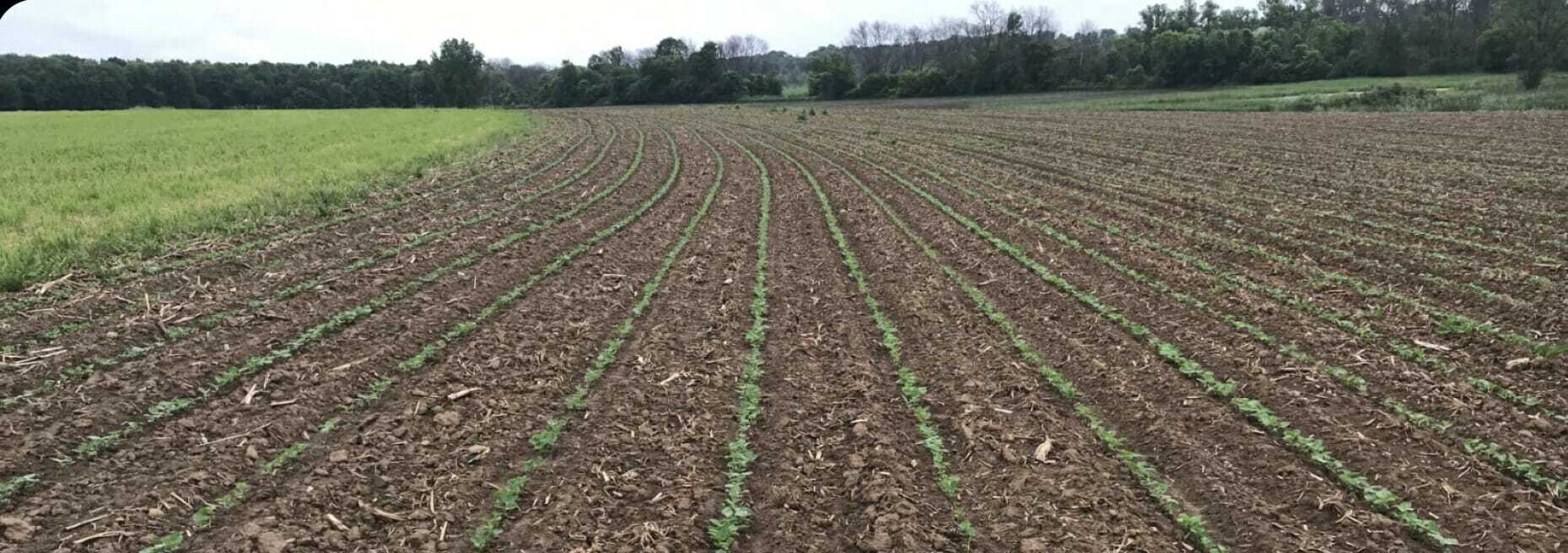
    Without delay, Mike started planting his 2011 soybean crop.  Going straight from planting corn to soybeans appears to be the trend this season, but it has caused many farmers to question whether it’s the right thing to do. Optimal soil temperatures for soybean germination and growth is a minimum of 55-60 degrees Fahrenheit, and soil temperatures statewide are averaging well above that this week.

    “Last year many soybeans were planted in mid-to-late April in absolutely perfect soil and weather conditions. Then cold, rainy conditions followed,” John Holmes, Iowa State University Extension crop specialist at Clarion in north central Iowa, was quoted in yesterday’s Wallaces Farmer article.

    That’s why it’s important for farmers to take a look not only at current weather conditions but also at the short-term forecast.  If the seedbed is suitable, we’re encouraging our customers to start planting soybeans without delay.

    Soil temperatures have climbed an average of 1 degree daily for the past three days in a row in Franklin County, Iowa.  And, soil temperatures should only continue to climb thanks to 90-degree temps yesterday and highs in the 80s and 70s forecast for the next two days.  The five-day forecast calls for temperatures to cool slightly and for rain to set in late this week, so it appears there is a window of opportunity to plant soybeans now.  Why not take it?

    Webspec Admin

    May 11, 2011
    Agronomics, Corn, Crop, General, Soybeans
  • Latham Hi‑Tech Seeds

    Establishing a Good Soybean Stand

    Farmers are continually working to increase their soybean yields. The statewide average in Iowa is now more than 50 bushels per acre, but last year several farmers broke the 80-bushel yield barrier with Latham soybean genetics and the Genuity® Roundup® Ready 2 technology.

    Raising record-breaking soybeans begins before the seed even hits the soil. Mark Grundmeier, Latham’s product manager, recently contributed to a Wallaces Farmer article with tips on how to establish a good soybean stand.

    In the article, Mark says the first step to establishing a good soybean stand starts with treated seed. The benefit from seed treatments far outweigh the costs. He adds that fungicide-treated seed is a must to prevent damping off from Pythium, Rhizoctonia, Phytopthora and Fusarium. It’s no secret soybean plants are subject to thousands of variables throughout the growing season.

    Proper planting conditions are crucial, and Mark says it’s important to remember that it’s much better to plant correctly than to plant quickly. Soil temperature sets the stage for healthy growth, and he recommends a temperature of 50 degrees or more at planting.  It’s also important to wait for soils to dry. Wet soils cause trouble from the beginning, and compaction resulting from wet soil can kill root growth.

    For Mark’s full list of tips to establish a good soybean stand, click here to read the article in Wallaces Farmer.

    Team Latham

    April 7, 2011
    Agronomics, Crop, Emergence, General, Soybeans
  • Latham Hi‑Tech Seeds

    It's March: Time to Pick Your Strongest Players

    Morehead State beat Louisville.  Richmond beat Vanderbilt.  Virginia Commonwealth beat Georgetown.  There’s nothing like March Madness! The first weekend of tournament play is one of my favorites because there are so many upsets, near upsets and buzzer beaters.  Inevitably, a Cinderella team upsets a highly ranked Goliath team.

    Latham Hi‑Tech Seeds knows what it feels like to be positioned against a Goliath.  And just like many of these basketball teams, we’re prepared to do battle.  The 2011 acreage battle is expected to intensify through spring, but our starting soybean lineup is ready to play as acres become available.

    Our team captain and power forward is Latham 2440R2, which was the top yielding bean in its maturity across the entire industry in 2010!  When head-to-head with Y-series beans, Latham 2440R2 beat 92Y30 by 8.2 bushels per acre (bu/A) across 21 research locations in 2010.  It shoots a high percentage, winning 69% of the time in Latham’s own yield trials last year across Wisconsin, Iowa, and South Dakota.  Latham 2182R2 is the defensive stopper – great against major diseases – that every team needs at the “wing forward” to win.

    Our “big man” is Latham 2885R2.  This “center” was one of the highest yielders in Latham’s internal 2010 research trials.  Medium tall with good stress tolerance, L2885R2 scores high against Phytophthora, white mold, and SCN tolerances.  The guards on our team on Latham 1985R2 and Latham 2084R2.  These two provide the speed out of the ground, yield potential and defensive characteristics, like excellent resistance to Iron Chlorosis and Cyst Nematode, that our customers need to win.

    Make sure your planting top scorers this spring.  Call on Latham, the soybean team with nearly 65 years of proven product performance.  We’d love the chance to put a winning team in place for you!

    John Latham, President

    March 21, 2011
    Crop, General, Season, Soybeans, Spring
  • Latham Hi‑Tech Seeds

    Pushing Corn Populations

    With corn pushing $6 to $7 per bushel, many farmers will look at pushing corn populations to increase yield even more this year.

    “Trying to uncover the mystery behind plant populations” is the focus of a recent Wallaces Farmer article, featuring Latham’s own Nick Benson.  As corn product specialist and Northeast Iowa regional sales manager, Nick had the opportunity to share his thoughts with Rod Swoboda.

    There are multiple factors corn growers should consider when looking to push plant populations, but Nick says the highlights include:

    1) Reviewing the true data – not the skewed data.

    2) Avoiding planting populations that are too high and thus risking decreased yield.

    3) Remembering that all growing conditions are different, from grower to grower and from field to field – plant populations aren’t a “one size fits all” practice.

    Click here to read the full article and to get Nick’s complete list of factors to consider when pushing plant populations.

    With corn markets where they are today, are you planning to push population in your field(s) this year?

    Team Latham

    February 28, 2011
    Corn, Crop, General
  • Latham Hi‑Tech Seeds

    Fertility Levels Key to Raising Top Soybeans, Part II

    A common practice for farmers in a corn-soybean rotation is to apply enough P&K prior to planting corn to supply their crops for two years.  This works well until corn yields are higher than expected, and no extra nutrients are added for the subsequent soybean crop.  Soybeans are big users of Phosphorus (P) and Potassium (K), and soybean yields will suffer unless more nutrients are applied to compensate for the higher corn yields.

    Nitrogen is essential to photosynthesis.  Nitrogen is usually supplied to soybean plants by a process called nitrogen fixation, which is associated with Rhizobia bacteria in the soil.  It’s important to note, however, that these bacteria are not always present – especially if soybeans haven’t been grown in that field for a few years.  Recent studies show that adding an inoculant to seed may have beneficial effects if planted in soils with low organic matter content or in fields that have undergone significant flooding in recent years.  Try inoculants in your own fields and study whether they benefit your production levels.

    In addition, be sure to monitor the calcium levels in your fields.  There are soils in the Upper Midwest that contain too much calcium.  Known as alkali soils, they can cause other problems for soybean development including stunting, poor root development and iron deficiency chlorosis.

    Soybean yields will also suffer if micronutrient levels are deficient, even if there is adequate P & K present.  If soil tests show low levels of Sulfur, Zinc and Boron, add them to your fertilizer blends.

    Managing nutrient levels will help produce maximum yields – and returns – from your soybean crop given the high market values.

    Webspec Admin

    February 24, 2011
    Agronomics, Crop, Fertility, General, Soybeans
  • Latham Hi‑Tech Seeds

    Fertility Levels Key to Raising Top Soybeans

    Greg 1

    You can only yield what you put into your crops.  If you supplied enough of all of the nutrients required to produce 70-bushel soybeans but provided only enough of one nutrient to produce 40-bushel soybeans, then your yield will only be 40 bushels per acre!  Simply stated, this is what the computer industry refers to as “garbage in – garbage out.”

    To better manage nutrients for your soybean crop, pay particular attention to:

    1. N, P and K;
    2. Secondary nutrients like Calcium and Sulfur;
    3. Micronutrients like Manganese, Zinc and Boron.

    Greg 1Begin by establishing a soil sampling protocol for all of your fields.  Not only will this give you the best field-by-field fertilizer history, but it will be invaluable to your long-term nutrient management strategy.

    A common practice for farmers in a corn-soybean rotation is to apply enough P & K prior to planting corn to supply their crops for two years.  This works well until corn yields are higher than expected, and no extra nutrients are added for the subsequent soybean crop.  Soybeans are big users of Phosphorus (P) and Potassium (K), and soybean yields will suffer unless more nutrients are applied to compensate for the higher corn yields.

    Nitrogen is essential to photosynthesis.  Nitrogen is usually supplied to soybean plants by a process called nitrogen fixation, which is associated with Rhizobia bacteria in the soil.  It’s important to note, however, that these bacteria are not always present – especially if soybeans haven’t been grown in that field for a few years.  Recent studies show that adding an inoculant to seed may have beneficial effects if planted in soils with low organic matter content or in fields that have undergone significant flooding in recent years.  Try inoculants in your own fields and study whether they benefit your production levels.

    In addition, be sure to monitor the calcium levels in your fields.  There are soils in the Upper Midwest that contain too much calcium.  Known as alkali soils, they can cause other problems for soybean development including stunting, poor root development and iron deficiency chlorosis.

    Soybean yields will also suffer if micronutrient levels are deficient, even if there is adequate P & K present.  If soil tests show low levels of Sulfur, Zinc and Boron, add them to your fertilizer blends.

    Managing nutrient levels will help produce maximum yields – and returns – from your soybean crop.

    Webspec Admin

    February 23, 2011
    Agronomics, Crop, Fertility, General, Soybeans
  • Latham Hi‑Tech Seeds

    Tips to Maximize Soybean Yields

    A recent Successful Farming article provided readers with helpful tips for bagging more soybeans next fall. Below are a few of the 21 tips provided.

    1) Look for a high-yielding variety in your maturity zone. Mark Grundmeier, product manager for Latham Hi‑Tech Seeds, says variety selection is THE most important factor contributing to soybean yields. Careful variety selection can help reduce or even eliminate many stress factors including disease, insects and Soybean Cyst Nematodes. Remember “genetics first, then traits.” You can’t expect great trait performance from inferior genetics. Read more on variety selection.

    2) Plant on time. Note that this does not necessarily mean planting early, but planting timely. Mark says farmers need to balance the benefits of early planting with the risks. While soybeans are a light-sensitive crop and it stands to reason the earlier-planted crop receives more sunlight and creates more yield, farmers who plant early must also protect soybeans from seedling diseases and insects. Thus, at Latham, we recommend the use of seed treatments containing either a fungicide or a fungicide-insecticide combination. Our SoyShield™ brand seed treatments are an excellent choice to help with this.

    3) Stop SDS. Last year, many farmers in the Midwest were dealt the challenge managing an SDS outbreak in their fields. In these videos, Mark Grundmeier provides tips for preventing and managing SDS.

    Which of the above steps do you think is most important in maximizing yield?

    Click here for the full list of tips provided in the article.

    Team Latham

    February 8, 2011
    Crop, General, Soybeans
  • Latham Hi‑Tech Seeds

    USDA Approves Roundup Ready® Alfalfa Without Conditions

    The ag community breathed a sigh of relief last Thursday when the United States Department of Agriculture (USDA) announced the deregulation of Roundup Ready Alfalfa without conditions.  As a result, Roundup Ready Alfalfa will be available for spring 2011 planting.

    “This is really a win for farmers across the country as the UDSA’s handling of Roundup Ready Alfalfa could have set an unwelcome precedent for other biotechnology-derived crops,” says John Latham, president, Latham Hi‑Tech Seeds.

    The USDA’s Jan. 27th decision was the final step in an extensive environmental review process that took 46 months to complete.  For additional background information about this process, visit http://www.roundupreadyalfalfa.com/.

    For alfalfa growers’ perspective on the benefits of Roundup Ready alfalfa, check out these two blog posts:

    • http://www.truthabouttrade.org/news/editorials/board-commentary/17172-litigation-is-the-root-of-the-problem
    • http://commonsenseagriculture.com/2011/01/21/roundup-ready-alfalfa-understanding-practices/

    Team Latham

    January 31, 2011
    Alfalfa, Crop, General, Industry News, Seed Technology
Previous Page
1 … 55 56 57 58 59 … 62
Next Page

Latham Hi‑Tech Seeds

131 180th Street | Alexander, IA 50420

(641) 692-3258

SIGNUP FOR OUR NEWSLETTER
  • Contact
  • Legal
  • Dealer Center
  • Seedware Login
  • Latham Gear

© 2025 Latham Hi‑Tech Seeds. All rights reserved. | Iowa Web Design by Webspec | Privacy Policy

Latham® Hi-Tech Seeds is a trademark of M.S. Technologies, L.L.C., 103 Avenue D, West Point, IA 52656.