Latham Hi-Tech Seeds

(641) 692-3258

  • Home
  • Products
    • Corn
    • Soybeans
    • Alfalfa
    • Corn Silage
    • Seed Guide
  • Performance
  • Find a Rep
  • Media
    • Blog
    • News
    • Videos
    • Podcasts
    • TECHTalk
  • About Us
    • Company History
    • Our Mission
    • Careers
    • Become a Rep
    • Sowing Seeds of Hope
  • Contact Us
  • Latham Hi‑Tech Seeds

    Systematic, Diverse Approach Needed for RW Management

    CRW beetle

    CRW-beetleA systematic, diverse approach to corn rootworm management is needed if growers are to have successful corn-on-corn acres in the future, said Dr. Aaron Gassmann while presenting last month during the 25th Annual Integrated Crop Management Conference on the Iowa State University campus.

    Since 2009, Dr. Gassmann has studied the use of Bt corn hybrids in Iowa.  He says the number of fields showing severe rootworm injury has increased every year primarily due to the overuse of one specific trait on fields for many consecutive years, lack of refuge compliance, and lack of scouting for both larval rootworm and adult beetles.

    Farms with continuous corn production, and specifically those fields planted to the same Bt event year-after-year, are most at-risk for developing a resistant population. To delay resistance, Dr. Gassman and his colleagues recommend the following IPM approaches:

    • Rotate to soybeans or other crops to break the corn rootworm life cycle between growing seasons.
    • Consider using corn that contains different Bt proteins than ones that may have performed poorly in the past.
    • Consider using pyramided Bt hybrids, which is defined as corn that contains multiple Bt proteins targeting corn rootworm.

    Implementing a long-term integrated approach to corn rootworm management is most important, according to Gassmann. Integration of tactics across seasons is fundamental to prolonging the usefulness of any effective management strategy
    Webspec Admin

    January 30, 2014
    Agronomics, Corn, Crop, General, Insects
  • Latham Hi‑Tech Seeds

    Resolving to Obtain Higher Corn Yields in 2014

    Weather ranks as the most important factor affecting corn yield, says Dr. Fred Below, Professor of Plant Physiology at the University of Illinois.  Research he’s conducted show that weather accounts for 70 bushels per acre, or 27 percent, of total yield!

    Although we’re all hoping for better growing conditions in 2014, it’s unrealistic to think we can control the weather.  That’s why it’s important to focus on the things we can do better in our quest to raise 300-bushel corn consistently.

    Planting a portfolio of Latham® corn hybrids is one way to manage risk and improve your chances of achieving record-setting yields.  Last season we saw how different genetics handle stress from drought and wind.  That’s why genetic diversity is so important.

    You can also protect the 2014 corn crop with new technologies.  Latham’s 2014 product lineup includes 36 hybrid seed corn products, offering six different trait combinations in various maturities, for rootworm (RW) control.  In addition to corn rootworm, be sure to factor in management options to control nematodes that feed on corn.

    Nematodes are a growing problem across the Midwest, most likely due to trends of no-till farming.  Nematodes are sensitive to soil disturbance, so they tend to thrive in no-till situations.  Crop rotation isn’t an effective form of management, however, seed treatments can prevent nematodes from attaching to corn roots.  Applied directly to the seed, these treatments help prevent damage to early-season seedlings and roots before pests can strike.

    When finalizing your 2014 seed purchases, consider these Latham® Hi‑Tech Hybrids with Genuity® SmartStax® technology and the Poncho/VOTiVO plus Acceleron seed treatment:

    • LH 4579 SS
    • LH 4679 SS
    • LH 4819 SS
    • LH 4959 SS
    • LH 5088 SS
    • LH 5219 SS
    • LH 5349 SS
    • LH 5689 SS
    • LH 5779 SS
    • LH 5829 SS
    • LH 6089 SS
    • LH 6239 SS
    • LH 6359 SS

    Webspec Admin

    January 15, 2014
    Corn, Crop, General
  • Latham Hi‑Tech Seeds

    Day 5: 12 Days of Christmas

    12days

    12daysOne of the best ways to manage risk is by planting a diversified portfolio of seed products that includes minimum of three or four different hybrid numbers in varying maturities.  Different flowering dates can help reduce yield loss due to heat during pollination.

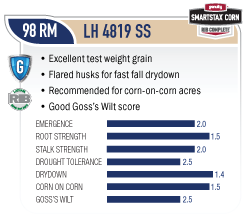
    4819LH 4819 SS, designated as one of Latham’s top Gladiator hybrids, is an excellent early product for North Iowa.  Not only does it portray a great defensive package needed for tough corn-on-corn situations, but this hybrid is high yielding with excellent test weight.  It has good stalks with excellent roots, giving this hybrid healthy late-season intactness.  Staygreen allows LH 4819 SS to move south of its comfort zone, too.

    Talk to your local Latham® representative about planting some 4819 in 2014.  If you have questions or need help finding a dealer near you, call the Latham office at 1.877.GO.LATHAM (1.877.465.2842).

    Team Latham

    December 30, 2013
    Corn, Crop, General, Industry News, Seed Technology
  • Latham Hi‑Tech Seeds

    Day 1: 12 Days of Christmas

    12days

    12daysAt Latham Hi‑Tech Seeds, we’re extending the spirit of giving for 12 more days!  Each day, from now through Jan. 5, we’ll feature some of our top performing seed products.

    Wrap up your 2014 seed order and take advantage of great discounts through January 6! Check out these “Big 3” that a great fit for eastern South Dakota, southern Minnesota and parts of northern Iowa:

    1. LH 4098 VT3 PRO RIB

      • 186.2 bu/A (2nd Overall) Casselton, ND FIRST Trials
      • 177.7 bu/A First Trials, Colfax, ND
      • 14.3 bushel Advantage over KR4189VT2P at Enderlin, ND
      • 13.7 bushel Advantage over 38N88 in 2012 3rd party replicated trials
      • 18.9 bushel Advantage over P8906HR in 2012 3rd party replicated trials
      • 17.4 bushel Advantage over P8917XR in 2012 3rd party replicated trials
    2. LH 4455 VT3 PRO RIB

      • 196.87 bu/A (1st) at Garner, IA (plot #1)
      • 200.15 bu/A (2nd) at Oshkosh, WI
      • 182.15 bu/A (3rd) at Bellingham, MN
      • 187.78 bu/A (4th) at Stewart, MN
      • 13.4 bushel Advantage over P9519HR in 2013 3rd party replicated trials
      • 23.3 bushel Advantage over 38M58 in 2013 3rd party replicated trials
      • 3.4 bushel Advantage over P9853HR in 2013 3rd party replicated trials
      • 29.4 bushel Advantage over P38A57 RRHX in 2012 3rd party replicated trials
      • 41.4 bushel Advantage over P38M58 RRHX in 2012 3rd party replicated trials
      • 19.9 bushel Advantage over N36K 3000GT in 2012 3rd party replicated trials
      • 17 bushel Advantage over N33R 3000GT in 2012 3rd party replicated trials
    3. LH 4568 VT3 PRO RIB

      • 227.09 bu/A (5th) at Sleepy Eye, MN
      • 207.88 bu/A (5th) at Osage, IA (plot #1)
      • 204.92 bu/A (5th) at Osage, IA (plot #2)
      • 187.25 bu/A (5th) at Stewart, MN
      • 172.64 bu/A (5th) at Bellingham, MN
      • 9.3 bushel Advantage over P9519HR in 2013 Latham replicated trials
      • 19.2 bushel Advantage over 38M58 in 2013 Latham replicated trials
      • 9.9 bushel Advantage over N34N-3111 in 2012 3rd party replicated trials
      • 3.9 bushel Advantage over P9630AM1 in 2012 3rd party replicated trials
      • 3.6 bushel Advantage over P9494XR in 2012 3rd party replicated trials

    Team Latham

    December 26, 2013
    Corn, Crop, General, Industry News, Seed Technology
  • Latham Hi‑Tech Seeds

    Apply the “Rule of Multiplicity” and Win

    Corn Bag

    A number of years ago, I went to Las Vegas on a business trip and spent some time observing folks in the casino.  Some appeared to have Lady Luck on their shoulder while others lost their shirts.  After watching for a while, I decided to play a nickel roulette wheel because I didn’t think I’d lose too much too quickly.

    The other reason I played roulette was to spread my risk of losing by betting on a number of colors or numbers at the same time. While it did cost me a little more each time I placed a bet, I won more often than others who only bet one color or number at a time.  I used the rule of multiplicity: placing multiple bets on multiple numbers increases the odds of winning.

    Corn_BagThe rule of multiplicity also applies to farming and risk management.  One way to reduce your risk is by planting multi-traited Latham® corn hybrids like Genuity® SmartStax® RIB Complete, which uses three different modes of action for control of European corn borer and two modes of action for Northern Corn Rootworm.

    Further reduce your risk and increase your odds for greater profitability by planting a diversified seed portfolio that includes Latham® products in varying maturities.  Each year our growing environment is different, so what may be your best hybrid this year may be second best next year.  That’s why we look at multiple plots over multiple environments to select products for our lineup.

    Just like playing the roulette wheel, you can increase the odds of achieving higher overall yields by implementing the rule of multiplicity on your farm.  Latham’s hallmark Seed-2-Soil® program can help create a crop plan by matching the right Latham product to the soils on your farm.  Learn more by calling 1-877-G0-LATHAM (1.877.465.2842).

    Webspec Admin

    December 23, 2013
    Corn, Crop, General
  • Latham Hi‑Tech Seeds

    Minimize Risk through Crop Planning

    No two crop years are exactly alike, so why base next year’s potential off last year’s results? In 2010, we received excessive rainfall. In 2011, we experienced three weeks of 100-plus degree heat. In 2012, we experienced the most severe drought since 1956. 2013 appeared to be a combination with widespread flooding and prevented planting in early spring following by long spans of extreme temps and little rain later in the growing season.

    We can’t predict the weather, but we can minimize risk from weather events through crop planning. Farmers, who planted both defensive and offensive products, will see higher yields overall. Make sure these numbers have varying maturities, too.

    Consider traits to help combat growing season risk (4) balance offensive and defensive characteristics. Keep your refuge strategy in mind as you crop plan. Latham’s Refuge in a Bag (RIB) is making the complex world of refuge simple with a broad list of options including Genuity SmartStax RIB, VT Triple PRO RIB, VT Double PRO RIB and Agrisure’s brand new 3122 E-Z Refuge option.

    Farmers in dry or light soil conditions may consider a strategy including moisture management products like the new Agrisure Artesian and Genuity DroughtGard traits newly available in the Latham product lineup this year. These products have proven to save yield in dry weather while boosting yield in those years when moisture is adequate.

    Rootworm control is a must in corn-on-corn protection, so it’s important to determine which trait is right for your situation. In an area with heavy rootworm pressure or multiple years of corn-on-corn, plant Latham hybrids with two modes of action against CRW like Genuity® SmartStax®, or the brand new Agrisure Duracade or 3122 dual mode of action.

    It’s all about balance… No matter how good a particular football team is, it can’t win on the gridiron by having a strong offense or a strong defense. It takes both! And the same is true whether you’re planting in a corn field or a soybean field. Remember to plant a minimum or three different seed numbers, with a mixture of offensive and defensive traits.

    Webspec Admin

    October 3, 2013
    Corn, Crop, General, Season, Soybeans, Winter
  • Latham Hi‑Tech Seeds

    Tips for Late-Season Scouting

    Detecting late season corn diseases ASAP will help you prioritize fields for harvest.  Hybrid maturity and crop residue management should take a backseat to weak stalks.  Start by harvesting fields with the weakest stalk to help preserve the quality and quantity of grain that goes into your hopper.

    At this time of year, the biggest concerns are stalk rots or fusarium.  Warm, moist weather with extended periods of overcast skies and high humidity makes conditions ideal for stalk rot.  Later in the season, you might see stalks break or bend below the ear.

    Walk fields now and note what you believe is the cause of stalk rot or lodging: fertility, hail, high wind, amount of rainfall, or the genetic predisposition of a hybrid.  The cause of stalk rot could affect the seed you purchase or your management practices in 2014.  There’s no better time than the present to plan your next crop!  Get your seed ordered while the availabilities of all products are at their highest.

    Webspec Admin

    September 12, 2013
    Agronomics, Corn, Crop, Disease, Fungicide, General, Insects, Soybeans, Weed Control
  • Latham Hi‑Tech Seeds

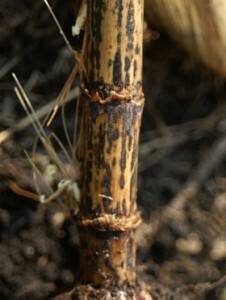
    Save Yield by Scouting for Stalk Rot

    StalkRot1

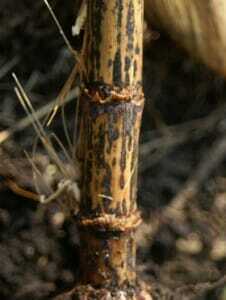
    Warm, moist weather with extended periods of overcast skies and high humidity makes conditions ideal for stalk rot.  That’s why it’s so important to continue scouting your fields.  Detecting late season corn diseases ASAP will help you access the potential impact and harvest early to preserve the quantity and quality of that grain that goes in your hopper.

    Start looking for stalk rot pathogens problems about 30 to 40 days after pollination.  Monitor stalk health over the next few weeks, and adjust harvest strategies accordingly to manage fields where stalk lodging may be a big problem.  Plants that were damaged by wind and hail earlier in the season are vulnerable to a number of problems that may show up, so it might be necessary to harvest those fields first to prevent stalk lodging or dropped ears.

    photo from the ISU Extension
    photo from the ISU Extension

    Later in the season, as the plant matures, you might see stalks break or bend below the ear.  Many factors can contribute to this situation: fertility, hail, high wind or level of rainfall, as well as the genetic predisposition of certain hybrids.  Goss’s Wilt and Gray Leaf Spot may also be contributing factors.  Knowing the true cause will help you determine how to better manage stalk rot.

    Stalk rots reduce standability.  Fields where greater than 10% of plants are affected by stalk rots should be scheduled for an early harvest.  The following video shows how to detect stalk rot.

    http://www.youtube.com/watch?v=c064-2Pd-do&feature=youtu.be

    To minimize damage from stalk rot in the future, consider these three best management practices: (1) maintain proper fertility in fields; (2) plant at recommended populations; and (3) rotate crops.  It’s important to note stalk strength and the disease package when selecting hybrids.  Only those corn hybrids with the toughest defensive package are designated as Latham’s GladiatorTM products.  They’re selected to do battle and win!  Talk with your local Latham® representative about Gladiator corn hybrids for your 2014 seed needs.

    Webspec Admin

    September 5, 2013
    Agronomics, Corn, Crop, Fungicide, General
  • Latham Hi‑Tech Seeds

    Tips to Assess Rootworm Activity

    CRW beetle

    Two months ago I posted a blog, encouraging farmers to scout every field for rootworm.  Because of the wide variance in planting dates in 2013, it’s important to continually inspect every field – regardless of seed selection – for insect pressure.

    With adult corn rootworm becoming active during silking this year, we highly recommend keeping an eye on fields in order to protect yield.  Now it is a good time to assess corn rootworm activity: score injury caused by larvae, and monitor adult activity in corn.  Late-planted fields or late-flowering hybrids are generally attractive to adult corn rootworm beetles.  Silks will still be developing in these fields when older fields have brown or drying silks.  Adults may migrate and aggregate in this later-maturing fields.

    Also evaluate root injury to better understand the efficacy of your management program.  Monitoring over several years will help establish a historical record of how larvae respond to management tactics (e.g., crop rotation, Bt corn, soil insecticides, etc.). One common outcome of severe larval feeding is lodging of corn plants.  However, it is important to confirm that feeding from corn rootworm was the cause of lodging and that it did not results from other factors such as strong winds.

    To help assess injury, ISU Entomologist Aaron J. Gassmann developed an Interactive Node Injury Scale.  Injury assessment made now and field notes taken will help you select seed products for 2014.  To prevent corn rootworm damage from reaching devastating levels, plant a portfolio of products.

    Continued use of the same rootworm-resistant trait in corn hybrids, an increase of corn-on-corn areas, plus a lack of refuge acres, has caused rootworm resistance to become an issue in some areas.  Best management practices to reduce corn rootworm pressure in the future include: crop rotation, trait rotation and respecting the refuge.

    Respecting the refuge just got easier thanks to the EPA last week granting approval of Agrisure Duracade E-Z Refuge trait stacks.  New, for 2014 planting, Latham® Hi‑Tech Hybrids is offering Agrisure DuracadeTM as another option in the fight against corn rootworm.  

    Farmers have a chance to see Latham’s new 2014 products this Saturday, Aug. 24, when we host the 5th Annual Latham Freedom of Independence Ride.  This year’s ride begins and ends in Lewis & Clark State Park in Onawa.  It’s free and open to motorcycles, classic cars and even pickup trucks.  For more details, visit our company website lathamseeds.com.  Then click on the Freedom Ride icon.  Pre-register today, and we’ll see you Saturday on the open road!

    Webspec Admin

    August 22, 2013
    Agronomics, Corn, Crop, General, Insects
  • Latham Hi‑Tech Seeds

    Pressure on the Rise from Insects & Disease

    Gray leaf spot early1
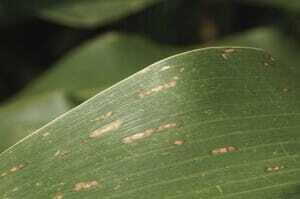
    Gray leaf spot (early symptoms). (photo from Alison Robertson)

    Corn diseases will likely be more prevalent this season due to an excessively wet spring followed by humid summer weather.  Plentiful moisture or dew is ideal for most fungal corn diseases.  Watch for Gray Leaf Spot, Southern and Common Rust, Northern & Southern Leaf Blight and Eyespot.

    Later planted crops can get stressed more easily, which also makes them more prone to insect pressure.  It’s likely we’ll see different insect and disease pressure now than we typically would because our corn is not as far along in its development as it would be in late July.

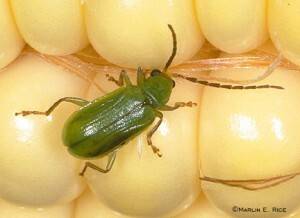
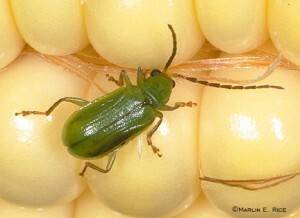
    Corn rootworm are strongly attracted to corn during pollination and can trim back silks to the husk. Photo by Marlin E. Rice.

    Watch for these insects now that corn is silking:  adult corn rootworm beetles, Japanese beetles, western bean cutworm, aphids, corn flea beetle, corn borer and grasshoppers.  Consider infection levels, potential economic damage and weather conditions before determining a treatment strategy.

    Take good field notes to help you select the right seed for the future.  For example, fields with confirmed Goss’s Wilt should be planted to a hybrid that is more resistant to Goss’s wilt in subsequent years.  Tillage and crop rotation can also help reduce corn rootworm.  Tillage and crop rotation also can help reduce the amount of residue that can harbor bacteria for the next corn crop.  For additional information about managing disease or insects, click on the related links below.

    Related Links:

    • Anthracnose Leaf Blight, Common Ruse, Gray Leaf Spot and Goss’s Wilt
    • Japanese Beetles are Back
    • It’s Fungicide Season

    Webspec Admin

    July 25, 2013
    Agronomics, Corn, Crop, Disease, General, Insects, Soybeans
Previous Page
1 … 27 28 29 30 31 … 36
Next Page

Latham Hi‑Tech Seeds

131 180th Street | Alexander, IA 50420

(641) 692-3258

SIGNUP FOR OUR NEWSLETTER
  • Contact
  • Legal
  • Dealer Center
  • Seedware Login
  • Latham Gear

© 2025 Latham Hi‑Tech Seeds. All rights reserved. | Iowa Web Design by Webspec | Privacy Policy

Latham® Hi-Tech Seeds is a trademark of M.S. Technologies, L.L.C., 103 Avenue D, West Point, IA 52656.