Latham Hi-Tech Seeds

(641) 692-3258

  • Home
  • Products
    • Corn
    • Soybeans
    • Alfalfa
    • Corn Silage
    • Seed Guide
  • Performance
  • Find a Rep
  • Media
    • Blog
    • News
    • Videos
    • Podcasts
    • TECHTalk
  • About Us
    • Company History
    • Our Mission
    • Careers
    • Become a Rep
    • Sowing Seeds of Hope
  • Contact Us
  • Latham Hi‑Tech Seeds

    Farming and Harvest Parties are this Family’s Traditions

    Johnson 1
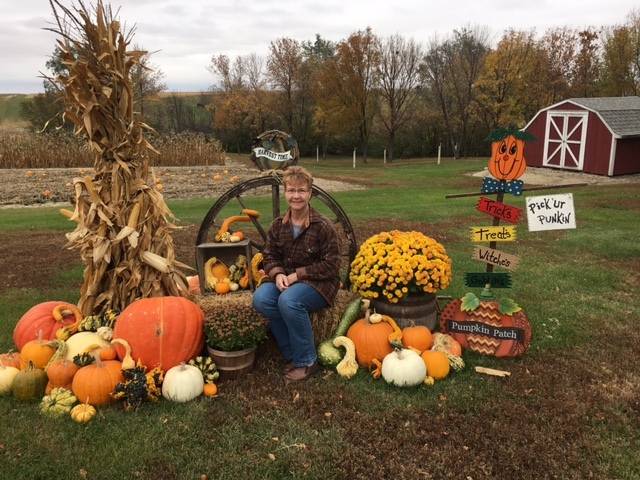
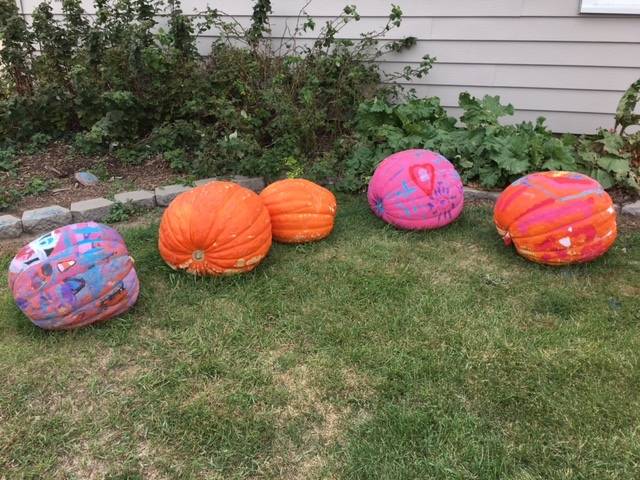
    Growing pumpkins has become a tradition for the Johnson family of Groton, SD. Brian and Jamie's kids enjoying painting these.
    Growing pumpkins has become a tradition for the Johnson family of Frankfort, SD. Brian and Jamie’s kids enjoying painting these.

    Nestled among the rolling hills along the James River near Frankfort, South Dakota, lies a picturesque farmstead and the cutest little pumpkin patch you can imagine. Black Angus cows graze in the pasture behind the house as corn is being harvested across the road. This is where Alan Johnson’s family has farmed since 1906, and it’s where his wife recently hosted her 31st annual pumpkin party.

    “I started hosting these parties when my children were young,” says Mickie. “Now Al and I enjoy seeing our children’s friends return with their own children. It’s fun seeing three generations of families enjoy the afternoon together as many of our friends attend now with their grandchildren.”

    Although the pumpkin party is held during fall harvest, it’s well attended on a Sunday afternoon. As many as 100 children have attended in past years; this year johnson-6about 50 kids participated. The Johnsons invite friends, family and fellow congregational members. No party is complete without games and good food, so Mickie bakes several batches of cookies and bars.

    “My kids are fortunate they get to make so many great memories with my parents on this farm,” says the Johnson’s son, Brian, who graduated in 2004 from South Dakota State University with a degree in Ag Business. He and his wife, Jamie, met while interning at the South Dakota Legislature and were married in 2005. Today they’re raising their family just a few miles away. “My kids love seeing the cows and the playing with the cats. During the harvest season, they’ll ride in the equipment with us for hours. It’s fun being able to share this with them.”

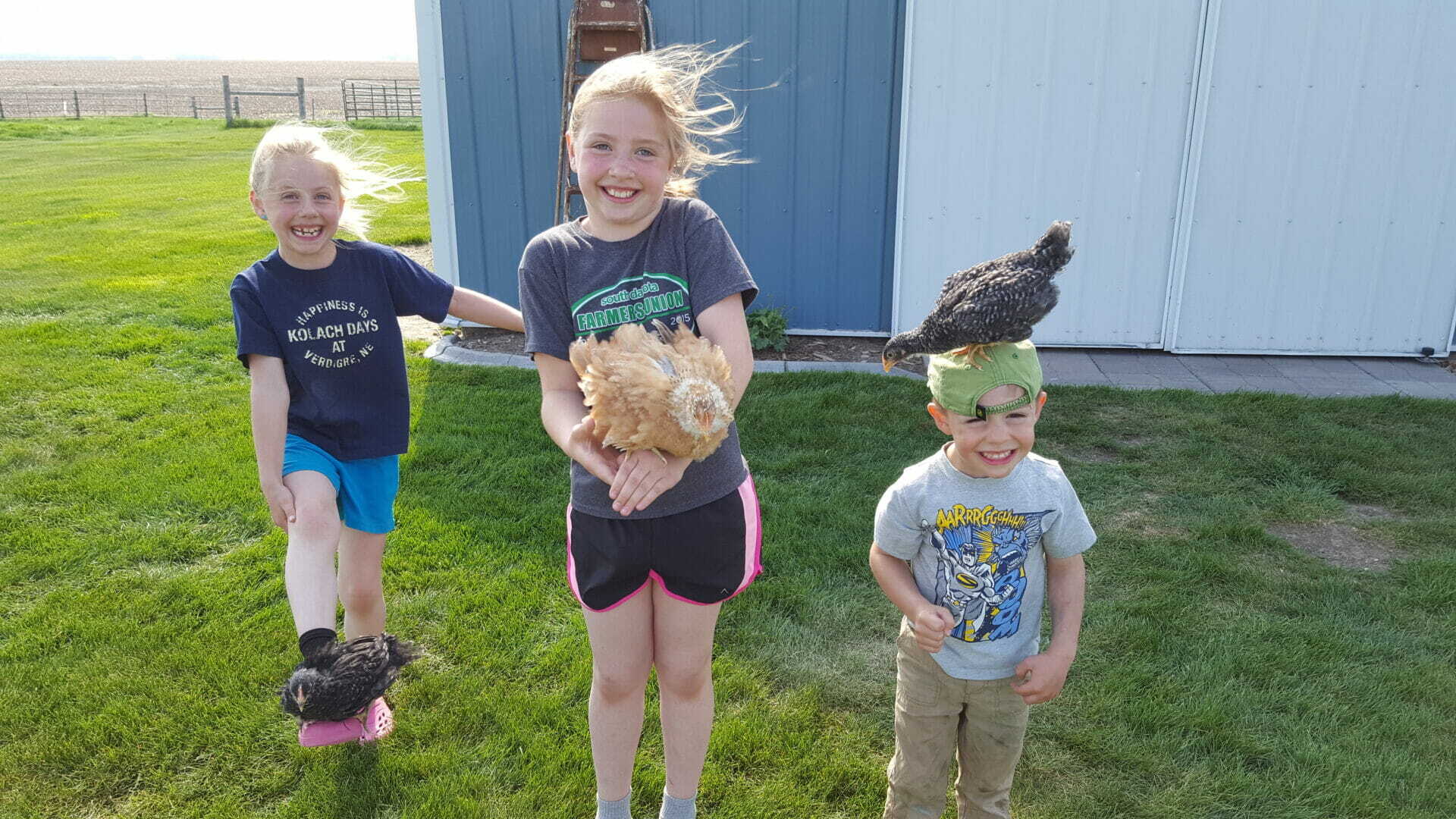
    Johnson's 3 big kids with their chickens, Auto & Steer
    Johnson’s 3 big kids with their chickens, The two black chickens are named Auto & Steer.

    Farming is a family affair. In the fall, Jamie and Mickie take turns driving the combine and operating the grain cart. In the summer, Jamie and the two oldest girls help with the cattle. Ten-year-old Ella earned a purple ribbon 2016 Spink County Fair with her commercial heifer. Lila, who will turn 8 in December, is looking forward to joining 4-H this summer. Their infant daughter, Evelyn, was born on August 31. Leo, who will turn 5 next month, already is a farmer at heart. He’s excited about the four laying hens that his mom purchased during a trip to the farm store. He named them two of them Auto and Steer.

    “There’s nothing like living on a farm,” says Brian. “You see how things grow and mature. I enjoy watching crops progress through the summer. Our kids learn the importance of doing a job correctly, and they feel a sense of purpose by helping.”

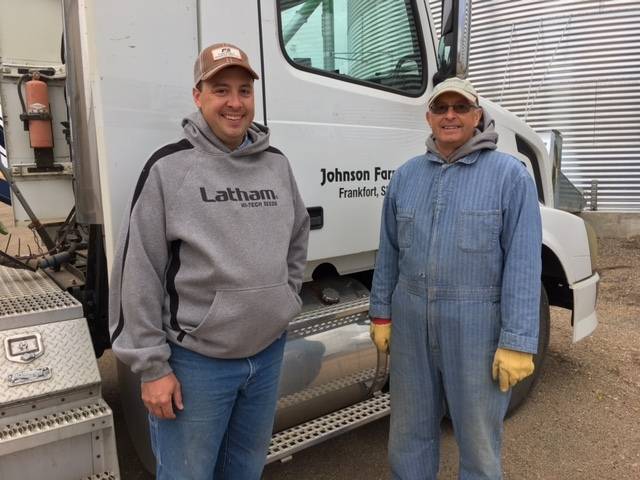
    Brian Johnson has farmed with his parents, Alan and Carol, since 2005
    Brian Johnson has farmed with his father, Alan, and mother, Mickie, since 2005.

    This fall many farmers in Northeast South Dakota harvested record crops for the second year in a row. Brian says no-till has been a real game changer because it builds soil health and helps retain water. He also credits the use of cover crops to providing nutrients in the soil and for breaking up soil compaction. Plus, the Johnson manage their fields by zone and apply variable rates of fertilizer and seed.

    “One thing I admire about Dad is that he’s always looking for ways to improve,” says Brian. “Thirty years ago, he planted corn at 18,000 plants per acre. Now we’re averaging 37,000 in 20-inch rows, and it’s taken our yields to the next level. With improved plant genetics and soil fertility, I don’t think we’ve hit the top yields yet!”

    In honor of all the farmers bringing in this year’s harvest and in celebration of Halloween, today we’re sharing a recipe from Mickie Johnson for M&M Bars.

    Team Latham

    October 28, 2016
    Desserts, Food & Family, Recipes
  • Latham Hi‑Tech Seeds

    Experience a Great Day at New Day Dairy!

    Photo May 19 4 31 02 PM e1470413450461

    Photo May 19, 4 31 02 PMWhat brings a smile to your face? Perhaps it’s the sweet taste and smooth texture of ice cream on a hot summer day. Maybe you’re amused by the boundless energy of baby animals or the cute things small children say. If you find yourself smiling while you’re reading, you’ll want to visit New Day Dairy! The good news is… we can help you get there.

    New Day Dairy near Clarksville, Iowa, will be one of the fabulous farm stops during Expedition Farm Country, Aug. 25-26, 2016. This two-day tour of North Iowa will include a drone demonstration on Aug. 25 at Latham Hi‑Tech Seeds, an overnight at the Historic Park Inn plus a series of farm visits on Aug. 26 including the Niess family farm near Osage.

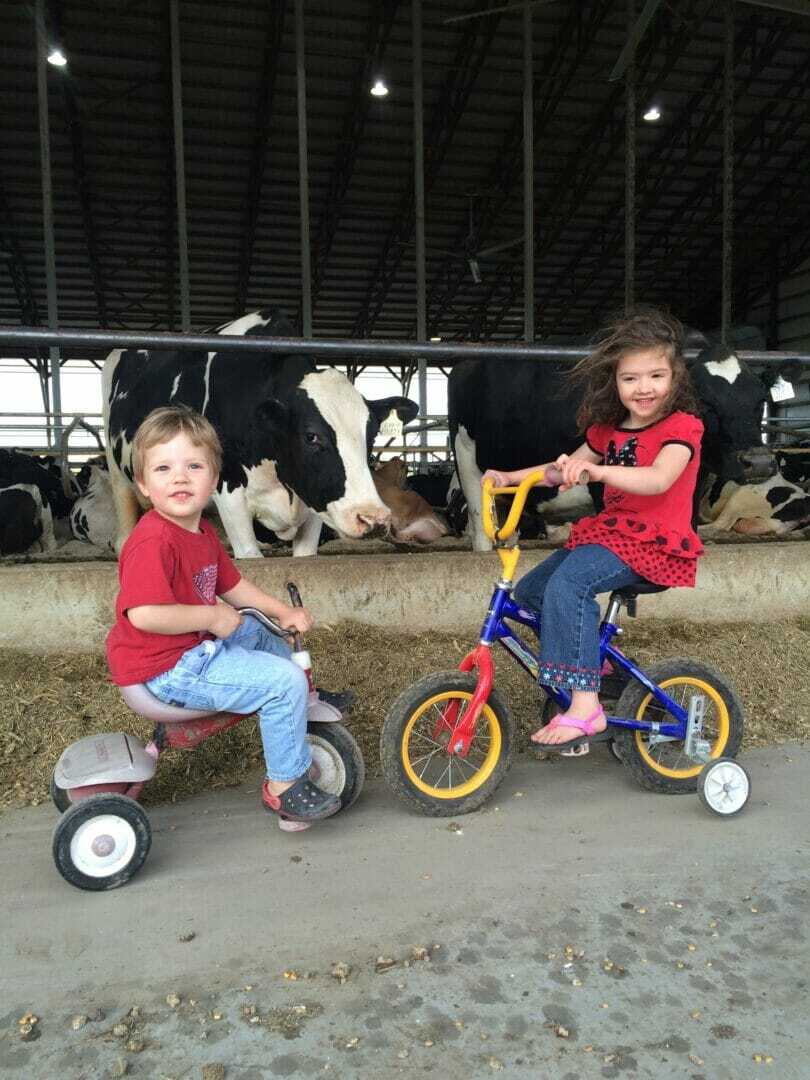
    “Technology in agriculture” is the theme of Expedition Farm Country, and New Day Dairy is state-of-the-art. Lynn Bolin, and her husband Dan, a fifth generation dairy farmer, started their own operation on December 9, 2015, with 110 cows. They’ll introduce you to their farm hand “Rita,” a robotic milker. You’ll also get to meet their two adorable children, Amara, 5, and Vance, 3.

    As soon as I parked my car in front of their dairy barn earlier this summer, the Bolin’s daughter walked right over to me. She reached out her arm to shake my hand and said, “I’m Amara (pronounced, A-mar-a). I’m really good at tours.”

    Now if seeing a child welcome you to her farm doesn’t put a smile on your face, I don’t know what will! Both children proudly told me what they know about the cows, and when he got more comfortable in my presence, Vance invited me to play in the sandbox. Just think how much better our world could be if more people played nicely in the sandbox!

    Photo May 19, 4 30 16 PMThe Bolin’s intentions are genuine as demonstrated by the way they welcome guests and care for their productive, thriving cows. The mission of New Day Dairy is simple: Develop. Milk. Bless. This family wants every guest to be blessed by a positive experience as they gain a better understanding the connection to the source of their milk.

    To help consumers stay connected after they leave the farm, New Day Dairy started a monthly newsletter. Readers can learn how many calves were born that month, which cow is producing the most milk and special activities on the farm.

    In the future, the Bolins plan to take the “farm experience” one step farther by opening a European-inspired guesthouse attached to their barn. Their vision is to give individuals the chance to experience a modern working dairy farm.Photo May 19, 4 29 57 PM

    See New Day Dairy for yourself on Aug. 26 with a group of consumers interested in learning how food is produced. Expedition Farm Country is being offered through the Iowa Food and Family Project with support from Latham Hi‑Tech Seeds. If you’re interested in attending, email lfoss@iasoybeans.com. Simply state why you’d like to embark on the farm tour!

    Keep an eye out for more blog posts coming soon about other stops on the farm tour. In the meantime, enjoy a sweet treat from New Day Dairy. This recipe for Apple Cinnamon Oatmeal a la Mode, which is the perfect dessert or afternoon snack, comes from the New Day Dairy blog.  Visit the Bolin family’s website or connect with them on Facebook!

    Team Latham

    August 5, 2016
    Desserts, General, Recipes
  • Latham Hi‑Tech Seeds

    Celebrate National Ice Cream Month with the Iowa Dairy Princess

    IMG 6255

    By Amber Hammes, Latham Hi‑Tech Seeds Marketing Intern

    IMG_6255
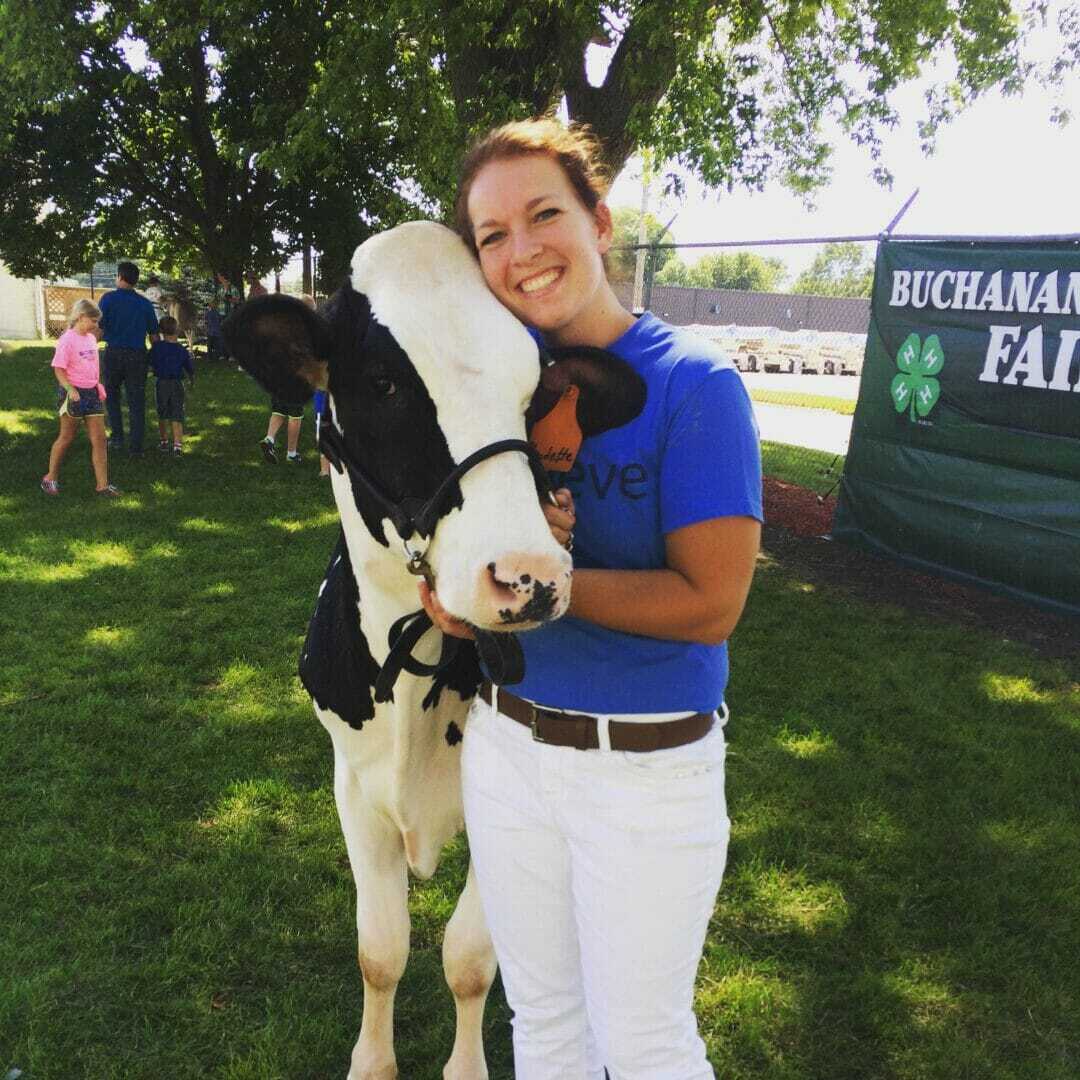
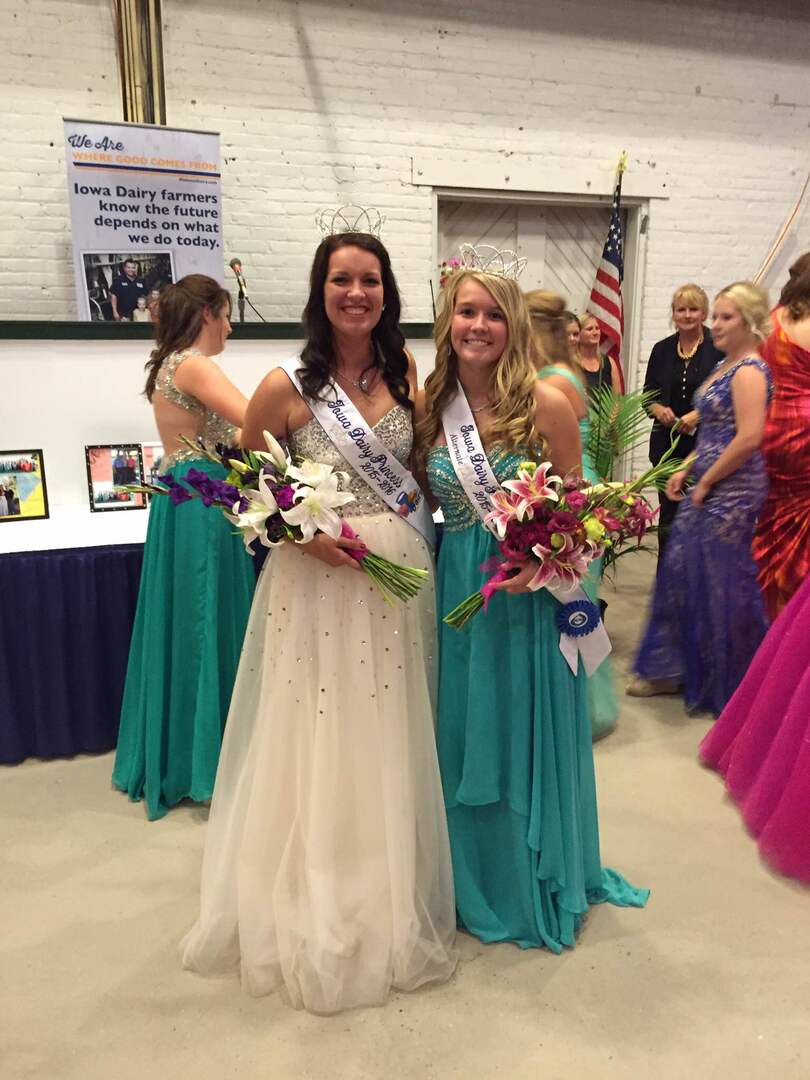
    2015-2016 Iowa Dairy Princess Kate Stewart is celebrating National Ice Cream Month! Join in by hugging your favorite dairy cow like Kate, or by scooping up some dairy-licious ice cream.

    At this point in the year, most Iowans are counting down days until the Iowa State Fair. July is chalked-full of county fairs, vacations and preparing campers and livestock trailers for another trip down to the Iowa State Fairgrounds. Kate Stewart, 2015-2016 Iowa Dairy Princess, has been just as busy celebrating National Ice Cream Month!

    Kate is a fifth generation dairy farmer from Oelwein, Iowa, where her family milks 150 Holstein cows three times per day and farms 290 acres of alfalfa and corn. She grew up following the footsteps of her four older siblings by becoming active in 4-H, FFA and the National Junior Holstein Association.

    “Whether it be showing cattle at the fair or testing my dairy knowledge in dairy quiz bowl contests at the state and national level,” Kate says, “these incredible organizations have given me countless opportunities to grow as a dairy enthusiast.”

    In 2014, Kate served as the Fayette County Dairy Princess. She spent the year serving frozen yogurt at local schools, throwing cheese sticks in parades and educating 2nd grade classrooms about the role dairy plays in a healthy lifestyle. After having these amazing experiences, she wanted to continue to reach more people and advocate for the Iowa dairy industry. In August 2015, Kate was crowned 2015-16 Iowa Dairy Princess.

    IMG_2439
    Kate and Leslie Sivesind, 2015-2016 Alternate Iowa Dairy Princess.

    The Midwest Dairy Association created the Iowa Dairy Princess position over 60 years ago to be a public figure that advocates on behalf of dairy farmers. Kate and Leslie, along with the Midwest Dairy crew, promote the importance of getting three dairy servings per day with the #Dairy3ForMe pledge.

    “The 2015 Dietary Guidelines have come out and they are still recommending that we get 3 servings of dairy every day to help us live healthy lives,” Kate said. “So make sure to grab a cheese stick for a snack on the go, celebrate ice cream month with a serving of ice cream, and grab a glass of milk after a workout – it just so happens to be the best way to rehydrate and refuel your body post-exercise!”

    Kate’s adventures as the Iowa Dairy Princess take her across the state, serving as an ambassador for the dairy industry. She gets to attend Iowa dairy farmer’s open houses, county fairs and dairy community events. Sadly, Kate’s term will end in August. She will be handing over her crown to the 2016-2017 Iowa Dairy Princess on August 10th at the Iowa State Fairgrounds in Des Moines. The public is welcome to attend the coronation and show support to contestants who work hard to advocate for the Iowa dairy community. For more information, visit the Iowa Dairy Princess Facebook page and stay up to date on Iowa Dairy Princess appearances throughout the year.

    About National Ice Cream Month

    July was established as National Ice Cream Month in 1984 by the American Dairy Association in conjunction with President Ronald Reagan. The third Sunday in July (this Sunday, the 17th!) is National Ice Cream Day. This year, Kate and Alternate Iowa Dairy Princess, Leslie Sivesind, will be attending an Iowa Cubs baseball game and throwing the first pitch. If you’re headed to Principal Park on Sunday, be sure to stop and say “Hi!” to Kate and Leslie! You can also talk to Kate at the Iowa State Fair, where she can be found working the dairy cattle shows, Midwest Dairy Association booth and Butter Cow exhibit.

    Kick your boots off, scoop up a dish of dairy-licious ice cream and enjoy the remainder of the summer with Kate and all of us at Latham!

    Wondering where you can get your ice cream fix at the Iowa State Fair? Here’s a list of all the vendors and their locations on the fairgrounds!

    ISF Ice Cream Locations

    Gary Geske

    July 15, 2016
    Desserts, General, Recipes
  • Latham Hi‑Tech Seeds

    Beef Industry Leader Says C.A.B. Benefits Producers & Consumers

    20160421 094159 resized 1

    On Monday’s blog, we shared how one of the oldest Black Angus operations in the nation got its start in 1896. Today we’ll learn more about the Greiman family’s legacy from 89-year-old Don Greiman of Garner, Iowa.

    Don’s grandfather, Fred Greiman, fell in love with the Angus breed for their smooth body style and excellent carcass. One day in 1896 Fred saw a poster advertising that a South Dakota farmer was interested in trading a Percheron stallion for an Angus bull. The two farmers corresponded by mail. After some months, they agreed to exchange animals. Fred placed his prize-winning Percheron stud on a railcar and eagerly awaited for the arrival of his Angus bull.

    “My grandfather couldn’t wait for that bull to come in!” explains Don. “When he went to the train station, he found a ‘wild and wooly’ 400-pound bull calf in a crate. It certainly didn’t look to be a good trade at the time, but that bull ended up paying out. He was crossed with Short Horn cattle and their offspring was sold at a premium.”

    When Don’s grandpa sold his first crossbred Angus-Short Horn, he topped the market. Fred was told by the buyer that he’d always be able to merchandise cattle like that.

    “Grandpa’s philosophy was it doesn’t cost any more to feed good quality stock than it does poor stock, plus you’ll take more pride in your operation,” said Don. “He continually worked to upgrade his cattle operation by buying purebred Angus cows with a calf at the side.”

    It was a philosophy shared by Don’s father, Addis. Addis was interested in continuing to upgrade the family’s stock, so he contacted his good friend and mentor Fred Haane for advice. As publisher and editor of the Angus Journal, Haane said, “Don’t just buy any Angus cattle. Buy good genetics. Buy Earl.”

    “Earl Marshall” was a young bull that was the most prolific in the Black Angus breed and became the foundation for Greiman & Sons Cattle. Earl produced a lot of champions for Don and his brother Cliff. As members of the Elcon Midget Indians 4-H Club, the brothers exhibited cattle at several county fairs and the North Iowa Fair in Mason City.

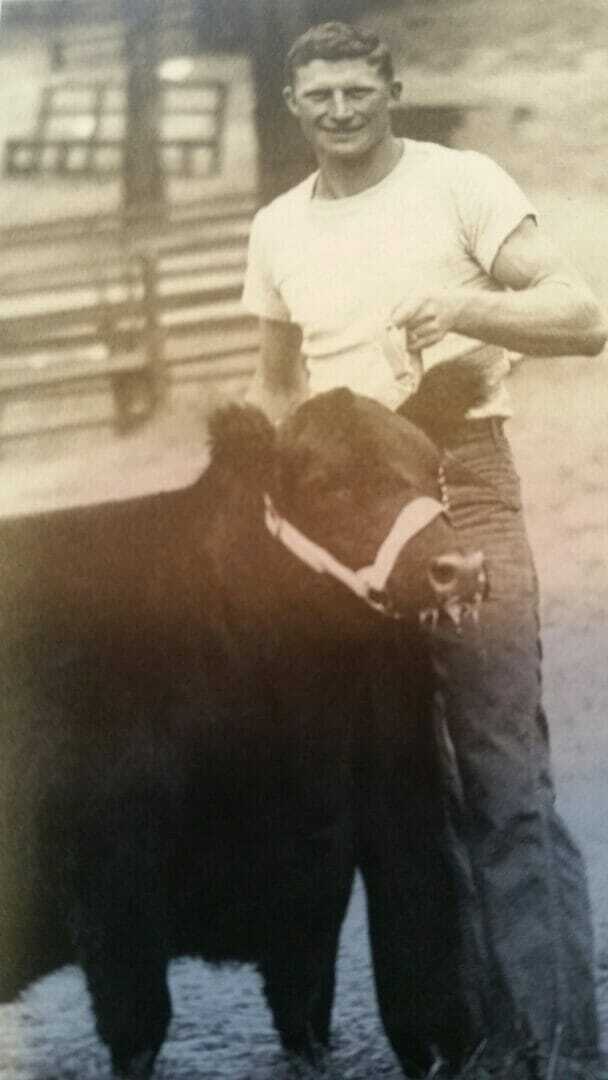
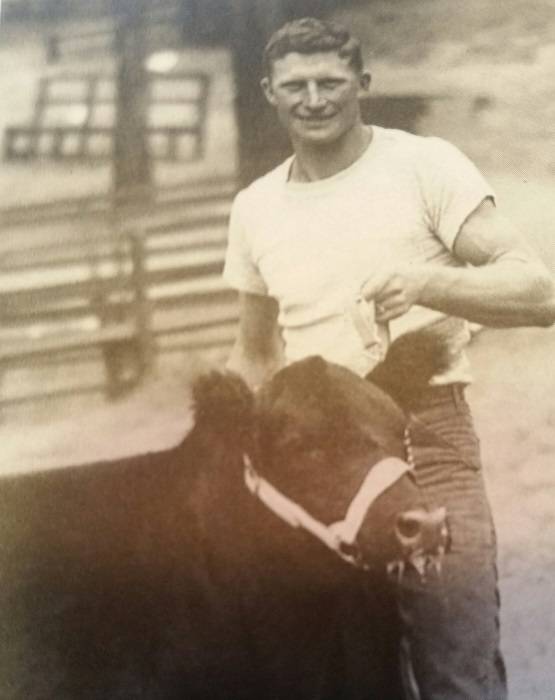
    At the age of 21, Don showed the Reserve Champion Angus Breeding Heifer at the 1947 Iowa State Fair. That year he also won showmanship and was awarded a gold watch engraved with “Wallaces Farmer presents this to the Champion Showman.”

    Don Greiman TheFieldPosition

    It’s no wonder that Angus beef and the Iowa State Fair has held a special place in Don’s heart. After graduating from Iowa State University through the ROTC and serving for two years at the Bolling Air Force Base in Washington, D.C., Don and his wife returned to Garner. He decided to start a county beef producers association and became its first president. This was the first of many board seats he would hold.

    Don was the first president of the Iowa Purebred Beef Council. He also was president of the Iowa State University Alumni Association. In addition, Don served on the American Angus Association’s board of directors when Certified Angus Beef® was initiated.

    “At that time, purebred producers were facing a real challenge marketing the meat produced from their livestock,” explains Don. “Feedlots were springing up out west, and the meat grading system changed. We knew our Angus produced a superior product, and it was a difference consumers could taste.”

    Case in point… Don and his family were invited to join an old college roommate at the new Minnesota Vikings stadium. He offered to provide the tailgate meal, consisting of his farm-raised steaks, fresh tomatoes, cucumbers and sweet corn. Also present at that tailgate lunch were board members of the Minneapolis Junior Chamber. They were so impressed with the quality of the meat that Don sold three whole beefs that day!

    “We knew we were onto something,” said Don. “Judges liked how our beef hung on the rail. When our kids would enter our Angus at a carcass show, we would win. Folks like those whom we met at the Vikings game like how it tasted. We just needed to find a way to change the industry’s grading standards.”

    Quality grades indicate palatability, or tenderness, juiciness and flavor of the cooked beef. The Angus Association developed higher standards for Certified Angus Beef, so Angus cattle are segregated at harvesting facilities. Then a USDA inspector goes into the cooler and grades them. To be authentic CAB, that carcass must be graded in the upper third of choice or prime.

    The Certified Angus Beef label has been credited with (1) increasing the number of registered Angus cattle in the U.S., (2) providing a higher return to its producers, and (3) becoming a “destination product” for consumers.

    In honor of the Greiman family’s tradition of raising Black Angus, today we’re linking to recipes featuring Certified Angus Beef. Don says it’s hard to beat a grilled ribeye. His wife, Yvonne with whom he will celebrate 63 years of marriage on June 6, says nobody makes braised beef brisket better than their daughter-in-law Mary.

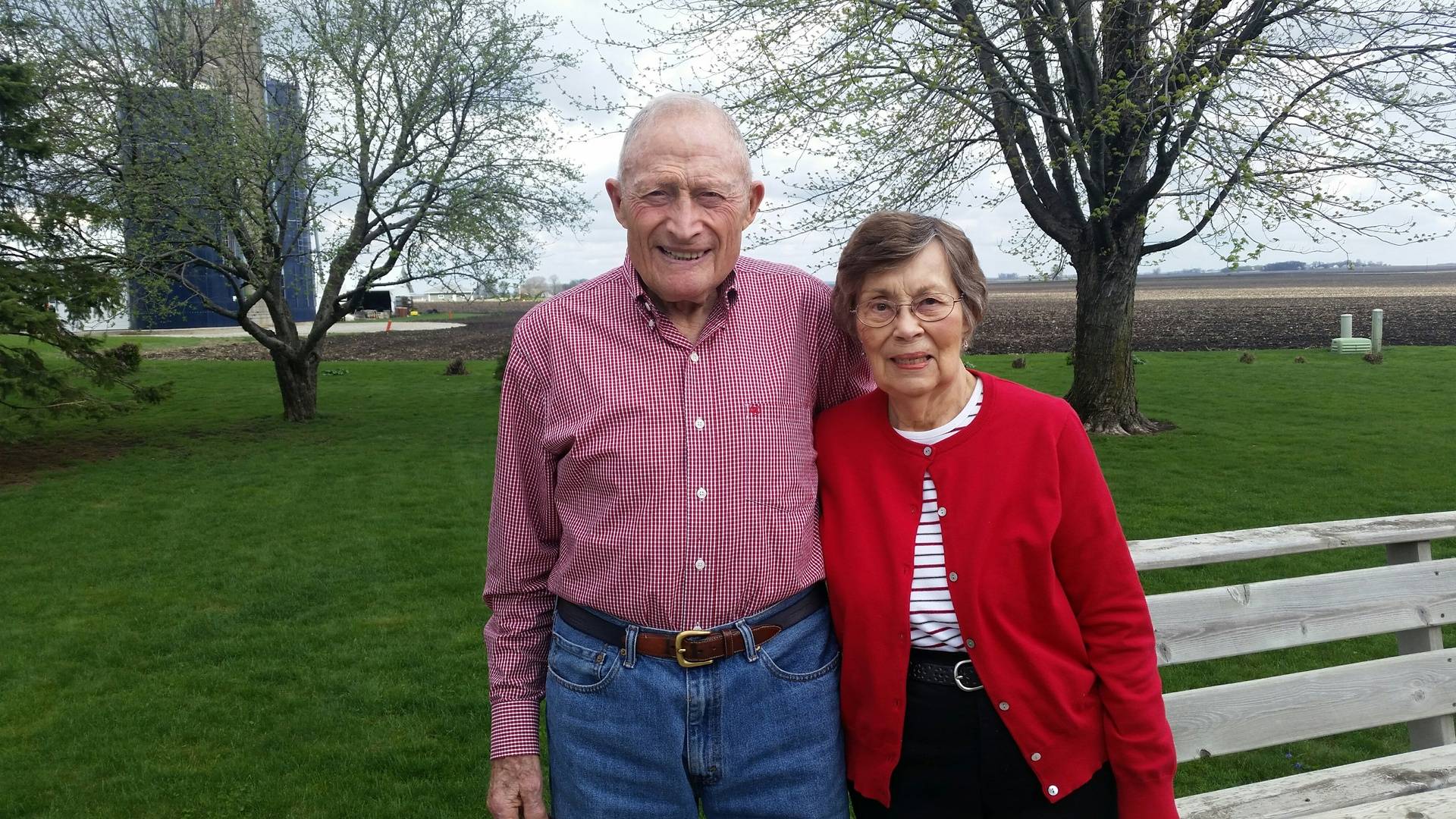
    Don and Yvonne Greiman TheFieldPosition

    Light the grill and enjoy some beef this weekend along with a slice of Yvonne’s Swedish Apple Cake!

    Team Latham

    May 27, 2016
    Desserts, General, Recipes
  • Latham Hi‑Tech Seeds

    All Roads Lead Home for Pocahontas Farm Family

    Image 2
    Maddie, Jessica, Heidi and Mark Vosika enjoy farm life in Pocahontas County, Iowa.
    Maddie, Jessica, Heidi and Mark Vosika enjoy farm life in Pocahontas County, Iowa.

    Schools across the Midwest will soon close their doors, and many families will enjoy taking a summer vacation. Mark Vosika, who farms near Pocahontas in West Central Iowa, looks forward to seeing new country with his wife, Heidi, and their two daughters.

    “We enjoy traveling and experiencing different cultures. We really enjoy watching the scenery change as we drive, and of course, Mark enjoys seeing the different crops that are grown,” says Heidi, a registered nurse who spent about a decade working in long-term care, home health and hospice before switching to medical claims review.

    A few of the Vosika’s favorite places include Rocky Mountain National Park, Yellowstone and the Grand Tetons. They also enjoyed Michigan’s Upper Peninsula and Mackinac Island. Heidi says, “We had so much fun exploring Arches National Park and JEEPing in Canyonlands that we’d love to visit Utah again.”

    No matter where the Vosikas roam, they always look forward to returning to home. Mark and Heidi feel blessed to raise their family in the same home where Mark was raised. Their oldest daughter, Maddie, is a high school junior and sold more than $1,000 in FFA fruit sales. Their youngest daughter, Jessica, is in seventh grade. She enjoys cross country, basketball and soccer. Jessica also enjoys helping Mark on the farm, running the grain cart and moving equipment. She also likes to spend time with him in the shop.

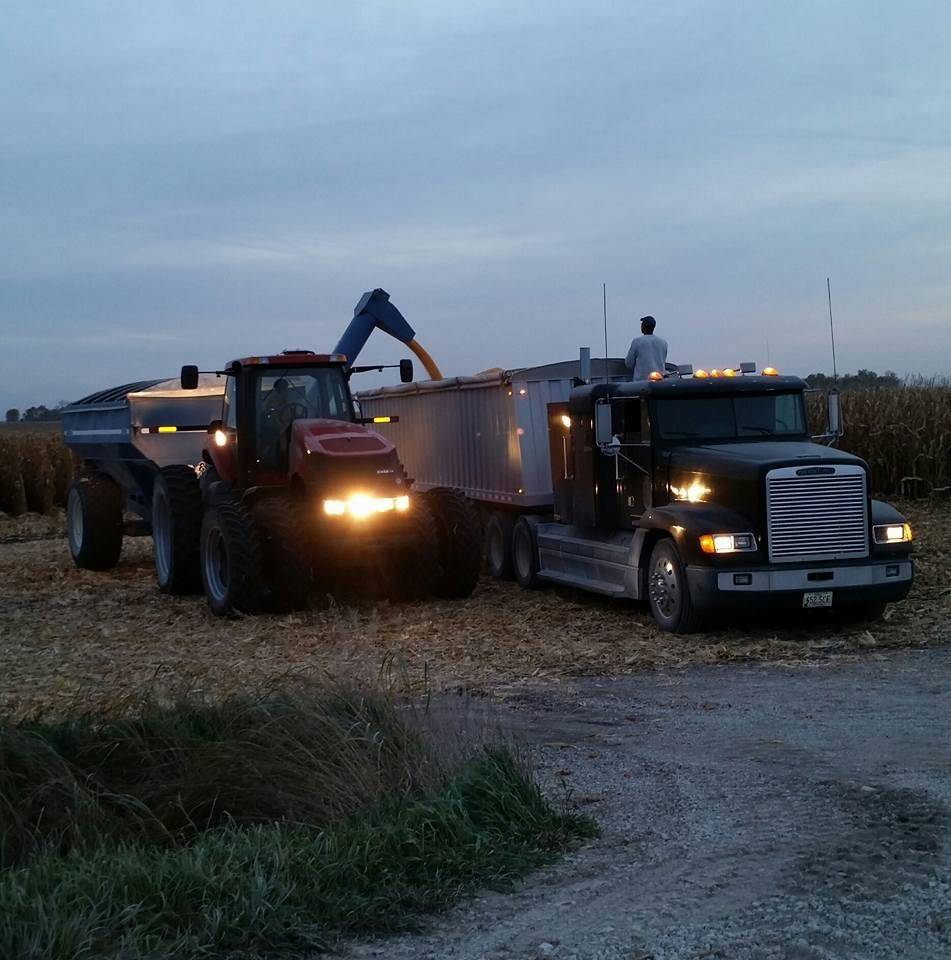
    Mark and Jesse bringing in the 2015 harvest
    Mark and Jesse bringing in the 2015 harvest

    “What I like the most about living here is that our kids get experiences they wouldn’t otherwise have. They see the long hours that go into farming, and they see how dedicated their dad is to the operation. They learn about farm safety, and they learn to accept more responsibility at a younger age,” says Heidi, who grew up in town and now enjoys the privacy of country living. Participation in extracurricular activities helps their daughters develop leadership skills, which will be of value if they decide to follow in their dad’s footsteps.

    Mark is a township trustee for Sherman Township. He also serves as a director for Pocahontas County Corn Growers and as a District 1 Director for Iowa Soybean Association. As a trained diesel mechanic, Mark proudly promotes biodiesel to increase lubricity and longevity of engines. As a soybean and corn farmer, he says it just makes sense to use homegrown fuel.

    Mark and his brother, Mike, farm in partnership. Mike usually runs the combine and planter; Mark does the spring fieldwork ahead of the planter and hauls grain from the field in the fall. Mark also does all the equipment maintenance and repairs, saving valuable down time and decreasing out-of-pocket expenses.

    Just as Midwest farmers work to get their crops in the ground this month, gardeners also are busy working the soil and planting seeds. April is National Gardening Month, so the Vosikas are sharing recipes that use spring produce. Chicken Oscar is one of Mark’s favorite meals, and the entire family enjoys dessert.

    Nothing showcases spring in Iowa quite like fresh asparagus and rhubarb. Get a taste of spring this weekend!

    Rubarb bars

    Team Latham

    April 29, 2016
    Desserts, General, Poultry, Recipes
  • Latham Hi‑Tech Seeds

    Digging the History of Hampton’s Earl Ferris Nursery

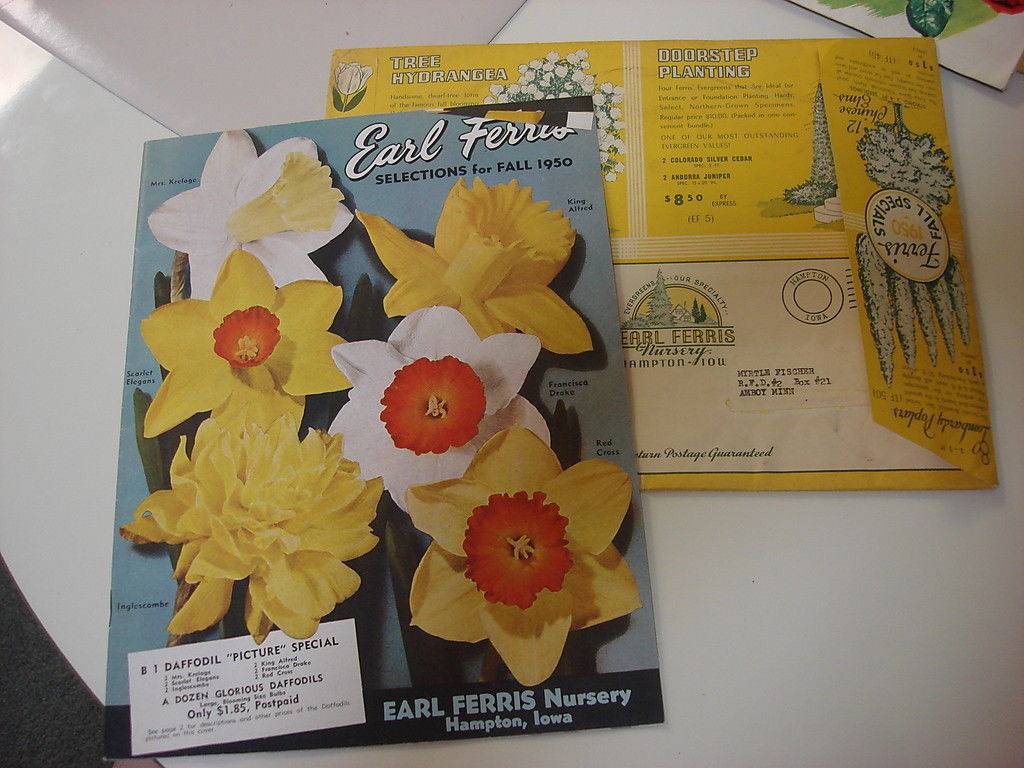
    Ferris Nursery 2 eBay 1957

    Ferris Nursery 1 eBay 1950

    by Darcy Dougherty Maulsby

    Gardeners know all the best dirt. For generations of gardeners across Iowa and beyond, one of the most trusted sources for high-quality plants, flowers and trees was the Earl Ferris Nursery, a Hampton landmark for nearly 100 years whose legacy lives on.

    “Everywhere we go, we see Ferris trees and shrubs,” said Mickey Ferris of Hampton, who ran the Earl Ferris Nursery with her husband, Wayne, for many years. “Some windbreaks are well over 100 years old.”

    The roots of the Earl Ferris Nursery run as deep as Iowa’s pioneer heritage. Solomon “Sol” Wayne Ferris started a small nursery in West Branch, Iowa, following in the footsteps of his father, John Ferris. The family moved the nursery to the Butler County town of Bristow in 1869 and established the Bristow Nursery, consisting of about an acre of fruit trees, berry plants and a few evergreens.

    The business took off when Sol bought land in the Dakotas and raised horses there. “Traveling through Northwest Iowa to the Dakotas, Sol discovered a good market for trees, especially fruit trees,” says Mickey, an avid historian. “New settlers needed to plant orchards, and they also Ferris Nursery 2 eBay 1957needed evergreens for windbreaks to protect against prairie winds and snow.”

    Sol sold and delivered nursery stock by wagon throughout the Midwest. The Ferris nursery became known for its field-grown evergreens, Mickey noted. In the winter of 1899, the Ferris family used sleighs to move their entire nursery stock to Hampton, which offered better railway facilities.

    By 1900, Sol’s son, Earl, had graduated from Upper Iowa University and was working for his father. Earl bought a half interest in the family business. In 1902, the ambitious young man became full owner of the company and had big dreams for this small business.

    Mail order helped business flourish
    While Earl continued to sell nursery stock using agents, in 1905 he pursued a promising new marketing option—mail order. He printed his first catalog in 1907 and changed the name of his growing company in 1912 to the Earl Ferris Nursery Co. By then, the nursery consisted of 360 acres of trees, shrubs, flowers, bulbs and evergreens.

    The Earl Ferris Nursery mailed more than 400,000 Ferris Nursery 3 eBay 1957catalogs each spring and sent nearly the same amount each fall. These attractive catalogs contained a full list of the varieties offered by the nursery, complete with prices. “Orders received were prepared for shipment in the ‘pack shed’ and mailed all over the United States, including Alaska,” Mickey said. “At one time, the catalogues represented half of the business at the Hampton post office.”
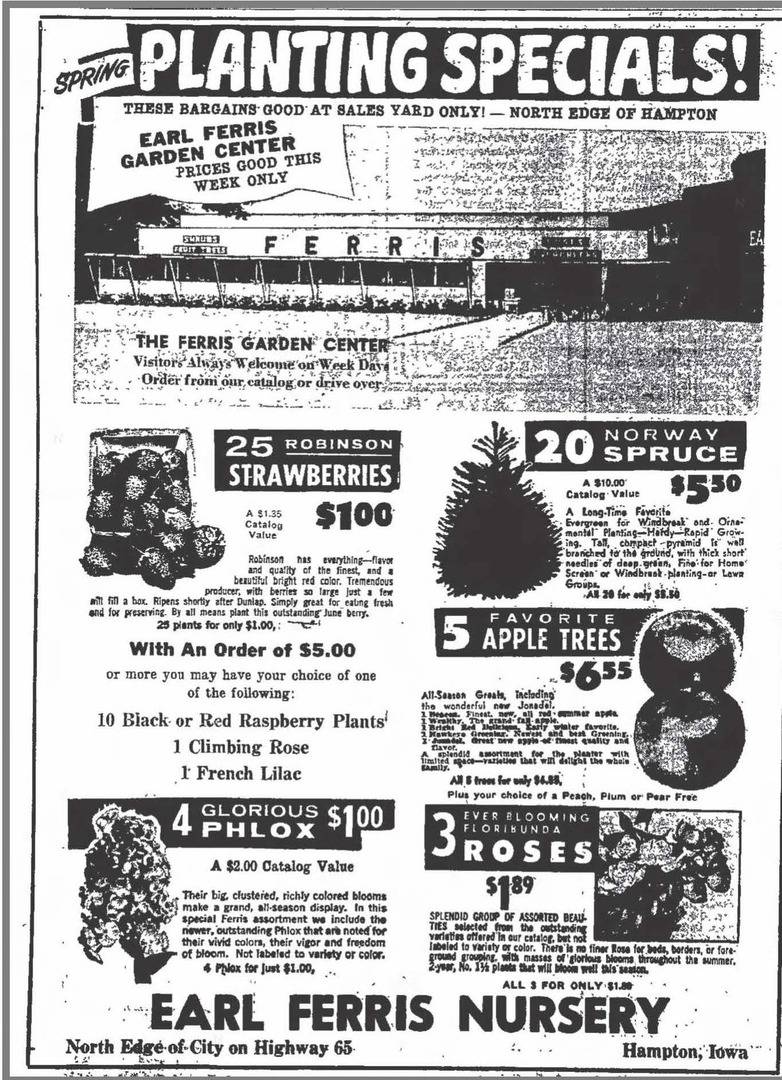
    Since the customer mail-order list was invaluable to the nursery, the list was locked in a large vault in the office every night. Thieves broke into the office one night, Mickey recalled. “They tried to peel the vault door off, assuming there was money in the vault. Then they then tried to enter the vault from the floor above, again without success. The family always wondered what the burglars would have thought, had they been able to get in and found only drawers of names and addresses!”

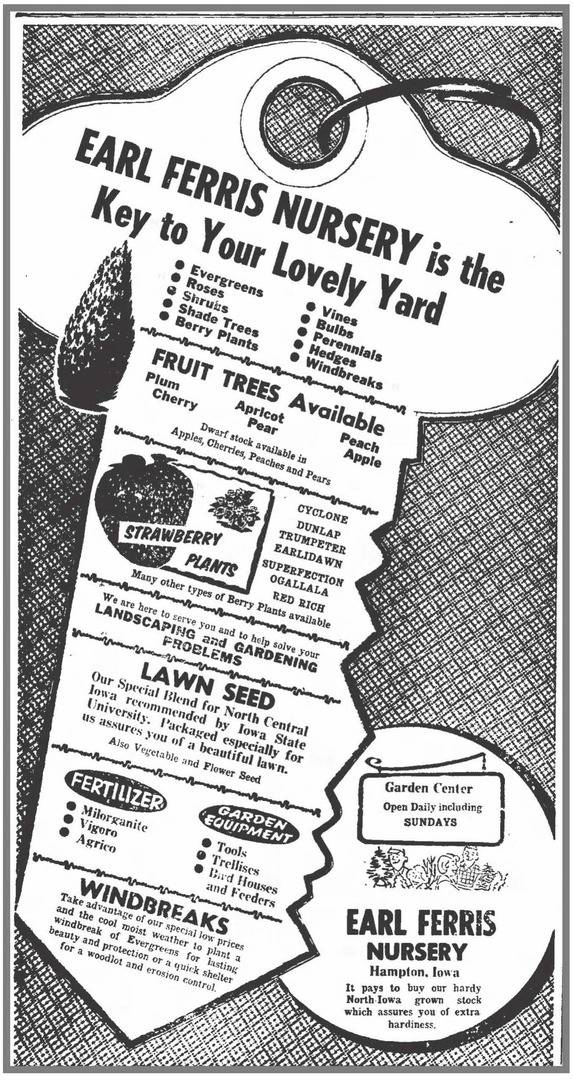
    Hampton Chronicle Ferris ad April 27 1963“Landscape by Mail” offered new options
    Innovation continued to define the Earl Ferris Nursery well into the twentieth century, thanks to S. Wayne Ferris, Sr.

    The only son of Earl Ferris, Wayne Sr. was born in Hampton in 1905 and worked in the nursery business all his life. He became president of the Earl Ferris Nursery in 1945 after his father died.

    Wayne Sr. started the “Landscape-by-Mail program,” employing a professional landscape architect to provide landscape plans for mail-order customers. “These customers would otherwise not have had access to professional landscaping,” Mickey said.

    Wayne Sr. also started a retail garden and gift shop in connection with his mail-order nursery. His two sons, Earl and Wayne Jr., came into the business, with Earl serving as office manager and Wayne Jr., in charge of propagation and fields.

    Wayne Sr. was a prominent leader in the local community, as well as at the state and national levels. He served as president of the American Association of Nurserymen and Iowa’s state association. He also served as director of the Iowa State Horticultural Society. Closer to home, he was president of the Franklin County Izaak Walton League when the group restored Beeds Lake. Wayne Sr. also served as a member of the Hampton City Council and Park Board and was chairman of the Franklin County Civil Defense program during World War II.

    Entering the last growth phaseHampton Chronicle May 12 1960
    After Wayne Sr. passed away in February 1977 and Wayne Jr.’s brother, Earl, moved to Illinois, Wayne Jr. and Mickey took over the operation of the nursery, which they renamed the Ferris Nursery.

    By this era, the once-thriving catalog business dwindled as big retailers like K-Mart and Walmart entered the market. “The stock and land were sold off, and Wayne began growing perennials and annuals in a large glass greenhouse,” said Mickey, who noted that Wayne became well known for his exceptional poinsettias, geraniums and annuals.

    Wayne purchased evergreens, trees and shrubs for the Ferris Nursery’s retail garden center. Mickey worked in the garden center and also started a flower shop. During the holidays, the Ferris Nursery also included a large Christmas shop.

    Wayne and Mickey’s sons, Jeff, Mark and David, all worked at the nursery during high school. The Ferris’s grandson Chad also worked in the greenhouse and flower shop, becoming the sixth generation to work at the nursery. When Wayne and Mickey decided to retire in 1997, no family members chose to continue the business. After 128 years in business, the nursery was closed permanently.

    Now in their 80s, Wayne and Mickey continue to call Hampton home and still enjoy growing plants for their small raised-bed gardens. “It’s a tiny thing, but we love it and
    wish we had a greenhouse,” Mickey said. “This part never leaves you.”

    For a taste of spring in Iowa, try this flavorful Daffodil Cake, which offers a colorful twist on a traditional angel food cake.

    Team Latham

    April 22, 2016
    Desserts, General, Recipes
  • Latham Hi‑Tech Seeds

    Maintaining Important Easter Traditions

    Filling Eggs16
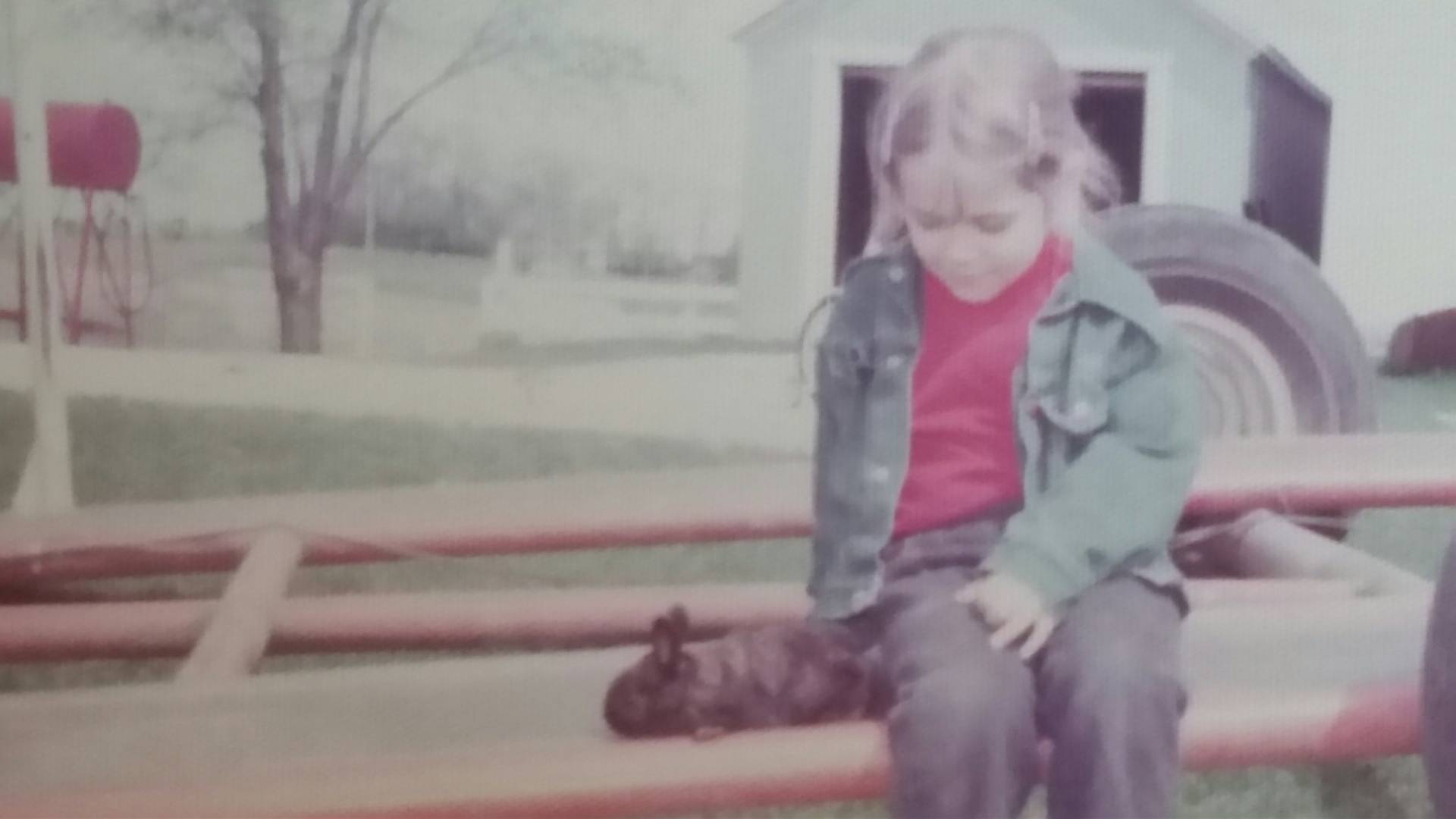
    When Shannon Latham was 5 years old, the Easter bunny delivered a live rabbit.
    When Shannon Latham was 5 years old, the Easter bunny delivered a live rabbit.

    When I was a child, I remember walking into the kitchen and finding my mom reading church cookbooks for new recipes to try. Fast forward to 2016, and I find myself saving recipes from my Facebook feed or pinning them to board on Pinterest.

    There are so many photographs of beautiful dishes in my newsfeed! I was intrigued by the thought of making Baked Potato Cupcakes or Krispy Eggs. I toyed with the idea of making the Iowa Girl Eats’ Easiest Fruit Salad because it’s so colorful – and I could use a little color after this week’s winter storm. Egg Lasagna sounded like an interesting side dish to ham.

    I’ll probably try my hand at some of these recipes in the future, but I won’t be making them for Easter. I’ve decided to stick with Asparagus Casserole. Any one of my family members could probably guess what’s inside my dish before the cover comes off, and that thought made me realize that my casserole has become a tradition. I honestly look forward to the Deviled Eggs that my brother makes. My daughter looks forward to the Corn and Macaroni hot dish that my cousin brings. Without intending to, we’ve created family holiday traditions by the foods we serve.

    Family traditions provide a constant in our otherwise ever-changing world. “Tradition gives us an opportunity to live in the moment and enjoy something that we have created as a family. It gives us the chance to slow down, appreciate and express gratitude towards the things in our lives that are not run by technology and busy demands.”

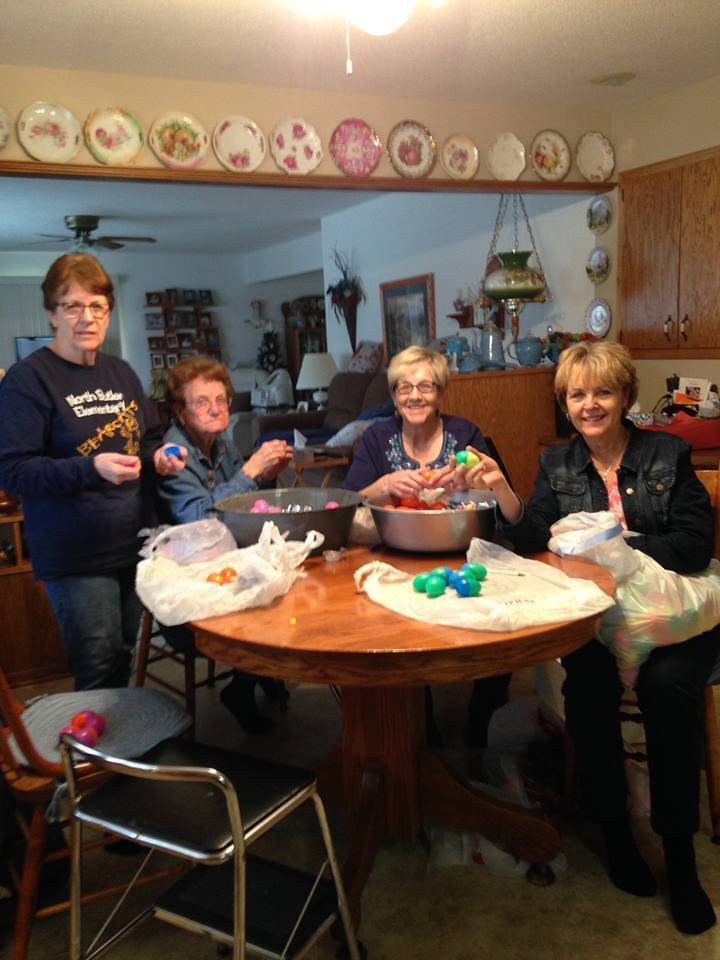
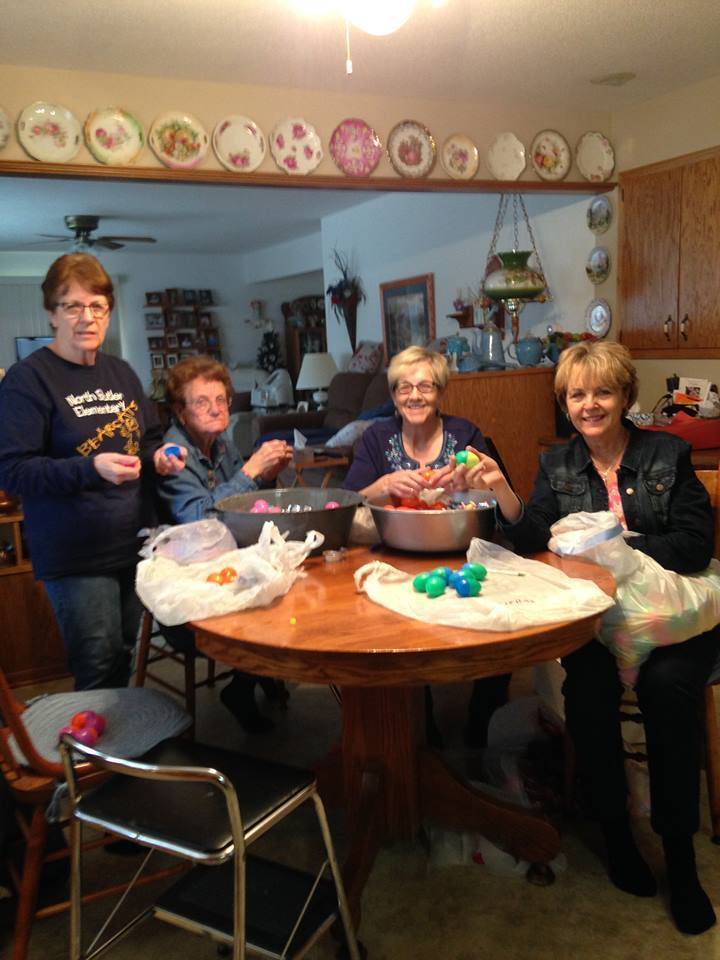
    Shannon’s mom and her aunts helping her 91-year-old grandma fill Easter eggs for the 2016 hunt.
    Shannon’s mom and her aunts helping her 91-year-old grandma fill Easter eggs for the 2016 hunt.
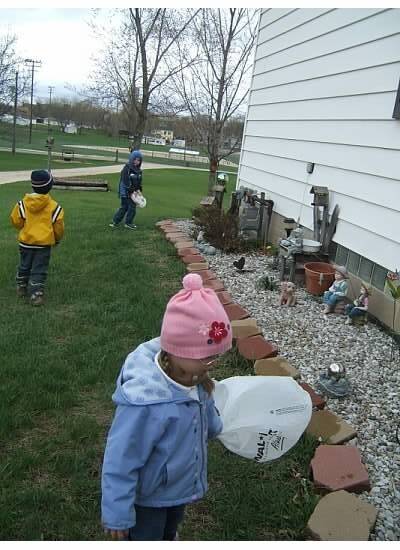
    Shannon's kids, at age 5, enjoying their family’s annual Easter egg hunt.
    Shannon’s kids, at age 5, enjoying their family’s annual Easter egg hunt.

    The case for preserving family traditions was made in a HuffPost Home blog article:

    1. Traditions give us something to look forward to.
    2. Traditions won’t preserve themselves.
    3. Traditions keep us grounded.

    The tradition I look forward to most each Easter is our annual egg hunt. My grandparents began hiding eggs more than 50 years ago. This weekend five generations will gather together to search for brightly colored plastic eggs filled with candy. Afterwards, we’ll enjoy a potluck meal. Like Pavlov’s dogs, my mouth is watering just thinking about it!

    What traditions do you look forward to this holiday season? Perhaps you can start a new one… Included below is a recipe for Cherry Red Raspberry Cheesecake, courtesy of Food and Swine. Photo credit to the Iowa Food and Family Project.


    Related Posts:

    • “Round 2” Recipe Ideas for Easter Leftovers
    • Bring New Meaning to “Colored Eggs”
    • Easy Easter Desserts and Crafts

    Team Latham

    March 25, 2016
    Desserts, General, Recipes
  • Latham Hi‑Tech Seeds

    New Orleans Melds Cultures into Unique Regional Cuisine

    20160303 1219542

    More than 8,000 farmers gathered last week in New Orleans for America’s largest farmer-led, farmer-IMG_1274focused trade show and convention. Open to all “friends of corn, soybeans, wheat and sorghum—from growers to member associations to agribusiness to farm media,” the 2016 Commodity Classic boasted an impressive schedule of presentations and events designed to get attendees jazzed about agriculture.

    There was so much to get jazzed about from the seeing state-of-the-art planting and fertility equipment to presentations by yield guru Dr. Fred Below and UAV guru Chad Colby. I enjoyed walking around the tradeshow, catching up with old friends and meeting new acquaintances. I stopped by booths to learn more about what our industry partners are doing to advocate for the next generation. I talked with farm broadcaster Duane Murley of KWMT in Fort Dodge about exciting projects that Latham Hi‑Tech Seeds has underway with the Iowa Soybean Association and the Iowa Food & Family Project. (You can bet I’ll be blogging about those soon!)

    The booze is the most crucial ingredient. Be generous.
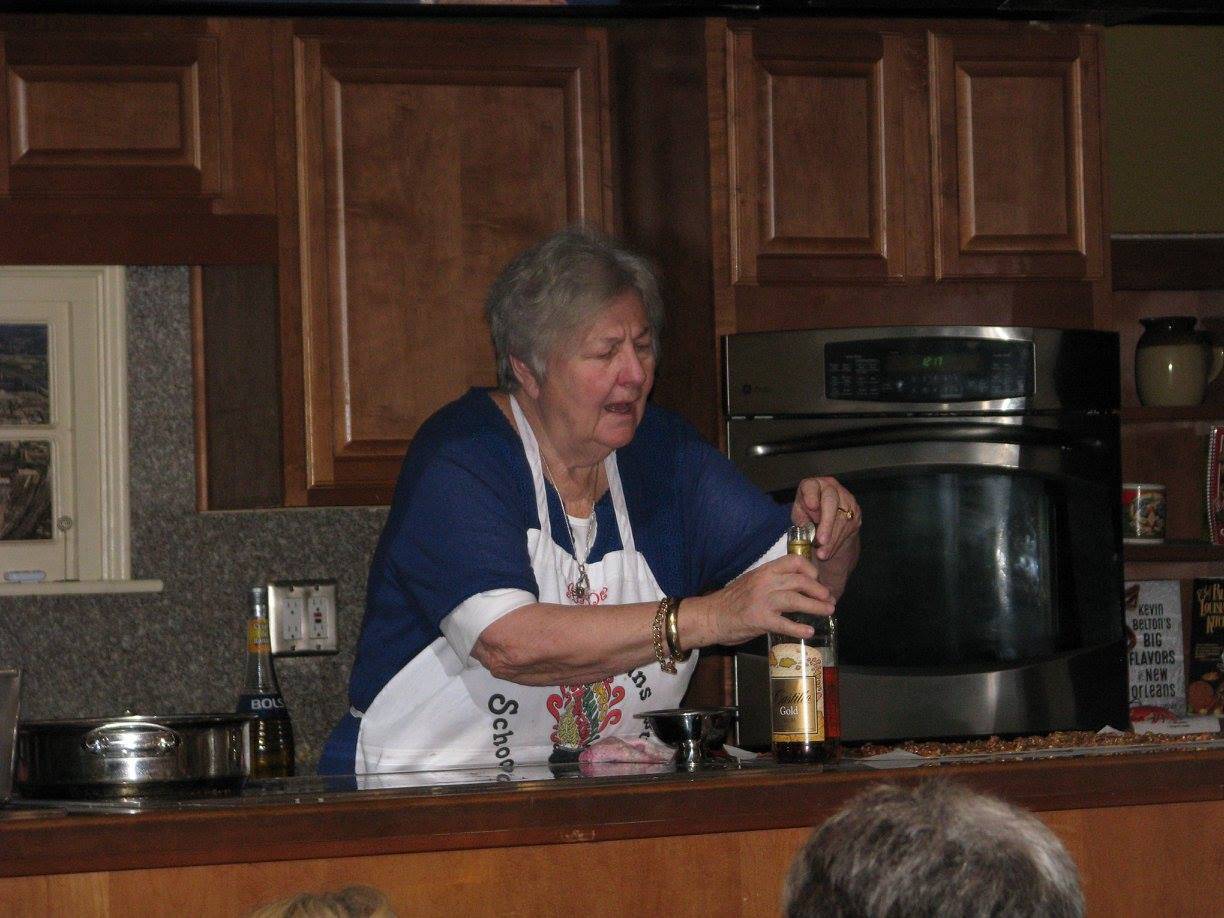
    The booze is the most crucial ingredient. Be generous.

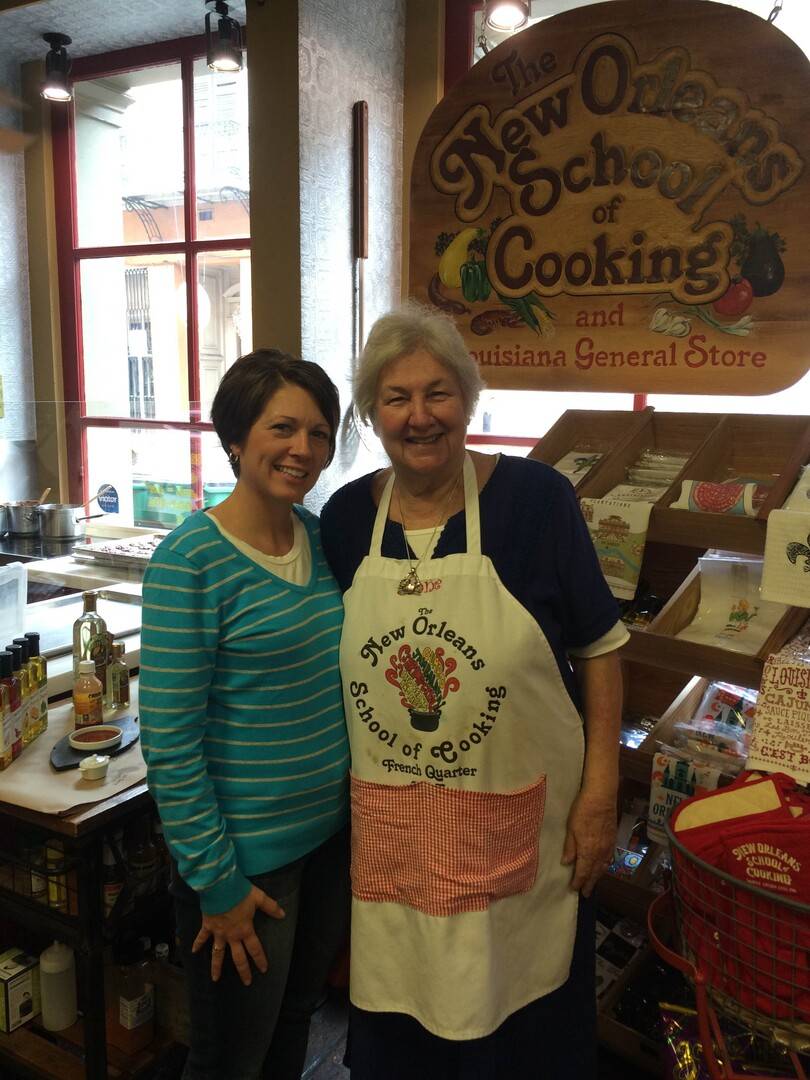
    There was simply more to see and do that I could squeeze into four very full days because I also needed to get outside the convention hall to enjoy the beautiful weather, see a few sights and eat a lot of great food. One highlight of my week in the South was a visit to the New Orleans School of Cooking. (Thanks to Carol Coleman for the invitation to join her and several other Iowans for this fun time!)

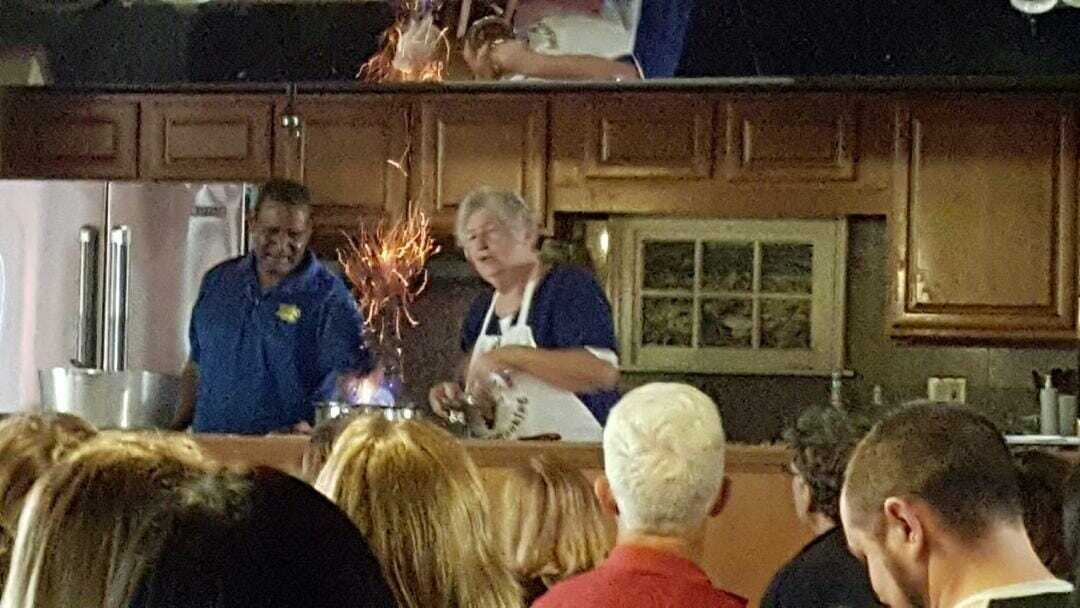
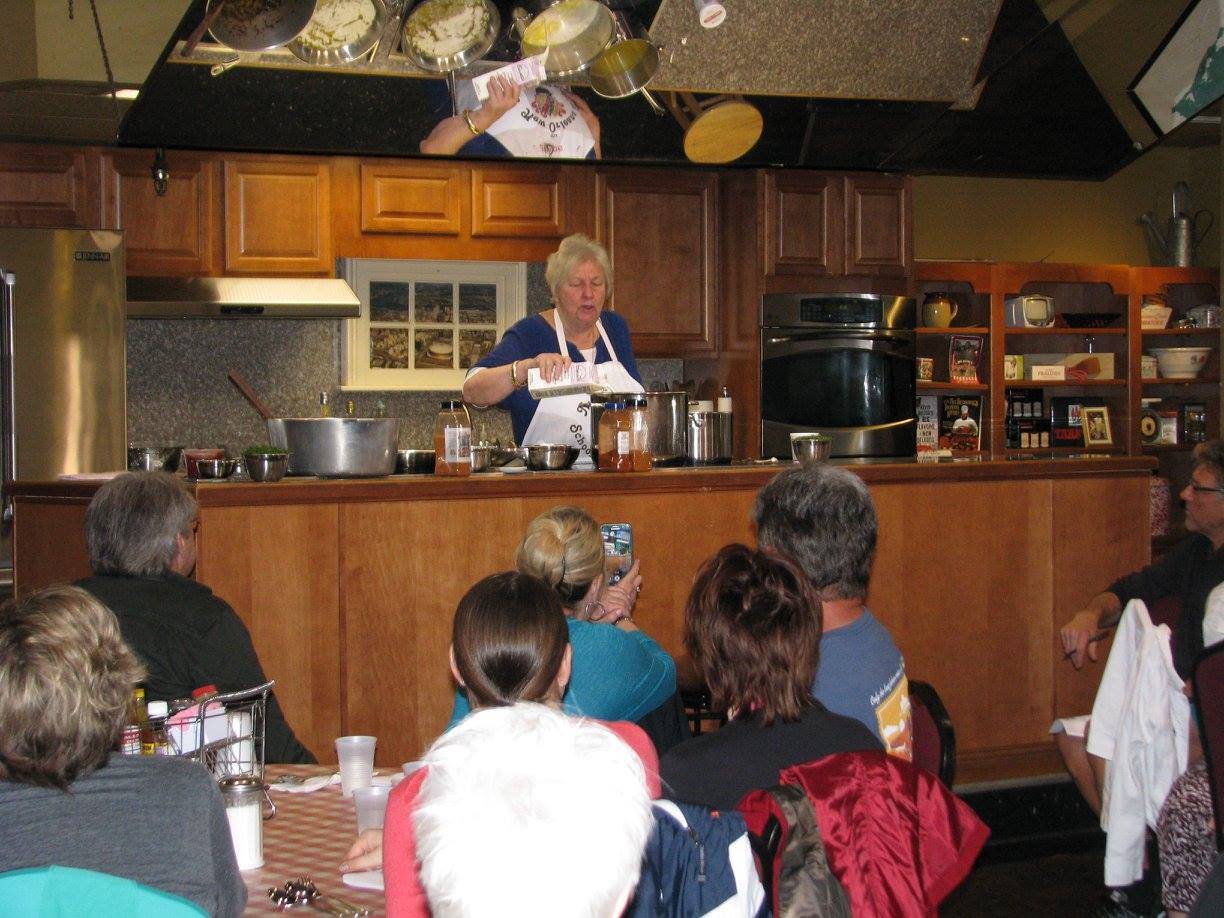
    Our cooking instructor, a former kindergarten teacher and certified tour guide, was a walking encyclopedia of Louisiana history plus a colorful storyteller. We learned how Spanish explorers, French settlers, Canadian immigrants and African slaves influenced the Cajun and Creole dishes for which New Orleans is famous.

    gravy
    You can see inside the pans using the mirror above the instructor’s head!

    What’s not to love about a history lesson that takes place over a four-course meal? As our class began, we were served hot buttermilk biscuits with cane syrup. (Before I made this trip, I assumed everyone ate maple syrup. We know what we grow, right? It only makes sense that cane would be the syrup of choice in Louisiana.)

    The Southern menu demonstrated during our cooking class included:

    • Corn & Crab Bisque – Oh. My. Yum. This is one dish Iwill make at home! (Even though it wasn’t on our menu, I’m linking to gumbo because it’s a signature dish in New Orleans.)
    • Shrimp Creole – This is another southern specialty that’s oh so good! Be sure to mix it all together before taking a bite. (Our instructor said she can always tell the northerners in the class because they leave the gravy on top of the rice. “Mix it up, y’all!”)
    • Bananas Foster and Pralines (pronounced here as praa-leens) – Talk about indulgent! We were treated to both desserts plus ice cream.

    Did you know that New Orleans (#NOLA) is the birth of Bananas Foster? I found it fascinating to learn this dessert was born out necessity. Here’s why… New Orleans was the major port of entry in the 1950s for bananas shipped from Central and South America. Owen Brennan, owner of Brennan’s Restaurant, challenged Chef Paul Blange to find a use for surplus or ripe bananas. Decadent Bananas Foster was created and named for Owen’s friend, Richard Foster, a local civic and business leader. Each year, Brennan’s flames 35,000 pounds of bananas for the famous dessert.

    Get a taste of the French Quarter at home by recreating these classic recipes at home!

    Team Latham

    March 11, 2016
    Desserts, General, Recipes
  • Latham Hi‑Tech Seeds

    West Central Iowans Revisit Scandinavian Roots in Uganda

    San photo 1

    When Steven and Charlene Sandven of Humboldt got married in 1982 and moved onto a West Central Iowa farm, they had no idea its history would lead them to Uganda as they celebrated their 33rd wedding anniversary. Their story is one that weaves together two families across three different continents.

    Steven’s great grandfather, Magnus, borrowed money from Lars Mandsager to emigrate to the United States from Norway. Magnus helped Lars farm, plus he worked as a tailor’s apprentice in Fort Dodge to earn additional money to pay back the loan. This tract of land transfers back and forth between the Mandsager and Sandven families throughout the years.

    Fast forward to Fall Harvest 2015. Steven and Charlene are in the midst of harvesting soybeans

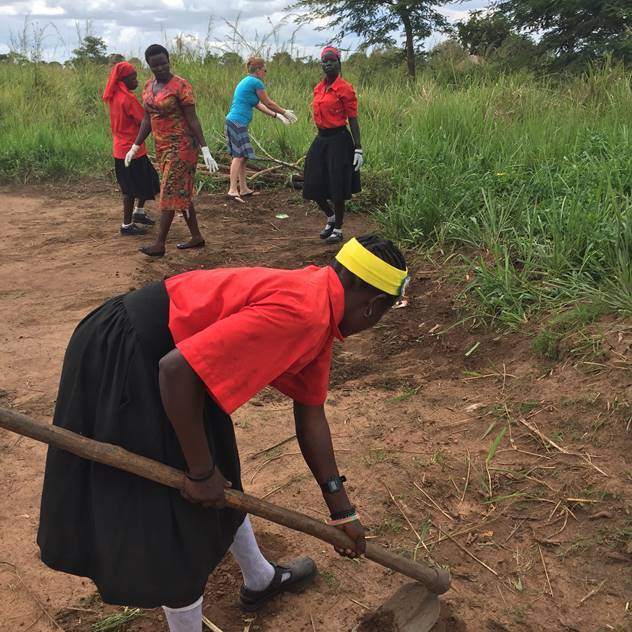
    Tilling, planting and harvesting is all done by hand at ChildVoice Uganda
    Tilling, planting and harvesting is all done by hand at ChildVoice Uganda

    when they received a call from Conrad Mandsager, CEO and Founder of ChildVoice. Conrad and his younger brother, Neil, were born in Cameroon where their father was a medical missionary. Conrad graduated from Marshalltown High School and played football at Wartburg College in Waverly, Iowa. Conrad returned to his family’s Humboldt County farm, but his entrepreneurial drive led him to explore farms in the Northeast. He’s now a consultant in New Hampshire, and the Sandvens rent the Mandsager family’s Iowa farm land.

    Regardless of where Conrad is hanging his hat, his heart is with people in Africa. He was moved by the women and children whose voices were silenced by war in Uganda. “The Lord’s Resistance Army began kidnapping children to become soldiers and women to be used as sex slaves. For 20 years, the rebels abducted an estimated 30,000 children from their homes in Northern Uganda and forced them to commit violent acts upon villagers.”

    In 2006, ChildVoice pioneered a unique community model to provide hope and opportunity for adolescent girls in northern Uganda because returning child soldiers and sex slaves were not welcome in their home villages. Years of war had left their home communities traumatized and facing abject poverty. “The second generation impact of war remains,” read the organizations website, “and our young students today still face many challenges.”

    One challenge is making the model community self-sustaining. Several fields, or large gardens, have been tilled and planted. The women primarily grow peanuts and vegetable crops like white sweet potatoes, beans, potatoes, okra and white, waxy corn that they call maize. They also grow watermelon. A few local men are hired to raise some chickens and a few pigs to supply ChildVoice with meat and eggs. A fish pond also has been built to raise tilapia, so they can raise their own fish as well as sell some.

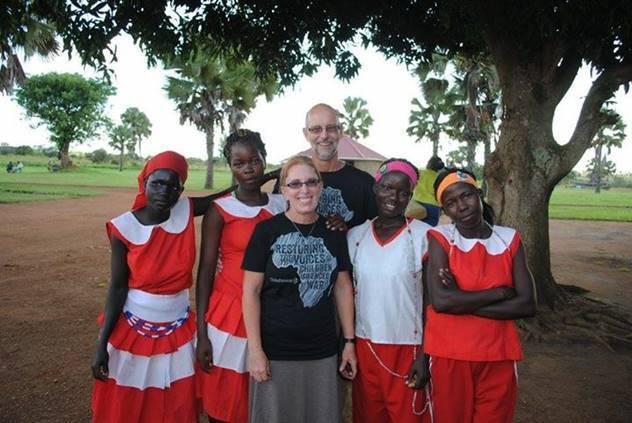
    Another challenge is teaching these women and children life skills, so they can become self-supportive. Women living in the village become apprentices in one of these areas: cooking for a restaurant, which is referred to as a hotel there, hairstyling or tailoring (seamstress). The Sandvens hope farming may be added, so the women may choose grain or livestock farming as a life skill. (As a sidebar, click here to read how one Iowa farm women has helped female farmers in Uganda.)

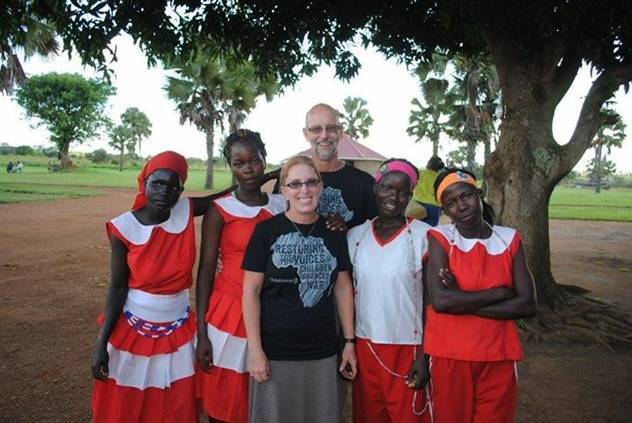
    Steven and Charlene Sandven greeted upon arrival at ChildVoice Uganda
    Steven and Charlene Sandven greeted upon arrival at ChildVoice Uganda

    During their two-week stay last October, the Sandvens helped make physical improvements to facilities around the mission. Steven and Charlene also used their farming skills to evaluate the maize program. They learned the maize is yielding only about 10 bushels per acres! The maize is being planted in hills at a plant population of about 18,000 per acre (although the local measurement is hectares).

    To demonstrate how more plants – and higher yield – could be achieved, the Sandvens taught the women how to plant in rows. They demonstrated with sweet corn, planted at a population of 32,500 plants per acre. They formed one measuring stick that was about 8 inches long for seed spacing and a 20-inch stick for row spacing.

    Soil fertility is also key to improving yield, so soils have been tested on the ChildVoice farm. The next step in achieving higher production is going to be adding nutrients to the soil. Plans are in the works to begin using nutrients from the rabbit hutch and fish pond as fertilizer.

    Of course, higher yield also means the villagers need to look at developing infrastructure. All labor is manual at this point. Should they consider oxen and equipment or purchase small farm machinery? Should they expand their land base? These are questions being pondered now by the ChildVoice board of directors, four of whom traveled with the Sandvens in October to Uganda along with five representatives from Lutheran Church of Hope in West Des Moines.

    This group also traveled to nearby villages to see how well graduates of ChildVoice were doing on their own. One graduate had opened her own bakery next to another woman, who sells beans and rice that is delivered by a farmer in bulk bags. Then locals use measuring cups to buy what they want from the roadside market. Another ChildVoice aluma works as a cook in a hotel, or what Americans would call a restaurant. A third graduate has her own salon, and a fourth graduate married a farmer from another tribe.

    “It was so rewarding to teach them things they could use to improve their lives,” says Charlene. “We hear the expression, ‘Another day, another dollar.” We’ll it’s true for these ladies! They earn so little, but they’re learning how to take care of themselves and their children.”

    The women the Sandvens met last fall in Uganda are just a few of the success stories being told as ChildVoice celebrates its 10th anniversary in 2016. Those interested in helping can contact ChildVoice International or an associated ministry through Lutheran Church of Hope.

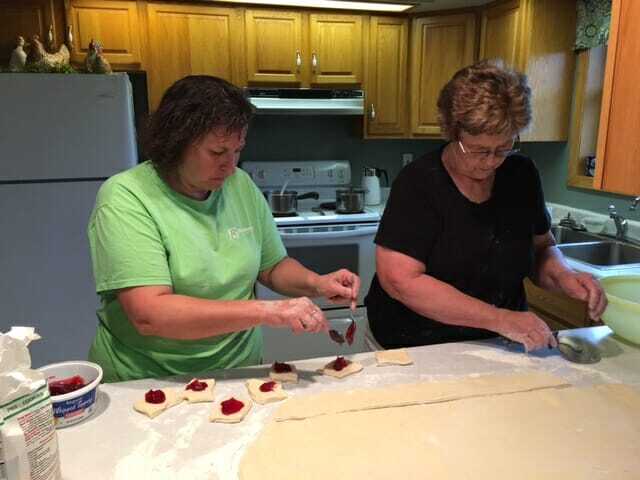
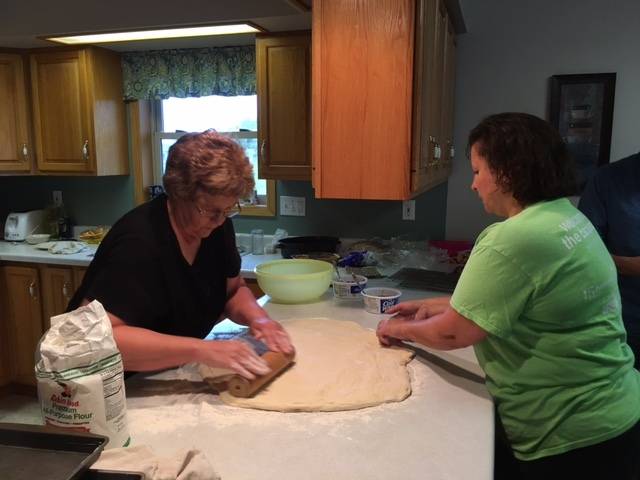
    In honor of the Norwegian heritage that brought together the Mandsager and Sandven families three generations ago, today we’re sharing a recipe for Kringla. Kringla seem to magically appear on the tables of those with Scandinavian heritage either on Thanksgiving and Christmas. The Sandvan family enjoys these pretzel-like pastries so much that Charlene freezes them to have on hand throughout the winter.

    As empty nesters with four adult children, Charlene says having casseroles and desserts in the freezer is a real life saver. Their oldest daughter, Brandy, lives nearby with her husband, Cody, who farms with Steven and Charlene. Brandy and Cody have two children. Brittany and her husband, Reed, have one son. The Sandven’s daughter Chelsea is a senior at the University of Northern Iowa, majoring in in Criminology and Psychology. Their youngest son, Skyler, is freshman in Aerospace Engineering at Iowa State University.

    Both Steven and Charlene’s families come from Norway, so today their sharing their recipe for one of their favorite comfort foods with us!

    Team Latham

    March 4, 2016
    Desserts, General, Recipes
  • Latham Hi‑Tech Seeds

    Harriman-Nielsen Farm Preserves Danish Traditions

    Doreen Petersen low res

    Guest Post by Darcy Maulsby

    Rural Iowa is steeped in beloved Christmas traditions that reflect the legacy of the state’s pioneer settlers, including the Danes. Iowa’s Danish heritage comes to life throughout the year at the Harriman-Nielsen Historic Farm in Hampton.Doreen Petersen low res

                “Many Danish traditions revolve around food,” said Doreen Petersen, who volunteers with the Harriman-Nielsen Historic Farm, which welcomes visitors throughout the summer and fall. “Typical Danish holiday meals include red cabbage, apple cake and Æbleskivers.”

    From approximately 2007 to 2010, Petersen and her fellow volunteers hosted a Sunday afternoon holiday celebration at the farm during the Christmas season. Guests could sample homemade Danish cookies, view the farm home’s Danish Christmas decorations (including handmade woven red and white hearts), and learn about Danish holiday traditions. “In Denmark, families would gather on Christmas Eve and walk around the Christmas tree while singing Christmas carols,” Petersen noted.

    Swedish hearts.crop

    While the museum no longer hosts a holiday open house, the Harriman-Nielsen farm home remains a time capsule of Danish history in Iowa. The story begins in 1881, when Dr. Oscar Harriman and his family acquired the property on the west edge of Hampton and made their home there. After Dr. Harriman’s death, Henry Skow, a local blacksmith of Danish heritage, brought the property and lived in the home with his wife and four daughters from 1908 to 1920.

    Harriman Nielsen home low res

    The final owners of the home, Chris and Anna Nielsen, emigrated from Denmark in 1905 and purchased the property in 1920. They operated the Whiteside Dairy for 25 years. During the 1920s, their daughters, Petrea and Nielsine, attended a Danish school in Minnesota, where they learned to read and write the Danish language so they could communicate with their relatives in Denmark.

    Harriman Nielsen interior

    The Nielsens left a variety of antiques, including Danish hand-painted dishes, that remain in the farm home. They also preserved more than 2,000 letters written to family and friends in Denmark. “Translations of those letters tell the story of Danish immigration to America and provide a fascinating glimpse into the lives of the Nielsen family in Hampton and life in Denmark for more than 100 years,” said Petersen, who noted the letters are preserved in the new book “The Nielsen Letters: Doorway to the Past” by Dr. James D. Iversen.

    Nielsen dishes

    Visitors can get a glimpse of this Franklin County heritage during the popular Fall Festival at the farm. This year’s event attracted more than 1,000 guests to the Harriman-Nielsen farm in 2015. No Fall Festival would be complete without Bean Soup, which is made from heirloom beans grown in the garden at the Harriman-Nielsen farm.

    “We prepared seven roasters of Bean Soup this year,” said Petersen, who noted that people can enjoy the soup in the barn or take some home to eat later. “Volunteers also donated about 75 pies, and they were all gone by the end of the festival.”

    If you’d like to enjoy a taste of Franklin County, make plans to attend the 2016 Fall Festival. In the meantime, create your own holiday memories with this recipe for Buttermilk Æbleskivers.

    Team Latham

    December 24, 2015
    Desserts, General, Recipes
Previous Page
1 … 7 8 9 10 11 … 20
Next Page

Latham Hi‑Tech Seeds

131 180th Street | Alexander, IA 50420

(641) 692-3258

SIGNUP FOR OUR NEWSLETTER
  • Contact
  • Legal
  • Dealer Center
  • Seedware Login
  • Latham Gear

© 2025 Latham Hi‑Tech Seeds. All rights reserved. | Iowa Web Design by Webspec | Privacy Policy

Latham® Hi-Tech Seeds is a trademark of M.S. Technologies, L.L.C., 103 Avenue D, West Point, IA 52656.