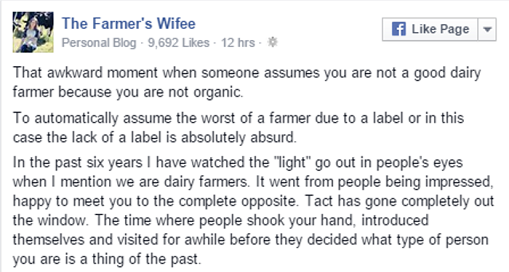
I’m not going to be politically correct because an attack on American’s freedom of choice is increasingly bothering me.
I always trying to understand all sides of any issue. I read all that I can get my hands on: newspapers, magazines, Facebook, blogs… But I learned a long time ago that if I read enough information, I can defend either side.
It’s no wonder today’s consumers are confused as to what to eat. Media reports are filled with mixed messages: Good fat. Bad fat. Eggs are good. Eggs are bad. Eat more beef. Reduce your red meat intake.
There is a huge amount of oversight keeping our food safe. We don’t need expensive regulation, just common sense. Let common sense prevail… Eat sensibly and work off what you consume.
Latham® Dealership Helps Bring Next Generation Home
They had never before planted Latham® Hi‑Tech Seeds but that didn’t prevent Mike and Patty Bergquist of Foxhome, Minnesota, from taking on a dealership when asked.
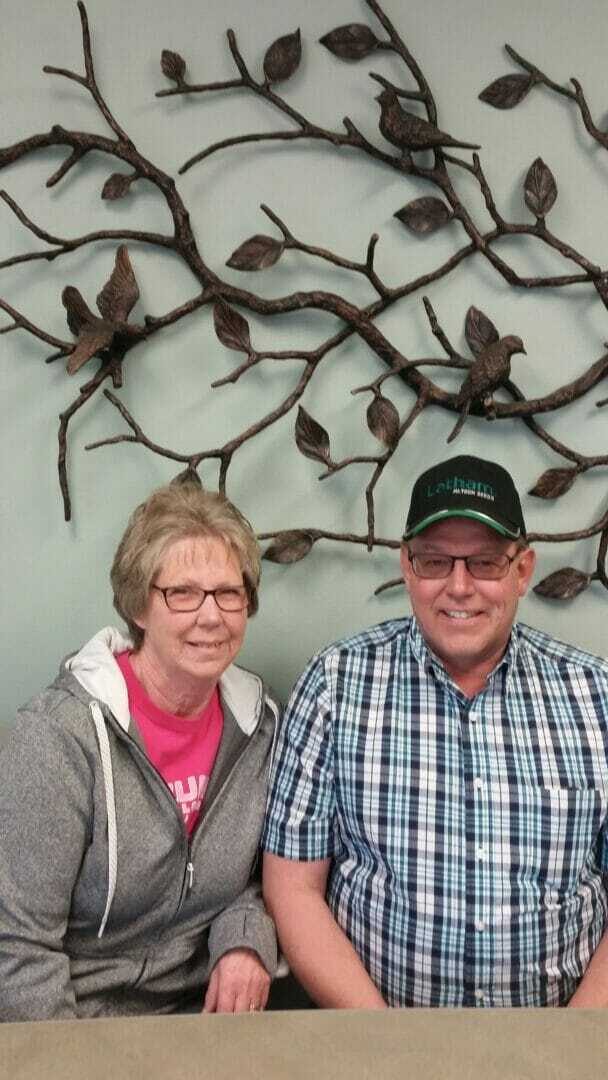
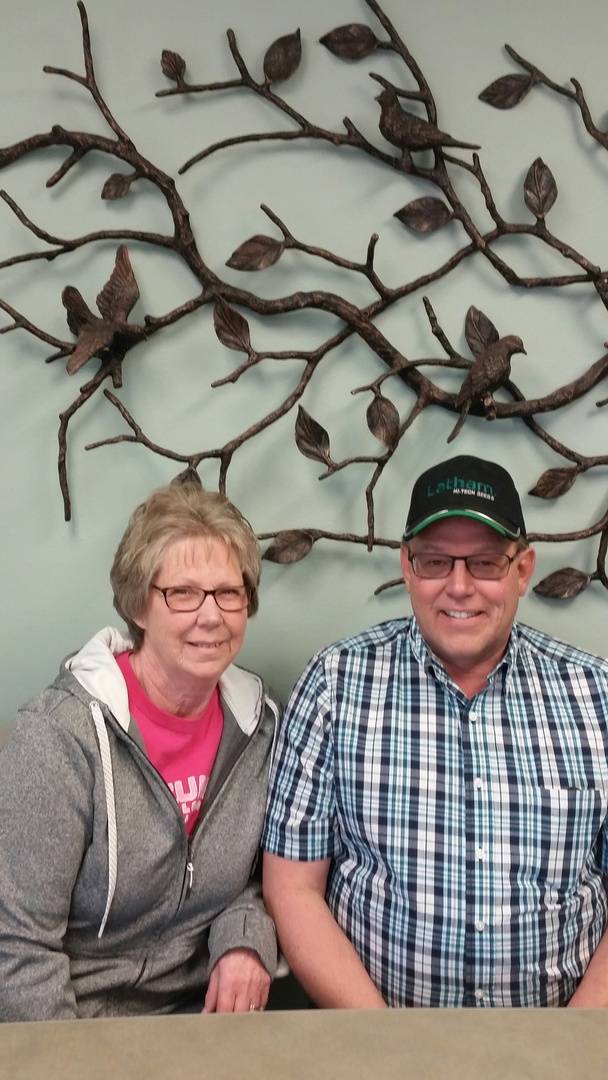
Mike and Patty Bergquist
“We were looking for a way to bring our son, David, home and this ‘solution’ seemed to present itself,” said Mike. “You might say opportunity knocked when your sales manager came to our door that day and talked with us about Latham Seeds.”
They weren’t able to get the soybean brand they were accustomed to planting, so the Bergquists decided to try Latham Hi‑Tech Soybeans. They also put Latham® corn to the test, and Latham Hi‑Tech Hybrids topped their on-farm yield test. He was sold on the Latham performance!
No one in their area had a Latham® dealership, so Mike said his family liked the idea of offering something others didn’t have. He said that national companies have several dealers in the area, but he really liked the idea of working with a family-owned company that shares similar values.
Mike served for three years in the U.S. Navy and then returned home and helped his step-grandfather, Harold, farm. To supplement his income, Mike started working campaigns in 1975 at the local sugar beet processing plant. He worked at the plant whenever Harold didn’t need him in the field.
When Mike and his wife, Patty, were married in 1977, Harold offered to let them move a trailer house onto the farm. They appreciated that opportunity to live on the farm where they could begin a family. Four years later their first child was born, and Mike had to choose between accepting a promotion at the beet plant or farming full time with Harold. He chose farming, but it wasn’t long before their situation changed.
Harold passed away in 1985. The 1980s Farm Crisis made it challenging for a young couple to support a growing family, so in 1988, this father of five went back to working campaigns at the beet plant. Mike accepted a full time position there in 1989, and today he serves as a plant supervisor. Because Mike only get weekends off once every four years, it helps to have David involved with the farming operation.
David, the Bergquist’s youngest child and only son, completed the John Deere program at North Dakota State College of Science (NDSCS) in Wahpeton. He has been at RDO Equipment for two years as a John Deere technician. He’s been dating Chloe Bergman since they were freshman in high school, and she’s studying to become a dental hygienist.
Their oldest daughter, Kari, and her husband, Tim Marquardt, have 3 kids. Their son Hunter is 8 and Hudson is 4. Their daughter Hadley is 6. Kari works as a school cook and Tim works at the co-op. Their daughter Heidi has two fur babies: Harley is a Black Lab and Buster is a mix that she rescued. She works as house manager for West Central Community Services.
Third in birth order is Katie. She is a daycare provider and her husband, Derrick Wolter, is an engineer for Willrich. They’re the proud parents of two sons, 3-year-old Dawson and 8-month-old Carsten.
Daughter Holly is a nanny. Her husband, Travis Rogahn, is a John Deere technician plus he farms. They have two son, 4-year-old Michael and 6-month-old Bennett.
In their free time, the Bergquist family enjoys camping. It’s something they enjoyed doing when their kids were young. Now it’s something the three generations enjoy doing together.
When everyone gets together for camping, Patty keeps the menu simple. A family favorite is Tequilaberry Salad, which she’s sharing with us today.
Want to add a little joy to your backyard? Plant a butterfly garden! Butterflies spread beauty as they feed on the flowers they help pollinate.
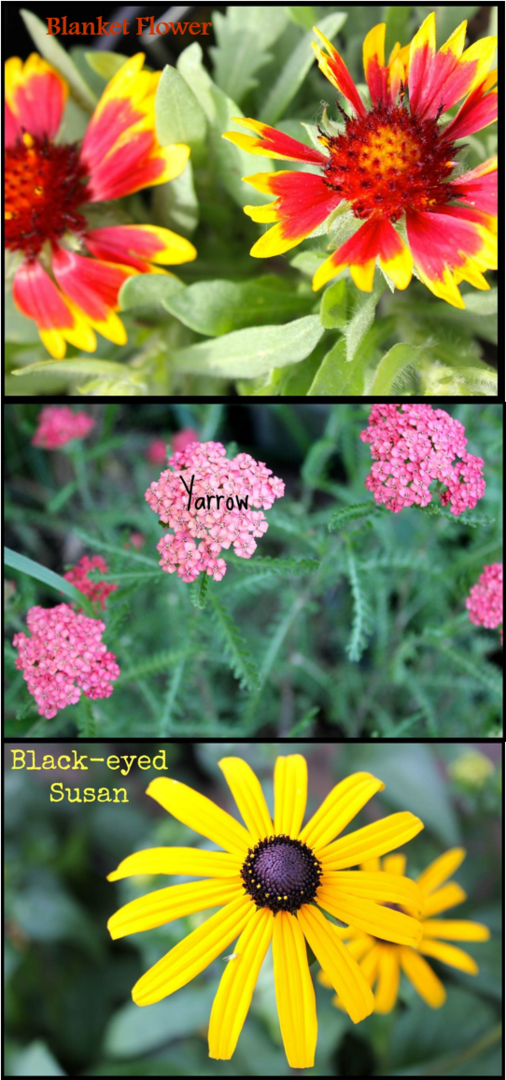
There are a lot of things to think about when planning a butterfly garden, but the most important – and also the most obvious – is the plants. Lure butterflies into your yard with flowers that produce the nectar they prefer.
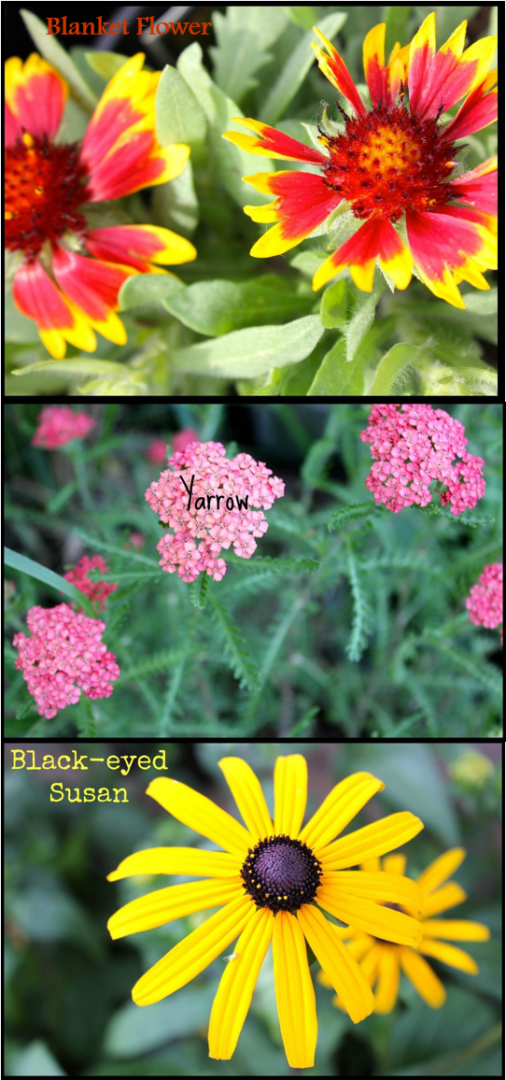
Some perennial plants that work well to attract butterflies to gardens in North Iowa and across Plant Hardiness Zone 4 include:
Butterflies are attracted to fragrance. Be sure to include good smelling plants like lavender, lilac and bee balm. These plants will be a treat to your senses, too!
April is National Gardening Month and a great time to plan your butterfly garden. Just click the links above to get started!
Join Cristen & Kristen on a Food Journey across Iowa
“Iowa Girl Eats” blogger Kristen Porter and “Food and Swine” blogger Cristen Porter are teaming up for a food journey across Iowa.
A self-described “born and raised Iowa farm girl with a passion for baking timeless recipes,” Food and Swine blogger Cristen Clark is teaming up with Des Moines native Iowa Girl Eats blogger Kristin Porter to “cook up” conversations about today’s farm and food system.
“I’m an Iowa girl through and through, but until I teamed up with Iowa FFP, my ‘farm visits’ were limited to seasonal trips to the farmers’ market, an apple orchard or a pumpkin patch,” said Porter. “… The biggest takeaway I had from each [farm] visit was the assurance that the farmer I just met does everything he or she can to raise quality food for their families, neighbors, communities and state.”
Starting this month, Cristen and Kristen will connect food-minded Iowans with the people who provide, prepare and serve food. They will partner with farmers and a dedicated team of chefs and dietitians from Hy-Vee, Inc. to share information about production methods, health information and food preparation.
Follow along with their journey at www. iowafoodandfamily.com. Watch for dates to be posted soon about these activities:
Iowa Food and Family (Iowa FFP) Cookbook: This recipe book features nearly 60 recipes from Cristen and Kristen, farmers and Iowa FFP sponsors like Latham Hi‑Tech Seeds. (Words alone cannot express how excited I am to have some of my favorite recipes included in this cookbook!) Complimentary copies of this cookbook will be distributed during in-store events at Hy-Vee, the Des Moines and Beaverdale Farmers’ Markets and the Iowa State Fair.
Recipe Refresh: You’ll have the opportunity to win a makeover and shopping experience — with food! Winners of “Recipe Refresh” events will be chosen statewide and will join Hy-Vee dietitians, area farmers and bloggers as they shop for ingredients to prepare their favorite recipes in-store while also stocking their carts with groceries courtesy of the Iowa FFP.
Make it & Take It: This dinner club event welcomes food-minded Iowans to participate in an informational, hands-on cooking demonstration alongside farm group leaders, a Hy-Vee chef and dietitian.
Bullying Can Happen to Someone You Love, Online or Off!
We no longer feel the isolation and loneliness that were common before instant communication. Through Facebook, I’ve been able to connect with old friends and meet new acquaintances with shared interests. Through Twitter, I’m able to follow a newsfeed filled with hot topics. There are so many people to communicate with – and so many opportunities to do so!
As much as I enjoy being active on Facebook and Twitter, as well as blogging, I’ve found that I am often misunderstood on social media! People reading my posts cannot see the twinkle in my eyes. They can’t hear the tone in my voice. Text messages – even with the use of emoticons – don’t allow us to look into someone’s eyes or read their body language.
Social media can be a very non-emotional form of communication. Comments can easily be taken out of context. Too often people make statements while hiding behind a computer. Facts can get twisted and feelings can get hurt when people post comments via social media that they would never say in during a face-to-face talk!
When I posted a blog taking a look inside #RealPigFarming on March 31, I received several unpleasant comments. Those comments hurt enough to make me question whether I should continue to keep blogging. That wasn’t the first time I’ve felt harassed online, and the negative effects are cumulative.
Think about it… what kind of communication are our young people having? My attention was focused on this very question while visiting with my granddaughter after one of her friends committed suicide this past week. This action was taken by a girl in Junior High!
After talking more with my granddaughter, I discovered that her friend was being bullied. Cyberbullying has become a new lethal form of bullying. Speaking of bullying, 85% of students witness bullying when adults are not present. I also learned that my granddaughter’s friend was a very troubled young girl. I understand that I’m only hearing one side of the story, but it brought mental healthcare to mind.
Why are so many kids today either involved in school shootings or taking their own lives? Many folks are quick to dismiss this topic by saying, “Kids have always been this way.” Or they ask, “What’s wrong with today’s kids?”
So many things can probably be blamed: social media, nutrition, the way we discipline our kids, and Common Core with all the testing. But I firmly believe that kids today must learn – and accept – that everyone is NOT the same. Not everyone deserves a blue ribbon. Not every team can win a game, so keep score at ball games. Teach kids how to win and lose! Kids need to learn that more effort often yields results. That way players, who don’t win every game, can feel good about their efforts. A kid who earns a red ribbon but desires a blue ribbon will be motivated to want to learn how to improve.
We need to stop making excuses and start looking for answers. Kids are dying! My granddaughter, like other teenagers facing a similar situation, is very hurt. She wonders if there was more she could have done, and the guilt she carries will be another problem. Suicide does not only involve one person; it has a huge effect so many people.
In the short term, my granddaughter needs to be reassured that she’s not to blame and that’s she’s loved! In the long term, this problem needs to be addressed by everyone. Empathy must be taught for bullying to stop, says internationally recognized educator, best-selling author, and bullying prevention expert Dr. Michelle Borba.
There isn’t a simple solution. A community must be willing to change. Community leaders, parents and educators must collaborate. What do you think is the best way to get a conversation like this started in a community?
Author and pie baker extraordinaire Beth Howard was right when she said you can create peace with a piece of pie. It’s been six weeks since we lost Amy Hild, a valued member of Latham Hi‑Tech Seeds’ marketing team, in a tragic automobile accident. It’s hard to feel like smiling when there’s a pit in your stomach and an emptiness in your soul that’s indescribable.
Iowa bloggers, creating soul food. from left to right: Mary Hopper, Jennifer Flaa, Jessica Wood, Shannon Latham and Val Plagge
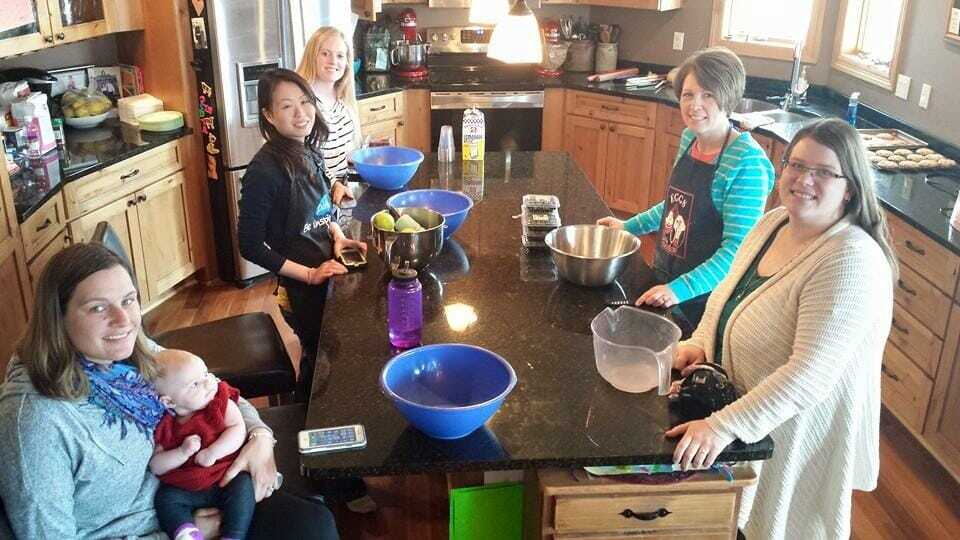
But thanks to a small group of positive women, there’s joy in my heart today. Yesterday four members of the North Iowa Bloggers and I road-tripped about two hours south to accept an invitation for a baking class from Cristen Clark, a national award-winning cook and baker. The idea originated from a post by blogger Jennifer Flaa entitled, “Baking Feelings into Pies.”
I spent a perfect day in the kitchen filled with positive women. (BTW, my experience yesterday reminded me the title to a book I greatly enjoyed. Click here if you’d like to learn more about it.) Even the most seasoned bakers in our group learned from one another.
A few of the tips and tricks I want to remember include:
“Fat is where it’s at!” (Fat adds flavor to hamburgers. It also makes pie crust delicious and flakey. Use butter or lard; it’s a personal preference.)
When mixing up the pie filling, zest half a fresh lemon peel into the sugar. (“Perfume the sugar.” Words alone cannot explain how delicious this smells. You must experience it yourself!)
Squeeze the juice from the half of lemon over your fruit, even fresh pears, as you mix the filling.
Use Tapioca (in place of flour) as a thickener.
A cake lifter helps prevent crust from sticking to the counter top. Continually shower flour (as opposed to “blizzard”) onto the counter top to prevent the crust from sticking.
Also use the scraper to keep your rolling pin clean to avoid putting dents in your crust.
“Thick strips are in” when making lattice top pie. Slide your pastry cutter or pizza cutter along a metal ruler to keep the strips straight.
Wrap pie plate with a ring of foil to prevent the edges of the crust from getting too brown or burning. While my mom taught me to cover the edges with foil, I have to admit that I had trouble keeping the foil ON the crust. The ring is the trick! NOTE: Put the foil ring around your pie BEFORE placing it in the over to avoid burning your fingers.
Once you bake the pie, let it cool for 4 hours before cutting into it. Talk about temptation… who can look at pie that long without sneaking a bite? (Fortunately, I baked my pie an hour before bed time. I woke to a cool pie – perfect for breakfast!)
P.S. Pull tabs on the ends of cling wrap help secure the roll and make it easier to dispense without the saran clinging to itself. Seriously, who knew?! That tip alone might have been worth the drive.
Because it’s Friday on TheFieldPosition.com, I’m sharing with you the recipe I used to bake blueberry pie yesterday. I have to confess that I was having “pie envy” as I watched Pear Pie being assembled, and I can’t wait to try my own hand at it very soon. Click here for the recipes Cristen uses for pie crust and $3,000 Pear Pie.
What answers do you get if you ask someone to list STEM careers? My guess is you may hear things like mechanical engineering, architecture, medicine, computer programming, or research analyst. I doubt you will hear farming very often. However, STEM is a large part of everyday farming in the 21st century!
STEM stands for Science, Technology, Engineering and Math. You don’t have to look far to find STEM in everyday farming. Here are a few examples:
SCIENCE – Midwest farmers will soon be planting #crop15, and one area that has seen a lot of science improvements is the seed that is planted. Scientists are constantly working to improve seeds to better withstand different weather conditions (e.g. wind and drought) and overall improve yield. Farmers do a number of scientific tests throughout the year to ensure all of their management practices are optimal. These tests include things like soil samples, water quality samples, moisture testing harvested grain in the fall, feed particle size for livestock operations, and the list goes on.
TECHNOLOGY – You can hardly open a farming magazine today without an article on new technology. Precision farming technologies are being used in much of the equipment today to auto-steer equipment and attachments with increasing precision and accuracy, vary the rate of seeds and fertilizer, and send alerts or messages to farm managers. Drones are being used for crop scouting and monitoring farm areas more efficiently. Technology has also increased for livestock operations with hardware and software to monitor everything from feed ordering to building maintenance issues. A number of farmers are also looking at installing solar panels around their operations for energy.
ENGINEERING – Engineering is designing and building a new or improved product or process. Farmers do this on a regular basis. They may modify a tool bar to better meet their needs, design a new grain leg, or modify a sprayer to plant cover crops. Farmers are also documenting their processes and looking for ways to improve efficiency.
MATH – Math is something that is definitely used on a daily basis. Farming is a business which requires solid financials to remain competitive in today’s environment. In addition to financial performance farmers are constantly doing mathematical calculations to determine everything from acres of coverage to bushels of grain.
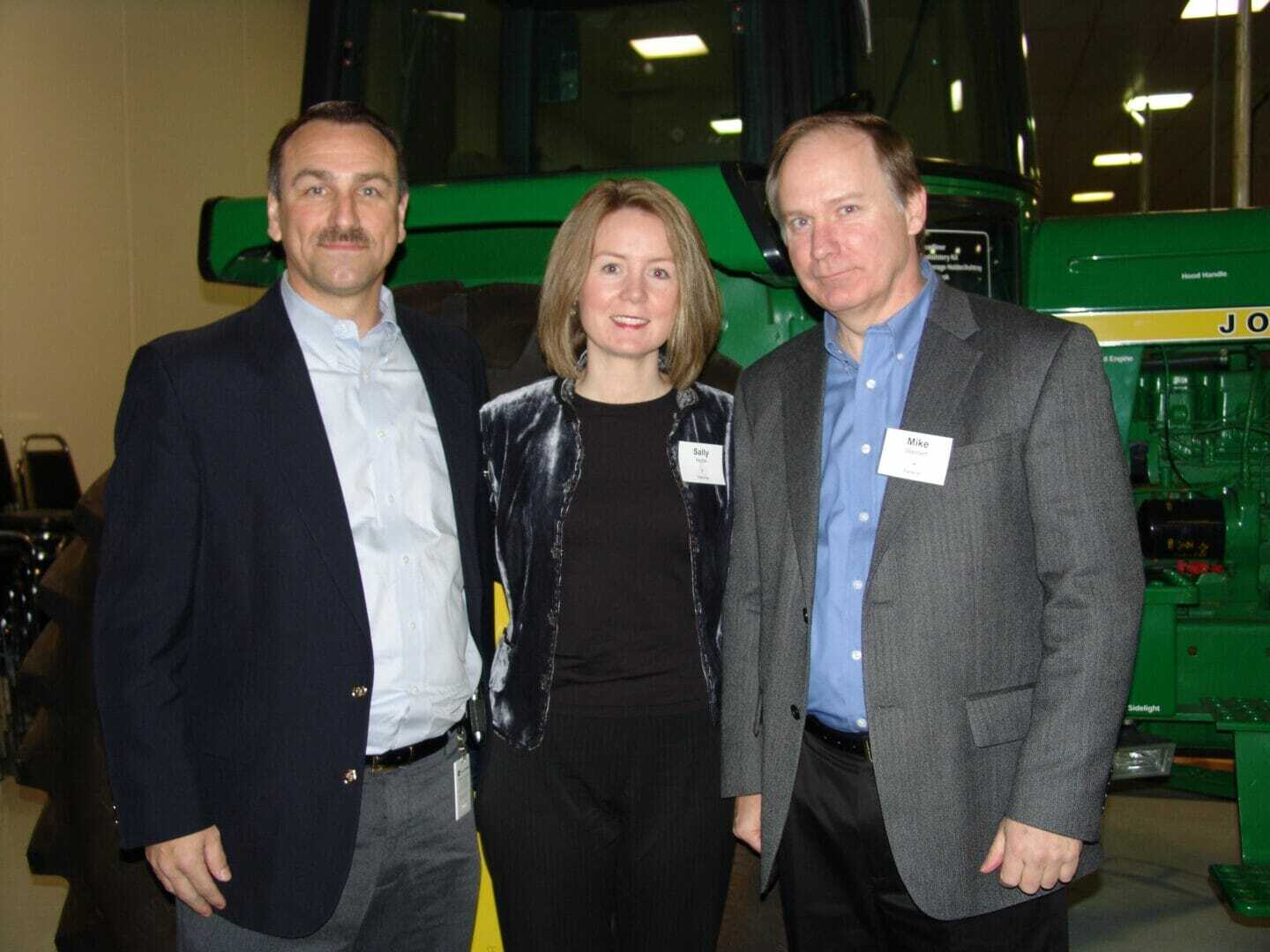
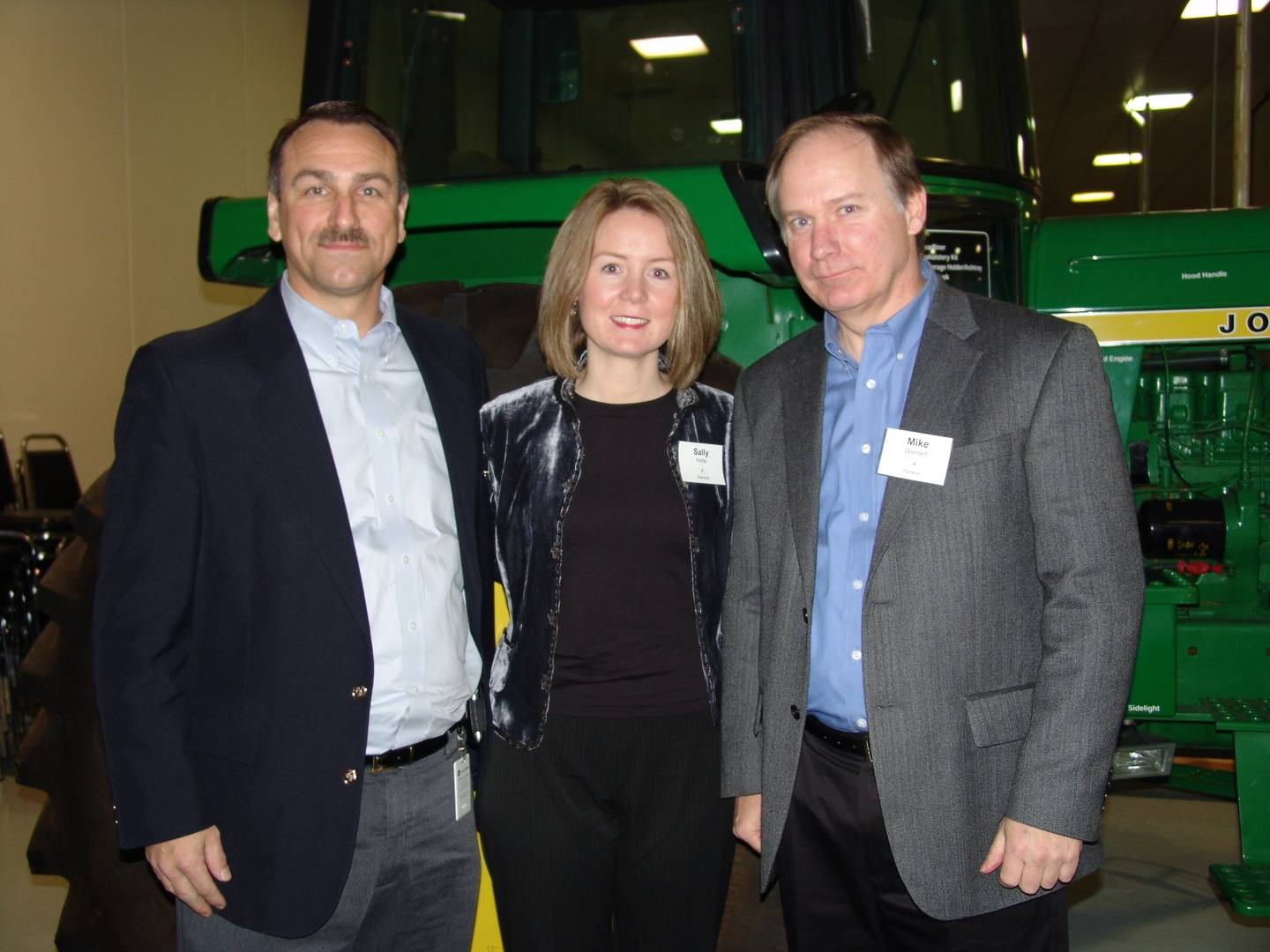
Sally Hollis with two of her previous managers from John Deere
The future is so exciting! Science, math and engineering are applicable to nearly every career. That’s why I believe STEM education in Iowa elementary and secondary schools is so important.
Farming can be an emotional roller coaster. Spring is a season of excitement as the weather warms up, and the grass turns green. I always look forward to a new planting season. Planting season is a high point, but I’m bracing for the lows that are sure to come. You never know when weather, weeds or bugs will change the fate of one’s crop. Yes, farming is filled with peaks and valleys.
Recently, I’ve been moving grain to town. I enjoy hauling grain, but the current market prices are a serious downer. More ups and downs…
The past week has been filled with more highs and lows. On April Fool’s Day, I enjoyed reading about the pranks being pulled. Cristen Clark shared how she celebrates April Fool’s Farm Style. Another prank I enjoyed was a video about a marshmallow farmer talking about his ruined crop. As my wife Janice and I watched that video, she reminded me that many people will believe it’s true.
Going from the high of enjoying the joke to the reality that we have not informed people how we grow food was another “roller coaster moment.” I couldn’t help but remember Desmund Adams asking me why we don’t we take Ag in the Classroom to Chicago because he grew up not knowing meat comes from animals.
Last Tuesday in my blog post, I shared how the way we care for livestock has changed throughout the years. In the “good old days,” we raised pigs outside in extreme cold or heat. They were exposed to disease and insects. Baby pigs were often sunburned because the momma sow was trying to stay cool in a mud puddle rather than seeking shade.
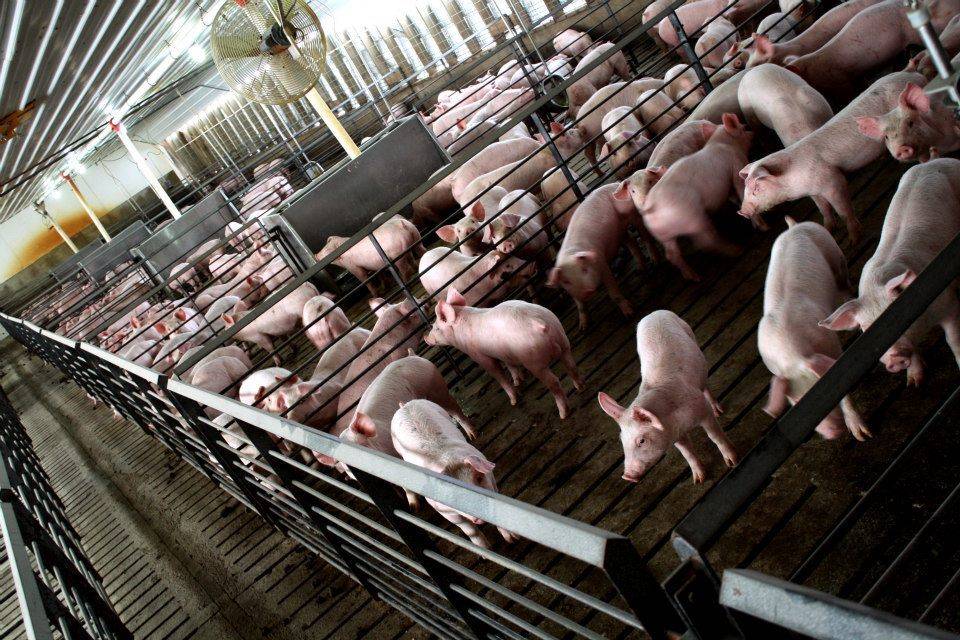
Contrast the methods of yesteryear to today’s climate-controlled hog barns where there’s a barn designed to meet the pigs’ needs from the time they’re born until they’re shipped to market. Pigs in my feeder operation are content. When it’s below zero outside, my pigs are warm inside. When it’s rainy and damp – like this week’s forecast for North Central Iowa – my pigs don’t get chilled and they stay dry. When it is 100 degrees in the shade like it is during many summer days, my pigs stay cool and don’t suffer sunburn.
I can see the huge improvements to animal agriculture made during my life time! Yet, comments left under my blog last week attack the way I farm! Situations like this make me doubt the price of advocating… Is sharing my story worth the ups and downs?
Agvocating, just like the rest of my “chores,” is full of ups and downs. I know those comments on my blog came from the anti-animal groups. All of the talking points were the same old points, which tells me they were given to people to use that have never been on a farm! Nonetheless, advocating is definitely an emotional roller coaster.
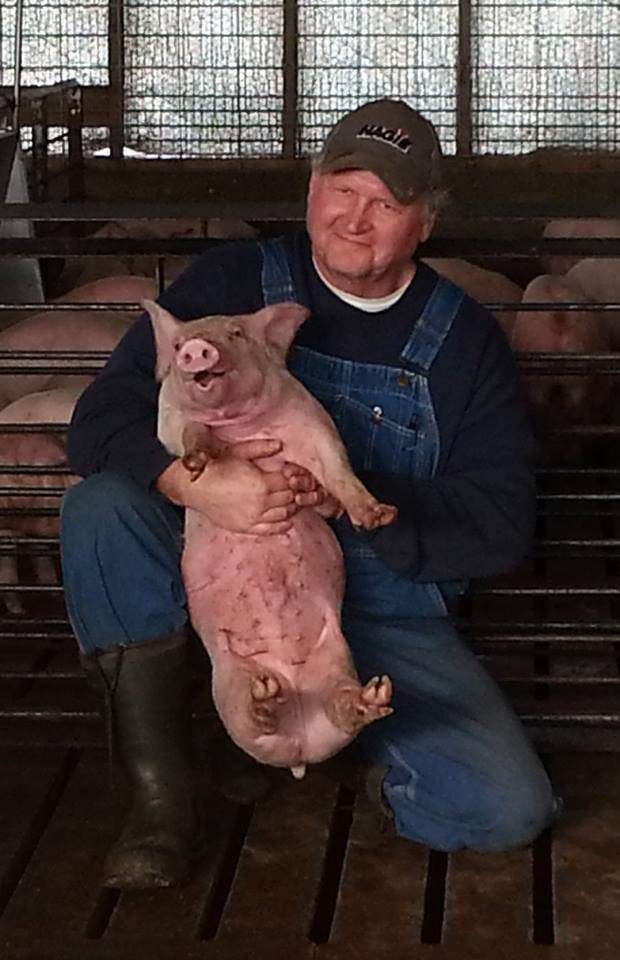
When I did my first “big” newspaper interview about antibiotics in animal agriculture, I almost said enough is enough! The reporter had his story written before he came to talk to me. He just needed to “interview” a real pig farmer to make it seem like he had researched pig farming. Of course, nothing I said was in the story. He only included my picture holding a pig! Since that first newspaper interview, I’ve learned to use pictures of pigs to my advantage! People love pictures of pigs. Highs and lows…
Now I’m working to get my current group of pigs to market. Two pig barns will be emptied this week, and repairs will be needed. Each barn must be cleaned and disinfected before new pigs arrive. I always look forward to bringing in cute little pigs, and I’ll receive a new group this Thursday. That’s a time I enjoy, but the pigs can also develop problems.
All I can do is try my best, and I was reminded of this “life lesson” in church on Sunday. Without the pain and suffering that occurred on Good Friday, we wouldn’t experience the joy of Easter morning.
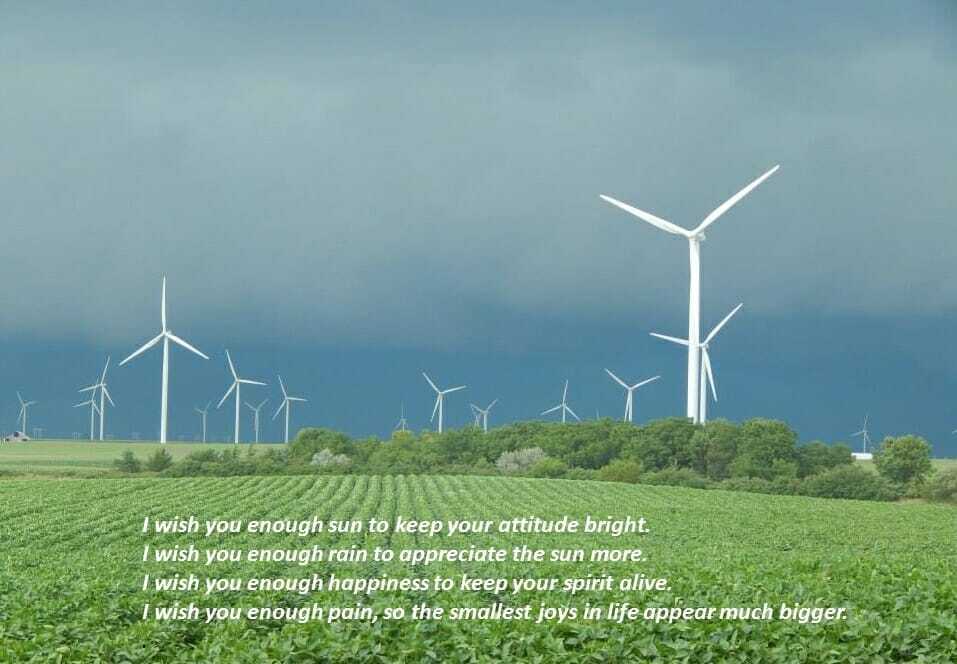
Life’s low points definitely make you appreciate the highs. That reminds me of a short story, “I Wish You Enough,” which I recently read on Facebook:
I wish you enough sun to keep your attitude bright.
I wish you enough sun to keep your attitude bright.
I wish you enough rain to appreciate the sun more.
I wish you enough happiness to keep your spirit alive.
I wish you enough pain, so the smallest joys in life appear much bigger.
Showcasing Conservation Practices is a “Snap” with #FarmersCoverIowa
The Iowa Food & Family Project is showcasing how farm families are covering Iowa – literally! From now through Earth Day on April 22, submit photos that show practices you have implemented to improve soil and water quality.
A photo project called #FarmersCoverIowa will depict environmental improvements farmers use including reduced tillage, cover crops, the proper application of livestock nutrients, grassed waterways and water retention ponds.
“Iowa’s landscape is being transformed with the construction of modern livestock barns and the implementation of more soil conservation practices in more locations,” said Aaron Putze, coordinator of the Iowa Food & Family Project (Iowa FFP) and communications director for the Iowa Soybean Association. “With the added interest in the topic of water quality this spring, providing a forum for farmers to showcase the many practices they’re using to cover Iowa takes on added importance.”
Farmers like Carl Roberts of Belmond, Iowa, use conservation tillage to protect against erosion and to preserve water quality. Larry Sailer of Iowa Falls has installed buffer strips and restored wildlife habitat. We know many other dealers and customers of Latham Hi‑Tech Seeds also have practices in place – planting cover crops and maintaining grass waterways – to conserve soil and preserve water quality.
More than 92,000 crop and livestock farms dot Iowa with the farm families who own and manage them providing stewardship of nearly 31 million acres. Show us what you’re doing by sharing photos online using the #FarmersCoverIowa hashtag.
Show us what you’re doing on your farm! Snap a photo of a conservation practice or landscape and post to Twitter, Facebook and Instagram using the hashtag #FarmersCoverIowa. Please identify the practice and the county in which it’s located, so we can help educate non-farmers about all that Iowa farmers are doing to keep soils productive and our water quality high. An ongoing album of photographs of how farmers are covering Iowa will be featured on the Iowa FFP Facebook Page.
Latham Hi‑Tech Seeds is a proud supporter of the Iowa FFP, which champions the continuous improvement of Iowa’s farm families and their dedication to providing wholesome food for everyone. The Iowa FFP, which involves nearly 40 farm and foodservice partners, proudly serves as presenting sponsor of the Iowa Games and supports Live Healthy Iowa.
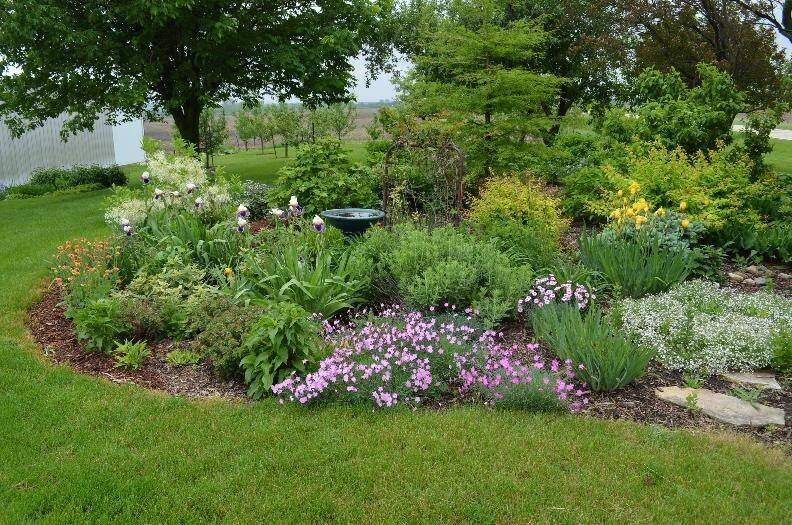
With the recent warm spring weather, home gardeners are getting eager to get their hands in the dirt. April is National Gardening Month after all! Perhaps you’d like to celebrate by planning a new garden space or refreshing an existing space that will be more inviting to your feathered friends.
The plants you choose will be dependent upon which birds you want to attract. Some families of birds will remain around your feeder all winter long, but most backyard birds will fly south when the Midwest weather turns cold. If you plant a food source for birds, however, they are more likely to find your backyard on their migration pattern and return year after year.
Two things are essential for attracting and keeping birds in your backyard: (1) an environment that is attractive to insects, which is a main food source for birds; and (2) cover, which is a place for them to live and build nests. A diverse combination of plants – perennials, annuals, shrubs, trees, vegetable and even herb plants – can provide a year-round habitat and year-round food sources for many of our favorite backyard birds.
When planning a year-round habitat, it’s important to consider garden design. Select trees, shrubs and perennials that will provide flowers and fall color for aesthetics, as well as fruit and cover for the birds. Some of my favorite trees and shrubs that can give you this include Serviceberry, Crabapple, Barberry and Chokeberry.
The main foods of backyard birds include insects, seed (including nuts), fruits, berries and nectar. Because of their beak size and structure, some birds will be able to eat larger and tougher fruits while others will only be able to eat mushy fruit and smaller seeds from perennials and annuals. NOTE: Hummingbirds are in a class all their own. They sip sweet nectar from many perennial and annual flowers, especially those with a trumpet shaped flower.
Ornamental grasses can be a good choice for attracting birds, as well. When left standing into the fall and winter, grasses provide the birds with cover and the seedheads can provide a food source.
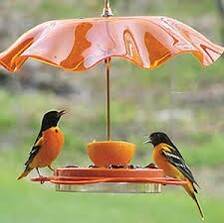
Even if you have a diverse plant pallet, you may still need to attract birds to your backyard with a feeder. Woodpeckers especially love a suet feeder in the winter; a feeder of sunflower seeds attracts cardinals. In the summer months, you will find finches flocking to a feeder full of thistle seed. Orioles, however, will only stop if you have grape jelly and oranges ready at just the right time in May.
Have particular questions about making your yard more enticing to birds? Feel free to leave comments on this post or send me a message on Facebook.
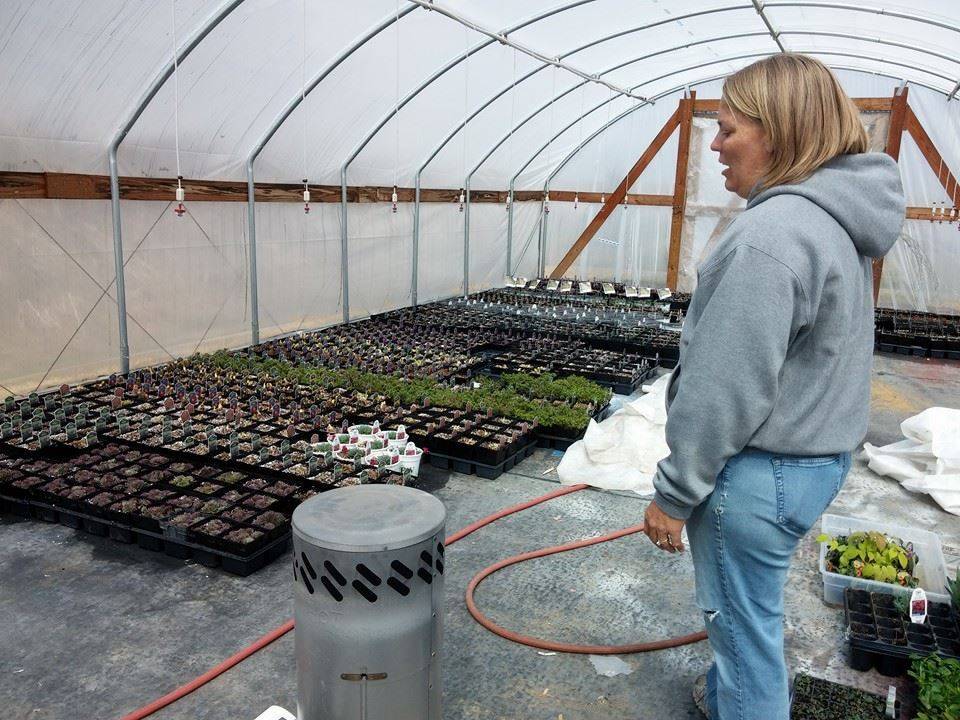
Nicole in the Greenhouse Photo credit: Val Plagge of Corn, Beans, Pigs, Kids
ABOUT THE AUTHOR: Nicole earned a degree in Ornamental Horticulture from Iowa State University (ISU). Her husband, Steve, earned a Horticulture degree from ISU in Fruit and Vegetable Production. On their farm near Boone, the Jonas family produces vegetables, fruits and perennial plants. Red Granite Farm will open May 1. Choose from more than 200 varieties of hardy perennials, vegetable and herb starts plus succulents. Red Granite produce is available at the North Grand Farmer’s Market in Ames. Farm fresh eggs from free range chickens are available at Red Granite Farm, Story City Locker and the Gateway Express station in Ames.

 I’m not going to be politically correct because an attack on American’s freedom of choice is increasingly bothering me.