A common theme you will hear when listening to national corn/soybean contest winners is they always use a few acres to try something new. Latham’s Forage Products Manager, Corey Catt, has written numerous articles, encouraging growers to use a few acres to experiment on their own farms with products, seeding rates and management practices.
While third-party research plays an important role in helping us choose seed products, it’s also important to conduct your own on-farm research. Here are a few ideas to try this growing season. If you have acres that struggle with Sudden Death Syndrome, try treating a few soybean units with Latham® SoyShieldTM Plus with Saltro and run a side-by-side comparison. Another idea is to apply sulfur to soybeans and measure your results. Experiment on a few corn acres with Xyway® 3D in-furrow fungicide or try a phosphorus-enhancer, such as Encompass from TALC USA.
You could create quite a list of new products, different tillage/planting practices, in furrow fertilizers, or in-season practices that you could try to break your farm’s yield plateau. Here are some tips to make the most of your on-farm research efforts:
Use a decent farm, or part of a decent farm, to do your research. Use a farm that has soil types and drainage/topography characteristics that represent a lot of your acres. Don’t pick the less desirable ground in terms of fertility. If pH, phosphorus (P), and potassium (K), levels are wacky, you won’t learn much when trying a new in-furrow treatment, biological or fungicide. Basic needs must be taken care of before you can add more yield.
Keep it short and simple (K.I.S.S.). Weather and soil types cause enough variation in any research that you don’t need to add complexity. Try one thing at time, so you’re not adding multiple factors into the equation. For example, run a planter pass with Xyway mixed in your starter fertilizer and then shut it off the next pass. Do these two “treatments” at least three more times across your field to reduce the influence of soil types on your results.
Garbage in, garbage out. Make sure your monitors/globes/planting equipment have the latest update, so you can capture the data when it’s go time. Layout your research, so your combine can capture it. This is very important! For example, if you harvest with an 8-row head, change “treatments” on 20-foot increments.
Mapping what you do this spring will allow you to analyze it next fall. You will want to look at how that new product did in your heavy soils, lighter soils and whether it is worth expanding on more acres next year. Every year is different, so keep weather in mind as it is usually the #1 influencing factor. Start small to find out what works best on your farm. I am happy to help you figure out what new thing to try on a few acres. Give me a call and we can chat more about it at: 641-692-0370.
Gene Thormodsgaard raised his children two miles north of his family’s farm in Beresford, South Dakota, but he traveled thousands of miles before returning to the land and the lifestyle he has always loved.
After graduating from high school in 1960, Gene moved east for opportunity.
“My dad told me not to be a farmer, so I tried following his advice,” recalls Gene. “My brother and his friend were living in southern Illinois and working in the ironworks. They told me the pay was better out east, so I moved to Janesville, Wisconsin. I worked in Wisconsin for a year but realized factory life wasn’t for me. I moved home and went to work at the co-op. I really enjoyed working with farmers.”
Shortly thereafter, Gene was drafted into the United States Army. He served with the 724th maintenance battalion from 1964 to 1966 in southern Bavaria during the Vietnam War. He was a teletype operator with Company A of the 24th Infantry Division in Augsburg, Germany.
When his military service was complete, Gene returned to Bearsford. He started working once again at the co-op, delivering fuel to farmers. Gene also began farming rented ground in 1968. When one of his parents’ neighbors got hurt, Gene was given the chance to buy his farm. Gene bought his first farm at age 27.
Gene’s bachelor years consisted of working and farming until one life-changing evening when he and a buddy drove into Sioux Falls. They saw a couple of girls sitting at a table. Like the lyrics to Franki Valli’s 1967 hit, “Can’t take my eyes off of you,” Gene was drawn to Carol. The couple was married in 1974.
The newlyweds made their home on the farm Gene has purchased. They were blessed with two sons.
“Carol is an organizer extraordinaire,” says Gene with a smile. “She does so much for all of us.”
In 1975, Gene and his neighbors decided to buy Northrup-King seed together to save money. Back then, seed was delivered on a flatbed truck. The truck driver backed up to the barn, and every bag was manually unloaded.
“My NK rep made the move to Latham Seeds, and he encouraged me to try some,” says Gene. “I wasn’t getting the product I wanted from NK at the time, so I tried Latham® soybeans. They were great! When you pulled the rip cord, you didn’t see dust. There was nothing but pure seed inside a bag. Once my customers tried Latham, they didn’t want to plant anything else. It wasn’t long before Latham was all I sold. Latham remains the best quality seed on the market.”
Gene enjoys working with farmers and selling seed so much that he continues to operate his dealership. Like many good farmers, he won’t ever really retire. One of his neighbors began renting Gene and Carol’s farm ground in 2012, but Gene still helps him put in and take out the crop each year.
“I got into Latham because of the quality of the seed, but I’ve stayed with the company because of the quality and they are a great company to do business,” says Gene. “My RSM, Ramie Coughlin, is always there when I need her. She does an awesome job.”
In addition to selling seed and farming, Gene has been active in his community. He is a member of the VFW Legion. He served on Co-op Service Association at Bearsford for 12 years, and then he started serving on the board of the Eastern South Dakota Soil & Water Research Farm in Brookings. Gene was its treasurer for 30 years and remains an active board member. He served on the Lincoln County Conservation Board for 48 years. Gene is also active in his church and has served on church council. He has been a deacon and trustee, as well. When his children were young, Gene taught Sunday school. Gene’s wife Carol was involved in ladies aid as president and vice president through the years. She was involved as a Cub Scout leader and the Thormodsgaard family was awarded Cub Scout Family of the Year. Carol enjoys keeping up with landscaping and her flower gardens across the farm.
The Thormodsgaard’s oldest son, Tyson, is a senior software engineer for Lockheed Martin. His wife, Jenny, is a speech pathologist in Colorado Springs. Their 15-year-old son, Colin, has medaled in golf. Their 13 daughter, Annika, has earned two black belts in Tao Kwando. The Thormodsgaard’s youngest son, Trent, is an account rep for PartsDoctor.com. His wife Victorria is a registered nurse. She is the manager of the case management department at Sanford Health in Sioux Falls.
The Thormodsgaard FamilyTyson and Jenny ThormodsgaardTrent and Victorria Thormodsgaard
The Ride of His Life
Trent gave Gene, a race fan, the gift of driving a stock car at the racetrack in Newton, Iowa. Due to the worldwide COVID-19 pandemic, the outing was postponed until August 2021. After two hours of instruction, Gene got behind the wheel.
“I was 79 when I crawled in there! You have to crawl through the window, and it’s really tight inside the car,” explains Gene. “My son thinks I was running 120 miles per hour around that truck. I didn’t dare put it to the floorboard! That was quite the experience and I sure enjoyed it. I met the nicest people there and became instant friends with a guy from Wisconsin, who attended the driving school with me.”
Gene and Carol enjoy unique experiences, which is one of the reasons they look forward to attending the annual Latham® Dealer Kickoff meetings. They also enjoy traveling as often as possible to visit their grandchildren in Colorado. They also enjoyed visiting Gene’s great aunt, who lived in Washington state. In loving memory of her, the Thormodsgaards are sharing a recipe that Aunt Hannah used to make when they visited her.
“This hearty salad is a great choice to brighten up a cool Midwest day, or a great way to cool down on a hot summer’s evening,” says Carol. “It especially good with a glass of white wine.”
Think of your alfalfa field as a work of art. Your canvas is 43,560 square feet. Our piece is titled, “Profits for 2022” crop season.
Although every square foot has always counted, 2022 is especially important when the commodity prices are as strong. The top three most valuable crops are corn, soybeans and alfalfa, according to U.S. Department of Agriculture (USDA). Each crop is commanding strong prices, but good quality alfalfa is bringing more than $300/ton. A well-managed, strong alfalfa stand can yield more than 5 dry matter (DM) tons per acres with lower input demands verses corn and soybeans. Plus, alfalfa seed costs can be amortized over three to four years after the first stand.
How can you make the most of existing alfalfa crop? Scout your field this spring. Watch for green up; be patient.
Tips for assessing spring stands:
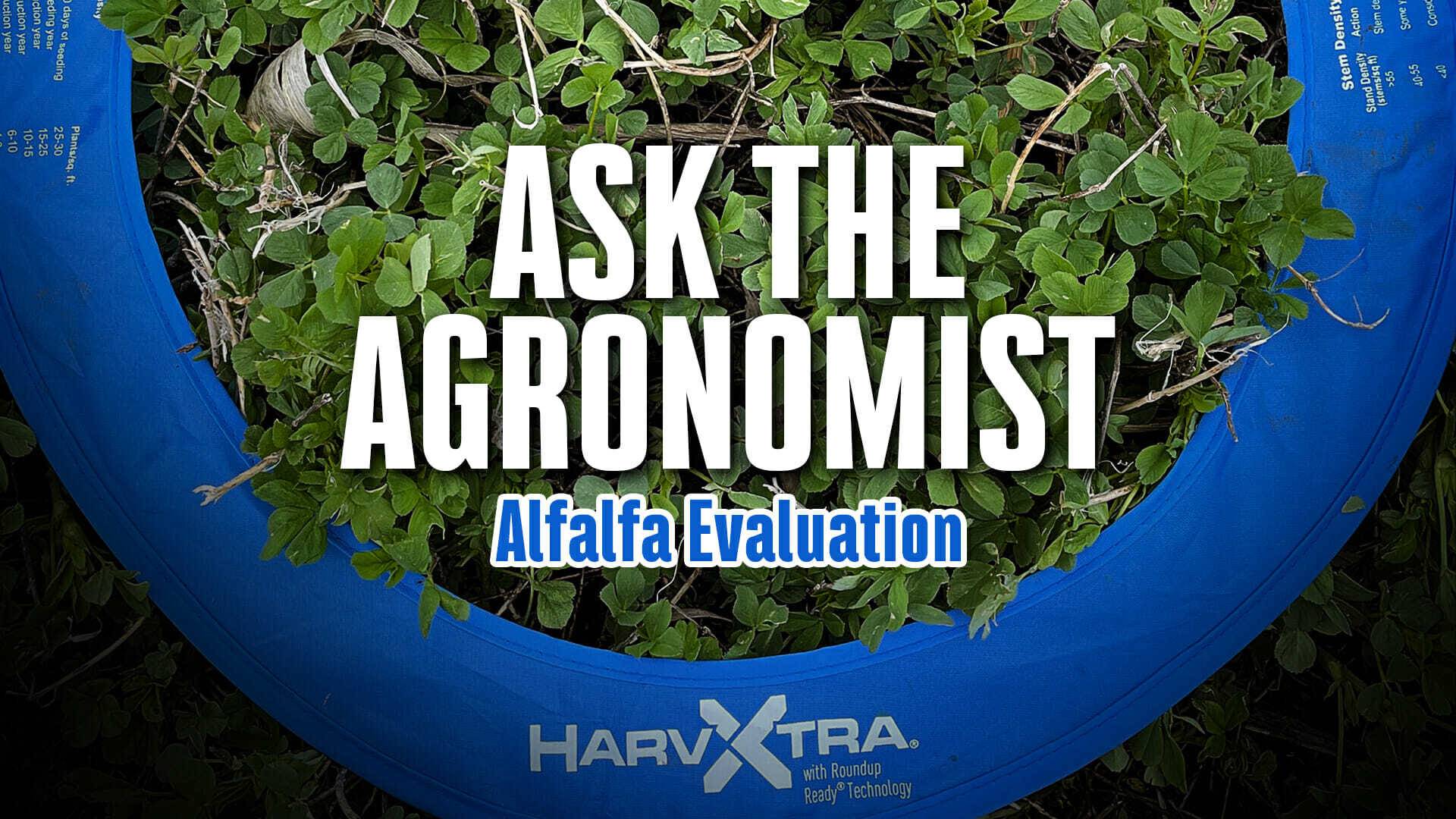
If the alfalfa isn’t greening up in some areas of field, grab a shovel and dig roots. It’s important to perform dig up samples from different areas within a field to capture the variability. Split crowns to look at crown health. Take the time to count the number of healthy plants per square foot, as well as how many stems per plant. Our goal is to have 4 to 5 strong, healthy plants per square foot or at least 55 stems in that square foot.
If the average stem density is low in some areas of field but not in others, consider interseeding 5 to 10 pounds of Italian ryegrass to bridge forage for this season. Italian ryegrass establishes quickly, provides tonnage, is good quality, and allows you to capture the value of the alfalfa that is still alive. If you can rotate this field into corn production, you could recognize a 50% nitrogen savings for your corn.
Calculate yield potential and consider rotating the crop. The University of Wisconsin – Madison Extension provides a calculator to help estimate yield based on the number of stems in a square foot. Once the stem number is determined, use this formula to calculate the yield potential of that stand: Yield (tons/acre) = (Stems/ft2 x 0.1) + 0.38
For example, an alfalfa stand with 50 stems per square foot would have a yield potential of 5.38 tons per acre. Keep in mind that soil, nutrient deficiency, insects, diseases and other factors may affect the actual yield.
The University of Wisconsin – Extension Office has additional resources to assist you with your alfalfa stand. Should you need to establish a new alfalfa stand this fall, contact your Latham® dealer. Latham has a tremendous lineup of alfalfa products to meet your needs!
I pledge My HEAD to clearer thinking, My HEART to greater loyalty, My HANDS to larger service and My HEALTH to better living, for my CLUB, my COMMUNITY, my COUNTRY and my WORLD.
The 4-H Pledge isn’t something the Mattsons simply recite; it’s a credo they live by.
“4-H Beef and Dairy Projects have allowed three generations to work side by side,” says Kerri, who grew up on a Wisconsin farm and has served as a 4-H leader for 15 years. “It’s so rewarding to be involved in an operation where parents, kids and grandkids work together to accomplish the day-to-day goals. Our kids learned to accept responsibility at a young age, and they developed a work ethic they can use everywhere.”
It’s these shared values that brought Matt and Kerri together when they were college students at University of Wisconsin – River Falls. Matt studied Ag Business and Animal Science, and Kerri double-majored in Chemistry and Secondary Education. After they were married in 1994, Kerri finished her coursework and graduated from University of Minnesota Morris.
Matt and Kerri have raised their three children on their family farm near Kensington, Minnesota.
The Mattson Family
Faith, family and farming sustained this family in the face of tragedy when their daughter, Taylor, passed away in April 2021 due to a car accident.
Family and Friends Celebrating Taylor Mattson’s Life.
“Looking back, the pandemic was a blessing for our family. We spent more time together, playing games, laughing and growing closer. We will forever cherish those times,” says Kerri. “Our faith in Jesus Christ and his triumph over the grave and his sacrifice for our sins is the cornerstone of our family. Our faith is what gives us the strength to move forward after Taylor’s accident. Even though we are hurting, Christ gives us hope for our future.”
A memorial tree was planted in remembrance of Taylor.
Many of the activities in which Matt and Kerri are involved honor Taylor’s interests. She belonged to the Ben Wade Blazers 4-H Club. Taylor was West Central Area (WCA) Football and Boys Basketball Manager, a WCA Track Athlete, as well as a Main Street Athletics Athlete and Coach. She also served as a Kensington Covenant Church Sunday School Helper and enjoyed showing cattle. Their oldest son, Zachary, works as a butcher. He and his fiancée, Jenna, are planning a September 2022 wedding. The Mattson’s middle child, Austin, graduated in 2021. He is in first year of the Marine, Motorcycle, Powersports Technician program at Alexandria Technical & Community College.
Working in partnership with Matt’s parents, the Mattsons raise approximately 400 newborn dairy bull calves to around 500 pounds each year. They also have 90 cow/calf pairs on pasture. In addition, they grow corn, soybeans, alfalfa and small grains.
Matt’s father, Rodger, is the main cattle hauler and closely monitors the calves year-round. He also does much of the tillage work during the crop season. Matt’s mother, Patty, is the farm historian. She keeps records and organizes documents. Matt handles all the logistics. Kerri does the bookkeeping and crop insurance.
“Everyone is invaluable to our operation,” says Matt. “We have one almost full-time employee, Erick, who is like family. He has been with us for more than 15 years and is like another son/brother. We also get part-time help from our sons, our nephew and other friends as needed.”
In 2015, Matt and Kerri took on a Latham® dealership as another income stream.
“We would like to bring additional family members home, so we need other income opportunities like a seed dealership,” says Kerri. “We chose Latham because it is family owned and Latham team members share many of our values. It’s important to work with a company that you trust and for us that is Latham Seeds. Plus, Latham has one of the best seed lineups in the business.”
In addition to operating a multi-faceted farming enterprise, the Mattson family believes it is important to give back to their community. Matt is chairman at Kensington Covenant Church. He serves on the board of directors for Runestone Electric Cooperative and is president of West Central Area (WCA) Ag Boosters. Kerri is the Sunday School superintendent at Kensington Covenant Church. She is past president of the Pope County Farm Bureau and is currently chairing its Breakfast on the Farm. She also serves as the Nora Township Clerk/Treasurer, as well as treasurer for WCA Ag Boosters and the Pope Co. Ag Society.
Community involvement and farm chores don’t get in the way of family time, however. The Mattsons make time to sit down and enjoy meals together. Today they’re sharing with us one of their favorite ways to enjoy the beef they raise. Enjoy their Upside Down Meatloaf recipe below!
#AsktheAgronomist – How to Keep Residue Out of the Furrow?
Residue in your fields can play a major factor on how your seed is planted. Phil Long, precision agronomy advisor, unpacks tillage/no-till, row cleaners and other factors to improve your stand when dealing with residue. Subscribe to our YouTube Channel today to learn more agronomy tips and industry news.
Iowa Ag Secretary Recognizes Latham Seeds’ 75th Anniversary
Happy National Ag Week! This annual event is a great opportunity to say thank you to the farmers and agribusinesses that provide food and fuel for all of us. National Ag Week also provides us with an opportunity to showcase the importance of agriculture to others across our nation, as well as around the world.
Because one of his main responsibilities is being the chief promoter and advocate for Iowa agriculture, today we’re shining a spotlight on Iowa Secretary of Agriculture Mike Naig. He was born and raised on his family’s Century Farm near Cylinder, Iowa, where they raised crops and livestock. He remains active in the operation along with his father and uncle.
“The agriculture community shaped who I am. I still plant and harvest our family farm every year,” says Sec. Naig, who was elected in 2018 and is running for re-election in 2022.
Secretary Naig and his wife, Jaime, have three boys. Picture from L-R: Jaime, Zach, Mike, Joe, Mitch
“I’ve been in agriculture my entire life. I believe it’s important that the person holding the title of Secretary actually has experienced the industry, so they have a deep understanding of the challenges that our agriculture community faces daily.”
The people in Iowa’s agriculture community make this job worth doing, says Sec. Naig. Our farmers help feed, fuel and clothe the world. In addition, Iowa Agriculture is critical to the health of state’s economy and that of local communities.
Agriculture is about producing food and Secretary Naig has a passion to reduce food insecurity in our state. During a recent visit to the Bremer County Food Bank, he learned about a partnership between the food bank and a local pork producer who regularly donates.
“Our farmers and agribusinesses work hard every single day to feed and fuel consumers here and across the world. I am incredibly grateful for the opportunity to work alongside them, hear their concerns, and then work together to solve those challenges,” says Sec. Naig. “My top priorities in this role include expanding markets domestically and internationally for Iowa’s farmers, accelerating the implementation of conservation practices that improve water quality, and supporting the next generation of leaders in Iowa agriculture.”
Secretary Naig recently made a visit to Clarion Locker, who is working to attain Cooperative Interstate Shipping status (CIS). The CIS program was implemented by Sec. Naig in early 2020 and provide meat lockers with the ability to remain under state inspection while also allowing them to ship their products across state lines to enter new markets.
Whether it’s representing Iowa on an international trade mission or meeting with a business that is considering moving into Iowa, Sec. Naig says he is always excited to share the great things we have going on in our state and agriculture community.
“Latham Seeds is a great Iowa business that supports Iowa’s farmers with the latest products and technologies on the market,” says Sec. Naig. “I love seeing a family business have such great success over the course of so many generations. Congratulations on 75 years of business and here’s to many more!”
Farm families celebrate special events, including milestone anniversaries and holidays, with food. When the Naig family gathers, kringla is usually served.
“Like most families, we’ve passed this kringla recipe down from previous generations. But it seems like no matter how closely we follow the recipe, we can never make it the same as mom,” says Sec. Naig. “Mom has a special way that is always far superior. I suppose that’s the case when you know the ingredients and process by heart, so you don’t have to rely on a recipe like we do at our house!”
Making kringla is an activity the Naig family enjoys.
“Jaime and I have never had an issue recruiting our boys to help with the rolling and shaping that’s required. After all, helping in the kitchen makes it a lot easier for them to sneak a bite when they’re still warm out of the oven.”
In celebration of strong families and productive farmers everywhere, enjoy this kringla recipe!
Like all great athletes and entrepreneurs, Myron Keltgen has learned it pays to surround yourself with greatness. He was fortunate to get his start in the seed business in 1984 with Keltgen Seed Co.
Myron Keltgen, Corn Product Specialist
“I feel kind of like Brett Favre… I have one last chance to win the big one with the team that will carry me to the goal line,” says Keltgen, who has served as Western Corn Product Specialist for Latham Hi‑Tech Seeds since July 2015. Myron also is a Latham® dealer through Lake Area Ag, which he owns and operates. “The thing that most excites me about Latham is the people on the team.”
The ability to talk to the people who make the decisions is something Myron enjoyed about working for Keltgen Seed. Myron’s father, Darwin, and Darwin’s brother, Keith, started the family-owned seed company.
“If I had an issue, I could go right to the president for help,” says Myron. “If I made a call in the field, I knew they trusted my judgement and would stand behind me. I also knew they sincerely cared about our customers and dealers. This is also what I enjoy about working with family-owned Latham Seeds. I can call John, Shannon or Chris Latham anytime I need help, and they will be there. They also are very sincere. They respect our dealers and customers and greatly care about each one’s success.”
One way Latham Seeds helps set up its dealers and customers for success is by offering the industry’s newest and most effective traits in genetics packages that are specific to the geographies the company serves. Myron’s passion has always been watching crops develop throughout the season, so product development is a great fit for his background and interests.
Myron spends countless hours walking soybean and corn fields every week throughout the growing season, looking for something that differentiates one product from another. He especially enjoys helping select products for Latham’s lineup. He also enjoys the opportunity to work with Gary Geske, who was a district sales manager at Keltgen Seeds and serves as Latham’s Northern Corn Product Specialist.
“I still enjoy calling on friends and customers from when I worked at Keltgen and Wensman,” says Myron. “I enjoy visiting with them and getting updates on their kids and grandkids. My youngest son, Jason, has joined the Lake Area Ag dealership in Watertown. I’m enjoying the opportunity to work with both of my sons now.”
Myron’s oldest son, James, is a regional sales manager for Latham Hi‑Tech Seeds. He and his wife Laurie also are the proud parents of one daughter.
The Keltgen Family
“All our kids and grandkids live within an hour of us, so we’re blessed they’re all so close,” says Myron. The Keltgen family enjoys spending time together at their farm. Many of their fields are research sites for the products they sell.
When he’s not working or farming, Myron enjoys spending time with his family at the river. He especially loves fishing the Lake Ohae area and often serves as a fishing guide. Since the family does an extensive amount of fishing, they shared with us their favorite walleye recipe!
#AsktheAgronomist – How to Take on Soybean Gall Midges
Phil Long, precision agronomy advisor, unpacks new research that was conducted on soybean gall midges. He highlights ways that farmers can combat them including tillage, spray nozzles and learning about their life cycle. Subscribe to Latham Hi‑Tech Seed’s YouTube Channel for other agronomy topics and industry news.
More Tonnage on Less Acres… What’s Your Blueprint?
Striving for tonnage and quality has never been more important than now with high cost of inputs and high commodity prices. More tonnage on less acres could mean more #2 yellow at a good price. Additionally, maximizing quality means more protein, more starch, more digestibility and greater feed efficiency.
What’s your blueprint to success for 2022? Here are a few things to consider:
Hybrid Selection for Corn Silage: Review of Latham’s 2021 Wisconsin corn silage trials results = WOW. This summary reveals the incredible tonnage some of our hybrids showed in the trials, blowing past the competition. We have many winning dual-purpose hybrids highlighted in our product guide, as well as our silage specific leafy hybrids. Check out these top-performing Latham® hybrid product numbers: 4937, 5245, 5742, 5965, 6285, 6477. Access to tonnage starts with hybrids that have historically had evidence of strong, known performance. Using trusted genetics has never been more important.
Seed Placement: Latham Seeds’ product guide provides specific placement details to help you achieve the best performance. Key in on the plant population for soil type, especially with the leafy hybrids. Leafy hybrids are massive plants, so they require a lot of in-row room to grow. To maximize leafy tonnage and starch, ensure proper seed depth. It’s important to promote the development of a superior nodal root system to hold up the large plant, as well as to bring in essential water and nutrients.
Nutrients: With a high premium on nitrogen, use in-season tissue and soil testing to determine whether the plant needs supplemental nutrition. Additionally, think about booking fungicides early to make sure you have them. High input investment coupled with high value commodity means many farmers will protect the plant with fungicides, so book early to ensure you have access to them! It seems a lot of helpful inputs are short supply, and fungicides like Headline AMP® have shown to produce 2 to 3 more tons/acre average. This is a very valuable consideration. When corn is $6/bushel, corn silage is about $60/ton. Adding 2 or 3 tons is about $120-$160/acre. A healthy corn plant adds more quality, as well as helps mitigate the expensive risk of mold and mycotoxins.
Know and Maximize Manure and Alfalfa Credits: The adage “think outside the box” recommends that we think freely and openly, so that we’re not bound by old, nonfunctional, or limiting rules or practices. While I believe there is a time and a place for this type of thinking, today I’m suggesting that we think “inside the box.” We can leverage what we already have.
What do you have on hand that can help reduce your expenses and minimize financial exposure?
Because the 2022 crop cycle is likely to set a record for the highest input investment crop, many farmers are scrutinizing every input. They’re leveraging what is on hand or readily available, so manure has become a highly sought-after resource. Manure also is proving to be effective. These manure credit charts give an idea of some “inside the box” considerations of nitrogen sources.
Additionally, corn planted on rotated alfalfa crop can yield as much as 20% more, especially in combination with manure. Applying manure requires some extra work and planning, here’s an online calculator to help you decide what manure is worth to your farm. Remember the intangibles. Manure provides the soil with needed nutrients, plus it unfolds a world of the living microbes.
Every growing season starts with a custom tailored blueprint. Consider how powerful genetics and some “inside the box” thinking can help you create more tons from less acres this season!
This week college basketball teams and their loyal fans will travel to eight cities for 48 games during the first four-day weekend of America’s unofficial hoops holiday. They will then move to four cities for the Sweet 16 before arriving in New Orleans where the Final Four will run April 2-4.
We’re helping fans everywhere prepare with 10 themed recipes from our blog. Whether your favorite teams win or loses, you’ll always be a winner when you bring your “A Game” to the table! Good food makes the agony of defeat more bearable or the thrill of victory sweeter.
Iowans were thrilled on Selection Sunday, March 13, when both the University of Iowa Hawkeyes and the Iowa State University Cyclones were invited to The Big Dance. Fresh off a Big 10 Championship title, the University of Iowa Hawkeyes were given a 5-seed. The Hawks will play 12th-seeded Richmond Spiders, which also won its conference tournament, at 2:10 p.m. on March 17.
Iowa State University will play on Friday, March 17, at 6:20 p.m. After going 0-18 last season in the Big 12 and 2-22 overall, new head coach T.J. Otzelberger’s has led the Cyclones to their first NCAA tournament since 2019. The Cyclones will be an 11th-seed this year, matching up against the sixth-seeded Louisiana State University Tigers.
Throughout the basketball season, every free throw made by Iowa State University and University of Iowa, Latham Hi‑Tech Seeds donated to the American Cancer Society through Coaches vs Cancer!
The 2022 Iowa State University Check Presentation.The 2022 University of Iowa Check Presentation.
Whether you want to cheer on your favorite teams while enjoying a St. Patrick’s Day feast, simple pub grub or southern comfort food, you’ll find it in our Game Day Recipe Roundup. Below are favorite recipes that were featured by Latham Seeds on “The Field Position:
Remember to tune into after the game to the Latham Locker Room Report on Cyclone Radio. The Latham Locker Room show is a post-game radio broadcast in which analysts, coaches and players share their thoughts on the game.