-
Latham Hi‑Tech Seeds
#AskTheAgronomist: Sulfur & Soybeans
Are you looking for the next step in your soybean yield? Tune in for discussion on sulfur and soybeans! #AskTheAgronomist0:20 – Topic introduction1:25 – The role of sulfur3:50 – How soybean plants respond to sulfur6:50 – Recommended sulfur forms8:50 – Final thoughts -
Latham Hi‑Tech Seeds
Managing Soil Erosion

Soil erosion resulting from heavy rainfall events and wind leads to the loss of essential soil nutrients and soil carbon. Eroded soil and the loss of organic matter essential for supporting crop growth can damper corn and soybean production and reduce yield. Across the Corn Belt, an observed 20% increase in rainfall has led to a 40% increase in soil erosion. Record breaking flooding across the Midwest has further exacerbated erosion.Identify Soil Erosion
Gully erosion is one of the most pronounced forms of erosion and its large grooves that form in the soil following heavy rainfall make it easy to identify. Less evident to the naked eye are signs of erosion that can be identified by looking for standing water in the field. Puddles of water seen after a rainstorm that are clouded with sediment suggest erosion is occurring whereas puddles of clear water are a sign of minimal erosion. Lighter colored soil seen overtime is also a sign of erosion but can be more difficult to identify.
In Iowa, the average rate of erosion has been five tons of soil per acre every year with intense weather events worsening rates, in some cases reaching 100 tons of soil per acre per year. The loss of natural vegetation can lead to greater rates of erosion from both wind and water. Using cover crops and no-till are the most effective methods for reducing and preventing erosion, increasing soil water holding capacity and boosting moisture content.
Take Action with Promising Solutions
Annual cover crops such as winter rye can be planted in the fall to preserve the soil over the winter and reduce erosion. PROTECTioN™ Cereal Rye, DRILLER™ Daikon Radish and FIXatioN Balansa Clover can be planted in the late summer and early fall to enrich organic matter and reduce soil loss. Perennial cover crops including legumes and fescue have established root systems that can prevent the loss of soil nutrients to rain or weather erosion. Legumes are also nitrogen fixing and can support crop growth.
In addition to integrating cover crops and no-till, terracing or planting grasses near waterways can prevent the formation of gullies. Buffer and filter strips can reduce the loss of soil nutrients and runoff of fertilizer and pesticides. Prairie strips can be implemented by planting perennial grasses to protect topsoil and prevent the loss of organic matter. Integrating a combination of these methods with cover cropping can combat soil erosion and offer great protection for your corn and soybean crops.
-
Latham Hi‑Tech Seeds
#AskTheAgronomist: Seed Treatments
Tune in to hear the top three reasons to use our SoyShield soybean seed treatment this spring. #AskTheAgronomist0:30 — Topic introduction3:14 — Early planting & cool soils3:34 — SDS protection5:30 — Soybean Gall Midge protection -
Latham Hi‑Tech Seeds
#AskTheAgronomist: Phosphorus Application
When should you apply phosphorus? Tune in for discussion on planning for 2020.0:28 — Topic introduction1:19 — Ideal conditions for phosphorus application3:50 — How does phosphorus move?4:48 — Phosphorus application example6:34 — Phosphorus usability and root exploration8:21 — Phosphorus placement -
Latham Hi‑Tech Seeds
Strong Supply of Soybeans for #Plant20

Our corn and soybean products performed exceptionally well in 2019, and as a result it’s been an exciting few weeks building customer crop plans for 2020. The Enlist E3™ platform is leading in early sales with many opting to try them for the first time next spring.While supplies are getting tight for several products, Latham Hi‑Tech Seeds has a deep lineup. The following 10 soybean lines, in order of maturity, have performed very well plus strong supplies remain:
L 0124 R2X – This RR2 Xtend® soybean carries the K-gene for Phytophthora, has excellent tolerance to BSR and IDC, and is very good against White Mold. This soybean was the earliest entry in our 2019 research trails, and it still garnered 13th place in the overall summary.
L 0225 E3 – This E3 soybean features the 3a gene for Phytophthora. It also has excellent scores for Iron Chlorosis and Stress Tolerance. It was an early entry in SuperStrip TM plots at Maddock and Ardoch, ND, where it took 8th and 9th places respectively.
L 0282 R2X – In those same plots near Maddock and Ardock, this soybean took 1st and 3rd places! It also performed well in the F.I.R.S.T. trials (RRNO) and in Latham Research trials. Emergence and standability are outstanding, plus it has the C-gene and excellent IDC tolerance.
L 0995 E3 – One of the earlier entries in our research test, this soybean captured 10th place in the overall summary. It also did well in SuperStrips and F.I.R.S.T. trials. It has strong SCN protection, plus the 3a gene with very good tolerance to IDC, SDS and stress.
L 1769 R2X – This Ironclad™ Xtend soybean has excellent scores for both White Mold and Sudden Death Syndrome. It topped SuperStrip plots in Webb, Iowa, and Milbank, SD. It also had seven other Top 10 finishes in South Dakota, Iowa, Minnesota and Wisconsin.
L 2084 R2 – A long-time, top-selling variety, this soybean topped a SuperStrip near Watertown, WI. It also had several Top 10 places in other plots, including our own research and F.I.R.S.T. trials.
L 2186 L – This has been Latham’s top-selling LibertyLink® soybean for several years. It performed very well again in our 2019 research trials. It served as the check variety in a number of SuperSrtrip plots – sometimes winning the plot as the check!
L 2228 R2 – Our #1 selling soybean for several years, this Latham Ironclad bean performed very well in 2019 trials. It won five Top 10 F.I.R.S.T. trials, grabbed four Top 10 finishes in other plots and was the check in a number of SuperStrip plots.
L 2295 R2X – A personal favorite, this Xtend soybean is consistent. It has been a standout in the F.I.R.S.T. trials, as well as in Latham SuperStrips and research trials for years. In 2019, it topped four SuperStrip plots and had a host of Top Five finishes in other trials. It works best on better soils and high fertility fields.
L 2887 R2X – This popular Xtend line performed very well in 2019, taking 1st place at the SuperStrip plot in Center Point, Iowa. It also had three 2nd place finishes across Iowa and was 3rd at in our plot at Monroe, WI! It is widely adapted east to west and works well in all soil types.
These are just 10 of the products that we have excellent supply of for 2020 planting. Talk with our Dealer, RSM or Seed Account Manager on what other soybeans are available for your area.

-
Latham Hi‑Tech Seeds
#AskTheAgronomist: Top 10 Soybeans for Your Christmas List

This morning we are bringing you some NEW and some TRIED & TRUE products for Christmas! What’s on our top 10 list? Tune in for soybean product highlights on our top 10 list! #AskTheAgronomist
1:09 – L 0124 R2X
1:52 – L 0225 E3
2:39 – L 0282 R2X
3:26 – L 0995 E3
4:39 – L 1769 R2X
5:50 – L 2084 R2
6:31 – L 2186 L
7:24 – L 2228 R2
8:13 – L 2295 R2X
8:54 – L 2887 R2X
-
Latham Hi‑Tech Seeds
9 Reasons to Try LibertyLink® GT27™ Soybeans

While Enlist E3™ soybeans have been grabbing all the attention, LLGT27 soybeans have been quietly performing very well for both weed control and yield. This new technology has a real opportunity to capture market share due to its outstanding performance plus the flexibility of using Liberty®, glyphosate herbicides or BOTH.
Another reason LLGT27 appeals to farmers is because they’re seeing much less stunting and better yields when LLGT27 soybeans are planted in fields with carryover of HPPD (group 27) herbicides. Remember, NO group 27 herbicide is approved for post-emergent application on LibertyLink GT27 soybeans.
Need more reasons to take a second look at LLGT27? Below is a brief summary of some 2019 yield reports from new Latham soybean lines:
- L 1359 LLGT27– Topped Latham® SuperStrip™ near Watertown, SD; placed 3rd in Latham Elite Research Test in Alexander, Iowa; placed 3rd in F.I.R.S.T. trials in Clear Lake, MN and Wheaton, ND.
- L 1429 LLGT27– Placed 1st near Sanborn, MN; eight more Top 10 finishes in Latham SuperStrip plots across Minnesota and South Dakota; Top 10 in Latham’s research trials in southern Minnesota and northern Iowa.
- L 1648 LLGT27– Topped F.I.R.S.T. trial at Webster, SD; won two Latham SuperStrip plots near Groton, SD, and Ward, SD; four other Top 10 finishes in Minnesota and South Dakota.
- L 1739 LLGT27– Placed 9th in F.I.R.S.T. trials at Cannon Falls, MN; six Top 10 finishes in SuperStrip plots across South Dakota, Iowa and Minnesota.
- L 1983 LLGT27– Won at Alexander; placed 4th at Kensett, Iowa, and 7th at Linn Grove, Iowa; three Top 10 finishes in Minnesota F.I.R.S.T. trials; six Top 10 finishes in Latham SuperStrips in Iowa and Minnesota.
- L 2178 LLGT27– Won Latham SuperStrip near Pocahontas, Iowa; scored two 2nd place finishes at Sheldon, Iowa, and Janesville, Wisc.; 11 other Top 10 finishes in SuperStrips across Iowa, Wisconsin and Minnesota; placed 3rd at LuVerne, Iowa, F.I.R.S.T. trial.
- L 2395 LLGT27– Seven Top 10 finishes in F.I.R.S.T. trials across Iowa and South Dakota; topped two SuperStrips near Vail and Albert City, Iowa; 11 Top 10 finishes in SuperStrip plots across Iowa, Minnesota and Wisconsin!
- L 2578 LLGT27– 2nd place in F.I.R.S.T. trial at Central City, Iowa and 2nd in the IASC overall summary! Topped Latham SuperStrip near Olin, Iowa; placed 2nd at both Princeton and South English, Iowa; four other Top 10 finishes in other Iowa SuperStrips.
- L 2839 LLGT27– Took 3rd at F.I.R.S.T. trials in Boyden, Iowa; 4th at Dell Rapids, SD and 10th at Moorland, Iowa. In Latham SuperStrips plots, placed 2nd at Moorhead, Iowa; 3rd at Olin, Iowa; three other Top 10 finishes.
Put Latham LLGT27 soybeans the test in your own fields! Order seed today for 2020 planting.
-
Latham Hi‑Tech Seeds
#AskTheAgronomist: Fall Fertilizer

Tune in for today’s #AskTheAgronomist as we discuss Fall fertilizer application.- 0:20 — Crop Report Update
- 1:30 — Topic Introduction
- 1:40 — Soil sampling and fertility
- 4:15 — Know critical test levels
- 5:15 — Yearly fertilizer application
- 7:15 — Corn and soybean must-haves
- 10:15 — Organic manure advantage
- 12:00 — Know your pH levels
-
Latham Hi‑Tech Seeds
Test for Soybean Cyst Nematode

One comment I often hear from farmers is “I just can’t seem to get an increase in soybean yields as I do for my corn yields.” This is the perfect time of year to reflect on the growing season while analyzing yield results. It’s also the best time to sample for soybean cyst nematodes.
What is SCN?
Soybean cyst nematode is a microscopic ground worm. When analyzing soybean roots, it’s important to correctly identify the difference between nitrogen-fixing nodules and cysts. Nodules for nitrogen production are larger and the size of a pea. Cysts are microscopic and smaller than a grain of sand.
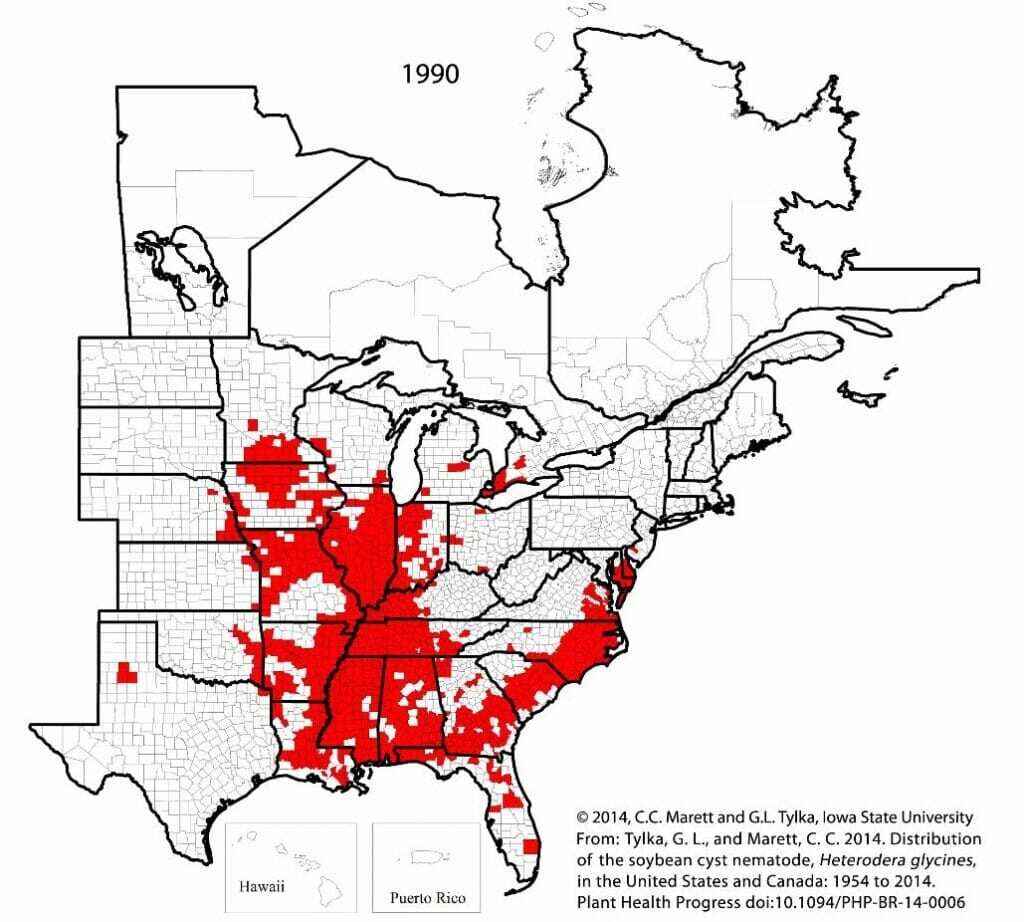
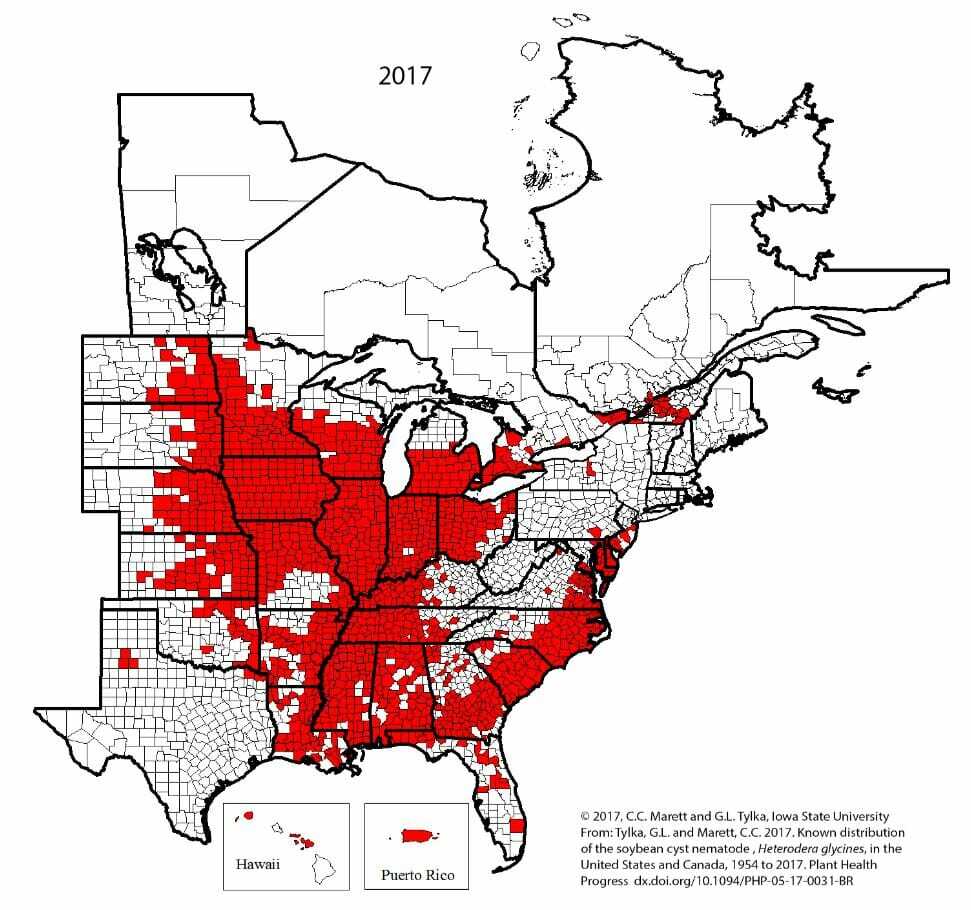
One of the biggest challenges when identifying SCN is that it is not accompanied with many symptoms, but can cause up to a 30% yield loss. Usually SCN shows up in hot spots, where you can see severe stunting, yellowing, shorter crop, lack of canopy or early maturity. These symptoms tend to show up on lighter soil or during tough growing seasons. Wherever soybeans are grown, typically SCN is an issue. Below are two maps to show the growth of SCN over the years.
What is the life cycle of SCN?
Essentially the cyst is the life cycle of a nematode. Juvenile nematodes come in and infect the root. Typically, just the females feed on the root which takes away nutrients from the plants results in a loss of yield. They will then mate and produce eggs. When they produce eggs, they expand in the root, erupt and spread 20 to 500 eggs throughout the soil. The cysts then harden on the root and the process begins again.
In Iowa, we can see that happen for at least three generations per season. Each cyst can have between 20 and 500 eggs inside, creating opportunity for juveniles to come back and begin feeding on the soybean root.
Once the eggs get in the soil, it’s important to understand the number that you have in the soil. Those eggs can stay dormant year-over-year in the soil. Since these eggs are so small, they require very little oxygen to survive.
Management of SCN
The most important management practice of SCN is IPM – Integrated Pest Management. In the Midwest, having a corn and soybean rotation is a great start. Corn is not a host crop whereas soybeans are. I also suggest soil sampling this fall to identify the egg population in your soil. Pull a core from about 8 inches down, right next to the soybean plant right in the root zone.
I also advise to stay away from sampling in the middle of a hot spot for SCN. Often the eggs are concentrated along the edge of the hot spot, so sampling that area will give most accurate results. Population thresholds vary by state. I suggest looking closely to your management practices if results are anywhere from 2,000 – 5,000 eggs per sample. Once you know what is in your field, you can begin to manage it.
Here are three ways to help manage this pest:
- Plant Latham® brand resistant soybeans. Reference product characteristics on our website to identify the disease rating
- Use Latham SoyShield Plus® with Saltro® seed treatment. This will fight SCN and Sudden Death Sydrome.
- TALC USA. Protect corn and soybeans against parasitic nematodes.
Feel free to call into the Latham Seeds office or email me at phill@lathamseeds.com with any questions.
-
Latham Hi‑Tech Seeds
#AskTheAgronomist: Soybean Cyst Nematode

Is SCN really a problem in your fields? Tune in to find out! #AskTheAgronomist
:40 — Topic introduction2:10 — What is SCN?2:50 — The life cycle of SCN6:20 — Soil sampling8:55 — SCN egg populations9:45 — Product selection for 2020