Skip to content
Latham Hi-Tech Seeds

(641) 692-3258

  • Home
  • Performance
  • Products
    • Corn
    • Soybeans
    • Alfalfa
    • Corn Silage
    • Seed Guide
  • Find a Rep
  • Media
    • Blog
    • News
    • Videos
    • Podcasts
    • TECHTalk
  • About Us
    • Company History
    • Our Mission
    • Careers
    • Become a Rep
    • Sowing Seeds of Hope
  • Contact Us
  • Latham Hi‑Tech Seeds

    Rust Diseases in Corn

    Common Rust – Crop Protection Network
    Southern Rust – Crop Protection Network
    Southern Rust. Credit: Crop Protection Network

    Common Rust and Southern Rust infect corn in the late summer. The diseases generate raised spores known as “pustules” on the surface of leaves, leading to reduced yield  and poor grain quality.

    Common rust (Puccinia sorghi) and southern rust (Puccinia polysora) fungi are unable to overwinter in the Midwest and require a host plant to remain alive. The spores created by rust diseases are transported by wind to the Midwest from Southern states.

    Temperatures ranging from 61–77° fuel the growth of rust diseases. Cool and humid temperatures, especially when exhibited overnight, can further drive the development of the fungi.

    As long as the weather conditions are right for rust diseases, the cycle of spore development will continue. The return of hot and dry weather can prevent further development of the fungus and kill off the spores.

    Implications  

    Rust can reduce yield and decrease grain quality. Foliar damage from rust diseases can interfere with water  transpirationand reduce photosynthetic leaf area.

    Nutrients designated to support plant growth are rerouted in response to the damage incurred by leaves. Damage from rust diseases deplete carbohydrate reserves in corn leaves. As a result, the plant will begin sourcing the nutrients from stalks and roots, leading to reduced yield and stalk rot.

    Common Rust – Crop Protection Network
    Common Rust. Credit: Crop Protection Network
    Scouting for Rust Diseases 

    While common rust has less of an impact on yield, southern rust has been found to reduce yield by 25 bu/acre in corn with no fungicide application. The fungi can begin to infect plants under favorable conditions in as little as six hours.

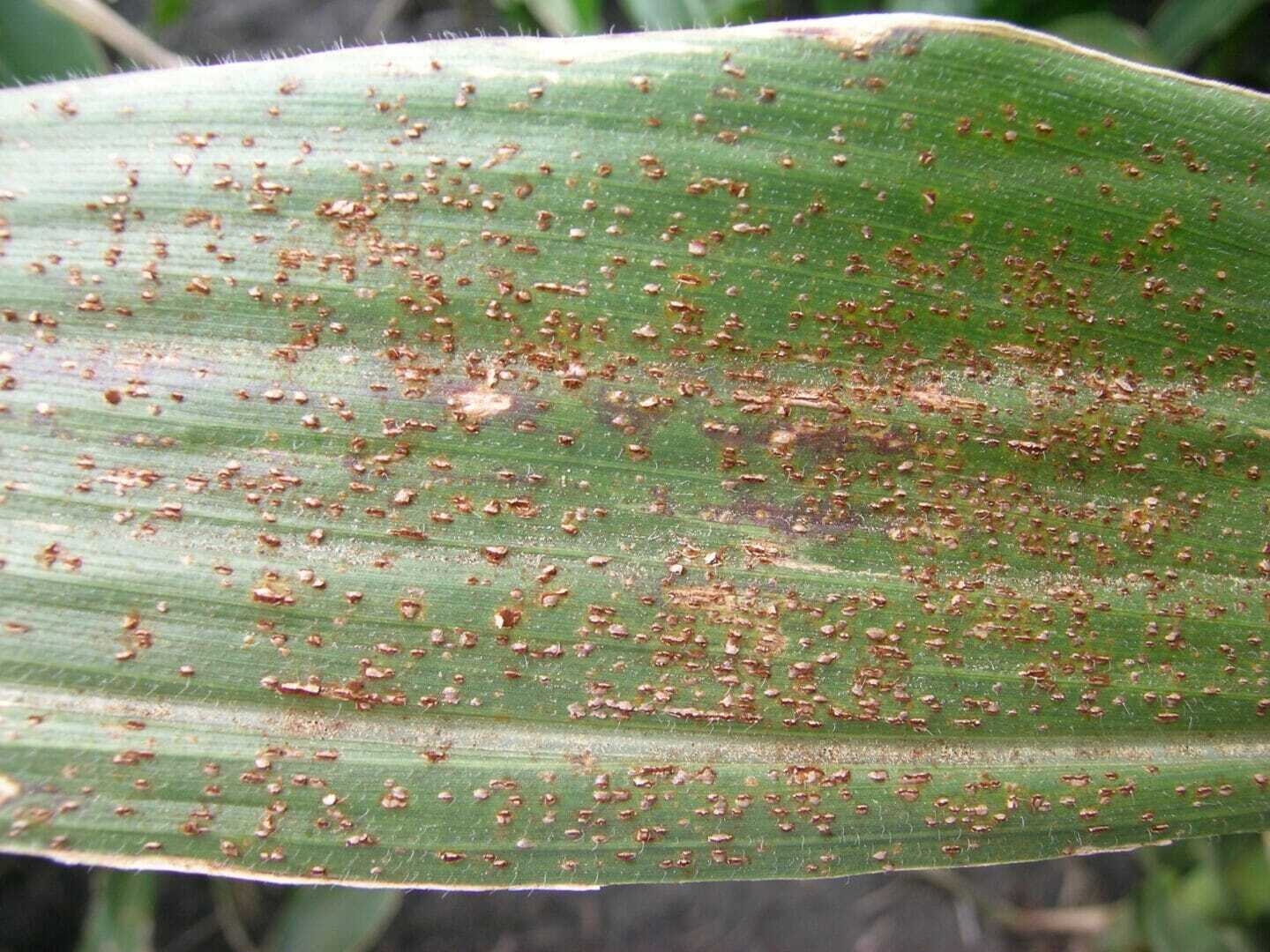
    Southern rust signs are evident  on the upper leaf surface and are round, as opposed to elongated in plants infected with common rust. The pustules will be orange compared to the darker color of common rust. Overtime, southern rust pustules will become brown or black.

    Common rust pustules are found on the upper and lower leaf surface and are oblong. Common rust pustules will be brick red in appearance and can coalesce to kill parts of leaves. In order to determine the difference between common and southern rust pustules, use a magnifying lens to inspect the leaf surface.

    Management 

    Planting early is one of the best ways to reduce corn’s vulnerability to rust diseases. Corn planted late in the season is most susceptible to experiencing yield loss and grain damage. Many hybrids are also equipped with resistance to rust diseases, though the extent to which they are protected from the fungus can vary.

    When pustules are observed on 50% of scouted plants, it is advised to begin implementing  a treatment plan. Fungicides can also be used to treat corn infected with common and southern rust. Be sure to consult with your local Latham representative to determine the best management options for rust diseases.

     

    Latham Seeds Precision Agronomy Advisors

    April 1, 2019
    Agronomics, Corn, Crop, Disease, Fall, Season, Summer
  • Latham Hi‑Tech Seeds

    Anthracnose Leaf Blight 

    Anthracnose Leaf Blight UMN
    Photo Credit: University of Minnesota

    Colletotrichum graminicola is a fungal pathogen that causes anthracnose leaf blight. Anthracnose leaf blight is a foliar disease that appears in the early and late stages of growth in corn plants. The fungus survives in infected corn residue that remains in the field over the winter. The disease creates elongated lesions with a dried, brown appearance across the length of the leaf blade and is bordered by a darker reddish-brown color.   

    In the earliest part of the season, leaf blight will impact the lower leaves of the plant and expand toward the top of the plant by late season. The upper part of the plant will begin to exhibit early senescence while the lowest part of the corn plant will remain green and healthy.  This is a characteristic of the Top Dieback part of this disease.   

    Disease Causes 

    Anthracnose leaf blight develops predominately from the infected residue left behind in the field. No-till, reduced till and corn on corn rotations can increase the likelihood of the disease to emerge. Though no-till and reduced-till methods are critical for preventing erosion and other corn disorders, it can lead to the accumulation of corn debris that is conducive for housing the fungal pathogen.   

    The fungus thrives in a warm and wet environment. Moisture from rainfall will often create black specks that appear across the lesions. Wind can also act as a transportation method for the fungus as spores can travel by air or water.  

    Implications and Treatment 

    The disease will infect at the seedling stage, causing foliar damage, and end at the growing season, causing stalk rot. Although anthracnose leaf blight has the potential to occur later in the growing season, early signs of the infection do not guarantee that it will resurface closer to harvest. Iowa State University researchers state that because of the early-season nature of the leaf blight, impacts on yield are rarely demonstrated. The late season stalk rot phase of the disease tends to be more detrimental on yield and harvestability. 

    Crop rotation and the use of resistant hybrids are the best ways to combat leaf blight. Fungicides can keep anthracnose leaf blight in control, but it likely will not be effective for combatting the stalk rot phase. Further, corn hybrids that provide resistance against the earliest stages of leaf blight are not often effective for preventing the onset of late-season stalk rot.  

    If tillage is used, methods that bury infected corn residue can prevent leaf blight from emerging again during the next season. Crop rotation has also been deemed as an effective way to prevent the continued onset of anthracnose leaf blight. For corn that has perpetually been impacted by leaf blight, two-year rotations away from corn are also advised.  

    Latham Seeds Precision Agronomy Advisors

    April 1, 2019
    Agronomics, Corn, Crop, Disease
  • Latham Hi‑Tech Seeds

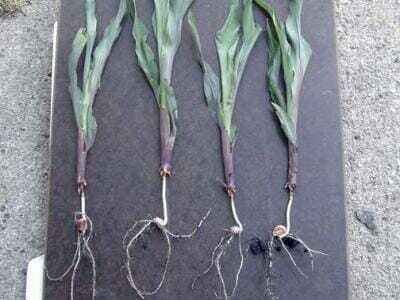
    Rootless Corn Syndrome

    Rootless Corn Syndrome Photo Credit ISU
    Rootless Corn Syndrome Photo Credit ISU
    Credit: Iowa State University

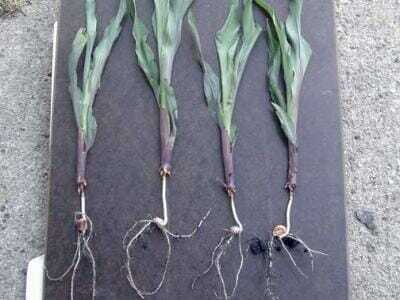
    Rootless corn syndrome is a disorder, often a result of hot and dry soil surfaces and planting into dry soil. With rootless corn syndrome, the nodal roots will fail to attach to the soil. Nodal roots are essential conduits for transporting water and nutrients to corn plants. Their absence is highly consequential for the quality of stand and overall yield outcomes.  

    Dry soils warm more rapidly than moist soils, and combined with conventional tilling, corn plants can become susceptible to failed nodal root development. Heavy rainfall and planting when the soil is too wet can compact the soil, preventing nodal roots from extending downward.  

    The erosive effects of rainfall and wind combined with shallow planting depth are the primary drivers of rootless corn syndrome. In addition to weather-related causes, when corn is planted at a depth less than 1 inch below the surface, nodal root development can take place at a depth shallower than what is needed for having access to moist soil. Nodal roots should form between 1 to 1.5 inches below the surface.  

    What to Look for 

    Nodal roots first appear around the V1 and V2 stage. Rootless corn occurs in plants with poorly developed root systems and is usually observed in plants from about V3 to V8. When rootless corn syndrome is suspected, look for signs of lodged and collapsed corn plants. Corn plants may still be standing but later on they will lose vigor and fall over. Test plants in the area of concern by tugging on them to determine whether nodal roots are established and growing down.  

    Preventative Action 

    Rootless corn can largely be prevented by ensuring that seeds are planted at least 1.5 to 2 inches below the soil surface. For corn plants whose nodal roots fail to grow, the prospects for survival are bleak. Corn nutrient and water uptake hinges on having a developed nodal root system. For plants that do survive, poor stands and low vigor will be exhibited.  

    Moving soil to cover roots may allow them to recover – but if an operation is following a no-till plan, this may not be viable. Further, row cultivation for bringing soil around nodal roots will be ineffective if the soil below the surface lacks moisture for supporting recovery. Adequate rainfall and the absence of drought conditions will support optimal nodal root development and prevent rootless corn syndrome.   

    Latham Seeds Precision Agronomy Advisors

    April 1, 2019
    Agronomics, Corn, Crop, Disease, Drought, Emergence
  • Latham Hi‑Tech Seeds

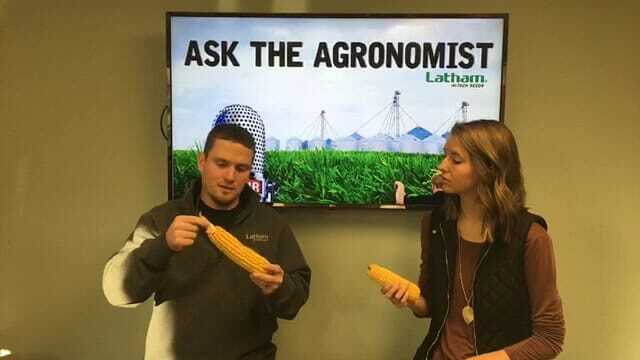
    #AskTheAgronomist: What’s Wrong With My Ear?

    1


    LIBSYN header 2 01

    Join us as we identify agronomic issues with ear symptoms!

    https://www.facebook.com/LathamSeeds/videos/2143666655851395/

    Laura Cunningham

    October 18, 2018
    #AskTheAgronomist, Agronomics, Corn, Crop, Disease
  • Latham Hi‑Tech Seeds

    #AsktheAgronomist: Vivipary

    10.4.18

    LIBSYN header 2 01

    We have a new word of the week today, vivipary! Tune in to our ask the agronomist video series to learn more.

    https://www.facebook.com/LathamSeeds/videos/159231695013639/

    Laura Cunningham

    October 4, 2018
    #AskTheAgronomist, Agronomics, Corn, Crop, Disease
  • Latham Hi‑Tech Seeds

    #AskTheAgronomist: Stalk Rot & Harvest 2018 Complications

    Stalk rot

    LIBSYN header 2 01

    The time is here! Don’t delay corn harvest. Tune in for our weekly #AskTheAgronomist.

    https://www.facebook.com/LathamSeeds/videos/157593215174798/

    Laura Cunningham

    September 27, 2018
    #AskTheAgronomist, Agronomics, Corn, Crop, Disease
  • Latham Hi‑Tech Seeds

    FB Live: Sudden Death Syndrome or Brown Stem Rot?

    8.30 Facebook Live

    LIBSYN header 2 01
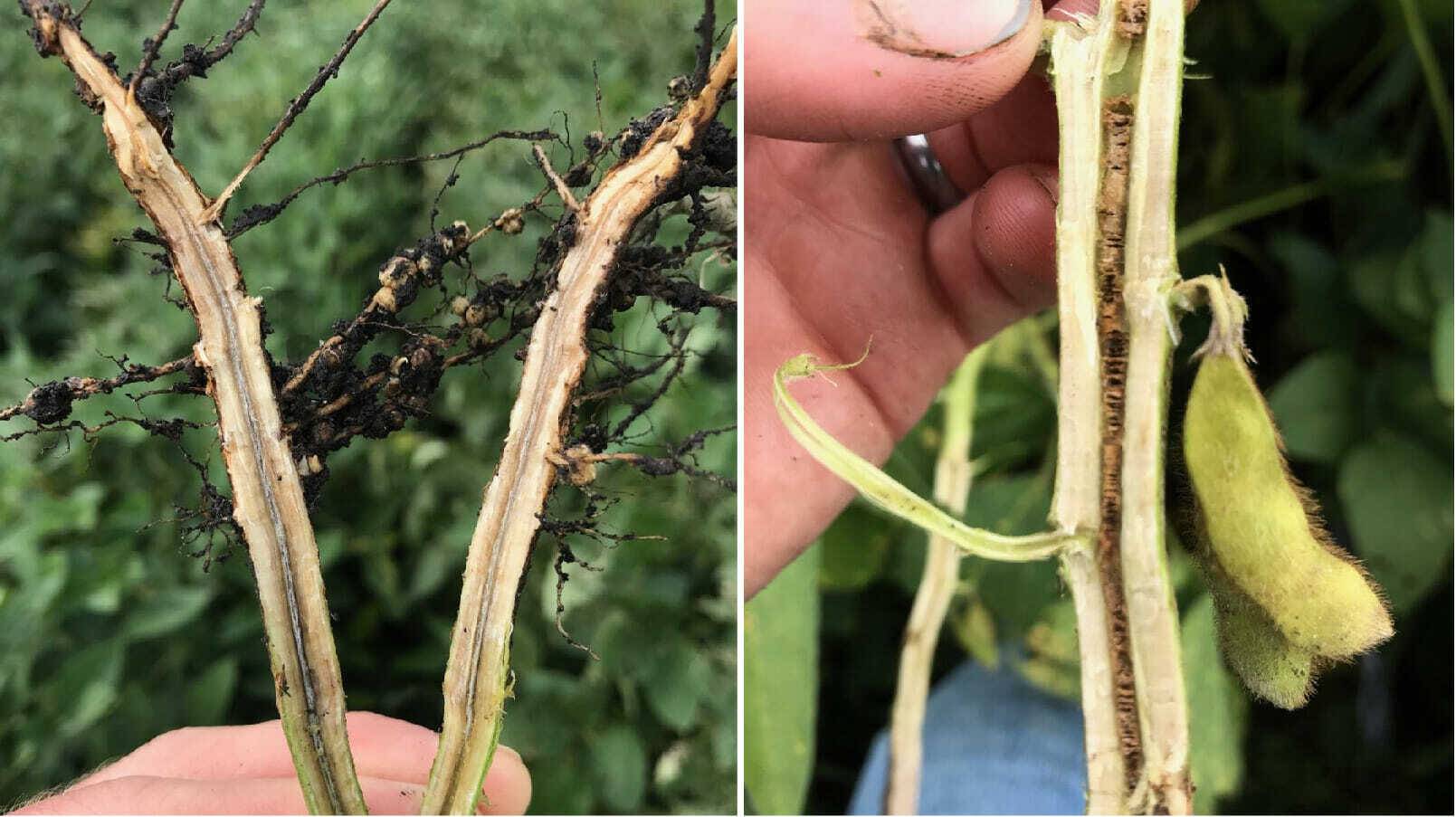
    Sudden Death Syndrome or Brown Stem Rot? Tune in for identification tips the impact of these diseases.

    https://www.facebook.com/LathamSeeds/videos/2077027295959408/ 

    Laura Cunningham

    August 30, 2018
    #AskTheAgronomist, Agronomics, Crop, Disease, Soybeans
  • Latham Hi‑Tech Seeds

    Podcast: Ear Rot

    LIBSYN header 4

    LIBSYN header 2-01

    http://traffic.libsyn.com/fromthefield/Ear_Rot.mp3

    Welcome back! It’s been a wet and cold fall for many farmers in our marketing territory. Today, our Agronomy Specialist, Phil Long, discusses different types of ear rot he has seen in the field and how to plan for the next year.

    Thanks for tuning in and have a safe harvest.


    October 12, 2017
    #AskTheAgronomist, Agronomics, Corn, Disease, Podcast
  • Latham Hi‑Tech Seeds

    Podcast: Stalk Rot

    LIBSYN header 4

    LIBSYN header 2-01

    http://traffic.libsyn.com/fromthefield/Stalk_Rot.mp3

    We know it’s hard to patiently wait for fields to dry up before continuing #harvest17. Phil Long, our Agronomy Specialist, gives advice and shares identifying factors to look for when prioritizing fields. Tune in to hear what he has to say! Below are images Phil refers to in the podcast.

    Screenshot (218)
    Photo sourced from Purdue Extension
    Screenshot (217)
    Photo sourced from Purdue Extension
    Screenshot (219)
    Photo sourced from Purdue Extension

    Have a safe and happy harvest!

    October 5, 2017
    #AskTheAgronomist, Agronomics, Corn, Disease, Podcast
  • Latham Hi‑Tech Seeds

    Podcast: Sudden Death Syndrome vs. Brown Stem Rot

    SDS BSR 01

    LIBSYN header 2-01

    http://traffic.libsyn.com/fromthefield/SDS_vs_BSR.mp3

    Phil Long discusses the difference between Sudden Death Syndrome and Brown Stem Rot. Tune in to learn about the identification, life cycle and management practices for both of these diseases. Also, find differentiating pictures of both of these diseases below.

    Thanks for tuning in and find us back here next week!

    SDS BSR-01

    September 7, 2017
    #AskTheAgronomist, Agronomics, Disease, Podcast, Soybeans
Previous Page
1 … 5 6 7 8 9 … 13
Next Page

Latham Hi‑Tech Seeds

131 180th Street | Alexander, IA 50420

(641) 692-3258

SIGNUP FOR OUR NEWSLETTER
  • Contact
  • Legal
  • Seedware Login
  • Latham Gear

© 2026 Latham Hi‑Tech Seeds. All rights reserved. | Privacy Policy

Latham® Hi-Tech Seeds is a trademark of M.S. Technologies, L.L.C., 103 Avenue D, West Point, IA 52656.