Could Tar Spot be the next Gray Leaf Spot? Tune in for our #AskTheAgronmist discussion!!
0:25 Crop report update
1:21 Tar spot topic introduction
2:10 Identification of tar spot
3:25 Favorable tar spot conditions
5:05 Where to find tar spot in your fields
6:25 The spread of tar spot
9:35 How does tar spot survive through winter
10:45 Take home points on tar spot
Pictured above are vulnerable areas in the Midwest for Tar Spot. “Threats of Tar Spot Complex disease of maize in the United States of America and its global consequences” (Mottaleb et al. 2018).
Many Latham sales managers, dealers and customers have shared their concerns about the excessive rainfall received. Most of Latham Country in the last few weeks have been wetter than normal.
Wet weather brings to mind diseases, and too often we see corn fields with some leaf and stalk quality issues late in the season. I’ve personally seen a lot of Common Rust, Northern Corn Leaf Blight, Gray Leaf Spot and Eyespot this year.
Even with harvest underway, it’s important to continue checking fields and assessing stalk integrity as weather conditions can cause crop conditions to change. Ideally, farmers harvest the driest fields first so crops can dry naturally. This obviously saves time and money, but those plans must be revised if stalk rot shows up.
There are two primary ways to check corn plants for stalk rot: (1) Pinch the stalk at the base of the plant, usually below the first and second nodes. If the stalk pinches easily between your fingers, stalk rot is likely. (2) Take the entire stalk and bend it to a 45-degree angle. If stalk rot is present, the plant usually breaks at the lower part. Do this with at least 10 plants from different areas of your field to provide a good sampling. If stalk rot is present, harvest that field as quickly as possible regardless of the moisture content. The yield that could potentially be lost during high winds or complete rot will far outweigh the extra cost of drying grain.
Weather will, of course, dictate how corn stalks hold up to disease and normal decay. Adjust your harvest plan if needed to harvest the worst first.
Latham product team members have been busy traveling to our SuperStrip™ and other research plot locations across the Upper Midwest.
It’s our job to take notes to help our company offer the best possible product lineup, as well as to assist our customers in choosing the best products for their given situations.
We also encourage you to take notes on your own fields to help identify your seed needs for next year. We recommend keeping an eye out for the following:
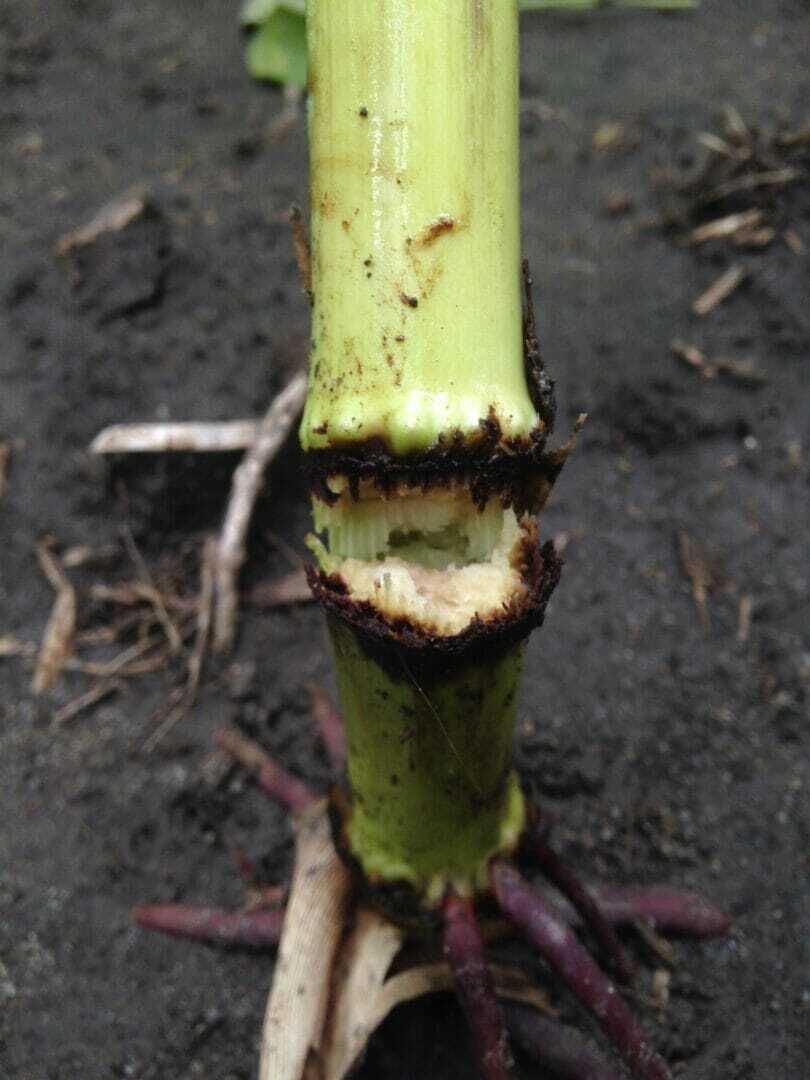
Physoderma in corn: While this isn’t a new disease, it’s been getting more publicity recently because some fields have suffered economic damage. Physoderma is a soil-borne fungus that seems to surface when there are warm early season temperatures followed by rainy periods, causing water to sit in the whorls during the v5 to v9 stage. Sporangia release huge amounts of zoospores that can literally swim their way to attack plant cells. Leaf symptoms include yellow-to-brown spots on the leaves and dark purple oval spots along the midrib. The real damage happens on the lower nodes of the plant that become weak and thus susceptible to breakage. Look for a brown to black ring of decay around the node. I’ve heard reports of fields in Illinois where 75% of the plants have broken. While physoderma seems to be more of a problem on the eastern side of our area, it has been identified in Nebraska.
Soybean Gall Midge: This insect pest is so new that entomologists aren’t entirely certain what species it is. It was reported in Nebraska in 2011 and South Dakota in 2015. Just last fall SGM was recorded in 69 counties of Nebraska, Iowa, Minnesota and South Dakota.
Sudden Death Syndrome and White Mold: Scout your fields all the way to maturity, So you don’t have any big surprises come harvest. Also remember to plant Latham® IRONCLAD™ products in these affected areas in the future. I’ve heard of some areas In southern Iowa and northern Illinois that are showing signs of Frogeye Leaf Spot, but I haven’t seen any of those myself – yet!
Weed resistance continues to be a growing issue. Last year I noticed serious problem fields in Wisconsin. Previously, Wisconsin farmers controlled weeds with glyphosate and some tank mix combinations. It’s becoming very obvious that weed resistance in Wisconsin is catching up quickly with the rest of the Upper Midwest. Exercise your weed control options in 2019 with Independent Latham Hi-tech Seeds.
If you’re fortunate to be done with planting your crops, it’s time to get back out there and check your stands. This year I’m especially concerned with soybean stands for three main reasons:
Cold soils. Many fields were planted when soil temperatures were below the recommended 60° Fahrenheit. (This link goes into more detail about the importance of soil temperatures: https://bit.ly/2JuHTkO) Cool, wet conditions can lead to severe disease infestation and reduced stands. Seed treatments protect the seedlings before and just after emergence. Historical data shows that not using a seed treatment can cause yield loss of 2½ to 3 bushels per acre if damping off occurs, but many farmers cut back on seed treatments this season to lower their input costs.
Wet soils. Farmers felt like they were racing against the calendar during an especially wet spring, so some seed was planted into unfit soils. Planting into wet soils can lead to both sidewall and overall field compaction. Delayed emergence may cause uneven stands and reduce yield. Nutrient deficiency, reduced crop productivity and restricted root development are three of the top 10 reasons to avoid compaction. (Click here for the rest of the story: https://bit.ly/2VS06zo)
Soybean Gall Midge. This new insect pest was especially damaging last season in Northeast Nebraska, Northwest Iowa, Southeast South Dakota and Southwest Minnesota. Ask your local Extension Agronomist if any of these pests have been reported in your area. (You can learn more about Soybean Gall Midge in this blog post: https://bit.ly/2JSLetw)
Walking fields right after emergence gives you the most time to make corrections or to replant. Stand reductions rarely occur evenly across a field. That’s why I recommend taking 10 stand counts in the area where the problem is the worst, as well as taking 10 counts in an area that was not affected or is slightly affected. Most university researchers recommend keeping a final stand of at least 100,000 plants per acre.
University trials also indicate that planting soybeans on or before June 1 in northern Iowa and southern Minnesota gives 95% of expected yield. It is usually June 15 before soybean yields drop below 85% of what is expected. Over the years, we have seen decent soybean yields when soybeans were planted around the 4th of July.
Scouting early and often is the best advice I can give, so you can remedy the situation as soon as possible. Different insects, diseases and pests may be present due to weather conditions and stage of crop development. Scout diligently all growing season long!
Rotting of soybean stem and root tissue, or “damping off,” can jeopardize stand quality and reduce yield. The Phytophthora fungi can impact seedlings both before and after emergence. Even if seedlings successfully emerge above the soil, they will have poor vigor and slow early growth.
Poor stand is one of the primary consequences of damping off, though replanting may be possible. North Dakota State University research cites that Phytophthora-related yield loss has reached up to 30% in states throughout the Midwest.
Cool weather is a major cause of damping off as it slows germination and stifles growth. Phytophthora thrives in soil temperatures between 70 and 77°F but can also survive in extremely cold temperatures. Warm temperatures, poor drainage and/or clay soils create a susceptible environment for damping off.
Scouting for Phytophthora
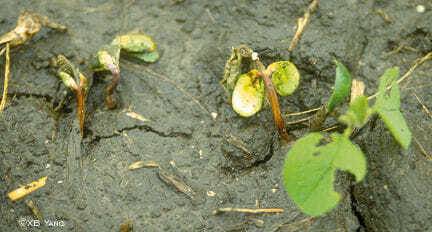
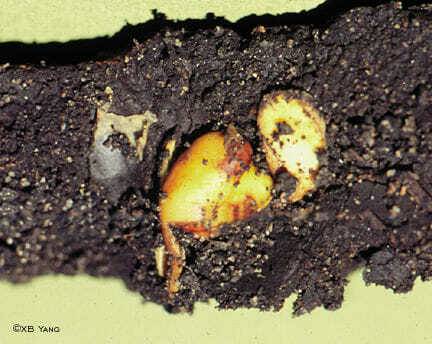
Before seedlings emerge, the fungi can cause seeds to rot. Rotten seeds will appear to be caked in soil with discolored roots. Roots may not be fully developed or even exist.
Wilting can occur in emerged seedlings as the cotyledons will appear brown and saturated. Plants that developed leaves before showing signs of damping off will begin to turn a grayish color before turning brown.
Treatment
Damping off can sometimes be confused with herbicide injury. Whereas fields impacted by herbicide injury will have uniform damage, damping off will create inconsistent patches of impacted crops.
With the overwintering nature of the Phytophthora fungi, controlling the amount of field residue can make the environment less conducive for fungal growth. Also, when planting early or in fields with poor drainage consider using fungicide seed treatments to protect seedlings.
Varieties equipped with genes resistant to Phytophthora will protect plants after they emerge and later in the season as well. Contact your local Latham® representative to determine which varieties will work best for your needs.
Sclerotinia stem rot – also known as White Mold –can lead to significant yield loss in soybeans. Yield loss from white mold is attributed to the damage it causes to leaves, pods and stems. Research from the University of Wisconsin estimates the disease has costed growers in the U.S. and Canada 101 million bushels of soybeans – equal to $1.2 billion.
White mold is caused by the fungus Sclerotinia sclerotiorum and overwinters in the soil for a number of years. After the fungus emerges from the soil, mushroom shaped structures known as apothecia will form on the soil surface. The apothecia, ranging between ¼ and ½ an inch wide, will first infect through soybean flowers before it reaches the stem.
While the fungus primarily spreads through the air via spores, moisture is required for infection to take place. As a result, cool and wet weather along with high humidity are the main causes of white mold.
Credit: University of Wisconsin
Scouting for White Mold
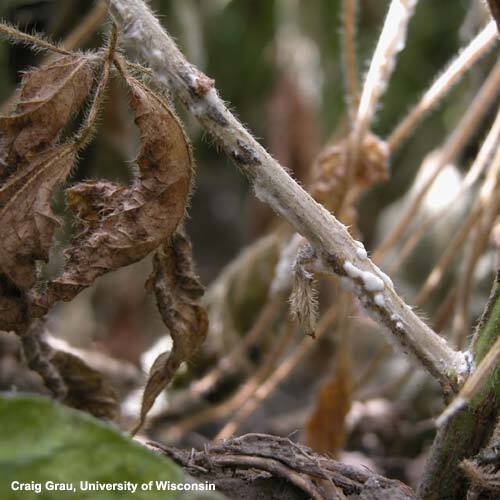
While Sclerotinia sclerotiorum is often confused with other fungal pathogens, the sclerotia distinguishes white mold from other look-alike diseases. Symptoms of white mold will be most prevalent between R3 and R6. Infected plants will exhibit white fuzzy growth on the lower stem.
Soybean blossoms are the first area of the plant to exhibit signs of infection and neighboring stems and pods may appear water-saturated. After infecting blossoms and pods, white mold may eventually spread through the entire stem causing it to turn tan or bleached of color. As the mold growth becomes thicker, black spots will begin to surface throughout the fuzzy white surface.
White mold also creates foliar symptoms, causing leaves to completely die while still attached to the stem. In infected soybeans, the tissue area between the leaf veins will turn gray and cause leaves to become wilted and curled.
Treatment Options
Due to the overwintering nature of the sclerotia, a two to three-year rotation away from soybeans is advised. When it comes to genetics, some soybean varieties are more resistant to white mold than others. Varieties with resistance to the fungus may recover better than others. It is also important to consider planting practices that cause white mold growth. Shade created from high plant density and growing canopies can lead to the fungal disease. Increasing row width and reducing planting populations are the best methods to improve airflow through the canopy and reduce infection from white mold.
In addition, broadleaf weeds are notorious for hosting white mold and herbicides should be used to control weeds. Fungicides are a viable method for treating white mold and can reduce the negative impacts incurred by soybeans. However, they are most effective when applied just before infection takes place. Be sure to consult with your local Latham representative to determine the best treatment plan for white mold.
There are a variety of stalk rots that infect corn, causing extensive damage to crops and losses in yield. Common factors make corn susceptible to stalk rot including warm and wet weather, stress after pollination, fertility issues, stalk boring insects, and the presence of other foliar diseases. There are key signs, symptoms and differences that distinguish the different types of stalk rot.
Credit: Crop Protection Network
Scouting for Signs and Symptoms
Physoderma stalk rot is caused by the pathogen Physoderma maydis, the same fungus responsible for causing Physoderma brown spot. The fungal disease seems to be showing up in more and more corn fields each year, but typically shows up on random plants and and has minimal impact on yield. Like most stalk rot diseases, warm and wet weather favor the development of Physoderma stalk rot.
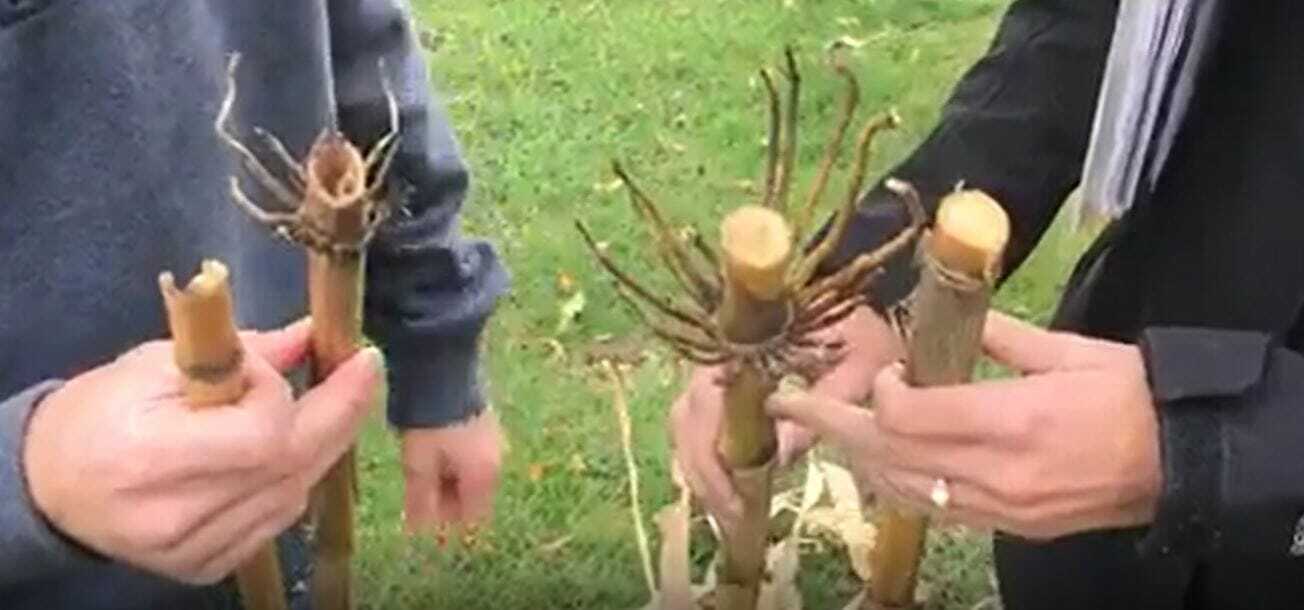
Physoderma stalk rot infects corn between the V4 and V9 stages. The disease is not associated with any foliar signs, so it is important to inspect plants closely at the base. Dark brown or black lesions will appear at the base of the stalk, and rotting of the pith will be observed upon splitting the stalk open. Overtime, blackening of the pith will move to higher nodes. Sporangia can also be found on the outside of nodes and within the rotted pith tissue.
Scout for symptoms of Physoderma stalk rot across five areas of the field. Stalks will make a distint “pop” and snap at one of the first 3 nodes above the soil line. If more than 10 to 15% of plants exhibit stalk rot, the field should be harvested early.
Management Strategies
With this being a newer disease we are still learning differences in hybrid tolerances to both stalk and foliar phases of this disease.
As a majority of stalk rots overwinter, one to two-year rotation away from corn and controlling corn residue are key for preventing the return of the disease. Fungicides may also be applied to prevent Physoderma leaf blight , but these studies are in early phases as well given the novel nature of this diesease
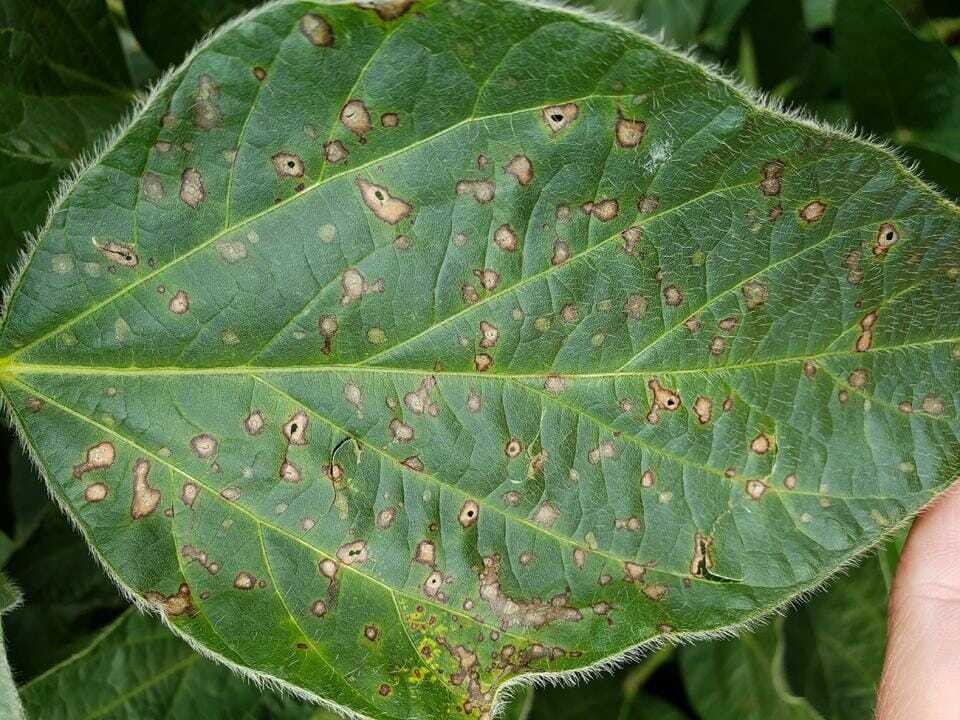
Frogeye leaf spot is a foliar disease caused by the fungus Cerosporasojina. The fungus primarily spreads from infected plants through air and water droplets. During particularly wet years, frogeye leaf spot can lead to yield loss as high as 30%.
Warm, humid weather and heavy rainfall are key drivers of frogeye leaf spot. Areas with standing water and high moisture are notorious for hosting the fungus and fuel the damaging disease. Soybeans grown year after year in the same field are also more susceptible to frogeye.
Scouting for Frogeye
Frogeye leaf spot most often infects plants after flowering, and signs are most evident in the upper canopy of plants. Dark spots with a gray center and a red-purple border will form on infected eaves. The smaller spots can join to create larger lesions, leading to defoliation that can reduce photosynthetic leaf area.
In addition to causing defoliation, frogeye leaf spot often leads to premature leaf drop. The disease can also infect stems and pods. Later in the growing season, reddish-brown lesions will form on stems and turn the centers of the stems gray. Gray or brown cracked seeds can also form as a result of the disease and pods will be discolored with long lesions.
Treatment Options
Selecting varieties with resistance to frogeye leaf spot is the best way to prevent the disease. As the fungus Cerospora sojina is able to overwinter, tillage practices that reduce weeds and bury residue will decrease the likelihood of future infection.
Fungicide application for treating frogeye leaf spot is most effective between the R2 and R5 growth stages. Be sure to consult with your local Latham representative to determine the best strategy for managing frogeye leaf spot.
There are a variety of stalk rots that infect corn, causing extensive damage to crops and losses in yield. Common factors make corn susceptible to stalk rot including warm and wet weather, stress after pollination, fertility issues, stalk boring insects, and the presence of other foliar diseases. There are key signs, symptoms and differences that distinguish the different types of stalk rot.
Anthracnose stalk rot is the most common type of stalk rot and is caused by the fungus Colletotrichum graminicola. The fungus is favored by wet, warm weather and overwinters in corn residue. Signs of the disease will be observed four to six weeks following pollination.
Scouting for Signs and Symptoms
The disease undergoes three phases with distinct signs and symptoms:
In the first phase, foliar lesions will appear in the early part of the growing season. The leaf blight will begin on the lowest leaves, and will reach the upper leaves by late season.
During the second phase, top-dieback will appear in the middle part of the season after tasseling, killing the parts of the plant located above the ear.
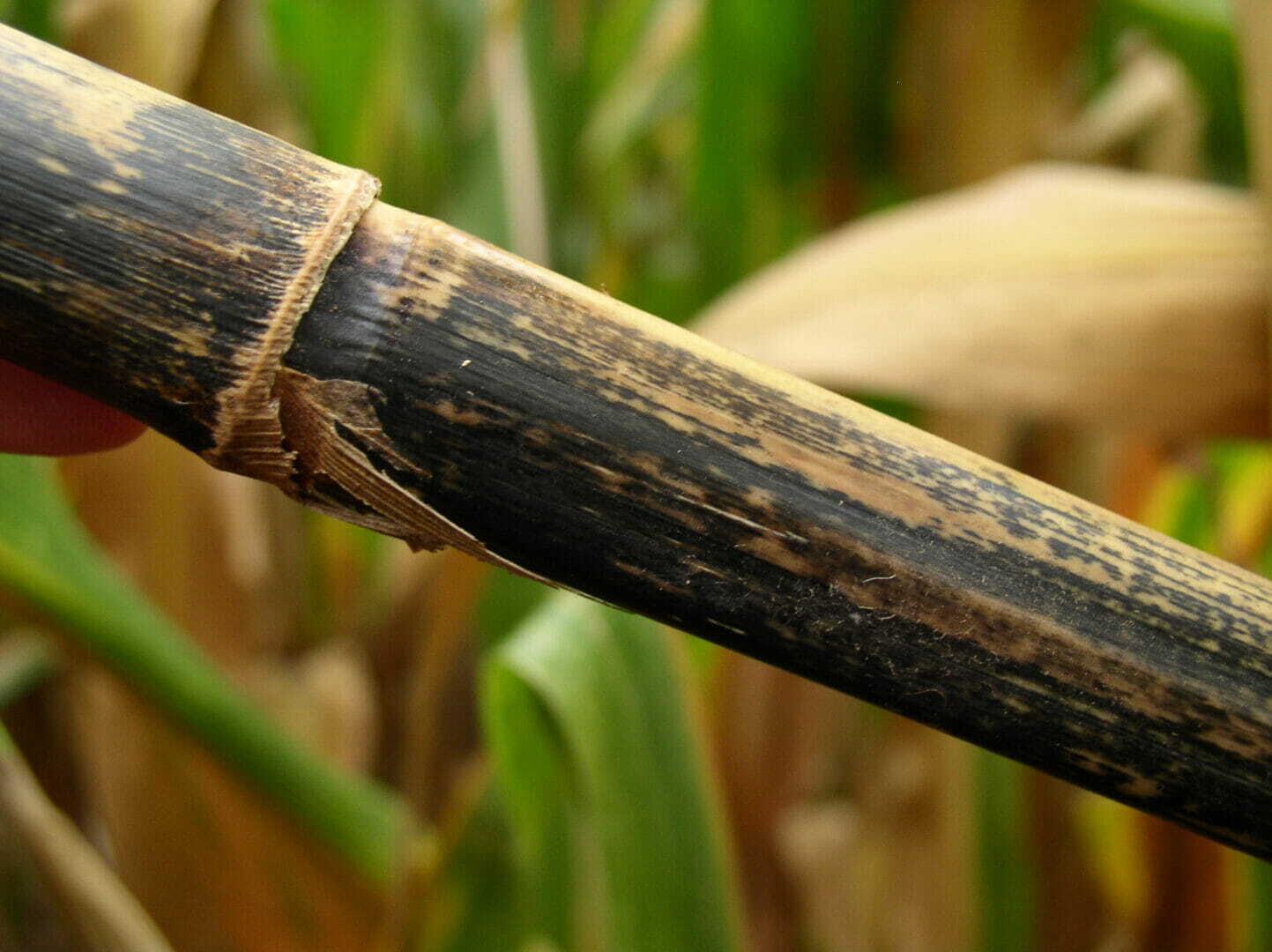
In the third phase, shiny black lesions will appear on outside surface of stalks. Look for setae, or bristles that cover the surface of the stalk. A hand lens can be used to look for the bristle-like texture and black dots in the center of lesions.
Stalks will exhibit fragility and appear to be brittle when handled. Different from other forms of stalk rot, anthracnose stalk rot will cause plants to lodge at the upper portion of the stalk. Pinching or bending at the nodes can be used to test for stalk lodging.
Stalk rot can lead to death just before maturity and reduce yield. In addition, plants defoliated from hail damage and those that are nitrogen deficient are at an increased risk for being infected from the stalk rot.
Management Strategies
Planting hybrids with resistance to stalk rots is a helpful defense against these diseases.