Latham Hi-Tech Seeds

(641) 692-3258

  • Home
  • Products
    • Corn
    • Soybeans
    • Alfalfa
    • Corn Silage
    • Seed Guide
  • Performance
  • Find a Rep
  • Media
    • Blog
    • News
    • Videos
    • Podcasts
    • TECHTalk
  • About Us
    • Company History
    • Our Mission
    • Careers
    • Become a Rep
    • Sowing Seeds of Hope
  • Contact Us
  • Latham Hi‑Tech Seeds

    Consider Traits & Chemistries in Your Crop Rotation

    Soybeans2

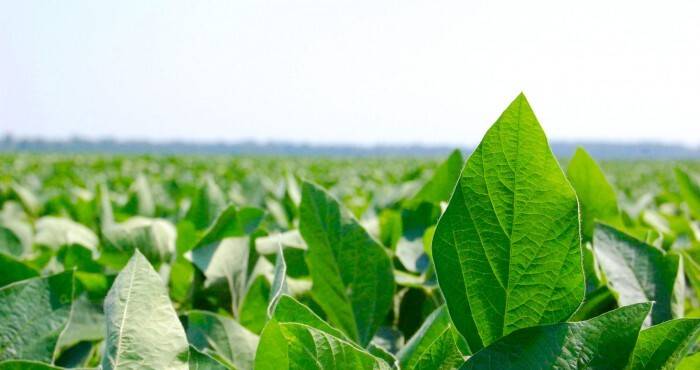
    A soybean-corn crop rotation allows farmers to spread out spring and summer fieldwork and provides a larger window for harvest.  Plus, a soybean-corn rotation can lead to energy savings during production and when handling, drying and conditioning of stored grain, according to recent issue of “Advance” published by the ISA On-Farm Network.

    “Studies show us that corn yields are higher following soybeans. The advantage of a soybean-corn rotation still centers on yield. The positive impact is probably due to several factors,” says Ed Anderson, Iowa Soybean Association senior director of supply and production systems.  “Soybeans break disease, insect and weed cycles and provide a nitrogen credit for corn the following year.

    It’s true that crop rotation can help achieve higher yields, as well as reduce risk ranging from volunteer corn to weed resistance.  Other benefits include better soil health, less disease pressure and higher profits are a few of the benefits that come from rotating corn and soybeans if farmers are careful about rotating traits and chemistries.  Plus, crop rotation can be one of the best management practices to control CRW.

    However, it’s no longer enough for farmers to merely rotate crops. Farmers also must rotate between herbicide chemistries, as well as hybrid/variety traits.  Rotating between various herbicide traits is important from the standpoint of reducing weed resistance.  It also has been proven that it helps in overall herbicide performance.

    Rotating traits, especially insect resistance traits in corn, is especially important for the same reasons – to decrease the risk of insects becoming resistant to those traits and also to improve overall trait performance.  As newer traits become commercially available in soybeans, the same will be true.  We  will need to be good stewards of these traits and rotate them whenever possible!

    One advantage of working with family-owned and independent Latham Hi‑Tech Seeds is that we can help you select the trait packages needed to change up your modes of action. Latham offers the industry’s broadest, deepest seed lineup – which makes it more convenient for farmers to get all their seed needs met.


    Team Latham

    May 2, 2013
    Corn, Crop, General, Herbicide Technology, Industry News, Seed Technology, Soybeans
  • Latham Hi‑Tech Seeds

    Genetically Modified News?

    Earth1

    Guest blog by Dan Gogerty, Communications editor for CAST

    Information comes at light speed and in bulk proportions through websites, news releases, and social media outlets.  This can be good and bad. For example, the topic of genetically modified food – plant and animal – becomes mind numbing with the barrage of articles and opinions.  Maybe we consumers of news need a bit of genetic modification ourselves in order to handle it all.

    Most, not all, seem to agree that GMO plants used in food have not been a research-proven hazard, but some say there are other problems with the concept, and they speculate that problems could surface. Food from biotech animals brings up a similar mix of opinions, but the tone is even more edgy.

    The following links show a wide variety of opinions, but many other sources are available:

    • The FDA provides a questions & answers page about food from genetically engineered plants.
    • This agri-journalism site by Ag Professional gives a top-ten list of positives about biotech crops.
    • This Farm Aid site provides opinions and links about GMO crops, some of them questioning the practice.
    • A blog from the “Chicks on the Right” favors the new law supporting GMO crops, and it provides a link to the Mark Lynas’ speech. The “chicks” also have a DDT problem with Rachael Carson.
    • Maybe this writer could be called “Dude on the Left.” He opposes the new GMO law, and he seems skeptical of the wide use of biotech food products. This letter is a farmer’s pro-GMO response.

    SIDEBAR by Shannon Latham
    From Dan Gogerty’s guest post, it is evident there are two sides to every (news) story.  “Dude on the Left” obviously believes the “Farmer Assurance Provision” was put in place to protect Monsanto.  “Why do GMOs need protection?” he asks.  Here’s why…

    It’s farmers who need the protection!  The so-called “Monsanto Protection Bill” doesn’t protect Monsanto.  The true name is the “Farmers Assurance Provision.”  This provision was added to a bill that was signed into law on March 26 for the express purpose of protecting farmers!  The intention of the provision is to mitigate the effects of repeated and future litigation from anti-biotech activists, who have been using the courts to impede the use of biotech crops.

    My hope is that, by providing several articles with points and counterpoints, today’s blog post will help set the record straight.  For additional background information on GMOs and why they’re planted, read:

    • Necessity-Genetically Engineered Crop
    • The Truth Behind GMOs
    • Why Farmers Plant GMO Crops

    Team Latham

    April 15, 2013
    General, Industry News, Seed Technology
  • Latham Hi‑Tech Seeds

    3 New Soybean Technologies in the Pipeline

    Roundup ready 2 xtend1

    As a family-owned company, Latham Hi‑Tech Seeds has one major advantage over our competitors:  We have the freedom to help our farmer-customers choose the traits and technologies that will work best for their given farming situations.  That’s why we’re especially excited about Latham’s pipeline of soybean products!

    Strategic alliances with the world’s leading technology providers means Latham is testing soybean products with three of the industry’s newest trait packages.  Here’s a summary of the emerging soybean technologies that farmers in the Upper Midwest could access in the near future from Latham Hi‑Tech Seeds:

    1. Enlist E3 – Developed and produced by Dow Agrosciences, Enlist E3 soybeans will be tolerant to new 2,4-D choline, glyphosate and glufosinate. Dow AgroSciences is working to introduce Enlist Duo™ herbicide with Colex-D™ Technology. Enlist Duo is a proprietary blend of new 2,4-D choline and glyphosate that will offer growers minimized potential for drift and near-zero volatility. We’re expecting the first E3 soybean products to hit the market for the 2014-2015 sales season.
    2. The Balance Bean – This new soybean product from Bayer® has the working name of “FG72” and will be a double stack for resistance to isoxaflutole and glyphosate. Isoxaflutole is the active ingredient in Balance® Flexx and in Corvus® corn herbicides. Eventually this product will be stacked with Liberty®, making it a three-way stack.
    3. Roundup Ready® Xtend Crop System – Monsanto continues to advance its stacked product featuring Genuity® Roundup Ready 2 Yield® technology with Dicamba resistance. Known as Xtend, this product will help extend the life of glyphosate. This technology appears to be slightly ahead of the other two now, depending on regulatory approvals.

    We’re hopeful regulatory approval will be received in time for at least limited supplies to be planted in 2014.  Although 2014 may seem like a distant future, the truth is, we’re working on our 2014 seed guide right now.  Latham must grow seed beans a full season ahead to produce products that farmers will plant the following year.

    Weed resistance is a growing problem – literally.  Diversity of tactics is the key to consistent weed management and high crop yields.  That’s why, at Latham Hi‑Tech Seeds, we couldn’t be more excited about the new traits that will soon be available to diversify modes of action and help farmers fight weed resistance!

    John Latham, President

    March 21, 2013
    General, Industry News, Seed Technology
  • Latham Hi‑Tech Seeds

    Duracade Approval Puts New Trait in Arsenal to Fight CRW

    Agrisure Duracade logo1

    Farmers need multiple options to fight corn rootworm (CRW), and the efficacy of Agrisure DuracadeTM appears promising.  With its new and unique mode of action, Agrisure Duracade will be combined with the Agrisure® RW trait to provide dual modes of action on corn rootworm.

    When more than one trait is added to individually control corn borer and CRW, studies have shown the yield advantage increases by an additional 6-8 bushels per acre over the single-traited CRW protected hybrids.  Research by the United States Department of Agriculture has reported that the Agrisure Duracade trait delivers the highest reduction in beetle emergence (99.79%) of any commercial CRW trait.*

    Corn rootworm is the single most destructive pest in U.S. corn production.  Before the availability of corn-rootworm-resistant biotech traits, populations of western corn rootworm and northern corn rootworm caused annual yield losses and control costs that exceeded $1 billion.  To prevent corn rootworm damage from reaching such devastating levels again, it’s important for farmers to plant a portfolio of products and to reduce risk with rotation.  Rotation involves rotating modes of action, and that’s why Agrisure Durcade will be an important defense mechanism in farmers’ ongoing battle with CRW.

    Supplies of Latham® Hi‑Tech Hybrids with the Agrisure Duracade trait will be available for the 2014 sales/planting season.  For more information, talk to your local Latham® representative or call 1-877-GO-LATHAM (1-877-465-2842).

    *Field measures of Western corn rootworm mortality caused by transgenic corn expressing the mCry3A (MIR604) and eCry3.1Ab (5307) proteins. (Hibbard et al. ESA Meeting December 2010)

    John Latham, President

    March 4, 2013
    General, Industry News, Seed Technology
  • Latham Hi‑Tech Seeds

    Maximize Yield on Every Acre with Integrated Systems

    IFS logo1
    Peter Bixel

    by Peter Bixel, Seed-to-Soil® Lead

    Dale Sorenson, Commercial Breeding Lead for Monsanto, last week talked with a group of Seed-to-Soil and SciMax clients about maximizing yield potential on every acre through integrated farming systems. Integrated Farming Systems include:  improved weed management, pest protection, disease protection, stress tolerance, and increased yield potential.

    One technology to help maximum yield potential is Roundup Ready® Xtend Crop System for soybeans.  Also in Monsanto’s pipeline is Corn Rootworm III Technology, designed to complement current commercial traits.  This “next generation corn rootworm technology” will attack corn rootworm through a new mode of action using a natural process different than Bt.

    New programs for Goss’s Wilt protection and Gray Leaf Spot resistance also are in the pipeline.  . Monsanto’s Ag Biologicals Platform is focusing on BioDirect™, which is designed to target glyphosate-resistant weeds for better control.  BioDirect™ was also seen to provide protection against insect pests and reduce symptoms of viruses.

    While weed management and pest protection are certainly two important factors when maximizing yield potential on each acre, seed selection is perhaps the single most important factor.  Traited products from Latham Hi‑Tech Seeds combine industry-leading genetics with industry-leading traits from technology providers like Monsanto.

    NOTE:  Not all traited products offer rootworm protection. Herculex I, for example, has resistance/tolerance to Liberty, Roundup and corn borer. Herc 1, however, does not protect against corn rootworm. A person can’t just assume that a “Bt hybrid” will have rootworm protection.

    Take some time now to review what seed you’re planning to plant in which fields.  Planning pays!  Seed can have a 700% return on investment… What else does?

    Webspec Admin

    February 18, 2013
    General, Herbicide Technology, Industry News, Seed Technology
  • Latham Hi‑Tech Seeds

    Latham Offers More Refuge Hybrids for 2013 Planting

    RespectRefugeCorn1

    In early September, the EPA gave final approval for Genuity® VT Triple PRO® RIB Complete®.  Genuity VT3 PRO has been our top-selling trait, so we’re excited that it will now be much easier for farmers planting these hybrids to comply with refuge requirements.

    Latham® hybrids with VT Triple PRO RIB Complete offers farmers dual modes-of-action for protection against above-ground insects, a single mode-of-action for corn rootworm protection and herbicide tolerance. Plus, it’s extremely convenient as the single-bag solution is a blend of 90% VT Triple Pro with 10% of the corn carrying the Roundup Ready trait.

    Many farmers say they like simplicity of a single bag that has the refuge included, so we’re pleased to now offer three RIB Complete corn blend products:

    • Genuity® SmartStax® RIB Complete – a blend of 95% insect-protected and 5% refuge seed. It offers the broadest spectrum of protection against above- and below-ground insects, as well as herbicide tolerance. Latham® Hi‑Tech Hybrids with SmartStax RIB Complete has dual modes of action for full-season rootworm control and is a good fit on corn-on-corn acres that can be associated with high corn rootworm infestations.
    • Genuity® VT Triple PRO® RIB Complete – a blend of 90% insect-protected and 10% refuge seed. It contains herbicide tolerance, a single mode of action for corn rootworm control and dual modes of action for above-ground insect protection – including corn earworm, fall armyworm and European and Southwestern corn borer. It’s a great fit in geographies experiencing low to moderate rootworm pressure.
    • Genuity® VT Double PRO® RIB Complete – a blend of 95% insect-protected and 5% refuge seed. It offers herbicide tolerance and dual modes of action for above-ground insect protection – including corn earworm, fall armyworm and European and Southwestern corn borer. It’s a great choice for fields that do not have corn rootworm pressure.

    John Latham, President

    October 11, 2012
    General, Industry News, Seed Technology
  • Latham Hi‑Tech Seeds

    Protect 2013 Corn Yields with Traits

    Since you can’t predict the weather, do what you can to minimize your risk.  Planting corn hybrids with a corn rootworm trait protect the corn plant’s root system better than soil insecticides do, particularly in a dry year.  It’s like having an extra insurance policy in place.  Beware, however, because not all traited hybrids are created equally!

    Genetics make yield but traits protect yield.  This season we certainly saw how different genetics handled stress from drought and wind.  Roots and stalk strength were put to the test.  That’s why genetic diversity is so important.  Plant a portfolio of 4 to 6 different Latham® numbers for added protection.

    As an independent, family-owned company, Latham Hi‑Tech Seeds is able to guarantee genetic diversity.  Our independence allows us to provide farmers with an industry-leading number of product choices from provides including:  Monsanto, Bayer, BASF, Syngenta, Dow AgroSciences and more.  In addition to planting different genetics, you can further minimize their risk by planting various maturities.

    In our 2013 product lineup, Latham Hi‑Tech Seeds offers 33 hybrid seed corn products with 6 different trait combinations for rootworm control in various maturities:

    • SmartStax, leading the industry with 2 modes of action against rootworm
    • VT Triple Pro
    • VT3
    • Herculex Xtra
    • Agrisure 3111 Viptera
    • Agrisure 3000 GT

    Not all traited products offer rootworm protection.  Herculex I, for example, has resistance/tolerance to Liberty, Roundup and corn borer.  Herc 1, however, does not protect against corn rootworm.  A person can’t just assume that a “Bt hybrid” will have rootworm protection.

    Rootworm control is a must in corn-on-corn protection.  You’ll see extended diapause in ground that has been rotated.  In an area with heavy rootworm pressure, plant Latham hybrids with Genuity® SmartStax® technology.  Look at dual modes of action and consider rotating crops in areas where rootworm pressure is extreme.

    Because corn-on-corn acres are more susceptible to challenges presented by weather, soil and pest pressure, Latham has introduced the Gladiator designation to help with 2013 seed selection.  They have the industry’s most advanced genetic foundation, offering powerful root and stalk strength and superior above- and below-ground insect protection.  Latham’s Gladiator hybrids are developed to battle your field’s continuous corn challenges and win.  Give them a try as part of your diversified 2013 crop plan!


    John Latham, President

    September 20, 2012
    General, Industry News, Seed Technology
  • Latham Hi‑Tech Seeds

    Genetic Garden Shows How Different Types of Corn React to Drought

    Genetic Garden Shows Drought Stress1

    by Rachel Norby, Seed-2-Soil® Summer Intern

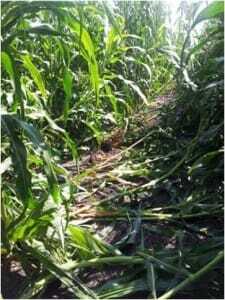
    As you drive through the countryside, it’s evident that different corn hybrids are handling the drought stress differently.  Some hybrids have stronger roots and stalks, so they’re holding up better in these dry conditions.  Other hybrids have weaker stalks and are lodging.

    Latham Hi‑Tech Seeds’ Genetic Garden shows how corn from many different eras is reacting to the drought conditions.  You can see how much better today’s hybrids can withstand the high heat and low moisture than their early ancestors.

    Genetic Garden Shows Drought Stress

    Although minimal irrigation was used to keep our “living museum of corn” alive for the Latham Country Fair on August 25, many varieties still reacted to the drought.  You’ll see lodging in many early varieties.  (NOTE:  “Early” is being used here to reference the chronological history corn of varieties, not as in the relative maturity of hybrids.)

    Open-pollinated corn varieties grown during the Dust Bowl of the 1930s didn’t pollinate then, and you’ll see the same thing happened in our Genetic Garden.  A corn variety found in the Genetic Garden from around the time of the 1988 drought is also showing signs of stress.  One of the differences in the droughts of 1988 and 2012, however, is there was less rainfall during the months of April to June in 1988 than we received in 2012.  This lack of rain during that quarter of the year meant more stress on crops during early season growth compared to this year when the majority of the stress happened around the time of pollination.

    We’d like to invite you to see the differences for yourself!  Take a walk through our “living museum of corn” on Saturday, Aug. 25, during the Latham Country Fair.  We’ll be hosting tours between 9 a.m. and 3 p.m.

    Gary Geske

    August 13, 2012
    Agronomics, Corn, Crop, Drought, General, Industry News, Seed Technology, Weather
  • Latham Hi‑Tech Seeds

    Latham Hi‑Tech Equals High-Quality Alfalfa

    The demand for hay is high, and the prices being offered for top-quality forage are making farmers sit up and take notice. Quite a few fields will be planted to alfalfa in the next few weeks. That’s why Latham Hi‑Tech Seeds is making three of the very best alfalfa brands available.  Following is a short summary of each.

    LH9100 Prolific II:  This alfalfa features a superior branch-root structure, which is located high in the soil zone above the water table. A high water table often severely damages or kills tap roots of traditional varieties, exposing those plants to disease or winterkill. The distribution of roots closer to the soil surface, however, increases the plant’s ability to better uptake nutrients. It also allows LH9100 to be an exceptional performer for hay producers under most soil conditions and especially in poorly drained soils. LH9100 carries an exceptional disease package. It’s highly resistant to most major pathogens, including Aphanomyces Root Rot (races 1 and 2). This new Latham® variety allows for very good alfalfa in more areas that previously were not even considered for hay production.

    LH9600HY:  This product is the next generation of branch-rooted hybrid alfalfas with the msSuntra technology. It’s characterized by aggressive re-growth, high quality and high yields. LH9600 is a fine-stemmed product with a similar disease package to LH9100 Prolific II. An added benefit is that LH9600 is also highly resistant to stem nematodes and Northern Root Knot nematodes. It also features excellent drought tolerance and a very high leaf-to-stem ratio.

    AmeriStand 405T RR:  Our first Roundup-Ready® alfalfa, this product is a high-yielding, Traffic-Tested™ brand that carries high resistance to seven major yield-robbing pests. Supplied to us by America’s Alfalfa, this is an excellent choice to maximize yield and profitability while reaping the benefits of the Genuity® Roundup-Ready weed control system. It’s ideally suited for those areas where stand establishment can be a challenge due to tough-to-control weeds. Keep in mind that once a stand is established, it’s always best to rotate your use of herbicides to help prevent weeds from building resistance to glyphosate-based products.

    For additional information on pricing and product placement, contact me or your Latham Regional Sales Manager. Have a great spring!

    Webspec Admin

    March 21, 2012
    Alfalfa, Crop, General, Industry News, Seed Technology
  • Latham Hi‑Tech Seeds

    Hawaii’s Seed Crops Experience Exponential Growth

    Last Friday guests of Latham Hi‑Tech Seeds had the opportunity to visit Monsanto’s research and production operations based in Kihei, Maui.

    Move over sugar cane, pineapples and tropical flowers…  seed crops are now the highest value commodity in Hawaiian agriculture.  The value of Hawaii’s seed industry set a new record high of $247.2 million for the 2010-2011 season.

    Since its roots were established 40 years, Hawaii’s seed crop industry has experienced exponential growth.  Hawaii’s seed crop industry has grown an average of 14% in value since 1968.  The seed industry serves as one of state’s few stable sectors for jobs, according to a study commissioned by the Hawaii Farm Bureau Federation.  The seed crop industry provides 22.7% of all agricultural jobs in the state.

    Hawaii’s seed crop industry also contributes substantially to the state’s public policy objectives:

    • Economic diversification
    • Maintaining prime lands for ag use with any incentive to convert these lands to alternative use
    • Creating Hi‑Tech jobs

    The rapid adoption of Hi‑Tech crops has also fueled growth of Hawaii’s seed crop industry.  Its climate allows research operations to play a critical role in the development of new corn hybrids.  Farms fields on Maui can produce up to four crops in just one calendar year!  That means a new hybrid can be developed in about half the time it would take if a seed company relied solely on more temperate growing conditions found on the continental U.S.

    Last Friday Paul Koehler and David Stoltzfus who work for Monsanto in Kihei, Maui, explained to a group from Latham Hi‑Tech Seeds the key role Hawaii plays in hybrid development:

    1st generation (parent seed increase) in Hawaii
    0.3 acres of parent line increase planted in Hawaii, harvested and planted again

    Second generation (parent seed increase) grown in Hawaii
    35 acres of parent seed increase, harvested and sent to South America

    Hybrid seed production grown in South America
    3,500 acres of hybrid seed production planted in South America, harvested and sent to North America

    Hybrid seed sent to North America
    600,000 acres of hybrid seed planted in North America as a full-scale commercial release

    Developing new hybrids that help farmers produce more crops while conserving more natural resources is going to be critical to meet growing global demands.  The world’s population is expected to grow by 40% in the next few decades.  That means farmers will need to grow as much food in the next 50 years as they did in the past 10,000 years combined!

    And that’s why seed companies like Latham and Monsanto are on a mission to help farmers produce higher yields.  It’s also why Monsanto invests more than $3 million a day on R&D. As a result of these investments, Genuity® products are providing increased yields, reducing chemicals into our water supply and helping to feed a growing population

    Team Latham

    February 15, 2012
    Agriculture, General, Industry News, Seed Technology
Previous Page
1 … 3 4 5 6 7 8
Next Page

Latham Hi‑Tech Seeds

131 180th Street | Alexander, IA 50420

(641) 692-3258

SIGNUP FOR OUR NEWSLETTER
  • Contact
  • Legal
  • Dealer Center
  • Seedware Login
  • Latham Gear

© 2025 Latham Hi‑Tech Seeds. All rights reserved. | Iowa Web Design by Webspec | Privacy Policy

Latham® Hi-Tech Seeds is a trademark of M.S. Technologies, L.L.C., 103 Avenue D, West Point, IA 52656.