Latham Hi-Tech Seeds

(641) 692-3258

  • Home
  • Products
    • Corn
    • Soybeans
    • Alfalfa
    • Corn Silage
    • Seed Guide
  • Performance
  • Find a Rep
  • Media
    • Blog
    • News
    • Videos
    • Podcasts
    • TECHTalk
  • About Us
    • Company History
    • Our Mission
    • Careers
    • Become a Rep
    • Sowing Seeds of Hope
  • Contact Us
  • Latham Hi‑Tech Seeds

    Finding Love After Loss: Sharing Passion for Seeing New Places, Meeting New People

    AugieSchad

    Suffering crop loss in 1993 turned out to be one of the best things that could have ever happened to Augie Schad. If it wouldn’t have been for Mother Nature, he might never have met claims adjuster Nancy Ruesink.

    Augie and Nancy enjoy traveling. This photo was taken while visiting Jasper National Park in Alberta, Canada.

    Nancy grew up on a farm in western North Dakota and moved to Minnesota after she married.  When she became a widow at age 26, she chose to farm so she could stay home with her two young sons.  Then in 1989 Nancy became a crop adjuster.  Today she works as claims supervisor for eastern Minnesota and is also actively involved with the seed business.

    “My experience in crop insurance complements the seed business and vice versa,” says Nancy.  “I stay informed about the newest technology and have the privilege of seeing many different products perform on many different farms.   And knowing what’s happening in the seed world helps me inform the producers I work with.  It’s really all about helping people.”

    Helping farmers become even more productive and profitable keeps the seed business interesting for Augie, who was raised on a dairy farm near Plainview, Minnesota, and has been a Latham® dealer for 18 years.

    “New seed traits and technologies have made production agriculture safer for producers and consumers alike,” says Augie.  “And making the best seed products available to customers is really important to me.  I know that, as a family-owned business, Latham Hi‑Tech Seeds is most interested in helping farmers be profitable and successful.  I also like the fact that I can talk directly to the company’s owners.”

    Outside of work, Augie and Nancy enjoy traveling.  This winter they headed west for a few weeks, visiting family and friends.  They spiced up a community potluck in Arizona with a batch of “Bacon Wrapped Stuffed Jalapenos.”  As soon as someone tried the first pepper and said how much he liked it, Nancy said the rest of the batch was gone in a blink of an eye.

    See how quickly these appetizers disappear as you gather with family and friends!  Nancy’s recipe for stuffed jalapeños follows.  Also listed below is her recipe for Blueberry Chicken Salad, which has been a hit at their family reunions.

    Now that the days are getting longer and warmer, it won’t be long before the picnic season is here.  What’s your favorite dish to make for a potluck?

    Blueberry Chicken Salad

    BlueberryChickenSaladYield:  4-6 servings
    Photo from TasteofHome.com

    Ingredients:

    • 2 cups fresh blueberries
    • 2 cups cubed, cooked chicken breast
    • ¾ cup chopped celery
    • ½ cup diced sweet red pepper
    • ½ cup thinly sliced green onions
    • 1 carton (6 oz.) lemon yogurt
    • 3 T. Mayo
    • ½ tsp. salt
    • Bibb lettuce leaves, optional

    Directions:

    1. Set aside a few blueberries for garnish.
    2. In a large bowl, gently combine the chicken, celery, red pepper, onions and remaining blueberries.
    3. Combine the yogurt, mayo and salt: drizzle over chicken mixture and gently toss to coat.
    4. Cover and refrigerate for at least 30 minutes.
    5. Serve on lettuce-lined plates if desired.
    6. Top with reserved blueberries.

    COOK’S NOTE:  Great for lunch or a light summer supper.

    Team Latham

    March 25, 2011
    General, Pork, Poultry, Recipes
  • Latham Hi‑Tech Seeds

    International Demand Increases for U.S. Soy

    World-wide demand for U.S. soy is climbing, according to a recent article in Beyond the Bean. The U.S. Soybean Export Council believes the need for U.S. soy by users in eight countries could significantly increase over the next five to 10 years: China, Egypt, Indonesia, Mexico, Philippines, Russia, Syria and Vietnam.

    Escalating incomes among these citizens means they can now afford to consume more vegetable oils, protein, poultry, meat and fish. Thus, the animal producers in these countries will require more animal feed and food processors more vegetable oil.

    In Southeast Asia, for example, the annual per capita meat consumption is expected to increase to 11 pounds by 2030. That’s double the amount of meat consumed by the average citizen a decade ago!

    Soybean oil continues to be the preferred vegetable oil for consumption in the Middle East, and Syria’s growing demand has led to the construction of several new processing facilities.

    Demand is also expected to increase for soy in China and Mexico, which are currently the United States’ strongest export markets. In 2010, China imported 825 million bushels of U.S. soy.

    The Food and Agriculture Organization of the United Nations (FAO) predicts the global population will reach 8.3 billion by 2030. As the world’s population grows, demand for high-quality soybeans, soybean meal and soybean oil is expected to further increase.

    Click the below links to read more about growing soy exports:
    Growing global demand.
    Can U.S. ports handle growing soy exports?

    Team Latham

    March 24, 2011
    Agriculture, General, Industry News
  • Latham Hi‑Tech Seeds

    Planting Tips for a Record-Breaking Season

    The temperature has started heating up, and the anticipation of spring planting is around the corner has arrived.  To help ensure you get the best from your crop this year, I wanted to provide a few tips to consider both for planting preparation and for plant health as you head into the field this spring.

    Soil Testing: The first step to ensure a successful season is to make sure your field has the proper nutrients. If you didn’t have a soil test done in the fall, there’s still time to have one done yet this spring. Remember, the benefits of soil testing far outweigh the costs. Lack of fertilizer, or applying inadequate amounts of nutrients can cause fertility levels to drop when hungry crops are feeding. The best practice is to sample every field, every year, to establish consistency and trim overall fertilizer costs.  If you grid sample, the higher costs and greater accuracy of that system allow for less frequent sampling – most recommend every 3 or 4 years.

    Planting Date/Soil Conditions: Remember to base your planting date on the readiness of the soil versus the date on the calendar. Ideal soil temperature is no less than 50 degrees for corn.   Wet soils cause trouble from the beginning; compaction resulting from wet soil can kill root growth. For soybeans, fungicide-treated seed is a must to prevent damping off from Pythium, Rhizoctonia, Phytopthora and Fusarium. For corn, treated seed is a must for Pythium, seed corn maggots, wireworm and no-till. Click here for additional planting date tips.

    Fertility: I recently posted some tips for managing nutrients in your soybean crop, including N, P and K, and secondary nutrients like Calcium and Sulfur. You can read those posts at the links below to learn more about how to balance nutrient levels in your soybean crop to help ensure plant health.

    Fertility Levels Key to Raising Top Soybeans

    Fertility Levels Key to Raising Top Soybeans Part 2

    You know better than anyone that there are an incredible number of variables that can affect plant health and overall yields.  Addressing what challenges may come now versus down the road will help ensure a successful season in a year that holds the promise of record returns.

    Please feel free to comment if you have any questions that we may be able to help answer as planting nears.

    Webspec Admin

    March 23, 2011
    General, Season, Spring
  • Latham Hi‑Tech Seeds

    The many reasons to thank a farmer

    I had the honor of joining some Latham customers on combine rides last fall.  I talked with them about product performance and the markets. I talked with them about their goals for expansion or about their desire to pass their farm to their children.  Although agriculture has been a part of my life since I was a child, I was reminded during those conversations just what an incredibly special group of people farmers are.

    That’s why when consumers have misconceived notions about food prices, food quality or “food versus fuel,” I have to give farming a voice. I believe it’s vitally important to educate individuals about today’s agriculture practices, so they have a better understanding of just how dinner arrived on their plate or clothes on their backs.

    The South Dakota Corn Growers Association is doing a marvelous job at educating consumers about agriculture and the many reasons consumers should “thank a farmer.” With their recent campaign, the True Environmentalists, the SDCGA is sharing with consumers how farmers were concerned about the environment before being concerned was “trendy.”

    This campaign website shares ways in which farmers work to protect the soil, air, water and wildlife.  It also shares 10 reasons consumers should “thank a farmer.”

    One reason to thank a U.S. farmer is because their productivity allows us to save money at the grocery store.  Americans as a whole spend just 9.6 percent of their disposable income on food (including dining out) – the lowest percentage in history! Not only that, but according to a United States Department of Agriculture article, just 11.6 cents of every dollar we spend on that food makes it back to the farmer.

    I encourage you to visit SDGA’s site and share this page with your Facebook friends and Twitter followers to help educate consumers about agriculture and provide them with a few of the many, many reasons they should thank a farmer today.

    Thanks to those farmers in Latham country and beyond who work so hard to help feed and fuel our world!

    Team Latham

    March 22, 2011
    Agriculture, General, Industry News
  • Latham Hi‑Tech Seeds

    It's March: Time to Pick Your Strongest Players

    Morehead State beat Louisville.  Richmond beat Vanderbilt.  Virginia Commonwealth beat Georgetown.  There’s nothing like March Madness! The first weekend of tournament play is one of my favorites because there are so many upsets, near upsets and buzzer beaters.  Inevitably, a Cinderella team upsets a highly ranked Goliath team.

    Latham Hi‑Tech Seeds knows what it feels like to be positioned against a Goliath.  And just like many of these basketball teams, we’re prepared to do battle.  The 2011 acreage battle is expected to intensify through spring, but our starting soybean lineup is ready to play as acres become available.

    Our team captain and power forward is Latham 2440R2, which was the top yielding bean in its maturity across the entire industry in 2010!  When head-to-head with Y-series beans, Latham 2440R2 beat 92Y30 by 8.2 bushels per acre (bu/A) across 21 research locations in 2010.  It shoots a high percentage, winning 69% of the time in Latham’s own yield trials last year across Wisconsin, Iowa, and South Dakota.  Latham 2182R2 is the defensive stopper – great against major diseases – that every team needs at the “wing forward” to win.

    Our “big man” is Latham 2885R2.  This “center” was one of the highest yielders in Latham’s internal 2010 research trials.  Medium tall with good stress tolerance, L2885R2 scores high against Phytophthora, white mold, and SCN tolerances.  The guards on our team on Latham 1985R2 and Latham 2084R2.  These two provide the speed out of the ground, yield potential and defensive characteristics, like excellent resistance to Iron Chlorosis and Cyst Nematode, that our customers need to win.

    Make sure your planting top scorers this spring.  Call on Latham, the soybean team with nearly 65 years of proven product performance.  We’d love the chance to put a winning team in place for you!

    John Latham, President

    March 21, 2011
    Crop, General, Season, Soybeans, Spring
  • Latham Hi‑Tech Seeds

    Make "Eyes Smile" with Irish Stew

    JohnnyWilson
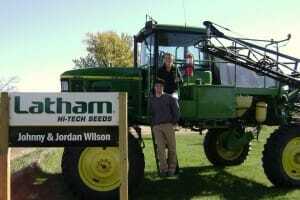
    Johnny Wilson, and his wife, Jordan, operate Marshall Ag in central Iowa. In addition, Jordan will graduate this May as a registered nurse.

    The love of farming prompted John Wilson to leave his native Ireland and study agriculture at Iowa State University (ISU) just as his father had.  The difference is that upon graduating from ISU his father returned to northern Ireland.  John Wilson, however, immigrated to the United States.

    Without an opportunity to farm in his native Ireland, young John Wilson moved to the central Iowa community of Laurel. He soon began farming land that had been in his mother’s family.  And today the family’s farming tradition continues as his son, Johnny, farms in partnership with him in Marshall County.

    “My dad has been really good about allowing me to get my feet wet and about entertaining new ideas,” says Johnny, who returned to the family farm four years ago.  “We buy equipment together.  We make our seed selections and we buy our chemicals together.  We each have our own roles, but we’re both very passionate about continually educating ourselves in an effort to increase yields.”

    In addition to raising row crops, Johnny operates Marshall Ag in Laurel.  He sells chemicals, fertilizer and seed with the objective to make every seed a success.

    “I’ve always wanted to be in business and technology.  But in my wildest dreams, I never thought I’d farm with my dad,” says Johnny, who completed an engineering internship and then worked four years for Mechdyne, one of the world’s largest companies dedicated to consulting and developing advanced Audio Visual (AV), immersive 3D, networked, and collaborative visualization solutions.

    “The cool thing is that agriculture incorporates business and technology,” adds Johnny.  “I’m delighted to get back to my roots in agriculture.”

    Like any good farmer, Johnny appreciates where his food comes from.  And like any good Irishman, he especially enjoys his meat and veggies.  Fried lamb chops with mint sauce is one of his favorite meals.  Another favorite is Ulster Fry.

    “As my grandparents say, there’s nothing more northern Ireland than an Ulster Fry,” he says.  This full breakfast consists of several courses.  It traditionally begins with fruit juice, cereal, potato bread and soda bread.  It also includes several entrees such as bacon and eggs, blood sausage, small pancakes, fried tomatoes, baked beans and sometimes black pudding. Hot tea with milk is the traditional beverage.

    As a tribute to the Emerald Isle, today we’re sharing a recipe for Irish Stew that’s very similar to what Johnny’s grandmother makes.  Fortunately, the recipe below calls for “cups” and “teaspoonfuls” rather than grammes and milligrammes.  Whip up a batch of Irish Stew with a side of soda bread and see if you can make your family’s eyes smile!

    Team Latham

    March 18, 2011
    General, Recipes, Sides
  • Latham Hi‑Tech Seeds

    Farmers Are America’s MVPs

    “America’s ‘Most Valuable People’ aren’t found on magazine covers. Rather, they are found in farm fields, feed stores, and livestock barns. They are American farmers, a group whose labors, although largely unrecognized, are vital to the lives of all U.S. citizens – or at least the ones that eat,” writes the 2011 Ag Day Written Essay Contest Winner Nora Faris.

    Faris of Concordia, Missouri, continues by writing, “In this modern age of supermarkets and 24-hour fast food restaurants, it has become increasingly hard for the American public to fathom where their food comes from. Long gone are the days when a chicken dinner meant selecting a bird from the henhouse. Today’s consumer, faced with an endless array of choices, selects their poultry with little knowledge of its origin, unaware of the work that went into producing and dispatching the bird. They fail to realize the vital connection between farm and food, between production and consumption. Little do they realize that without our nation’s strong agricultural infrastructure of farmers, their grocery store shelves would be bare.”

    It’s so true that many Americans have no concept of where their food comes from or how it’s produced.  AgWeb Editor Greg Vincent recently conducted “man on the street” interviews in New York City by asking them, “What comes to mind when ya think of a farmer?”  Although the indivdiuals’ responses were entertaining, it was a sad commentary because it highlighted how many Americans are ignorant about their food supply. It’s one thing not to understand how a dairy cow is fed and cared for; it’s another thing to not even know that the milk in a milk chocolate bar was produced by a cow.

    “Agriculture provides almost everything we eat, use and wear on a daily basis. But too few people truly understand this contribution,” writes Jeffrey Stapper in the Southwest Farm Press.  “Today each American farmer feeds more than 144 people, a dramatic increase from 25 people in the 1960s. Quite simply, American agriculture is doing more – and doing it better.”

    Hats off to America’s farmers who produce the safest, most abundant food supply in the world!  Latham Hi‑Tech Seeds is  proud to help you feed and fuel the world.

    Team Latham

    March 17, 2011
    Agriculture, General, Industry News
  • Latham Hi‑Tech Seeds

    Survey Shows Consumers Trust Farmers

    Article submitted by Carol Balvanz, Director of Policy for the Iowa Soybean Association.

    A recent survey of non-farm residents by the Iowa Soybean Association (ISA) shows that consumers trust Iowa’s farmers to supply safe, abundant food – and to do it while taking good care of their animals.

    Iowa is a top pork, egg, chicken, turkey and beef state. It has a growing dairy industry. Some might think that all this production would lead to disgruntled neighbors and consumers susceptible to animal rights organization horror stories. But it may be that all this familiarity with livestock production and with the farmers who raise the livestock help Iowans see through the radical rhetoric from groups whose main goal is to eliminate livestock production in the U.S.

    One clue to Iowans’ perception of livestock agriculture was found in the survey question which asked, “Can there be a difference between what is considered humane treatment of farm animals and humane treatment of household pets?”

    Polling showed 83% of survey participants agreed there is a difference between pets and farm animals, leading the Iowa Soybean Association to believe that the education efforts of individual farmers and groups such as the Coalition to Support Iowa’s Farmers have made an impact on those Iowans who have no remaining connection to the farm. Those consumers trust Iowa’s farmers to supply safe, abundant food, and to do it while taking good care of their animals.

    Iowa consumers seem to have no illusions that pigs are pets. Instead, they see value in housing systems that keep those pigs warm, dry, comfortable and gaining weight quickly so that they can reach their destiny of becoming part of the food supply.

    Team Latham

    March 16, 2011
    Agriculture, General, Industry News
  • Latham Hi‑Tech Seeds

    Saluting America’s Farmers on Ag Day

    March 13-19, 2011 is National Ag Week, and today many Americans will celebrate National Ag Day.  It’s a time to educate the general public about how food and fiber are produced, as well as the important role U.S. agriculture plays in feeding a hungry world.  It’s a time to consider career opportunities in agriculture, as well as a time to salute America’s farmers.

    Today I’d like to give a “shout out” to all of the hardworking and productive farmers in Latham Country.  I hope you’ll take two minutes to watch this moving video about why God made farmers.

    [youtube]http://www.youtube.com/watch?v=oWpeNAUe5Vw&feature=player_embedded#at=40[/youtube]

    The photos featured in this video show “farming through the years,” reminding me about visits to my grandparents’ farm.  While farm equipment has certainly changed through the years, the values and animal care found on Grandpa’s farm live on with today’s farmers and ranchers.

    Team Latham

    March 15, 2011
    Agriculture, General, Industry News
  • Latham Hi‑Tech Seeds

    Bursting with Hometown Pride

    Our hometown of Sheffield, Iowa, has been bursting with pride since Friday night when the West Fork Warhawks won the Class 2A Boys State Basketball Championship at Wells Fargo Arena in Des Moines and capped a perfect 27-0 season.  The Warhawks beat Western Christian of Hull, Iowa, in a thrilling 60-56 overtime victory.   West Fork’s Seth Tuttle, who scored 27 points including the game-clinching, free throw with 7 seconds left, was named captain of the All Tournament Team.

    “This is everything that I’ve ever wanted. It’s the best way to end it,”  said Tuttle in a Des Moines Register article. “But it’s not about me, it’s about this West Fork team. It’s about West Fork nation.”

    West Fork is a new school district that formed last year when the Sheffield, Chapin, Meservey, Thornton school districts combined with Rockwell-Swaledale.  West Fork was chosen as the name because the West Fork River runs through the district.

    Congratulations to the State Champion Warhawks! We’re proud to be part of the West Fork Nation and are proud to call Sheffield “home.”

    John Latham, President

    March 14, 2011
    Agriculture, General, Industry News
Previous Page
1 … 131 132 133 134 135 … 159
Next Page

Latham Hi‑Tech Seeds

131 180th Street | Alexander, IA 50420

(641) 692-3258

SIGNUP FOR OUR NEWSLETTER
  • Contact
  • Legal
  • Dealer Center
  • Seedware Login
  • Latham Gear

© 2025 Latham Hi‑Tech Seeds. All rights reserved. | Iowa Web Design by Webspec | Privacy Policy

Latham® Hi-Tech Seeds is a trademark of M.S. Technologies, L.L.C., 103 Avenue D, West Point, IA 52656.