Latham Hi-Tech Seeds

(641) 692-3258

  • Home
  • Performance
  • Products
    • Corn
    • Soybeans
    • Soybean Blends
    • Alfalfa
    • Corn Silage
    • Seed Guide
  • Find a Rep
  • Media
    • Blog
    • News
    • Videos
    • Podcasts
    • TECHTalk
  • About Us
    • Company History
    • Our Mission
    • Careers
    • Become a Rep
    • Sowing Seeds of Hope
  • Contact Us
  • Latham Hi‑Tech Seeds

    Early Season Frost or Freeze Damage in Corn

    Picture 2

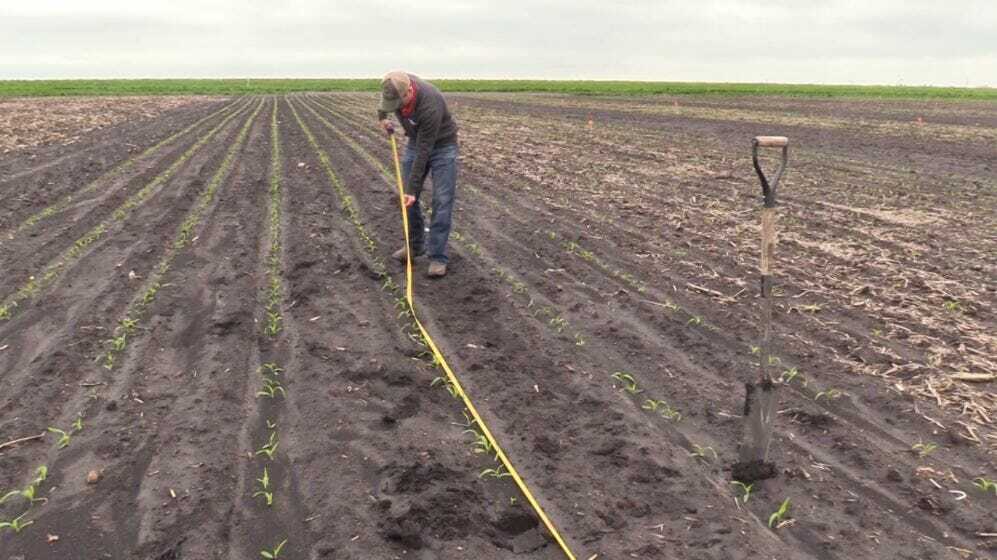
    The virtue of patience is most beneficial when the time comes to assess frost or freeze damage in early-season corn.  Once a frost or freeze event takes place, do an initial assessment of your field and wait 3-5 days before making any final decision on how to proceed.  Young corn plants can tolerate cool temperatures up to V5 since the growing point is still below the soil surface.  Early season damage caused by the cold temps does not show up immediately as the cells that get broken from the freezing moisture inside the plant may look normal the first morning after a freeze. Depending on the actual low temperatures, symptoms may take a day or so to appear.

    Frost Damage Assessment

    • Identify Location – Note field locations that experienced the cold temperatures. Also note the lay of the land in those fields such as low spots, hill tops, general slope direction.
    • Soil Moisture – Record the soil moisture levels across the entire fields, possible dry hill tops and wetter low areas. Moist soil can offer some protection.
    • Soil Temperature – Check soil temp in different location across the field.
    • Soil Type – Be conscious of the soil type. Sandy soil cools much faster than silty or clay soils.
    • Weather Data – Utilize location weather station info to determine the lowest temperature and duration of that temperature.

    Frost Damage

    Picture 1
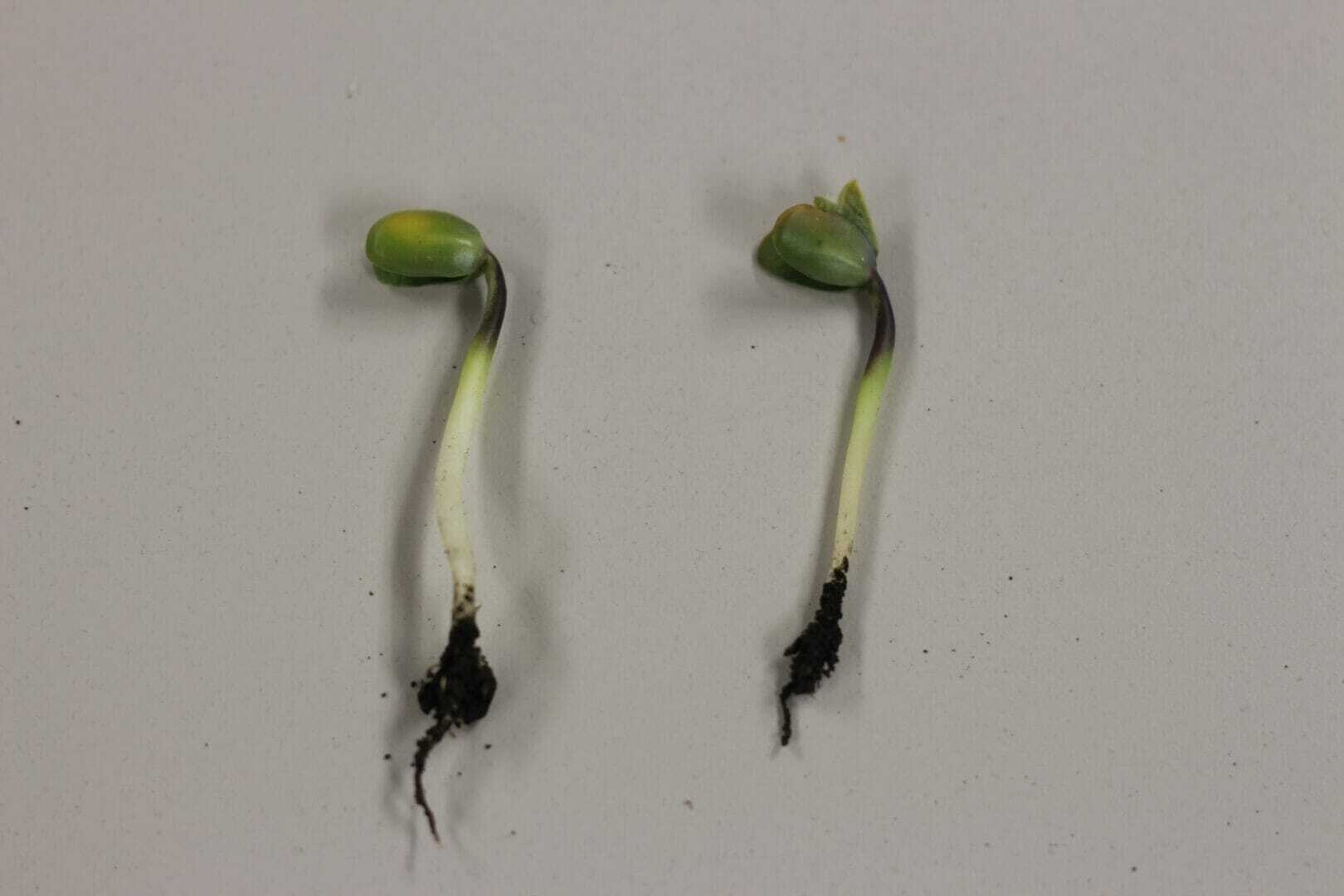
    Corn at V4 damaged from frost event. Above-ground tissue is dead (brown) but the growing point was still below-ground and is alive (white-yellow tissue)

    Young corn plants can tolerate some low temperatures and still survive and achieve high yields.  The growing point of the plant remains under the soil until the plant reaches V5. At this stage, you will see five leaf collars showing around the stem. You may have more leaves visible, so count the collars for accurate assessment of crop stage. Low temperatures that do not fall below 30 degrees generally just damage the exposed leaves and do not hurt the growing point. However, recovery of these plants may take some time (up to a full week) depending on weather after the frost. Below is a photo from the Iowa State University Integrated Crop Management newsletter showing a viable growing point after a frost event.

    Frost Damage Management

    • Wait 3 to 5 days with temps above 70 degrees. Wait even longer with lower temperatures.
    • Assess percentage of damaged plants and survival rate prior to any replant decision.
    • Allow plants to recover prior to any herbicide or fertilizer applications, this may take a week to 10 days.
    • Note the amount of leave tissue lost and how it will affect your crop staging.
    • Loss of two leaves in 4 leaf corn will still be classified as V4. This becomes important for later application of herbicides. Keep the leaf loss in mind when staging corn for later applications to assure you are not past a window that may cause herbicide injury.

    Freeze Damage

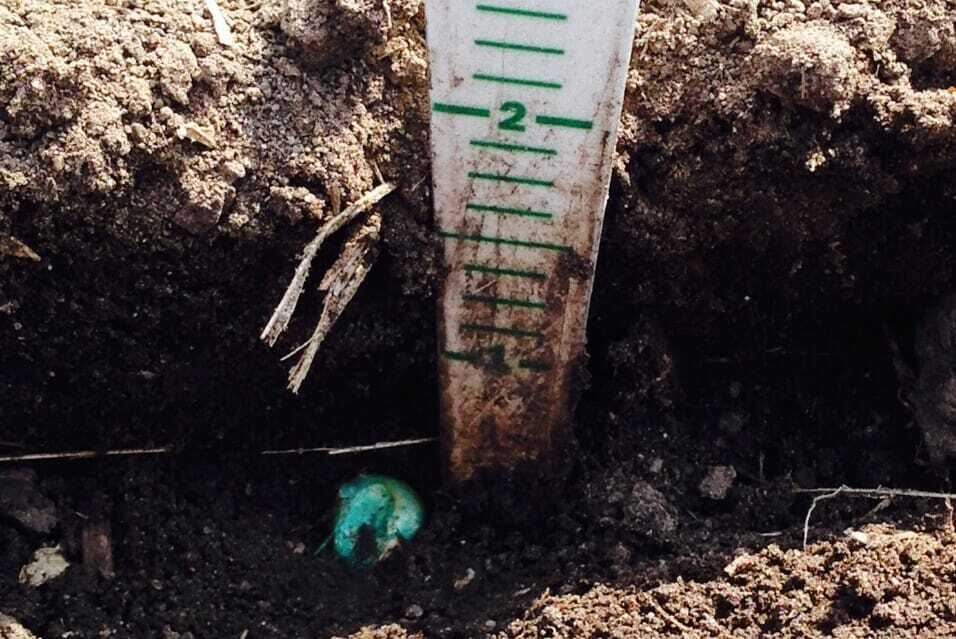
    If you experience low temperatures of 28 degrees or lower for a prolonged period of time, most all the plants in a field will show significant damage. These extended low temperature situations become more critical for assessment. You may see variation across a field due to soil type, soil moisture content or the amount of residue on the field. Corn damaged by a hard freeze will still need patience for assessment.  Assess all fields after hard freezing temperatures, even those that have not emerged yet. Check soil temps at 2” level soon after a freeze for a sound understanding of the scope of damage to a field.

    Freeze Damage Assessment

    • Soil Temps – Check soil temps at 2” level in multiple locations of the damaged field to gain knowledge of how widespread the damage has occurred. This needs to be recorded early.
    • Patience – Wait 3-5 days to allow the full expression of effects of the freeze.
    • Plant Tissue – Slice open young plants and observe the growing point. Brown and water-soaked tissue vs white or green tissue. See earlier photo for viable plant.
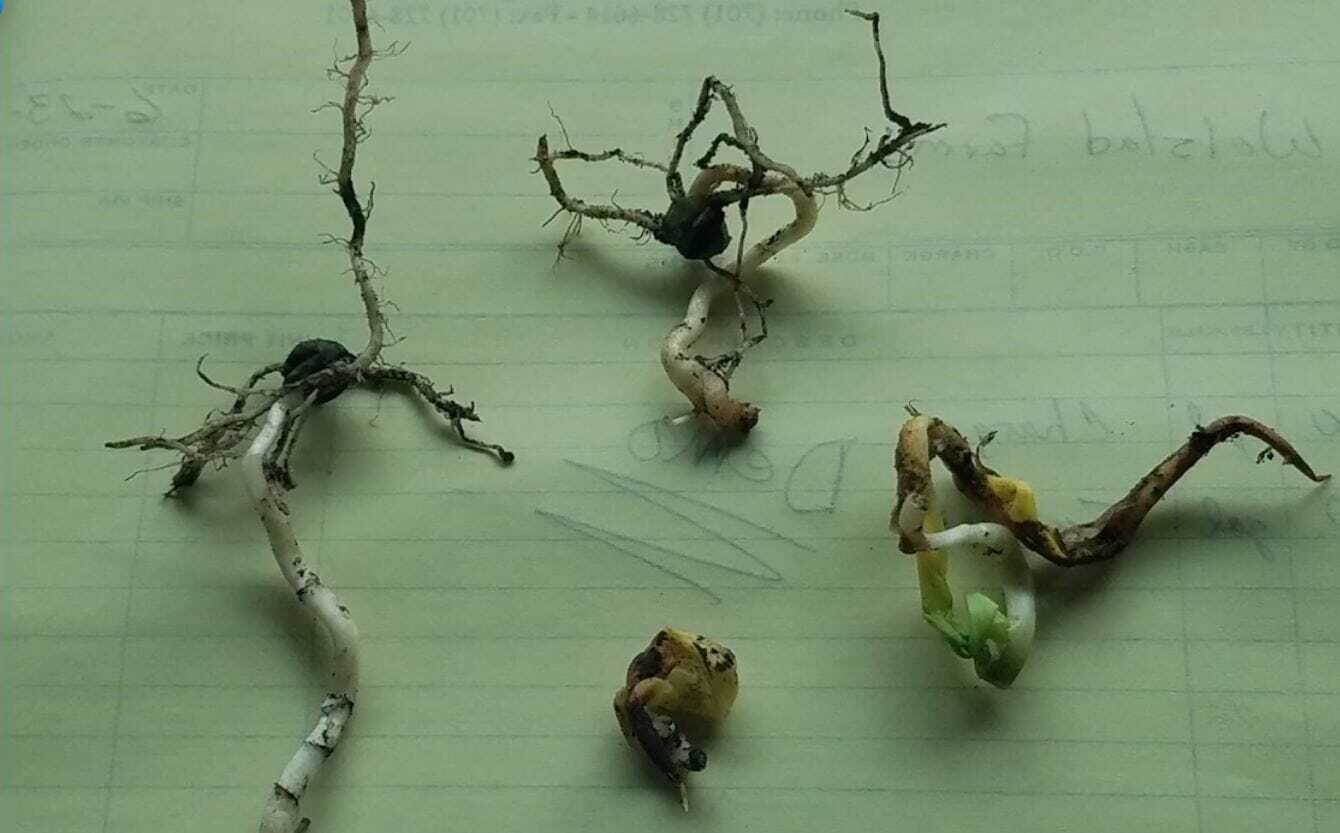
    • Dig Un-emerged Seeds – Hard kernels remain viable while soft/mushy kernels will not germ or have the energy to push the sprout through the soil.

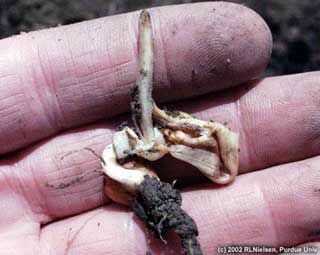
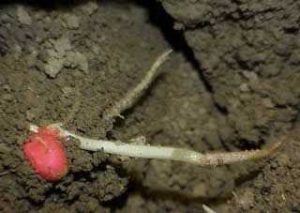
    The photo on the left shows leafing out underground due lack of energy of seedling. The photo on the right shows damage to the coleoptile that will result in shoot not having capacity to push through the soil. Photo courtesy of RL Nielsen, Purdue Univ.

    Picture 2
    Picture 3

    Freeze Damage Management

    • Wait 3 to 5 days with temps above 70 degrees, longer if lower temps.
    • Slice open emerged plants and determine percentage of population damaged.
    • Dig up un-emerged seedlings and kernel assess viability and determine percentage of population damaged.
    • If stand damage is substantial, assess the costs and benefits of leaving the stand versus replanting.

    Patience is key when assessing damage from a frost or freeze event.  If you allow time for the crop to respond to the event, you will make better decisions for that damaged field.

    Latham Seeds Precision Agronomy Advisors

    May 7, 2020
    Agronomics, Corn, Crop, Emergence, Frost, Season, Spring, Weather
  • Latham Hi‑Tech Seeds

    Ask The Agronomist: Herbicide Performance & Dry Conditions

    Sprayer
    How does the lack of rainfall affect your herbicide program? Phil Long discusses the implications of recent dry weather. #AskTheAgronomist
     
    1:15 – Topic introduction
    3:30 – Importance of residual herbicides
    5:20 – Implications of recent dry weather
    9:30 – Herbicide program planning

    Laura Cunningham

    May 7, 2020
    #AskTheAgronomist, Agronomics, Corn, Crop, Soybeans, Weed Control
  • Latham Hi‑Tech Seeds

    #AskTheAgronomist: Planting Depth

    Corn Planting Depth
    It pays to double check seeding depth! Tune in as Phil Long discusses ideal seeding depth for both corn and soybeans. #AskTheAgronomist
     
    :20 – Introduction
    :50 – Topic overview
    1:50 – Corn: Why 2 inches?
    2:00 – Imbibitional phase
    3:13 – Nodal root development
    6:25 – Soybean seeding depth
    7:25 – Soybean seed size
    9:15 – Final thoughts

    Laura Cunningham

    April 23, 2020
    Agronomics, Corn, Crop, Emergence, Season, Soybeans, Spring
  • Latham Hi‑Tech Seeds

    Effects of Early Planting

    Corkscrewing
    Do cool soils affect corn or soybeans more? Tune in as Phil Long discusses how cold temps affect corn and soybeans differently. #LathamSeeds
     
    0:12 — Welcome & topic introduction
    2:00 — Days to emerge
    5:50 — Corn cold injury potential
    8:15 — Soybean cold injury potential
    10:35 — Forecast of opportunity

    Laura Cunningham

    April 16, 2020
    Agronomics, Corn, Crop, Disease, Emergence, Growth Stages, Season, Soybeans, Spring
  • Latham Hi‑Tech Seeds

    Planting Speed Matters

    4.9.20

    Dial in your planter speed this spring season. Phil Long discusses the importance of planter speed in relation to efficiency, singulation and yield potential. #AskTheAgronomist #LathamSeeds

    :30 – Welcome & Topic Introduction
    1:30 – Scenario 1
    2:40 – Efficiency & yield potential
    6:30 – High speed planters
    7:20 – Singulation & speed
    10:05 – Final thoughts

    Laura Cunningham

    April 9, 2020
    Corn, Crop, Season, Spring
  • Latham Hi‑Tech Seeds

    #AskTheAgronomist: Nitrogen Application

    3.26 Ask The Agronomist

    Are you getting the biggest bang for your buck from your nitrogen application? #AskTheAgronomist

    1:06 — Welcome & topic introduction
    2:26 — Nitrogen 4 R’s: right source, right time, right place
    5:30 — Right rate
    9:36 — On-farm research with Data Forward

    Laura Cunningham

    March 26, 2020
    Agronomics, Corn, Crop, Fertility, Season, Spring
  • Latham Hi‑Tech Seeds

    Healthy Soils Lead to Increased Yields

    April May recruitment ad

    April May recruitment adBy Lyle Marcus, Corn Production Manager

    The 2019 growing season left many acres across Latham Country less than optimum for good crop growth and development. Late harvest and saturated soil conditions reduce good soil organisms that help our corn hybrids get off to the best start. Using planter box treatments like Talc USA products offered by Latham Hi‑Tech Seeds can improve your crop’s success in 2020.

    All planter manufacturers recommend some type of planter box additive to aid seed flow and lubricate seed meters. Talc USA’s lineup provides the needed lubrication, plus a yield advantage:

    Talc USA, planter box talc and talc/graphite combo product

    · Premium 200 micron grind product

    · Fortified with .7% iron and .09% manganese

    MicroSurge Inoculant

    · Increases atmospheric nitrogen used by your corn plants

    · Adds Azospirillum organisms to the soil via the seed and enhances root function

    Encompass

    · Contains five microbials that fix nitrogen and mobilize phosphorus

    · Helps with key functions of the corn plant through better uptake of nutrients

    Inceptive

    · Contains the Harpin Protein, which suppresses plant-feeding nematodes

    · Shows yield response even when nematode populations fall below economic threshold

    Latham’s Agronomy team in 2019 showed an increase in yield and plant health at our Alexander research farm TALC USA trial. If you’re looking for opportunities to improve the performance of your crops, find more information on TALC USA products at www.lathamseeds.com.


    Talc USA yield trial handout JPEG

    Webspec Admin

    March 17, 2020
    Corn, Tech Tuesday
  • Latham Hi‑Tech Seeds

    Focus on Achieving Even Emergence for Maximum Yield

    IStock 000018151817Large
    IStock 000018151817Large
    By Darin Chapman, Precision Agronomy Advisor

    The cost of achieving uniform emergence is a complicated one as achieving uniform emergence is dependent upon receiving adequate moisture, heat units and proper seed-to-soil contact.

    If you’ve struggled with achieving uniform emergence, there are three key areas on which to focus. Start at the front of the planter and work your way back:

    1. Look at the row cleaners. Assure the planter is clearing trash as it moves through the field.

    2. Next, check the downforce to make sure that seeds are being placed at a consistent seed depth across your field. Take the time to dig in the trench behind the planter, which is important but often overlooked.

    3. Maintaining consistent seed-to-soil contact and proper closing of the seed trench is vital.

    There are many options to control these aspects at varying levels of cost. Look at your own operation and balance the improvements you desire with the potential return on investment. Below are options to consider for even emergence:

    · Tillage Practices– Prepare an optimal seed bed.

    · Residue Management– Move residue, not topsoil.

    · Planter Row Unit Maintenance– Use an annual planter checklist. (See sidebar below.)

    · Planter Downforce– Look at planter upgrades for the best down and lift force option for your operation. In certain cases, lift force versus downforce is more beneficial.

    · Seed Settlement– Make sure seed is reaching the bottom of trench for seed-to-soil contact.

    · Closing the Trench– Confirm the closing system is doing its job to close the trench; make certain there are no air pockets.

    Non-uniform stands result in lower yields because the smaller plants that emerge later cannot capture enough sunlight. Without even emergence, your work to achieve even seed spacing and singulation is in vain. The extra time spent now on planter maintenance will be worth it come spring planting.

    Contact your Latham Precision Agronomy Advisor to take a deeper look at your operation now. We’re here to help you achieve better emergence.

    8 step checklist

    Latham Seeds Precision Agronomy Advisors

    March 10, 2020
    Agronomics, Corn, Crop, Emergence, Soybeans, Tech Tuesday
  • Latham Hi‑Tech Seeds

    #AskTheAgronomist: Talc USA Benefits

    3.5.20

    Is talc worth it? Phil Long reviews real benefits of our Talc USA line and research from our test at Alexander. #LathamSeeds

    0:40 — Topic Introduction
    1:30 — The importance of talc
    3:10 — Why Talc USA?
    4:30 — Talc study at Latham Seeds
    7:00 — How to incorporate Talc USA products on you farm

    Laura Cunningham

    March 5, 2020
    #AskTheAgronomist, Agronomics, Corn, Crop, Season, Seed Treatment, Soybeans, Spring
  • Latham Hi‑Tech Seeds

    RR2 Xtend® System for 2020

    IMG 8888

    IMG 8888Bayer CropScience has announced a special herbicide program for 2020 to be used on RR2 Xtend soybeans. Called the “Spray Early with Confidence Program,” it is designed to help farmers planting Xtend soybeans to gain an upper hand on weed management. 

    There are two strategies farmers can use to qualify. A brief summary of the program is as follows:

    Strategy #1 (Preferred Option):

    • Start Clean– Use tillage or the appropriate burndown herbicides.
    • Pre-emergence Application– Use a qualifying residual herbicide within two weeks before planting or prior to soybean emergence to control broadleaf weeds.
    • Post-emergence Application– Make a post-application when weeds are less than 4 inches tall and within 30 days after planting soybeans. Application should include: Warrant® Herbicide (3-4 pts) or Warrant Ultra Herbicide (50 fl oz) + Roundup PowerMAX® herbicide or Roundup WeatherMAX® herbicide (32 fl oz) + XtendiMax® herbicide with VaporGrip® Technology (22 fl oz) + an approved drift reduction agent at labeled rate.

    Strategy #2 (Alternative Option):

    • Start Clean– Use tillage or the appropriate burndown herbicides.
    • Pre-emergence Application– Make an application that includes: XtendiMax with VaporGrip Technology (22-44 fl oz) + Warrant Herbicide (3-4 pts) + Metribuzin at planting or as soon as possible after planting but prior to soybean emergence. Include Roundup PowerMAX herbicide or Roundup WeatherMAX herbicide in minimum-till and no-till situations.
    • Post-emergence Application– Make a post-application when weeds are less than 4 inches tall and within 21 days after soybean emergence. Application should include Roundup PowerMAX herbicide or Roundup WeatherMAX herbicide (32 fl oz) + Warrant Ultra Herbicide2 (50 fl oz).

    Before using either of these strategies, farmers will want to consult with their local ag chemical suppliers. If a farmer experiences less than commercially acceptable weed control, Bayer will provide up to $15 per acre for a second post-emerge application.

    We still have a good supply of Xtend soybeans available for 2020 planting! These Latham Ironclad™ Xtend soybeans have the outstanding defensive packages along with top-end yield: L 3197 R2X, L 2887 R2X, L 2682 R2X, L 2384 R2X, L 2184 R2X, L 1948 R2X, L 1769 R2X, L 1482 R2X and L 0739 R2X. 

    Other top-performing Xtend products from Latham include: L 0124 R2X, L 0282 R2X, L 0553 R2X, L 0883 R2X, L 2159 R2X, L 2295 R2X, L 2549 R2X and L 3394 R2X. 

    Tech sheets for each product are available on LathamSeeds. com. Remember, it’s always best to plant a package. Contact your local Latham rep to select the best Xtend soybean for your fields. Selecting seed field-by-field yields!

    Latham Seeds Precision Agronomy Advisors

    March 3, 2020
    Corn, Crop, Soybeans, Spring, Tech Tuesday
Previous Page
1 … 12 13 14 15 16 … 36
Next Page

Latham Hi‑Tech Seeds

131 180th Street | Alexander, IA 50420

(641) 692-3258

SIGNUP FOR OUR NEWSLETTER
  • Contact
  • Legal
  • Dealer Center
  • Seedware Login
  • Latham Gear

© 2025 Latham Hi‑Tech Seeds. All rights reserved. | Iowa Web Design by Webspec | Privacy Policy

Latham® Hi-Tech Seeds is a trademark of M.S. Technologies, L.L.C., 103 Avenue D, West Point, IA 52656.