Latham Hi-Tech Seeds

(641) 692-3258

  • Home
  • Products
    • Corn
    • Soybeans
    • Alfalfa
    • Corn Silage
    • Seed Guide
  • Performance
  • Find a Rep
  • Media
    • Blog
    • News
    • Videos
    • Podcasts
    • TECHTalk
  • About Us
    • Company History
    • Our Mission
    • Careers
    • Become a Rep
    • Sowing Seeds of Hope
  • Contact Us
  • Latham Hi‑Tech Seeds

    Seed Quality: How Long is Germ Viable?

    Trays1

    While perusing some ag chat sites this week, we came across the following questions posted by a Midwest farmer. Today, Latham Product Manager Mark Grundmeier answers the questions that are top-of-mind with farmers.

    Q: How long will seed corn hold its quality/germ? A lot of seed is in warehouses already, and I presumed tested and determined “good quality” before it was shipped. Is it possible that the condition of any of this seed will deteriorate before spring planting?

    A: You’re right in that state and federal guidelines require seed companies to test – and tag – all seed before it ships to dealers and farmers. We must perform germination tests no sooner than December 2012 for spring 2013 delivery/planting.

    The germ on seed corn is quite stable and is largely dependent on heat and moisture. Since it’s unlikely that we’ll experience excessive heat and humidity before this seed corn gets planted, it’s very unlikely that the condition of this seed corn will deteriorate before spring planting.

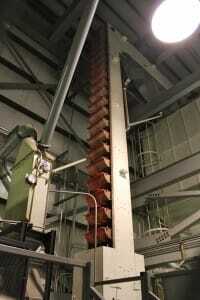
    The trays we use to bring soybeans from the cleaner to the bagging system are so gentle they’re used to make corn flakes!

    On a side note, soybean seed is much more delicate and how it’s handled can greatly impact the germination rate. Extremely dry conditions in 2012 produced seed beans that were drier than optimal when harvested. Because the seed coat is so fragile, rough handling can crack the seed coat and deteriorate the quality. To preserve seed quality, Latham Hi‑Tech Seeds “babies its beans.” The majority of our seed beans are brought to our Alexander, Iowa, facility where it’s hand-tested before its stored on site.

    Our equipment is specially designed to treat the soybean seed as gently as possible. The trays we use to bring soybeans from the cleaner to the bagging system are so gentle they’re identical to those that are used to make corn flakes! We also don’t bag in extremely cold conditions, which can lead to splits and cracks and further reduce the chances of having that seed germinate. But the care doesn’t stop there… dealers and farmers must also handle soybean seed with care. Dropping bags of soybeans can damage the seed coat and lead to a lower germination rate than appears on the bag tag.

    Unlike corn, soybean seed can fall out of quality quite rapidly. Look for the germ rate on the seed tag. Anything above 90 percent indicates high quality soybeans; germ rates of 95% indicate high quality seed corn. If your soybeans are tagged at 80%, seed quality is most likely on a downward spiral. You’ll definitely need to increase your seeding rate to account for lower germination rates. You might even be better off to switch soybean brands.

    Don’t assume that all soybean seed is tagged at the highest quality. Be sure to read the tags on all products that get delivered to your farm.
    Webspec Admin

    February 13, 2013
    Agronomics, Emergence, General
  • Latham Hi‑Tech Seeds

    To Inoculate, or Not to Inoculate?

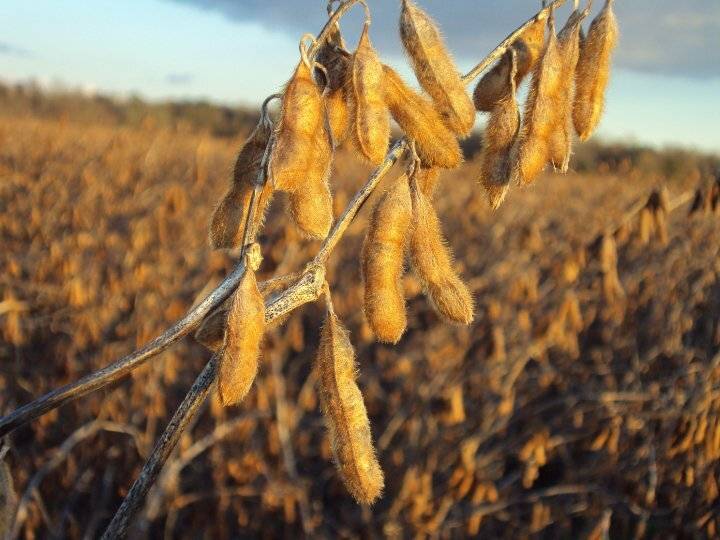
    Soybeans harvest

    With the extremely stressful weather conditions we experienced last year, growers are starting to inquire about using soybean inoculants going into the 2013 planting season. While there is no definitive answer to this question, here are a few tips to keep in mind:

    1. Soybean inoculant is comprised of living bacteria (Bradyrhizobia japonicum), which is necessary for the establishment of the nitrogen nodules on the roots of young soybean plants. Soybeans can require more than 300 pounds of nitrogen per acre and most of it is needed during the initial flowering through seed-set stages. Living organisms do need adequate moisture to thrive.
    2. Inoculate the seed if soybeans haven’t been grown in your field for four or five years. If the field is sandy or in the event of severe weather problems (e.g., flood or drought), you might consider inoculating if the field has not been in soybeans for as little as three years.
    3. Nitrogen is essential to photosynthesis. Nitrogen is usually supplied to soybean plants by a process called nitrogen fixation, which is associated with Rhizobia bacteria in the soil. It’s important to note, however, these bacteria are not always present – especially if soybeans haven’t been grown in a field for a few years. In this case, consider adding an inoculant to your soybean seed.
    4. Scouting your fields and digging up plants to assure proper nodulation is crucial for achieving top-end yields. If you decide to use inoculants in your own fields, be sure to study whether the inoculants benefitted your production levels.
    5. Get to know your local Latham sales representative, who can introduce you to our Seed-2-Soil program. This program helps determine the best varieties to plant in your fields, giving you the best possible chance to achieve high yield.

    Webspec Admin

    January 31, 2013
    Agronomics, Corn, Crop, General, Soybeans
  • Latham Hi‑Tech Seeds

    Seed Selection is Even More Critical in Dry Years

    The Iowa Legislature convened last week, and along with that, came talk that Iowa’s drought law may get a closer look this year.  “Water restrictions” isn’t a typical topic of conversation in the north, but it looks as though it might become commonplace across the Upper Midwest in 2013 if weather patterns don’t change.

    It’s safe to say we’ll be planting the 2013 crop in dry soils.  The 2012 drought caused most soils here to be depleted of moisture in the upper 7 to 8 feet, so it will take at least two growing seasons to recharge those soils.

    Seed selection will certainly be critical for 2013 due to the extremely dry conditions.  That’s why we’re recommending that most of our corn customers plant hybrids at least double- or triple-stack hybrids this spring.

    A hybrid’s genetics will be the biggest factor in whether a hybrid can handle drought.  Plot data shows that multiple-trait stacks, like Latham® hybrids with the Genuity® SmartStax® technology, can really help protect yield.  REMEMBER:  Traits protect yield.  Genetics make yield.  Seed products carrying the Latham brand name combine the industry’s best genetics with the latest traits and technologies.

    While corn genetics have come a long ways over the past decade and are much better at handling drought stress than ever, soybeans historically perform even better in dry weather.  Farmers will need to consider whether they can manage corn-on-corn in another extremely dry year or whether the economics favor soybeans.  Other factors to consider when finalizing your 2013 crop plans are outlined in this recent article posted on agriculture.com: Six Take-Home Lessons from the 2012 Drought.

    Regardless of whether you choose to plant corn, soybeans or alfalfa, Latham has the products you need! Our seed portfolio contains products that were bred specifically to thrive in specific areas of the Upper Midwest. Call your local Latham rep to learn more about the products best suited for your growing conditions, or feel free to call our office directly at 1.877.GO.LATHAM (1.877.465.2842).

    John Latham, President

    January 23, 2013
    Agronomics, Drought, General, Precision Ag, Season, Spring, Weather
  • Latham Hi‑Tech Seeds

    Choosing the “Smartest” Phone for Your Operation

    Ipad31
    Katy Flint

    Guest blog post by Katy Flint, Sales Manager / Team Leader for CellTech

    I was raised on a farm, belong to a Century Family farm, worked in the cooperative system for almost five years, and am married to an agronomist.  Now I’m putting my background and experiences to work at CellTech, a premium Verizon retailer, in Hampton, Iowa.

    I can’t count the number of times I’ve had someone say to me, “I don’t need anything fancy; I’m just a farmer”.  The first thing I think is, “JUST a farmer”?  The second thing that comes to mind is, “What makes a phone fancy?”  Is it a phone that you can only use if you’re in your Sunday best?  🙂

    What if picking a phone or tablet was about choosing something fancy?  Would you be more interested in a new phone if it could make your work easier and perhaps even make farming more profitable?

    I’ve never met a farmer who didn’t want to make more money, so let’s consider how a Smartphone or tablet could do just that!  The first place we typically look at is apps ,or applications.  While there are literally thousands to choose from, here are a few of my favorites:

    • Market Strategies by DTN will keep up-to-date on market prices.  Create a watch list based on the commodities you want to follow and the futures board on which you want to sell.  You can see both the futures and the cash bids around your area – no more having to call the co-op 4 or 5 times a day to see what the markets are doing! Get for your iPhone | Android
    • Accuweather and Weatherbug keep the weather at your fingertips.  You can also plan your day accordingly because these apps use GPS to follow your location. Get WeatherBug for your iPhone | Android. Get Accuweather for your iPhone | Android
    • Monsanto and Precision Planting recently launched a new app that is compatible with your variable rate (VR) planter.  Did you know that 90% of planters sold today have VR capabilities but only about 5% are being used because the people don’t know how to use them?  Simply plug your iPad into your VR planter.  Your planter will adjust as necessary so there isn’t any waste, which means more money in your pocket! Get for your iPhone | Android (not available)

    Technology today has never made it easier to optimize every dollar you spend.  At CellTech, we pride ourselves in being connected with farmers.  We would love an opportunity to show you how technology can help you!

    Team Latham

    December 5, 2012
    Agronomics, General, Precision Ag
  • Latham Hi‑Tech Seeds

    Extension to Host Meetings about Weed Resistance

    Iowa State University Extension, beginning next week, will host a series of meetings about weed resistance. The meetings will provide information about the causes of herbicide-resistant weed populations, as well as weed management programs.

    There is no cost to attend, but advanced registration would be appreciated. Registration at each location opens at 8:30 a.m. with the program beginning at 9 a.m. Each meeting will conclude with a noon meal.

    Meeting Schedule

    • November 20:  Decorah The Oaks Steakhouse
    • December 4:  Ottumwa Bridgeview Center
    • December 18:  Clear Lake – Best Western Holiday Lodge
    • December 19:  Wall Lake Community Center
    • December 20:  Red Oak Red Coach Inn

    Click here for additional information about the program or to register online.

    Team Latham

    November 15, 2012
    Agronomics, General, Weed Control
  • Latham Hi‑Tech Seeds

    Battle Corn Rootworm with Gladiator Hybrids

    RIB logo1

    Managing corn rootworm has become increasingly important as the number of corn-on-corn (c-on-c) acres rises.  University research data confirms the real strategy for dealing with high corn rootworm pressure is to use rootworm-traited genetics in addition to other strategies.

    Yield is often lost in c-on-c situations due to increased pressure from insects and disease, plus issues related to residue management and soil drainage.  Farmers must manage continuous corn acres differently than corn-following-soybeans.

    Helping farmers better manage their c-on-c acres is the reason Latham Hi‑Tech Seeds developed the Gladiator group of products. These products combine the best genetics and traits available in the market today to help farmers maximize yields from corn-on-corn acres.

    Latham Hi‑Tech Seeds’ 2013 product guide features 33 hybrid seed corn products with 6 different trait combinations for rootworm control in various maturities.  Last year we sold out of nearly every bag of our best corn-on-corn products, so order now while supplies last!

    We’re also pleased to offer more refuge-in-a-bag (RIB Complete) options than ever before.  If you order a Latham® Genuity® SmartStax® hybrid, you’ll receive Poncho 500 and VOTiVO for free. This is a $20 per unit value and will only be offered while supplies last!

    Contact your local Latham® representative or call 1-877-GO-LATHAM (1.877.465.2842)

    Choose your region:Iowa- Central and Eastern: Kevin MeyerIowa- North Central: Latham HeadquartersIowa- Northeast: Nick BensonIowa- Northwest: Glenn FullerIowa- Central: Nick ColemanIowa- Western: Bart PetersonIowa- Southwest: Larry KrapflMinnesota- Southeast and Iowa Northeast: Craig HaalandMinnesota- South Central and Iowa- North Central: Ryan OhrtmanMinnesota- Southwest: Greg BrandtNebraska- Eastern: John ToftNorth Dakota- Southeast: Gary GeskeSouth Dakota- Notheast: Scott StadheimSouth Dakota- Southeast: Bill EichackerWisconsin- Southwest: Steve Bailie

    John Latham, President

    November 12, 2012
    Agronomics, Corn, Crop, General, Insects
  • Latham Hi‑Tech Seeds

    Reduce Risk in 2013 with Rotation

    LathamBags

    Recently, I’ve received calls from concerned farmers on a wide range of topics from volunteer corn to weed resistance and corn rootworms. There is no simple solution to these problems, but rotation is one common management practice that can certainly help.

    Consider how rotation can help with these issues:

    1. Herbicide-Resistant Weeds. Resistance to glyphosate-based herbicides (e.g. Roundup®) is due to using herbicides as the only source of weed management. Weed resistance can be significantly slowed down or even averted altogether with careful crop and herbicide use plans. Bring LibertyLink® or conventional soybeans into your rotation. Likewise, when it comes time to plant corn, use conventional or straight LibertyLink hybrids. Using herbicides that have different modes of action is critical.
    2. Volunteer Corn. With careful crop planning and herbicide usage, volunteer corn can be controlled in both corn and soybeans. Several herbicides (e.g. Select, Fusion, Poast Plus, etc.) will take care of volunteer corn in soybean fields, but persistence is key as more than one application may be needed.Volunteer corn in continuous corn situations can be managed by understanding the herbicide tolerances of the traits involved. For example, most Monsanto-traited hybrids contain only the glyphosate-resistant trait for herbicide use. If you plant corn following one of those hybrids, choose a hybrid that incorporates the LibertyLink trait. If you plan to have many years of continuous corn, stay away from hybrids that contain both the LibertyLink and the glyphosate gene for herbicide resistance. Rotating to soybeans or alfalfa also can help break that cycle.
    3. Corn Rootworm. Continued use of the same rootworm resistant (Bt) trait in corn hybrids, coupled with the lack of required refuge acres, has caused rootworm resistance to become an issue. Rotation is key. Rotate traits between Monsanto, Agrisure and Dow products. They may also need to rotate to other crops (like soybean or alfalfa) if rootworms cannot be managed by rotating traits. Additionally, the use of hybrids with more than one rootworm trait (e.g. SmartStax) may need to be used. Refuge acres must be planted, and Refuge-In-the-Bag (RIB) hybrids make compliance simple. Respect the refuge® and it will greatly increase our likelihood of keeping rootworm traits viable for years to come.

    * Respect the refuge is a registered trademark of the National Corn Growers Association

    Webspec Admin

    November 8, 2012
    Agronomics, Corn, Crop, Disease, General, Soybeans, Weed Control
  • Latham Hi‑Tech Seeds

    O + D = W

    2012homecominglogo

    It’s that time of year when communities show their hometown pride by turning ot for Friday night football games.  Saturday I’ll be heading to Ames, Iowa, where I’ll be celebrating Iowa State’s 100th Homecoming – and hopefully a Cyclone victory.  Whether or not ISU gets the “W” will depend on how well they play as a team – on both sides of the fields.

    Regardless of how good a particular football team is, I’m sure you’ll agree that it can’t win on the gridiron by having only a strong offense or a strong defense. It takes both!

    The same is true whether you’re planting in a corn field or a soybean field.  Remember to plant a minimum or four different seed numbers, with a mixture of offensive and defensive traits.  You also want to make you have a mix of maturities to further reduce your risk.

    As you finalize your seed purchases for 2013, remember:

    1. Diversify your crop plan.
    2. Protect 2013 Yields with Traits.  NOTE:  Not all traited products are created equal.
    3. Respect the refuge.
    4. Plant the right trait for your situation.

    John Latham, President

    October 25, 2012
    Agronomics, Corn, Crop, Soybeans
  • Latham Hi‑Tech Seeds

    Charcoal Rot in Soybeans

    As if yield losses to dry weather stress weren’t enough, the drought of 2012 has brought another problem to the forefront of soybean producers in the Upper Midwest – Charcoal Rot. Also known as dry weather wilt, this is a soil-borne root and stem disease that usually develops in mid-to-late summer when plants are under severe heat and drought stress. Not since 2003 has there been an outbreak of this disease that had a major impact on yields and the effect on this year’s crop could be the worst in recent memory.

    Spores overwinter in plant tissue and can survive for several years in dry soil. Infected plants often appear yellow, wilted and stunted. These symptoms are very similar to other yield-robbing problems that farmers experience in our growing region, so they may go unnoticed or could be attributed to other pests like Soybean Cyst Nematode (SCN), Brown Stem Rot, Sudden Death Syndrome or even Iron Chlorosis. One fairly easy method of identification is to dig up soybean roots and take a knife to gently scrape off the epidermis (outer layer) of the root. Gray-colored lines or striations present throughout the root tissue are an indication of Charcoal Rot.

    There are no viable methods to manage this disease other than to do your best to insure ample moisture for your crop throughout the growing season. Anything that reduces soil moisture, including unnecessary tillage passes or excessive tillage, will add to the impact of the disease. There is no known varietal resistance available on the market today, however, there are some soybean cultivars that show tolerance to Charcoal Rot. Contact me or your local Latham® representative for more information.

    Webspec Admin

    October 8, 2012
    Agronomics, Crop, Disease, Fungicide, General, Soybeans
  • Latham Hi‑Tech Seeds

    Till Less for More Water in 2013

    Graph1

    guest blog post by Mark Licht, ISU Extension and Outreach

    Current weather pattern trends are causing some concern that moisture reserves will be depleted for the 2013 crop.  While we can’t control the weather, we can help manage soil moisture reserves by reducing tillage.

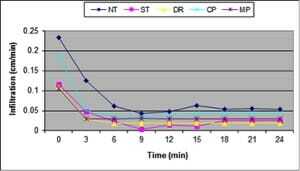
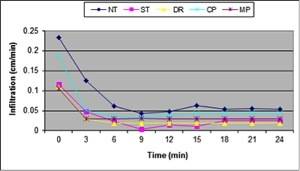
    Reducing fall tillage will help conserve soil moisture as each tillage pass can lead to ¾ of an inch of plant available water.  Tillage reduces water infiltration by breaking large pores, and the small pores are clogged by the dislocation of soil particles.  Raindrops break the soil aggregates, which clog soil pores leading to slow water infiltration and increases surface runoff.  Additionally, subsequent rains result in more runoff because of potential soil crusting.  Research has shown a significant decrease in water infiltration rate as the intensity of tillage increased as shown in the figure below.

    Figure 1. Water infiltration with five different tillage systems. NT=No-till, ST=Strip-tillage, DR=Deep Rip, CP=Chisel Plow and MP=Moldboard Plow. (Al-Kaisi, 2011). Note that strip-tillage infiltration rates were taken in the tilled zone.

    Three reasons why farmers should consider avoiding fall tillage this year include:

    1. Crop residue moderates soil temperature, leading to less soil moisture evaporation.
    2. Residue helps reduce the amount of wind at the soil surface, which helps further reduce soil moisture evaporation.
    3. Soil compaction due to equipment traffic was minimal due to dry conditions from planting through harvest 2012.

    There is no reason to allocate time and fuel for deep tillage; the normal freeze/thaw cycles should alleviate any mild compaction that resulted.

    Another benefit of leaving standing corn residue is that it can help catch snow that would otherwise blow across the surface and pile up somewhere else.  Eight to 16 inch corn stalks hold more snow than bare soil.  Additionally, corn stalks will help reduce runoff and increase infiltration of snow melt in the spring.  This could mean another 1 or 2 inches of soil moisture next spring.

    A final reason to forego tillage this fall is because Goss’s Wilt was not a large concern in 2012.  Goss’s Wilt survives the winter on corn residue, but because there was minimal presence this year, there is no need for tillage this fall to further reduce risk in 2013.

    Team Latham

    October 4, 2012
    Agronomics, Drought, General, Soil, Weather
Previous Page
1 … 52 53 54 55 56 … 67
Next Page

Latham Hi‑Tech Seeds

131 180th Street | Alexander, IA 50420

(641) 692-3258

SIGNUP FOR OUR NEWSLETTER
  • Contact
  • Legal
  • Dealer Center
  • Seedware Login
  • Latham Gear

© 2025 Latham Hi‑Tech Seeds. All rights reserved. | Iowa Web Design by Webspec | Privacy Policy

Latham® Hi-Tech Seeds is a trademark of M.S. Technologies, L.L.C., 103 Avenue D, West Point, IA 52656.