
Latham Hi-Tech Seeds

(641) 692-3258

  • Home
  • Products
    • Corn
    • Soybeans
    • Alfalfa
    • Corn Silage
    • Seed Guide
  • Performance
  • Find a Rep
  • Media
    • Blog
    • News
    • Videos
    • Podcasts
    • TECHTalk
  • About Us
    • Company History
    • Our Mission
    • Careers
    • Become a Rep
    • Sowing Seeds of Hope
  • Contact Us
  • Latham Hi‑Tech Seeds

    Till Less for More Water in 2013

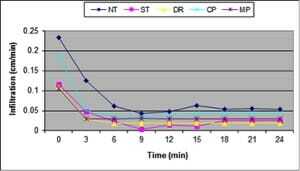
    Graph1

    guest blog post by Mark Licht, ISU Extension and Outreach

    Current weather pattern trends are causing some concern that moisture reserves will be depleted for the 2013 crop.  While we can’t control the weather, we can help manage soil moisture reserves by reducing tillage.

    Reducing fall tillage will help conserve soil moisture as each tillage pass can lead to ¾ of an inch of plant available water.  Tillage reduces water infiltration by breaking large pores, and the small pores are clogged by the dislocation of soil particles.  Raindrops break the soil aggregates, which clog soil pores leading to slow water infiltration and increases surface runoff.  Additionally, subsequent rains result in more runoff because of potential soil crusting.  Research has shown a significant decrease in water infiltration rate as the intensity of tillage increased as shown in the figure below.
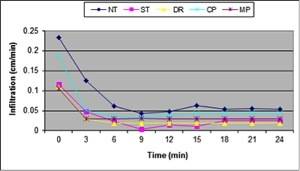
    Figure 1. Water infiltration with five different tillage systems. NT=No-till, ST=Strip-tillage, DR=Deep Rip, CP=Chisel Plow and MP=Moldboard Plow. (Al-Kaisi, 2011). Note that strip-tillage infiltration rates were taken in the tilled zone.

    Three reasons why farmers should consider avoiding fall tillage this year include:

    1. Crop residue moderates soil temperature, leading to less soil moisture evaporation.
    2. Residue helps reduce the amount of wind at the soil surface, which helps further reduce soil moisture evaporation.
    3. Soil compaction due to equipment traffic was minimal due to dry conditions from planting through harvest 2012.

    There is no reason to allocate time and fuel for deep tillage; the normal freeze/thaw cycles should alleviate any mild compaction that resulted.

    Another benefit of leaving standing corn residue is that it can help catch snow that would otherwise blow across the surface and pile up somewhere else.  Eight to 16 inch corn stalks hold more snow than bare soil.  Additionally, corn stalks will help reduce runoff and increase infiltration of snow melt in the spring.  This could mean another 1 or 2 inches of soil moisture next spring.

    A final reason to forego tillage this fall is because Goss’s Wilt was not a large concern in 2012.  Goss’s Wilt survives the winter on corn residue, but because there was minimal presence this year, there is no need for tillage this fall to further reduce risk in 2013.
    Team Latham

    October 4, 2012
    Agronomics, Drought, General, Soil, Weather
  • Latham Hi‑Tech Seeds

    Best Management Practices for Drought

    LathamBags

    Dry growing conditions in 2012 are prompting questions this fall about soil fertility, herbicide carryover and seed product selection. Implementing best management practices this fall will help reduce stress for crops next spring.

    Conserve Soil Moisture
    When soils are dry, farmers must conserve remaining moisture. This may mean holding off on disking and cultivating, so as not to let moisture escape in the process. Keeping the harvested crop’s residue on the ground’s surface also will help conserve soil moisture.

    Test for Herbicide Carryover
    Herbicide breakdown may be slowed greatly in drought conditions. The best time to test for carryover is between late October and mid-November. By this time, soil temperatures remain below 50° F – a point at which herbicide breakdown is minimal. If you take residue samples before this time, herbicide levels could be greater than those that will be present at the time of 2013 planting.

    Select Seed Products
    Since dry conditions could increase the chances of herbicide carryover, farmers may want to select seed for 2013 with greater tolerance to the herbicide used during the 2012 drought year. Another option might be to alter your crop rotation to avoid planting a crop susceptible to the herbicide used.

    Whether you want to plant corn, soybeans or alfalfa – Genuity® Roundup Ready 2 Yield® or LiberyLink®, SmartStax® RIB Complete, Herculex® XTRA or Agrisure® GT – Latham Hi‑Tech Seeds has the products and our trait packages to fit your needs. Call your local Latham® rep or 1-877-GO-LATHAM (1-877-465-2842). The time is now to plan for the 2013 growing season!

    Webspec Admin

    August 30, 2012
    Agronomics, Drought, General, Weather
  • Latham Hi‑Tech Seeds

    Adjust Combines for Drought Conditions

    It’s going to be an early harvest – perhaps three to four weeks earlier than “normal.” As we posted in our Aug. 15 crop report, crop conditions are well ahead of the 5-year average with 94% of the corn crop already at the milk stage and 80% at dough stage. Third crop alfalfa is one month ahead of schedule.

    That means the time is now to prepare for harvest! Harvest, for both and soybeans, typically begins in the Midwest between Sept. 17-27. Soybean harvest is usually finished by Halloween. Corn harvest is most active Oct. 5 through Nov. 10 and usually ends before Thanksgiving.

    It’s certainly not going to be “harvest as usual” this fall. Harvest will begin sooner and most likely progress slower. With weak and/or lodged stalks and stems, slower combine travel speeds will help ensure the crop feeds into the combine as easily as possible. Finding the correct travel speed to balance machine field with crop quality requires checking both losses behind the combine and grain quality in the tank, says Iowa State University’s Mark Hanna with the Department of Agricultural and Biosystems Engineering.

    Be sure to adjust combine settings for drought conditions. The gap between snapping plates above the stalk rolls on a corn head should be adjusted this year. In normal years, a gap of 1.25 inches is used. Given the situation this year, however, that gap most likely should be narrowed to just over an inch to avoid butt shelling of smaller diameter ears. The use of a reel, cones or divider modifications on the corn head may also help pick up more of the lodged corn.

    To help reduce the amount of lodged corn at harvest time, assess crop progress now and identify potential problem areas. Focus first on harvesting fields that show signs of Stalk Rot or exhibit weakened stalks that could subsequently lead to Stalk Lodging. Secondary concerns include hybrid maturity, crop residue management and logistics.

    Prepare now for a safe and fruitful harvest!

    Webspec Admin

    August 16, 2012
    Drought, Fall, General, Season, Weather
  • Latham Hi‑Tech Seeds

    Genetic Garden Shows How Different Types of Corn React to Drought

    Genetic Garden Shows Drought Stress1

    by Rachel Norby, Seed-2-Soil® Summer Intern

    As you drive through the countryside, it’s evident that different corn hybrids are handling the drought stress differently.  Some hybrids have stronger roots and stalks, so they’re holding up better in these dry conditions.  Other hybrids have weaker stalks and are lodging.

    Latham Hi‑Tech Seeds’ Genetic Garden shows how corn from many different eras is reacting to the drought conditions.  You can see how much better today’s hybrids can withstand the high heat and low moisture than their early ancestors.

    Genetic Garden Shows Drought Stress

    Although minimal irrigation was used to keep our “living museum of corn” alive for the Latham Country Fair on August 25, many varieties still reacted to the drought.  You’ll see lodging in many early varieties.  (NOTE:  “Early” is being used here to reference the chronological history corn of varieties, not as in the relative maturity of hybrids.)

    Open-pollinated corn varieties grown during the Dust Bowl of the 1930s didn’t pollinate then, and you’ll see the same thing happened in our Genetic Garden.  A corn variety found in the Genetic Garden from around the time of the 1988 drought is also showing signs of stress.  One of the differences in the droughts of 1988 and 2012, however, is there was less rainfall during the months of April to June in 1988 than we received in 2012.  This lack of rain during that quarter of the year meant more stress on crops during early season growth compared to this year when the majority of the stress happened around the time of pollination.

    We’d like to invite you to see the differences for yourself!  Take a walk through our “living museum of corn” on Saturday, Aug. 25, during the Latham Country Fair.  We’ll be hosting tours between 9 a.m. and 3 p.m.

    Gary Geske

    August 13, 2012
    Agronomics, Corn, Crop, Drought, General, Industry News, Seed Technology, Weather
  • Latham Hi‑Tech Seeds

    Soybean Wind Damage

    Recent strong wind events have also taken their toll on soybean seedlings. Shown below is damage post-storm. While it may appear to be bean leaf beetle feeding, it is in fact wind damage. No course of action is needed at this time, but farmers should be vigilant is scouting for potential disease invasion later on in the growing season.

    Webspec Admin

    May 29, 2012
    Crop, General, Season, Soybeans, Weather
  • Latham Hi‑Tech Seeds

    Aid in the Recovery of Flood-Damaged Fields

    Flood waters that raged through the Missouri River Basin in 2011 will create a slippery road ahead for many Midwest farmers in 2012.  About 150,000 acres of crops were lost in Iowa and an estimated 2 million acres of crops were lost in the Dakotas and Ohio.

    About 60% to 70% of farmland in northwest North Dakota and parts of northeast South Dakota never got planted last year between wet pockets and flooding, says Gary Geske, Latham Hi‑Tech Hybrids’ corn product specialist for the north region.  In the February issue of Midwest Producer, Geske said cropland that was flooded in the previous season needs special considerations during the upcoming growing season.

    All crops need N, P and K, but Geske says flood-damaged fields have even more need for fertilizer.  Micronutrients are like vitamins for the crop to keep it healthy in these types of soils.

    Another way to help rebuild soils and to help flooded fields recover is by seeding cover crops this spring.  According to an article posted yesterday by Integrated Crop Management NEWS, cover crops can also benefit flood-damage soils in several ways:

    • Residue from the cover crop will help reduce soil erosion and crusting.
    • The upright cover crop residue will keep wind and sun off the soil surface, reducing wind erosion, sandblasting, and soil water evaporation.
    • Growing roots of the cover crop will help feed the soil biological life.

    For more information about crop selection, seeding rates and methods, click here.

    Team Latham

    February 9, 2012
    Flooding, General, Weather
  • Latham Hi‑Tech Seeds

    Do Dry Soils at Planting Lead to Yield Loss?

    It’s likely that Midwest farmers could complete spring 2012 planting at a record pace after a dry fall and winter.

    To help determine the impact of dry soils at planting, Iowa State University’s Roger Elmore has employed a hybrid-maize modeling tool.  Elmore, a professor of agronomy with research and extension responsibilities in corn production, says he varied soil moisture conditions at planting to simulate different possibilities.  Overall, his simulations show that yields will be reduced at many of ISU’s research locations if soil moisture conditions do not improve by planting time.

    Every area is different, however.  Subsoil moisture levels certainly vary across Latham’s six-state marketing area.  Gary Geske of Enderlin, North Dakota, serves as Latham Hi‑Tech Seeds’ corn product specialist for the north.  In a recent issue of Midwest Producer he said, “We’ve got dry topsoil, but it seems dry because we are used to it being so wet.  With a couple of timely spring rains, I’m anticipating a good growing season.”

    Dry soils are welcome while the planters are rolling, but spring rains will be needed once the seed is in the ground for timely emergence, growth and ultimately yield.

    Webspec Admin

    February 8, 2012
    Drought, General, Season, Spring, Weather
  • Latham Hi‑Tech Seeds

    Management Options for Previously Flooded Soils

    Farmers generally put away their harvesting equipment and complete fall tillage, and then turn their attention to planning for the next growing season.  Late fall is typically when most farmers plan what they’ll plant and where.  However, extra consideration needs to be given to farmland was flooded in 2011 before the spring 2012 planting season begins.

    Iowa State University’s Mahdi Al-Kaisi, in the November 7th issue of Integrated Crop Management News, offers management considerations for farmers whose soils were affected by the Floods of 2011.

    “Farmland in western Iowa and eastern Nebraska affected by flooding early this year and not planted to any crop has potential economic and soil environmental consequences if the soils are left unattended,” writes Dr. Al-Kaisi.  “Long-term damage to soil in areas of significant flooding need to be considered when planning for next season’s crop.”

    Al-Kaisi says these aspects should particularly be managed for previously flooded soil:

    • Land Leveling and Sand Cleaning
    • Soil Testing
    • Cover Crop

    For more information about each of these management aspects, click here to download Al-Kaisi’s entire article on “Management Considerations for Post Flooding Soils.”

    Team Latham

    November 8, 2011
    Flooding, General, Weather
  • Latham Hi‑Tech Seeds

    "Tipping Back" is a Sign of Heat Stress

    Farmers across the state are starting to see “tipping back,” where kernels aren’t filling all the way to the end of an ear of corn.  In this video report, Latham’s Corn Product Specialist explains why high temperatures for prolonged periods during key corn developmental stages have attributed to the amount of tipping back that’s evident this season.

    Stress can result in tipping back, agrees Iowa State University (ISU) Extension Corn Agronomist Roger Elmore.  Kernels may not have pollinated in the first place or pollinated kernels may have been aborted around milk stage or blister stage.  For more information on what causes tipping back, click here to read a related Wallaces Farmer article.  To read how tipping back affected yields in 2010, click here.

    Night-time temperatures after silking greatly impact yield.  Cool night-time temperatures after silking in 2009 resulted in the highest average statewide corn yield ever recorded in Iowa.  On the contrary, warm night-time temperatures contributed to lost yield in 2010.

    [youtube]http://www.youtube.com/watch?v=4sJ1aRzFLTU&feature=channel_video_title[/youtube]

    Team Latham

    August 9, 2011
    Agronomics, Corn, Crop, Disease, Drought, General, Weather
  • Latham Hi‑Tech Seeds

    Determining Hail Injury

    Hail damage on Bohman farm, Franklin County Iowa

    Heat units were finally accumulating and the 2011 crop was just catching up when Mother Nature issued yet another challenge to Midwest farmers: strong winds, pounding rains and hail.  The good news is experts say that late planting dates and could work to our advantage this season.

    “The growing point in the corn plant is still underground for corn plants at the V6 stage of growth (sixth leaf stage) and younger,” says Roger Elmore, Iowa State University Extension agronomist, in a recent Wallaces Farmer article.  Plus, adequate moisture combined with the short-term weather forecast for warm and sunny weather should encourage rapid and healthy regrowth.

    Reports from our Seed-2-Soil intern, Tanner Bohman, indicate his family’s farm located

    Bohman soybean field in Franklin County, Iowa: Post-Hail

    in Franklin County, Iowa was hit hard by hail this past week.  He commented that the majority of corn plants had growing points above the soil surface and stand counts were reduced by 5,000 to 8,000 plants per acre.

    More information on hail damage and other corn management issues is available from the ISU Extension Corn Production Website. Photos of damaged corn can be found in the “Image Gallery” under “Crop Diagnostics.”

    Additional online resources to determine growth stages, estimate the yield loss and remedial actions are listed below:

    • Hail on Corn
    • Evaluating Hail Damage to Corn
    • Assessing Hail Injury in Corn
    • Hail Injury on Corn
    • Assessing Corn Stands for Replant
    • Replant Checklist
    • Fungicide Treatments for Hail Damaged Corn

    Gary Geske

    June 16, 2011
    General, Hail, Weather
Previous Page
1 … 3 4 5 6
Next Page

Latham Hi‑Tech Seeds

131 180th Street | Alexander, IA 50420

(641) 692-3258

SIGNUP FOR OUR NEWSLETTER
  • Contact
  • Legal
  • Dealer Center
  • Seedware Login
  • Latham Gear

© 2025 Latham Hi‑Tech Seeds. All rights reserved. | Iowa Web Design by Webspec | Privacy Policy

Latham® Hi-Tech Seeds is a trademark of M.S. Technologies, L.L.C., 103 Avenue D, West Point, IA 52656.