Latham Hi-Tech Seeds

(641) 692-3258

  • Home
  • Products
    • Corn
    • Soybeans
    • Alfalfa
    • Corn Silage
    • Seed Guide
  • Performance
  • Find a Rep
  • Media
    • Blog
    • News
    • Videos
    • Podcasts
    • TECHTalk
  • About Us
    • Company History
    • Our Mission
    • Careers
    • Become a Rep
    • Sowing Seeds of Hope
  • Contact Us
  • Latham Hi‑Tech Seeds

    Latham® Dealership Helps Bring Next Generation Home

    Bergquist

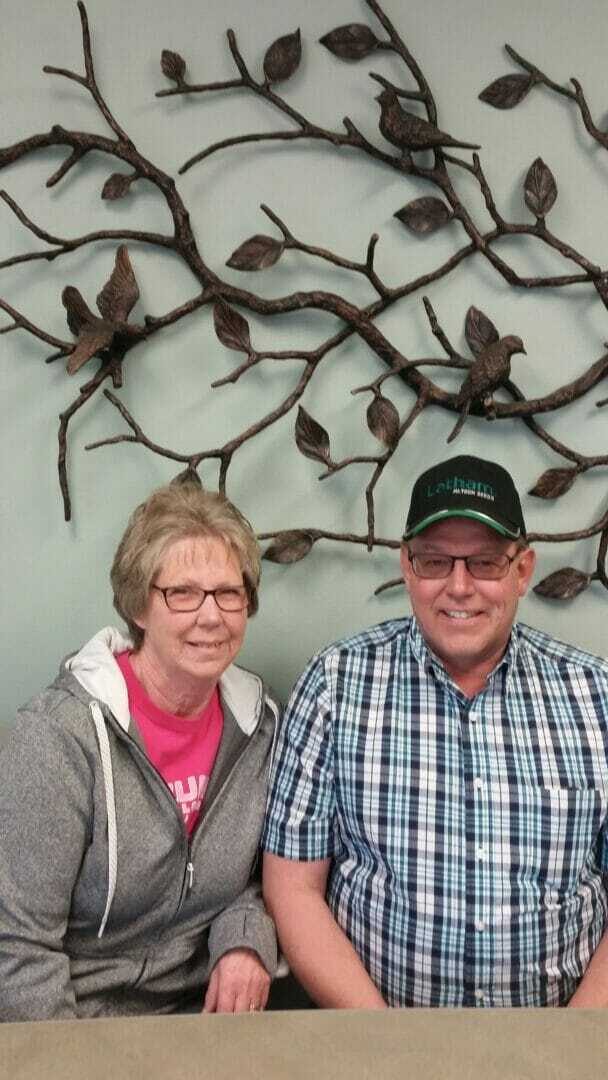
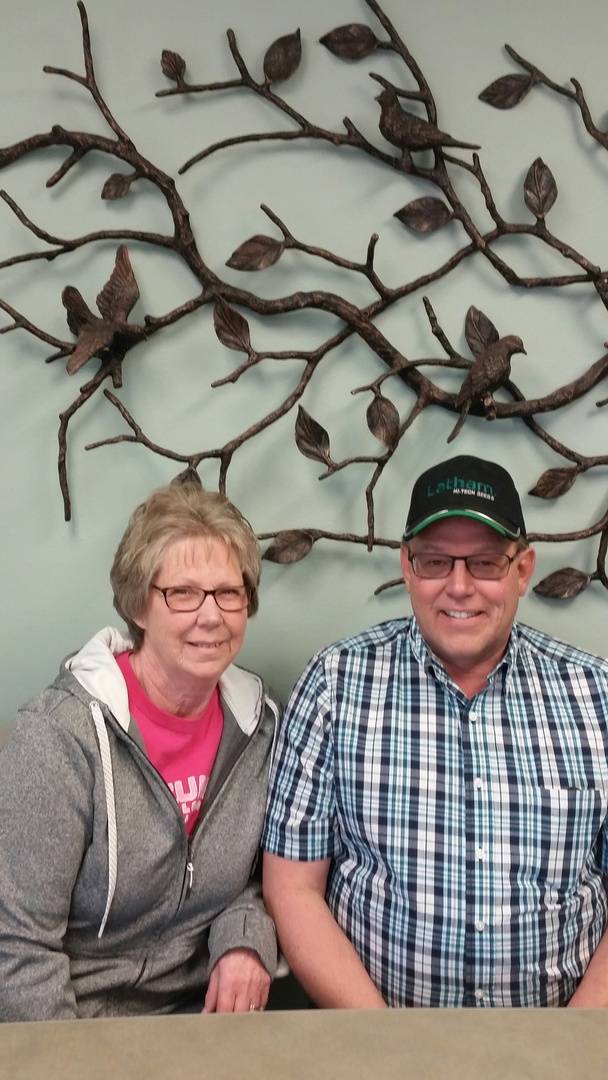
    They had never before planted Latham® Hi‑Tech Seeds but that didn’t prevent Mike and Patty Bergquist of Foxhome, Minnesota, from taking on a dealership when asked.

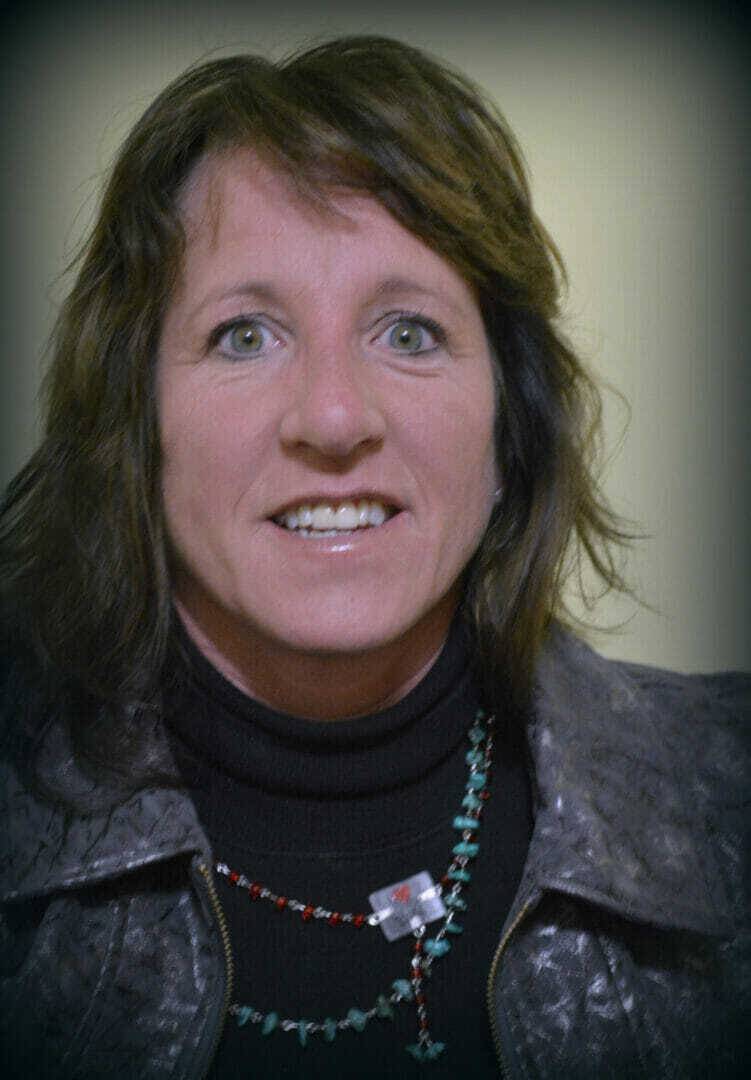
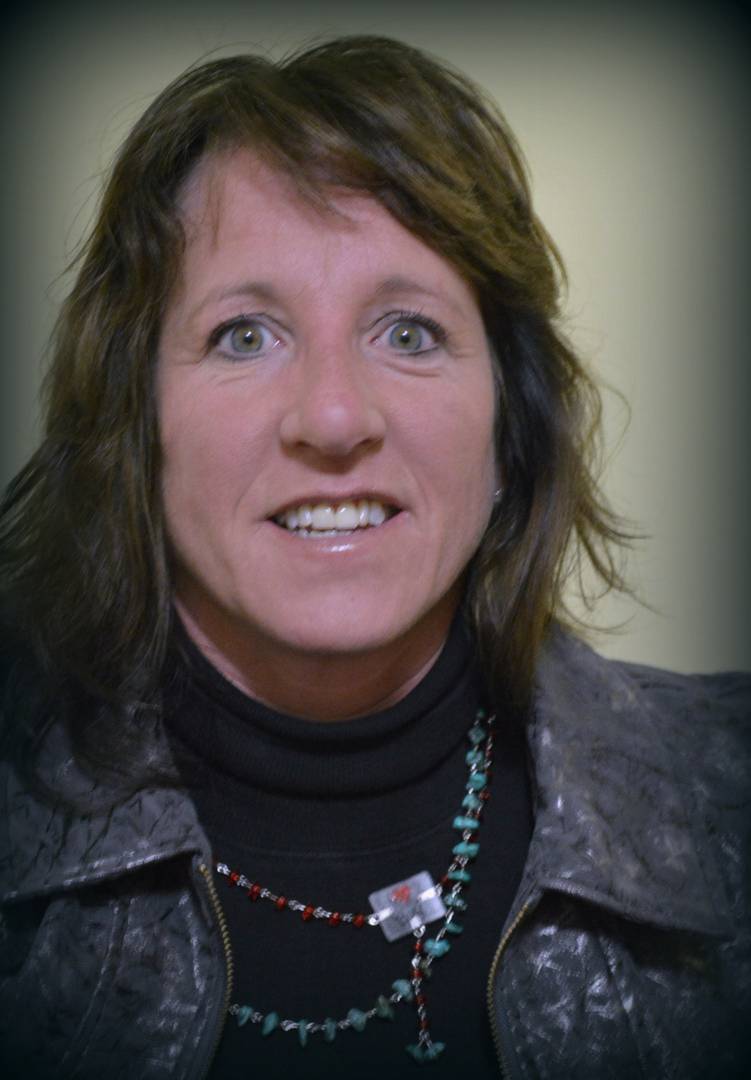
    Mike and Patty Bergquist
    Mike and Patty Bergquist

    “We were looking for a way to bring our son, David, home and this ‘solution’ seemed to present itself,” said Mike. “You might say opportunity knocked when your sales manager came to our door that day and talked with us about Latham Seeds.”

    They weren’t able to get the soybean brand they were accustomed to planting, so the Bergquists decided to try Latham Hi‑Tech Soybeans. They also put Latham® corn to the test, and Latham Hi‑Tech Hybrids topped their on-farm yield test. He was sold on the Latham performance!

    No one in their area had a Latham® dealership, so Mike said his family liked the idea of offering something others didn’t have. He said that national companies have several dealers in the area, but he really liked the idea of working with a family-owned company that shares similar values.

    Mike served for three years in the U.S. Navy and then returned home and helped his step-grandfather, Harold, farm. To supplement his income, Mike started working campaigns in 1975 at the local sugar beet processing plant. He worked at the plant whenever Harold didn’t need him in the field.

    When Mike and his wife, Patty, were married in 1977, Harold offered to let them move a trailer house onto the farm. They appreciated that opportunity to live on the farm where they could begin a family. Four years later their first child was born, and Mike had to choose between accepting a promotion at the beet plant or farming full time with Harold. He chose farming, but it wasn’t long before their situation changed.

    Harold passed away in 1985. The 1980s Farm Crisis made it challenging for a young couple to support a growing family, so in 1988, this father of five went back to working campaigns at the beet plant. Mike accepted a full time position there in 1989, and today he serves as a plant supervisor. Because Mike only get weekends off once every four years, it helps to have David involved with the farming operation.

    David, the Bergquist’s youngest child and only son, completed the John Deere program at North Dakota State College of Science (NDSCS) in Wahpeton. He has been at RDO Equipment for two years as a John Deere technician. He’s been dating Chloe Bergman since they were freshman in high school, and she’s studying to become a dental hygienist.

    Their oldest daughter, Kari, and her husband, Tim Marquardt, have 3 kids. Their son Hunter is 8 and Hudson is 4. Their daughter Hadley is 6. Kari works as a school cook and Tim works at the co-op. Their daughter Heidi has two fur babies: Harley is a Black Lab and Buster is a mix that she rescued. She works as house manager for West Central Community Services.

    Third in birth order is Katie. She is a daycare provider and her husband, Derrick Wolter, is an engineer for Willrich. They’re the proud parents of two sons, 3-year-old Dawson and 8-month-old Carsten.

    Daughter Holly is a nanny. Her husband, Travis Rogahn, is a John Deere technician plus he farms. They have two son, 4-year-old Michael and 6-month-old Bennett.

    Berquist famIn their free time, the Bergquist family enjoys camping. It’s something they enjoyed doing when their kids were young. Now it’s something the three generations enjoy doing together.

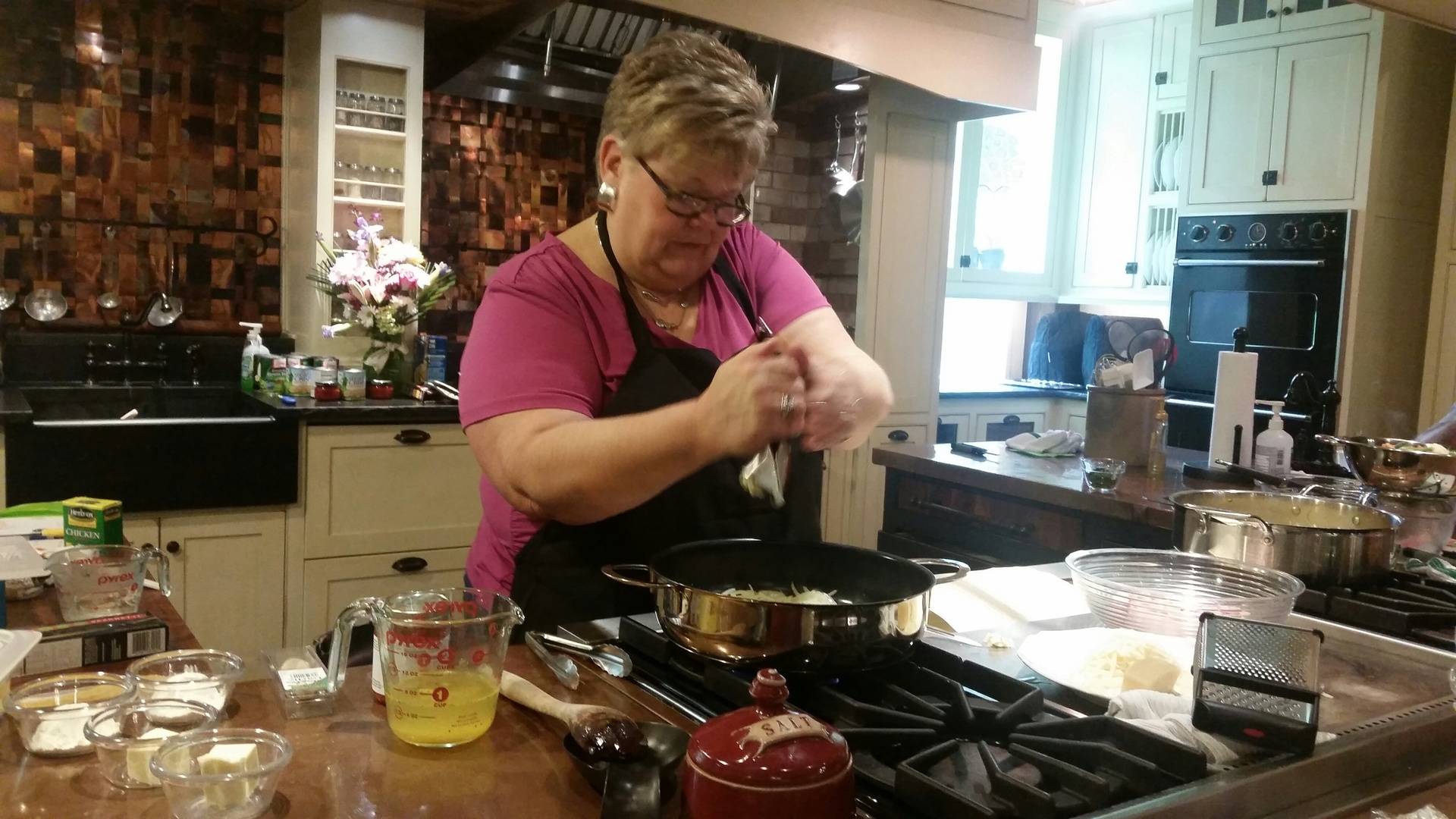
    When everyone gets together for camping, Patty keeps the menu simple. A family favorite is Tequilaberry Salad, which she’s sharing with us today.

    Team Latham

    April 17, 2015
    General, Recipes, Sides
  • Latham Hi‑Tech Seeds

    Lifting Spirits with Blue Ribbon Baking

    Pie bakers

    Author and pie baker extraordinaire Beth Howard was right when she said you can create peace with a piece of pie. It’s been six weeks since we lost Amy Hild, a valued member of Latham Hi‑Tech Seeds’ marketing team, in a tragic automobile accident. It’s hard to feel like smiling when there’s a pit in your stomach and an emptiness in your soul that’s indescribable.


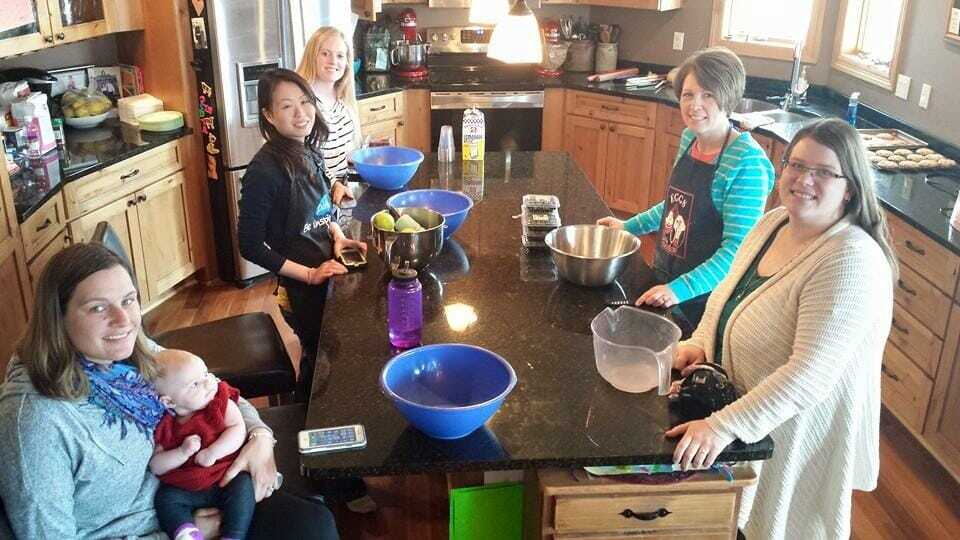
    Iowa bloggers, creating soul food. from left to right: Mary Hopper, Jennifer Flaa, Jessica Wood, Shannon Latham and Val Plagge
    Iowa bloggers, creating soul food. from left to right: Mary Hopper, Jennifer Flaa, Jessica Wood, Shannon Latham and Val Plagge

    But thanks to a small group of positive women, there’s joy in my heart today. Yesterday four members of the North Iowa Bloggers and I road-tripped about two hours south to accept an invitation for a baking class from Cristen Clark, a national award-winning cook and baker. The idea originated from a post by blogger Jennifer Flaa entitled, “Baking Feelings into Pies.”  Pies-Quote

    I spent a perfect day in the kitchen filled with positive women. (BTW, my experience yesterday reminded me the title to a book I greatly enjoyed. Click here if you’d like to learn more about it.) Even the most seasoned bakers in our group learned from one another.

    A few of the tips and tricks I want to remember include:

    1. “Fat is where it’s at!” (Fat adds flavor to hamburgers. It also makes pie crust delicious and flakey. Use butter or lard; it’s a personal preference.)
    2. When mixing up the pie filling, zest half a fresh lemon peel into the sugar. (“Perfume the sugar.” Words alone cannot explain how delicious this smells. You must experience it yourself!)
    3. Squeeze the juice from the half of lemon over your fruit, even fresh pears, as you mix the filling.
    4. Use Tapioca (in place of flour) as a thickener.
    5. A cake lifter helps prevent crust from sticking to the counter top. Continually shower flour (as opposed to “blizzard”) onto the counter top to prevent the crust from sticking.
    6. Also use the scraper to keep your rolling pin clean to avoid putting dents in your crust.
    7. “Thick strips are in” when making lattice top pie. Slide your pastry cutter or pizza cutter along a metal ruler to keep the strips straight.
    8. Once your crust is in place, be sure to brush on the egg wash.
    9. Wrap pie plate with a ring of foil to prevent the edges of the crust from getting too brown or burning. While my mom taught me to cover the edges with foil, I have to admit that I had trouble keeping the foil ON the crust. The ring is the trick! NOTE: Put the foil ring around your pie BEFORE placing it in the over to avoid burning your fingers.
    10. Once you bake the pie, let it cool for 4 hours before cutting into it. Talk about temptation… who can look at pie that long without sneaking a bite? (Fortunately, I baked my pie an hour before bed time. I woke to a cool pie – perfect for breakfast!)

    P.S. Pull tabs on the ends of cling wrap help secure the roll and make it easier to dispense without the saran clinging to itself. Seriously, who knew?! That tip alone might have been worth the drive.

    Because it’s Friday on TheFieldPosition.com, I’m sharing with you the recipe I used to bake blueberry pie yesterday. I have to confess that I was having “pie envy” as I watched Pear Pie being assembled, and I can’t wait to try my own hand at it very soon. Click here for the recipes Cristen uses for pie crust and $3,000 Pear Pie.

    Team Latham

    April 10, 2015
    Desserts, General, Recipes
  • Latham Hi‑Tech Seeds

    Six Reasons Why 4-H is Fit for a King

    KingCarter

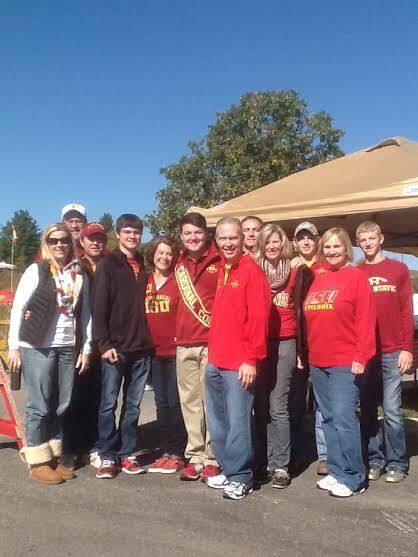
    KingCarterWhat’s one word to describe 4-H? “Addictive,” said Carter Collins, who couldn’t wait to join a club after he saw how much fun his older sister, Taylor, had.

    “She had such a great experience that I wanted to get involved, too,” said Collins, a Hampton native and Iowa State University’s (ISU) 2014 homecoming king. “For me, 4-H became addictive.”

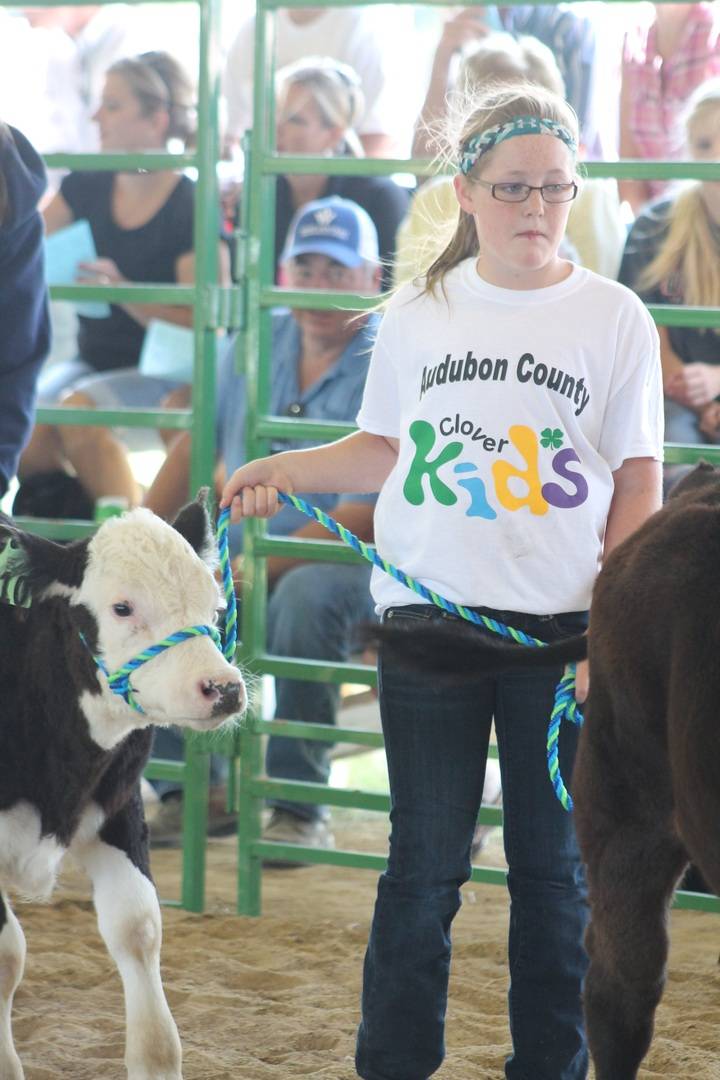
    As a member of the Reeve Hampton Hustlers 4-H Club, Collins’ 4-H adventure encompassed six life-changing benefits:

    1. Exploring new interests. Collins was interested in photography, along with food and nutrition projects. He earned top honors at the Iowa State Fair with recipes like Mint Truffle Cups (see recipe below). “I enjoyed spending time in the kitchen with my mom and grandma while expanding my culinary skills,” Collins said.
    2. Developing life skills. From grade school through high school, 4-H taught Collins how to set goals, be resourceful and complete projects. “4-H helps kids develop a work ethic from the very beginning,” noted Collin’s mother, Dawn. “The more you put into it, the greater the reward.”
    3. Learning to lead. Not only did Collins serve as treasurer, secretary and president of the Reeve Hampton Hustlers, but he co-chaired the Franklin County 4-H Council, served on the area 4-H council and attended state leadership conferences. “I was always looking for the next step at every level,” he said. “I also learned how to work with people from all different kinds of backgrounds.”
    4. Improving communication skills. Collins and his friend, Spencer Claypool, often collaborated on 4-H working exhibits. Their demonstrations ranged from how to build pinecone bird feeders to creating “soil sundaes,” complete with chocolate cookies and gummy worms, to show layers of soil and promote conservation. Not only do these opportunities develop 4-H members’ public speaking skills, but they give young people the confidence to become advocates for what they believe in. “In large groups or small groups, they are able to present ideas with confidence,” Dawn Collins said.
    5. Discovering new opportunities. While Collins grew up in town, he enjoyed expanding his horizons through 4-H field trips that included a visit to ISU’s veterinary medicine facilities. He also appreciated 4-H’s emphasis on STEM (science, technology, engineering and math). “I got to experience a lot of the agriculture world through 4-H, thanks to club leaders like April Hemmes,” added Collins, a senior majoring in journalism/mass communication and political science at ISU. “Her energy and enthusiasm are contagious.”
    6. Networking with others. Not only did Collins make friends through 4-H, but these connections endured beyond high school. “I reconnected with a lot of former 4-Hers at ISU,” Collins said. “It’s great to have a 4-H family at college.”

    Dawn Collins is grateful that 4-H has given her children so many things that other groups can’t offer. “We really appreciate the long-lasting friendships and opportunities the kids would have missed out on had it not been for 4-H,” she said.

    There’s no youth development program like 4-H, Collins concluded. “4-H gives you the chance to grow. All you have to do is seek these opportunities.”

    Team Latham

    March 27, 2015
    Desserts, Recipes
  • Latham Hi‑Tech Seeds

    Van Wert Family Celebrates Four Generations of 4-H

    Jay Van Wert news clipping 2 web

    Oh the anticipation! If you grew up in the Van Wert family near Hampton, the day you could join 4-H marked a big milestone.

    “We couldn’t wait to get our own 4-H projects, because we’d heard so much about4-H from our parents,” said Jay Van Wert, a Franklin County farmer who is proud that four generations of his family have participated in 4-H.

    It all started with Van Wert’s father, J.S. “Pat” Van Wert, who joined 4-H in Franklin County in the 1920s, and his mother, Alice Anderson, who was a 4-Her in Minnesota. “They both benefited from great county Extension staff members and local volunteer leaders who lit the spark of 4-H participation,” said Van Wert, whose father raised pigs, calves and lambs, while his mother specialized in foods, clothing and home furnishings projects.

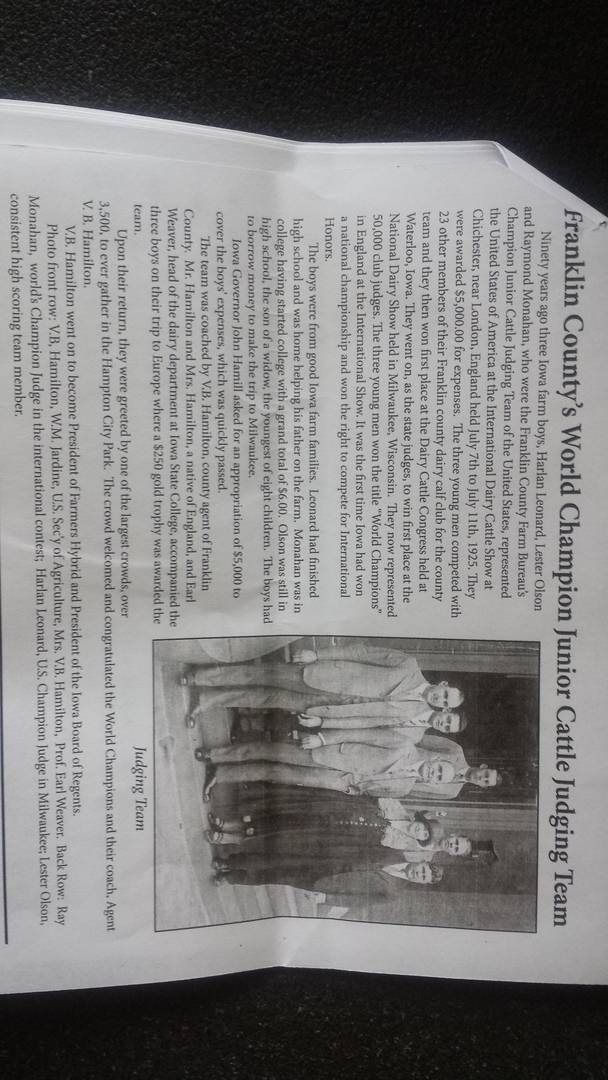
    Pat, who was a member of the Franklin County dairy judging team that won state and national judging contests, also represented Iowa at the National 4-H Camp in Washington, D.C. His experiences prepared him well for his studies at Iowa State College in Ames, where he met Alice.

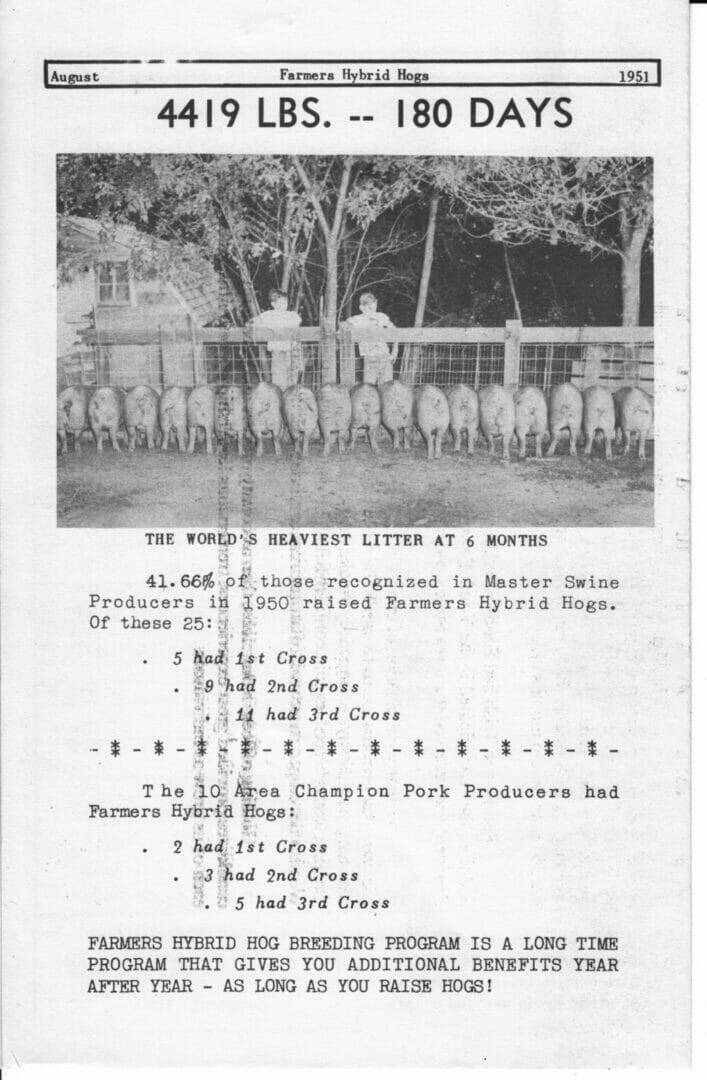
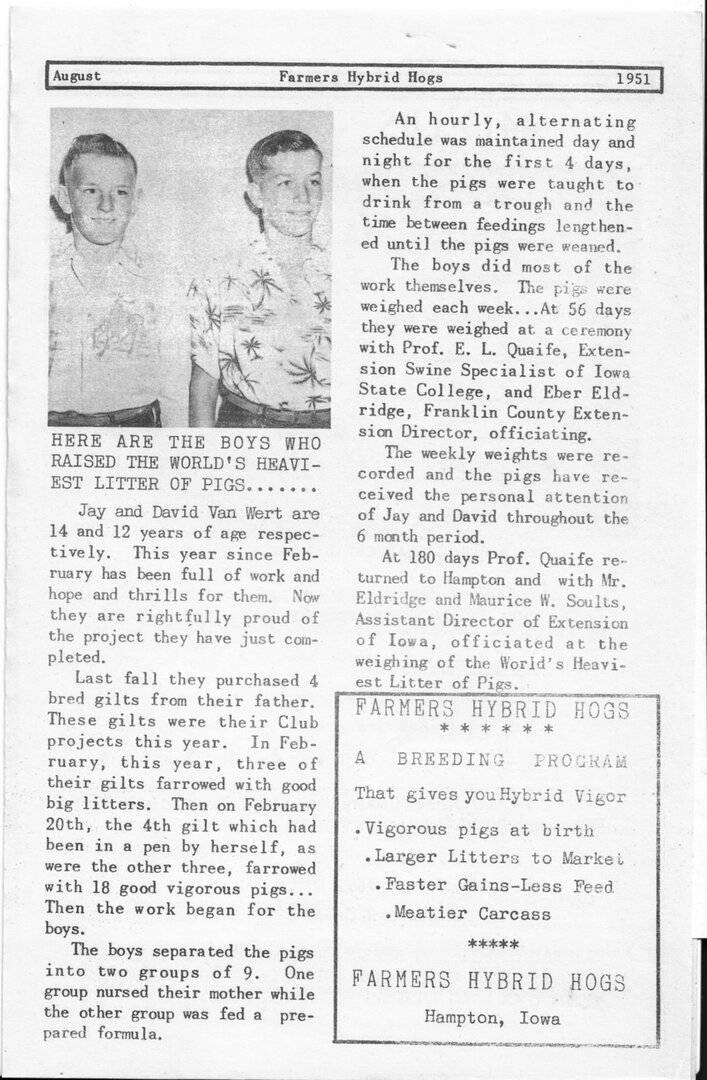
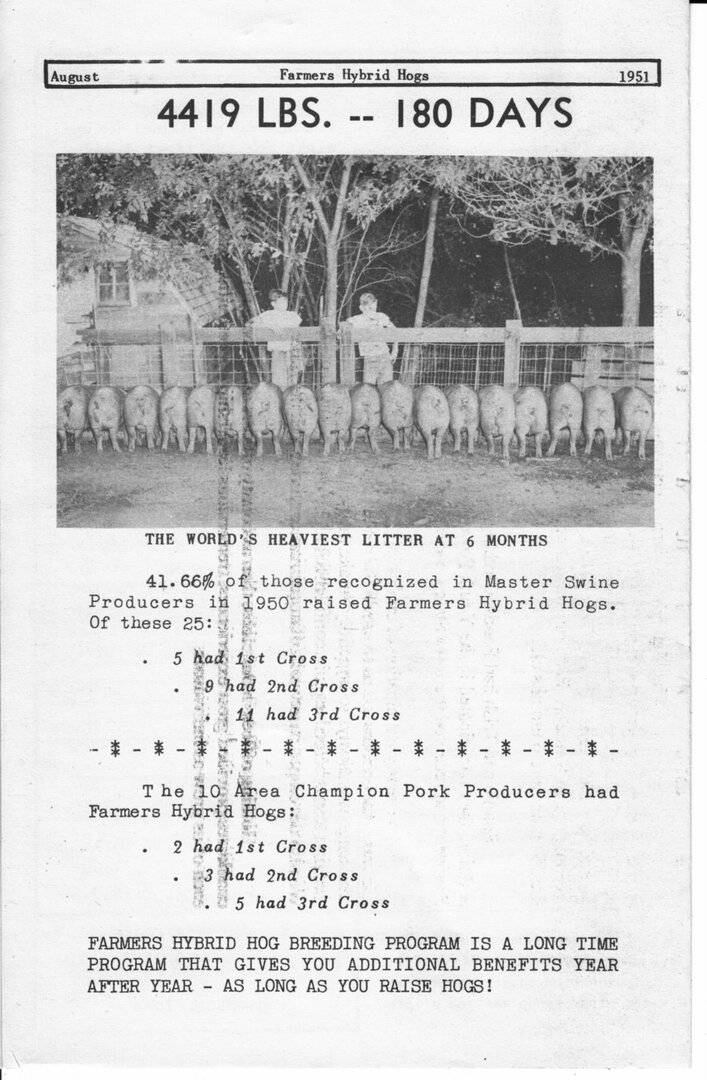
    After the young couple married, they encouraged their four children (Jay, David, Sonnie and Trish) to get involved in 4-H. As soon as they were old enough, the boys joined the Mott Meat Makers, while the girls joined the Mott Cloverettes. The boys raised hogs, calves, hens and dairy cows and competed on the livestock, dairy, crops and poultry judging teams. The highlight of their 4-H projects included a gilt that gave birth to 18 piglets on Feb. 20, 1951.

    “We raised all the pigs to market weight,” said Van Wert, who added that the total market weight of 4,419 pounds set a world record.

    Jay Van Wert news clipping web versionReaching this goal was no small feat. When the piglets were young, Van Wert and his brother rotated the animals so nine nursed from the sow while the other nine received a homemade milk replacer every 20 minutes throughout the day and night. “This routine was extended out until every 45 minutes until the pigs reached weaning age at eight weeks,” Van Wert recalled.

    The boys also named each pig. Nine had “A” names, including Abner, Abigail, Agnes, Abraham, Albert, Amy, Alex, Amos and Archie. Eight had “B” names, including Barney, Betty, Benny, Bertha, Bernie, Billy, Beulah and Barbara, while the smallest piglet at birth was named Squirt.

    Jay Van Wert news clipping 2 web

    Learning lessons that last a lifetime

    The yearly anticipation of exhibiting 4-H projects at the county, district and state fairs encouraged all the Van Wert kids to invest the time necessary to succeed. “The challenge was always to make the best better,” said Van Wert, who was honored in 2014 with the Iowa Farm Bureau Federation’s Distinguished Service to Agriculture Award. “4-H demonstrations and judging teams also helped us gain confidence and become comfortable speaking before the public.”

    4-H also gave the Van Werts a network of friends throughout the state. “Holding offices in our clubs, and later serving as Franklin County officers and state officer candidates provided great learning experiences,” added Van Wert, who is proud that his children and grandchildren have participated in 4-H, too. “4-H offers tremendous leadership opportunities and helped each of us grow as individuals.”

    Jay Van Wert IFBF web

    Home-cooked favorites

    Jay and his wife, Sally, served as 4-H leaders while their three children were growing up. Despite their business schedules, which included running J’s Hay Company, home cooking was a priority for the Van Werts, who were inducted into the Iowa 4-H Hall of Fame in 2010.

    Here’s one of their go-to recipes:

    Team Latham

    March 20, 2015
    General, Recipes, Sides
  • Latham Hi‑Tech Seeds

    My Iowa. My Ireland.

    Irish Breakfast


    Guest blog by Jody Halsted.

    Jody Halsted is a family travel authority with a mad passion for Ireland.  A frequent visitor to the Emerald Isle, she loves nothing more than exploring the country with her husband and two daughters.  The publisher of Ireland Family Vacations, Jody also plans Ireland itineraries and provides Ireland travel coaching.  Get inspired by the Ireland Family Vacations Pinterest boards or follow Jody on Twitter @IrelandFamTrvl.

    OLYMPUS DIGITAL CAMERAAs I look out my window right now I see a gentle creek parting the rolling hills that will soon be green. The pre-dawn air is still a bit too brisk for the grass to have the smell of morning dew when I open the door to let my dog out. And the only ruined castle I see is made of snow, its frozen turrets slowly dwindling in our glorious spring thaw.

    Burren colt 2014Across the ocean I am watching my Irish friends already harvesting early spring vegetables from small gardens. Each day brings new photos of baby lambs and colts romping in damp grass, the filtered sunlight creating a magical effect over the entire image. A centuries old ruin can be seen far in the background, its stone walls holding stories of life, love, and intrigue.

    Iowa. And Ireland. My two homes.

    Though an ocean separates them, I see so very much similarity between my home state and the country of my heart.

    Dramatic Views: Though Ireland can boast extraordinary ocean views from its magnificent cliffs, the stark natural beauty of Iowa’s river borders as Bald Eagles soar overhead are just as majestic.

    Ancient History: You build with what you have available. In Ireland it was stone. In Iowa it was trees and dirt. Megalithic tombs and ‘thin places’, effigy mounds and sacred places.

    Amazing People: The people of Ireland are known as the friendliest in the world, the land of “céad míle fáilte” or “One hundred thousand welcomes”. In Iowa we’re known as nice. Iowa Nice, that is.

    John Wayne: OK, this one may be a stretch. But I don’t live so very far from Winterset, where John Wayne was born. And one of my favorite villages in Ireland is Cong, where The Quiet Man was filmed. In both towns you’ll find a statue of ‘The Duke”.

    John Wayne statue in Ireland
    John Wayne statue in Ireland

    The Weather: Let’s just face facts. No one vacations in Ireland – or Iowa- for the weather. When it is bad it is beyond horrid. But when it is good, oh it is glorious!

    Lush, open fields stretching for miles: It’s mid-spring. Stand in the center of Ireland or Iowa. Close your eyes and breathe deep. Open your eyes and slowly turn. A prism of green spreads before you. The land is alive, growing beneath your feet. Everything is fresh, clean, holding promise.

    I know that soon the grasses will be lushly green and birds will be singing outside my window. When I open the door as the sun is just breaking the horizon I’ll smell the morning dew before it burns off. For a moment I’ll smell Ireland.

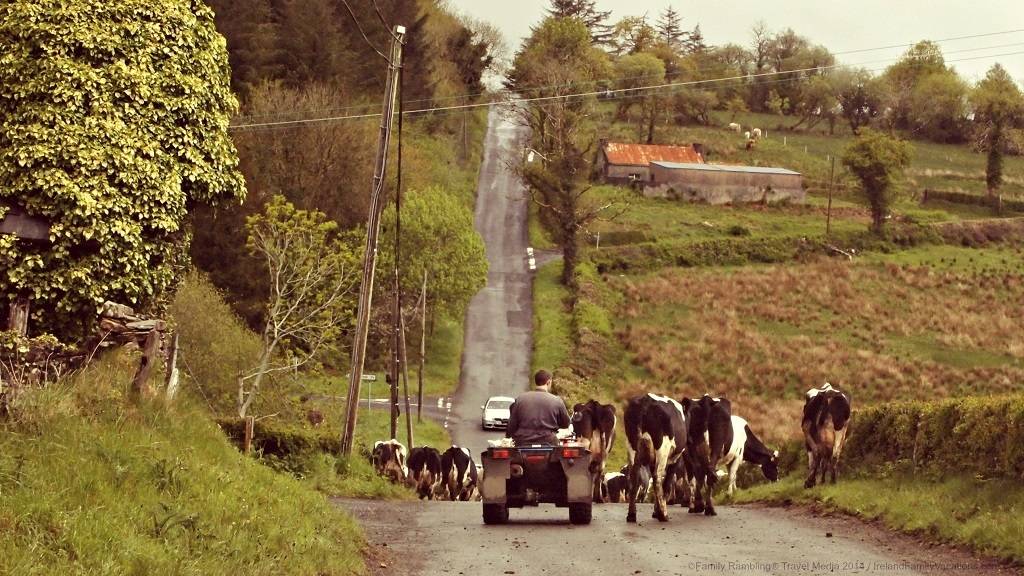
    Farmer herding cattle in Ireland
    Farmer herding cattle in Ireland

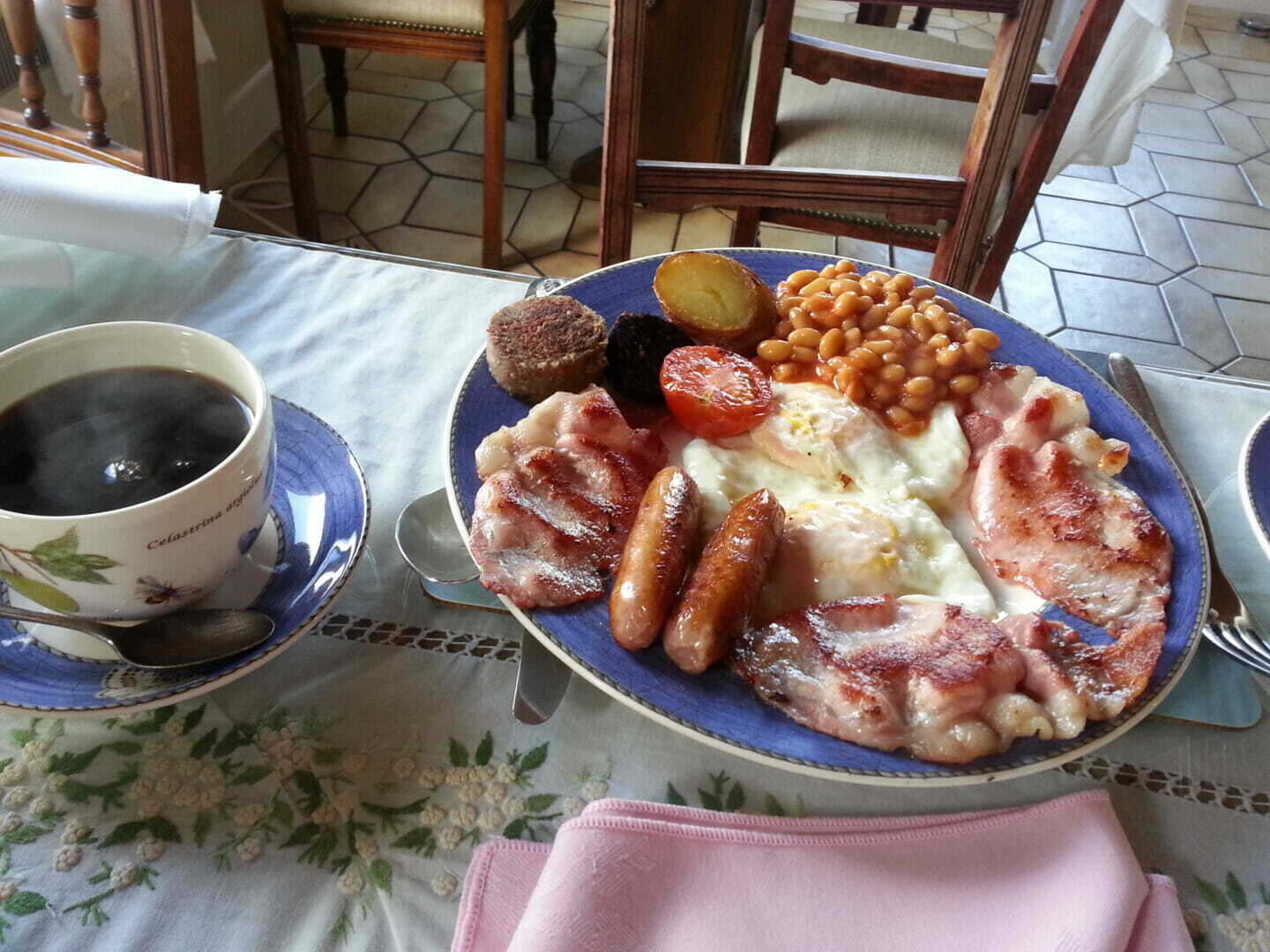
    Traditional Irish Breakfast

    Also known as the “Full Irish” or the “Fry Up”, you may find it’s not that different from a hearty farm breakfast.

    Begin by searching your area for a British or Irish market. (I visit the British Food Store at the Mucky Duck Pub in Ames.)  This is where you will find bacon rashers, also called back bacon, a thicker piece of meat than American bacon, the bangers, a tube shaped sausage, and the puddings, also a sausage.  Black pudding may be called blood pudding, or blood sausage, while the white pudding has no blood.  If you don’t have a market nearby, you can order these treats online from sites like FoodIreland.com.

    After gathering your necessary ingredients, you’ll want to bake a loaf or two of Irish Brown Bread.  This filling bread is made with both wheat and white flour, as well as oatmeal and wheat germ. (Note:  This is not Soda Bread.  Soda Bread is made with only white flour.) See the recipe below.

    Cooking Your Irish Breakfast

    Cooking the perfect Irish Breakfast is really a lesson in timing.  It’s best to have all your ingredients at hand.

    Begin with the items that can be kept warm in the oven- the meats.

    Begin by frying the bacon.  As Irish bacon is not as fatty as American bacon, you may need a bit of pure butter in the frying pan.  Do not fry the bacon crisp, but just to a bit brown on the edges.

    Next you will fry your bangers.  An alternate method of preparation is to bake them on the oven at 375° for 20-25 minutes.

    As the bangers are frying, slice the bread and place it in the oven to warm.

    Slice your puddings, about ¾” thick, and fry them next, until browned on both sides.

    If you are preparing potatoes, you have a couple options.  Slice peeled, boiled potatoes and fry them in a mixture of pure butter and the meat drippings.  Or prepare boxty, an Irish potato pancake, ahead of time.  If you are serving beans, put them in a pan to heat.

    Add your sliced tomato or mushrooms to the side of the pan while you are frying the potatoes.

    After the potatoes are done, it’s time to fry the eggs.  Though you can serve your eggs in your favorite way, sunny side up or over medium are best for dipping the warm brown bread into the runny yolk.

    After the eggs are done, plate it all and enjoy a hearty Irish breakfast.

    Sláinte!

    (to your health)

    If you’re looking for a few great recipes for a St. Patrick’s Day feast, download my Favorite Irish Recipes cookbook.

    Team Latham

    March 13, 2015
    General, Recipes, Sides
  • Latham Hi‑Tech Seeds

    Family Farm Expands Iowa’s “Farm to Table” Movement to Seafood

    Sweeney family1

    A typical Iowa family farm usually consists of approximately 360 acres that get planted to corn and/or soybeans. Sometimes the farm also includes a livestock enterprise, such as cattle or hogs. Some families, desiring to bring the next generation home, look for additional income opportunities such as a seed dealership.

    With both of their sons interesting in returning to the family farm, Annette and Dave Sweeney are taking a non-traditional approach to make room for everyone. Joe Sweeney is pictured on the left; Jim in between his parents.
    With both of their sons interesting in returning to the family farm, Annette and Dave Sweeney are taking a non-traditional approach to make room for everyone. Joe Sweeney is pictured on the left; Jim in between his parents.

    “With farmland and cattle prices as high as they are, growing our existing operation wasn’t a viable option,” said Annette Sweeney, who in 1983 moved from Illinois where she was teaching middle school to take over her family’s 1,350-acre row crop and cow/calf operation upon her father’s untimely death. “Both of our sons would like to be a part of our family farm, so Dave and I decided to take a non-traditional approach to help make that happen.”

    The Sweeney’s youngest son, Joe, became interested in fish production. As a student majoring in Ag Business, Economics and Entrepreneurial Studies at Iowa State University (ISU), he learned there was a supply gap for fish. He wanted to make a mark for himself, and Joe was interested in owning his own business.

    “When an economics student hears ‘supply gap,’ he thinks ‘market opportunity’,” says Joes, a sixth generation Iowa farmer. “My entrepreneurial side identified ‘market opportunity’ with ‘business opportunity.’ Starting my own fish farm is a way to continue my family’s farming legacy while making my own mark.”

    Barramundi Seabass photo courtesy Randy Heitz
    Barramundi Seabass photo courtesy Randy Heitz

    Much research on fish production has been done at Auburn University, so Joe reached out to experts there. Once he graduated from ISU in May 2013, Joe spent that summer traveling and conducting his own research. He visited Auburn, as well as traveled to other fish farms and fish markets in Alabama, Arkansas, Mississippi and Georgia. Sometimes he traded “labor for lessons” from other fish farmers.

    Breaking ground in July 2014 for Buckeye Fish Company’s production facilities was the result of two years’ preparation. Joe wrote a business plan and secured funding. His parents sold him land on which to build the fish farm. His older brother, Jim, designed the solid core insulated panel building. From the outside, the building resembles a machine shed. On the inside, you’ll find state-of-the-art systems that regulate air and water flow. Lighting simulates daytime and nighttime.

    Jim earned a degree in structural engineering from Iowa State and has worked since 2011 as an engineer for Energy Panel Structures in Graettinger. The brothers worked together innovating floor plans and materials typically used for hog and chicken production, so they would be better suited for the higher humidity environment created by fish production.

    After eggs from Barramundi Seabass hatch, the fry are flown from Australia to the Minneapolis airport. From Minneapolis, the fry are trucked to a bass farm in Webster City where they’re grown to about four inches long. The fingerlings are then transported to Buckeye Fish Company where they’ll be fed to 2 pounds.

    The first fingerlings are expected to arrive mid-March. Buckeye Fish will take a staggered approach to filling and emptying tanks, so fingerlings will be placed in 2 of the 24 tanks at first. Two more tanks will be filled each week for the next 6 months. When running at full capacity, Joe and the other five farm families involved will produce nearly one-quarter million fish annually. It takes approximately 6 months for each tank of Barramundi Seabass to be market-ready.

    As part of her statewide tour, Lt. Governor Kim Reynolds on Wednesday toured Buckeye Fish Company with a group of women in ag from North Iowa.
    As part of her statewide tour, Lt. Governor Kim Reynolds on Wednesday toured Buckeye Fish Company with a group of women in ag from North Iowa.

    “The trend toward farm-raised seafood represents a great opportunity for us to enter this market early,” says Joe. “Farm-raised seafood has surpassed beef in worldwide consumption. China, which has been the primary seafood supplier to the U.S., is expected to reduce its exports in coming years. The demand for U.S. farm-raised fish should continue for the next 30+ years as the world population is expected to reach 9 billion people to 2050.”

    Barramundi Seabass is the species of choice for Sweeney as it’s becoming more popular in U.S. markets. This particular type of fish is sought after for its affordability, mild flavor, versatility, ease of cooking plus health benefits. Barramundi Seabass is full of heart- and brain-healthy Omega 3s and Omega 6s, so it’s becoming known as a Super Food.

    Home cooks will enjoy learning that Barramundi Seabass is not a “fishy fish” and won’t leave an odor in your kitchen. Moms will like knowing there are no little bones that create choking hazards. Health-conscious Americans will appreciate knowing it’s raised without antibiotics or hormones, and specially formulated feed ensures that every bite is free of mercury.

    The Lenten season is a perfect time to experiment with new fish recipes like Barramundi with Lemon Basil Sauce from Hy-Vee. Click here for additional recipes from Iowa’s First, the fish farm in Webster City that raises fry for Buckeye Fish.

    Team Latham

    March 6, 2015
    General, Recipes, Seafood
  • Latham Hi‑Tech Seeds

    Pros Share Tips for Creating Heart Healthy Meals

    HealthySnacks
    1000 anne individual pic
    Anne Hytrek

    Not only are hearts synonymous with Valentine’s Day on Saturday, but February is National Heart Month. Today we’re sharing tips from health professionals to help you prevent heart disease. Adequate exercise and healthy meals are key to wellness.

    “A healthy meal is balanced by eating something from every food group,” says Anne Hytrek, Dietitian and Diabetes Educator at the Ankeny Prairie Trail Hy-Vee, and member of the Iowa Food & Family Project’s Advisory Committee. “Many times excess calories are consumed when one eats more than the serving size for meat and grains per meal and thereby eating less vegetables.”

    Eating a well-balanced diet is extremely important for overall health, adds Hytrek. Eating fruit and vegetables daily lowers the risk of serious health problems like heart disease, stroke, type 2 diabetes and obesity. In spite of all these benefits, only 1 in 5 Americans eats the recommended 5 servings of fruits and vegetables each day.

    A healthy meal centers on the USDA’s food guidance system MyPlate, which recommends half the plate is composed of fruit and vegetables.  Hytrek explains the other half the plate is divided between protein like meat or cheese and grains such as bread, pasta or rice.  A serving of dairy, such as 1 cup low fat milk or yogurt, is also included. Pack fruits and vegetables for mid-morning and for mid-afternoon to help reach the 5 A Day goal.

    HealthySnacks

    To eat healthier Hytrek suggests:

    • Select any lean meat or protein first followed by a low fat cooking method such as grilling, broiling, roasting or baking.  Choose at least two different colors of vegetables to include in your meal.  Finally, choose whole grain foods to balance your meal that provide fiber to not only fill you up, but also help lower LDL “bad” cholesterol.
    • Cook from scratch as much as you can rather than relying on processed foods.  Use low fat dairy products and reduced fat/light condiments according to their serving size on the nutrition label.  Switch to Kosher salt, which is naturally one-third less in sodium than iodized salt. You will not notice a taste difference since the salt crystal is hollow inside and “pops” on the tongue a lot like pop rock candy!
    • Put a new twist on traditional foods. Try Greek yogurt topped with blueberries, aronia berries or strawberries that are rich in antioxidants. Replace traditional lettuce salads with greens like kale and spinach. Add fiber into your diet with 100% whole grain or ancient grains like quinoa or faro. Salmon and tuna are great sources of Omega 3 healthy fats.

    “Hy-Vee dietitians are happy to set up personal shopping appointments where we can suggest heart healthy foods,” says. Hytrek “We can also provide a meal planning consultation with a physician’s referral to individualize meals, according to food preferences and schedules. And on Hy-Vee.com, you can select meal solutions and access recipes tailored to special diet restrictions and individualize healthy eating.”

    Team Latham

    February 13, 2015
    General, Recipes, Sides
  • Latham Hi‑Tech Seeds

    Farmer Ingenuity Leads to Family Owned Business

    Horse judging team

    IMG_1161.JPGFarmer ingenuity led Jerry Miller of Deering, ND, to start his own business. This third generation farmer couldn’t find a provider for the type of fertility program he was interested in using, so he founded AgriTec.

    “AgriTec looks for high quality, cost-effective products that are biologically superior,” says Jerry. “We want to be the one stop for all the products and services a farmer needs to have a successful growing season, so we also sell seed.”

    Desiring to work with a family-owned seed company that offers a broad and deep lineup, last year Jerry and his wife, Dana, planted Latham® brand soybeans on their own farm. Impressed by the high quality and performance – with yield gains as high as 10 bushels per acre over the competition – the Millers decided to make Latham products available to their customers for the 2015 planting season.

    Saving time, reducing risk, simplifying decisions and providing options are shared promises of Latham Hi‑Tech Seeds and AgriTec. AgriTec strives to provide unequalled service including: custom fertilizer blending, chemical and seed sales, seed treatment, plus custom application of dry and liquid fertilizers and chemicals, both on the ground and aerial.  Soil testing, prescription farming services and agronomy consultation also are offered.

    “We enjoy working with everyone at Latham because, although they are personable and friendly, they are also very professional and competent,” says Dana. “Information, orders, deliveries and questions are all addressed with precision.  Dealings are stress free and accurate.”

    Raised in a small town in central Saskatchewan, Canada, Dana came to North Dakota for college. She earned a bachelor degree in deaf education and a master’s degree in special education diagnostics from Minot State University. She had served as diagnostic team coordinator for Minot State University but left her job in 1996 to help with Agri-Tec.

    The Ward County horse judging team placed fifth overall at the Western National Roundup in Denver last month. Pictured from left to right are coach Paige Brummund and team members Shaylee Miller, Kara Scheresky and Kali Miller.
    The Ward County horse judging team placed fifth overall at the Western National Roundup in Denver last month. Pictured from left to right are coach Paige Brummund and team members Shaylee Miller, Kara Scheresky and Kali Miller.

    In addition to growing a business, Jerry and Dana have raised their three children on the same farm where Jerry grew up. Their 21-year-old son, Jory, will graduate in May from the University of North Dakota (UND) with a degree in Marketing and Communications. He interned with the North Dakota State Fair in 2014 and is very involved with his fraternity and philanthropy projects.

    Jory-Miller

    The Miller’s oldest daughter Kali, 19, is in her first year at UND. She’s planning to pursue a career in the medical field.  Kali was an active 4-H member, and in 2014, she won the state 4-H horse judging competition in Fargo.

    Kali-Miller

    Judging horses is a passion Kali shares with her 15-year-old sister, Shay. A freshman at Surrey High School, Shay is active in volleyball, basketball, track and student council.  She also is very active in 4-H. She enjoys showing horses including: Western riding, English riding and games, such as barrels and poles.

    Shay-Miller

    Shay and Kali have participated in Hippology contests and were important parts of the team representing North Dakota at the national competition last month at the National Western Stock Show. In March 2014, the Miller sisters along with teammate Kara Scheresky competed in the state 4-H judging competition in Fargo. They took first place in horse judging and were invited to judge at the Western National Roundup in Denver, Colorado. More than 900 youth from 33 states plus Alberta, Canada attended the Roundup from January 8-11, 2015, and the North Dakota team proudly placed fifth overall.

    Although Dana wasn’t raised on a farm, she says she’s enjoyed raising her children on a farm where they can pursue their own interests. Growing up on a family farm has also taught them responsibility, she says.

    “Our children enjoy the quietness and the open spaces of the farm. They spend a lot of time in the barn with their animals,” adds Dana. “Our girls can be found all summer long with their horses. They have learned independence, responsibility and compassion from owning and caring for animals.”

    Caring for livestock and running an agribusiness, plus attending extracurricular activities, means there’s limited time to spend in the kitchen. Dana enjoys recipes that are quick and easy. Today she’s sharing a favorite recipe for Easy Lemon Bars, which is like a vacation for your taste buds.

    Team Latham

    February 6, 2015
    Desserts, General, Recipes
  • Latham Hi‑Tech Seeds

    Scrambling to Prep for Super Bowl Sunday?

    Beer cheese soup

    It feels like we just gathered together to celebrate the New Year, yet January Soup Month ends today. While I’m trying to come to terms with how quickly the month has passed, most Americans have moved on to the next big thing… Super Bowl XLIX!

    Scrambling like a quarterback about to get sacked, I sat down at my laptop this morning to come up with a game plan to help feed a crowd tomorrow! Fortunately, I didn’t have to search very long or hard to find recipes for Game Day Grub like dripping roast beef sandwiches or ideas to serve up a little Super Bowl-themed fun.

    Below are links to some recipes that will help you keep it simple on Super Bowl Sunday, so you can spend less time in the kitchen and more time in front of the television watching top commercials like “Lost Dog.” As touching as this new #BestBuds spot is, nothing pulls at my heart strings like “So God Made a Farmer.”

    If you’re in need of some last-minute ideas, check out Latham Seeds’ “Super Bowl” board on Pinterest. Below are a few Super Bowl recipes that our customers and ag friends have shared with us in the past:

    • Take it to the House with Pork
    • Something Delicious is Stirring
    • Cheer On the Cheeseheads with Meatball Soup

    Soup sounds like an ideal meal tomorrow for two reasons: (1) I can fix it ahead of time and forget about it until we’re ready to eat; and (2) there’s an 80% chance of snow. We may just need to warm up with Beer Cheese Soup!

    Beer_cheese_soup

    Team Latham

    January 31, 2015
    General, Recipes, Sides
  • Latham Hi‑Tech Seeds

    Get Yourself in a Jam—in a Good Way!

    JamToast Maulsby

    Guest Blog by Darcy Maulsby

    Darcy Maulsby is a farm cook whose family operates a Century Farm in Calhoun County between Lake City and Yetter. Darcy also runs her own ag marketing/communications business (www.darcymaulsby.com) and enjoys teaching cooking classes, reading and improving her photography skills in her free time. Darcy’s motto? “As long as people need to eat, agriculture will never be irrelevant.” 


    Got 30 minutes? You’ve got enough time to make freezer jam. Once you’ve tried this amazing spread, you may never buy the jarred stuff from the store again.

    I can speak from experience, because I got hooked on home canning nearly a decade ago. During my class at the recent Women in Denim seminar in Storm Lake, I showed how making a simple, homemade freezer jam is the best way to break into canning. It’s easy, delicious and will make you feel like a major-league home cook.

    JamToast-Maulsby

    Jam isn’t just for toast, however. I use it for all sorts of recipes, from sweet to savory. In case you’d like to know what defines a jam, jelly or preserve, here’s the scoop:

    • In jelly, the fruit comes in the form of fruit juice.
    • In jam, the fruit comes in the form of fruit pulp or crushed fruit (and is less stiff than jelly).
    • In preserves, the fruit comes in the form of chunks in a thick syrup.

    Here are a few of my best recipes to get you started:

    30-Minute Raspberry Freezer Jam

    You can use red raspberries or blackberries with this recipe, which is fast, fun, and fabulous!

    3 cups prepared fruit (about 6 cups fully ripe red raspberries)—can also use frozen berries
    5 cups sugar, measured into separate bowl
    ¾ cup water
    1 box fruit pectin (I use the regular kind, not freezer pectin)
    Canning jars

    Crush raspberries thoroughly, one layer at a time. Press half the pulp through sieve to remove seeds, if desired. Measure exactly 3 cups crushed raspberries into large bowl. (If using frozen berries, drain off much of the liquid, and save for jelly making). Stir in sugar. Let stand 10 min., stirring occasionally.

    Mix water and pectin in small saucepan. Bring to boil on high heat, stirring constantly. Continue boiling and stirring 1 min. Add to fruit mixture; stir 3 min. or until sugar is almost dissolved and no longer grainy. (A few sugar crystals may remain.)

    Fill containers immediately to within 1/2 inch of tops. Wipe off top edges of containers; immediately cover with lids. Let stand at room temperature 24 hours. Jam is now ready to use. Store in refrigerator up to 3 weeks, or freeze extra containers up to 1 year. If frozen, thaw in refrigerator before using.

    ChocoalteTorte_Maulsby

    Team Latham

    January 30, 2015
    General, Recipes, Sides
Previous Page
1 … 42 43 44 45 46 … 71
Next Page

Latham Hi‑Tech Seeds

131 180th Street | Alexander, IA 50420

(641) 692-3258

SIGNUP FOR OUR NEWSLETTER
  • Contact
  • Legal
  • Dealer Center
  • Seedware Login
  • Latham Gear

© 2025 Latham Hi‑Tech Seeds. All rights reserved. | Iowa Web Design by Webspec | Privacy Policy

Latham® Hi-Tech Seeds is a trademark of M.S. Technologies, L.L.C., 103 Avenue D, West Point, IA 52656.