After a long winter like we experienced earlier this year, I’m eager to fire up the grill and enjoy some fresh air and a tasty meal. Then again, who am I kidding? I grill all year-round no matter the Iowa elements!
May is Beef Month in Iowa. I always find this is a great time to brush up on my grilling tips while celebrating all things beef. Do you know that it’s possible to enjoy beef every single day this month? I’ll get to that, but first I’d like to share a few fun facts.
Iowa is one of nine U.S states where cattle outnumber the total population. In fact, there are 4 million head of cattle in the state and more than 26,000 cattle farms. Iowa’s beef industry contributes more than $6.3 billion annually to our economy and provides jobs for more than 32,000 Iowans.
There are so many ways to enjoy great-tasting beef this summer, especially on the grill. Here are a few quick tips to get you started:
Choose your cut. The All-American juicy hamburger is a great option when it comes to grilling. Prior to cooking, season your burger patty or steak with herbs and seasonings. To keep it juicy, avoid flipping the burgers excessively. Click here for more burger tips.
Some of the best cuts for grilling include the strip steak, flank steak, or ribeye steak. My favorite is the shoulder petite tender. Pro Tip: If you happen to have some leftover, it tastes great on a salad for lunch the next day.
Prepare your beef. Trim visible fat before grilling to help prevent flare-ups. For best results, grill over medium heat. The exterior can become overcooked or charred before the interior reaches the desired doneness when beef is grilled at too high of heat. Pro Tip: Beef can go directly from the refrigerator to the grill. No need to set out at room temperature.
Cook to proper doneness. Color is not a reliable indicator of ground beef doneness. To determine the proper degree of doneness for a burger, insert an instant-read thermometer horizontally from the side into the center of the patty to ensure an internal temperature of 160°F. Remove steaks the grill about 5-10°F before your desired degree of doneness. Pro Tip: Let steaks rest before cutting to allow them to finish cooking and to reabsorb all of those delicious juices. Determine your desired degree of doneness for Medium Rare (145°F), Medium (160°F), and/or Well Done (170°F).
Fire up your grill and celebrate with beef all summer long! You’ll find hundreds of tried and true recipes on our website. Today I’m sharing with you one of my favorites for Garden Herb Strip Steak. I love grilled zucchini with mine!
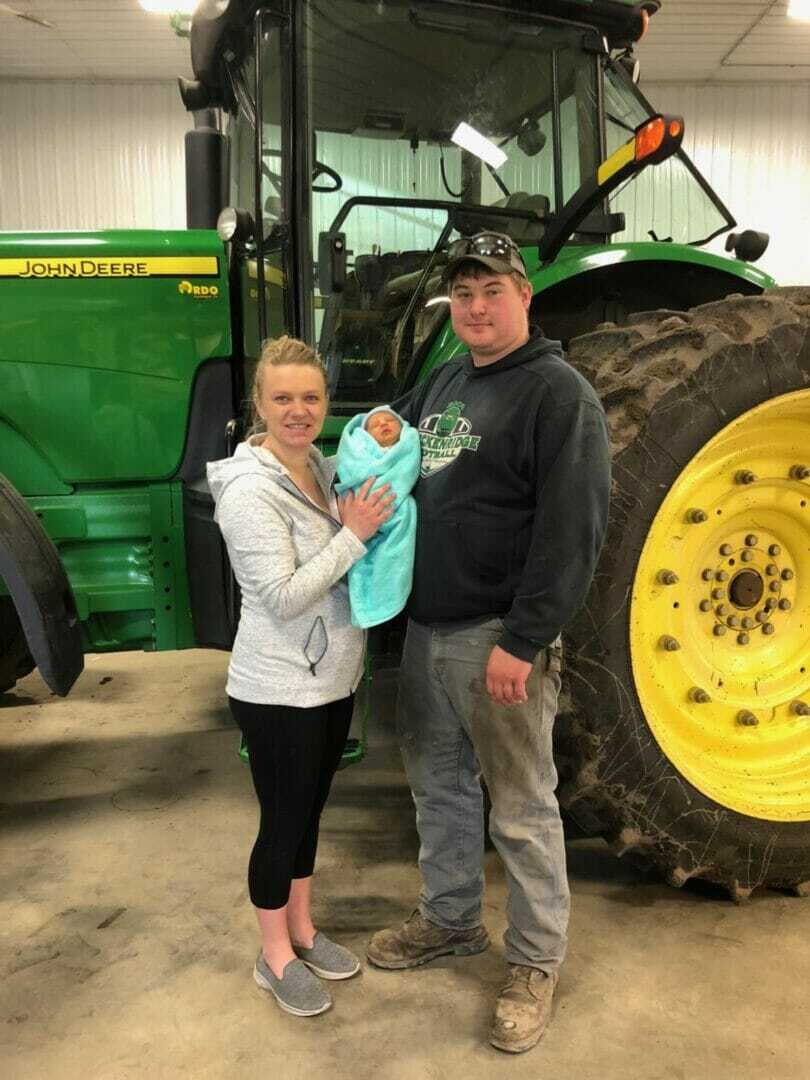
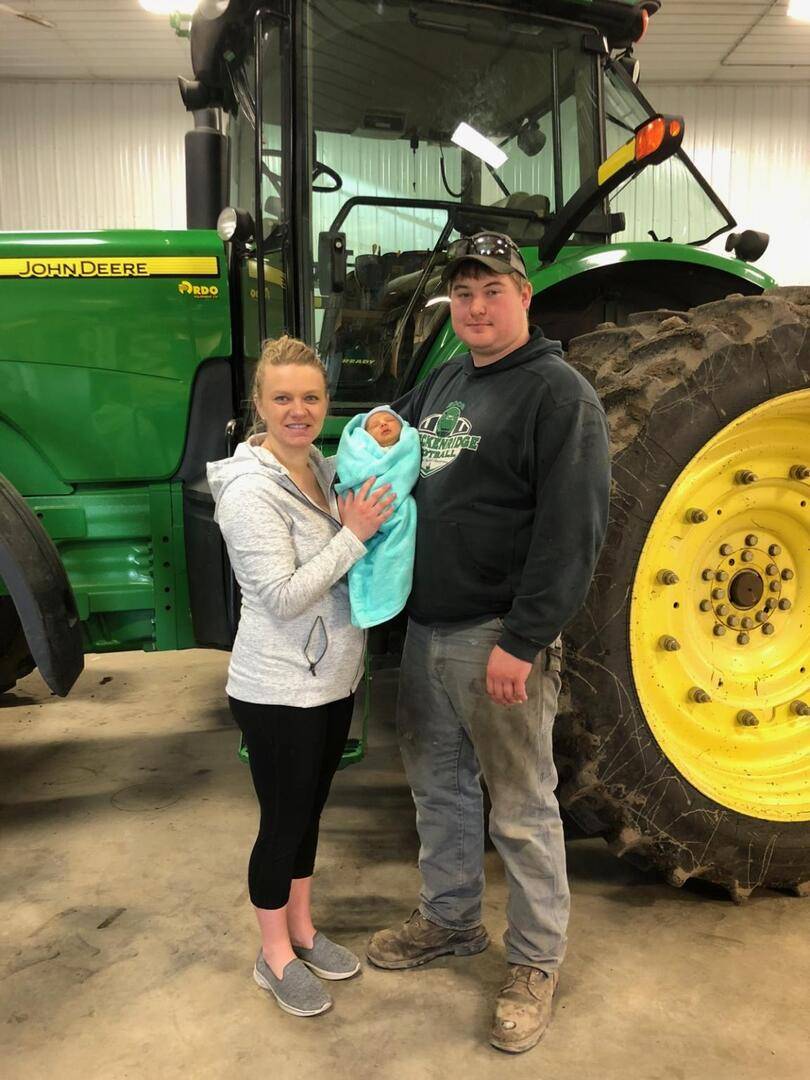
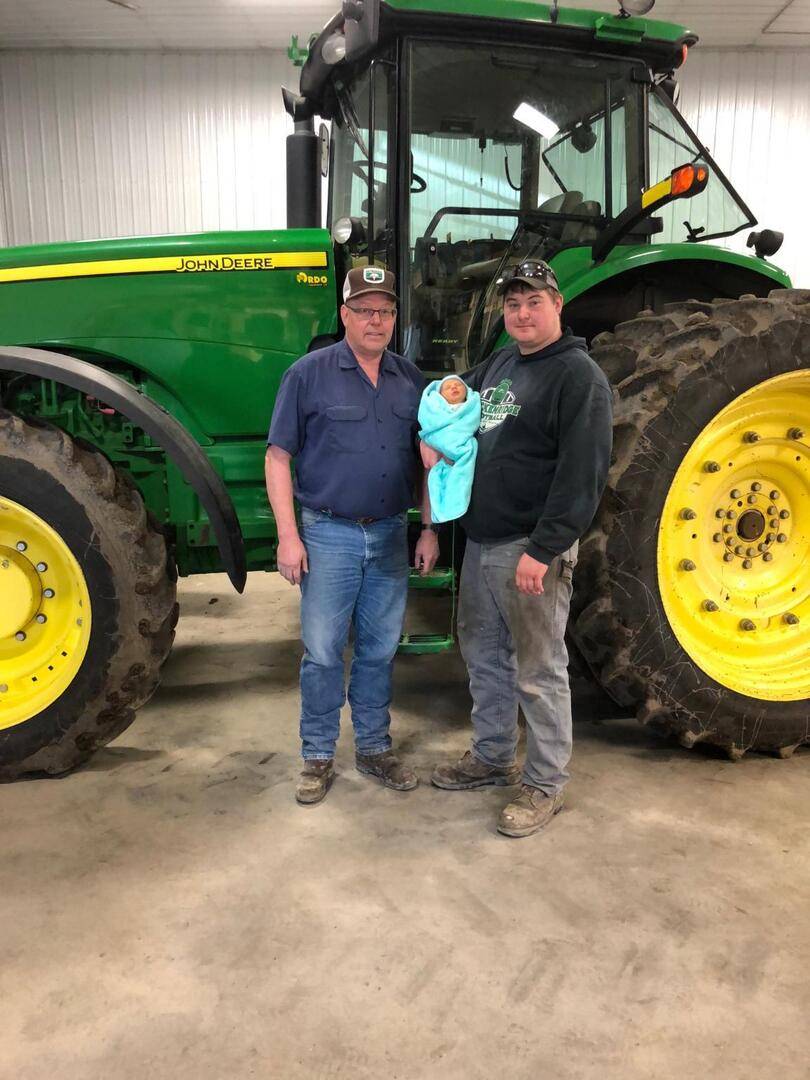
Roots run deep and continue to do so as Latham® dealer Dave Bergquist and his wife, Chloe, recently welcomed their new baby boy into the world.
The Bergquists have followed a “like father, like son,” motto throughout generations. This makes the birth of their son, Briar, even more exciting as they hope add another generation to the Bergquist family farms.
Dave’s great step grandfather started farming in the early 1900s, and they continue to grow their operation. Dave and Mike raise wheat, sugar beets, corn and soybeans in Foxhome, Minn. The 2018 crop year marks Dave’s first year of full-time farming. He’s seeking opportunities to grow the legacy his great step grandfather started.
After completing the John Deere program at North Dakota State College of Science, Dave worked five years as a technician at a John Deere implement dealership. Through hands-on learned both in college and on-the-job, Dave has developed many skills that are much needed on the farm and in his seed dealership.
Taking on a dealership has allowed Dave supplement his income, so he can farm full time. He says he and his family enjoy working with independent, Latham Hi‑Tech Seeds.
“Not only do they offer great products, but Latham Seeds is family owned. Everyone really does treat you like family,” says Dave.
Mike and Dave are point people for their operation, but it really is a family operation. Dave’s four sisters, his mom and his wife pitch in when needed. Chloe also works as a dental hygienist in Foxhome, Minn.
As the Bergquist family grows, Dave looks forward to working and relaxing with family. He enjoys fishing and hunting, so hopes Briar will want to join him in a few years. He and Chloe also enjoy spending time at the lake with her family. The couple met in high school when Dave was playing baseball and Chloe was keeping stats for the team.
After creating memories as a couple for 10 years, they’re looking forward to continuing family traditions and creating memories with their children.
“I grew up wanting to be like my dad,” says Dave. “As someone who you look up to your whole life, it only makes sense to do what you were taught. I really enjoy farming. It’s satisfying to plant seed, watch the plants grow and harvest the year-long accomplishments.”
Today, Chloe, is sharing a family favorite recipe. It is also a tractor-friendly recipe, and it won’t be long before Upper Midwest farmers are in the field!
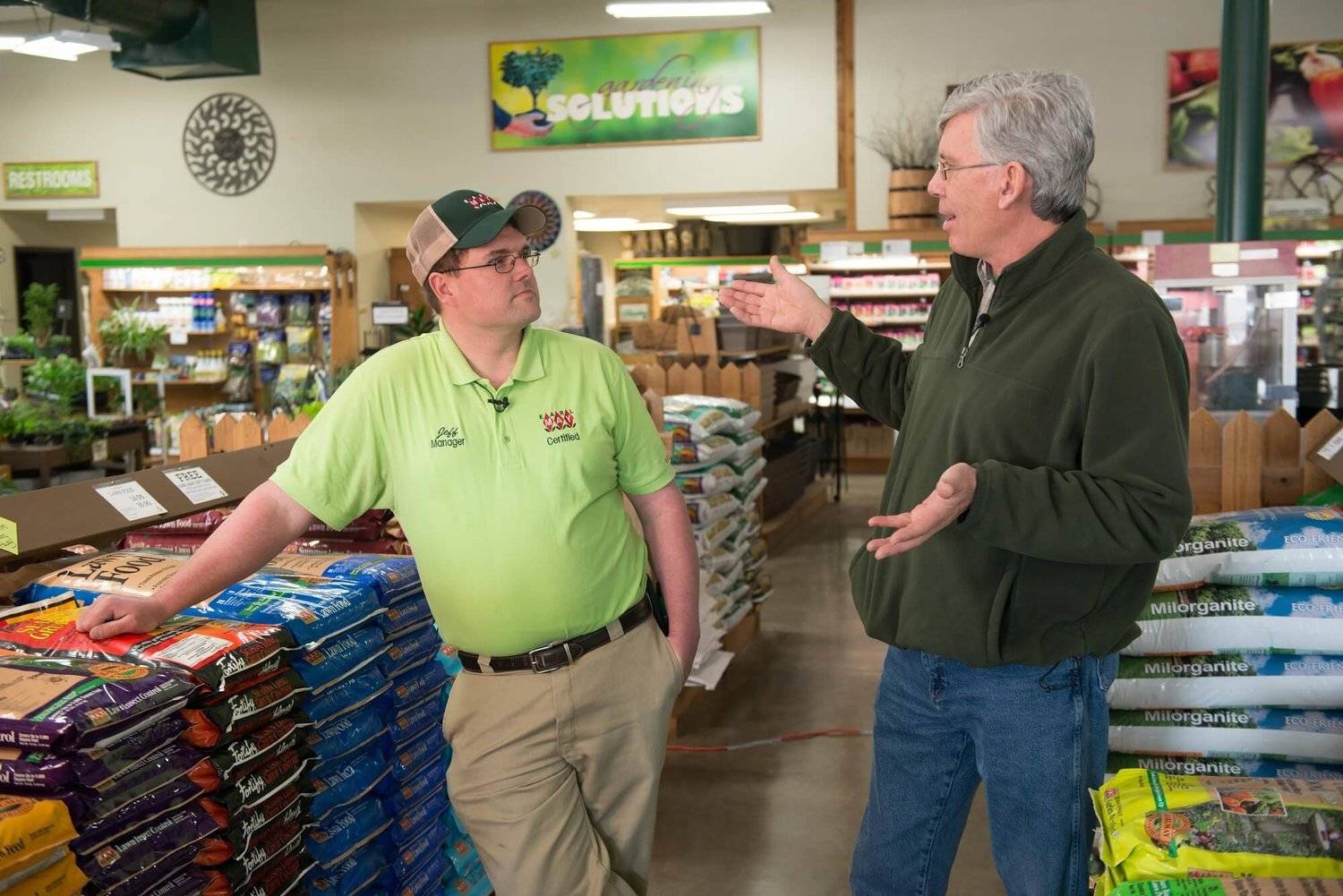
Mark Jackson and Jeff Lanphier discuss the similarities of growing food in a garden and in a field.
Gardeners and farmers are gearing up for planting season. Whether using a trowel in a backyard garden or a 12-row planter in a field, working in the dirt can spark ingenuity and inspire an intense appreciation for where food really comes from.
Throughout the growing season, the Iowa Food & Family Project is teaming up with Earl May Garden & Nursery Center to connect Iowans though the “Let’s Grow Together” program. The program inspires Iowans to try their hand at food and flower gardening, while also learning the many similarities gardening has with farming, through blogs, videos and gardening prizes.
“Let’s Grow Together” showcases conversations between Mark Jackson, a grain and livestock farmer from Mahaska County, and Jeff Lanphier, an Earl May garden expert. Together they discuss how conservation efforts for the soil and water, managing pests and preventing disease are top priorities for both farmers and gardeners.
“Less than 1 percent of the U.S. population farms. Gardening is a connection to farming because it’s the same cut of cloth as agriculture,” says Mark.
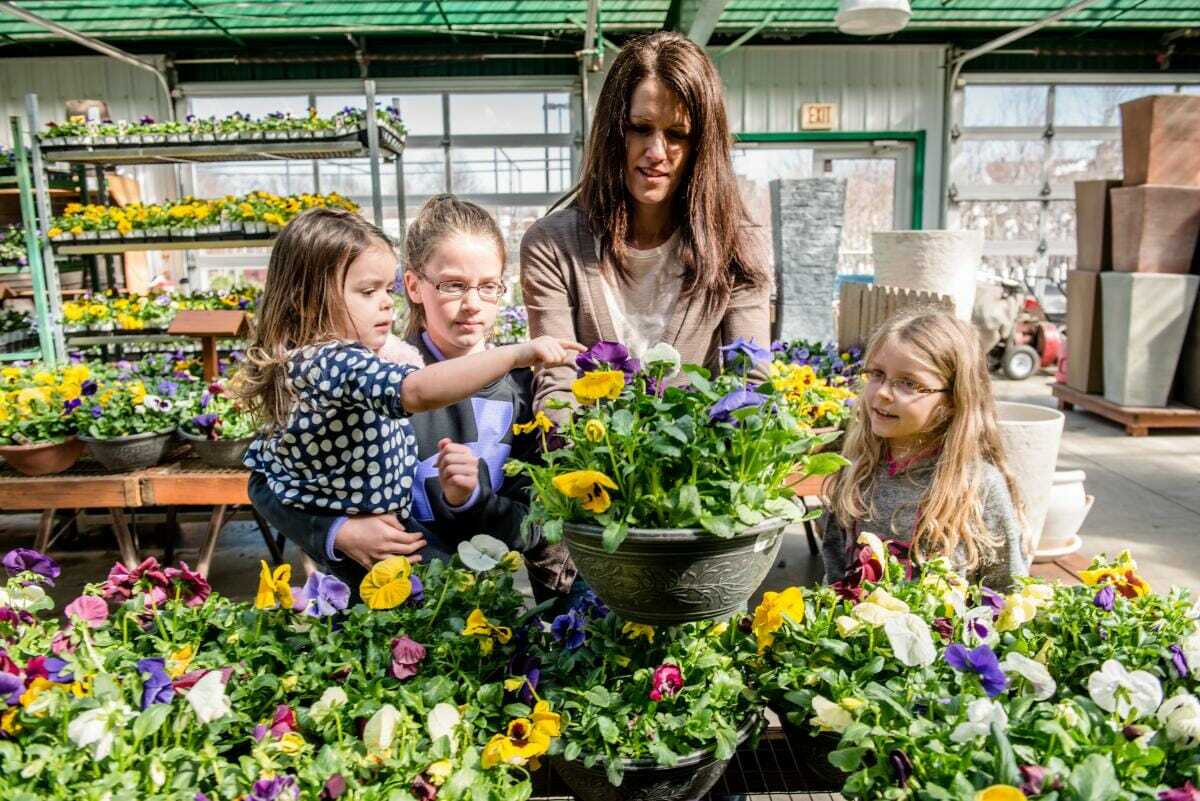
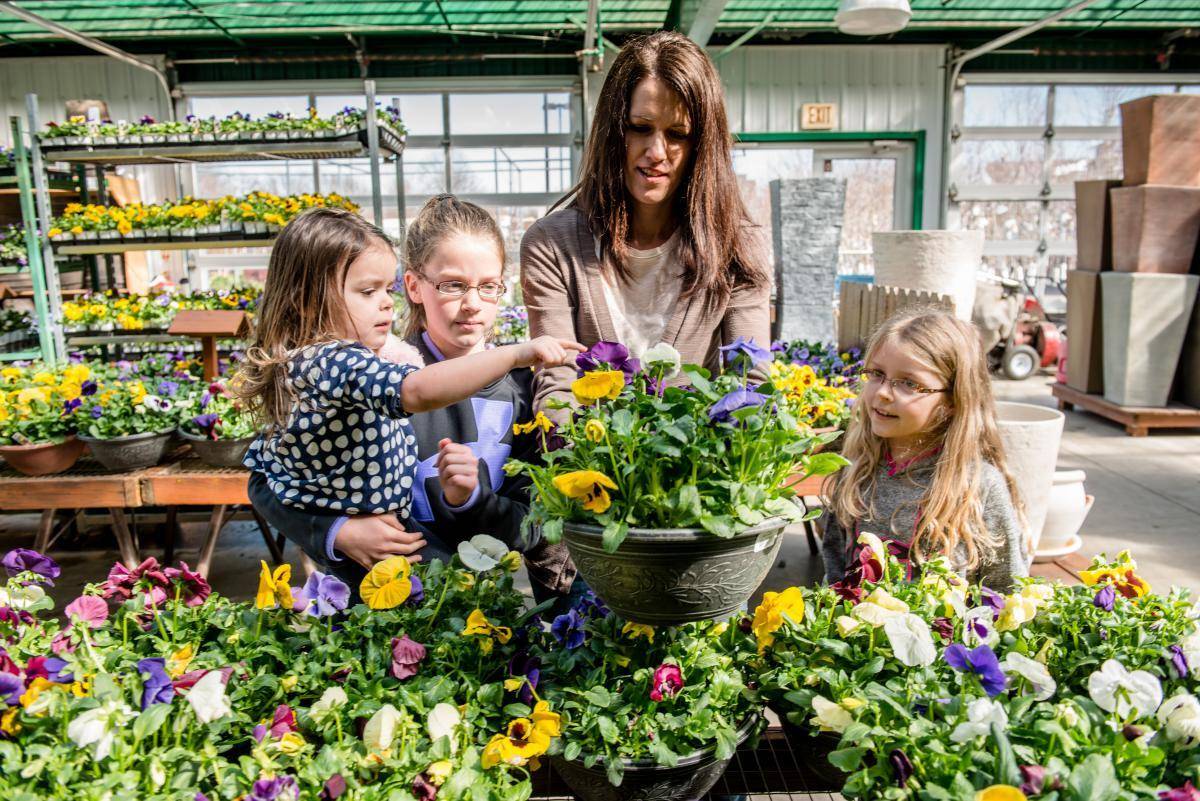
The Streck family envisions their flower garden at Earl May.
Did you know the average American is at least three generations removed from the farm? To help bring farm life to Iowans who don’t have direct connections or experiences on the farm, the Iowa Food & Family Project has teamed up with Darcy Maulsby, a grain farmer, author and award-winning cook in Calhoun County, to author a Farm Life Journal blog series.
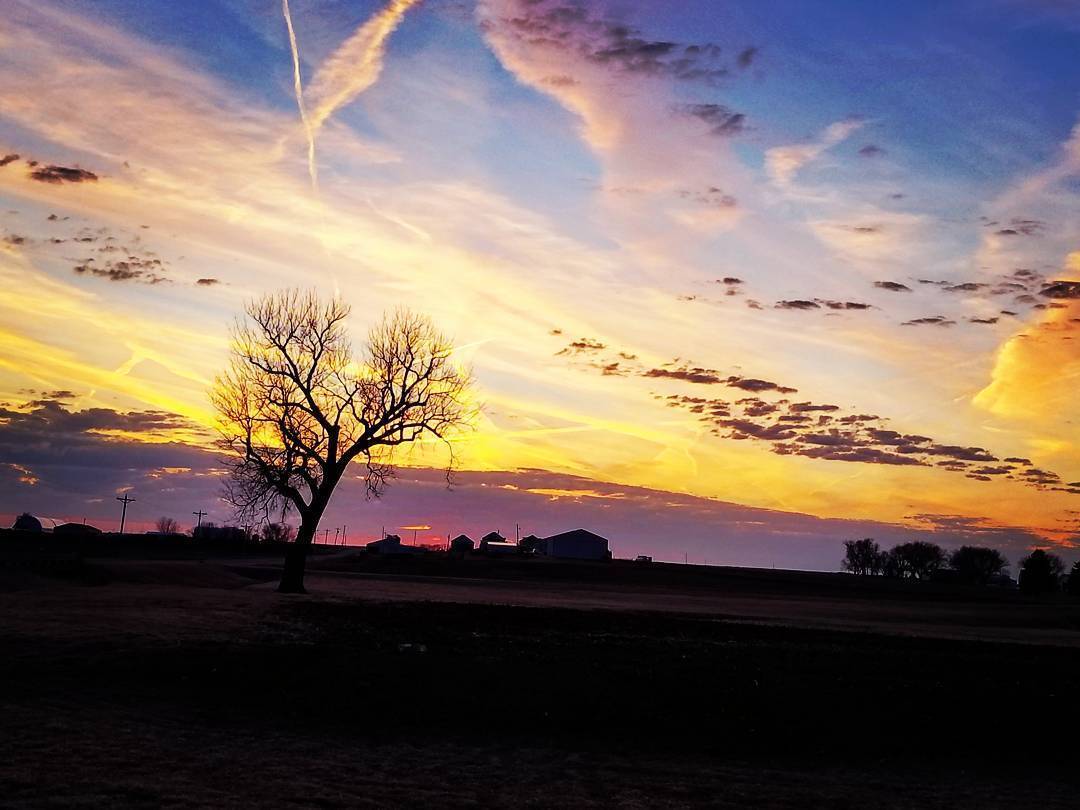
In this monthly journal series, Darcy provides insights on the day-to-day life of modern agriculture. She also shares her tried-and-true recipes, as well as captures the most beautiful sunrises and sunsets that can only be viewed from the tractor cab. Her heartfelt entries provide an intimate perspective on the challenges and joys of farming in Iowa, giving readers a personal connection to the fields they may drive by each day.
Darcy Maulsby captures the beauty of farm life in her blog series.
The glimpse into farm life is shared with more than 100,000 Iowans each month through the Iowa Food & Family Project’s Fresh Pickings newsletter and social media channels.
Variety – and pork loin – is the spice of life for Bob Plathe
There’s no such thing as a “typical” day for Latham® dealer Bob Plathe, and that’s exactly how he likes it.
“All my jobs keep me very busy, but I like it that way,” he says. “It keeps me on my toes.”
Bob works full-time at Bomgaars in Algona, Iowa, and has farmed with his son, Bobby, for more than a decade. His wife, Carol, works part-time at the Algona library. They also have a daughter, Emma. The Plathes raise corn and soybeans, and Bob is proud to be a fourth-generation Iowa farmer. In fact, his family was honored at the Iowa State Fair in 2017 with a Century Farm Award from the Iowa Department of Agriculture and Land Stewardship.
“When I started farming in 1980, I bought Latham soybeans from a dealer,” says Bob. “I was always impressed with Latham products. They had great results then and still do to this day.”
Bob says he got to know Don Latham while serving on the Iowa Soybean Board, so that’s what first sparked his interest. After purchasing products for years, he decided to take on a Latham dealership about seven years ago.
“When you work with the Latham’s, you just feel like they are your neighbors,” he says. “You don’t find many companies where the president gives tours and explains what the products are all about.”
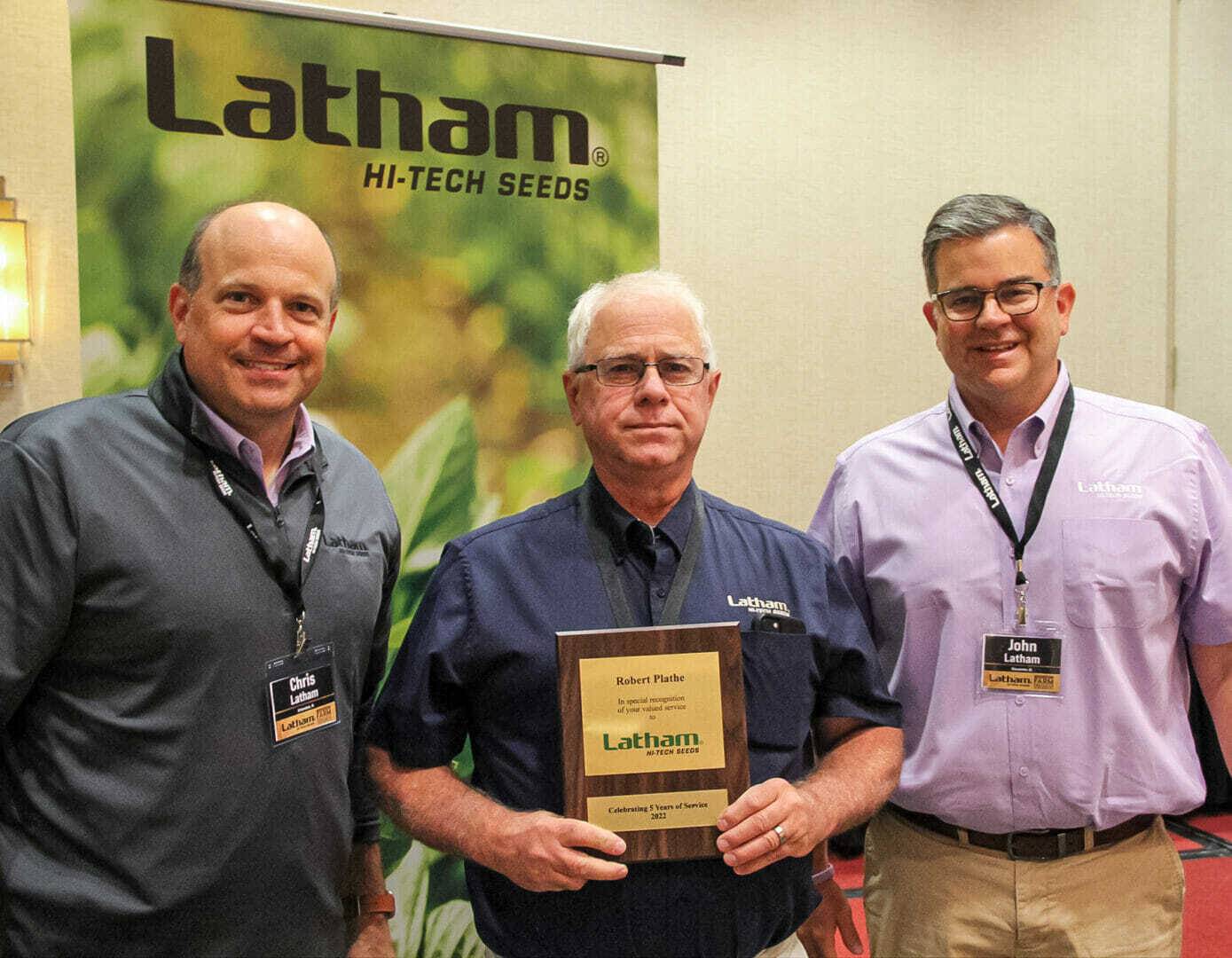
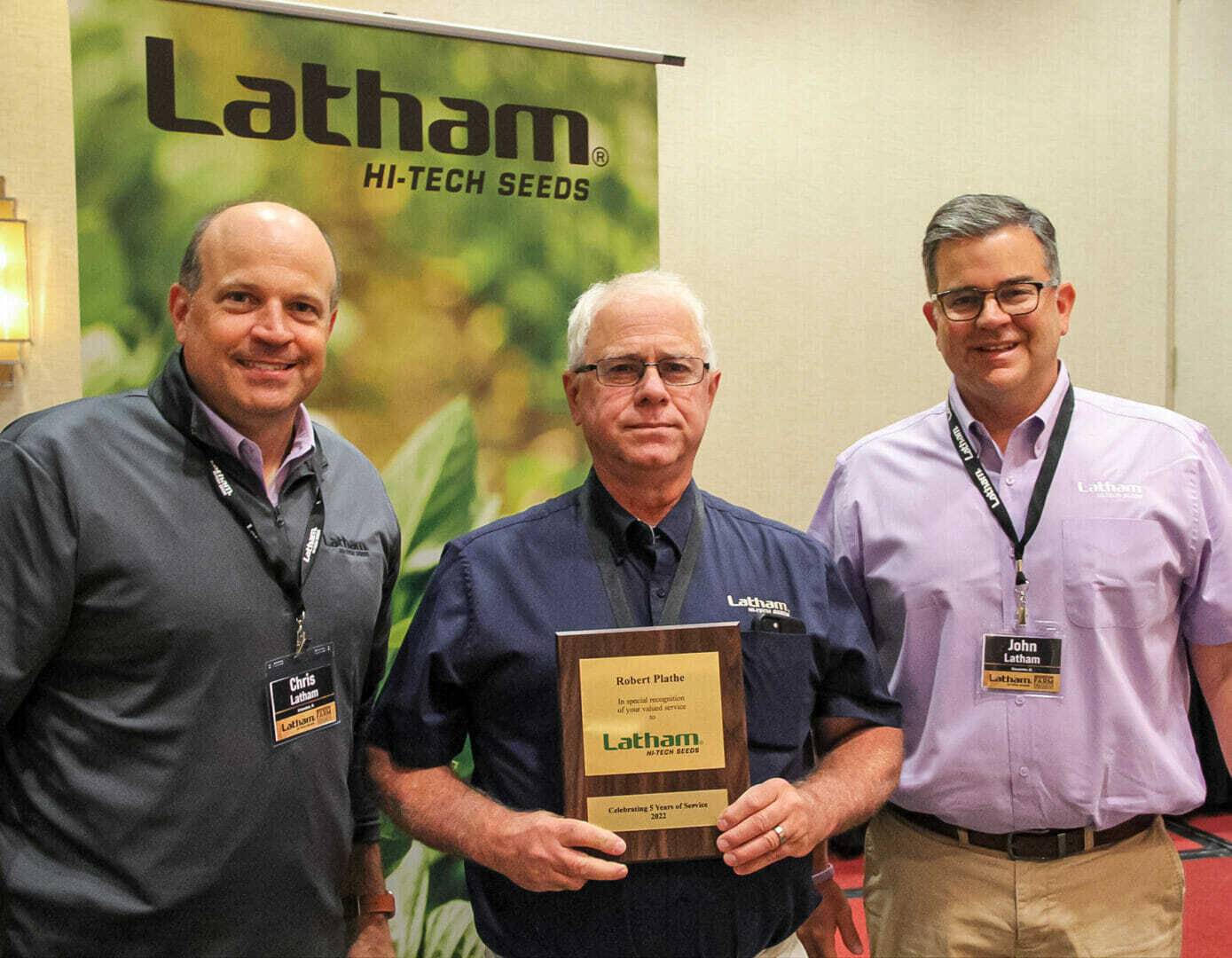
Chris Latham, Bob Plathe and John Latham
In addition to farming and working in agriculture, Bob finds time to serve on industry boards and stays active in his community. He served on the Iowa Soybean Association board for nine years. He also has been a leader in the Knights of Columbus. He served on the Extension council and the Farm Service Agency Committee, as well.
The Plathes enjoy watching Cyclone sporting events and try to make it to Jack Trice Stadium at least once every fall. Bob is also a fan of the Minnesota Twins and the Minnesota Vikings.
After a long day in the field, one of Bob’s favorite meals is marinated pork loin. He’s sharing the recipe with us here.
So how do we cultivate a culture of leadership? Our state is fortunate to have Leadership Iowa, which began in 1982 “to instill passion in our current and emerging leaders while fostering a high level of civic engagement.” A fundamental founding principle of Leadership Iowa was to educate and motivate new leaders from all sectors: business, education, farming, labor, nonprofits and government.
These leaders have different careers, different interests and different points of view, providing a valuable learning environment for all participants. They come to realize that public and private sectors share common interests, and they see how their teamwork can help benefit Iowa and its communities.
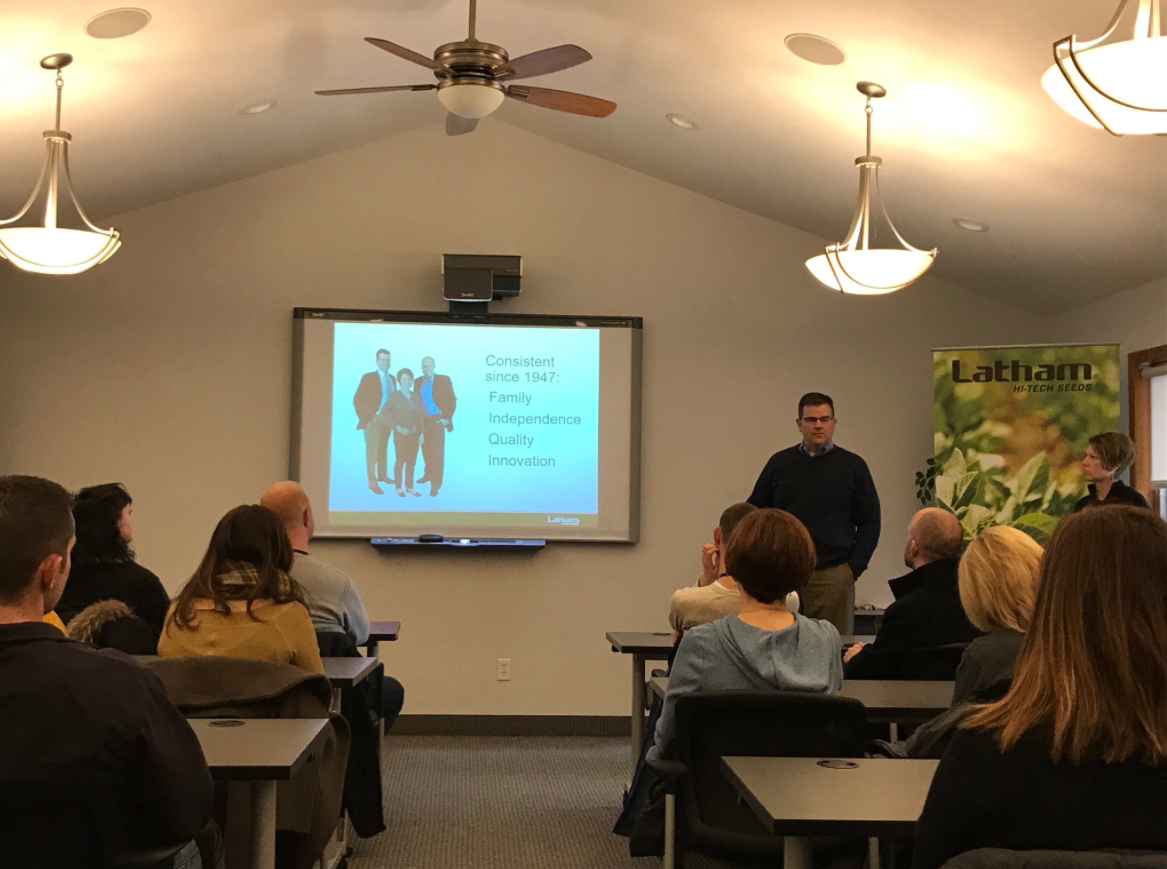
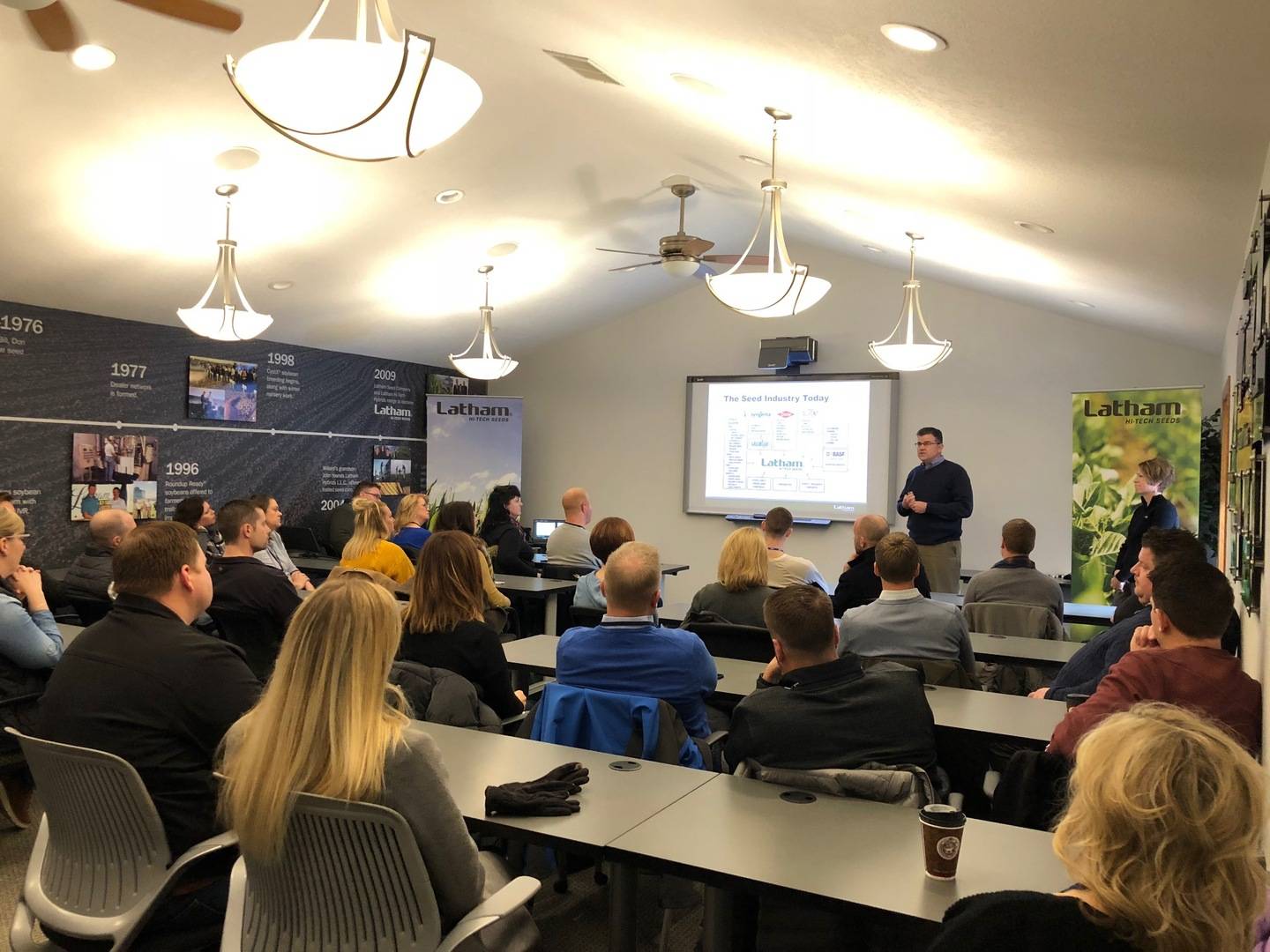
It was a full house of leaders in our conference room yesterday morning!
Leadership Iowa participants travel around the state, focusing on economic development, health care, education, government services, environment, recreation and other issues. This month they are focusing on agriculture, and Latham Hi‑Tech Seeds had the pleasure of hosting the group’s first stop. We shared our story of how we’re proud to carry on the family tradition of producing the highest quality seeds for farmers to plant throughout the Upper Midwest.
“I had no idea where farmers got the seeds they plant and was impressed by how much science and research go into modern agriculture. It’s fascinating,” said Leadership Iowa participant Maureen “Mo” Lockwood, manufacturing manager for Thombert, Inc. in Newton.
John and Shannon Latham explained how farmers don’t plant the seeds they harvest. A lot of science goes into the development of seed, and as a result, yields have dramatically increased. (Click here if you’re interested in learning more about why farmers don’t save their seed.)
“Much of what we discussed about ag is all new to me. I didn’t know much about GMOs. I also had no idea how many complicated decisions farmers have to make. When you drive by a soybean field, you don’t think about details like where the seed comes from, how the land is managed or where the crop goes after it’s harvested. I learned a lot here in Franklin County,” said Sandy Byers, director of surgical services at CHI Health Mercy in Council Bluffs.
John & Shannon Latham tell the Latham Story to the group.
At Latham Seeds, we contract with farmers to grow seed stock. Most of our soybeans, for example, are grown within 30 miles of our plant in Alexander, Iowa. Upon harvest, that seed is delivered to Alexander. We then check each wagon load or semi load by hand. Each variety that meets our initial inspection is stored in separate grain bins until we’re ready to clean, condition and bag it. The quality of the seed is checked every step of the way.
“I was impressed by how high tech today’s corn and soybean seeds are. I also learned a lot about what cover crops are and why farmers plant them. I liked the opportunity to visit with farmers and ask them questions,” said Leadership Iowa participant William Sonderman, manager of transmission planning and tariffs, Central Iowa Power Cooperative, Cedar Rapids.
One question asked by participants was related to succession planning. Succession planning helps ensure the family business or family farm will continue to operate by identifying future leaders and managers. We also talked about the importance of work experience and succession planning.
“I noticed how many speakers talked about the importance of working for someone else before returning to the family business. This is something that’s important to my family for our business, too,” said Michelle Cassabaum, COO/CFO, 21st Century Rehab in Nevada.
Leadership Iowa visited Latham Customer April Hemmes to learn about her production agriculture.
From Alexander, Leadership Iowa participants traveled to Mayne’s Grove near Geneva where they met with young Franklin County farmers about how they got started farming. They also learned about drones and precision technology that can help farmers use variable rate planting to match plant population to field conditions, as well as manage micronutrients through foliar feeding and nitrogen through timing and placement.
“Some of the things I take for granted as common knowledge about ag aren’t common knowledge for our non-farm friends. This struck me during our Leadership Iowa ag sessions in Franklin County, and I’m reminded why sharing ag’s story is so vital. Some of my Leadership Iowa classmates weren’t raised in rural Iowa but grew up in New Mexico or Massachusetts. Others are Midwesterners but grew up in large cities like Minneapolis. Even native Iowans in my class have little or no contact with modern agriculture. They have a lot of interest in learning about ag, though, and ask a lot of thoughtful, honest questions about what defines a factory farm versus a family farm, what’s being done to address water quality, why do farmers plant cover crops, and more. Who better to help answer these questions than farmers and other ag professionals?” Darcy Maulsby, fifth generation farmer and author-preneur from Lake City.
Yesterday afternoon the Leadership Iowa group also toured the Whispering Willow Wind Farm south of Hampton before ending their day with a meal on the farm of Charlie and Barb Brown of Hampton. Sitting down to share a meal allows people to reflect upon the day, share stories and reflect upon experiences.
“Even though our business serves agriculture, I don’t come in contact with all the different aspects of crop and livestock production. Now when people talk about various ag terms and farming methods, I have a much better idea of what this all means and how things work.” –Molly Varangkouhn, president, Hy-Capacity, Humboldt
We hope the Leadership Iowa group departs Franklin County with fond memories! Good food also helps make good memories, so today we’re sharing with you a favorite recipe from Claire Masker, who was a member of Leadership Iowa 2015-16 and also is director of public relations for the National Pork Board. Find other recipes, like Pulled Pork Tortilla Soup, at Pork.org.
Spring has officially sprung! The first day of spring marks National Ag Day, which began in 1973 to help Americans understand the role agriculture plays in providing safe, abundant and affordable products, as well as in maintaining a strong economy.
The theme for this year’s Ag Week celebration is “Agriculture: Food for Life,” which is fitting since those of us engaged in agriculture and agribusiness are responsible for growing and producing what each person needs for daily living: food, clothing and shelter. In addition, agriculturists get the credit for golf courses and grass turf used for sports like soccer and football. Through science, innovation and caring hands, a seed was the start of all these things that contribute to our quality of life!
One of the things I enjoy most about Ag Week is watching what others in our industry are doing to celebrate and advocate. Agronomist Karen Corrigan (@weedgirl24 on Twitter) put together Ag Bags for each student in her daughter’s preschool class to take home on National Ag Day. Each bag included a beef stick from Clint & Sons; the company donated one stick for each one that Corrigan purchased. Each bag also included ag mags, coloring books and soybean crayons donated by the Tazwell (Illinois) County Farm Bureau. In addition, Corrigan gave a bag full of books to the two preschool teachers.
“My daughter’s teachers mentioned they were having a hard time finding materials to teach kids where food comes from, so I made it a point to find them resources for their nutrition unit,” says Corrigan.
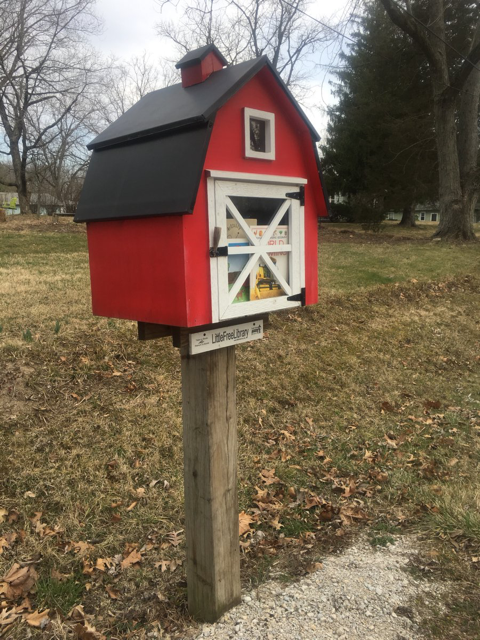
Corrigan’s unique Ag Day celebration inspired Pam Smith, who is crops technology editor for DTN/The Progressive Farmer magazine, to fill a “little free library” with agriculture-related books. Little Free Library is a nonprofit organization that inspires a love of reading, builds community, and sparks creativity by fostering neighborhood book exchanges around the world.
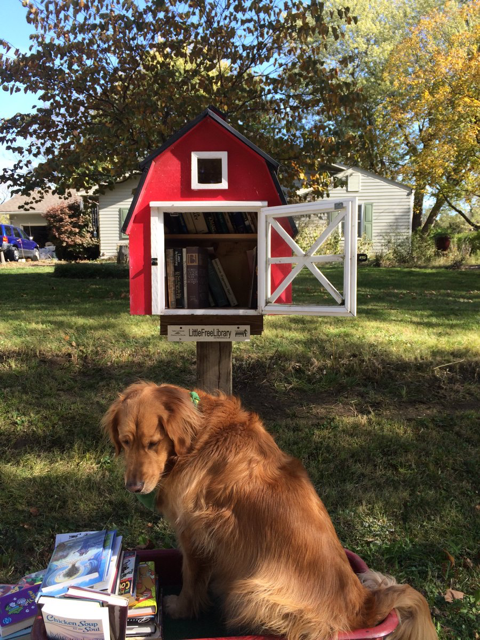
Pam’s best girl, Lucy, helped her do a little “fall cleaning” in the little library.
“The idea of the little free library is to ‘take a book, return a book’,” explains Smith. “The only thing better than finding a book that touches your heartstrings is to share that joy with someone else.”
What I love about Smith’s little library is its unique barn shape. The barn shape is fitting for Smith, who as a child, snuck into the barn loft to read books.
“My husband and I were on a bicycling trip in Ohio and started noticing what looked like very fancy or interesting mail boxes. We finally stopped to check them out and realized they were little libraries. I was smitten,” says Smith. “About five years ago, my husband surprised me by giving me this barn-shaped little free library as a Christmas gift.”
Now these ladies have me thinking about what difference I can make in my own community to help residents better understand agriculture. Although we live in a rural community, we can’t take it for granted that everyone understands farming and food production. I know Iowa’s commodity groups have done a great job of producing children’s books, so I plan to stock little free libraries in Latimer and Hampton with children’s books that tell stories about farmers who raise the corn, soybean and forage crops that are fed to cattle, pigs, turkeys, chickens and other animals.
In honor of the hardworking men and women who care for land and livestock, today we’re featuring a recipe for the Ultimate Pork Breakfast Burgers. It really could be called the Ultimate Farmer’s Breakfast as it includes something from every food group including burger, bacon, eggs and cheese plus onions and peppers served on a sweet Hawaiian bun. Thinking about it is enough to make one’s mouth water!
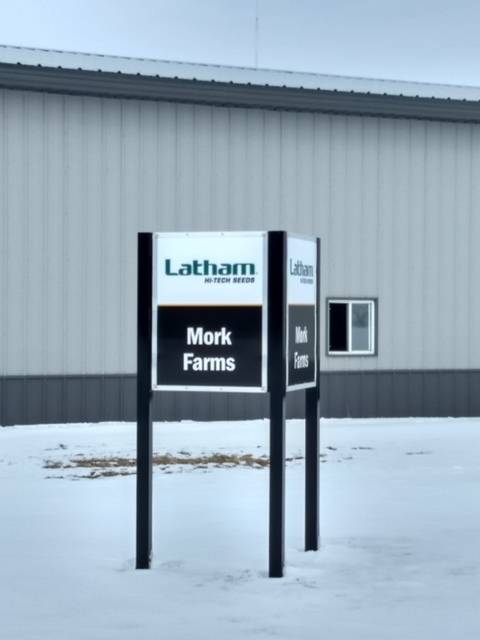
Jerry Mork knew at a young age that he wanted to farm, but he never thought he would have the opportunity to do so. His patience was tested like Job in the Bible, but he persevered after 40 years.
After graduating in two years from the North Dakota State College of Science, Jerry spent 12 years in the oil industry. Two and one-half of those years were spent in the Middle East, where he encountered many harrowing experiences including facing the wrong end of an AK47 in Libya. Jerry worked a five-year stint as a hydraulics specialist on the northern slope of Alaska, as well as one winter in Northwestern Alberta, Canada.
Jerry worked numerous job locations in the western half of the United States before he decided to return to college. He earned a Bachelor of Science degree from the University of Nebraska – Lincoln. He then worked another 18 years as an electronic engineer primarily in Nebraska before his path led him to Day County South Dakota.
“When I first got out of college, I started investing. My first opportunity was with an old family friend, who wanted me to own his farm. I was blessed with other opportunities adjacent to where I grew up, and I was able to grow my farm base in South Dakota,” says Jerry. “I started farming 25 acres just two miles from the farm where I grew up, although I was living in Nebraska at the time. I would plan time off to plant my 25 acres in the spring and hire it harvested in the fall. Eventually, I had enough land that I could consider making it work to farm full time.”
Jerry and his wife, Rita, decided they wanted to raise their sons in the country. In 2008, they moved to Webster, South Dakota.
To supplement his farming income, Jerry worked as a sales and service technician for the healthcare division of GE until he could justify farming full time. He then decided to replace his off-farm income with a seed dealership in 2008. He noticed that Latham® seed products were performing well in the F.I.R.S.T. trials and decided to learn more after passing by the Latham Hi‑Tech Seeds booth at the Watertown Farm Show in 2015.
“I know I have superior products to sell, but I’ve found that selling seed requires deep, long-term relationships. I enjoy forming these relationships,” says Jerry. “With Gary Geske and Myron Keltgen on the Latham team, we really have access to two of the industry’s leading product specialists. I know that I can pick up the phone and call them whenever I have a question. I also appreciate Latham Seeds’ commitment to continuous training for its dealers.”
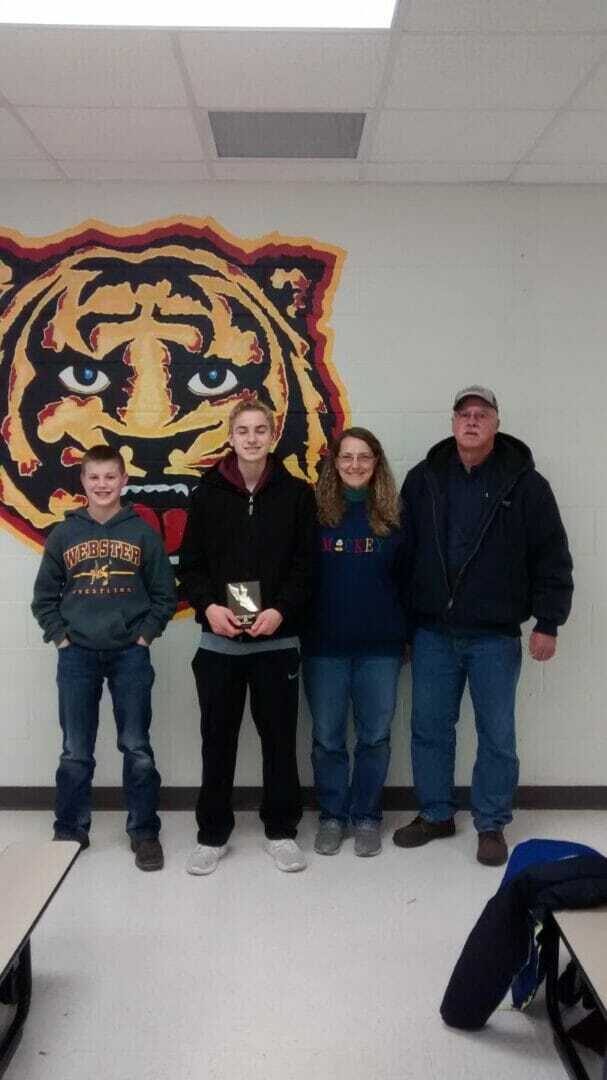
Another thing Jerry says he likes about Latham Seeds is that it’s a family-owned business that encourages families to enjoy spending time together at its business meetings. Rita and their two sons enjoy the annual Latham® dealer sales meeting. Their oldest son, Brian, is a sophomore at Webster Area Community School. He enjoys basketball and track. Last season he went to state in cross country. He is also working toward becoming an Eagle Scout. Brian is interested in technology and computers; he plans to pursue a career as an architectural engineer. Matthew, 13, loves anything that deals with farming. He’s excited that he was old enough to join FFA this year. He wants to learn how to weld and plans to sell seed, too. Matt also enjoys competed in the state 4-H archery competition.
Interest in shooting sports is growing thanks to a unique partnership between Webster 4-H clubs and the Isaac Walton League. The community of Webster got a new outdoor 3-D archery range from a $5,000 grant from the South Dakota Farm Bureau Centennial Community Initiative plus contributions from local businesses. The addition of the outdoor 3-D range means competitions can now be held in Webster, drawing in shooting sports enthusiasts from miles away.
“This has really been a cooperative project,” says Jerry, who serves as president of the Clark/Day Counties Farm Bureau. “I believe its location along U.S. Highway 12 will increase the visibility of shooting sports here and serve as another draw to Webster for people who enjoy outdoor sports. A new sign will go up at the shooting range this spring as part of an Eagle Scout project. It’s all coming together.”
In addition to serving on the Farm Bureau board, Jerry is serving as grand night for Knights of Columbus. He’s also in his fourth year as a CCD teacher. When he’s not busy working or volunteering in his community, Jerry enjoys riding snowmobiles with his family. They also enjoy traveling and attending KC Royals games in the summer.
Just Dig into the FFA, Encourages Experienced Teacher
Whether you’re interested in touring the U.S. Capitol, building your resume, developing your leadership potential or seeing international sites like the Great Barrier Reef, the FFA can take you there! Global Programs allow FFA members to explore different agricultural practices, business practices and cultures in countries around the world. Career Development Events (CDEs) help students develop the abilities to think critically, communicate clearly and perform effectively in a competitive job market.
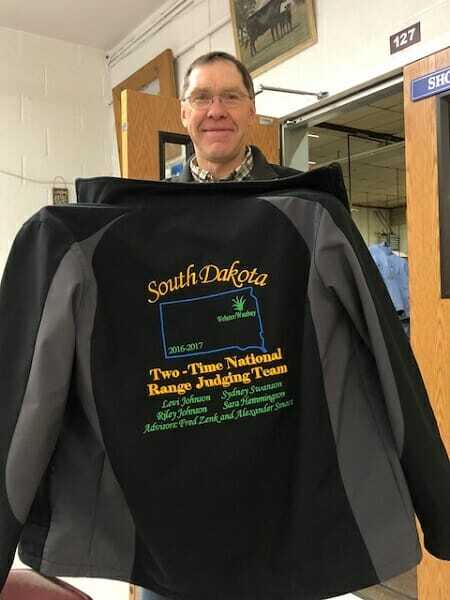
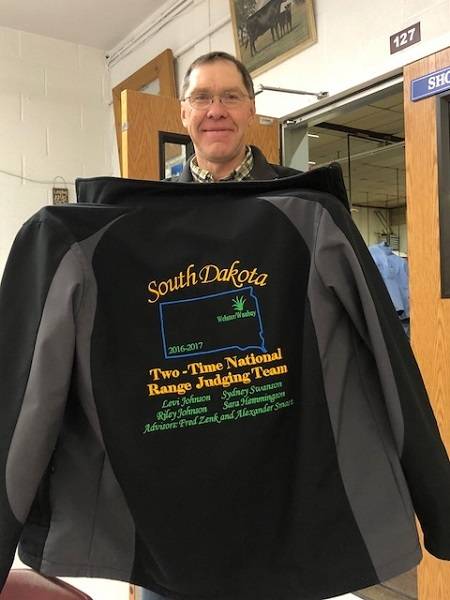
“If you just a little digging, there is something for everyone. There are programs and activities that will interest students whether they live in town or in the country and whether or not they’re interested in livestock or agronomy,” says Mr. Fred Zenk, who is in 20th year as ag instructor and FFA advisor in Webster, South Dakota. “One of my students placed in the top four nationally in public speaking. Seven students have worked and studied overseas in Africa, China and Europe. There is literally a world of opportunity for FFA members.”
Variety is one reason Mr. Zenk said he became interested in teaching agriculture. “Agriculture education” covers so many subjects: small engine repair, soils, ag mechanics, agronomy and animal science. He also teaches 7th and 8th grade exploratory and Ag Business plus offers an Ag Science for freshman.
“I really enjoy it when students discover their strengths and you see them really start to enjoy their studies. It’s a lot of fun when they start asking questions, desire to learn more and show a genuine interest,” says Mr. Zenk. “I really enjoy watching students develop their potential and gain confidence. There were a few students who had low self esteem and went on to become state FFA officers.”
Mr. Zenk and his wife, Cindy, have four children who also benefitted from participating in the FFA. Their two daughters and two sons had FFA projects in beef and crop production. Mr. Zenk says he knows their FFA experiences have contributed to their career success. Oldest daughter, Crissa, graduated from South Dakota State University (SDSU) and worked for Monsanto. She and her husband own their own feed company plus raise beef cattle and Katahdin sheep. Kyli went into social work and now does accounting. Derek works as a seed production specialist for Kuecker Seed Farm in Webster. Danny works as an agronomist for the newly formed AgTegra Cooperative.
The Zenks share a love of agriculture. As conservation district manager and state soil health coordinator, Cindy Zenk wants to get kids involved with conservation. She coordinates tree plantings and manages CRP acres, so she and Fred work together to identify learning opportunities for students.
One such learning opportunity is Range Judging. There are more than 120 plants in South Dakota that students must identify as part of the state competition. Students must determine if the plant is native or introduced, cool or warm season, perennial or annual, good or bad for grazing, as well as whether it’s used by wildlife and fowl for cover or food.
“Our state has chosen Prairie Grouse as the indicator for wildlife habitat because pheasants aren’t native to South Dakota,” explains Mr. Zenk. “In the Range Land competition, students must identify factors that are important to Prairie Grouse such as nesting cover, brood food, and brood habitat.
Mr. Zenk coached an FFA Land and Range Judging team in 2016 and co-coached a 4-H Land and Range Judging team in 2017. His two teams qualified for national competition in both 2016 and 2017. The Day County team was named reserve national champion at the National Land and Range Judging Contest on May 4, 2017, in Oklahoma City.
Understanding soils is key for both livestock and crop production. Students studying agriculture at Webster High School must decide which crops they’re going to plant on the 78-acre student-run farm. Their farm has been no-till since 1996. They usually plant oats and soybeans but have planted wheat. This year Mr. Zenk said the students’ biggest decision was whether to plant oats or spring wheat. Students decided to plant oats because the soils where the crop will be planted contains 13 inches of good soil with a level of gravel underneath.
“This area receives just enough moisture to get a 35-pound test weight on oats,” explains Mr. Zenk. “They decided to go with oats and also picked a cover crop mixture.”
Students learn about new agricultural practices and technologies through
“Technology has changed how I teach,” says Mr. Zenk. “We can take so many more ‘field trips’ through the Internet.”
His classes have taken virtual field trips to the Ford Motor Company, Texas Tech, Cornell University, Cal Poly College of Agriculture, Food and Environmental Sciences, Iowa State Veterinary Laboratories and Crops Lab, as well Cat® Equipment to name a few.
Mr. Zenk tells his students, “The harder you work the further you will go.” We salute teachers like Mr. Zenk who inspire the next generation of agriculturists!
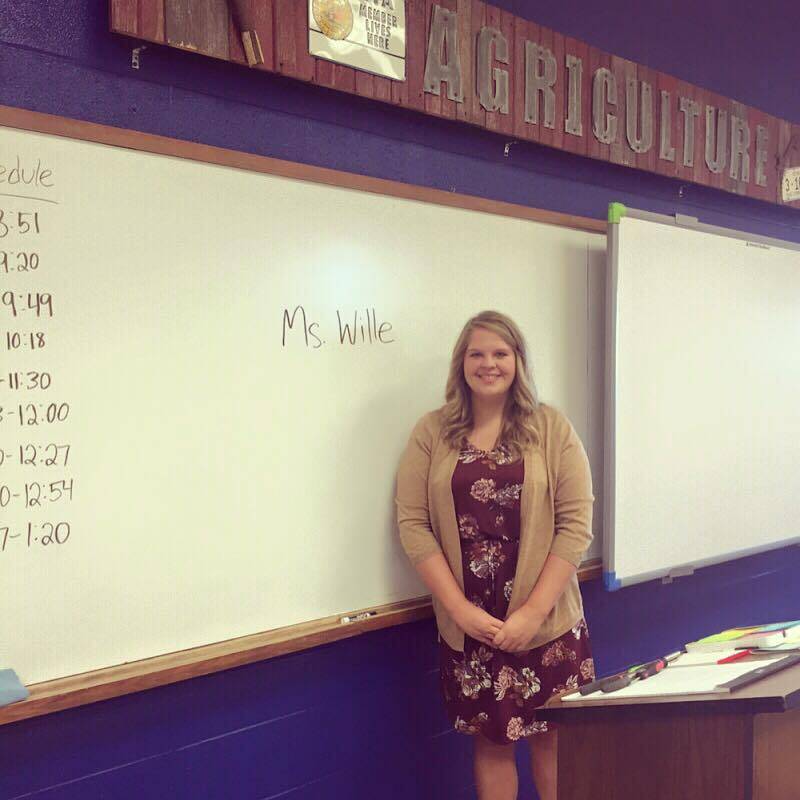
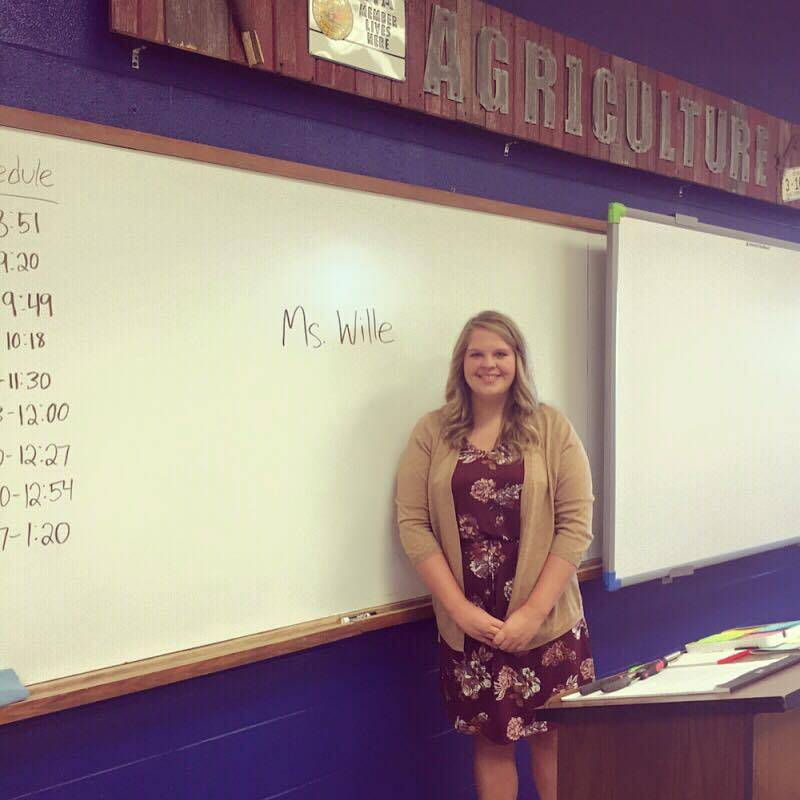
Sarah Wille on her first day at MFL MarMac School.
As a young girl, Sarah Wille looked up to her mom in her role as a teacher in their community. She spent a lot of time in her classroom, watching her mom make a difference in the lives of her students. Sarah dreamed of one day doing the same as a teacher, but she had another passion for agriculture.
“When I was younger, I loved helping my dad on the farm whenever possible,” said Sarah, whose family owns a small row crop and beef feedlot near Williamsburg, Iowa.
When Sarah began high school, she wanted to be involved with the Williamsburg FFA program.
“I got my start in FFA by participating in speaking events, and I was hooked on the program from then on! I loved all of the opportunities to get more involved with agriculture and meet students from all around the U.S. who had the same passion for agriculture as I did.”
Sarah served as a chapter officer, competed in numerous Career Development Events and earned the Iowa FFA Degree. In fact, Sarah and I met while standing in line to receive our Iowa degrees at Iowa FFA Convention.
After graduating from high school, Sarah chose to attend Iowa State University and study agriculture.
“Iowa State’s College of Agriculture has an outstanding reputation. I knew I wanted to be involved in the industry, but I wasn’t sure in which capacity. I started out as ‘Ag Undecided,’ so I explore a variety of options the college had to offer. I eventually chose Ag Education because I wanted to help today’s students find satisfying careers in agriculture.”
In addition to preparing to become a teacher through her curriculum, Sarah interned for the Iowa FFA Association during her senior year.
“I really enjoyed giving back to FFA by helping out with programs and events throughout the state. It also allowed me to get a sneak peak of what my future job as an FFA advisor would be like, plus I made some great connections along the way!”
Upon graduating from ISU in May 2017, Sarah accepted a teaching position at MFL MarMac Community Schools in Monona. She spent most of the summer remodeling her classroom. She cleaned out old materials, painted the walls and redecorated. She started new activities within the FFA chapter, so students would step outside their comfort zones and compete in events they have never done before such as livestock judging and parliamentary procedure. She also increased the number of students involved in chapter activities during her first year as advisor.
MFL MarMac FFA Chapter
“I enjoy the connections I make with students through FFA because you get to know them better. I also like to see my students succeed when they take opportunities outside of the program and have the chance to apply what they have learned in the classroom.”
The MFL MarMac FFA Chapter hosts many events throughout the year in their school district and community. These include a blood drive and plant sale, as well as maintaining sports fields. They also attend as many leadership conferences as possible such as national convention, state convention and training within their FFA district.
To celebrate FFA Week earlier this month, MFL MarMac FFA Chapter had dress up days at school and cooked breakfast for the teaching staff. They also attended the Clayton County Commodity evening where they learned more about opportunities in agriculture.
Due to Sarah’s busy schedule running the FFA program, her time to cook is somewhat limited. See her favorite quick and easy crock-pot recipe for Honey Garlic Chicken below!
Webster FFA & Day County 4-H Alum Pursues His Passion for Farming
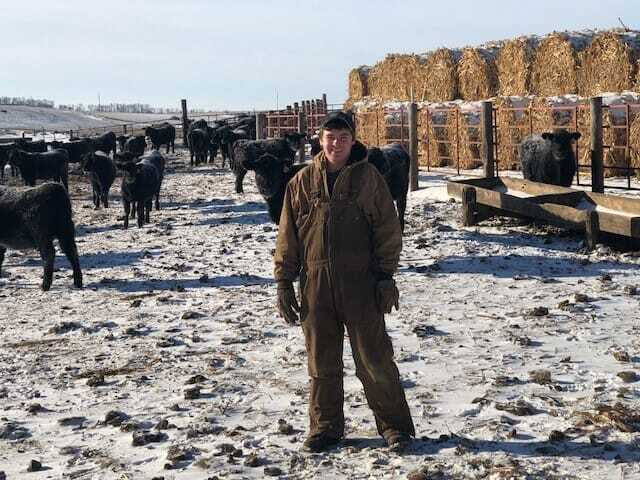
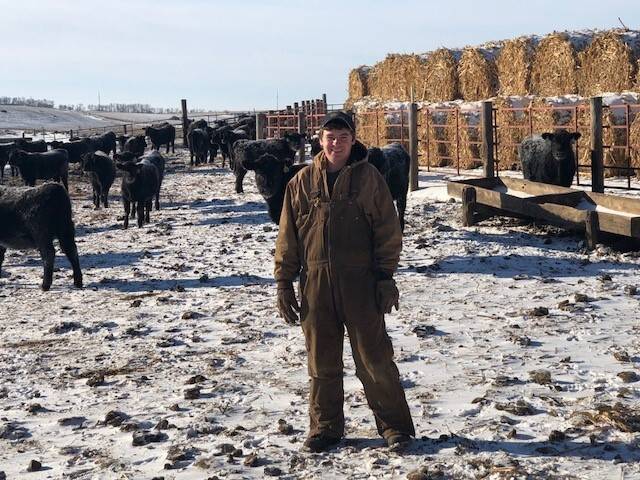
Riley Johnson is a fifth generation farmer in Webster, SD. He says his FFA Supervised Agricultural Experience helped him prepare to raise cattle and crops.
Before Riley Johnson of Webster, South Dakota, was old enough to join the FFA Organization, he was living its creed:
I BELIEVE that to live and work on a good farm, or to be engaged in other agricultural pursuits, is pleasant as well as challenging; for I know the joys and discomforts of agricultural life and hold an inborn fondness for those associations which, even in hours of discouragement, I cannot deny.
“I’ve always wanted to farm and never really had the passion to pursue another job,” says Riley. “I enjoy ag mechanics and welding, but I get to do both of those on the farm any way. I really enjoy growing crops, raising cattle and running equipment.”
From the time he was old enough to shadow his father, Riley has been a part of his family’s family operation. This fifth generation South Dakota farmer started raising crops and Black Angus cattle full-time with his family in May 2017 after he graduated from high school. The three generations that he farms with include Riley’s grandfather, Walter Johnson; his father, Larry; his uncle Wayne; and Wayne’s son, Andy.
“When I was little, I looked up to my dad. I thought it was neat to ride next to him in the big machinery. When I got older, I realized how much hard work and skill really goes into farming. You can’t control the markets or the weather, but you can do your best to raise the best crop and livestock. I like that challenge.”
In addition to working with his family, Riley farms some of his own ground and runs 26 cow/calf pairs. He has had his own cow herd ever since he was old enough to buy bottle calves from his dad. Riley also trades bull calves to his grandpa for heifers.
In addition to the on-the-job training Riley receives from his family members, he says the FFA prepared him well. His FFA Supervised Agricultural Experience (SAE) started in beef production and then transitioned into crop production.
“I really enjoy raising cattle because it’s a year-long journey. Our calves are usually born in April. I enjoy working with the calves and watching them grow. Then we usually put the cows and calves on pasture from the end of May through mid-October. I enjoy riding out to check on them plus I keep a close watch on pasture quality.”
Preparing for the range judging competition helped Riley appreciate the value of pasture quality. He learned to calculate the optimal number of cows to have on pasture. It also helped him become more aware of the types of plants that provide forage for his livestock and habitat for wildlife. If there are too many weeds in the pasture, then plant control is needed. It’s also important not to overgraze pasture or it will hurt the native Prairie Grouse population.
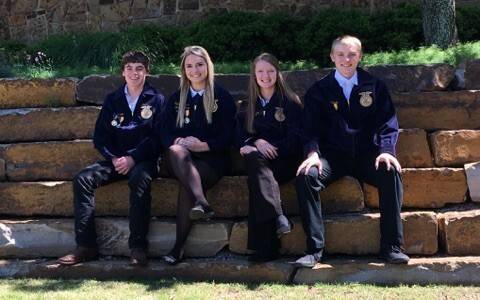
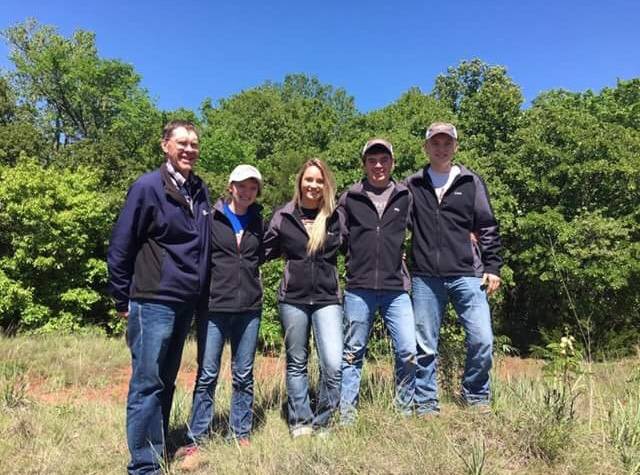
Range judging team with Mr. Fred Zenk, Webster FFA advisor
It’s impressive enough that Riley competed in range judging locally. What’s more impressive, however, is how well he and his Day County team members performed. Coached by both Riley’s FFA Advisor, Mr. Fred Zenk, and SDSU Extension Sheep Field Specialist Dave Ollila, the Day County Range Judging team qualified both in 2016 and 2017 for the national competition.
The FFA creed concludes: “I believe that American agriculture can and will hold true to the best traditions of our national life and that I can exert an influence in my home and community which will stand solid for my part in that inspiring task.”
Riley Johnson has chosen to exert an influence in his home and community.
“I like working with my family,” says Riley. “No one else cares about your business as much as you do. We all to share this experience, and we get to spend every meal together.”
Like any good beef producers, the Johnsons enjoy a homegrown steak on the grill. They also enjoy cooking with beef. When you’ve been out working cattle in these cold temperatures, nothing hits the spot like a warm lunch. Today Riley is sharing with us his favorite recipe for lasagna soup.

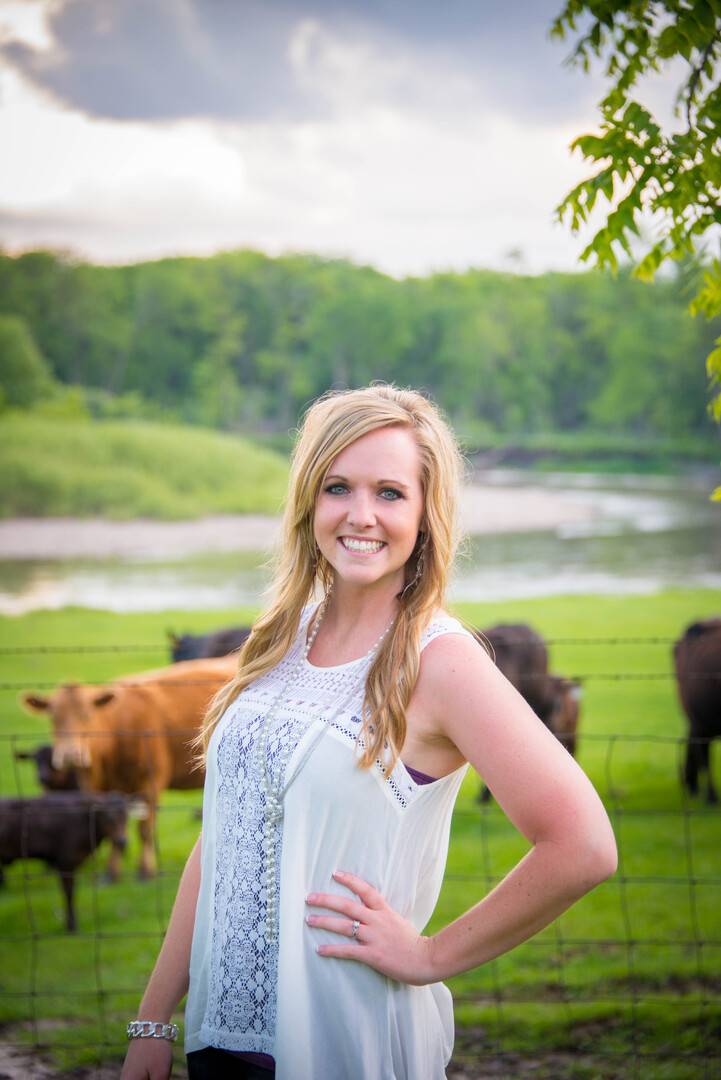 guest blog post by Brooke German, Director of Marketing, Iowa Beef Industry Council