Duracade Approval Puts New Trait in Arsenal to Fight CRW
Farmers need multiple options to fight corn rootworm (CRW), and the efficacy of Agrisure DuracadeTM appears promising. With its new and unique mode of action, Agrisure Duracade will be combined with the Agrisure® RW trait to provide dual modes of action on corn rootworm.
When more than one trait is added to individually control corn borer and CRW, studies have shown the yield advantage increases by an additional 6-8 bushels per acre over the single-traited CRW protected hybrids. Research by the United States Department of Agriculture has reported that the Agrisure Duracade trait delivers the highest reduction in beetle emergence (99.79%) of any commercial CRW trait.*
Corn rootworm is the single most destructive pest in U.S. corn production. Before the availability of corn-rootworm-resistant biotech traits, populations of western corn rootworm and northern corn rootworm caused annual yield losses and control costs that exceeded $1 billion. To prevent corn rootworm damage from reaching such devastating levels again, it’s important for farmers to plant a portfolio of products and to reduce risk with rotation. Rotation involves rotating modes of action, and that’s why Agrisure Durcade will be an important defense mechanism in farmers’ ongoing battle with CRW.
Supplies of Latham® Hi‑Tech Hybrids with the Agrisure Duracade trait will be available for the 2014 sales/planting season. For more information, talk to your local Latham® representative or call 1-877-GO-LATHAM (1-877-465-2842).
*Field measures of Western corn rootworm mortality caused by transgenic corn expressing the mCry3A (MIR604) and eCry3.1Ab (5307) proteins. (Hibbard et al. ESA Meeting December 2010)
Latham Employees “Do Battle” to Support Local Food Pantries
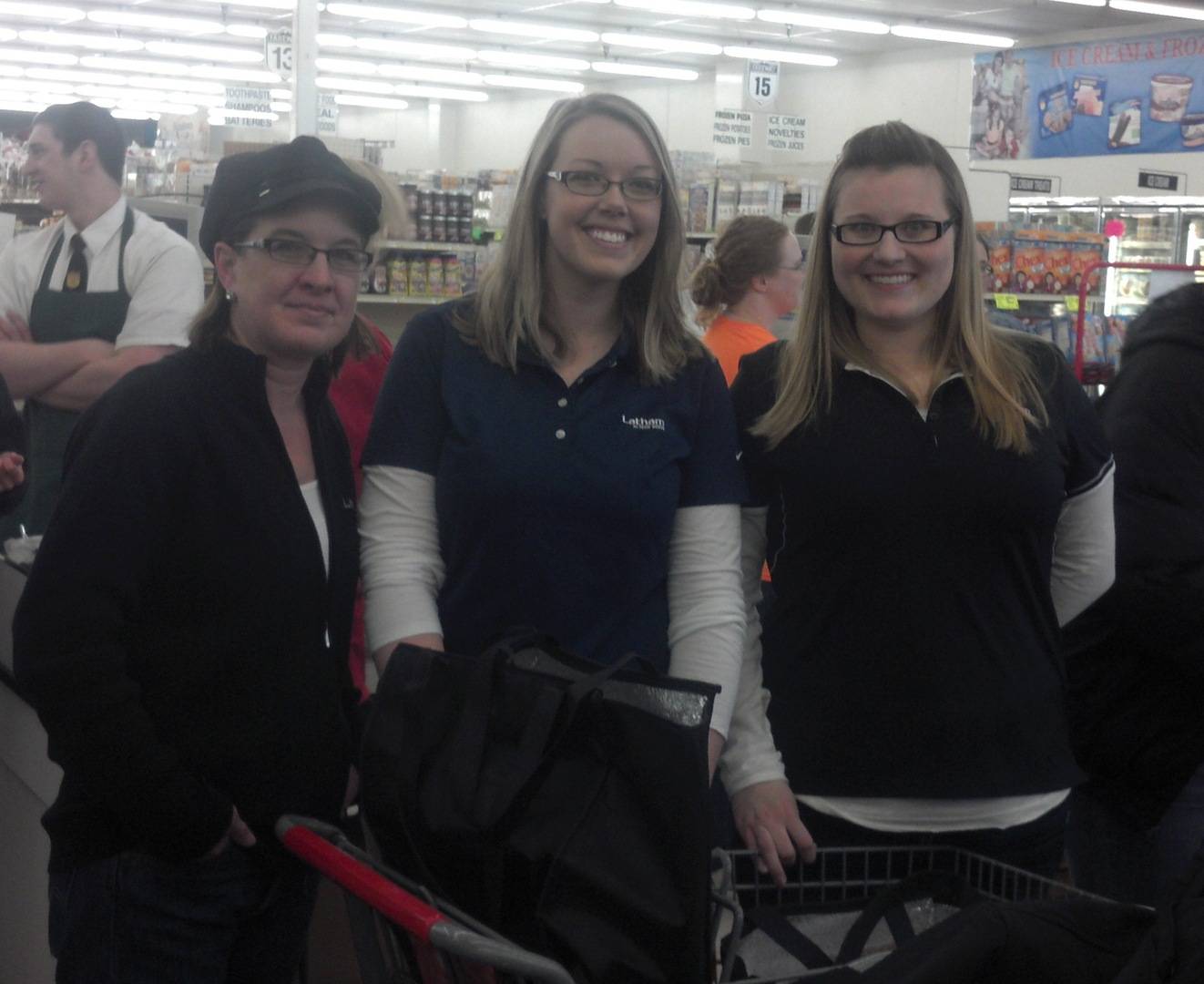
Julie, Laura, & Amy at the end of the “Breakfast Battle”
Just yesterday, Latham Hi‑Tech Seeds participated in the 2nd Annual Franklin County Farm Bureau Breakfast Battle. This event, held in honor of National Food Check-Out Week, promotes the abundance and safety of our country’s food supply. One interesting fact shared during the event was that each year National Food Check-Out Week is celebrated at the time that most Americans have earned enough of their annual income to purchase all the food they will need in a year. How fortunate we are to have an abundance of safe and affordable food to be able to pay for it in two months’ time!
National Food Check-Out Week celebrates the time when most Americans have earned enough of their annual income to purchase enough food for one year.
Latham Seeds was one of 9 businesses participating in this event. Battle began early last week with a “Facebook Fan Favorite” poll on Facebook. Many of you may have seen our calls for help in voting, and we THANK YOU for the great response! Latham Hi‑Tech Seeds was voted “fan favorite” of the event – an honor we’ve captured for the second year in a row. Team Latham edged out the number two team this year by almost 10 votes, receiving 10 seconds off our total time.
Yesterday at 8 AM teams met at Fareway in Hampton, Iowa, to compete in additional events including a challenging round of Ag Trivia. Each correctly answered question was worth 10 seconds off your grocery shopping time for the latter part of the competition. While the questions were tough, the Latham team brought down one correct answer for an additional 10 seconds off our total time.
The next step of the competition required each team to draw a menu from the stack. Our menu consisted of Chewy Granola bake for breakfast; lunch was a Creamy Egg Salad sandwich; and supper was Creamy Chicken and Vegetables. The challenge then was to race through the store selecting each of the required ingredients while spending between $45 and $50.
This year’s competition was even more intense than last year! While we didn’t come in first place, we did a great job of selecting items with a total of $46.66. Nine families will receive groceries and additional monetary donations collected through this event will go to neighboring food banks.
Having another battle under our belt, team Latham is feeling experienced and has already begun training to “do battle” again in 2014!
The countdown is on… just three days remain until the “world ends” due to sequestration. Who knows what will really happen on Friday, March 1? There have been so many threats made about the Federal budget; half-truths and mistruths abound.
Reading the White House fact sheet on how the sequester would impact the middle class, jobs and economic security could make a person question whether anyone will be able to survive. The last news release I read talks about cuts to education, small business, food safety, mental health, and the list goes on – and on!
U.S. Secretary of Agriculture Tom Vilsack, in an article posted Feb. 21 on agweb, said the USDA might be forced to make big cuts to its budgets that will disrupt service to farmers and consumers including:
Food safety;
The Farm Bill; and
Small businesses, which could have a negative impact especially on rural communities.
What troubles me the most is that all of the areas on the chopping block are vital to some American or some U.S. industry. Meantime, expenditures like aid to foreign countries and less vital programs, are never mentioned.
There are claims that we will have food shortages and many problems with food safety due to a lack of Federal workers. A potential furlough requiring every meat and poultry inspector nationwide to stay home for two weeks could effectively shut down the meat industry. These particular claims concern me since my livelihood is based on producing pork.
Consumers must be able to purchase food from the meat counter with confidence, so that we’ll continue to have strong markets for our products. But wait… Some have said that Americans would be healthier with less meat in their diets.
“A meat industry shutdown would actually give consumers — and their bodies — a much-needed break from the foods that are causing our nation’s worst health problems,” writes Susan Levin on thecalifornian.com.
Talk about misleading! It’s clear from reading Levin curse “factory farms” that she’s never visited with a family farmer like myself.
Why can’t we just agree that eating healthy can include meat as a very good source of protein and vitamins? Eating fruits and vegetables play an important role in a healthy, and getting enough exercise should always be one’s goal. “Balance” and “moderation” are often overlooked in favor of self-interest and special interests groups.
This whole process of “working on the federal budget” has turned into a publicity stunt. There will be disruption and hardships for many people as a result, but it’s doubtful that we’ll starve. Food is still being produced by farmers like me. Grocery stores will remain open. This country will eventually move ahead. But, the next few days will be telling as to whom and what floats to the top!
“The Accord” Shows How Group of Committed Citizens Can Impact Policy
There are so many political issues that impact not only the seed industry, but agriculture in general, that it’s important to engage in the political process. We must let legislators and rule makers know how proposed laws and rules could and do impact our business. Sometimes they have good intentions, but their laws or rules have unintended consequences.
We can become so involved with the day-to-day tasks involved with running our businesses and farms that it can be difficult to follow issues and anticipate how they might impact our livelihoods. However, we must make time! We can’t just rely on paid lobbyists to represent our best interests. While lobbyists play an important role, they can’t entirely replace a constituent’s voice – or vote.
Remember these famous, wise words of Margaret Mead:
Never doubt that a small group of thoughtful, committed citizens can change the world; indeed, it’s the only thing that ever has.
During the Iowa Seed Association’s (ISA) annual meeting last Wednesday in Des Moines, John Latham spoke about several issues of interest to seed professionals in attendance. Three issues that could have the largest and/or most immediate impact on the seed industry are: (1) the Accord; (2) food labeling; and (3) seed treatment stewardship.
Today I’ll focus on the Accord, which will allow access to seed technologies after a patent on technology expires. The Accord went into effect on Nov. 15, 2012. A news release announcing this landmark agreement opens by stating:
The Biotechnology Industry Organization (BIO) and the American Seed Trade Association (ASTA) announced today that the Generic Event Marketability and Access Agreement (GEMAA) is now effective. Following its launch on October 31, five BIO and ASTA member companies and agriculture biotech providers – BASF Plant Science, Bayer Crop Science, Dow Agro Sciences, DuPont Pioneer and Monsanto Company – have all signed on as signatories.
Why does this matter? Here’s my personal take…Roundup Ready® soybeans, the world’s most widely adopted biotech trait, is set to go off patent soon in the United States. Monsanto, which first development this technology, in 2009 introduced second-generation Roundup Ready soybean technology. This means Monsanto is developing new soybean products based off the Genuity® Roundup Ready 2 Yield® technology platform, and Monsanto is licensing this next-generation technology to companies like Latham Hi‑Tech Seeds. Companies like Pioneer and several universities have breeding programs based off the original Roundup Ready platform, so the Accord allows them to continue offering soybean brands containing the original Roundup Ready trait.
The Accord creates a process based on binding contractual relationships, so regulatory and stewardship obligations are maintained. It encourages innovation among biotech providers as they invest in product development. It provides technology choices to seed companies like Latham. And, it means farmers will be able to purchase soybeans with some form of the Roundup Ready trait even after the patent expires. Win, win, win!
Today through Friday, you can bid for your chance to get tickets to the Iowa State Men’s Basketball Game which is next Monday. All the proceedes will go to the American Cancer Society. The Bid is now up to $125 so make sure you click on the picture to bid. (comments on this post will not count towards the bidding)
For the Love of Food: Farmers & Consumers Must Bridge the Communications Gap
“Musings of a Pig Farmer”
By Larry Sailer
Michele Payn-Knoper, Michael Libbe and Larry Sailer share “food love” on Valentine’s Day. Michele is author of “No More Food Fights!” and Larry is one of 35 contributing writers. Michael is host of “Insight on Business.”
Last Tuesday I wrote a blog about how farmers spend their time when there aren’t any crops in the fields. I mentioned that winter is the “meeting season,” and today I want to share highlights of one particular meeting I had on Valentine’s Day in Des Moines. I got to share some “food love” while making media visits with Michele Payn-Knoper (pronounced “Pain – Ka-nope-r”).
A food and farm advocate, Michele wrote No More Food Fights! Growing a Productive Farm & Food Conversation. This is the first-ever book to speak to all sides of the food movement in an attempt to bridge the divide between farmers and consumers. I had the honor and privilege of being one of 35 contributing editors. Chefs, registered dieticians and Olympic athletes also share their stories.
“Food and farming seem to have become the new politics and religion,” says Michele during an interview last Thursday with Michael Libbe, host of Insight on Business. “You don’t dare talk about it with people because you don’t want to get your friends upset with you. That’s really unfortunate.”
More than 98% of Americans are several generations removed from first-hand farming experiences and very few have even visited a farm. Most are very disconnected from and distrusting of modern agriculture, writes Michele in a No More Food Fights!news release. At the same time, Michele says many farmers have done a poor job of talking about today’s farming practices. Not enough farmers are taking advantage of tools like social media that could help facilitate connections to the farm that food buyers crave.
To satisfy your own craving for knowledge, check out No More Food Fights! It’s providing me with great insight as I work to bridge the communication gap with consumers through social media and presentations.
That reminds me… I’m looking forward to getting together Friday evening and all day Saturday with fellow #agnerds and #agvocates at the AFC Upper Midwest Regional Conference.
Before I head north to that conference in Minnesota, I must head south for another meeting. Today I’m making about a 90-minute trip south to the Statehouse in Des Moines where Iowa Farm Bureau members will visit elected officials. Side note: Anyone can be a member of Farm Bureau. You don’t need to be a farmer to become part of the IFBF’s grassroots efforts either. Members can sit in on board meetings or even go to the member section of the web site and voice your opinions on topics ranging from education to what our kids (or grandkids in my case) eat in school. #Schoollunchrules
Thursday, in the middle of a forecasted blizzard, I’m planning to attend a PQA Plus continuous improvement program for pork producers. Although I’m not due to renew my CEU’s, this class is being held right within 10 minutes of my farm. That’s too good to pass up! I can always learn something.
This busy week is sure to be disrupted by weather, but we’ll “play the hand that Mother Nature deals us.” How’s your week looking?
One technology to help maximum yield potential is Roundup Ready® Xtend Crop System for soybeans. Also in Monsanto’s pipeline is Corn Rootworm III Technology, designed to complement current commercial traits. This “next generation corn rootworm technology” will attack corn rootworm through a new mode of action using a natural process different than Bt.
New programs for Goss’s Wilt protection and Gray Leaf Spot resistance also are in the pipeline. . Monsanto’s Ag Biologicals Platform is focusing on BioDirect™, which is designed to target glyphosate-resistant weeds for better control. BioDirect™ was also seen to provide protection against insect pests and reduce symptoms of viruses.
While weed management and pest protection are certainly two important factors when maximizing yield potential on each acre, seed selection is perhaps the single most important factor. Traited products from Latham Hi‑Tech Seeds combine industry-leading genetics with industry-leading traits from technology providers like Monsanto.
NOTE: Not all traited products offer rootworm protection. Herculex I, for example, has resistance/tolerance to Liberty, Roundup and corn borer. Herc 1, however, does not protect against corn rootworm. A person can’t just assume that a “Bt hybrid” will have rootworm protection.
Take some time now to review what seed you’re planning to plant in which fields. Planning pays! Seed can have a 700% return on investment… What else does?
On his Facebook page, I Am Agriculture Proud, Ryan Goodman recently asked his farming and ranching friends to share they spend their winter months. My winter months are filled with so many different activities that I decided to devote today’s blog post to answering Ryan’s question more in depth.
There isn’t any field work for Midwest farmers from about Thanksgiving to Easter, but I still manage to stay quite busy during “the slow winter season” by (1) planning next season’s crop (2) attending meetings and completing continuing education; and (3) communicating with consumers.
Once harvest is complete and the machinery is back in the shed, I finalize plans for next season’s crop. I buy inputs and fix machinery. I also care for 4,000 head of hogs. Winter farm chores and moving snow seems to keep me as busy as ever. I haven’t had to move as much snow this winter as I have in past years, but it seems the snow always falls when I’m either loading out hogs or bringing in a new group. Murphy’s Law, right?
Congressman King
Winter also is the “meeting season,” which I consider my continuing education time. To farm in this era of government regulation, I need to keep up with the current laws. The commodity groups to which I belong are very active with programs to make me a better farmer. For example, PQA Plus was developed by the Iowa Pork Producers Association (IPPA), the National Pork Board (NPB) and National Pork Producers Council (NPPC). This is such a great program, teaching pork producers the latest and best known techniques to raise pigs. Most pork processors require pork producers to be PQA certified in order to sell hogs to them.
In addition to attending the commodity group’s annual meetings and continuing ed programs, winter is the season for machinery shows like the Iowa Power and Machinery Show that was held recently in Des Moines. There is also a show on fertilizer and herbicides. In addition, Extension offers many regional and statewide winter programs on everything from pork production to crop production and insect identification.
Yesterday I participated in a meeting in our county seat that was sponsored by the Franklin County Farm Bureau. We were honored that U.S. Congressman Steve King visited a local school system (CAL) in the morning where he watched our Ag in the Classroom program in action. At noon, Congressman King shared his thoughts about the current session of Congress and then we had the opportunity to talk about issues that concerned us.
Another area that I work on more during the winter months is the art of communicating with non-farmers. Yep, the commodity groups even teach that! I’m even going to do some teaching myself on Feb. 23 when the AgChat Foundation hosts a regional conference in Rochester, Minn. This group has done an amazing job helping me to understand that the way I talk may be a foreign language to someone not familiar with farming. Terms that are familiar to farmers like me aren’t always the same slang used in the city. Who knew?
Off season? Yeah, right. I didn’t even mention all the desk time required to get our tax returns ready. Off to the office I go!
Emotion Catches Attention & Gives Reason to Share a Message: Social Media Told Ag’s Story on Super Bowl Sunday
Even if I hadn’t been tuned into the Super Bowl on Sunday, news feeds on Facebook and Twitter accounts provided a play-by-play account – at least of the commercials. Who would’ve guessed that “farmers” would be trending during the Super Bowl?
The top Super Bowl spot, at least during the first quarter, was the “Got Milk?” ad featuring Duane “The Rock” Johnson. Soon thereafter Budweiser’s “Brotherhood” Clydesdale ad surpassed the Milk “Morning Run” as top ad, according to Forbes.
The commercial about the little Clydesdale is very much a true picture of how farmers feel about our animals. This particular commercial did a masterful job of telling a farmer’s story and showing an emotional connection with his animal, which brings up an important point I’ve been trying to make: emotion attracts the attention of those whom we want to share our message.
For years and years, those of us in the ag community have talked about facts and science. We’ve been armed with research and data– and we’ve been largely overlooked. To get noticed for the right reasons, farmers must use emotion to gain attention of the non-farming public and to share our messages! Why? Because agriculture is relevant today – maybe even more so if you take into consideration the growing world population – as it was when 98% of all people were farmers.
Recently, U.S. Secretary of Agriculture Tom Vilsack said rural America is less relevant now. Really? Farmers and ranchers provide food, fiber, and fuel for this country. Products made from agricultural products are used to make medicines and other products used for healing, such as pig skin for burn grafts and heart valves. Knowing that my pigs are helping feed people – and heal their hearts – is a source of pride.
There are many reasons that I Am Agrihculture Proud. Nothing stirred Pride, Passion and Conversation on Sunday – and nearly every minute since it aired – like the Dodge Ram truck commercial featuring a poem recited by Paul Harvey during the 1978 FFA annual convention. It was a nice, little piece that paid tribute to farmers and God, both of which have been getting bad press lately!
Dodge Ram’s ad is part of a campaign to support the National FFA Foundation’s hunger initiative “Feeding the World – Starting at Home.” Each time this commercial is watched online, the National FFA earns $1 up to $1 million! Check out this post by fellow Franklin Count farmer, Val Plagge, “for the rest of the story.”
Also be sure to check out these related blog posts from farmers across America:
While this list is long, I’m sure it’s not complete. Feel free to share additional links. A special thanks to I Am Agriculture Proud for starting this list of great blogs!
Guest Blog from Dan Gogerty, Communications Editor for CAST
Dad, my uncle, and my grandparents farmed together and lived on three homesteads that were spittin’ distance from each other. The combined kid-count for the families eventually reached fourteen, so we could move like a swarm of locusts from house to house–playing in the yards, spilling kool-aid in the kitchens, and tracking in enough mud to start small indoor gardens.
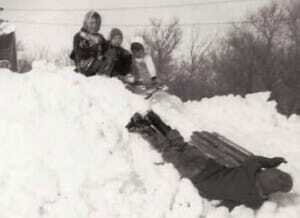
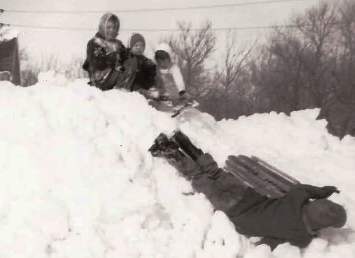
Before we were old enough to chore and drive tractors, the adults tolerated this mayhem. As Mom recalls, “On a snowbound day, you kids could wreck my house in the morning and then move on to Aunt Ruth’s place for a second shift in the afternoon.” With no video games, cartoon networks, or battery-driven toys, we built pillow forts, played hide-n-seek, and concocted games with marbles, plastic army men, and knicked-up Lincoln Logs. When cabin fever reached a certain point, the folks would relent and let us brave the snow and cold. Even in the dead of winter, a Midwest farm in the 60s could be a vibrant playground.
(photo from dhochwender.tumblr.com)
We might start in the yard with snowball fights, snow angel designs, and our own kamikaze version of duck-duck-goose. With Mom’s home-sewn snow suits on, we survived tumbles on the ice and wrestling matches with the dogs, but as we grew a bit older, our boundaries expanded. Red plastic saucer sleds worked well on snow drifts and short inclines, but large runner sleds gave us more speed. We’d take off down the lane, often with brothers or cousins jumping on until a sled might look like a shaky pile of logs with a boy at the bottom groaning in pain until all three or four of the bobsledders crashed in a heap.
The creeks and pastures called us further afield even when they looked like silver arctic zones. The two streams on our farm provided a Jack London setting, and we would walk on the ice looking for muskrat trails and rare beaver dams. As in London’s famous story “To Build a Fire,” one of us would occasionally break through the ice and fill a boot with frigid water. Unlike the story’s main character, we all survived, although I’m sure we entertained the shivering victim on the fast walk home with tales of frozen fingers and amputated toes.
Survival was tougher when we became old enough to skate and play hockey on the creek. We’d make holes in the ice for goals and the pucks were rocks, clods, or maybe a frozen “road apple” from an old cow pie on the bank. Scores were low but wet clothes and near concussions came regularly from our awkward falls and lack of skating ability.
When cold winds started to numb our cheeks, we might seek refuge in one of the barns. Hogs and cattle provided a type of bio-heat that came from warm animal bodies and the steamy straw-manure bedding they lay on. The heat rose into the haymow where we’d make tunnels and play some type of king-on-the-hill turf war. It was a bonus if we found a nest of baby kittens and a bummer if someone crawled through a tunnel that the raccoons had used for a litter box.
A classic winter day on the farm ended with a peel-and-pain routine. We’d peel off wet gloves, four-buckle boots, and ice-laden coveralls and then complain as our fingers and noses burned with the stinging pain of the thawing-out process. We then huddled in front of the furnace vent and got warm with the help of fresh-baked rolls. Mom knew how to cure frostbite. She also knew how to acquire some sanity on snowbound days. In an era long before smartphones, Mom had an app for kid cabin fever: it was an aperture called the front door, and she knew how to download it—you dressed the kids in warm clothing, turned the door handle, and let them access the winter wonderland that came already installed on a Midwest farm.


 Farmers need multiple options to fight corn rootworm (CRW), and the efficacy of Agrisure DuracadeTM appears promising. With its new and unique mode of action, Agrisure Duracade will be combined with the Agrisure® RW trait to provide dual modes of action on corn rootworm.