Consider Traits & Chemistries in Your Crop Rotation
A soybean-corn crop rotation allows farmers to spread out spring and summer fieldwork and provides a larger window for harvest. Plus, a soybean-corn rotation can lead to energy savings during production and when handling, drying and conditioning of stored grain, according to recent issue of “Advance” published by the ISA On-Farm Network.
“Studies show us that corn yields are higher following soybeans. The advantage of a soybean-corn rotation still centers on yield. The positive impact is probably due to several factors,” says Ed Anderson, Iowa Soybean Association senior director of supply and production systems. “Soybeans break disease, insect and weed cycles and provide a nitrogen credit for corn the following year.
However, it’s no longer enough for farmers to merely rotate crops. Farmers also must rotate between herbicide chemistries, as well as hybrid/variety traits. Rotating between various herbicide traits is important from the standpoint of reducing weed resistance. It also has been proven that it helps in overall herbicide performance.
Rotating traits, especially insect resistance traits in corn, is especially important for the same reasons – to decrease the risk of insects becoming resistant to those traits and also to improve overall trait performance. As newer traits become commercially available in soybeans, the same will be true. We will need to be good stewards of these traits and rotate them whenever possible!
One advantage of working with family-owned and independent Latham Hi‑Tech Seeds is that we can help you select the trait packages needed to change up your modes of action. Latham offers the industry’s broadest, deepest seed lineup – which makes it more convenient for farmers to get all their seed needs met.
Iowa farmers had been protected for more than 40 years under the recreational use and immunity statute. It stated: “farmers are immune from liability of injuries that occur on their property aside from a farmer willfully injuring an individual.” That all changed on February 15 when the Iowa Supreme Court ruled that the owners of a Northeast Iowa dairy farm could be sued by a chaperone, who was injured when she fell through a hole in a hayloft during a kindergarten class field trip.
“It is important that farmers reach out to the general public and show them what we are doing on our farms and why. Iowa agriculture has a tremendous story to tell, and it is important we make it easier for farmers to share what they are doing, not more difficult,” said Iowa Agriculture Secretary Bill Northey in a FarmWorld article posted Feb. 27. “It will be extremely unfortunate if the Iowa Supreme Court decision discourages farmers from opening up their farms for tours and other educational efforts.”
Secretary Northey said it well. The Supreme Court ruling, without corresponding state legislation to provide immunity, could cause many farmers to shut their doors. The Daily Iowan, on April 11, quoted me as follows: “It’s one of my passions to show people who don’t know a lot about a farm what a farm is.”
Harvest Tour 2012
I’ve been very involved with giving people, who are removed from farming, a porthole to view how modern farms operate. I believe in letting them watch as we go about our business of making food, fuel and fiber! I was – and still am – under the impression that we must do everything possible to protect visitors to our farms. Sometimes, however, things happen that are beyond a farmer’s control.
When I think back to the visit to my farm last fall by a group from Japanese Public TV, I believe there also has to be some personal responsibility. That camera man stood on top of anything he could climb to get the right angle! He stood on top of tractors, climbed into wagons of corn, and crawled all over my combine. I could tell him he wasn’t being safe, but he would choose to get the angle.
That same week, Fox News Network, was in my field as we harvested soybeans. The man with the camera hung on the outside of my combine as my son Corey drove across the field. Personally, I think these camera guys are nuts! If something had happened to one of these people, I would’ve been responsible!
I’ve been involved with the Franklin County Bloggers Harvest Tour. For the past two years, we’ve invited urban bloggers to spend a weekend in rural Franklin County where they tour historic sites and see firsthand how we harvest our crops. These tours have been highly successful because our guests are very active with their followers on Twitter and Facebook. They also post blogs to their vast readerships, spreading what they have witnessed far and wide. They share farming insights with literally thousands of folks across the country, who enjoy learning more about Iowa agriculture.
Consumers, our customers, want to see how their food is raised. I want them to see how their food is raised, too! There are too many misunderstandings being spread through the mainstream media and through social media networks. That’s why there is a need for our harvest blogger tour, on-farm visits and on-farm interviews. Hopefully, these will be able to continue. I encourage you to contact your elected officials if “transparency at the farm gate” is important to you!
I am a rich man. No, I’m not talking about being a rich farmer. That I’m not! But, I am rich in the ways that matter most.
The tragic events that unfolded this past week – from Boston to West Texas – caused me to pause for a moment and think about how good life really is here in the Heartland. For example, yesterday was Earth Day. Such a day reminds me of what a wonderful world God has created! I also caused me to reflect upon the change Janice and I are making as we transfer our memberships to the church she attended as child.
Thinking about Janice’s childhood then caused me to reflect upon my own childhood. I was born to farm! From the time I was a toddler, I literally followed in the steps of my great grandfather, my grandpa and my dad. Fifty years later, I’m still proud to call myself a farmer – but it hasn’t always been easy.
In the 70s, I was one of what they called the “Young Tigers.” I reached my goal of farming 1,000 acres, which at that time, was worth $1,000 per acre. I spent all my available hours working on the farm. As a workaholic, I was focused on the wrong goals!
My way of thinking changed a decade later. On my 30th birthday, I married Janice and had an instant family. We joked that “something had to go” to make room for four kids, so I sold my airplane. During the 1980s Farm Crisis, I sold off some farmland. Janice ran the farming operation, including doing hog chores, while I took an off-farm job working construction. We built hog units across the Midwest, so I was gone from home too much of the time. We did what we was required to provide for our growing family at the time, and we were all thankful when I could return to farming full time.
Over the last 30 years, I’ve become very wealthy in a non-material way. Our family has brought us so much joy! The past two weeks have been particularly enjoyable: our grandchildren Jessica and Zach went to prom; and grandson Devin finally was healed enough to play some great football in Iowa State’s spring game!
I mentioned in a previous blog post that each of our grandkids has his/her unique talents and interests. Some, like Devin and Jessica, have a passion for sports. Carlie enjoys writing and dancing. Darin enjoys hunting, fishing and gardening. Zach is interested in wood working and mechanics. Hallie, Lindi and Jessica are very artistic. Sydney is an avid reader, while Quinten is a computer guru.
Today I’m showing some of my favorite photos of each. While it’s not exactly a “Wordless Wednesday” post, it’s about as close as this proud grandpa can get!
Hopefully, looking through family photos will help you remember to take time to count your blessings. I can’t think of anything better to do, especially on a gray day!
While sipping my morning cup of coffee, I usually browse my social media news feed. While doing so last Thursday, I came across a post entitled “Did You Know?” on the blog Jean’s Boots Are Made for Talking. Imbedded in this post was a video that I’d seen before, and honestly, it blows my mind every time I watch it. This video virtually reminds how we’re not isolated in our own part of the word, and it also explains why I believe we must work diligently to educate others about farming practices and how their food is grown.
Why should farmers care about consumers? The long and short of it is that hate stems from fear. People, who lack a clear understanding of GMOs, for example, fear the GMOs and hate everyone who grows GMO crops. More consumers need to understand why farmers plant GMOs, for example.
Another reason farmers should care about consumers’ thoughts and opinions is because – thanks in large part to social media – misinformation spreads faster than wildfire. Below is an excerpt from a post I saw last week on Facebook:
DANGER TO YOUR FAMILY!!
from the Department of Life Education: The small cocktail (baby) carrots you buy in small plastic bags are made using the larger crooked or deformed carrots, which are put through a machine that cuts and shapes them. What you may not know and should know is the following…
There is no truth to the myth that the whitish film on baby cut carrots is a chlorine residue from carrot processing.
Once the carrots are cut and shaped into cocktail carrots they are dipped in a solution of water and chlorine. (This is the same chlorine used in your pool). Since baby carrots don’t have a skin or natural protective covering, they’re given a higher dose of chlorine.
You’ll notice that once you keep these carrots in your refrigerator for a few days, a white covering will form. This is the chlorine which resurfaces! At what cost do we put our health at risk to have esthetically pleasing vegetables? I used to buy those baby carrots for vegetable dips. I know that I will never buy them again!!!
It’s difficult to always be in the right place at the right time as Carolyn was, but I hope this explains why there is a group of agvocates speaking out and trying to have that conversation. I hope this also helps explain why we need more farmers to join our effort. Agvocating: It’s harder to say than do. Just do it!
Guest blog by Dan Gogerty, Communications editor for CAST
Information comes at light speed and in bulk proportions through websites, news releases, and social media outlets. This can be good and bad. For example, the topic of genetically modified food – plant and animal – becomes mind numbing with the barrage of articles and opinions. Maybe we consumers of news need a bit of genetic modification ourselves in order to handle it all.
Most, not all, seem to agree that GMO plants used in food have not been a research-proven hazard, but some say there are other problems with the concept, and they speculate that problems could surface. Food from biotech animals brings up a similar mix of opinions, but the tone is even more edgy.
The following links show a wide variety of opinions, but many other sources are available:
The FDA provides a questions & answers page about food from genetically engineered plants.
This Farm Aid site provides opinions and links about GMO crops, some of them questioning the practice.
A blog from the “Chicks on the Right” favors the new law supporting GMO crops, and it provides a link to the Mark Lynas’ speech. The “chicks” also have a DDT problem with Rachael Carson.
Maybe this writer could be called “Dude on the Left.” He opposes the new GMO law, and he seems skeptical of the wide use of biotech food products. This letter is a farmer’s pro-GMO response.
SIDEBAR by Shannon Latham From Dan Gogerty’s guest post, it is evident there are two sides to every (news) story. “Dude on the Left” obviously believes the “Farmer Assurance Provision” was put in place to protect Monsanto. “Why do GMOs need protection?” he asks. Here’s why…
My hope is that, by providing several articles with points and counterpoints, today’s blog post will help set the record straight. For additional background information on GMOs and why they’re planted, read:
Most Midwest farmers have spent the past week preparing for the spring planting season and closely monitoring soil temperatures in anticipation of #plant13. There are a few things that I still need to get done before I head to the field, but I’ll admit, my energy level is low right now.
While eating my lunch on Friday, I was trying to figure out why I have less ambition than I used to. Several thoughts came to mind:
It’s been a long winter. (Those early spring snowfalls dampened my spirits, even though I appreciate the moisture they brought.)
I’m not a spring chicken any more. (I’ve been farming for 50 years!)
During the winter months, I’m less physically active even though hog chores keep me pretty busy.
Then I had the proverbial “light bulb moment…” I believe government has played a large role in my recent frump. It seems that apathy and anxiety has become a pandemic affecting our nation. Why?
Breaking news on Friday, April 5, was that U.S. unemployment numbers are lower. This sounds like good news until you realize that unemployment fell for all the wrong reasons – five times as many people quit looking for work than jobs that were created! The job participation rate of “prime-age” workers, age 25 to 54, fell to match the lowest reading since 1984, according to CNN.
“One of the most valuable commodities we can cultivate in this emerging generation of kids is ambition,” writes Elmore. “By wanting our children and students to be happy, we may have created the most depressed population of kids in recent history. By leading them in this way, we have all but removed ambition in them… Think about it. If I grow up in a world where almost everything has been given to me, or made easy—I start feeling entitled to it.”
Have Americans become so politically correct that we’re taking the will to learn away from our kids? Every kid is different, yet many sports programs and educational endeavors try to treat everyone equally. My own grandkids provide a great example. Some, like Devin and Jessica, have a passion for sports. Carlie enjoys writing and dancing. Darin enjoys hunting, fishing and gardening. Zach is interested in wood working and mechanics. Hallie, Lindi and Jessica are very artistic. Sydney is an avid reader, while Quinten is a computer guru.
Speaking of government… I received a notification on Friday of an update from the Caffeinated Thoughts blog with news that Iowa Senator Brad Zaun filed a bill (Senate File 336) to repeal the Iowa Department of Education and the Iowa State Board of Education. Senator Zaun believes an increase in educational funding will not lead to an increase student performance. He says he wants “real education change” and is quoted as saying, “This bill will increase student performance and give parents 100% choice.”
Regardless of whether you’re Republican, Democrat or Independent, the fact remains that America is facing big issues that need to be addressed. Unless we change current policies and attitudes, unemployment and poverty is only going to grow. How can a nation maintain its position as a World Leader then?
“Buy Local” Initiative Brings “Dough” to Rural Communities
Knowing where food comes from and how it is grown is becoming increasingly important for many U.S. consumers. Connecting consumers with local producers is one goal of the Healthy Harvest of North Iowa’s “Buy Fresh. Buy Local.” initiative.
Local food initiatives help fuel stronger communities. Each dollar spent on locally grown food keeps dollars circulating through the community, which can have a big impact on rural communities. The average Iowa family spends $137.90 weekly on food. Residents in the Iowa counties of Franklin and Wright spend $69 million annually on food.
“If we could capture 10% of the food dollars in Franklin and Wright counties, that means $6.9 million would be reinvested in our local communities! Even a 1% market share would be significant,” said Jan Libbey, coordinator for Healthy Harvest of North Iowa.
Why is USDA Expanding StrikeForce While Cutting Other Programs?
Isn’t it ironic that new programs are being created – government is expanding – at the same time our nation’s politicians are stumping about our need to balance the federal budget?
The U.S. Department of Agriculture this past week announced plans to expand its StrikeForce program, which was launched in 2010 to promote economic growth in rural areas. It began as a pilot program in Arkansas, Georgia and Mississippi. In 2011, StrikeForce expanded to Colorado, New Mexico and Nevada. New efforts would bring StrikeForce to poverty-stricken areas in Alabama, Alaska, Arizona, North Carolina, North Dakota, South Dakota, Texas, Utah and Virginia.
I have mixed emotions about this program for many reasons. StrikeForce spends tax dollars we don’t have. It will grow government since additional “rural partnerships” will require additional governmental administration. Plus, I don’t understand reasoning behind axing some existing programs only to create new programs or expand others. The Sequester is supposedly taking money away from current programs, some which are required by laws already on the books! Yet, it appears dollars can be found for the current administration’s pet projects.
Eleven new states will be added to the StrikeForce program. When I heard this reported on 1040 WHO radio early Monday morning, I googled the program to be sure that I heard the announcement correctly. My search yielded a Huffington Post article in which an embedded USDA video explains some of the success that StrikeForce has had to date including “tackling food insecurity in Arkansas and improving access to farm programs in Nevada.”
The Huffington Post article also states: “Every day the U.S. Department of Agriculture provides assistance to help grow American agriculture and increase opportunity for rural communities. Unfortunately, 90% of America’s persistent poverty counties are in rural American – and we can’t allow these areas to be left behind.” One question I have is, “Does the 90% of the poverty counties refer to the number of people or are we just looking of area size?”
I’m conflicted. Watching the USDA video, one can be persuaded to believe StrikeForce is a great program. But, how’s it being funded? Is the program focused only on minorities? (Sidebar: The deadline was just extended on a big settlement of discrimination cases for minorities… Why?) Rules to apply loans of over $30,000 look simple, which raises more questions about how this program is run.
StrikeForce could be a fantastic program, but I’m pessimistic when it comes to bigger government as a whole. Take a look for yourself. Do some checking. And of course, let your elected officials know what you think. It’s our government, our money, and our program!
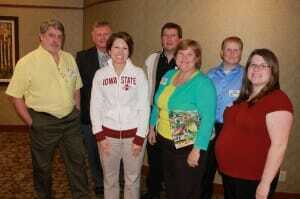
Franklin County was well represented at the Iowa Agriculture Leadership Forum, March 15-16, 2013, in Des Moines. Larry Sailer is back row, second from the left. From row, from left to right: Shannon Latham, April Hemmes and Val Plagge.
If you follow my posts, you know that winter is “meeting season” for Midwest farmers. Many of the meetings I attend are a two-hour drive from my farm, so I have plenty of windshield time – alone with my thoughts. I spent a lot of time (probably too much time!), analyzing what I’ve learned from these meetings and thinking about how I can apply this new knowledge to my operation. I also spend a lot of time in the winter months reading ag-related articles and blog posts.
Yesterday, Shannon Latham’s blog post about how members of the ag community define “technology” differently made me think about the stark contrast between two meetings I’ve recently attended. Midwest farm leaders gathered at both of these meetings, but their use of technology was totally different.
The AgChat Upper Midwest Regional Conference in February was all about technology, so it was “socially acceptable” for attendees to send Tweets and update their Facebook status throughout the conference. In fact, it was encouraged! Sponsors announced the hashtag (#ACFR13), and many speakers began their presentation by telling audience members their Twitter handle. Presentation topics ranged from how to set up a Twitter account to creating a fan page on Facebook for your farm, and even fine-tuning your blogging skills. As fellow Franklin County farmer Val Plagge says, “The Upper Midwest Regional Conference was set-up to empower farmers and ranchers to connect communities through social media platforms.” And that’s really what that did!
Then about two weeks ago I attended the Iowa Ag Leadership Forum, which was really a reunion for alumni of training programs from several groups including: the Iowa Farm Bureau Federation, Iowa Cattlemen’s Association, Iowa Corn Growers Association and Iowa Soybean Association. The one thing everyone in the room had in common was a desire to share what he/she knows about farming with folks who don’t understand it… or so I thought!
Erika Poppelreiter
I was proved wrong during a question and answer session led by Erika Poppelreiter (@poppel), a Kansas farmer and representative for the U.S. Farmers & Ranchers Alliance (@USFRA). Erika had just given a presentation about the USFRA’s The Food Dialogues: New York, where farmers, ranchers, industry experts, pundits and media tackled some of today’s toughest questions on biotechnology (GMOs), antibiotic use on farms and ranches, and how media and marketing influence “healthy” food choices.
It was then that an Iowa farmer stood up and asked Ericka, “Why should I give a damn about what customers think?” A brief moment of silence followed.
Most of us were a little slow to come up with the answer for that person, but Erika did respond with an example of what happened with caged layers and the impact that could on of the use of gestation crates. The end product is still pork (bacon), and it should be up to the producer to determine the best way for him to produce that pork.
If only I would’ve been quicker on my feet! I would’ve shared this quote with that farmer:
“We as agricultural producers are proud of feeding our world, but that doesn’t go far when the world doesn’t understand how we produce that food. We must participate in conversations with consumers at every opportunity. I am proud of the U.S. Farmers and Ranchers Alliance for starting these dialogues with both the pro and con sides represented. It’s the only way we can explain our story to others and not just ourselves.” – Barb Determan, a Sioux County Iowa farmer and pork advocate, who served on a panel at The Food Dialogues: New York
Barb Determan
Barb mentions that farmers need to share their stories with others besides like-minded individuals. While I thought farmers were pretty good about preaching to the choir, it appears our work is not done! Perhaps we need to fine-tune our message, so our fellow producers understand “why” it’s so important for us to share our stories with consumers.
I have given that farmer’s some thought since the Ag Leadership Forum. In an ideal world, his way of thinking would be great. It’s just not acceptable today because there are so many groups opposed to certain farming practices. There is no simple answer. We must take our message to the rest of the congregation if we want to continue to raise our products in a way that allows us to make a living, free from unnecessary rules and regulations.
“How do we share with consumers what we want them to know?” asked another attendee at the Ag Leaders Forum. I believe we need to take AgChat to the state level. Each state’s ag leaders much understand how to communicate, effectively, using today’s technology. For example, there were only 20 tweets total from the two-day Ag Leader Forum. I would guess (and this literally a guess because I can’t count them all) there were way more than 20 per hour coming out of the AgChat Convention!
Iowa Farmers lead the nation in production, yet they’re slow to adopt social media for advocacy.
Farmers and ranchers are always looking for a way to do something better. It is what we do! Technology has been used from the time early settlers learned from the natives the value of using fish to fertilize crops to farming with smartphones. It’s time for the masses to adopt communications technology. I’m not saying social media is the only way. Face-to-face visits go a long ways toward sharing and communicating, but social media really allows us to have a broader reach.
With more consumers curious about where their food comes from and how it’s raised, there is a greater need for more farmers to share their stories. If you’re a fellow farmer, I encourage you to share your story!
As a family-owned company, Latham Hi‑Tech Seeds has one major advantage over our competitors: We have the freedom to help our farmer-customers choose the traits and technologies that will work best for their given farming situations. That’s why we’re especially excited about Latham’s pipeline of soybean products!
Strategic alliances with the world’s leading technology providers means Latham is testing soybean products with three of the industry’s newest trait packages. Here’s a summary of the emerging soybean technologies that farmers in the Upper Midwest could access in the near future from Latham Hi‑Tech Seeds:
Enlist E3 – Developed and produced by Dow Agrosciences, Enlist E3 soybeans will be tolerant to new 2,4-D choline, glyphosate and glufosinate. Dow AgroSciences is working to introduce Enlist Duo™ herbicide with Colex-D™ Technology. Enlist Duo is a proprietary blend of new 2,4-D choline and glyphosate that will offer growers minimized potential for drift and near-zero volatility. We’re expecting the first E3 soybean products to hit the market for the 2014-2015 sales season.
The Balance Bean – This new soybean product from Bayer® has the working name of “FG72” and will be a double stack for resistance to isoxaflutole and glyphosate. Isoxaflutole is the active ingredient in Balance® Flexx and in Corvus® corn herbicides. Eventually this product will be stacked with Liberty®, making it a three-way stack.
Roundup Ready® Xtend Crop System – Monsanto continues to advance its stacked product featuring Genuity® Roundup Ready 2 Yield® technology with Dicamba resistance. Known as Xtend, this product will help extend the life of glyphosate. This technology appears to be slightly ahead of the other two now, depending on regulatory approvals.
We’re hopeful regulatory approval will be received in time for at least limited supplies to be planted in 2014. Although 2014 may seem like a distant future, the truth is, we’re working on our 2014 seed guide right now. Latham must grow seed beans a full season ahead to produce products that farmers will plant the following year.
Weed resistance is a growing problem – literally. Diversity of tactics is the key to consistent weed management and high crop yields. That’s why, at Latham Hi‑Tech Seeds, we couldn’t be more excited about the new traits that will soon be available to diversify modes of action and help farmers fight weed resistance!


 A soybean-corn crop rotation allows farmers to spread out spring and summer fieldwork and provides a larger window for harvest. Plus, a soybean-corn rotation can lead to energy savings during production and when handling, drying and conditioning of stored grain, according to recent issue of “Advance” published by the ISA On-Farm Network.