
Latham Hi-Tech Seeds

(641) 692-3258

  • Home
  • Products
    • Corn
    • Soybeans
    • Alfalfa
    • Corn Silage
    • Seed Guide
  • Performance
  • Find a Rep
  • Media
    • Blog
    • News
    • Videos
    • Podcasts
    • TECHTalk
  • About Us
    • Company History
    • Our Mission
    • Careers
    • Become a Rep
    • Sowing Seeds of Hope
  • Contact Us
  • Latham Hi‑Tech Seeds

    Fertility Levels Key to Raising Top Soybeans, Part II

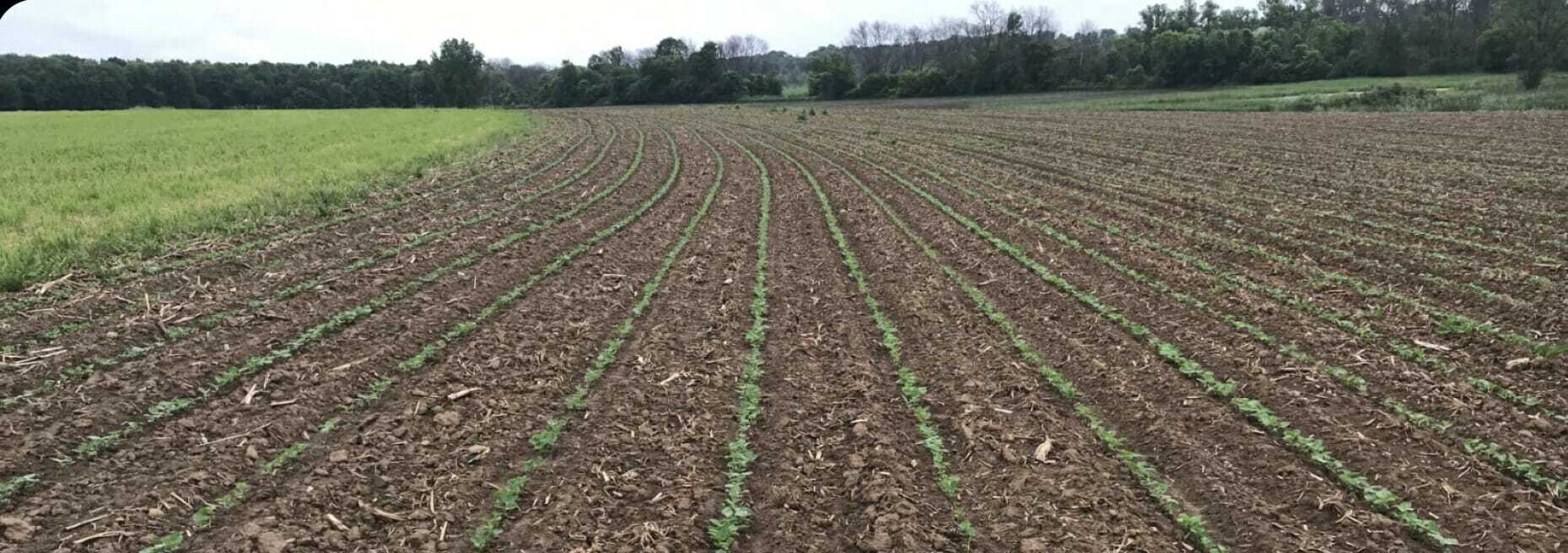
    A common practice for farmers in a corn-soybean rotation is to apply enough P&K prior to planting corn to supply their crops for two years.  This works well until corn yields are higher than expected, and no extra nutrients are added for the subsequent soybean crop.  Soybeans are big users of Phosphorus (P) and Potassium (K), and soybean yields will suffer unless more nutrients are applied to compensate for the higher corn yields.

    Nitrogen is essential to photosynthesis.  Nitrogen is usually supplied to soybean plants by a process called nitrogen fixation, which is associated with Rhizobia bacteria in the soil.  It’s important to note, however, that these bacteria are not always present – especially if soybeans haven’t been grown in that field for a few years.  Recent studies show that adding an inoculant to seed may have beneficial effects if planted in soils with low organic matter content or in fields that have undergone significant flooding in recent years.  Try inoculants in your own fields and study whether they benefit your production levels.

    In addition, be sure to monitor the calcium levels in your fields.  There are soils in the Upper Midwest that contain too much calcium.  Known as alkali soils, they can cause other problems for soybean development including stunting, poor root development and iron deficiency chlorosis.

    Soybean yields will also suffer if micronutrient levels are deficient, even if there is adequate P & K present.  If soil tests show low levels of Sulfur, Zinc and Boron, add them to your fertilizer blends.

    Managing nutrient levels will help produce maximum yields – and returns – from your soybean crop given the high market values.

    Webspec Admin

    February 24, 2011
    Agronomics, Crop, Fertility, General, Soybeans
  • Latham Hi‑Tech Seeds

    Fertility Levels Key to Raising Top Soybeans

    Greg 1

    You can only yield what you put into your crops.  If you supplied enough of all of the nutrients required to produce 70-bushel soybeans but provided only enough of one nutrient to produce 40-bushel soybeans, then your yield will only be 40 bushels per acre!  Simply stated, this is what the computer industry refers to as “garbage in – garbage out.”

    To better manage nutrients for your soybean crop, pay particular attention to:

    1. N, P and K;
    2. Secondary nutrients like Calcium and Sulfur;
    3. Micronutrients like Manganese, Zinc and Boron.

    Greg 1Begin by establishing a soil sampling protocol for all of your fields.  Not only will this give you the best field-by-field fertilizer history, but it will be invaluable to your long-term nutrient management strategy.

    A common practice for farmers in a corn-soybean rotation is to apply enough P & K prior to planting corn to supply their crops for two years.  This works well until corn yields are higher than expected, and no extra nutrients are added for the subsequent soybean crop.  Soybeans are big users of Phosphorus (P) and Potassium (K), and soybean yields will suffer unless more nutrients are applied to compensate for the higher corn yields.

    Nitrogen is essential to photosynthesis.  Nitrogen is usually supplied to soybean plants by a process called nitrogen fixation, which is associated with Rhizobia bacteria in the soil.  It’s important to note, however, that these bacteria are not always present – especially if soybeans haven’t been grown in that field for a few years.  Recent studies show that adding an inoculant to seed may have beneficial effects if planted in soils with low organic matter content or in fields that have undergone significant flooding in recent years.  Try inoculants in your own fields and study whether they benefit your production levels.

    In addition, be sure to monitor the calcium levels in your fields.  There are soils in the Upper Midwest that contain too much calcium.  Known as alkali soils, they can cause other problems for soybean development including stunting, poor root development and iron deficiency chlorosis.

    Soybean yields will also suffer if micronutrient levels are deficient, even if there is adequate P & K present.  If soil tests show low levels of Sulfur, Zinc and Boron, add them to your fertilizer blends.

    Managing nutrient levels will help produce maximum yields – and returns – from your soybean crop.

    Webspec Admin

    February 23, 2011
    Agronomics, Crop, Fertility, General, Soybeans
  • Latham Hi‑Tech Seeds

    Connecting Family Farmers with Family Shoppers

    A recent article in Wallaces Farmer highlighted a new tool called MarketMaker, dedicated to connecting family shoppers with family farmers. Consumers who are interested in finding fresh local products can visit www.agmrc.org and click the MarketMaker link. The program is already available in 17 states and is expecting to add more soon.

    MarketMaker allows farmers the opportunity to easily find outlets like farmers markets and grocery stores where they can sell their food products, while allowing family shoppers to search for restaurants, vineyards, dairies, pick-your-own produce locations and more. My own search quickly led me to Hansen Dairy of Hudson, Iowa – a fun stop that I discovered last June while traveling with the Ag-Urban Leadership Initiative.  In fact, I enjoyed that stop so much that I’m planning a return visit there in May with my son’s Boy Scout pack.

    Another one of my favorite activities is attending flower auctions at the Cedar Valley Produce Auction in Elma, Iowa.  While traveling there, I enjoy stopping at many of the greenhouses in Floyd, Mitchell and Howard Counties.  It’s always a bonus if I pass by an Amish or Mennonite bakery and score a loaf of home-made bread along the way.

    Traveling Iowa’s countryside can be a fun – and tasty – adventure for the whole family.  MarketMaker can help by either allowing you to register your own business or by connecting you with fresh products in other areas.  Click here for the full article.

    Team Latham

    February 22, 2011
    Agriculture, General, Industry News
  • Latham Hi‑Tech Seeds

    Extend the Biodiesel Fuel Credit

    I had the privilege of joining members of the Iowa Biodiesel Board on Feb. 16 as they talked with Gov. Terry Branstad and Lt. Gov. Kim Reynolds about the benefits of extending Iowa’s Biodiesel Blended Fuel Credit.

    Unless the Iowa Legislature takes action this session, retailers’ incentive to make biodiesel available at the pumps will end.  This Biodiesel Blended Fuel Credit prompts many retailers to offer the product, so members of the Iowa Biodiesel Board (IBB) met last Wednesday at the Statehouse to ask state leaders for their continued support.

    I had the privilege of joining them at the Statehouse as they communicated the following points:

    • Based on 2010 numbers, Iowa biodiesel generated an estimated $14 million in tax revenue and 1,100 full-time equivalent jobs in all sectors of the state economy.
    • Iowa has 15 biodiesel plants capable of producing 325 million gallons of biodiesel.  Several of the state’s plants are experiencing an increase in sales this year, primarily due to federal energy policies that have created a strong market for biodiesel.
    • Other states like Minnesota and Illinois are positioned to capture a majority of the nation’s biodiesel market because they have requirements, tax exemptions and producer credits that make their state’s biodiesel industries extremely competitive.

    “If we want Iowa to be the renewable energy capital of the world, the key is to create local markets here at home to help our plants keep running,” said Randy Olson, executive director of the Iowa Biodiesel Board.  “We appreciate Governor Branstad’s supportive words and look forward to working with him on legislation.”

    In addition to renewing the biodiesel fuel credit, the IBB is asking state legislators and the Governor to support an increase in the minimum content of biodiesel.  Biodiesel sold in Iowa can contain as little as 2% blend, so the IBB would like to raise this floor.

    Team Latham

    February 21, 2011
    Agriculture, General, Industry News
  • Latham Hi‑Tech Seeds

    Add a Little "Punch" to Family Celebrations

    When you’re part of a large family, says Mary Schumacher of Ackley, Iowa, there is always something to celebrate.  Mary is the youngest of nine children.  Her husband, Steve, is the ninth out of 15 children.

    Birthdays, baptisms, weddings, anniversaries and graduations keep their social calendar full, and each special occasion calls for special party foods.

    Fortunately, cooking is a favorite past-time for this busy wife and mother.  Mary has been employed for 24 years by the Ellsworth Hospital.  Her husband, Steve, is a Latham® dealer.  And the two of them are the proud parents of two daughters and one son:  Molly, 18, attends Loras College in Dubuque.  Abbey is a sophomore at AGWSR High School, where she’s involved with volleyball and track. She also plays AAU volleyball.  Lucas, 11, is active in baseball, wrestling, karate and trap shooting.

    The girls enjoy shopping with their mom in their free time, while Lucas prefers to spend time making customer calls with his dad.  Just recently, Lucas said he’d like to farm and take over Schumacher Seeds when he grows up.  There’s nothing like a kid dreaming of a career in agriculture.  And if Lucas plans to become a Latham dealer, I’ll volunteer to make the punch!

    Sherbet Punch is one way the Schumachers celebrate special occasions.

    “My mom always made punch for holidays when we were growing up, and the favor of sherbet would vary with the season,” says Mary Schumacher.  “It’s a tradition that I’ve continued.  This punch recipe is easy to make, and kids love it.  We’ve used strawberry soda with strawberry or raspberry sherbet.  We also like using orange soda with orange sherbet.”

    Check out Mary’s favorite punch recipe below.  She’s also included a recipe for bagel spread, which could be the perfect complement to one of the 18 soup recipes now posted on The Field Position.

    How do you add “punch” to family celebrations?  What foods are made for special occasions?

    BagelDip

    Team Latham

    February 18, 2011
    Desserts, General, Recipes
  • Latham Hi‑Tech Seeds

    Battle for Crop Acreage Gains Intensity

    Last year’s crop was the third largest ever recorded, however, University of Illinois Ag Economist Darrel Good says it isn’t large enough to meet demand.   The Corn Balance Sheet shows supplies will be so low by the time we harvest the 2011 crop that it will feel like our nation has run out of corn.

    There are 10 million more acres available over last year’s total number used, and Good says their allocation will be vital.  A four-way battle for acreage wages between corn, wheat, soybeans and cotton.  Hay prices also are strong by historical standards and may restrain farmer temptations to plant some hay land to row crops.

    The battle for U.S. crop acreage this spring is likely to be more intense than anticipated just two or three months ago, says Dr. Robert Wisner, Professor Emeritus, Iowa State University.  As a result, there is plenty of room for the markets to move – and to move quickly.

    Team Latham

    February 16, 2011
    Agriculture, General, Industry News
  • Latham Hi‑Tech Seeds

    How will Iowa’s increasing precipitation affect agriculture?

    Iowa Learning Farms will host a webinar, “Will the rain ever stop?” Wednesday at noon. The webinar is open to all who are interested in participating, and will be lead by Christopher J. Anderson, assistant director of the Climate Science Program at Iowa State University. He will discuss increasing Iowa rainfall amounts and the implications this precipitation has on the agriculture industry.

    A clear trend in the U.S. is the frequency and intensity of heavy rainfall in Northeastern and Central States. A recent Wallaces Farmer article stated the long-term impact these weather trends have on the farming community is crucial. Farm management will have to adapt. The agriculture industry will be required to respond with improved genetics, a change in planting and harvest schedules, and more, to help defend seeds against growing precipitation.

    To participate in the webinar, visit http://connect.extension.iastate.edu/ilf/. To view upcoming topics and speakers for the year, visit http://www.extension.iastate.edu/ilf.

    Team Latham

    February 14, 2011
    Agriculture, General, Industry News
  • Latham Hi‑Tech Seeds

    Another Go-Round for Food v. Fuel

    Just when you think that ethanol opponents have returned to their corner, they go another round in the food v. fuel debate.

    “They keep repeating the same complaints without any thought to whether they have been disproven,” writes Bart Schott, president of the National Corn Growers Association (NCGA), in a Feb. 9th post.  “We and our allies in American agriculture and the ethanol industry have spilled a lot of digital ink trying to set the record straight.”

    As an ally for American agriculture, we’ll spill a little more digital ink today explaining why ethanol has a minimal impact on the corn supply and on food prices.

    There are two reasons why Schott says we needn’t be concerned about ethanol’s impact on the corn supply and food prices:

    1. We’re growing more corn on each acre.  In 2010, U.S. growers reached an average yield of 152.8 bushels per acre (bu/A). In 2000, it was 136.9 bu/A.  In 1990, the average yield was 118.5 bu/A.

    2. Corn demand for ethanol production is stabilizing as we’re reaching the limit of how much ethanol can be utilized.  The U.S. ethanol production represents only 3 percent of the increasing global grain supply, according to the Renewable Fuels Association points.  Therefore, it can have little, if any, impact on global food prices.

    “Rising food prices” has been making the headlines worldwide since the New Year began, but we have to remember that there are many factors contributing to increased food prices.  Corrupt foreign regimes, currency fluctuation, land price and availability and even the weather factor into food costs.

    For more factors, read Schott’s blog post in its entirety at  http://ncga.com/our-view-ethanol-there-they-go-again-2-9-11

    Team Latham

    February 10, 2011
    Agriculture, General, Industry News
  • Latham Hi‑Tech Seeds

    The Family Just Got Bigger

    Our baby turned one yesterday!  To celebrate this milestone, my son and I baked a peanut butter birthday cake.  Then we sang “Happy Birthday” and watched as Bailey, our Black Lab, devoured every last crumb.

    The “puppy party” continued yesterday afternoon as we watched Beverly Hills Chihuahua 2.  I have to admit, it’s the first time I’ve liked the sequel as much as the original movie.  Plus, the music lifted my mood and transported me (albeit temporarily) to a tropical location.

    My toes started tapping and my head started bobbing as I listened to the Chihuahua theme song.  I dare you to watch this one-minute video and remain sitting still. On second thought, I double dog dare you to try it!  (I couldn’t resist.)

    I was just starting to believe that Iowa is “my paradise” when reality hit.  My dog started barking, letting us know nature was calling and she needed to go outside.  Instead of stepping onto white sand beaches like one of the pampered Beverly Hills pups, my big girl ran into the white snow and began to roll. Maybe this is her paradise! Or maybe she was just begging for another bite of Peanut Butter Delight.

     In case you’d like to treat your dog to a home-made “pup cake,” the recipe follows. And, for those of you who may not have a pup birthday on the way but still want to spoil your dog, check out this great article with tips on how to show affection and reward your pup.

    Recipe Note:  I didn’t have a cake mold, so I used half of a Bundt pan.  In the year ahead, I’ll keep my eyes open for a bone-shaped cake pan.  Does anyone know where I might buy one?

    Team Latham

    February 9, 2011
    Desserts, General, Recipes
  • Latham Hi‑Tech Seeds

    Tips to Maximize Soybean Yields

    A recent Successful Farming article provided readers with helpful tips for bagging more soybeans next fall. Below are a few of the 21 tips provided.

    1) Look for a high-yielding variety in your maturity zone. Mark Grundmeier, product manager for Latham Hi‑Tech Seeds, says variety selection is THE most important factor contributing to soybean yields. Careful variety selection can help reduce or even eliminate many stress factors including disease, insects and Soybean Cyst Nematodes. Remember “genetics first, then traits.” You can’t expect great trait performance from inferior genetics. Read more on variety selection.

    2) Plant on time. Note that this does not necessarily mean planting early, but planting timely. Mark says farmers need to balance the benefits of early planting with the risks. While soybeans are a light-sensitive crop and it stands to reason the earlier-planted crop receives more sunlight and creates more yield, farmers who plant early must also protect soybeans from seedling diseases and insects. Thus, at Latham, we recommend the use of seed treatments containing either a fungicide or a fungicide-insecticide combination. Our SoyShield™ brand seed treatments are an excellent choice to help with this.

    3) Stop SDS. Last year, many farmers in the Midwest were dealt the challenge managing an SDS outbreak in their fields. In these videos, Mark Grundmeier provides tips for preventing and managing SDS.

    Which of the above steps do you think is most important in maximizing yield?

    Click here for the full list of tips provided in the article.

    Team Latham

    February 8, 2011
    Crop, General, Soybeans
Previous Page
1 … 133 134 135 136 137 … 159
Next Page

Latham Hi‑Tech Seeds

131 180th Street | Alexander, IA 50420

(641) 692-3258

SIGNUP FOR OUR NEWSLETTER
  • Contact
  • Legal
  • Dealer Center
  • Seedware Login
  • Latham Gear

© 2025 Latham Hi‑Tech Seeds. All rights reserved. | Iowa Web Design by Webspec | Privacy Policy

Latham® Hi-Tech Seeds is a trademark of M.S. Technologies, L.L.C., 103 Avenue D, West Point, IA 52656.