Heat units were finally accumulating and the 2011 crop was just catching up when Mother Nature issued yet another challenge to Midwest farmers: strong winds, pounding rains and hail. The good news is experts say that late planting dates and could work to our advantage this season.
“The growing point in the corn plant is still underground for corn plants at the V6 stage of growth (sixth leaf stage) and younger,” says Roger Elmore, Iowa State University Extension agronomist, in a recent Wallaces Farmer article. Plus, adequate moisture combined with the short-term weather forecast for warm and sunny weather should encourage rapid and healthy regrowth.
Reports from our Seed-2-Soil intern, Tanner Bohman, indicate his family’s farm located
Bohman soybean field in Franklin County, Iowa: Post-Hail
in Franklin County, Iowa was hit hard by hail this past week. He commented that the majority of corn plants had growing points above the soil surface and stand counts were reduced by 5,000 to 8,000 plants per acre.
More information on hail damage and other corn management issues is available from the ISU Extension Corn Production Website. Photos of damaged corn can be found in the “Image Gallery” under “Crop Diagnostics.”
Additional online resources to determine growth stages, estimate the yield loss and remedial actions are listed below:
Guest blog by Chad Huyser, Director – Sales & Operations, Lely USA.
It goes without saying that farmers in all food production industries work hard year-round, helping to feed our hungry world. The need to more efficiently feed such a rapidly growing population is driving innovation. The evolution in technologies that we use today to care for our livestock and to keep our crops safe is forever-changing the face of modern agriculture.
At Lely, we’re dedicated to providing dairy producers with tools to better manage their herds, including solutions that help increase herd health and improve milk quality. The Lely Astronaut, for instance, allows dairy farmers to milk their herd automatically, which gives them the freedom to spend time with family or focus on other aspects of their operation. It’s because of this that we, at Lely, believe that robotic milking is changing more than the way producers milk their cows. It’s changing the way producers live their lives.
Ten years ago, the Knigge family became the first dairy producers in the U.S. to install robotic milkers on their operation. Hear their story in the video below.
As you know, June is Dairy Month and to celebrate, a number of dairy producers host events to connect with their communities and tell the story of modern dairy. A member of our “Lely Family,” Ehrhardt Dairy Farm, from Monona, Iowa, recently held an Open House inviting the community to see their robotic dairy operation in action. Meet the Ehrhardt’s below.
Another member of the “Lely Family,” Nor-Bert Farms, in Bremen, Indiana, will open their doors June 18 to serve guests a free brunch and provide tours of their robotic dairy farm.
Today, in honor of June Dairy Month, I invite you to raise a glass of milk in honor of the many dairy farmers who provide safe and nutritious milk and dairy products.
More about Lely USA
Since 1948, the Lely brand has played a major role in the advancement of farm equipment, both in America and around the world. From the invention of the ground-driven wheel rake in the 1940s to today’s revolutionary Astronaut robotic milking system, Lely has always worked hard to recognize and anticipate the needs of the dairy farmer. The Astronaut is the latest Lely innovation, developed to enhance productivity, reduce overall operating costs and increase profitability through better herd management.
More information about Lely dairy industry innovations is available at Lely’s website, www.lely.com, or by calling 1-866-LELYUSA. You can also visit Lely’s Facebook page, Twitter page, blog or YouTube page.
Growth Has Been This Dairyman’s Goal Since Childhood
Growing up on a century farm near Lancaster, Wisconsin, Josh Bailie learned the value of hard work and determination at a young age. He’s been milking ever since he could reach the pipeline, which was in sixth grade at the age of 12. And, it’s all he’s ever wanted to do.
“I’ve always wanted to be a dairy farmer. It’s just in my blood!” says this third generation dairyman, with a grin that stretches as far as the meadow behind his milk house.
Josh and Terry Bailie pose for a quick photo after morning milking.
Josh bought his own milk cows nearly three years ago when his dad decided he wanted to step back from day-to-day farm management. Today Josh farms in partnership with his parents, Terry and Sue Bailie, and milks on their home place. Although they help each other as needed, they each have their own areas of responsibility: Terry focuses more on crop production and Josh manages the dairy. Sue lends a helping hand in each aspect of the operation.
In addition to milking about 60 Holstein cows, the Bailies have a 60- to 80-head mostly Hereford beef operation. Their Holstein bull calves also become part of the beef operation, while the heifer calves become replacements in their dairy herd.
“I’m thankful for the opportunity to be part of my family’s operation,” says Josh, who worked as a carpenter in Madison for five years before returning to his hometown where he was continuing the trade. “Although I was working outside as a carpenter, I didn’t find quite the same enjoyment as I do now that I’m working outside on my own farm. Owning land and cattle is a dairy farmer’s dream, but it’s so capital intensive. It’s hard to cash flow all of that when you’re just getting started.”
Escalating input costs make cash-flowing difficult enough, but thankfully milk premiums are strong today for high quality milk. Bailie’s Grade A milk is sold to Dean Foods, where it’s processed into bottled milk.
Maintaining high milk yield results in more income, potential profit, and feed efficiency, according to a recent article in Hoard’s Dairyman. And, the Bailies focus on efficiency and productivity.
“My favorite part of dairying is taking care of the animals, which is key to productivity,” says Josh. “When our cows are in good health and are comfortable in their environment, they produce more milk.”
Producing more milk and growing the herd is all a part of Josh’s plan for the future. “I believe dairying is one of the most honorable ways to make a living and to raise a family,” he says.
Fortunately, his fiancée shares this sentiment. Jennifer Sigg was raised on a dairy near Hollandale, Wisc., and she shares Josh’s love for milking. The two have a goal of increasing their dairy herd to 70 cows, which would fully utilize the Bailie’s existing facilities, without the added expense of building or remodeling.
Best wishes to this young couple, who plan to exchange vows on Feb. 18, 2012! Since exchanging recipes is a cherished tradition at bridal showers, here’s a Bailie family favorite for Jennifer’s recipe book – and yours. Of course, it makes use of several dairy products including butter, milk and ice cream. With Real® ingredients like these, it has to be good!
Do you have a favorite recipe that you’d like to share with this young couple?
Tune into WHO News Radio Today for Round 2 of Crop Tour Update
We’re preparing to go on air shortly for the second round of the “From the Field” Crop Tour Series with News Radio 1040 WHO, and wanted to provide you with an update from each of the four producers’ fields being featured in the crop tour series. Tune into News Radio 1040 WHO today between 11:30 a.m. and 1:00 p.m., when we’ll provide live on-air updates including plant growth stages and growing conditions.
Meet each of the featured producers below and receive updates on their growing season progress.
Scott Jencks’ field in Hawkeye, Iowa
The Jencks’ field of Latham® hybrid LH 5877 VT3PRO was scouted on June 6, and the crop is looking great. Ninety-five percent of the corn plants are at the V4 stage. Plant population is ranging from 32,000 to 38,000 – and that’s right where we want it to be in this variable rate field. Recent warm, dry weather has helped give crops here a boost, but it’s getting to the point where a little moisture is needed. The soil here is dry enough that it’s starting to crack.
As of June 6, Latham® hybrid LH 6167 VT3PRO that Scott Mandernach planted May 4 is at V5 stage with great stand and great root structure. The corn is about 18 inches tall throughout the field. The field has been pretty dry for the last week and a half, but that dry spell was needed to force the roots to dig down a little deeper after a wet spring. There is no disease or insect pressure at the moment.
Johnny Wilson’s field near Laurel, Iowa
Scouted on June 9, Latham® hybrid LH 5877 VT3PRO is looking good right now. Recent dry weather let the roots establish themselves, but yesterday’s rain was welcome. There seems to be a good hold on stand. The field was planted on May 3 at a population of 36,000 plants/acre. There is no sign of disease or insects in the field at this time.
Mike Aldinger’s soybean field near Iowa Falls, Iowa
This soybean field was scouted June 9. The soil has been dry for the past 10 days but it started to rain as we were scouting. This crop looks good for the most part. Plants are at the V1 stage, working on V2. Population looks good, and the plants have developed a good root system. There are a few bean leaf beetle marks on the leaves, but insect pressure is minimal throughout the field.
All too often, agronomists provide crop recommendations according to stages of crop growth. For corn and soybeans, this is referred to as the “V” stage. While a plant’s progression through these stages can’t be determined by days on the calendar (due to varying hybrid types, environments, planting dates and location,) they are standardized by visual plant development.
Corn Plant at Stage "V3"
The V stage of the corn plant is determined by the number of collars present on the plant. The leaf collar is the light-colored collar-like “band” located at the base where every leaf blade connects to the stem of the plant. Leaves within the whorl, (those not fully expanded to allow for a visible leaf collar) are not included. For example, the photo at left has three collars so it’s considered a “V3 plant”, even though there are 6 leaves present. If this example were to be converted to a whole-field recommendation, the field would be considered at stage “V3” when 50% of the plants are determined to show three fully developed collars.
The soybean version of this identification system divides plant development into vegetative (V) and reproductive (R) stages. With the exception of the first two stages, the (V) stages are designated numerically as V1, V2, V3, through V(n), where (n) represents the total number of nodes that develop (fluctuates by variety and environmental influence). The V stages following VC are numbered according to the uppermost fully developed leaf node. To determine the correct stage, start with the unifoliolate leaf node. A leaf node is fully developed when the leaf above it has fully unrolled, meaning the leaflet edges are no longer touching. The eight R stages are simply designated numerically and describe the stages of flowering, pod production, pod fill and maturity.
Click the photo below for an expanded and printable visual of all growth stages in both corn and soybeans. We’d love to hear how the crop is progressing on your farm. What stage are your crops currently in?
These on-farm tours will give attendees a chance to see how the robotic milkers work. More importantly, there will be opportunities to hear stories from the herd owners and ask questions about how this robotic technology has affected their animal’s well being, business success and family life.
No preregistration for the tour is needed, just visit the extension webpage or contact Extension representatives listed below for additional information on tour times and meeting places. Extension tour dates, places and times are postedbelow.
As a preview to the tour, here is a video of one farm family implementing robotic milking technology that was featured on Iowa Public Television’s Market to Market. Click here for their story.
ISU Extension Farm Tour Dates, Times and Meeting Places:
June 7, 10 am, South Wayne, WI. Jack Wiegel Farm, 10037 Phillipine Rd, South Wayne, WI. Lely installation. From Browntown, Wi take MM north which turns into M at the Lafayette Co line. At Woodford go west (left) still on M. In one mile go south on Phillipine Road and it is the second farm on the right.
June 7, 1 pm, Stitzer, WI. Jim Lepeska Farm, 1683 Hopewell Rd, Stitzer, WI. DeLaval installation. From Montfort, go south on Hwy 80 2 miles, 5 miles west on Hopewell Rd.
June 14, 9:30 am, Monona, IA. Mark and Sandra Ehrhardt Farm, 567 Big Foot Road, Monona, IA. Lely installation. From Monona, take CR-X26 6 miles, then turn right onto Big Foot Rd. for 2.4 miles, farm on right.
June 14, 1:30 pm, Caledonia, MN. Heintz Badger Valley Farm, Doug and Julie Heintz, 8903 State Hwy. 76, Calendonia, MN 55921. Lely installation. From Caledonia, take Hwy 76 North 8 miles, (long driveway), If coming from North- it is 3 ½ miles south of Houston, MN.
June 15, 10:30 am, Buffalo Center, IA. Hawktree Dairy/Mike Bauman, 3100 Hwy 9, Buffalo Center, IA (just east). Lely installation. 563-583-6496.
June 15, 1:00 pm, Buffalo Center, IA. Stacey’s Dairy/Bruce Meinders, 2307 380th Street, Buffalo Center, IA. Lely installation. From Buffalo Center, west on 9 for 2 miles, South on R14 for 5 miles, west on 380th Street ¼ mile.
For more information about these tours, please contact ISU Extension Dairy Specialists Larry Tranel at 563-583-6496 or Jenn Bentley at 563-382-2949.
A big part of agriculture is the reality that Mother Nature holds an incredible amount of the possibility of success or failure in the palm of her hand. Unfortunately, this year “flooding” has been the word of the season for many in the Midwest.
Just over a month ago the Army Corps of Engineers broke a levee to relieve flooding problems in Cairo, Illinois, and more than 200 square miles of Missouri farmland were submerged in the onslaught of rising waters.
This week residents in South Dakota, Iowa and Nebraska have been evacuating their homes and businesses as the swollen Missouri River continued to rise. Residents close to the Missouri are expected to get four to six feet of water in their homes.
True to the American spirit, hundreds of volunteers are working to minimize expected damage by providing materials and time stacking sandbags to hold waters back. We couldn’t help but join the volunteer effort when we heard about our customers’ and their families who are being affected. Yesterday, our Latham truck drivers and local sales manager drove mini bulk seed bags to South St. Sioux to be used as sandbags.
Our thoughts and prayers are with all of the families and communities affected by flooding this season. Red Cross is working to provide volunteers and funding to those areas affected by flooding. Click here if you would like to donate.
Fresh Milk, Squeezed Daily by this 5th Generation Farmer
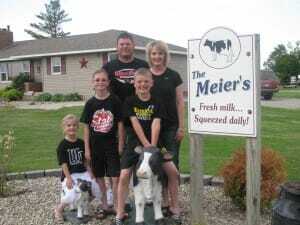
Joel and Mindy Meier with their children: Morgan (10), Jason (8) and Mallery (5)
Joel Meier’s passion for teaching is evident whether he’s hosting a group of elementary students on his family’s dairy farm or coaching one of his kids’ sports teams. This fifth generation Iowa dairy farmer feels fortunate to have the opportunity to raise his family on the same farm where his father was raised.
“I started milking cows before I started school,” says Joel, with a smile on his face. “I always wanted to be where my dad was, so I spent a lot of time outside or in the dairy parlor with him.”
Joel’s involvement on the farm increased as he grew older. At 10 years old, Joel was responsible for feeding veal calves. Using a feeding system designed and patented by his grandfather, Joel fed the calves twice a day. The bagged milk replacer was mixed in an old bulk tank and then pumped through a hose into pails.
Joel Meier (at right) is pictured with his grandfather, Martin; father, Brad; and son, Jason.
Martin Meier, Joel’s grandfather, was the first person to raise veal calves in Iowa. He raised 400 head at a time for 16 weeks until they reached 350 to 400 pounds for the Kosher market in Dubuque, Iowa. The Meiers raised 22,000 head of veal calves before the ‘80s Ag Crisis hit. Despite the extremely challenging conditions at the time, the Meier family was able to hold onto its main dairy operation and 500 acres of farmland.
Although Joel continued to help with the family’s row crop and dairy operations throughout high school, he also made time for sports. He was a four-year letter winner in both basketball and football. Along with being selected 1st Team All-Conference in both sports, he was also selected All-State twice in basketball. His love of the games prompted him to major in Education and earn a coaching certificate. Joel earned his degree from Buena Vista on the campus of North Iowa Area Community College (NIACC) in Mason City. Because he attended classes close to home, Joel was able to remain active in his family’s dairy operation.
“In 1993, I started getting part of the milk check and building my own herd,” said Joel. “When my grandpa retired in 2001 and moved to town, I became more involved with the dairy. Then my wife, Mindy, and I moved to the home farm.” In addition to the dairy, Joel and his parents have a wean-to-finish hog operation. They also raise corn, soybeans and alfalfa together.
Today Joel and Mindy make their home in rural Cerro Gordo County with their three children. Their oldest daughter, Morgan, is 10 years old. As a first-year 4-H member, she plans to show three calves at this summer’s county fair. Their son, Jason, is 8, and their youngest daughter, Mallery, is 5. Joel has coached both Morgan’s and Jason’s flag football teams, Morgan’s basketball team and is busy this summer coaching Jason’s baseball team.
It’s only a natural for the Meiers to be advocates for dairy consumption. They’ve hosted dairy farm tours for each of their kids’ classes and have also sponsored the local Girl Scout troop to earn the Dairy Delights badge, which involved learning about dairy cows and making foods that are made from milk. The Scouts churned butter and made ice cream in a bag, so we thought it would be fitting to share this recipe during June Dairy month. Also included below is one of Joel’s favorite dairy recipes for Strawberry Pizza.
What’s your favorite way to enjoy dairy?
Ice Cream in a Bag
Ingredients:
1 T. sugar
½ c. Half & Half
¼ tsp. vanilla
6 T. rock salt
1 pint-size Ziploc plastic freezer bag
1 gallon-size Ziploc plastic freezer bag
How to make it:
Fill the large bag half full of ice and add the rock salt. Seal the bag.
Put milk, vanilla and sugar into the small bag and seal it.
Place the small bag inside of the large one and seal again carefully.
Shake or squeeze until mixture is ice cream, about 5 minutes. The trick is to keep the mixture moving so it becomes ice cream.
Wipe off top of the small bag, then open carefully and enjoy!
The application of micronutrients during early crop growth stages can result in some yield increase. That’s why we recommend tissue testing for farmers, who are interested in pushing their yield goals.
When combined with soil testing and yield data, tissue sampling gives us a more complete picture of what nutrients the plant is using and where deficiencies exist. It’s a “real time” look at what nutrient levels are within a plant. Tissue testing is a very useful tool to determine macronutrient uptake including Nitrogen (N), Phosphorus (P) and Potash (K). It also helps determine micro-nutrient uptake including Zinc (Zn), Boron (B), Sulfur (S), Maganese (Mn), Copper (Cu) and Iron (Fe).
Tissue sampling can be done at any stage, however, we recommend testing at these three times during the growing season:
Corn: V4-V6, V14 to tassel, and R2
Soybeans: V3, R1, and Pod Fill
For more information about tissue testing, contact the trusted professionals associated with Latham Hi‑Tech Seeds. Call 1.877.GO.LATHAM (1.877.465.2842) today to get yours scheduled!
In a recent Wallaces Farmer article, Sukup Manufacturing of Sheffield, Iowa, was recognized as an official sponsor of the 100 Firestone Indy Lights Race at the Iowa Speedway to be held June 25, 2011. They have also partnered with ISU and the Farm Progress Show to sponsor the ISU Racecar. This new partnership with ISU, NASCAR and the Iowa Speedway is designed to promote the use of ethanol-based blended fuel and the renewable fuels industry.
This year NASCAR started fueling its stock cars with a blend of 15% ethanol made from corn grown by American farmers. This month’s races at Iowa Speedway marked the first time NASCAR’s ethanol-fueled cars raced in Iowa.
The Chevrolet pictured here, with number 85 on the sides, was driven Saturday, May 21, by Tanner Whitten in the NASCAR K&N Pro Series. It was a big weekend for the 18-year-old driver, who graduated from high school the next day, May 22.
ISU Racecar sponsored by the Farm Progress Show and Sukup Manufacturing
Eugene Sukup, founder of Sukup Manufacturing, spoke at a press conference held in Des Moines to promote the new project. He said, “Ethanol has been a real boost for Iowa and indeed Midwest agriculture. Iowa has done the groundwork in developing alternative energy and has done it very well. ISU is helping to further develop renewable fuels, the next generation of biofuels.”
He added, “Our business is making bins and equipment to store and handle grain, including corn that’s made into ethanol. The 41 ethanol plants we have in Iowa today, plus the rest of them in the U.S., have raised the price of corn and have helped boost U.S. farm income. The big thing we all need to do today is to help address the public’s understanding of the importance of biofuels and the need to continue to do research and development. Today’s corn ethanol is a much needed step to help bring us to the next generation of renewable fuels.”
Visit this link for coverage of a press conference held in Des Moines to promote this new biofuels promotion and for an interview with race car driver Tanner Whitten.