Soybean fields are entering the critical reproductive stages and yields hang in the balance. While there are several yield-determining factors that are beyond a farmer’s control, insect pressure can often be managed.
Now is the time to intensify your soybean scouting efforts, advises Iowa State University Extension Entomologist Erin Hodgson. Scout every field right now to see if there is any type of pressure, and keep a watchful eye to see if conditions warrant treatment. We could see outbreaks in late July or early August.
With the predicted market value of soybeans so high, farmers may be tempted to spray aphids at low populations. ISU recommends a threshold of 250 aphids per plant, although some agri-businesses are suggesting that aphids be sprayed when populations are lower. Click here and listen to Hodgson discuss whether research confirms the value of such lower thresholds. In this podcast, she also discusses whether it makes a difference to spray with generic or labeled compounds.
There’s never a dull moment when you’re a parent – especially when your three kids are all 4-H’ers and have less than a week to get their projects ready for the county fair.
It’s a good thing that Scott Mandernach is used to multi-tasking. This fourth generation Iowa farmer is a 100% Latham® seed dealer, has a stop on the 2011 Latham-WHO Radio Crop Tour, farms his own ground and custom farms, plus he operates a general trucking business.
With all of these irons in the fire, it’s obvious that Scott has a good partner. His wife, Mindi, has helped build their operation for nearly 18 years. (They’ll celebrate their 18th wedding anniversary next month.) In addition to driving the tractor and keeping books, Mindi works two days a week as an x-ray technician for St. Anthony Regional Hospital in Carroll.
“I grew up in town, so I didn’t realize that farming wasn’t an 8 to 5 job,” recalls Mindi, with a smile. “But, it didn’t take me long to learn! I just love the freedom that comes with living in the country, and I’m glad we’re raising our kids here. I never have to worry about where they are.”
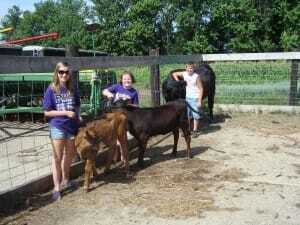
The Mandernach children were working cattle when I arrived on their Century Farm near Odebolt in Sac County, Iowa. Twelve-year-old Clayton had just finished cleaning the pen for his steere, Charlie. Karlie, 14, was leading her beautiful, doe-eyed bottle calf she named Kenya. And 9-year-old Kacie was giggling over how well her Angus bottle calf, Leslie, was leading.
After stopping to pose for a couple of photos, the older two Mandernach kids got back to work in the cattle yard while Kacie showed me to the family’s newly remodeled and spacious kitchen. Sitting on a tall stool at the snack bar was the perfect place to take in the action around me.
Kacie Mandernach will exhibit latchhook at the county fair this year
Mindi was busy looking through a community cookbook for the recipe that Kacie wanted to share with me. Meanwhile, Kacie’s eyes were lighting up as she talked with me about the projects she’ll be exhibiting. As a first-year 4-H member, Kacie is especially excited to be a part of the action this year. Her latch hook of vibrant flowers is ready for framing, and now she’s eager to get her food projects underway. She and her mom were going to make a “trial batch” of Ice Cream Sandwiches, so Kacie could have a chance to practice her Pride of Iowa presentation.
The Pride of Iowa makes 4-H’ers aware of food ingredients that are made in Iowa. The contest participant selects a recipe and then prepares it in front of the judges and the public. Samples of the recipe are then given to the judges and the public. (Now if I would’ve known this, I would have changed my interview date just to sample this dessert!) Judging criteria includes originality of recipe, enthusiasm of the 4-Her, as well as the public’s enthusiasm for the product.
Kacie is definitely enthusiastic, so I’m sure she’ll score well on that criterion. I’d give her a good score for originality, too. Who’s ever heard of an ice cream cookie that doesn’t require you to first make the cookie? That’s usually a barrier in my house because all of the cookies get eaten before they’re made into ice cream sandwiches. (Honestly, much of the dough gets eaten before it even gets baked!)
The easy-to-make graham cracker crust is a real bonus in my opinion. The second bonus is that it required only four ingredients, which are common to most Iowa kitchens. In addition, this recipe is a cost-effective way to feed a hungry crowd of kids. Kacie says it makes a huge amount – enough to fill the extra large jelly roll pans.
With all the benefits of this recipe, it’s no wonder Kacie is excited about entering the Pride of Iowa competition this year. Whip up a batch and let me know what color of ribbon you’d give it! Also feel free to post your own blue-ribbon winning recipe on TheFieldPosition.com.
Peter Bixel, Seed-2-Soil powered by Sci Max Team Leader
The effects of this past’s week heat wave on this fall’s corn yields is a main topic of conversation in the countryside. Farmers are wondering if consecutive days of excessive heat will cut yield. It’s true that stress during pollination and silking may result in shorter ears, increased tip back and fewer kernels per ear – all of which contribute to less yield potential. Sometimes.
Fortunately, the availability of pollen is usually not a problem with modern hybrids for a couple of reasons:
At its peak, a plant produces 500,000 pollen grains per day! There is usually more than enough pollen to go around.
Most pollen shed occurs during the morning when temperatures are cooler and moisture stress less evident.
Breeding efforts have significantly improved the stress-tolerance of today’s hybrids. The time between pollination and silking – also known as the anthesis-silk interval (ASI) – is very short with modern hybrids. This shorter ASI results in few barren plants. In older hybrids, however, silking always followed initial pollen shed by at least several days.
The good news iscurrent soil moisture conditions are excellent throughout much of our territory. Likewise, the crop moisture index shows that all of Iowa sits at the midpoint, “Slightly dry/ Favorably moist.” A good share of our soils have high water holding capacity. As the heat spell continues, the differences in mid-afternoon corn leaf rolling between soils with better moisture holding capacities than others will be evident.
High temperature impacts on corn
This heat wave may have a double impact on the crop. The first is the increase in rolling of corn leaves in response to moisture deficiency. By rule-of-thumb, the yield is diminished by 1 percent for every 12 hours of leaf rolling – except during the week of silking when the yield is cut 1 percent per 4 hours of leaf rolling. Unfortunately, most of our crop will be silking next week. The second impact is less obvious initially.
When soil moisture is sufficient, as it is for the most part this July, the crop doesn’t have a measurable yield response to one day of temperatures between 93 F to 98 F. The fourth consecutive day with a maximum temperature of 93 degrees or above, however, results in a 1 percent yield loss in addition to that computed from the leaf rolling. The fifth day there is an additional 2 percent loss; the sixth day an additional 4 percent loss. Data are not sufficient to make generalizations for a heat wave of more than six days, however, firing of leaves becomes likely and very large yield losses are incurred. Generally a six-day heat wave at silking time is sufficient to assure a yield not to exceed trend (Iowa trend yield is near 174 bushels per acre).
Hopefully, this hot-weather trend will end soon! Everything – plants, people and pets – could use a break.
Last week Latham’s Corn Product Specialist Nick Benson posted a video, urging farmers to walk their fields as Corn Borer infestations were spotted in Northeast Iowa. Today he focuses again on European Corn Borer as infestations have risen well over economic thresholds for many producers in the area. His follow-up video further explains why it’s important to catch these pests before they move down the corn stalk.
Click the video link for tips on how to scout beyond the whorl. Make sure you catch your fields before pests move down the plant and “past the point of no return” for foliar-applied control methods.
With foliar-applied insecticides, growers are able to acheive nearly an 80% kill rate. However, when corn borers burrow into the stalk, foliar applications are no longer affective. Growers are then left to rely merely on careful harvest and season management approaches to fight against stalk lodging, ear drop and repeat infestations.
Post-infestation management procedures for harvest and for next season are also included in today’s video by Nick Benson. For more information on scouting for and managing European Corn Borer, contact Latham’s Corn Product Specialist on Twitter @lathamcornguy or contact us directly at this link.
It’s no wonder that farmers always have one eye on the radar and both ears tuned to the next weather report. Weather is the number one factor in determining yield, said Dr. Fred Below, professor of Plant Physiology for the University of Illinois.
During a July 15th presentation to a group of farmers enrolled in Latham’s Seed-2-Soil® program, Dr. Below said that rain in July and cool night-time temperatures in August make grain. His data shows that about 70 bushels of yield can be attributed to weather.
Unfortunately, the weather last Monday was out of control! Straight-line winds of 75 to 100 mph struck many corn fields in Latham Country, including our WHO Crop Tour Stopon Johnny Wilson’s farm near Laurel in Central Iowa. These photos by John Latham show damage in the area, including a new bin that collapsed, and downed corn.
Yield loss to the maturing corn crop may be large, reports Rod Swoboda in a recent Wallaces Farmer article entitled “Severe Storms High Winds Flatten Iowa Corn.”
This bin located north of Johnny's field didn't fare quite as well.
Despite the damage that occurred July 11, ISU Extension Corn Specialist Roger Elmore says we can be thankful the damage wasn’t more extensive. Wet soils caused more root lodging from the derecho winds, explains Dr. Elmore in a blog posted July 15 by Iowa Farmer Today. Drier soils would have cause more greensnap, and thus higher yield losses. Read Elmore’s blog post for more information about yield loss from root lodging, greensnap and pinching.
Corn in Johnny Wilson's field near Laurel, Iowa after 80-100 mph straight-line winds passed through.Derecho winds on Monday, July 11, damaged fields in Marshall County, Iowa. This competitor hybrid was located in a field just to the North of Johnny's LH 5376.
Lavender signifies charm and enchantment, so it’s only fitting that lavender shrubs are nestled aside the beautiful home of Mike and Donna Aldinger near Iowa Falls. The Aldinger’s colorful landscaping also includes an assortment of succulents, herbs and wildflowers.
“When I grew up, we went to the park or the ball diamond to play in wide, open spaces,” says Donna, who was raised in the nearby town of Alden. “But here, all you have to do is just open the door. This was just the best place to raise our kids.”
Playhouse at the Aldinger farm
Mike and Donna moved to this location right after their wedding and will celebrate their 39th anniversary on July 22. Their three children have spent countless hours having scavenger hunts, playing in the play house and riding four wheelers.
Today the tradition continues when their grandchildren come to visit. The Aldinger’s oldest daughter, Stacey, and her husband, Randy, have three daughters: Lexi, 11; Emma, 9; and Abigail, 6. The Aldinger’s daughter, Jamie, and her husband, Ben, also have three children: Gabrielle, 7; Gavin, 4; and Greta, 8 months. The Aldinger’s son, Landon, is not yet married and works at Toro as a design engineer in Minneapolis.
The Aldinger’s children all live in the Twin Cities, but they enjoy frequent visits to North Central Iowa. The whole family spent the Fourth of July weekend on the farm. The adults enjoyed spending time outdoors, watching the children play. The grandchildren also enjoyed helping with chores and “working” in the garden.
Mike and Donna Aldingerfarm. The adults enjoyed spending time outdoors, watching the children play. The grandchildren also enjoyed helping with chores and “working” in the garden.
“Our grandkids had a ball picking radishes and onions over the Fourth of July,” says Donna. “They would see who could find the biggest radish or the biggest onion. But as much fun as they had, they’re still looking forward to the fall harvest. Roast beef with potatoes and carrots is a family favorite. There’s nothing quite like a home-grown meal!”
Beef cattle, isowean pigs and row crops encompass the Aldinger’s farming operation. They’re serving as one of the stops on the Latham-WHO Radio 2011 Watch It Grow Crop Tour.
“We broke the 80-bushel barrier last year with Latham’s L2560R,” says Mike, who has been planting Latham® brand soybeans for 38 years. “The yield monitor popped to 83 and held. We had treated 120 acres with a fungicide and 40 acres we also treated with a foliar fertilizer application. We got 60 bushels plus where we treated only with the fungicide treatment, which is a good yield, but 83 was unbelievable where we added the foliar fertilizer!”
In addition to farming, Mike operates Precision Farm Management. He provides recommendations for manure management and provides crop consulting services. He also sells seed, as well as fertilizers and chemicals.
Work hard, play hard is the Aldinger’s motto. They look forward to their annual Minnesota vacation with their children and grandchildren when the group of 13 gathers for pontoon rides and campfires. The adults also enjoy golfing, while kayaking and swimming are a hit for the kids. This year they might even squeeze in time to try some lavender punch since the Fourth of July weekend passed before they got it done. Here’s a recipe that Donna is eager to try.
What are your plans to savor summer?
LAVENDER PUNCH
1 c. water
3″ stick cinnamon
1/2 tsp. whole cloves
3 tbsp. fresh lavender or 1 tbsp. dried lavender
6 oz. can frozen limeade concentrate
2 c. bottled purple grape juice
1 lime, sliced
Ice cubes
1 liter bottle seltzer or ginger ale
Ribbon-tied bouquet of lavender
In covered 1 quart saucepan, heat water, cinnamon stick and cloves to boiling. Simmer spice mixture over low heat 5 minutes; remove from heat. Add lavender flower. Cover and let stand 10 minutes to steep. Strain into a container or bowl. Discard the particles. Stir in frozen limeade concentrate into the brew until melted and add grape juice; cover and refrigerate.
Just before serving, pour into large pitcher, add lime slices and ice. Tie bouquet of flowers to handle of pitcher if desired. Fill pitcher with seltzer and serve immediately. Makes about 1/2 gallon.
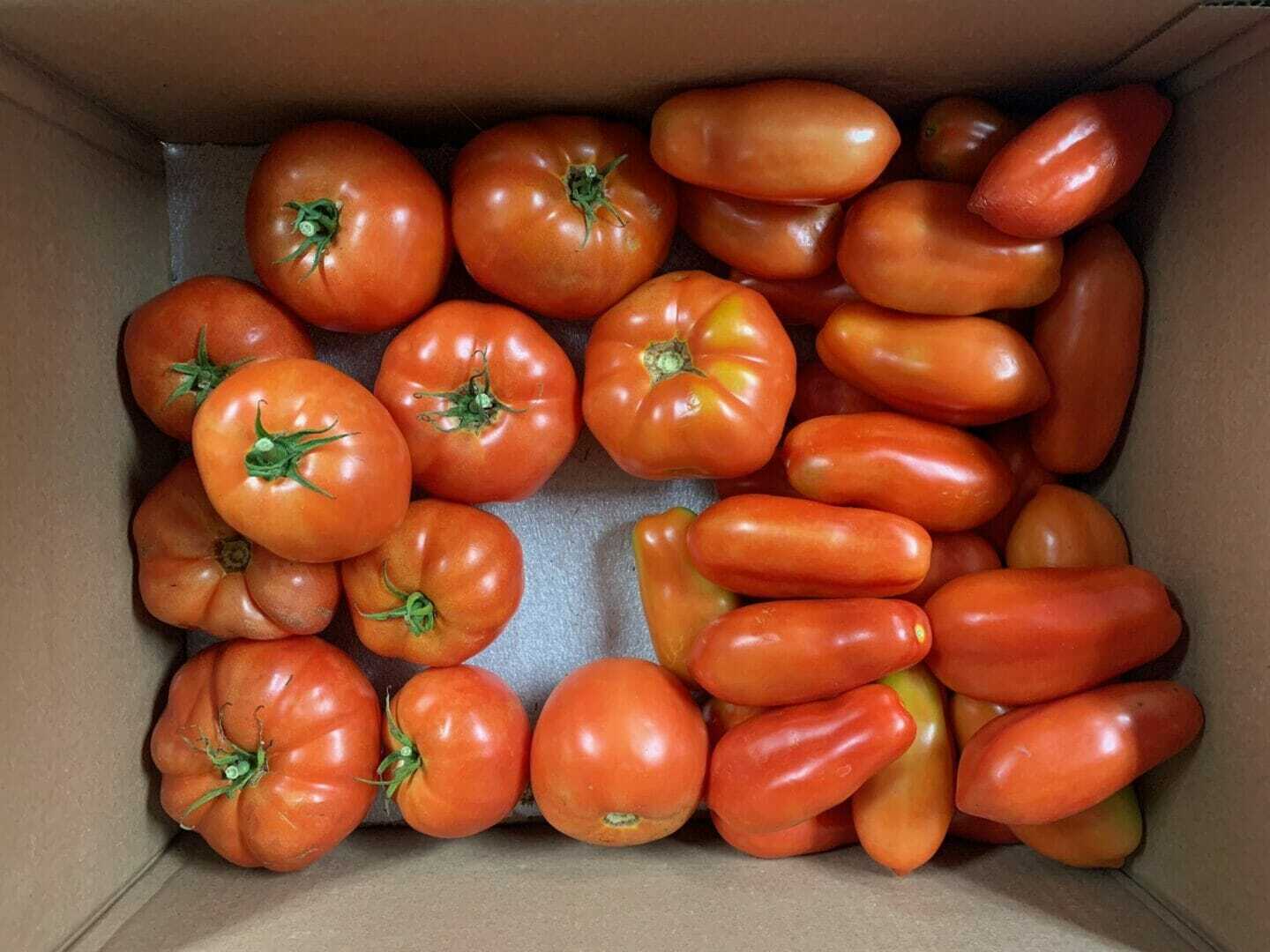
A few years ago I decided to start an herb garden, but it’s not your traditional herb garden. My “garden” is comprised of a plant stand, which I found at a local gardening store, and terracotta pots painted to match. The herbs I selected include: sage, rosemary, thyme, basil and oregano. I also have a habanero pepper in a pot next to the stand.
Although potted herbs are growing in my breezeway now, I can move them indoors when it gets cold. I was motivated to plant this herb garden in anticipation of our family’s canning weekend, which has become an annual event spread over two weeks. It begins when my mother-in-law and I head to the Mennonite Auction Houses. We’ll bid against grocery store buyers and others to get the best price that we can for bulk canner tomatoes, which we’ll use to build up the liquid volume of our sauce.
We’ll come home with a load of tomatoes and other fresh produce including raspberries for jam, gourds for fall décor, pickles for canning, onions and other homegrown veggies.
After returning home from the auction house, we’ll set the tomatoes outside on picnic tables to continue ripening so they’re ready for the canning weekend. The remaining ingredients for our sauce will be picked fresh from our own 30 Roma Tomato plants and our two herb gardens.
The actual recipe for this sauce has been handed down from one generation to the next, so I’m sworn to secrecy! But I will list the ingredients and provide a few directions, so you can try your hand at brewing your own blend of spaghetti sauce.
Compaction Effects Felt Long After Fall Tillage and Spring Planting
We’ve heard several reports about uneven corn stands this season, and compacted soils is one reason for some of the variability that’s now evident in the fields. Today we’re following up our recent posts, Uneven Corn Stands Part 1 and Uneven Corn Stands Part 2, with a video example of compaction.
Steve Bailie, Latham RSM, recently shot this footage in his Southwest Wisconsin territory. While completing fall tillage operations, the grower entered this field when it was too wet. This action led to deep wheel tracks in the soil and compaction in the seedbed.
Here’s a photo of corn plants from the same field, eight rows apart. Compaction took its toll on the plant on the left.
Make adjustments to your crop management plan this year to avoid situations like these from happening to your acres in 2012. The majority of yield is determined during planting. Good things come to those who wait for the right seedbed conditions. For more tips on how to avoid soil compaction, read Mark Grundmeier’s post.
Latham Corn Product Specialist Nick Benson is seeing above-average pressures of corn borer in his northeast Iowa territory. If your acres aren’t protected by a corn borer trait, Nick advises you to check fields as soon as possible for corn borer larvae and consult with an agronomist about treatment if thresholds are met.
Click the video below for information on how to scout your fields for corn borer.
Female moths have dull, buff colored wings while males have brown colored wings.
Corn Borers damage plants when their “boring” tendencies disrupt the plant tissues and interfere with water and nutrient uptake and transfer. Boring into plants creates a wound providing opportunity for infectious disease to enter the plant. Lastly, corn borers can cause weakened stalk and ear strength leading to lodging or ear drop. It’s important to catch these pests early on in the infestation stages to prevent severe damage to the integrity of your plants.
Late-stage larvae commonly tunnel into the earshank of corn.
Management approaches differ according to generation of corn borer, stage of growth in the corn plants and the cost analysis in your field. Iowa State provides these guidelines, but it’s advisable to run an individual analysis and consult with your agronomist for recommendations to suit your unique situation.
For more information on corn borer or management approaches, don’t hesitate to ask questions in the comment box below, or contact us directly.
Franklin County 4-H to Hold Pancake Breakfast July 17
WHO: Everyone!
WHAT: Pancake breakfast
WHEN: Sunday, July 17, 2011, from 7:30 to 10:30 a.m.
WHERE: 4-H Food Stand on the Franklin County Fairgrounds
Help support the Franklin County 4-H Scholarship Endowment! All are invited to enjoy food and fellowship during a pancake breakfast presented by Franklin County 4-H.
Free will donations will be accepted to support the youth scholarship endowment fund.

 Soybean fields are entering the critical reproductive stages and yields hang in the balance. While there are several yield-determining factors that are beyond a farmer’s control, insect pressure can often be managed.