[youtube]http://www.youtube.com/playlist?list=PLB96473611C340E26[/youtube]

[youtube]http://www.youtube.com/playlist?list=PLB96473611C340E26[/youtube]

With the increase of new technologies in the field, from GPS to RIB, along with factors beyond individual control – from vast changes in weather patterns to fluctuating markets – it has never been more important for seed businesses to stay up to date on changing trends within the industry.
There are many key elements to seed retailers’ “crystal ball” forecasting to help ensure the seed that moves from plan to planter will meet demand. Those qualities I find key to seed companies’ success include:
[youtube]http://www.youtube.com/watch?v=MMdXdw0ZM8U&feature=youtu.be[/youtube]
It’s official… National Ag Day will be celebrated Thursday, March 8!
NOW, THEREFORE, in recognition of the preeminent role that agriculture plays in the daily life of every American, in acknowledgment of the future progress and prosperity of the Nation’s economy, and in appreciation of farmers and ranchers across the Nation, I, Thomas J. Vilsack, Secretary of the United States Department of Agriculture, do hereby proclaim March 8, 2012, as National Agriculture Day.
Latham Hi‑Tech Seeds is kicking off its National Ag Week celebration today by sharing a recipe for Breakfast Casserole. Why breakfast casserole? For starters, breakfast is the most important meal of the day! This recipe is an especially tribute to the American farmer as it contains something from nearly every major food group. Toss in some green peppers or pair this casserole with a serving of grapefruit and you’ve got a balanced meal in a matter of minutes. This recipe is so easy that you could even host your own Ag Day Breakfast.
Our celebration continues on Monday when we host our first Facebook contest with ag trivia. Facebook friends, who post responses, will be entered into a drawing for food and ethanol gift certificates. Be sure to check out our Facebook page each day next week for your chance to win!
Through our blog posts and Facebook updates, Latham Hi‑Tech Seeds can helps Americans understand the value of agriculture to each and every citizen. How can you help celebrate the abundance provided by American agriculture?
An article published on wallacesfarmer.com this week highlighted that there’s still time to test soil for the presence of soybean cyst nematode (SCN). The small, plant-parasitic roundworm feeds on roots and can cause significant yield losses, especially in dry growing seasons.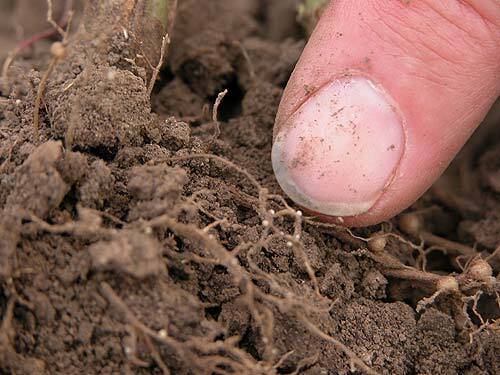
While SCN is a devastating pest, its risk is often overlooked because SCN damage isn’t readily apparent during growing seasons with excess moisture. SCN is an incredibly persistent pest, however, and adequate moisture or not, has the ability to live more than a decade in infested soils without the presence of soybeans, and produce more than three generations in just one growing season.
In a recent Iowa State University Integrated Crop Management article, Greg Tylka, with the Department of Plant Pathology and Microbiology, highlighted the need to remain offensive against SCN, this year especially.
“As we approach spring planting season, increased vigilance about SCN is warranted for the 2012 growing season because of the dry soil conditions statewide,” Greg said. SCN can cause substantial yield loss to susceptible soybean varieties under dry soil conditions, even when SCN egg population densities are low. If soybeans will be produced in 2012 in fields infested with SCN, high-yielding, SCN-resistant varieties should be grown.”
For more information about SCN, and to find tips for collecting a soil sample to detect whether or not it’s present in your field, visit http://farmprogress.com/wallaces-farmer-story-still-time-check-fields-scn-9-57633.
Thursday, Feb. 23
 Our bus left at 7 a.m. for a three-hour ride to an ethanol, sugar and biodiesel plant called Barracool. A group of seven cattle farmers founded this company in the 1980s, and there are currently 27 owners. The plant can run on either sugar or ethanol; it’s presently running 75% ethanol and 25% sugar. Facts that we learned about production here:
 After visiting Barralcool, we stopped by a school where children learn English. Then we visited a beautiful place that Barralcool helped establish for at-risk kids. Social awareness and volunteerism are apparently alive and well within this company.
Friday, Feb. 24
On our last day in Brazil, we headed to the headquarters of FAMATO of Mato Grosso, which is equivalent to America’s Farm Bureau. We met with the Under Secretary of Agriculture for the Mato Grosso state. He was assisted by representatives from the departments of economics, livestock and the environment.

The FAMATO presentations were so interesting because they were filled with facts about Brazil. We learned that Mato Grosso, mainly because of its size and climate, is the main state for agriculture in Brazil. Each truck load of grain has to travel 1,000 miles to port since there is only one main road to the ports or rail line.
Interestingly enough, almost half of Brazil’s farms are “small” and are comprised of fewer than 2,000 acres. We had the opportunity to visit some of the country’s largest farms, which were on a totally different scale than what we’re accustomed to in the Midwest.
Our group spent some time reflecting on our trip and talking about the misconceptions we had before touring the country. Most of us thought we would see the rainforest being cut down to make room for production agriculture, but that just isn’t the case. Brazil has had a ban on clearing land in effect since the mid-2000s. Plus, farmers are required to leave 20% of their land in its natural state; 85% of the land must be left in its natural state if it’s closer to the rainforest.
I came home from this trip with the impression that farmers – whether they live in Brazil, Delaware or Iowa – are in the business of producing food for the world while caring for the environment. I no longer see Brazil as our competition, but our ally in production agriculture.
Musings of a Pig Farmer
by Larry Sailer
Willie Nelson, who first organized Farm Aid in 1985 to raise awareness for the farm crisis and to raise funds to keep families on their land, is still actively promoting “family farms” today. In a recent article to The Huffington Post, Willie writes:
“Despite all they’re up against, family farmers persevere. Each and every day they work to sustain a better alternative – an agricultural system that guarantees farmers a fair living, strengthens our communities, protects our natural resources and delivers good food for all. Nothing is more important than the food we eat and the family farmers who grow it.”
I can agree with these statements. In fact, I wholeheartedly agree with that paragraph penned by Mr. Nelson. It’s just that the two of us are practically diabolically opposed to in the type of system we believe “guarantees farmers a fair living, strengthens our communities, protects our natural resources and delivers good food for all.”
It’s my contention that America’s current agricultural system does this and more! We don’t have to look any further than our neighbors to the north to prove my point.
Sioux County, Iowa, is showing the rest of us what can be done with “a mix of feedlots and biotechnology, Christianity and capitalism, hard work and higher education.” The county’s unemployment was 3.6 percent at the end of 2011, according to a recent Register article entitled, “How cows and pigs have fueled economic growth in northwest Iowa.” Sioux County’s population grew 6.7 percent in the 2010 census, which is 63 percent faster than the rest of our great state. Although the population is growing, cows and pigs still outnumber people there 44 to 1.
The key to Sioux County’s success is livestock farming. Innovative, entrepreneurial-minded farmers and businessmen turned their “geographic disadvantage” into a real advantage. Instead of paying astronomical trucking fees to transport grain to the Mississippi River or load grain onto trains headed to the Pac Northwest, they started feeding local grain to livestock. Sioux County farmers add value to their crops by using it as livestock feed, and as a result, their Main Streets flourish.
Where there’s livestock, there’s economic activity. “Cattle yards and hog confinements require loans, feed and ethanol byproducts for the animals to eat, veterinarians and nutritionists to keep them healthy, truck drivers to transport them to market, as well as contactors to build and wire buildings, repair fences and pour feedlots. Livestock farming generates paychecks to feed mill workers, auctioneers, stock trailer builders and equipment mechanics. You get a ‘flywheel effect’ when dollars compound and gain speed with each transaction.” More examples of economic success and lesson learned can be gleaned from this six-page Register article, and I invite you read it in its entirety.
You’ll see that modern agricultural practices are allowing today’s farmers to make an honest living while strengthen our communities and protecting the environment. And in the end, I’m sure you’ll see that yesterday’s “Global Day of Action” (aka #occupyourfoodsupply) is really based on misconceptions.
Time and effort would be better spent getting to know the American farmers who produce the world’s safest and most abundant food supplies. But don’t just take my word for it. Take a few minutes to read what other farmers like Wag’nTales and The Farmers Life have to say about who controls their family-owned farming operations.
Indeed, “nothing is more important than the food we eat and the family farmers who grow it.” I’m proud to be a fourth generation Iowa farmer.

“Racing through the grocery store” took on new meaning as Latham Hi‑Tech Seeds and nine other county businesses competed Friday in the first ever Breakfast Battle, sponsored by Franklin County Farm Bureau. This event was held in honor of National Food Check-Out Week, which celebrates the abundance and safety of America’s food supply plus helps kick off March National Nutrition Month.
Team members met at Fareway in Hampton, Iowa at 8 a.m. to see who could find everything on their shopping lists in a record amount of time. According to contest rules, each team had to meal plan a breakfast, lunch and dinner. Then they had to turn in their shopping lists before they were “on the clock.” The objective was to see which could purchase all of their groceries in the least amount of time. When they got to the checkout, the cost of the grocery items had to total between $45-50. If the total was less, they had to add to their cart. If it was more, they had to remove items from the cart.
Competition was fierce as the team battled! Fortunately, Latham Hi‑Tech Seeds’ team was voted “fan favorite” and earned 10 seconds off its final time. Thanks to all of you who voted for us on Facebook! It’s just too bad that it was worth 60 seconds off the total because those ladies from ABCM were fast shoppers!

Although Team Latham didn’t place where we had hoped, we did help raise money for a worthy cause. It’s nice knowing that 13 families will benefit from the groceries and donations that we helped collect.
The inaugural Breakfast Battle was such a huge success that Franklin County Farm Bureau plans to host it again in 2013. Watch for Team Latham to perform better in the 2nd Annual Breakfast Battle. We’ll have a team uniform. We’ll train. We’ll be ready to “do battle” in 2013! And, that’s a promise.
Guest blog by
April Hemmes, Hampton, Iowa
Franklin County farmer April Hemmes is traveling through Brazil with a group of Iowans. You can get a sneak peek at Brazilian culture and agriculture here. Read below for a daily account of her journey.
Tuesday, February 21, 2012

What a trip so far! We started the day at a John Deere dealership where we saw new tractors and combines. New combines cost about $100,000 more in Brazil than in the U.S.
Next we stopped at a chemical and seed dealership that works directly with Syngenta. While their costs are similar to ours for chemicals, seed corn and seed beans, tech fees are different. Brazilians have two options to pay tech fees: (1) either pre-harvest at the cost of 1% of an 88-pound bag of seed beans or (2) post-harvest at 2% of the crop that is harvested. The tech fee on seed corn gets figured into the price of the corn.

Farmers here also believe their soybeans will run 2-4 bushels/acre less than normal at yield of 49 to 52 bu/A. It’s extremely dry in southern Brazil and Argentina. Our guide said, “Whatever you have heard about how dry it is, double it. It’s that bad!”
After lunch, we visited a newly formed farmer-owned, co-op that serves farmers in a 60-mile radius. Sixteen million dollars has been invested in the facilities; 80 farmers bought in for $40,000/year. The day ended with supper in a pizza parlor where we had fun telling each other stories and doing what we do best, talking farming!
Wednesday, February 22, 2012

Today we traveled about 70 miles on gravel to the Girassol do Prata farm, which is owned by a state senator. This operation is very diverse and includes beef, eucalyptus, seed soybeans and seed corn.
Our first stop on the tour was a beef feedlot and a nice, new loading facility. They buy feeder cattle, put them on pasture for a year, and then feed them some grain. It takes 30 months for them to get to market weight, which is around 1,200 pounds.

After lunch, we visited their seed bean plant. It was HUGE! They were bagging Roundup Ready Soybeans, so Monsanto’s Dave Tierney was happy to pose for a photo beside the state senator. Next, we walked to the cotton gin. The gin is 20 years old and needs a lot of maintenance.


Guest blog by
April Hemmes, Hampton, Iowa
Franklin County farmer April Hemmes is traveling through Brazil with a group of Iowans. You can get a sneak peek at Brazilian culture and agriculture here. Read below for a daily account of her journey.
Saturday, Feb. 18

Today we toured Brasília, the capital of Brazil. After taking a bus tour of the city, group members chose to shop or attend carnival (carnaval) celebrations. Carnival is similar to New Orleans’ Mardis Gras with parades, costumes, dancing and lots of food. Different regions of Brazil hold carnival annually in February or March, depending on the date of Easter. It ends as Lent begins since historically Lent is a period during which there are no parties and people refrain from eating rich foods in honor of the 40 days Jesus spent in the wilderness.
Sunday, Feb. 19
Today we took a two-hour flight from Brasília, followed by a three-hour bus ride to Primavera do Leste. Primavera do Leste is located in Mato Grasso, the agricultural region of Brazil where they raise a lot of Zebu, which is the Indian cattle breed that resembles Brahma.

Riccardo, our guide, farms with his brother. The soybeans they planted in October and November is now ready to harvest. Yields will average 53 bushel/acre this year, which is a little less than normal. Sometimes they harvest beans at 25% moisture, so they have to dry them. They do not double crop beans because of rust. Corn planting will follow soybeans harvest, but they must plant corn before the middle of February to get a good crop.
One interesting thing about how they do business here is that they buy things in “bags of soybeans.” For example, if I were to buy an acre of land, it would be 400 bags. A bag of soybeans here is 2.2 bushels, so it comes to roughly $3,200/acre. The same goes for a combine or any equipment purchase, so the price of everything fluctuates with the price of beans!
Monday, Feb. 20

Today we visited a huge farm. And I do mean HUGE! Totaling 500,000 acres and 50,000 livestock, it’s one of the world’s largest farms. It has storage capacity for 5.5 million. It also has the world’s largest John Deere fleet.
Cotton and soybeans are their principal crops with corn, rice and beans as secondary crops. They also have a fish farm, so we got to watch their annual fish harvest. We also got to watch combines harvest soybeans and learned the big drought southern Brazil is lowering yields to 49-51 bushels/acre. Soybeans are harvested as wet as 25%, so they dry them with Eucalyptus wood burners. It’s a sustainable energy source as they plant  20 acres of Eucalyptus; it takes eight years for a tree to reach maturity.
What an interesting day! We could look one way and see soybeans being harvested, turn another way and see cotton growing, and then look another direction and see corn being planted in the same field.
MUSINGS OF A MIDWEST PIG FARMER
by Larry Sailer
Feb. 21, 2012
With less than 2% of the world’s population engaged in production agriculture, farmers shoulder a lot of responsibility to feed a growing world. It’s been said repeatedly that we’ll have to double crop yields by 2030 in order to meet food/feed demand. Population growth and rising incomes are driving increased demand for high-value animal protein, as well. That’s why it continues to amaze – and perplex – me how and why people continue to criticize food production and pit consumer against farmer and even farmer against farmer. It seems the definition of “sustainable agriculture” has become convoluted.
The complexity of this issue really hit home for melate last week when I stepped into a classroom at CAL (Coulter-Alexander-Latimer) High School in rural Franklin County, Iowa. CAL, like many other schools nationwide, showed a screening of the Graham Meriwether’s documentary entitled American Meat. This film criticizes many modern production practices and encourages farmers to raise livestock on pasture rather than inside buildings.
“There’s no reason for a confinement house in the country, in the word, anywhere!” says Joel Salatin of Virginia in American Meat. As someone who’s been engaged in farming for 50 years, I can think of several reasons for raising livestock in buildings. For starters, let’s consider the Midwest’s climate and weather patterns. The average temperature of an Iowa winter is about 34 degrees, and often the mercury dips below the freezing point. How comfortable is it for pigs to root through snowdrifts during a freezing, cold Iowa winter?
My family raised pigs outside for a number of years, and in doing so,we experienced more problems with disease, pests and weather. Because of Iowa’s weather patterns, we farrowed outdoors in spring and fall. The majority of pigs were raised this way, so the worst market prices were whenthe porksupply was the largest in the fall and in the spring. Moving our pigs inside allowed us to farrow year roundand recognize better market prices. Indoor hog operations also allow us to raise a leaner, more consistent product that was driven mainly by consumers. During the 1980s, there was a public perception that chicken was healthier than pork. Today’s pork is actually leaner than chicken, and because of this, our hogs don’t have enough natural insulation (i.e. fat) to handle inclement weather. Lean genetics were bred primarily into hardy Large White pigs, but this breed also gets sunburn and is better suited for indoor environments.
“We know pigs are ‘happier’ in warm, dry buildings,” writes Missouri hog farmer Blake Hurst in his Feb. 19 editorial to the New York Times. Hurst’s editorial refutes the Chipotle restaurant’s recent ad campaign saying the company uses only “happy pigs.” The day after the Grammy Awards, during which Chipotle’s ad first aired, McDonald’s announced it would require its pork suppliers to end the use of gestation crates. While crates restrict a sow’s movements, they also serve their purpose. Gestation stalls ensure sows get the nutrition they need to produce healthy piglets. Otherwise, sows fight for feed. The stronger, more aggressive sows get the most food and often get too fat. The more timid sows are often undernourished during the gestationperiod, which can result in underdeveloped offspring.
[youtube]http://www.youtube.com/watch?v=vbdB9WOICyo&feature=player_embedded[/youtube]
I love opportunities to talk with consumers about how we raise pork and why. In fact, I did just that today. Earlier today I was the guest speaker for the Morning Exchange Club of Waterloo (similar to Lions, Rotary and Kiwanis). They got to know me, an Iowa hog farmer. And they had an opportunity to get their questions answered.
“Know your farmer” is a statement made in the American Meat documentary. And it’s a statement I can agree with… in my own context! Americans have the privilege of living in the “land of the free.” This means we all have the freedom to choose. It also means that we operate under a free market economy. So, let the market place determine what foods get produced and how they are produced. Farmers’ markets and the local foods movement have their place as do larger scale operations. There’s enough demand – and enough need – for all farmers.