

Latham Hi-Tech Seeds

(641) 692-3258

  • Home
  • Products
    • Corn
    • Soybeans
    • Alfalfa
    • Corn Silage
    • Seed Guide
  • Performance
  • Find a Rep
  • Media
    • Blog
    • News
    • Videos
    • Podcasts
    • TECHTalk
  • About Us
    • Company History
    • Our Mission
    • Careers
    • Become a Rep
    • Sowing Seeds of Hope
  • Contact Us
  • Latham Hi‑Tech Seeds

    Till Less for More Water in 2013

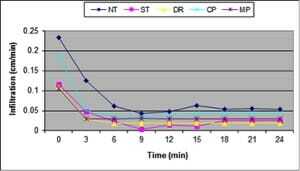
    Graph1

    guest blog post by Mark Licht, ISU Extension and Outreach

    Current weather pattern trends are causing some concern that moisture reserves will be depleted for the 2013 crop.  While we can’t control the weather, we can help manage soil moisture reserves by reducing tillage.

    Reducing fall tillage will help conserve soil moisture as each tillage pass can lead to ¾ of an inch of plant available water.  Tillage reduces water infiltration by breaking large pores, and the small pores are clogged by the dislocation of soil particles.  Raindrops break the soil aggregates, which clog soil pores leading to slow water infiltration and increases surface runoff.  Additionally, subsequent rains result in more runoff because of potential soil crusting.  Research has shown a significant decrease in water infiltration rate as the intensity of tillage increased as shown in the figure below.
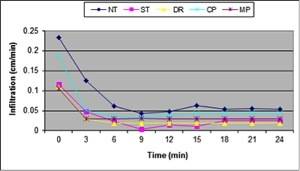
    Figure 1. Water infiltration with five different tillage systems. NT=No-till, ST=Strip-tillage, DR=Deep Rip, CP=Chisel Plow and MP=Moldboard Plow. (Al-Kaisi, 2011). Note that strip-tillage infiltration rates were taken in the tilled zone.

    Three reasons why farmers should consider avoiding fall tillage this year include:

    1. Crop residue moderates soil temperature, leading to less soil moisture evaporation.
    2. Residue helps reduce the amount of wind at the soil surface, which helps further reduce soil moisture evaporation.
    3. Soil compaction due to equipment traffic was minimal due to dry conditions from planting through harvest 2012.

    There is no reason to allocate time and fuel for deep tillage; the normal freeze/thaw cycles should alleviate any mild compaction that resulted.

    Another benefit of leaving standing corn residue is that it can help catch snow that would otherwise blow across the surface and pile up somewhere else.  Eight to 16 inch corn stalks hold more snow than bare soil.  Additionally, corn stalks will help reduce runoff and increase infiltration of snow melt in the spring.  This could mean another 1 or 2 inches of soil moisture next spring.

    A final reason to forego tillage this fall is because Goss’s Wilt was not a large concern in 2012.  Goss’s Wilt survives the winter on corn residue, but because there was minimal presence this year, there is no need for tillage this fall to further reduce risk in 2013.
    Team Latham

    October 4, 2012
    Agronomics, Drought, General, Soil, Weather
  • Latham Hi‑Tech Seeds

    Sidewall Compaction in Northeast Iowa

    Nick Benson shows us the sidewall compaction side by side to a normal corn stalks. For more information, tune into Nick Benson’s most recent YouTube video:

    http://youtu.be/kM2xrMgUuxE

    Team Latham

    June 11, 2012
    Agronomics, General, Soil
  • Latham Hi‑Tech Seeds

    Conditions Favor Rootless Corn Syndrome

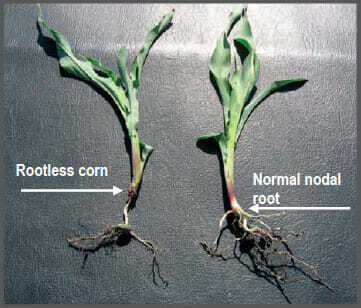
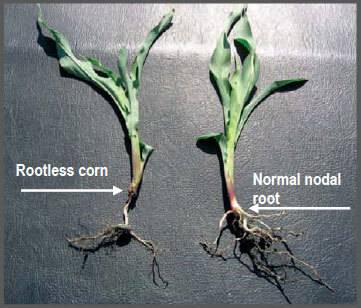
    Rootlesscorn1
    Rootless corn (left) compared to corn with normal nodal root development. Photo credited to Monsanto.

    The change from excessively wet to unusually warm, dry weather has resulted in the development of a substantial crust in fields that were previously worked and planted in late April. Obviously, a thick crust can restrict the emergence of corn and cause underground leafing. The rapid drying of the upper soil layer is also conducive for the development of the “floppy corn,” or Rootless Corn Syndrome.

    The aforementioned weather pattern may mirror situations across Latham Country this spring, but it’s actually an excerpt from an article that was originally written in May 1998 by an agronomy professor at Purdue University in Lafayette, Indiana. Dry surface soils, shallow planting depths, sidewall compaction and cloddy soils all contribute to Rootless Corn Syndrome.  Roots will take the path of least resistance, which means they might grow out the bottom of the seed furrow.

    Such corn plants are technically not root-lodged; they are simply broken over at the base of the stem near the crown area. The nodal roots will appear stubbed off but not eaten. The root tips will be dry and shriveled. For a brief description of normal corn root development, click here for  R.L. (Bob) Nielsen’s “Primer on Corn Root Development.”

    Nodal root growth may resume if more favorable temperatures and moisture conditions return to the fields exhibiting signs of Rootless Corn Syndrome. Cultivation can help by putting soil around the base of plants or aiding in new root development when it does rain.  If the ground is hard, cultivation will help with soil aeration.

    Team Latham

    May 31, 2012
    Agronomics, Corn, Crop, General, Soil
  • Latham Hi‑Tech Seeds

    Time to Develop a Residue Management Plan

    Baling cornstalks is an option to reduce surface residue. The loss of that much organic material will deplete some soil nutrients, however, especially Potassium. Farmers just need to bear this in mind as they develop their Nutrient Management Plans.

    Getting rid of crop residue can allow the soils to warm up quicker and dry out faster in the spring.  But there is a fine line between removing residue to provide such benefits and leaving so much residue that it actually impedes crop development.  Taking time to develop a crop residue management plan this fall may greatly improve crop emergence and reduce disease problems next spring.

    Options to manage crop residue include: tillage, chopping, the use of residue cleaners or burning.

    If you believe burning is your best option, keep these tips in mind from county conservationists, who were recently interviewed by the Iowa Farmer Today:

    • The best time to burn is when grass has gone dormant, after the first killing freeze and into April or early May.
    • Conditions need to be favorable to prevent a wildfire.  The National Weather Service offers a fire weather forecast on its website.  Also be cognizant of whether there is a ban on burning in the area.
    • Fire breaks should be established by creating a line of bare soil to stop the fire.
    • Once a burn is scheduled, notify the local fire department. That puts the department on alert in case the fire burns out of control.  Once the burn is done, the local fire department should be notified again.
    • Smoke also needs to be managed to avoid having smoke cover a road.

    Webspec Admin

    October 10, 2011
    Agronomics, General, Soil
  • Latham Hi‑Tech Seeds

    Compaction Effects Felt Long After Fall Tillage and Spring Planting

    We’ve heard several reports about uneven corn stands this season, and compacted soils is one reason for some of the variability that’s now evident in the fields.    Today we’re following up our recent posts, Uneven Corn Stands Part 1 and Uneven Corn Stands Part 2, with a video example of compaction.

    Steve Bailie, Latham RSM, recently shot this footage in his Southwest Wisconsin territory.  While completing fall tillage operations, the grower entered this field when it was too wet.  This action led to deep wheel tracks in the soil and compaction in the seedbed.

    [youtube]http://www.youtube.com/watch?v=YSb1yf4p7nY[/youtube]

    Here’s a photo of corn plants from the same field, eight rows apart.  Compaction took its toll on the plant on the left.

    Make adjustments to your crop management plan this year to avoid situations like these from happening to your acres in 2012.  The majority of yield is determined during planting. Good things come to those who wait for the right seedbed conditions. For more tips on how to avoid soil compaction, read Mark Grundmeier’s post.

    Gary Geske

    July 12, 2011
    Agronomics, General, Soil
  • Latham Hi‑Tech Seeds

    Ways to Reduce Soil Compaction

    After unseasonably wet, cold weather this spring, farmers are eager to get their seed in the ground but they must be conscientious of soil compaction. We understand their sense of urgency, but we also know they’ll have better results if they wait for more suitable field conditions.

    The best rule of thumb is to let the field dry before doing fieldwork.  Use a quick field test to check the soil moisture:  mold a length of soil between your index finger and thumb, or roll it into a ball in your hand.  Observe whether the soil breaks apart as you work it.  If you toss the ball of soil into the air and it shatters or cracks upon falling to the ground, then conditions are likely suitable for tillage or planting.

    Working soils that are too wet this spring could have negative impacts on your crops during the growing season including:  stunted plant growth; slow infiltration of water and/or ponding; high surface runoff and soil erosion under normal or light rainfall; poor root system establishment; and nutrient deficiency.

    To reduce or minimize soil compaction:

    • Avoid working wet soil. Soil is most susceptible to compaction when it’s saturated and cannot absorb any more water.  Use the quick field test method above to access the soil conditions, and  begin planting or working the soil only if the proper conditions exist.
    • Reduce tillage. Crop residue can intercept raindrops and prevent the soil surface from sealing and compacting.
    • Use the right implements. The degree of compaction is determined by the moisture content of the soil, as well as the weight of the equipment in the field. Reduce the weight on each axle, choose wider tires and adjust air pressure to reduce the load on the soil surface.  Iowa State University research shows that using equipment with 6 pounds per square inch (psi) of surface pressure yielded 9 bushels per acre more than equipment with 16 psi.

    Soil compaction can be avoided with better management.  For more information, click here to download Iowa State University Extension’s publication, Understanding & Managing Soil Compaction.

    Webspec Admin

    April 27, 2011
    Agronomics, Soil, Tech Tuesday
  • Latham Hi‑Tech Seeds

    The Time is Right to Grid Sample

    Peter Bixel, Seed2Soil powered by Sci Max representative

    It all starts with the soil, whether you’re growing grain or vegetables.  Knowing what the soil is capable of is very important to reach your field’s yield potential and to make the best use of inputs.

    Learn how to better place fertilizer and to better time fertilizer applications with information gleaned from Latham’s hallmark Seed2Soil® program, powered by SciMax. Grid sampling takes your soil sample data and your yield data to the next level. We highly recommend 2.5 acre grids for our grid sampling protocol.

     A great time to have your acres grid sampled is right after planting. Soil sample data gathered this spring could help you adjust the timing of your fertilizer applications during the growing season, plus it will leave you with one less thing to worry about while you’re in the combine next fall.  After finding out what the soil test results are, you can start planning for the next crop and have it in place by September.

     We’re able to use actual yield data for crop removal values, soil sample test values, and management zones for recommendations. We can also use Learning Blocks to measure the most economic return on your investment. A learning block is put within an area with a high or low rate of nutrients. We can also help you determine the correct amount of nitrogen for your field through our variable rate Nitrogen program which has its own trade secret.

    The benefits of grid sampling far out-weigh the costs. In fact, when managed properly, grid sampling can make you money by increasing yield and identifying areas where you can push plant populations. Learn more about grid soil sampling by contacting trusted experts at Latham Hi‑Tech Seeds. 

    Webspec Admin

    April 14, 2011
    Agronomics, General, Soil
  • Latham Hi‑Tech Seeds

    Keep An Eye on Soil Temperatures

    While there are many benefits to planting early, planting too early can have negative impact on yield.  Planting in soils that are too cold or too wet will cause seeds to sit dormant and become more vulnerable to diseases, insects and animal predators.

    Let soil temperatures and soil conditions – not the calendar – dictate your planting date. For a map of current soil conditions throughout Iowa, click here. We recommend waiting until soil temperatures in a region reach between 55 and 60 degrees Fahrenheit before you plant soybeans or 50 degrees before you plant corn. Remember, soil temperature for soybean planting is more critical than for corn. The main reason for this is because soybeans can germinate in a soil environment of about 55 degrees Fahrenheit, but if the air temperature after germination hits 28 degrees Fahrenheit or less, the young seedling can be killed with the growing point of the plant right at emergence. Adversely for corn, the growing point stays under the surface until much later.

    If planting conditions aren’t fit for planting, yield may be sacrificed due to:

    • Chilling Injury – Imbibitional chilling can negatively affect both corn and soybeans. This happens often when farmers jump the gun and plant in soils that are too cold. For a seed to germinate, it must absorb water, which usually happens within a few hours of planting. If the water is too cold, tissue damage will occur within the seedling and will either kill it or drastically slow down emergence. This can allow diseases and other problems to enter. Typical symptoms of chilling injury may include a swollen seed that has not germinated, as well as a fragile or absent primary root.
    • Soil Compaction – If mud sticks to your tires and ruts are deeper than an inch, the field is too wet to work.  Compaction will likely result, causing decreased germination, root and plant growth, as well as nutrient uptake.
    • Soil Crusting – Wet soil at planting can cause a crusted layer to form, which may delay or prevent seedling emergence.  Soybean hypocotyls can easily break as they push through the crust, which may result in significant stand reductions and lower yield potential.

    Webspec Admin

    April 12, 2011
    Agronomics, General, Soil
  • Latham Hi‑Tech Seeds

    Fall Tillage Impacts Soybean Diseases

    To till or not to till?  That’s been one of the most frequently asked questions this fall as many farmers finished harvest 30 days ahead of last year and weather conditions allowed them to work the ground.

    Fall tillage practices impact Soybean White Mold and Sudden Death Syndrome, says Iowa State University Plant Pathologist X.B. Yang.  The effects of fall tillage are completely opposite: no-till can decrease the risk of White Mold while SDS is usually more severe in no-till fields.

    SDS is more severe in no-till situations because soil temperatures remain cooler and wetter, according to a recent Wallaces Farmer article.  No-till fields have a lower risk of White Mold, however, due to the placement or distribution of sclerotia. 

    To read this article in its entirety, click here.

    Team Latham

    November 23, 2010
    Agronomics, Crop, Disease, General, Soil, Soybeans
  • Latham Hi‑Tech Seeds

    No-Till Soybean Management

    There are several factors to consider when managing soybean production in no-till conditions: variety selection, insect management, disease management, fertility management and weed management.

    “Choosing a variety is the single most important decision a soybean producer can make to maximize yield,” says Aaron Saeugling, Iowa State University Extension Field Agronomist.  He also recommends that growers choose varieties that have the ability to excel in a given environment because no-till varieties requires more than just picking the highest yield variety in a seed plot.

    As for fertility management, Saeugling says fall is the best time to build your farm’s fertility program. You need a quality soil sample for the basis of fertilizer. Click here to read Tuesday’s blog post for soil sampling guidelines.

    For more tips on no-till soybean management read the complete article here.

     Source: Iowa Soybean Association’s E-Gold Standard Newsletter.

    Team Latham

    November 4, 2010
    Agronomics, General, Soil
Previous Page
1 … 6 7 8 9
Next Page

Latham Hi‑Tech Seeds

131 180th Street | Alexander, IA 50420

(641) 692-3258

SIGNUP FOR OUR NEWSLETTER
  • Contact
  • Legal
  • Dealer Center
  • Seedware Login
  • Latham Gear

© 2025 Latham Hi‑Tech Seeds. All rights reserved. | Iowa Web Design by Webspec | Privacy Policy

Latham® Hi-Tech Seeds is a trademark of M.S. Technologies, L.L.C., 103 Avenue D, West Point, IA 52656.