Latham Hi-Tech Seeds

(641) 692-3258

  • Home
  • Products
    • Corn
    • Soybeans
    • Alfalfa
    • Corn Silage
    • Seed Guide
  • Performance
  • Find a Rep
  • Media
    • Blog
    • News
    • Videos
    • Podcasts
    • TECHTalk
  • About Us
    • Company History
    • Our Mission
    • Careers
    • Become a Rep
    • Sowing Seeds of Hope
  • Contact Us
  • Latham Hi‑Tech Seeds

    Potassium Deficiency is Growing Problem in Corn

    DeficiencySymptoms
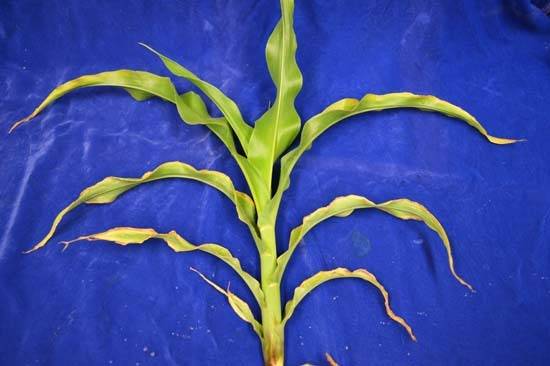
    Potassium deficiency symptoms in corn develop on the edges of older leaves, typically starting at the tip, while the new growth appears normal. (Photo courtesy of the University of Illinois Plant Clinic.)

    While walking fields recently, I’ve seen corn leaves that are yellowing around the leaf margins.  The yellowing starts at the tip of a leaf, extending along its edges to the base of the leaf.  In more severe cases, the edges are brown.

    Corn and soybeans are showing signs of potassium deficiency this growing season. Most of the potassium deficiency I’ve seen so far this season is not due to planting in too-wet soil conditions or compaction, although this certainly could be a reason in some cases.  Instead, I’m seeing more potassium deficiencies where there is an extremely dry soil surface and where root activity has been slow.  Dry conditions typically limit root growth, which explains why soils can have good levels of potassium but nutrients don’t get to the plants.  It also helps explains why, in some fields I have observed, the K deficient symptoms are occurring in the best-drained soils in the field while the more poorly drained areas look better.

    Dry surface soils express K deficiency most often.  Ridge-till, no-till situations and side wall compaction will sometimes show symptoms in dry years.  Irrigation or simply rainfall is a great way to jumpstart the root systems and help the plant develop through the K deficiency.

    It’s important to understand why if and why there is a potassium deficiency because K is an essential nutrient for plant growth that has a large impact on overall yield.  Potassium controls transpiration and respiration, as well as the uptake of certain nutrients including nitrogen and magnesium.
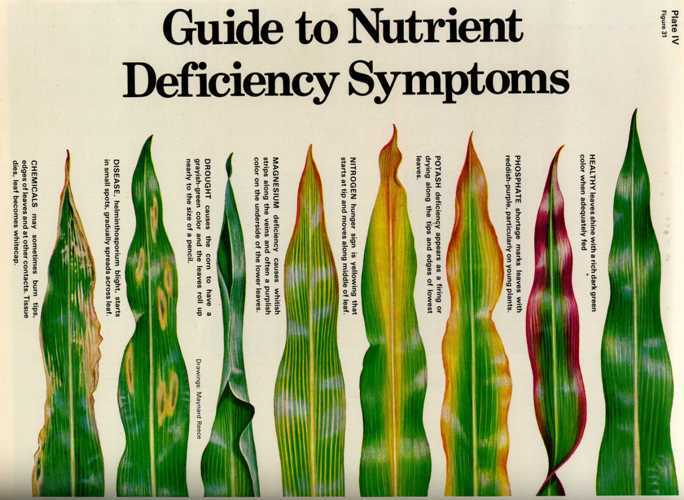
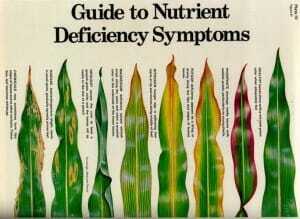
    Photo courtesy of www.omafra.gov.on.ca

    The type of nutrient deficiency determines soil management strategies.  Some people side-dress potash or various forms of K.  Others try foliar products.  One word of warning is that some of these products can be harmful to the plant at certain stages of growth.  A grower should select a low salt form of K and avoid anything with KCl or KSO4 for foliar applications.  A better and safer means is to address the situation by applying potassium before planting 2013.

    Walk your fields now and note where you’re seeing signs of potassium deficiency, so you can be sure to test and possible treat those areas before the 2013 crop is planted.  Another leaf tissue sample can provide helpful information, too.  You can see if there are other nutrient deficiencies in your field.  Tissue sampling is one service provided through Latham’s Seed-to-Soil program.

    Team Latham

    June 28, 2012
    Agronomics, Corn, Crop, Fertility, General
  • Latham Hi‑Tech Seeds

    Potassium Deficiency in Northeast Iowa

    Symptoms of potassium deficiency are surfacing in Northeast Iowa corn fields. These symptoms are most likely the result of dry top soil during late May and early June. Any soil factor that limits root growth and water uptake can limit K uptake. For more information, tune into Nick Benson’s most recent YouTube video:

    http://youtu.be/F7iVHw8BMo4

    Team Latham

    June 11, 2012
    Agronomics, Fertility, General
  • Latham Hi‑Tech Seeds

    Considerations for NH3 Application

    Kurt Metzger, West Area Seed Solutions Specialist, MaxYield CooperativeGuest blog by Kurt Metzger,
    West Area Seed Solutions Specialist, MaxYield Cooperative

    Unusually dry weather this fall has corn growers asking questions about whether or not they should wait to apply Anhydrous Ammonia (NH3).

    Applying NH3 in dry soils is actually the best situation if a producer can get it to seal. The NH3 bar must be deep enough to get adequate soil separation between the point of ammonia injection and the depth where corn seed will be planted next spring, as stated by John Sawyer, Department of Agronomy, in his recent Integrated Crop Management News article entitled, “Anhydrous Ammonia Application and Dry Soils.”

    At MaxYield Cooperative, we began applying NH3 nearly two weeks ago.  It was exceptionally dry then, so we made sure the NH3 bar was in the ground 6 to 7” (4-6” is typical).  We’re recommending that producers apply nitrogen deeper to help prevent damaging seed next spring.  This same point is made in Sawyer’s newsletter article.  He writes, “Shallower injection, greater movement upward from the injection point, wider knife spacing, or higher rates can lead to ammonia being in the seeding area at rates high enough to cause damage” next spring.

    Fortunately, the newer NH3 bars have much better disk closers and will be more aggressive to move the soil in order to seal the in the soil.

    Another point is with the dryer soils, the zone that the ammonia in the soil becomes a larger radius to attach to the clay.  This means it takes more moisture next spring in order for leaching to occur.  Remember the nitrogen moves with the soil water profile and only will move with the excess moisture.  Use of N-Serve is still very much recommended.

    With that said, however, overnight rainfall will help mellow the soil and provide for better sealing upon NH3 application.  Soils are so dry that it will take many more inches of rain before it’s too much moisture is a concern.  The best analogy is that our glass is only ¼ full now, so we have a lot of room before rain fills our glass and runs it over next spring.

    Larry Sailer, Musings of a Pig Farmer

    November 3, 2011
    Agronomics, Fertility, General
  • Latham Hi‑Tech Seeds

    Time to Begin Early Crop Scouting

    Many Midwest farmers will wrap up the 2011 planting season this week, but there won’t be much rest for the weary.  As soon as seed is in the ground, it’s a good idea to start scouting fields.

    Post-planting is an ideal time to begin scouting one’s crops.  Many soilborne pathogens strike as soon as the seed begins to take on water; others strike young seedlings.  Because seeds can germinate quickly and emerge in 3 – 5 days, it’s not too soon to start walking your fields.

    Check plant populations, evaluate stands and be on the lookout for early summer diseases.  Is there a germination problem?  Do you see effects of chilling or crusting?

    Assessing your situation ASAP will allow you to formulate a plan while there’s still plenty of time to implement it.  You could replant in parts or in all of a field now, so you can attain the yields and returns you want this fall.  Information on corn replanting decisions is available from www.agronext.iastate.edu/corn. Click on the “Planting” topic, then click on the “Replant Decision Aid Calculator” tab and use that tool and related information to help make a replant decision. For a resource on soybean replanting decisions, go to www.extension.iastate.edu/publications/pm1851.pdf.

    Another benefit of evaluating current stands is to help you determine what adjustments should be made before planting next year’s crop:  Do you need to adjust your planter settings or your planting speed?

    Once you get past the mechanical issues, look at the disease pressure.  If soybeans are damping off, perhaps next season you should opt for seed-applied fungicides? Do you need to pay closer attention to a particular soybean brand or corn hybrid’s disease rating?  Seed selection is one of the most important decisions affecting yield. Click here for tips on selecting  soybean brands and selecting corn hybrids.

    Webspec Admin

    May 12, 2011
    Agronomics, Disease, Emergence, Fertility, Fungicide, General, Growth Stages, Insects, Weed Control
  • Latham Hi‑Tech Seeds

    Determining the Correct Nitrogen Rate for Your Field

    Spring planting is just around the corner, and with it comes the age old question, “What is the right rate of Nitrogen for my field?”

    A recent research paper published by Purdue University sums up Nitrogen (N) management succinctly: Nitrogen fertilizer costs remain volatile but continue to be one of the most expensive variable costs for corn. Applying “more than enough N” is no longer cheap “insurance” as it once was many years ago. Applying “more than enough N” is also not environmentally friendly.

    High fertilizer costs and environmental impacts should encourage growers to critically evaluate their N fertility program, including application rate, fertilizer material, and timing.Here are a few tips for you to consider the right Nitrogen rate for your field this spring:

    • Customize applications. Tailor Nitrogen applications to each individual field. Because farmers are constantly striving to achieve higher yields, it’s not effective to try and use a general “one size fits all” recommendation.  That’s why it’s so important to first determine your needs with a soil test.
    • Soil test. Conduct a soil test to obtain a guideline of soil nutrients and needs. Purdue’s research paper stated some soils provide as little as 25% of the crop N requirement, the remainder coming from fertilizer N, while other soils provide in excess of 50% of the crop N demand, with a lesser amount needed from applied N. Thus, it’s vitally important to first determine soil needs before application. Through Latham’s Seed2Soil®program, we work with customers to conduct an Amino Sugar Nitrogen Test to help determine where Nitrogen rates need to be increased, maintained, or decreased.
    • Recognize timing differences. Certain hybrids respond better to Nitrogen at different times of the growing season. For instance, some hybrids will require an extra shot of Nitrogen when they begin the grain fill period directly after pollination. Work with your seed representative to determine the best timing for the products in your field.
    • Better for your pocketbook and the environment. The goal with Nitrogen management should be to place the right amount on the right acres at the right time. Latham’s Seed2Soil program helped reduce Nitrogen needs by 20-25 pounds, according to four years of research and in-field studies. Learn more about Latham’s Seed2Soil program.

    Do you have any questions regarding Nitrogen management for your field?

    Webspec Admin

    March 31, 2011
    Agronomics, Fertility, General
  • Latham Hi‑Tech Seeds

    Fertility Levels Key to Raising Top Soybeans, Part II

    A common practice for farmers in a corn-soybean rotation is to apply enough P&K prior to planting corn to supply their crops for two years.  This works well until corn yields are higher than expected, and no extra nutrients are added for the subsequent soybean crop.  Soybeans are big users of Phosphorus (P) and Potassium (K), and soybean yields will suffer unless more nutrients are applied to compensate for the higher corn yields.

    Nitrogen is essential to photosynthesis.  Nitrogen is usually supplied to soybean plants by a process called nitrogen fixation, which is associated with Rhizobia bacteria in the soil.  It’s important to note, however, that these bacteria are not always present – especially if soybeans haven’t been grown in that field for a few years.  Recent studies show that adding an inoculant to seed may have beneficial effects if planted in soils with low organic matter content or in fields that have undergone significant flooding in recent years.  Try inoculants in your own fields and study whether they benefit your production levels.

    In addition, be sure to monitor the calcium levels in your fields.  There are soils in the Upper Midwest that contain too much calcium.  Known as alkali soils, they can cause other problems for soybean development including stunting, poor root development and iron deficiency chlorosis.

    Soybean yields will also suffer if micronutrient levels are deficient, even if there is adequate P & K present.  If soil tests show low levels of Sulfur, Zinc and Boron, add them to your fertilizer blends.

    Managing nutrient levels will help produce maximum yields – and returns – from your soybean crop given the high market values.

    Webspec Admin

    February 24, 2011
    Agronomics, Crop, Fertility, General, Soybeans
  • Latham Hi‑Tech Seeds

    Fertility Levels Key to Raising Top Soybeans

    Greg 1

    You can only yield what you put into your crops.  If you supplied enough of all of the nutrients required to produce 70-bushel soybeans but provided only enough of one nutrient to produce 40-bushel soybeans, then your yield will only be 40 bushels per acre!  Simply stated, this is what the computer industry refers to as “garbage in – garbage out.”

    To better manage nutrients for your soybean crop, pay particular attention to:

    1. N, P and K;
    2. Secondary nutrients like Calcium and Sulfur;
    3. Micronutrients like Manganese, Zinc and Boron.

    Greg 1Begin by establishing a soil sampling protocol for all of your fields.  Not only will this give you the best field-by-field fertilizer history, but it will be invaluable to your long-term nutrient management strategy.

    A common practice for farmers in a corn-soybean rotation is to apply enough P & K prior to planting corn to supply their crops for two years.  This works well until corn yields are higher than expected, and no extra nutrients are added for the subsequent soybean crop.  Soybeans are big users of Phosphorus (P) and Potassium (K), and soybean yields will suffer unless more nutrients are applied to compensate for the higher corn yields.

    Nitrogen is essential to photosynthesis.  Nitrogen is usually supplied to soybean plants by a process called nitrogen fixation, which is associated with Rhizobia bacteria in the soil.  It’s important to note, however, that these bacteria are not always present – especially if soybeans haven’t been grown in that field for a few years.  Recent studies show that adding an inoculant to seed may have beneficial effects if planted in soils with low organic matter content or in fields that have undergone significant flooding in recent years.  Try inoculants in your own fields and study whether they benefit your production levels.

    In addition, be sure to monitor the calcium levels in your fields.  There are soils in the Upper Midwest that contain too much calcium.  Known as alkali soils, they can cause other problems for soybean development including stunting, poor root development and iron deficiency chlorosis.

    Soybean yields will also suffer if micronutrient levels are deficient, even if there is adequate P & K present.  If soil tests show low levels of Sulfur, Zinc and Boron, add them to your fertilizer blends.

    Managing nutrient levels will help produce maximum yields – and returns – from your soybean crop.

    Webspec Admin

    February 23, 2011
    Agronomics, Crop, Fertility, General, Soybeans
  • Latham Hi‑Tech Seeds

    Applying Recommended Nitrogen to Corn Maximizes Returns

    Applying nitrogen to corn at recommended rates is critical to maximize economic returns, minimize environmental losses and conserve energy, says John Sawyer, ISU Extension soil fertility specialist and agronomy professor.

    In an effort to increase awareness of farm energy conservation practices, Iowa State University Extension has released a publication titled, Energy Conservation in Corn Nitrogen Fertilization. This publication shows the energy consumed during the production of nitrogen versus phosphorus and potassium fertilizers. It also provides resources to determine recommended nitrogen application rates for corn, such as the online Corn Nitrogen Rate Calculator from ISU’s Department of Agronomy.

    More information, including a link to this Extension publication, is available today from Wallaces Farmer online.  To view the entire article, click here.

    Team Latham

    October 25, 2010
    Agronomics, Fertility, General
  • Latham Hi‑Tech Seeds

    Is In-Season Soybean Fertilization Effective?

    Oftentimes questions surrounding emergency or catch-up fertilization for soybeans arise in June, as highlighted in a recent e-newsletter from the Iowa Soybean Association. We’ve seen a lot of conversations on Farmers for the Future and New Ag Talk surrounding this question, as well. Most producers don’t have to worry about this since adequate amounts of phosphorous (P) and potassium (K) are usually applied before planting. In a year like this, however, excessively wet conditions alter the crop nutrient uptake and affect fertilization.

    Is applying dry, granulated fertilizer a viable post-emergence option?

    The short answer is “probably not” for two main reasons:  First, both P and K (but especially P) are needed at early growth stages to enhance plant cell multiplication when the number of nodes, leaves, and potential seed numbers are largely determined. Second, the application of fertilizer to the soil surface or banded/injected between the rows will be of low efficiency, mainly due to the common low, or infrequent summer rainfall (which hasn’t been the case for many areas this season). There is one situation in which an in-season application of granulated P and K fertilizer might be considered, and that’s when soil tests are very low, and for certain the producer will have to apply a high fertilizer rate for the following year’s corn crop to assure adequate P and K levels.

    What about foliar fertilization?

    Some producers ask if foliar fertilization could help improve soybean growth and grain yield. While it’s a possibility, the chances are low for fields that have been well fertilized or where growth is limited by factors other than nutrient supply.

    Thus, the article concluded in-season fertilizer application for soybean will seldom prove cost-effective in Iowa production systems. The exception might be when soil samples confirm that the soil tests very low or low and there was insufficient pre-plant fertilization. A large application of granulated fertilizer to soil during the very early growth stages may result in some yield increase and will begin to build up soil test levels that will have to be increased for the next crop anyway, but the economic benefit for this year’s soybean is very doubtful. The probability of an economic response to foliar fertilization is small, but this practice may be justified when nutrient deficiency symptoms are obvious, with confirmed deficient-testing soil, or when soil or climactic factors (other than drought) limit nutrient uptake in early summer.

    Source: Iowa Soybean Association, Gold Standard

    Team Latham

    July 5, 2010
    Agronomics, Fertility, General
  • Latham Hi‑Tech Seeds

    Cornfields showing signs of potassium deficiency, anthracnose leaf blight

    An article on the Wallaces Farmer website today stated some farmers and crop scouts are reporting signs of potassium deficiency on plants in cornfields. They also reported some fields showing symptoms of anthracnose leaf blight.

    Brian Lang, Iowa State University Extension field agronomist provided the following information.

    As corn begins to move to its rapid growth phase (beyond V6 stage), you may see potassium, or K, deficiency symptoms show up on corn in localized areas of the field (see right hand image). Areas showing potassium deficiency are usually associated with two situations:

    1) Soil K levels are low and initial seedling roots and/or

    2) The mesocotyl had premature rotting and contributed little to the rooting area for absorption and movement of K to the topgrowth.

    As the permanent root system advances in development, the symptoms of K deficiency will often subside, but not always. The following link provides a series of photos that walk you through a description of anthracnose and K deficiency symptoms as well as corresponding rooting problems found in some fields with these issues.

    www.extension.iastate.edu/NR/rdonlyres/229080A5-0FEE-44E7-86C0-C63F2E81654A/127137/AnthracnoseKDeficiency.pdf

    Anthracnose leaf blight is a disease of corn that’s fairly normal

    Most cornfields will exhibit some scattered anthracnose lesions on lower leaves (see image below). Corn routinely grows through this stage, however, some fields may exhibit necrosis of entire leaf margins on the lower two to three leaves. One way to distinguish this symptom from K deficiency or leaf burn injury from postemergence herbicides is to look for the acervuli on the lesions. These are small black spiny structures that are visible with a hand lens on the dark-bordered lesions on the corn leaves.

    If the field becomes a significant problem, the following management options are considered for the field’s immediate future:

    • Crop rotation to a nonhost crop like soybeans, alfalfa, etc.
    • Select a more resistant corn hybrid next year.
    • Utilize tillage to bury crop residue which can harbor the fungus over winter.

    Click here to read the full article.

    Photos courtesy of Iowa State University

    Team Latham

    June 21, 2010
    Agronomics, Fertility, General
Previous Page
1 … 4 5 6

Latham Hi‑Tech Seeds

131 180th Street | Alexander, IA 50420

(641) 692-3258

SIGNUP FOR OUR NEWSLETTER
  • Contact
  • Legal
  • Dealer Center
  • Seedware Login
  • Latham Gear

© 2025 Latham Hi‑Tech Seeds. All rights reserved. | Iowa Web Design by Webspec | Privacy Policy

Latham® Hi-Tech Seeds is a trademark of M.S. Technologies, L.L.C., 103 Avenue D, West Point, IA 52656.