
Latham Hi-Tech Seeds

(641) 692-3258

  • Home
  • Products
    • Corn
    • Soybeans
    • Alfalfa
    • Corn Silage
    • Seed Guide
  • Performance
  • Find a Rep
  • Media
    • Blog
    • News
    • Videos
    • Podcasts
    • TECHTalk
  • About Us
    • Company History
    • Our Mission
    • Careers
    • Become a Rep
    • Sowing Seeds of Hope
  • Contact Us
  • Latham Hi‑Tech Seeds

    Latham Announces Mid-Season Soybean Releases

    Feature Tech Tuesday 01

    Tech Tuesday Header-01

    One objective of Latham’s SuperStrip plot program is to help evaluate experimental seed products. Now that the 2017 harvest data has been analyzed, it’s my pleasure to introduce three soybean lines as mid-season releases for the 2017-2018 sales year.

    These new soybeans come from our research on a new herbicide trait, the HPPD inhibitors, or Herbicide Group 27 compounds. The active ingredient being targeted is isoxaflutole, which is the base chemistry in several corn herbicides like Corvus® and Balance® Flexx.

    You may have seen early announcements that the “Balance™ GT” soybean trait had cleared regulatory processes. It’s important to understand that as of press time, the EPA has NOT approved any isoxaflutole compounds to be sprayed over the top of soybeans. We are releasing these three cultivars as “GT” soybeans since they are cleared to be sprayed with glyphosate products only.

    Remember to check LathamSeeds.com for 2017 yield data on these newly released soybeans!

    L 2187 GT
    2.1 Relative Maturity
    Carries the Rps1-c gene for Phytophthora, as well as Soybean Cyst Nematode (SCN) tolerance from PI 88788.vIts ratings for Sudden Death Syndrome (SDS) and White Mold ratings are excellent, and its Iron Chlorosis score is very good. This line ranked in the top three in every trial in which it was entered during both 2015 and 2016!

    L 2458 GT
    2.4 Relative Maturity
    Produces excellent yields across Iowa and into Illinois. It carries the K-gene for Phytophthora and strong tolerance to SCN from PI 88788. The Brown Stem Rot rating is excellent. It also has very good scores for White Mold, SDS and Iron Chlorosis. It has a very attractive tawny color at harvest and is also tolerant to the STS family of herbicides.

    L 2638 GT 
    2.6 Relative Maturity
    Carries the Rps1-k gene for Phytophthora and has strong tolerance to SCN from PI 88788. It’s a fairly bushy plant type that fills wider rows easily and has shown very consistent yields across all of Latham Country in 2015 and 2016 trials. Sudden Death, Brown Stem Rot, White Mold and Iron Chlorosis ratings are all very good to excellent.

    Webspec Admin

    January 23, 2018
    Soybeans, Tech Tuesday
  • Latham Hi‑Tech Seeds

    How Could Your Operation Benefit from Imagery?

    Feature Tech Tuesday 01

    Tech Tuesday Header-01

    They say “a picture is worth a 1,000 words” but I like to say a good image is worth thousands of dollars. The term “imagery” gets thrown around so much in the precision ag realm that many of us gloss over the term and really don’t consider the full value it can bring to our operations.

    Imagery in precision agriculture encompasses a vast  array of valuable pictures, most of which originate from either satellites, airplanes, or UAVs (drones). The difference between these three sources is frequency and resolution. Airplanes and drones can fly essentially on command — unless it’s a cloudy day — while a satellite is fixed in orbit. In addition, airplanes and drones tend to have higher resolution than most satellites.

    So how can we get value from these fancy pictures? If you have flown in a small airplane or piloted a drone, you know it provides a convenient
    perspective. You can truly learn a lot from one snapshot of your field, as problem areas stand out due to differences in the amount of biomass or even a color variation if the crop is really stressed.

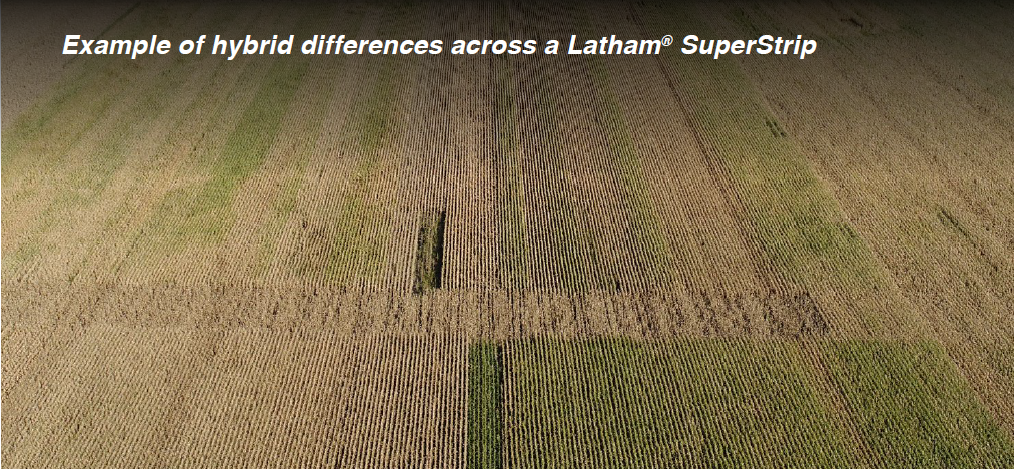
    In this drone image taken in Alexander, Iowa, you can see hybrid differences across a Latham® SuperStrip and where the planter ran out of seed. You also can note poorer spots in the field where there is frequent ponding or a germination issue due to planting date, soil type influences, and so on. Without imagery, many of these problems wouldn’t be revealed until harvest.

    Screenshot (84)

    Another use for satellite or aerial imagery is for crop insurance claims or other crop damage. You may have a 270-acre corn field that was hit by hail during the tassel stage. It would be almost impossible to scout thoroughly on foot at that stage; however, an aerial image shows which areas received the most damage. You could use such a drone image to selectively scout that field instead of taking a whole day trying to walk it on foot. After all, time is money!

    To enhance our crop scouting abilities, we use crop health images. A vegetative index allows us to compare crops across the season
    and even across multiple seasons and multiple crops. Crop health images also may be related to yield at the end of the season by (1) creating Production/Management zone maps to use for variable or burned up, depending on their topography. You might decide to go without production on that acre or put it in a government program to still make money on it. If it is a drainage issue, it might be time for additional tile.

    That reminds me of another use for imagery when it comes to tiling… you can use aerial imagery within a few hours or days of a heavy
    rain event when there isn’t a crop on the field. This gives you a better understanding of how your field drains. Thermal imaging is also used for this purpose.

    Hopefully, I’ve given you enough reasons to pique your interest about how imagery could benefit your operation by adding thousands of dollars to your bottom line by either saving inputs or increasing yield. Feel free to call me if you’re interested in learning more about imagery.

    Webspec Admin

    January 9, 2018
    Tech Tuesday
  • Latham Hi‑Tech Seeds

    Green Means Go, Especially When Soybeans Show Green Stem Syndrome

    Feature Tech Tuesday 01

    Tech Tuesday Header-01

    The topic of green soybean stems at harvest was discussed at several of our post-harvest meetings. What makes this disorder especially frustrating is that the soybean pods and beans within those pods are fully mature and ready to harvest.

    Unfortunately, all plants have a built-in mechanism that makes them want to shed their seeds on the ground when they’ve reached full maturity. This process is called dehiscence [di-’hi-s  n(t)s] in soybeans and has erroneously been referred to as “shattering” by many. Regardless of what it is called, lost yield and lost income results.

    There are several theories about what causes Green Stem Syndrome (GSS) but an exact diagnosis has not been found.  Some researchers blame insects, diseases, foliar fungicides, nutrient deficiencies, low pH and even compaction. The bottom line, however, is that GSS has been proven to occur in the absence of all the above conditions. To make matters worse, the symptoms of GSS are not always the same.  There are cases where all that is left on the plant are green stems and pods, but there are other cases where even some leaves remain on the plant. One thing that has been noticed is that it usually happens within a given geographic area or “neighborhood.” Also, GSS has never been associated with just one soybean variety from a single company.

    One of the more practical explanations for this problem is something happened during the growing season, probably after flowering, to cause pods to abort or not to fill properly. This produces an abnormal build-up of carbohydrates within the plant. Once that early-season stress has gone away, the plant wants to funnel those carbohydrates to the pods for seed-fill. However, the pods are
    either not there or they can’t finish the process. Carbohydrates are then trapped within the stem of the plant for a longer-than-normal period, so the stem remains green.

    There really isn’t any clear way to manage or prevent this problem. One thing I highly recommend is NOT to wait to harvest soybeans that are showing GSS, but to slow the combine down as much as necessary and get them out of the field. Waiting until the stems are dry almost always costs you in lost bushels.

    Webspec Admin

    December 19, 2017
    Soybeans, Tech Tuesday
  • Latham Hi‑Tech Seeds

    Avoid the Temptation to Buy Only Based on Plots

    Feature Tech Tuesday 01

    Tech Tuesday Header-01

    It’s that time of the year when we reflect upon the decisions we made last year and make changes for 2018. Many farmers will base next year’s planting decisions based only off this year’s results, so please avoid making that huge mistake!

    Base your decision on facts and results but also the odds. Odds are, the 2018 growing season isn’t going to be exactly like the 2017 growing season. We can’t control Mother Nature, so spread risk by planting packages of both corn hybrids and soybean varieties.

    Resist the urge to plant that racehorse hybrid or winning soybean variety on most of your acres! The breadth of Latham’s product strength is evident from our F.I.R.S.T. Trial performance. Multiple Latham brand products placed in the Top 10 at multiple trial locations.

    At printing time, we have 34 wins in soybeans and 17 wins in corn. We also have 293 Top 10 performances in soybeans and 220 in corn so far. With such great harvest results, it’s easy to order the yield trial winners. It’s important, however, that you do NOT buy based exclusively on this year’s winning results.

    At Latham Hi‑Tech Seeds, we select products bred to perform in specific geographies. The Latham team also takes pride in making sure only the highest quality seeds go in the bag, which is evident with the yield results we saw again this year in the F.I.R.S.T. Trials seed tests!

    Take the time to review your farm, field- by- field, and place the product for every acre! Seed selection is one of the important decisions a farmer will make. It’s well documented that the ability to reach yield potential begins with the seed. At Latham Hi‑Tech Seeds, we want to work with you to reach new yield levels in 2018!


    Webspec Admin

    December 5, 2017
    Corn, Soybeans, Tech Tuesday
  • Latham Hi‑Tech Seeds

    Variability on Your Farm Affects Seed Decisions

    Feature Tech Tuesday 01

    Tech Tuesday Header-01Once the busy harvest season winds down, many of us reflect on those spots that stuck out in each field. Maybe it was a spot that yielded 80+ on soybeans or 250+ on corn, or maybe it sticks out for the opposite reason.

    Variability on your farm influences the decisions you make throughout the rest of the year. We consider two types of variability — spatial and temporal — in precision ag.

    Spatial variability refers to different patterns in an area or space. This is influenced by physical things that don’t change quickly, such as soil type, texture, structure, depth of topsoil and organic matter. These physical soil properties are directly related to the chemical properties of your soil, including water holding capacity, nutrient availability and buffer capacity. All of them impact yield potential.

    Temporal variability in a field refers to the patterns between growth stages and/or seasons. One way this variability is evident is how a hybrid or variety responds to environmental stress. We all have areas within our fields that yield poorly one year and then produce top yields the following year. This is a combination of the underlying soil properties and how the hybrids/varieties respond to environmental conditions. No two seasons are alike!

    We understand that no two fields are alike either. Latham’s hallmark FieldXField™ crop planning process helps you choose the right product for each field. As an agronomist, I think of G x E x M why picking products on a field-by-field basis is the #1 thing you can do to set yourself up for the best yield potential.

    Temporal and spatial variability are key to understanding whether the yield variability in our field is consistent or inconsistent. Once you know how to categorize those areas, then you can put a variable rate program to work on your farm.

    This year we’re piloting the Seed-2-Soil® Advanced Program, which uses several years of yield data alongside soil, imagery, your personal input, and any other available data layers to determine how to treat each of those areas. The power is in the multiple years of yield history. Even if you don’t have several years of yield data, there is still a lot of data we can use to create these areas within each field.

    If you have fields that you know would benefit from variable rate management, feel free to call me and we can discuss different options. If you’re thinking about incorporating some precision services on your farm, I would be happy to have that discussion, as well.

    Webspec Admin

    November 14, 2017
    Corn, Soybeans, Tech Tuesday
  • Latham Hi‑Tech Seeds

    October Brought Changes to Soybean Technology Regulations

    Feature Tech Tuesday 01

    Tech Tuesday Header-01

    While harvest was in full swing around the Upper Midwest, regulators and lawmakers were busy making changes that will affect the planting of some soybean technologies next spring. Below is a brief overview of four new and emerging soybean technologies of interest to us at Latham Hi‑Tech Seeds.

    1. Roundup Ready 2 Xtend soybeans: The EPA in mid-October reached an agreement with Monsanto and the manufacturers of dicamba herbicides to lessen the possibility of damage from drift and volatilization. Monsanto, BASF and DuPont have cooperated with the EPA and the various state agencies and have voluntarily agreed to promote the new labels.

      It’s important that Latham® dealers learn the new guidelines, so they can ask their customers to follow them when planting Roundup Ready® 2 Xtend® soybeans. Here’s a brief summary of the changes as of mid-October:

      • Dicamba products will be restricted use. Only certified applicators with specific training can purchase and apply these products.
      • Farmers will be required to maintain records of all dicamba products used.
      • Wind speed must be below 10 miles per hour (mph) at time of application.
      • There will be a reduction in the time of day that dicamba may be applied.
      • To prevent cross contamination, there will be specific guidelines on tank clean-out.
      • Additional record-keeping will be required to increase awareness of risks to susceptible crops.

    Keep in touch with your local and state extension agencies, as well as with your chemical retailers, for the complete new labels and guidelines.

    1. Enlist E3 soybeans: Also in mid-October, it was announced that farmers in select areas will be able to plant Enlist E3 (2,4-D Choline tolerant) soybeans in 2018.  Dow AgroSciences and ADM have formed a partnership to maintain a closed-loop production system for the use and marketing of this new technology.  E3 soybeans are tolerant to three different herbicide families: glyphosate, 2-4-D Choline and glufosinate.

      Farmers near ADM soybean processing plants will have specific rules and regulations when accepting the grain from these fields.  Right now the only plants mentioned are in Mankato, Minn.; Frankfort, Ind., Mexico, Missouri; and Deerfield, Missouri. We are hopeful that others may be added and will keep you informed as we get more information.

    2. LibertyLink soybeans: Bayer recently sold this technology to BASF. Because Monsanto is trying to purchase Bayer, this sale was necessary to keep their product portfolio in tune with the Department of Justice rulings. We look forward to working with the people at BASF on this soybean technology as we already have a tremendous relationship with them regarding corn genetics.
    3. Balance GT soybeans: While the trait has been approved globally, we’re waiting for the EPA to approve the Balance Bean herbicide. We placed some of these soybeans in SuperStrip plots and F.I.R.S.T. trials in 2017 (listed as EGT) and saw some very promising yield results!

    Stay tuned to our blog (thefieldposition.com) and to our TECHtalk newsletter for updates on these important traits and technologies.

    Webspec Admin

    October 31, 2017
    Tech Tuesday
  • Latham Hi‑Tech Seeds

    Tips for Managing Ear Rot

    Feature Tech Tuesday 01

    Tech Tuesday Header-01

    Ear rot has been present in some corn fields that were harvested this year. These diseases can reduce the quantity and quality of the corn being harvested, and they can also produce mycotoxins that might be harmful to livestock and even humans.

    These diseases can continue to cause problems in stored grain unless it is closely monitored and maintained in the best possible condition.

    Scouting fields prior to harvest is key to avoiding situations caused by mold. A pre-harvest field check can help farmers to determine: (1) if ear mold is present; (2) what type of mold is present; and (3) how severe the infestation is.

    One method you can use when scouting fields for ear rots is to tear back the husks on 100 plants scattered randomly throughout the field. If you find 10% or more of the ears have mold on 25% or more of the ear, that field should be harvested immediately and dried to at least 15% moisture. (NOTE: If you plan to turn in a claim for that field to your crop insurance provider, do that before harvesting. The insurance adjuster may need to see proof of the ear rots in the field as opposed to just seeing it in the stored grain.)

    Samples of that grain should be tested to see what mycotoxins, if any, are present. You should then consult with someone like an extension specialist or veterinarian to decide the best method of using that grain.

    Corn ear rots and molds are present every year, but the severity and type of infestation is highly weather dependent and greatly depends on the region where the farm is located. Fungal pathogens that cause ear rots will remain in the soil for several years. Crop rotation and heavy tillage may help reduce spore survival. Planting hybrids with traits that provide above-ground insect protection and reduce ear damage might also be beneficial.

    If you browse online for other ear mold management practices, you will see it’s suggested to plant hybrids with known tolerance to these diseases. Unfortunately, most companies do very little screening for ear mold pathogens, simply because they are so varied and the instances of severe infestations are so rare. In the case of corn ear rots, the best offense is the best defense! Make time to scout each field for ear rots before harvest.


    Webspec Admin

    October 24, 2017
    Corn, Tech Tuesday
  • Latham Hi‑Tech Seeds

    Weed Management, PART III: Herbicide Mixing is Best Practice for Mitigating Weed Resistance

    Feature Tech Tuesday 01

    Tech Tuesday Header-01

    This is the third and final article in a three-part series, focusing on how to deal with herbicide-resistant weeds. In the two previous editions of TECHtuesday, we discussed the “how’s and why’s” of herbicide-resistant weeds. To read the two previous articles in the series click below:

    • Weed Management, PART II: The Hows and Whys of Herbicide Resistance

    • Weed Management, PART I: Learn from the Past, Look to the Future

    This article goes into more detail about planning your weed management practices.

    Research conducted in Illinois by Dr. Aaron Hager and his associates revealed, not surprisingly, that management factors are most important when it comes to the occurrence and the severity of resistance.

    Dr. Hager’s team also concluded that herbicide mixing, and not herbicide rotation, is the best practice for mitigating weed resistance. Using two herbicides with different sites of action each time you spray for weeds makes it 83 TIMES LESS LIKELY that weed resistance will develop!

    The following steps will help you put effective weed management practices in place:

    1. Identify your driver weed. Which weed will most likely develop resistance and has, historically, been the most difficult to control in your fields? For most of us in the Upper Midwest, this is Waterhemp. Depending on your geography, however, the driver weed could be Palmer Amaranth, Kochia, Marestail, Ragweed, etc.

    2. ALWAYS use a pre-plant or pre-emergence application. Never rely exclusively on post-emergent control options.

    3. ALWAYS follow label directions.When applying post-emerge products, make certain you do not exceed the labeled weed height for optimum control.

    4. Mix herbicides. Each time you make a herbicide application, use two products with different sites-of action for controlling your driver weed.
    » There are many lists available online from universities.
    » If you have a weed population that is already resistant to glyphosate, then glyphosate is NOT an effective site-of action product against your driver weed.
    » If you are trying to control a broadleaf weed, like Waterhemp, adding a product for volunteer corn does NOT give you an extra site-of-action for the broadleaf weed.

    5. Have a plan ready. Remember, selection for herbicide resistance happens every time you make a pass across the field. Make plans now for a comprehensive and sustainable weed management program.

    Implementing an effective weed management program is critical to protecting the effectiveness of seed options. Weeds can and will overcome all trait options given enough time. While we all recognize the value of having multiple options for herbicide resistant traits, the end-result will eventually be the same unless we protect against weed escapes now.


    Webspec Admin

    October 10, 2017
    Herbicide Technology, Tech Tuesday
  • Latham Hi‑Tech Seeds

    Harvest is Prime Time for Spring Planning

    Feature Tech Tuesday 01

    Tech Tuesday Header-01

    Written By: Phil Long

    You can practically feel the anticipation in the air as Upper Midwest farmer await fall harvest. While a few seed beans came into our plant last Friday, recent rainfall has brought harvest to a halt here in North Central Iowa. Believe me, I’m just as eager to roll as you are.

    There isn’t much I enjoy more during this time of year than watching a beautiful sunset from the seat of a combine. I do some of my best thinking behind the wheel!

    As the combine cuts the crop, you can be proactively “harvest scouting,” which will help you plan for next year’s crop needs. Make note of weed escapes. Weed pressure should be taken into consideration as your herbicide or weed management strategies may vary field by field.

    You also can make a few other notes like: how the hybrid or variety you planted did on low and high spots; early senescence due to disease; lodging issues; low yield areas that seem out of place, compaction issues and/or any problems that show up in a pattern.

    Use the Climate FieldView App on your phone to drop a pin every time you see something that should be taken into consideration for next year’s crop plan. You can even take a picture through the combine windshield and attach it to your note to remind you of what it looked like.

    A picture helps provide extra motivation next season to change something. These notes can be extremely valuable when discussing seed options, choosing diseases packages and considering seed treatments. They also add additional value to your yield maps.

    Yield data is by far the best tool for making seed selections. Selecting the best seed product for each field is the number one factor in starting the season with the highest yield potential. An on-farm hybrid/variety trial will provide you with invaluable data that you can put straight to use in your operation.

    The information behind every operation on your farm is your best tool to fighting the risk involved in each decision that you make to prepare for the following crop. This fall you can harvest more than your physical corn and soybean crops. Remember, harvest is prime time for spring planning!

    Webspec Admin

    September 26, 2017
    Fall, Tech Tuesday
  • Latham Hi‑Tech Seeds

    Why You Should Calibrate Yield Monitors

    Feature Tech Tuesday 01

    Tech Tuesday Header-01

    By: Phil Long, Agronomy Specialist

    Let’s start by examining the process a yield monitor performs to capture yield information while the combine moves
    through a field. The GPS receiver on top of the cab pinpoints where each piece of data is coming from; that location data goes to the monitor in your combine to integrate the location with information coming from sensors in the combine. Without correct communication between the receiver and monitor, you cannot record a yield map.

    One of the two main sensors recording data is a moisture sensor, which is typically located in or on the side of the clean grain elevator or in the grain tank. The other main sensor is the mass flow sensor, which is typically located at the top of the clean grain elevator. This sensor translates the impact of the grain into an electrical impulse and uses the moisture to correlate a yield value to that sample of grain.

    Systems installed on modern combines can be very accurate if properly calibrated. Calibration procedures usually require a series of loads (at least 3,000 pounds) to be run through the combine to provide the mass flow sensor with calibration standards. These calibration loads should be different amounts, and at different flow rates or combine speeds, to make sure the mass flow sensor can adjust to different yield conditions. The moisture sensor also should be calibrated; it’s important to calibrate it against an accurate tester.

    There are several other important settings that should be checked before harvest starts: header height stops; flow delay settings; swath width and initial vibration settings for the mass flow sensor. Also be sure field names are in the monitor. This is not an exhaustive list, but it’s meant to serve as a reminder of what to check before harvest begins.

    Major yield map issues that may be fixed before or during harvest are setting the correct flow delays and swath widths. If you are not harvesting with a full header because you are not using assisted steering, then bump your width down by a foot or two; that will make your yield calculation more accurate. Setting the flow delay for how long it takes the crop to begin hitting that mass flow sensor from the time your header is lowered will positively impact data quality. (See image.)

    Screenshot (135)


    Pre-harvest is the best time to look at your yield monitor and settings. Help farmers you work with to calibrate during harvest, so they have quality data to use when making post-harvest decisions.

    Team Latham

    September 5, 2017
    Precision Ag, Tech Tuesday
Previous Page
1 … 11 12 13 14 15
Next Page

Latham Hi‑Tech Seeds

131 180th Street | Alexander, IA 50420

(641) 692-3258

SIGNUP FOR OUR NEWSLETTER
  • Contact
  • Legal
  • Dealer Center
  • Seedware Login
  • Latham Gear

© 2025 Latham Hi‑Tech Seeds. All rights reserved. | Iowa Web Design by Webspec | Privacy Policy

Latham® Hi-Tech Seeds is a trademark of M.S. Technologies, L.L.C., 103 Avenue D, West Point, IA 52656.