
Latham Hi-Tech Seeds

(641) 692-3258

  • Home
  • Products
    • Corn
    • Soybeans
    • Alfalfa
    • Corn Silage
    • Seed Guide
  • Performance
  • Find a Rep
  • Media
    • Blog
    • News
    • Videos
    • Podcasts
    • TECHTalk
  • About Us
    • Company History
    • Our Mission
    • Careers
    • Become a Rep
    • Sowing Seeds of Hope
  • Contact Us
  • Latham Hi‑Tech Seeds

    How to Troubleshoot Issues with Precision Ag Equipment

    Feature Tech Tuesday 01

    Tech Tuesday Header-01

    Technology is so exciting when your prescription file (Rx) uploads to the monitor, when your planter runs smoothly, and when planting rates change by zone.

    The primary reason we implement new technology is for convenience. However, there are few things more frustrating than not being able to reach tech support when you have an issue with your precision ag software or hardware. That’s why in this article we’re providing you with a list of resources to help resolve issues that might arise.

    Your equipment dealer should be your first call if he or she sold you precision ag monitors or hardware for your equipment. They can typically walk through some diagnostics over the phone. Climate FieldView™ (CFV) also has an excellent staff on call at 1-888-924-7475. These staff members are trained to diagnose issues with CFV and the Cab Drive, as well as how to navigate through different monitors.

    Smartphones are another useful resource. Climate has excellent resources online, including a YouTube channel with “how to” videos that demonstrate how to import and export data. These videos also demonstrate other important tasks for planting season. In addition, Climate’s “Knowledge Center” is the best place to find helpful videos, information, and PDF reports that you can print and keep in the tractor cab for future reference.

    Another unique feature of the CFV platform is the “remote view,” which allows you to give permission for someone to see your iPad screen and troubleshoot in real time. This could help you diagnose a planter problem, such as issues with singulation or seed spacing. Remote View also may be used to load Rx planting file. Another benefit of this feature is that someone can see the field where you’re working and how much ground you have left, so he or she knows when to bring seed to the next field.

    Unless your precision ag equipment is working properly, the value is lost. Sometimes farmers decide to keep planting without taking the time to record the data or without making the time to ensure the data is being properly recorded. Remember, the data you’re collecting can only bring so much value to your operation. Garbage in equals garbage out!

    Think of precision ag equipment like the other equipment you fix on your farm. The technology in your cab is really another tool that can provide you with valuable insight. If you are interested in understanding how your data can impact your bottom line, call your Latham RSM to schedule a Cab Drive demo this spring in your planter.

    Webspec Admin

    May 1, 2018
    Precision Ag, Tech Tuesday
  • Latham Hi‑Tech Seeds

    Patience is a Virtue during #Plant18

    Feature Tech Tuesday 01

    Tech Tuesday Header-01

    Yesterday’s high of 70 degrees Fahrenheit at Latham Hi‑Tech Seeds, combined with a warm, dry short-range forecast, has all of us itching to get in the field. With such beautiful weather, it’s hard to remember that we received more than a foot of snow last week.

    Record-setting cold temperatures and snow fall in the middle of this month have slowed down field work. Temperatures on April 15 set new record lows with daytime highs in the 30s as compared to the 60-degree average for April in Des Moines. Cities in North Iowa received more than a foot of snow in the seven days that followed. Waterloo received 4.9 inches of snow Sunday, April 15, which shattered the previous snowfall record that was set during the statewide blizzard in April 1973. Nearly 8 inches of snow fell Mason City on April 17, bringing the April snow fall total to an all-time high of 25.5 inches.

    It’s amazing how quickly soil temperatures have rebounded! Last week soil temperatures hovered around the freezing mark. This week soil temperatures are averaging 47 degrees in Iowa’s northern counties, so we’re getting close to that desired 50-degree soil temperature for planting corn. In addition to checking soil temps, remember to check the moderate and long-range weather forecasts. Be sure the warm, dry weather holds long enough that newly planted seeds won’t imbibe cold water that can lead to chilling effect or that ambient air temperatures won’t freeze seedlings as they emerge.

    Temperatures are only half the battle. Wait for fields to dry before taking your equipment out of the shed. Working soils that are too wet leads to yield loss and problems during the growing season:

    1. Causes nutrient deficiencies
    2. Reduces crop productivity
    3. Restricts root development
    4. Reduces soil aeration
    5. Decreases soil available water
    6. Reduces infiltration rate
    7. Increases bulk density
    8. Increases sediment and nutrient losses
    9. Increases surface runoff
    10. Damages soil structure

    Practice patience. Remember to let soil conditions, not the calendar date, dictate when you plant. Believe me, I know firsthand how hard this is to do! I also know that we’ll be glad we waited a few more days.

    Webspec Admin

    April 24, 2018
    Soil, Spring, Tech Tuesday
  • Latham Hi‑Tech Seeds

    Control Planting Conditions to Maximize Yield Potential

    Feature Tech Tuesday 01

    Tech Tuesday Header-01

    The planters are ready to roll as this is coming to you! That’s why I’m reminding everyone how important the proper start to the season is.

    If the planting season gets off to a bad start, it’s only going to get worse throughout the growing season. That’s why it’s so important to plant into fit soil conditions, at the proper depth and at a slow enough speed.

    As a farmer, I understand the urgency to get seed in the ground. We’re so eager that sometimes we mud the crop into a less than desirable seed bed, and sometimes we plant at higher speeds to get more acres planted in a day. However, days on the calendar don’t make up for mistakes in the field. Keep in mind that haste makes waste.

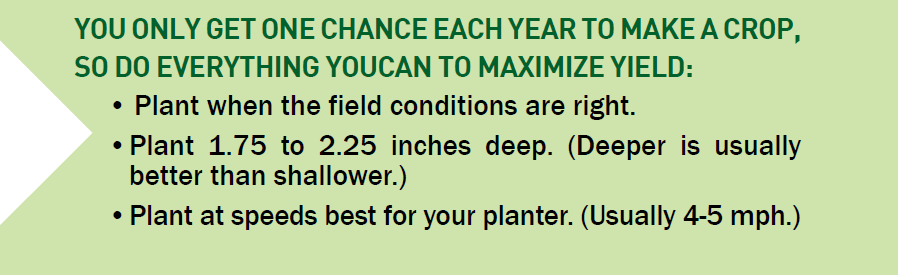
    A few years ago, I conducted speed and planter depth testing on our farm. I found that our John Deere 7000 planter was most accurate at 4.5 to 4.8 miles per hour (mph), and our yields were the best at a depth of 1.75 to 2 inches. I saw as much as a 10-bushel difference at higher planting speeds and a 20-bushel difference when seed was planted at 1.25 to 1.5 inches deep. Root systems were considerably smaller where the seed was planted shallower and at faster speeds.

    Also remember to check depth and spacing each time you move to a different field to ensure depth and spacing works in that field’s soil type and texture. Wishing you all a safe and great planting season!

    Screenshot (176)

    Webspec Admin

    April 17, 2018
    Spring, Tech Tuesday
  • Latham Hi‑Tech Seeds

    5 Things to Tackle during “Pre-Plant Technology Prep”

    Feature Tech Tuesday 01

    Tech Tuesday Header-01

    As we get closer to spring, farmers are busy making sure their equipment is running and their planters are calibrated. There is also “pre-plant prep” required for precision ag.

    Quality data and consistency go hand-in-hand. Take the time now to ensure everything is ready before the busy planting season begins.

    To help, I’ve compiled a list of five key areas for your consideration:

    1. Monitor software
    Make sure your monitor software is up-to-date. This is also the perfect time to update your list of your fields, including the hybrids/varieties that you will be planting in each field. Updates help the monitor record your data, as well as communicate with the tractor and planter.

    2. Field Boundaries
    One thing that often gets overlooked is changing field boundaries. Did you add a waterway or take out a grove of trees? Maybe you got rid of a fence line and are now farming two farms as one. There are an endless number of ways you could have changed the boundaries of your field, and these influence a planting prescription.

    As long as it’s set right in your monitor, you will typically just plant an “out of bounds” or “default” rate. If you catch these changes before you plant, however, you can save yourself the headache. Fixing the prescription now will allow you to be more prepared for the other unexpected issues that may arise.

    3. Planting Prescriptions
    If you’re running a planting prescription, make sure it’s loaded in your monitor before you head to the field. Again, this will save time and frustration when it becomes crunch time. NOTE: Some monitors require you to clean out old files and save them before bringing in new files.

    4. Variable Rate Prescriptions
    Those of you planting with VR (variable rate) prescriptions can have your dealer come out and run through it with you. While he or she is showing you what to do, record a video of the tutorial on your smart phone. That way you can quickly re-watch the video to remind yourself of the steps you need to do when you get in the cab.

    5. Calibrate Seed Meter
    Preparing your planter should always be a priority. Calibrate the seed meter. Checking the entire row unit for worn parts is critical for accurate seed placement. Research has shown that a variation in seed spacing of only one inch can have an impact of 2.5 bushels per acre due to inaccurate seed spacing! That doesn’t include seeding depth and emergence timing, which is an even bigger issue. Any other problems during the season including weeds, diseases, or other issues will only compound this effect.

    Webspec Admin

    March 20, 2018
    Tech Tuesday
  • Latham Hi‑Tech Seeds

    It’s Just Seed, Right?

    Feature Tech Tuesday 01

    Tech Tuesday Header-01

    Written by: Bob Foley | Research Team Guest Contributor

    Seed is an amazing little dynamo that contains next year’s plant and also provides food to feed the new seedling until it becomes a plant capable of thriving on its own.

    Back in my Dad’s and Granddad’s day, all one had to do is match up the correct plates to the seed size and sow into the ground. Planting seed typically kicked off a growing season that found dad spending his time trying to keep the crop alive while protecting it. He religiously used equipment like the moldboard plow, rotary hoe, mounted cultivator and maybe a dolly sprayer. He scouted rigorously for yield invaders like cutworm, wireworm, pythium, corn borer, phytophthora, ear worm, and weeds.

    To combat weeds, Dad had some weapons like Atrazine or 2-4-D, plus some kids who walked beans. Some years it seemed the list of pitfalls to deal with just to help the crop make it to harvest was endless. It’s alarming to think that in April these farmers had no idea what challenges they might face throughout the growing season or what the cost to manage them would be. Actually, they only managed them if they were fortunate! Mostly, they just did battle with them.

    Look inside seed today and you still see the future plant and a seedling’s food, but now there is so much more. Wouldn’t it be helpful if seeds had decals like a racecar, proclaiming all that was contained inside: Glyphosate, 2,4-D resistance? It’s in there. Bug and worm resistance, improved seed quality? Check. Better health,flexibility for higher planting density? Included. Drought tolerance, ethanol preferred? Yep. You get the picture… They would look like your new hunting jacket with all its tags: cattail camo, silent-suede fabric, water-tex, insul-force, techno zip, hook & loop closure, wind-stopper etc., etc., with all the logos showing what’s inside to help it perform and be a better value to you. All the added-in parts working together for your assault on the elements.

    Yield has become an “all-hands-on-deck” mission. Mechanical, Chemical, and Genetic engineering have all come together to help us understand genes so well that we not only map them, but we edit them, repair them, and move them, essentially turning genes on or off like flipping a light switch as we enter a room. Plant breeders scour the world like the yield-army’s foot soldiers. Fertilizers, surfactants, safeners, field agronomists, planter singulation, and what about the tremendous chemistry? Maybe the most unheralded group of the yield mission over the past 20 years is the seed treatment gang and their arsenal of powerful weaponry products that coat our seed and protect all that is packed into it.

    Remember the seed? Even though the decals won’t be found on any of the power-packed kernels, take a minute to appreciate this little dynamo, your army of dynamos. Take a minute as you pour the seeds into the planter to ponder the army you are about to unleash in your field.

    Dad and Granddad wouldn’t believe it!

    Webspec Admin

    March 6, 2018
    Tech Tuesday
  • Latham Hi‑Tech Seeds

    Tips for Carefully Selecting Corn Silage Hybrids

    Feature Tech Tuesday 01

    Tech Tuesday Header-01

    Risk reduction is one of the most critical considerations when designing your 2018 crop plan, as I’ve written in past articles.

    While I tend to be a very early adapter to new products and technology, I also assess the risk versus the reward. Taking “calculated risk,” rather than reacting somewhat spontaneously to emotion-based marketing tactics that make us want to buy on the spot, is especially important in fragile markets.

    “I think you should buy corn hybrids for silage only from seed companies that evaluate their hybrids for silage use,” writes livestock nutritionist Everett D. Thomas in an article published November 30, 2017, by Progressive Forage magazine. “… they should have silage yield and quality data, including fiber digestibility. In some seed company catalogs, corn silage is mentioned only in passing – or not at all.” Type this into your Internet browser to read this article in its entirety: bit.ly/2mE4az8

    What a great statement! There are so many things to consider when planting a hybrid: consider the end use first; keep crop rotation in mind; and minimize risk factors.

    From a plant genetics standpoint, top risk factors are moisture stress and disease pressure. Remember that healthy plants are needed in the field to produce high quality feed and top yield. The key is to strike that best balance between all critical factors, so what’s best in the field translates to what’s best in the bunk.

    Latham’s FieldXFieldSM approach to crop selection helps put the best in each field, which is part of bringing the best in the bunk. Genetics certainly play a role in delivering quality at the bunk, but that’s only one factor of many when producing silage. You also need stress tolerance and disease management, which may include a fungicide, along with good plant nutrition, and a strong plan for timely harvest.

    As an independent company, Latham Seeds has bountiful genetic options. Latham® Leafy products are a great corn silage-specific option. Sales of our leafy corn products continue to grow because they produce amazing tonnage and quality.

    NOTE: Leafy and silage-specific products typically don’t score high in university trials, as leafy hybrids perform better at lower planting plant populations and university trials are geared for higher populations. If corn silage evaluation programs were planted at the lower populations and evaluated fairly, the results would be more reliable and comparable. Many corn silage growers like the flexibility they get with dual-purpose hybrids for their utility across varying soil types and flexibility at harvest time, and trait options. If the bunk is filled, growers can still get top grain yield and sell some grain.

    Every grower’s needs and corn silage experience are unique and different. Silage-specific products don’t fit into some grower’s crop rotation based on the trait needed to reduce risk. The great news is that Latham has a full lineup of dual-purpose hybrids for those situations.

    At Latham Hi‑Tech Seeds, we’d like to help you select the seed that’s best for your situation. We’ve collected lots of corn silage data, and multi-year data is available on www.LathamSeeds.com. And, feel free to also contact me at 1-877-GO-LATHAM or coreyc@lathamseeds.com.

    Webspec Admin

    February 27, 2018
    Corn Silage, Tech Tuesday
  • Latham Hi‑Tech Seeds

    Resolve to Try VR Corn Planting in 2018

    Feature Tech Tuesday 01

    Tech Tuesday Header-01

    The precision ag world revolves around “variable rate” (VR) applications, which is typically where you unravel areas in fields where you can save input costs. Because we’re in our fourth year of low commodity prices, it’s a great time to see if variable rate seeding can increase your bottom line.

    The first step is breaking you field into production zones, which should be managed differently based on their production potential. I’ve discussed the different data layers that can go into this decision, so I won’t cover it in this article.

    The next step comes down to picking the right product and adjusting your seeding rates. Using Latham’s FieldXFieldSM service, we can determine the best hybrid for each situation. Choose a hybrid that will perform well on the majority of soil types in each field. If a field has uniform soils, then you need to use your historic knowledge of disease or other problems. Don’t pick a racehorse hybrid for a challenging field and wonder why it didn’t respond unless you plan on protecting it with a fungicide application, if necessary.

    After you match the hybrid to your field, look at the ear flex noted in tables below the hybrids in our 2018 Product Guide. A Semi-Flex (SF) is usually your best option for a VR seeding application. If you’re looking at a Semi-Determinate (SD) hybrid, don’t count it out. All hybrids have some flex, but the SF will not give up as much yield in those lighter soils as the SD. A full Determinate ear would not be a good choice as it will give up the most yield if stressed by lighter soil conditions.

    Be open to adjusting seeding rates more than 1,500 to 2,000 seeds per acre (spa). I normally like to see a swing of 3,000 to 4,000 spa when you’re trying VR seeding. Every soil type/hybrid combination has a different seeding rate sweet spot, so don’t expect to figure it out on your first try. When you pull the population down from 32,000 to 25,000 spa, plant spacing widens up another 2 inches and that dramatically changes the “competition” between plants. Suggested seeding rates can also be found in our product guide.

    *Disclaimer: Seed placement and precision equipment are very important. You won’t see an advantage if your planter plants more doubles and skips than it does well-placed seed. When you lower populations on lighter soils, each corn plant needs enough space so it’s not crowded when it comes to its roots and canopy.

    Variable rate seeding may provide that additional boost to your bottom line by bumping up yields in your top-yielding areas. Instead the focus is on lowering seed costs and maintaining yield on those areas that never seem to meet yield expectations. Experimenting on your farm is the best way to find an answer to this question. If you have the technology on your planter, make 2018 the year you give it a try! I’ll gladly help where I can, so feel free to give me a call.

    Webspec Admin

    February 20, 2018
    Corn, Tech Tuesday
  • Latham Hi‑Tech Seeds

    Climate FieldView Tutorial: Variable Rate Seeding Prescription

    LIBSYN header 4

    LIBSYN header 2-01

    Join us as Phil Long brings us through a tutorial on writing a variable rate seeding prescription. Learn hands-on by following along on his step-by-step process!

    View the video here: https://www.facebook.com/LathamSeeds/videos/10156163408237138/


    Webspec Admin

    February 15, 2018
    Tech Tuesday
  • Latham Hi‑Tech Seeds

    Soybeans with Low SDS Tolerance Benefit Most from ILeVO®

    Feature Tech Tuesday 01

    Tech Tuesday Header-01

    Once you have it, you have it! Because sudden death syndrome (SDS) is caused by a soil-borne fungus, there’s no getting rid of it. Farmers must manage it to protect yield. Keep in mind that SDS was widespread in 2016, and many of those acres will be planted once again to soybeans in 2018.

    The most promising tactic for SDS management is ILeVO® seed treatment. Numerous university trials have shown ILeVO effectively reduces SDS severity and protects yield. In addition, Latham’s own research confirms the findings.

    With the help of many of Latham® soybean SuperStrip cooperators, our first company-wide trial using ILeVO was held in 2016. That year SDS was widespread, so many farmers across Latham Country lost significant yield to the disease. Our 26 plots showed an average yield benefit of about 3.5 bushels per acre.

    This past growing season, however, SDS was not nearly as severe. Certain counties in Central and Eastern Iowa were impacted greatly by the disease but, in general, it was a season where SDS showed up late and didn’t cause as much lost yield.

    We doubled the number of side-by-side plots from 2016 to 2017, and we added a few more varieties to the test. Results varied quite a bit by location due to disease severity and the soybean that was used in the study.

    Following are a few observations based on the data gathered in 2017:

    • The highest yield benefit was seen in a plot in Hancock County, Iowa, where L 1858 R2 was the soybean treated and came in at 8.27 bushels per acre benefit.
    • Although SDS severity was down from 2016, we saw some significant differences in response between soybean varieties. Products like L 1858 R2 and L 2558 L, which are not known for their SDS tolerance, showed the most benefit from the ILeVO.
    • In 2016, we saw a few plots where the ILeVO seed treatment showed a negative response. Statistically, this is not unusual nor unexpected. We saw this again in 2017 but not to the magnitude observed in 2016. Both L 2084 R2 and L 1787 L averaged a negative response (-0.9 and -0.6 respectively).
    • Across the 51 plots, we saw about a ½ bushel per acre yield benefit for applying ILeVO seed treatment.

    We plan to conduct another ILeVO trial in 2018. Feel free to contact me or your Latham RSM if you’re interested in being an ILeVO plot cooperator.

    Webspec Admin

    February 13, 2018
    Soybeans, Tech Tuesday
  • Latham Hi‑Tech Seeds

    Begin with Basics to Build Precision Ag Platform

    Feature Tech Tuesday 01

    Tech Tuesday Header-01

    Yield monitors, fancy sensors, and imagery tend to receive the “oohs and aahs” when it comes to precision ag technology. But is that what matters most?

    For those who are just starting to use precision ag technology, it’s best to begin with the basics. Climate FieldView™ puts very valuable layers of data right at your finger tips to help make decisions that directly impact your bottom-line.

    Fertility should be the base of any crop production system because soil sampling gives your crops the best chance for success. Using the Climate FieldView app, you can pull in your soil sampling data. Use the split-screen tool to view the soil sampling side-by-side with yield data to diagnose season-long problems; or view it beside satellite imagery during the season to make critical last-minute application decisions (see image). You can even use it side-by-side while planting to make last-minute population adjustments based on areas you know have lower fertility.

    Soil pH and liming is the foundational piece of the puzzle that can significantly impact how well the other fertilizers and herbicides you apply are getting used by crops. You can apply variable rates of nitrogen (N), phosphorus (P) and potassium (K) and seed. Unless the pH is correct, many of those
    applications will be a wash in terms of yield impact. For example, once the soil pH drops below
    5.8, soybean nodulation for nitrogen fixation significantly decreases and causes that yellow
    soybean look to linger longer and lower yield. If your corn is growing in soils with a pH below 5.5, phosphorus availability takes a nose dive. Phosphorus is critical for yield as it is involved in photosynthesis, respiration, energy reactions, and many other important processes.

    In regions of Latham Country, farmers struggle more with high pH and the ability to bring it down into that preferred range of 6.0 to 7.0. It’s not economically feasible to attempt lowering pH for large scale production, but having this data at your fingertips can guide you to those areas where you may need for focus on more tolerant crops such as Latham® IRONCLAD™ soybeans. You also can monitor those areas for rescue applications of certain micro-nutrients. In addition, you can apply variable rates of N, P, K fertilizers that include Sulfur, Zinc, or other nutrients to meet a particular crop’s demands in higher-yielding areas.

    Whatever the case may be for your specific field, the soil database layers within the Climate FieldView App can help with everything from planning during these winter months to inseason
    diagnosis. A pretty yield map can be a real attentiongetter, but when you link your yield map with fertility, it takes FieldXFieldSM crop planning to the next level. By using precision ag tools, you can be confident you’re giving top-yielding Latham genetics the best chance of success!

    Webspec Admin

    January 30, 2018
    Precision Ag, Tech Tuesday
Previous Page
1 … 10 11 12 13 14 15
Next Page

Latham Hi‑Tech Seeds

131 180th Street | Alexander, IA 50420

(641) 692-3258

SIGNUP FOR OUR NEWSLETTER
  • Contact
  • Legal
  • Dealer Center
  • Seedware Login
  • Latham Gear

© 2025 Latham Hi‑Tech Seeds. All rights reserved. | Iowa Web Design by Webspec | Privacy Policy

Latham® Hi-Tech Seeds is a trademark of M.S. Technologies, L.L.C., 103 Avenue D, West Point, IA 52656.