Latham Hi-Tech Seeds

(641) 692-3258

  • Home
  • Products
    • Corn
    • Soybeans
    • Alfalfa
    • Corn Silage
    • Seed Guide
  • Performance
  • Find a Rep
  • Media
    • Blog
    • News
    • Videos
    • Podcasts
    • TECHTalk
  • About Us
    • Company History
    • Our Mission
    • Careers
    • Become a Rep
    • Sowing Seeds of Hope
  • Contact Us
  • Latham Hi‑Tech Seeds

    4-H Beef Project Teaches Life-Long Lessons

    Suntken 1

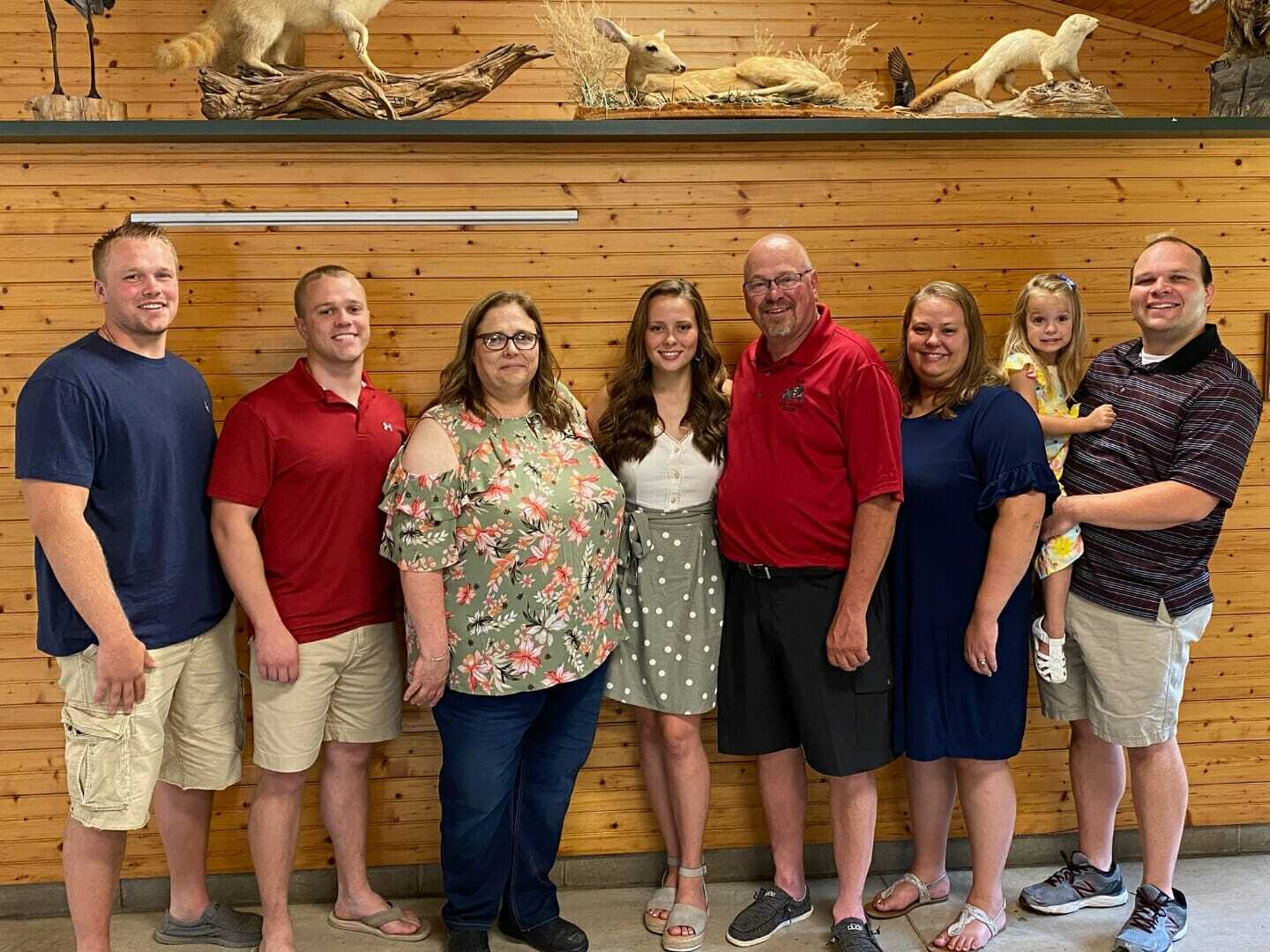
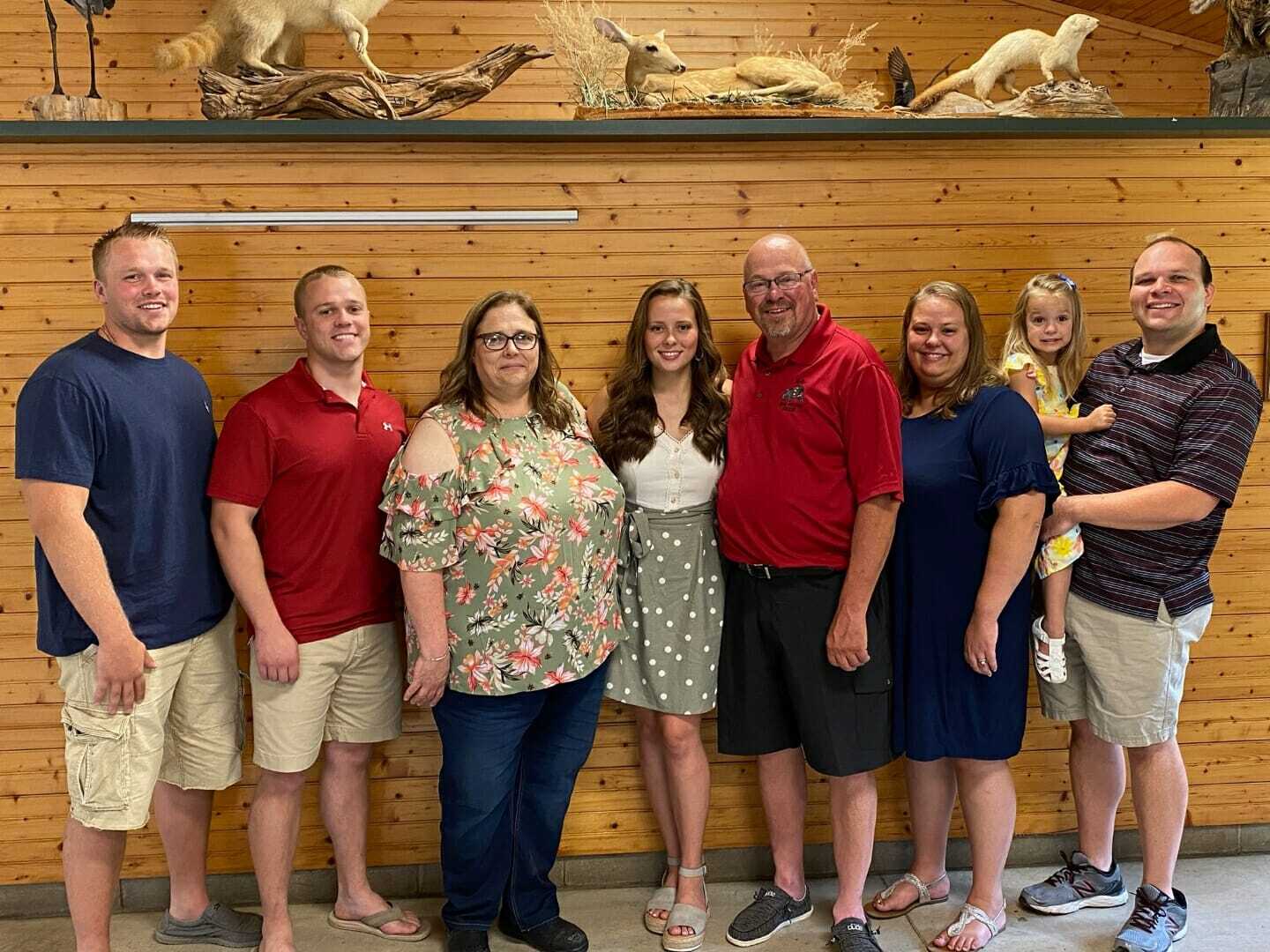
    Jon Suntken and Tami Pralle’s shared passion for 4-H brought them together in 1979 when they were selected to serve on the Franklin County 4-H Council. They have made their home on the Suntken’s Iowa Century Farm for 36 years.

    “All of our children began showing bucket calves at the Franklin County Fair when they turned five, and someone from our family showed bucket calves for 17 consecutive years,” says Tami. “This helped our kids develop a passion for showing and judging livestock.”
    Suntken 1
    The Suntken family.

    The 2021 Franklin County Fair will mark the first time in 27 years that the Suntken family will not be showing cattle at the fair. However, their years showing cattle provided them with life-long memories and taught them important life lessons.

    “4-H has taught our children lessons and provided them with many experiences that are important in life: work ethic, responsibility, how to start and finish projects, character development, meeting new people, public speaking, helping others and developing new friendships.”

    The Suntken’s oldest daughter, Katelyn, served as both Franklin County beef princess in 2007 and beef queen in 2008. She and her husband, Ryan Borcherding, live in Reading, Pennsylvania, with their four-year-old daughter. Katelyn is a stay-at-home mom, and Ryan works for Deere & Company as a regional manager. The Suntken’s oldest son, Kellen, interned with Latham Hi‑Tech Seeds in the early years of our precision ag program. Kellen graduated from Iowa State University. He serves as Plant Operations Lead for Syngenta Seeds in Lone Tree, Iowa. He also remains active in the family’s farming operation. Their son Kendrick played linebacker for the University of Northern Iowa and now farms with his dad. Kenrick also is a chemical rep for Innvictis Crop Care and Biodyne USA. Kirsten just finished her freshman year at Des Moines Area Community College (DMACC) in Ankeny where she is majoring in Ag Business. This summer is serving as a precision ag intern with Latham Hi‑Tech Seeds.

    Kirsten Beef Queen
    “Serving as Franklin County Beef Queen was an honor. I loved representing an industry that I am passionate about,” says Kirsten Suntken. “One highlight as Beef Queen was being part of a new cattle show in August called the North Iowa Cattle Battle. Although my time as queen wasn’t what I was expecting due to Covid-19, I learned a lot through these times. I also learned to never take anything for granted.”
    Steer[1]
    “It was an honor to be selected for the Governor’s Charity Steer Show and to raise money for a good cause,” says Kendrick Suntken. “It was also rewarding to help clean up the Ronald McDonald House in Des Moines.”
    294124 1857037996753 7234755 n
    Kellen and Kendrick Suntken had the honor of being part of the team that placed second in the 2011 Iowa State Fair 4-H livestock judging competition. From left to right are former Franklin County 4-H members: Kellen Suntken, Joe DeVries, Kendrick Suntken, and Drew Abbas. Kendrick also was the first place individual in that competition. During his career, he also placed third overall in the state FFA competition and earned High Individual at the ISU Spring Extravaganza. Kellen placed second in the individual competition for 4-H in 2011. He also was a member of the Iowa State University Livestock judging team when he was in college.

    The Sunkten’s diversified farming operation includes corn and soybeans plus a cow-calf herd and a custom hog finishing operation. Jon started farming full-time in 1979 and also worked 12 winters at Latham Seeds. He has been a contract Latham® soybean grower for 42 years. Tami works full time as a program technician at the Wright County Farm Service Agency.

    Today Tami is sharing a recipe for grape salad with an Irish twist. Kirsten is promoting Iowa beef during Beef Month by sharing with us one of her favorite recipes for pot roast in a crock pot.

    Grape Salad with an Irish Twist

    Ingredients

    • 8-ounces of Philadelphia® cream cheese (softened)
    • 1 cup brown sugar
    • 3/4 cup sour cream
    • 1/4 cup Bailey’s Irish Cream
    • 1 teaspoon lemon juice
    • 2 to 3 pounds of large, red, seedless grapes

    Directions

    • Wash grapes.
    • Cream cheese and sugars, then add other ingredients and mix all together.
    • Gently fold grapes into creamed mixture.

    Shannon Latham

    May 21, 2021
    Beef, Food & Family, Recipes, Salads, Season, Sides, Spring
  • Latham Hi‑Tech Seeds

    #AskTheAgronomist: What’s Our Next Move?

    ATA Next Move

    Phil Long compares this growing season to a hand of blackjack. We started with an early king face up, but the cards have fallen a little slower for farmers across the Midwest since then. What should our next move be? The answer in this week’s episode of #AskTheAgronomist.

    Webspec Admin

    May 21, 2021
    #AskTheAgronomist, Agronomics, Corn, Crop, Emergence, Season, Soil, Spring, Summer
  • Latham Hi‑Tech Seeds

    #AskTheAgronomist: Uneven Corn Emergence

    IMG 0510
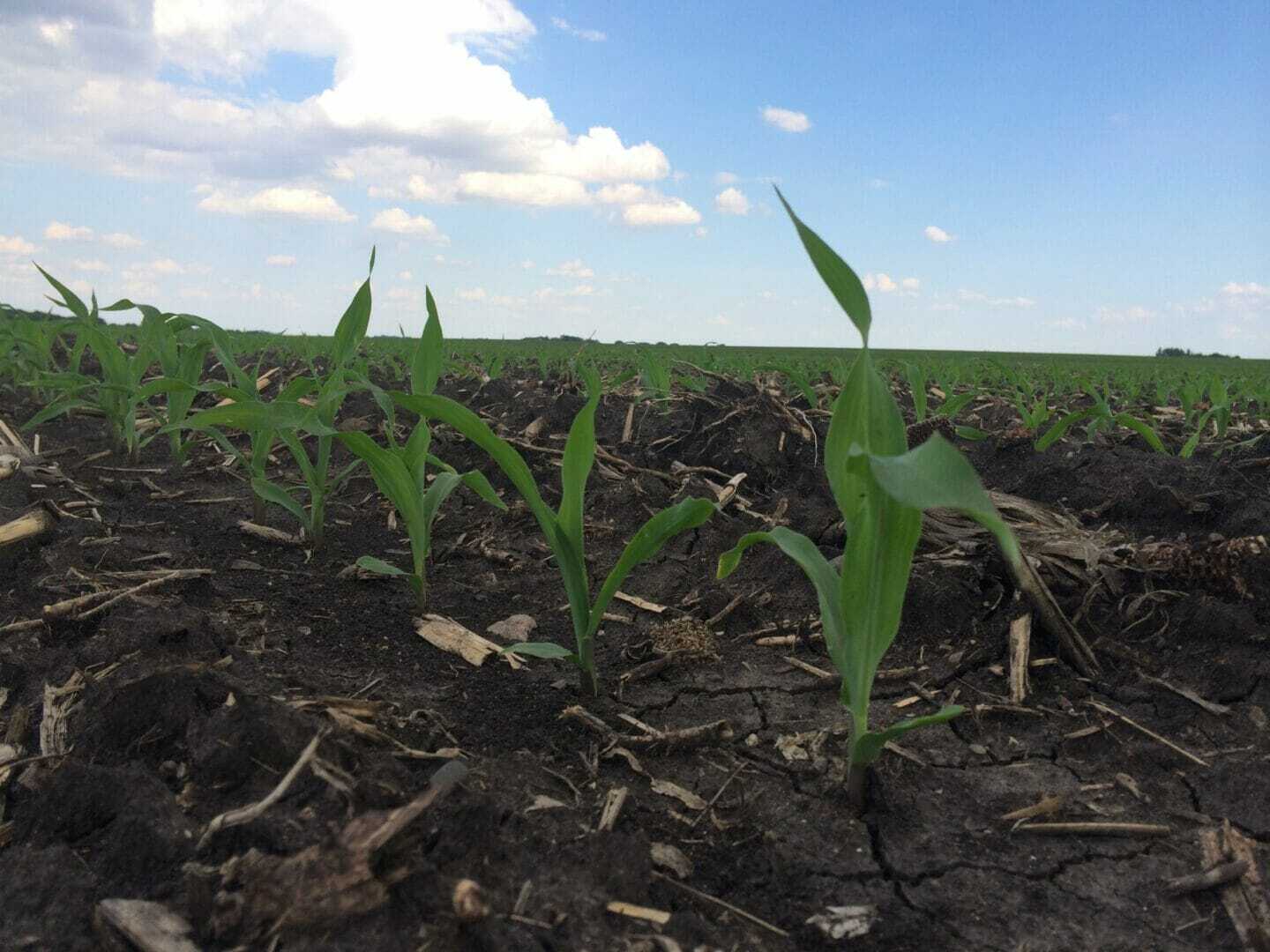
    Precision Agronomist Phil Long answers common questions related to uneven corn emergence, scouting tips and thoughts on changes to the planting plan at this stage of #Plant21.

    Webspec Admin

    May 16, 2021
    #AskTheAgronomist, Agronomics, Corn, Crop, Emergence, Season, Spring
  • Latham Hi‑Tech Seeds

    Execute Your Plan for Seeding Success

    Alfalfa3

    Vince Lombardi had many attributes that built his winning record, but I suspect it started with a vision of reaching the end zone. He then built and executed a plan. He kept it simple, often using the same play many times in a row. The power sweep was successful because the focus was on executing it flawlessly.

    The same steps can be applied in your pursuit of leaving no yield in the field. Keep the vision clear. Build the plan. Master the basics, and you’ll hit the proverbial end zone of success.

    Below are six basic steps to achieve success with alfalfa this growing season:

    1. Check emergence. Alfalfa is a survival of the fittest plant. Some research suggests 60% of seeds won’t become seedlings. Depending on your seeding rate, seeding bed, and weather, you should see 50 live plants per square foot within four weeks of spring seeding. AlfaShield™ improves survival chances.
    2. Check existing stands. The crown is fully developed after one full year, so we transition to stem count. Strive for more than 55 stems per square foot. If a field is not looking good and the stand is young enough, you should be able to no-till some supplemental alfalfa seed.
    3. Control weeds. Be the boss! Mortality rates are often high due to competition from aggressive weeds. Scout early and spray when label advises. The younger the weeds, the more vulnerable they are to herbicides. New seeding can be cut after about 60 days or so, which also can help manage certain weed populations.
    4. Be vigilant against pests. New seedings are vulnerable to leafhoppers, especially when they come from established fields nearby. Temperatures of 70+ degrees Fahrenheit also increase leafhopper reproduction. Eggs hatch in seven to 10 days and become adults in about 14 days. The damage to yield potential is often irreversible, so it’s important to be vigilant.
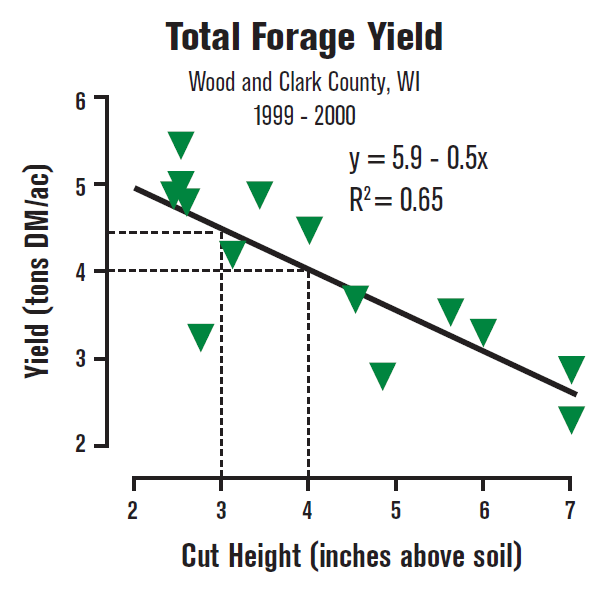
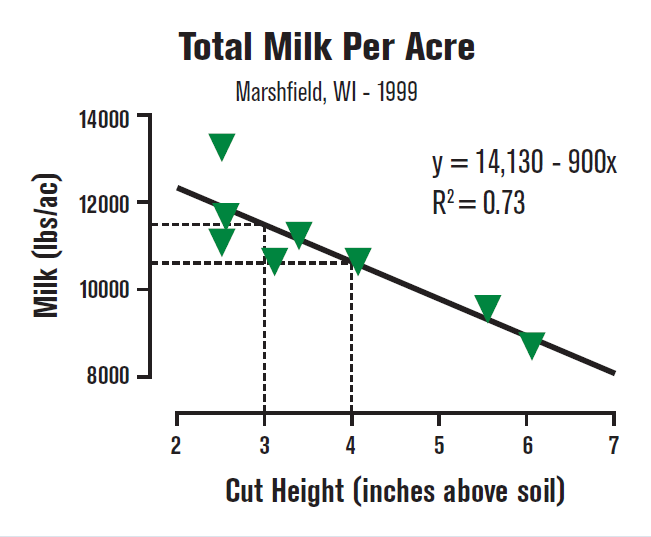
    5. Cut it short for best quality. A tremendous amount of research has shown a cutting height of two inches is the most economical and provides the best forage quality (See graphs below.) That is, as long as you don’t have rocks and gopher mounds!
    6. Feed the plants. Potash equals plant performance. Every dry matter ton of alfalfa removes about 50 to 60 pounds of potassium per acre. Consider adding sulfur, boron and zinc. Testing soil and tissue help you develop the best fertility program. Most growers apply supplemental fertilizer after first cutting and third cutting for best results.
    Total Forage Yeild
    Research on ideal cut height.
    Total Milk Yeild
    Research on ideal cut height.

    Webspec Admin

    May 12, 2021
    #AskTheAgronomist, Agronomics, Alfalfa, Crop, Emergence, Insects, Season, Spring, Summer, Weed Control
  • Latham Hi‑Tech Seeds

    Scout Early for Below-Ground Insects That Damage Corn

    Corn pest

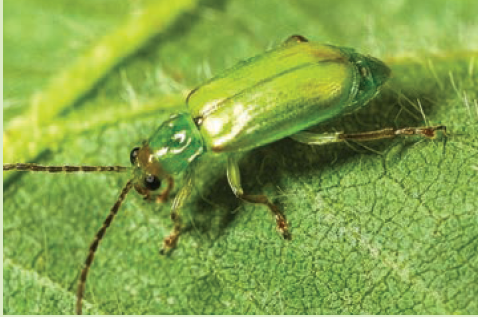
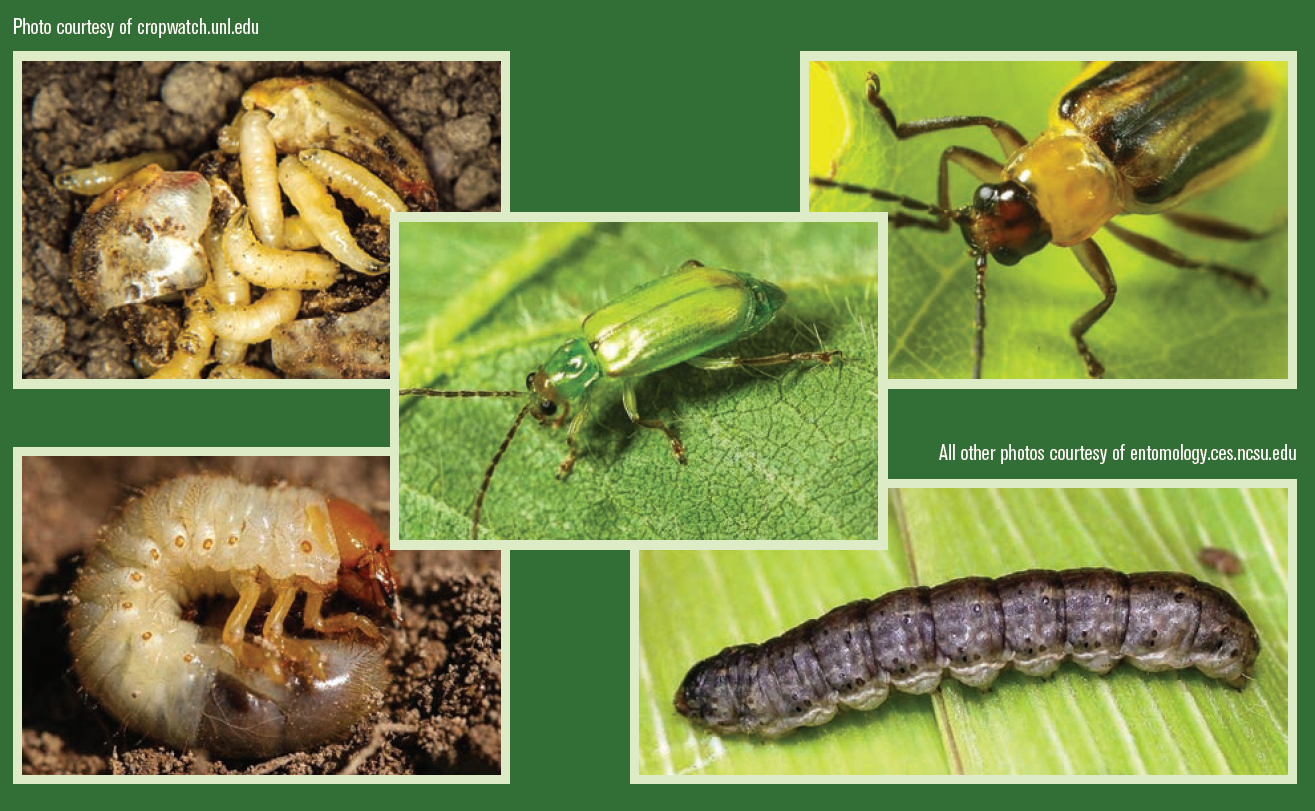
    Numerous below-ground insects can damage your corn stand. We will focus on four pests, including where you will likely find them and what management tips could help prevent damage.

    Seedcorn Maggots destroy seeds before germination. This can occur when soils are cold and germination conditions are less than ideal. Most damage occurs in high organic regions of fields, especially areas with heavy manure applications. The best time to scout is from planting to VE. Dig up seed in areas with damage to check for insect feeding. Note problem areas, and consider additional soil-applied insecticides in those areas in the future.

    Scout for White Grubs prior to planting. High-risk fields include those that have been in pasture one or two years previously or where willow or cottonwood trees are growing adjacent to the field. Most of Latham’s seed treatments control this insect unless infestations are high enough to overwhelm the seed treatment. In areas with that potential, consider soil-applied insecticides.

    Shortly after eggs hatch in May and June, Northern Corn Rootworm and Western Corn Rootworm larvae begin feeding on root hairs and tunnel inside roots. As they develop, larvae begin feeding on larger root tips. Extensive feeding can eliminate entire nodes of roots. In fields with known beetle history, use Latham® hybrids that contain SmartStax® or Agrisure Duracade® technology. In fields with heavy pressure, use a soil-applied insecticide in addition to a traited hybrid.

    Black Cutworm most commonly occur in low or poorly drained areas of fields. Latham brand SmartStax hybrids contain the Cry1F Bt protein that can control most problems of cutworm infestations. Our new hybrids for 2022 planting with the Trecepta® and 5222 Duracade traits contain the Vip3A Bt protein that also offers great control.

    Your Latham Dealer has the tools you need to effectively control these pests. As you scout fields and find pests, note those areas. Then ask your local seed dealer to help you build a plan that incorporates the Latham hybrids that can offer you the best protection.

    Insects Corn

    Latham Seeds Precision Agronomy Advisors

    May 12, 2021
    #AskTheAgronomist, Agronomics, Corn, Insects, Spring, Summer
  • Latham Hi‑Tech Seeds

    Check Those Soybean Stands!

    PythiumSoybeans

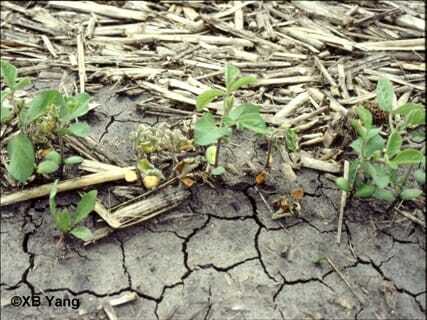
    Soybean stands can suffer from a wide variety of problems that will reduce population. Hail, diseases, insects, cold soil temperatures at planting, compaction, and planter failures can all affect the stand individually and in combination.

    Stand reductions almost never occur evenly across the field. Here are some basic steps to help evaluate soybean stands and decide if re-planting is necessary.

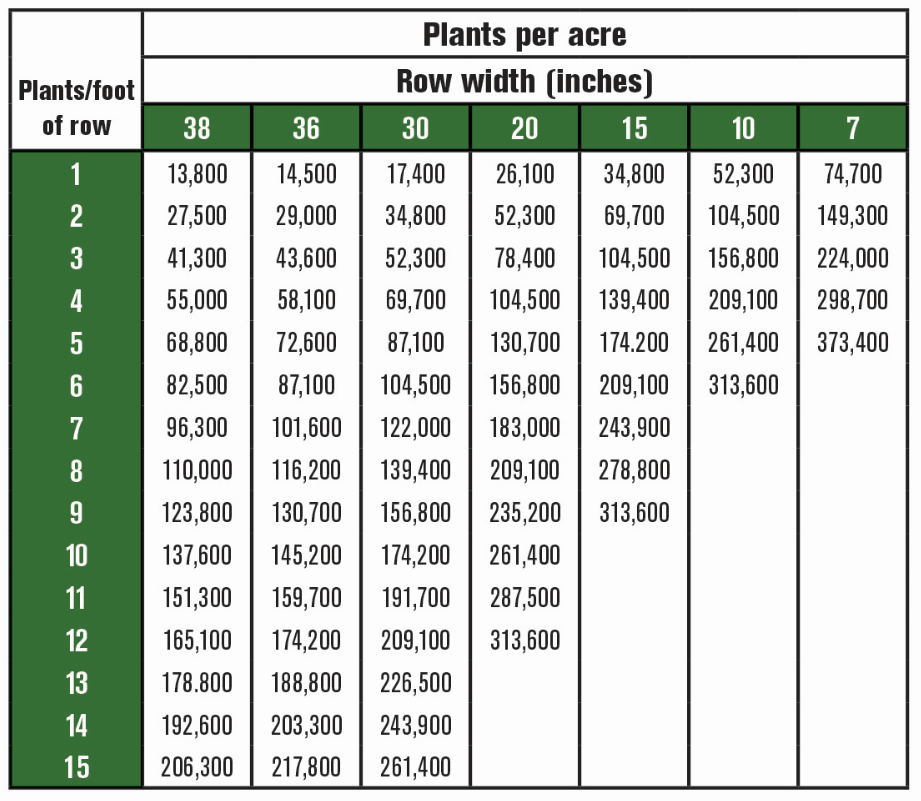
    Take 10 stand counts in the area with the worst damage and 10 counts in the part of the field that was not affected or affected just slightly. At each point, measure off 10 feet of row and count the number of live, viable plants. Then calculate the average of your 10 points and compare them to the table below to see how many plants per acre you have remaining.

    A stand of 100,000 evenly distributed plants generally gives you optimum yield. As the growing season progresses, however, it is much more difficult to establish a good stand. A stand of 75,000 on May 15 is inadequate, but you might be better off leaving a stand of 75,000 plants if it is July 1.

    Plants per acre

    Planting soybeans on or before June 1 averages 95% of expected yield. In a five-year Latham Seeds’ study, there was no significant yield difference in soybeans planted before May 15. Planting dates included late April, early May and mid-May. We did not see yields drop to 85% or lower until after June 15.

    Our results are similar to studies done by university researchers. If you farm below the line from Watertown, SD through the Twin Cities and over toward Green Bay, Wisc., I recommend staying with soybeans in your normal maturity until mid-June. After June 15, consider the precipitation expected in late June and early July because the biggest threat to establishing a late soybean crop is lack of rainfall. If you are north of that line, you may need to switch to an earlier variety a week or so sooner.

    Webspec Admin

    May 12, 2021
    #AskTheAgronomist, Agronomics, Crop, Soybeans, Spring, Summer
  • Latham Hi‑Tech Seeds

    Raising Cattle, Building Character

    Moretz Calf

    When Melissa (Bisbee) Moretz was 5 years old, she went into business with her brother and sister. Their father purchased a few ewes for them to raise. They were in charge of feeding and lambing them. As they grew older, they accepted more responsibility, including the finances.

    “This is where my farming background began. It was an effort made by my parents to help my siblings and I save money for college, but it developed into much more. As we grew older and became 4-H members, we decided to sell the sheep and get into cattle and swine,” says Melissa, who served as a high school ag instructor and FFA advisor before becoming a senior portfolio manager in 2017 at a local bank. “I showed breeding beef at the county fair along with market swine at the county and state fair. I farrowed swine for my Supervised Agricultural Experience (SAE) program in FFA. I participated in many career development events (CDE), met many people, served as a chapter officer for two years, and learned what hard work really was.”

    Moretz Family Photo_1
    The Moretz Family

    With so many life lessons learned, it’s no wonder that Melissa and her husband, Nate, desire to raise their family on a farm. She says she loves coming home from work and taking their children to the barn.

    “Raising our children on a livestock and grain farm has already begun to instill a strong work ethic within both of them,” says Melissa. “Having livestock gives my children an opportunity to learn about the circle of life at a very young age. They have also learned how to care for any bucket bottle calf that ends up on our farm, and they get so comfortable with them that they are more pets than cattle by the time they are weaned from the bottle.”

    Moretz Calf
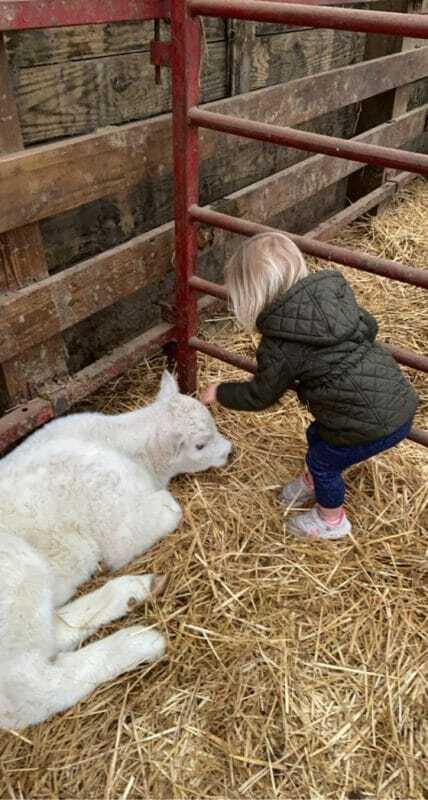
    The Moretz’s two-year-old daughter enjoys chasing her brother around the farm and checking on the family’s calves.

    Their five-year-old son is in preschool. He loves to farm any chance he gets. His two favorite things about the farm are spring calving season and riding in the planter or combine with his papa (Nate’s father).

    “This year for Kole’s class show-and-tell, we were able to do a Zoom meeting with his class. Kole shared a new calf that was born the day before our Zoom meeting. Kole explained to his class how to take care of calves and why we raise them. The class even got to name the baby. Rainbow is now happily out in our pasture with her momma.”

    The Moretz’s two-year-old daughter wants to keep up with her brother. When she isn’t chasing her brother around the farm, she helps her mom deliver meals to the field. She enjoys a good picnic in the tractor. She also loves playing outside on the swing set and going for bike rides.

    Nate and Melissa also farm with Nate’s parents, calving about 120 cows/heifers each spring. As young farmers easing their way into the operation, Nate and Melissa began to purchase market steers and heifers to finish out. Melissa says they care for each animal in the best way possible with two goals in mind: (1) keep our animals safe and healthy; and (2) produce quality offspring.

    “A special bond forms between people who are working together to accomplish a common goal,” says Melissa. “Both Nate and I were raised on farms and want to teach our children the life lessons that, in our opinion, are learned best on the farm. Responsibility, hard work, life/death, and teamwork are a few of the valuable lessons I have learned on the farm and want to share with our family.”

    In addition to raising kids, crops and cattle, the Moretz family has been Latham® seed dealers since 2015.

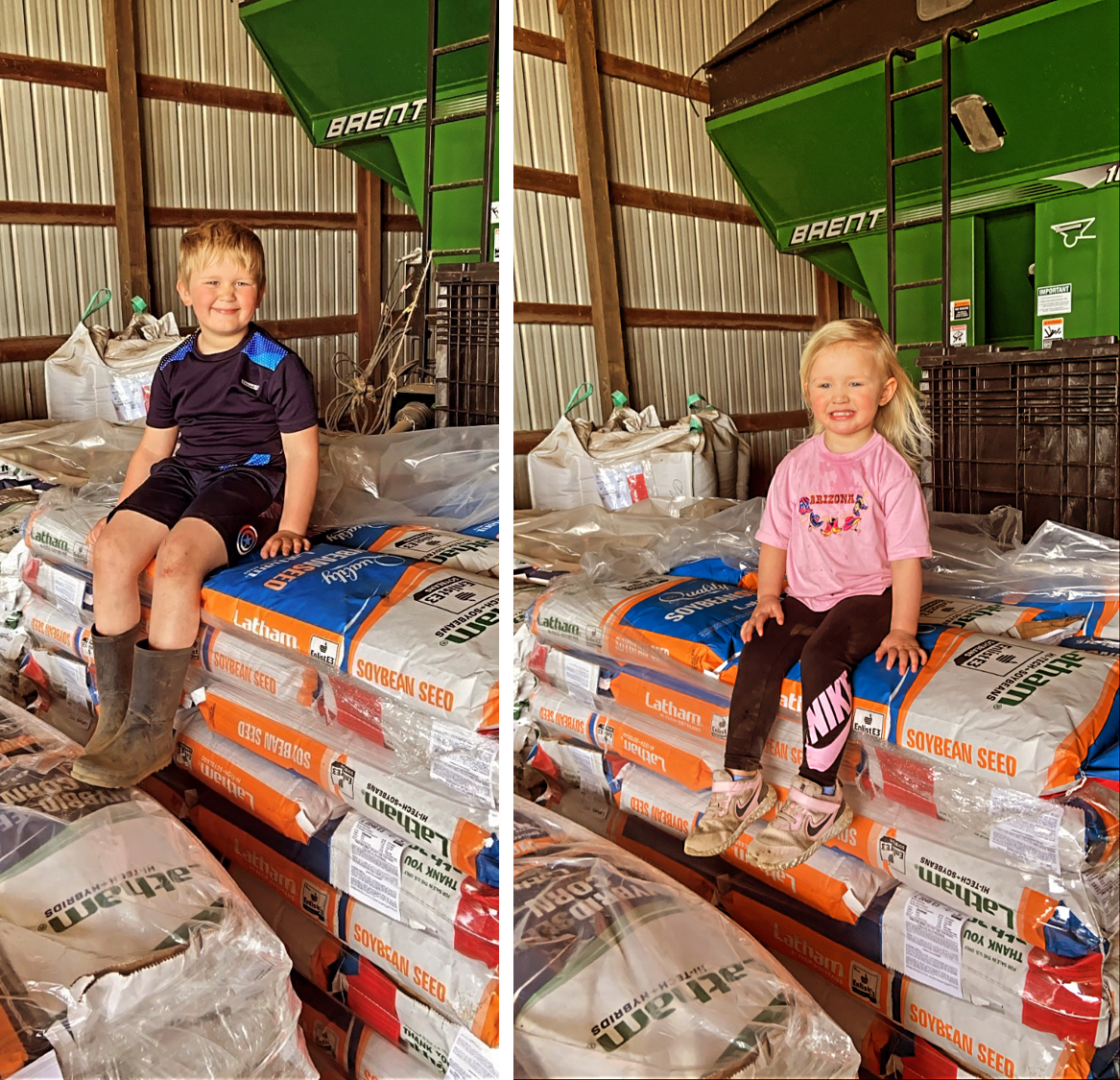
    Moretz Children Seed
    The Moretz children pose for a photo on a pallet of Latham seed. The family has been Latham seed dealers since 2015.

    “Our Latham Hi‑Tech Seed dealership has really taken off in the past couple of years. This has been a great side business for us and a supplemental income,” says Melissa. “Many customers continue to be impressed each year by the products they purchase. They show their appreciation by ordering larger volumes the next year and/or referring us to other farmers in the area. There’s nothing better than word-of-mouth advertising! We are very excited to sell for Latham and can’t wait to see what the future holds.”

    In celebration of May Beef Month and the season of tractor picnics, today we’re sharing one of the Moretz family’s favorite recipes for pizza burgers.

    Shannon Latham

    May 7, 2021
    #RootsInBoots, Beef, Food & Family, Pork, Recipes, Spring
  • Latham Hi‑Tech Seeds

    Frost Damage in Corn & Soybeans

    IMG 9552
    Phil Long discusses the implications of an early-season frost in both corn and soybeans. Tune in to learn if your crop was affected. #LathamSeeds
    :15 — Welcome
    :35 — Topic introduction & indicating factors
    3:30 — Frost damage in corn
    8:50 — Frost damage in soybeans

    Laura Cunningham

    May 12, 2020
    #AskTheAgronomist, Agronomics, Corn, Crop, Emergence, Frost, Season, Soybeans, Spring, Weather
  • Latham Hi‑Tech Seeds

    Early Season Frost or Freeze Damage in Corn

    Picture 2

    The virtue of patience is most beneficial when the time comes to assess frost or freeze damage in early-season corn.  Once a frost or freeze event takes place, do an initial assessment of your field and wait 3-5 days before making any final decision on how to proceed.  Young corn plants can tolerate cool temperatures up to V5 since the growing point is still below the soil surface.  Early season damage caused by the cold temps does not show up immediately as the cells that get broken from the freezing moisture inside the plant may look normal the first morning after a freeze. Depending on the actual low temperatures, symptoms may take a day or so to appear.

    Frost Damage Assessment

    • Identify Location – Note field locations that experienced the cold temperatures. Also note the lay of the land in those fields such as low spots, hill tops, general slope direction.
    • Soil Moisture – Record the soil moisture levels across the entire fields, possible dry hill tops and wetter low areas. Moist soil can offer some protection.
    • Soil Temperature – Check soil temp in different location across the field.
    • Soil Type – Be conscious of the soil type. Sandy soil cools much faster than silty or clay soils.
    • Weather Data – Utilize location weather station info to determine the lowest temperature and duration of that temperature.

    Frost Damage

    Picture 1
    Corn at V4 damaged from frost event. Above-ground tissue is dead (brown) but the growing point was still below-ground and is alive (white-yellow tissue)

    Young corn plants can tolerate some low temperatures and still survive and achieve high yields.  The growing point of the plant remains under the soil until the plant reaches V5. At this stage, you will see five leaf collars showing around the stem. You may have more leaves visible, so count the collars for accurate assessment of crop stage. Low temperatures that do not fall below 30 degrees generally just damage the exposed leaves and do not hurt the growing point. However, recovery of these plants may take some time (up to a full week) depending on weather after the frost. Below is a photo from the Iowa State University Integrated Crop Management newsletter showing a viable growing point after a frost event.

    Frost Damage Management

    • Wait 3 to 5 days with temps above 70 degrees. Wait even longer with lower temperatures.
    • Assess percentage of damaged plants and survival rate prior to any replant decision.
    • Allow plants to recover prior to any herbicide or fertilizer applications, this may take a week to 10 days.
    • Note the amount of leave tissue lost and how it will affect your crop staging.
    • Loss of two leaves in 4 leaf corn will still be classified as V4. This becomes important for later application of herbicides. Keep the leaf loss in mind when staging corn for later applications to assure you are not past a window that may cause herbicide injury.

    Freeze Damage

    If you experience low temperatures of 28 degrees or lower for a prolonged period of time, most all the plants in a field will show significant damage. These extended low temperature situations become more critical for assessment. You may see variation across a field due to soil type, soil moisture content or the amount of residue on the field. Corn damaged by a hard freeze will still need patience for assessment.  Assess all fields after hard freezing temperatures, even those that have not emerged yet. Check soil temps at 2” level soon after a freeze for a sound understanding of the scope of damage to a field.

    Freeze Damage Assessment

    • Soil Temps – Check soil temps at 2” level in multiple locations of the damaged field to gain knowledge of how widespread the damage has occurred. This needs to be recorded early.
    • Patience – Wait 3-5 days to allow the full expression of effects of the freeze.
    • Plant Tissue – Slice open young plants and observe the growing point. Brown and water-soaked tissue vs white or green tissue. See earlier photo for viable plant.
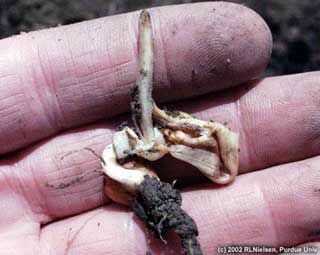
    • Dig Un-emerged Seeds – Hard kernels remain viable while soft/mushy kernels will not germ or have the energy to push the sprout through the soil.

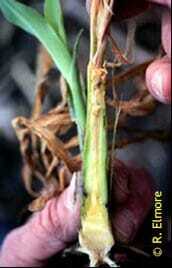
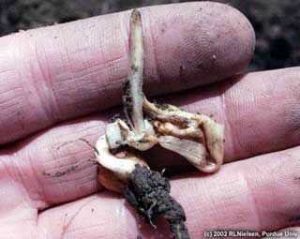
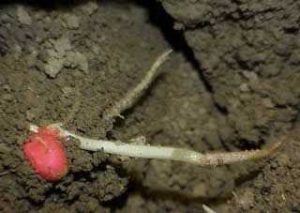
    The photo on the left shows leafing out underground due lack of energy of seedling. The photo on the right shows damage to the coleoptile that will result in shoot not having capacity to push through the soil. Photo courtesy of RL Nielsen, Purdue Univ.

    Picture 2
    Picture 3

    Freeze Damage Management

    • Wait 3 to 5 days with temps above 70 degrees, longer if lower temps.
    • Slice open emerged plants and determine percentage of population damaged.
    • Dig up un-emerged seedlings and kernel assess viability and determine percentage of population damaged.
    • If stand damage is substantial, assess the costs and benefits of leaving the stand versus replanting.

    Patience is key when assessing damage from a frost or freeze event.  If you allow time for the crop to respond to the event, you will make better decisions for that damaged field.

    Latham Seeds Agronomy Team

    May 7, 2020
    Agronomics, Corn, Crop, Emergence, Frost, Season, Spring, Weather
  • Latham Hi‑Tech Seeds

    Ask The Agronomist: Prepping The Seed Bed

    Ask The Agronomist Cover Image

    How much tillage is too much? Phil Long discusses proper seed bed preparation and the importance of protecting moisture in the ground. #AskTheAgronomist

    :20 – Welcome

    1:40 – Topic introduction

    3:00 – GDUs, rainfall averages and soil temperatures

    4:40 – Soybean germination

    5:15 – Conserving moisture in the seed bed

    6:40 – Optimal seed depth

    7:27 – Soil sealing

    10:36 – Cover crops and early termination

    11:35 – Final thoughts

    Laura Cunningham

    April 30, 2020
    #AskTheAgronomist, Agronomics, Cover Crops, Crop, Season, Soil, Soybeans, Spring
Previous Page
1 2 3 4 5 6 … 18
Next Page

Latham Hi‑Tech Seeds

131 180th Street | Alexander, IA 50420

(641) 692-3258

SIGNUP FOR OUR NEWSLETTER
  • Contact
  • Legal
  • Dealer Center
  • Seedware Login
  • Latham Gear

© 2025 Latham Hi‑Tech Seeds. All rights reserved. | Iowa Web Design by Webspec | Privacy Policy

Latham® Hi-Tech Seeds is a trademark of M.S. Technologies, L.L.C., 103 Avenue D, West Point, IA 52656.