Skip to content
Latham Hi-Tech Seeds

(641) 692-3258

  • Home
  • Performance
  • Products
    • Corn
    • Soybeans
    • Alfalfa
    • Corn Silage
    • Seed Guide
  • Find a Rep
  • Media
    • Blog
    • News
    • Videos
    • Podcasts
    • TECHTalk
  • About Us
    • Company History
    • Our Mission
    • Careers
    • Become a Rep
    • Sowing Seeds of Hope
  • Contact Us
  • Latham Hi‑Tech Seeds

    Field Notes Made Now Can Help Prioritize Fields for Harvest

    Week after week, in our Wednesday crop reports, we’ve reported the amount of rainfall that has been received from eastern Iowa to Nebraska and up to North Dakota. Continuous rainfall prolonged the planting season and made it a challenge for farmers to apply herbicides in a timely manner. Now we’re seeing the effects that wet weather has had on root development and stalk strength.

    Sunday’s wind and rain events across Latham Country caused corn to lodge in many fields. Hail damage, disease and other factors could put crop standability at risk. If this happened in your area, make notes now and take that damage into consideration as fall harvest approaches.

    Warm, moist soils are great breeding grounds for weeds and pathogens. That’s why so many farmers are considering whether to apply fungicide.  Mud that cakes on leaves and stalks from ponding or flooding encourages fungal and bacterial diseases to attack damaged plant tissue. If damage is severe enough, the plants won’t live through the growing season. That’s why farmers will be consulting their seed product guides and talking with local dealers to see on which hybrids fungicides are “highly recommended” or “recommended.”

    Knowing what has caused stalk lodging helps determine the best course of action. Four common cause of lodging include: (1) Weather, (2) Insects, (3) Diseases and (4) Other Stresses like extreme soil moisture or drought, nutrient deficiencies, and corn-on-corn rotations to name a few.

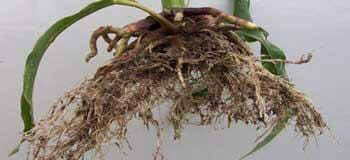
    More than anything, we’re seeing shallow roots developing as a result james downed cornof this spring’s wet weather. Saturated soils inhibit roots from developing deep into the soils. We’re also seeing poor root formation in fields that were planted too wet as soil compaction prevents roots from growing down into the soil.
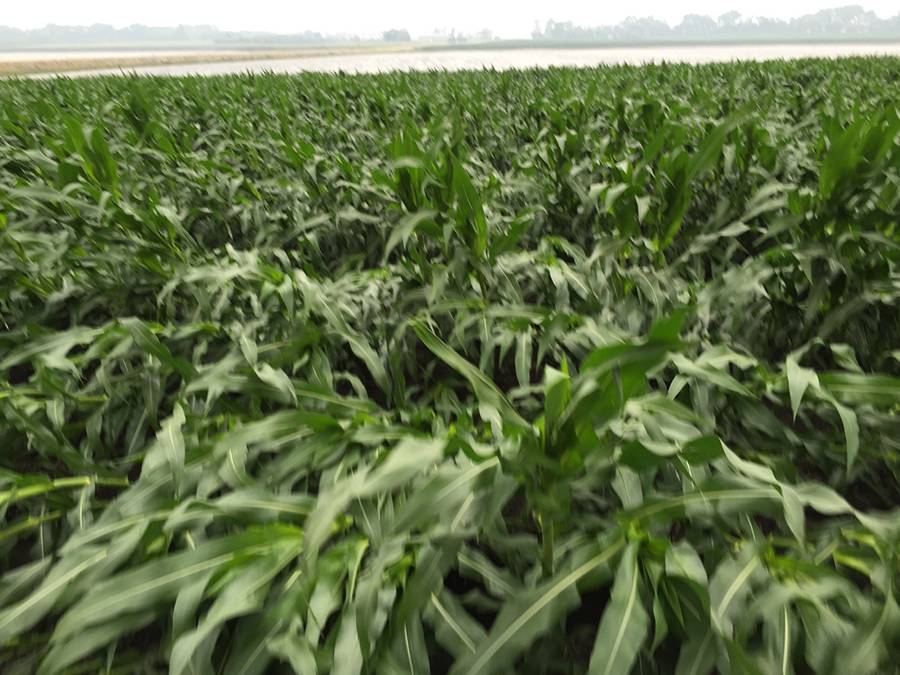
    Root function deteriorates in saturated soils, making the corn more prone to green snap and root lodging. The risk of green snap is exacerbated because right now corn plants are growing so quickly given our hot, humid environment. Weak roots also predispose these corn plants to late-season root and stalk rots. Fields will need to be monitored; during September and October, harvest-strategies may need to be modified. Careful scouting now and prioritizing fields for harvest according to condition can help prevent field losses due to low stalk quality.

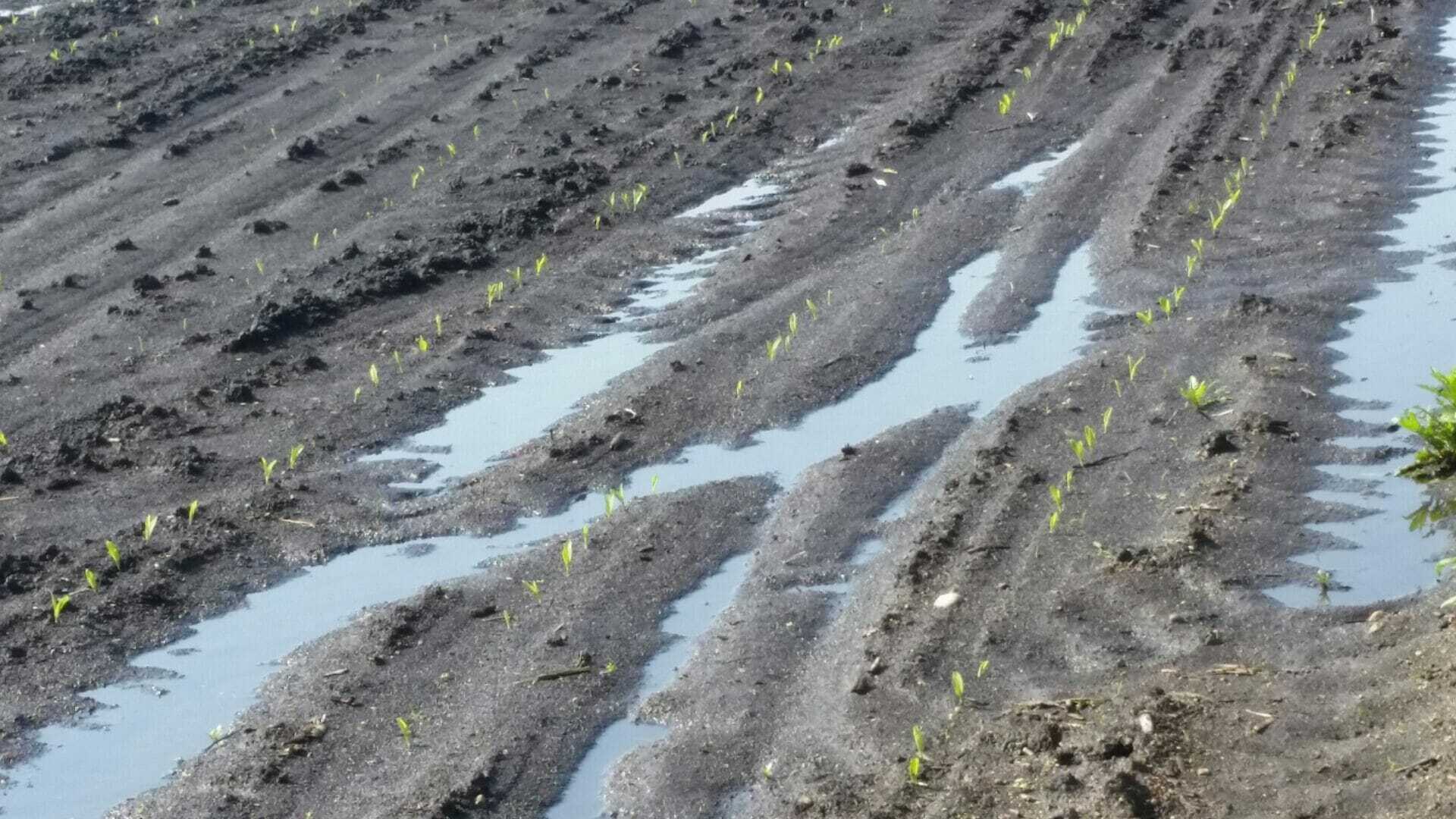
    Even before we received this last rain event, scouting was going to be more critical than ever this growing season because this crop has been stressed since seed went in the ground. Seed corn planted into wet soils is prone to problems throughout the growing season such as: stunted plant growth; slow infiltration of water and/or ponding; high surface runoff under normal or light rainfall; poor root system development, or rootless corn; and even nutrient deficiency.
    July 9, 2015
    Agronomics, General, Season, Summer
  • Latham Hi‑Tech Seeds

    Is It Worth Replanting at this Point?

    20150527 094903 resized

    Unseasonably wet, cold spring weather has lingered longer than any Midwest farmer had hoped. These conditions create stress on seed germination and on seedlings. Plus, there were reports last week of frost damage to both corn and soybean seedlings in the areas I cover. Many farmers here in the north are assessing the damage and hoping to get replants done by June 10.

    Whether farmers will replant corn or replant soybeans in earlier maturities will be determined after taking these three steps:


    1. Evaluate the current stand.  

    When evaluating the existing stand for population, only count plants that have a good chance of survival. Then, observe the uniformity across the field to decide whether replanting the entire field or portions of the field is justified. There are different stand count options to test for both corn and soybeans to perform an accurate count.

    2. Compare yield potentials.

    When judging the potential yield of the standing crop, again you should only count plants that have a good chance of survival. These tables for corn and soybeans help determine the percent of full-yield potential based on planting time.

    3. Consider various management practices. 

    Before replant occurs, remove any existing stand. Also keep in mind that most soil insecticides cannot be applied twice during the same growing season in the same location in the field.


    The decision as to whether or not a farmer should replant really comes down to individual circumstances and “local conditions.” For example, I heard about a farmer from the Fargo area who had purchased a competitors’ soybeans without seed treatment. The wet, cold spring weather caused those seeds to literally rot in the ground. Note: Seed treatments like Latham’s trademark SoyShield and SoyShield Plus give superior control of most seed and soil-borne diseases, including damping off, as well as controls early season Phytophthora.

    The germination in the particular farmer’s field mentioned above was so poor that it warrants a replant, but he’s in a precarious situation. Field conditions as of June 1 weren’t fit for planting, however, another 3 inches of rain is in the forecast this week with more precipitation likely in the 10-day forecast. If that farmer doesn’t get his crop replanted before the rain falls this week, it will most likely be another week or 10 days before he can get back in that field. Then we’re looking at a potential planting date of June 10.

    If you’re considering a replant, it’s best to be in contact with your insurance agent. I’ve heard Federal Crop and others may not pay unless the field is inspected first. Plus, farmers also need to know the final planting date that will be covered by their policies.

    The later the planting date, the better the chance we’ll have a killing frost before the crop matures. June 20-25 is a target date for switching soybean maturities in Iowa. However, our growing season is so much shorter in the north that June 4 is considered a late planting.

    On our family farm near Enderlin in Southeast North Dakota, we usually plant soybean maturities ranging from 08 to Group 1. We’ve already switched to earlier varieties and are hoping the weather will allow us to get these planted before rain brings planting to a halt again. To inquire about soybean maturities in your zone, contact me or your local Latham® representative by calling 1.877.GO.LATHAM (1.877.465.2842).

    June 4, 2015
    General, Season, Spring
  • Latham Hi‑Tech Seeds

    Uneven Corn Stands: The Why and How

    Stunted corn roots

    Lots of seed corn got planted early when temperatures were cool and moisture was abundant.  As a result, I’m hearing reports of uneven corn emergence. Some farmers are asking how to remedy the situation. Others are questioning whether they should replant portions of their fields.

    Let’s begin by explaining what causes uneven corn stands and then address whether or not anything should be done. Uneven corn stands most often are the result of these four circumstances:

    1. Improper equipment calibration/maintenance;
    2. Soil conditions at and after planting;
    3. Pests; and
    4. Poor management practices.

    At this point in the growing season, I’m going to focus on uneven stands that are a result of conditions at planting time including equipment calibration and soil conditions. Most farmers do a very good job and problems arising from equipment calibration or maintenance are few and far between.

    Problems are more often to arise when conditions for doing fieldwork and planting are good for an extended period of time.  Farmers tend to keep working until they get rained out, so they may not take time for regular equipment maintenance and calibrations if the sun shines for extended periods of time.

    Remember to check your equipment, especially your planter, before you head to the next field! Failure to maintain your planter can result in skips and doubles. University studies have found that skips are more limiting to overall yield in most situations but both can have a negative effect.

    In addition to having your equipment properly calibrated, it’s important to plant in fit soil conditions. Uneven emergence may result from soils that are either too wet or too dry. Soil moisture can differ because of varying soil types, topography and tillage practices. The difference can be seen across whole fields, in certain areas of a field, or even from one row to the next.

    Rainfall patterns leading up to planting are critical to emergence. Seeds placed in dry soil will not germinate without rainfall.  Rains that are spotty may cause uneven stands.

    Planting in soils that are too wet can cause lower germination, uneven emergence and growth, restricted root growth (as pictured), and stunted seedlings.
    Planting in soils that are too wet can cause lower germination, uneven emergence and growth, restricted root growth (as pictured), and stunted seedlings.

    On the other hand, working fields that are too wet also causes problems. Soil that is too wet will cause cloddy seedbeds, resulting in poor seed-to-soil contact and uneven emergence.

    Another concern, especially in continuous corn and no-till fields, is how residue from the previous crop will affect the current crop. Uneven distribution of residue can result in differing soil temperatures across the field, which causes plants to germinate irregularly.

    In addition, soil temperature may lead to uneven emergence. This spring a cold front caused soil temperatures to decrease after many acres of corn were planted. Look at planting when soil temps are consistently above 50° F and are expected to rise! The ideal soil temperature for planting corn is 60° F.

    To minimize the risk of uneven stands due to soil conditions, carefully monitor each field.  Check the moisture at different levels.  I like to see corn planted at 2 inches deep when conditions are optimal, but I have seen corn planted as deep as 3” without very many emergence problems. Keep in mind, the deeper you plant, the greater chance there is the seed “running out of gas” before it emerges, especially when there’s a heavy rainfall and the soil surface crusts over.

    There are many factors that can contribute to delayed emergence. So what should you do about uneven emergence? Assess if the problem really warrants remediation. Check with a trusted agronomist if you’d like another opinion.

    Rather than trying to fill in the gaps, it’s usually best to till up a field or a portion of a field prior before replanting. Click below for additional replanting resources:

    • Corn Replanting Decisions
    • Soybean Replanting Decisions


    Mark Grundmeier, Product Manager

    May 21, 2015
    Agronomics, Corn, Crop, Emergence, Season, Spring, Tech Tuesday
  • Latham Hi‑Tech Seeds

    Patience is Key at this Point in the Planting Season

    IMG 0302 e1431660505547

    Mid-May is here but there’s no need for farmers to rush into their fields to finish planting. Farmers across the Midwest are still within the time period for great yields, so there’s no need to switch crops or maturities now.

    Due to the shorter growing seasons in northern Minnesota, as well as in North and South Dakotas, farmers try to get their crops in the ground as early as possible. May 6-13 are considered optimal soybean planting dates for much of Northeast South Dakota, while early May dates are recommended for the southern areas of the state. Optimal planting dates in North Dakota range from late April to mid-May.

    Planting corn through May 15 is considered ideal in Iowa, but it sounds like almost all of the corn acres are planted across the state. For those farmers who still have some corn in the shed, there’s no need to even think about switching hybrids yet. Research shows that hybrids adjust to planting dates, so full-season corn hybrids can compensate somewhat for later plantings.

    As planting is delayed, hybrids shorten the time between planting and silking. Full-season hybrids almost always outperform short season hybrids, so Iowa State University Extension Corn Specialist Dr. Roger Elmore has said farmers really don’t need to consider switching maturities until May 25.

    Many planters are parked across much of Latham Country as measurable precipitation fell over the weekend, and rain clouds continue to hover this week. Moisture was needed to get many crops off to a good start, as well as to activate herbicides, in the north. It’s just too bad some of this precip came in the form of snow! It looks like fields will remain wet across much of the Upper Midwest this week, but sunshine and warmer temperatures are on the horizon.

    As hard as it is, be patient and wait for soils to dry before planting resumes. Planting into unfit conditions can cause lower yields than delaying planting by a few more days. Working soils that are too wet now could lead to soil compaction and have negative impacts on your crops during the growing season including: stunted plant growth; slow infiltration of water and/or ponding; high surface runoff and soil erosion under normal or light rainfall; poor root system establishment; and nutrient deficiency.

    The best rule of thumb is to let the field dry before doing fieldwork. Use a quick field test to check the soil moisture: mold a length of soil between your index finger and thumb, or roll it into a ball in your hand. Observe whether the soil breaks apart as you work it.  If you toss the ball of soil into the air and it shatters or cracks upon falling to the ground, then conditions are likely suitable for tillage or planting.


    May 14, 2015
    General, Season, Spring
  • Latham Hi‑Tech Seeds

    Check the 10-Day Forecast Before Planting

    Picture1

    Picture1The arrival of spring weather is something every Midwest farmer anticipates. Early to mid-April brought favorable conditions for fieldwork. Many local farmers finished tilling soils while others started putting seed in the ground.

    Soil temperatures across Iowa had been above the 50-degree mark, which is usually the target for corn planting to begin. However, a cold front moved in and soil temperatures have dropped a few degrees in recent days.

    Even when soil temperatures are warm enough to plant, farmers must be certain that warmer air temperatures are in the forecast.  Warmer air temperatures are critical to protect the seedlings.  If the air temperature hits 20 degrees Fahrenheit or less after germination, the young seedling can be killed with the growing point of the plant right at emergence.

    Remember, soil temperature for soybean planting is more critical than for corn. We recommend waiting until soil temperatures in a region reach – and maintain – 60 degrees Fahrenheit before soybeans are planted. Soybeans can germinate in a soil environment of about 55 degrees Fahrenheit, but if the air temperature after germination hits 28 degrees Fahrenheit or less, the young seedling can be killed with the growing point of the plant right at emergence. Adversely for corn, the growing point stays under the surface until much later.

    One more consideration before you putting seed in the ground is to make sure soils are fit. Wet soils cause trouble from the beginning and all through the growing season. Compaction resulting from wet soil can kill root growth.

    Latham Corn Product Specialists advise farmers to “take the crumble test” before reentering fields. Grab a clump of soil and watch how easily it crumbles. If it stays in a ball, conditions are NOT right for planting. If it crumbles easily, the soil is fit for planting.

    We’re well within the optimal Iowa planting dates for corn, so take the time to let fields dry if needed. There are plenty of other uncontrollable factors that determine crop yield, so why not control the ones you can?

    April 23, 2015
    General, Season, Spring
  • Latham Hi‑Tech Seeds

    Latham Corn Tops More F.I.R.S.T. Trials

    Corn latham

    John_inCornIt has been an incredibly exciting harvest season for a product guy like me! I love looking for products that work well for farmers and the specific challenges they face on their Midwest farms.

    This year the product team at Latham Hi‑Tech Seeds decided to put our lineup up against the competition in the F.I.R.S.T. Trials, an independent, third party testing service. We’ve always had a lot of confidence in our corn and soybean lineups. For years, we’ve tracked how we not only compete – but beat – national brands in our marketing footprint.

    Just like someone entering a livestock show or a team entering a basketball tournament, one never really knows what the actual performance will be at that particular time and place. All you can do is prepare and try your best. That’s what we did when we entered the F.I.R.S.T. Trials, and the results have been nothing short of amazing!

    Soybean trial results came first. Last Wednesday I wrote about how “Latham places first again and again.” I’ve never had so much fun checking my emails in the morning as I have this fall, watching test results show Latham® Hi‑Tech Soybeans at the top.

    The final total was 18 location or region summary wins for Latham brand soybeans! Unbelievable. Our soybean lineup was hitting a grand slam homerun!

    The more I thought about all of our soybean wins, however, the more anxiety I had over the corn results. I’ve known for years that our corn lineup can compete against anyone. After all, we do our own research against industry-leading products to help us choose our product lineup. Such research has given us confidence in our own lineup, yet there are still a great many farmers who are hesitant to give a “new” corn brand a try.

    LathamCornLatham® Hi‑Tech Hybrids are celebrating their tenth year, and we’ve been fortunate to grow our corn lineup for 10 straight year. Our customers have known for years that Latham has great corn, and now thanks to our performance in 2014 F.I.R.S.T. Trials, more Midwest farmers will know it!

    This week we were fortunate to win our 19th corn test – that’s one more test than our decorated soybean lineup! Eight different Latham corn products have won F.I.R.S.T. Trial locations all the way from 90 to 110 days.

    Products like LH 4097 VT2 PRO and LH 5215 VT2 PRO have absolutely dominated their area of adaptation.  Latham has had 140 Latham corn products place in the top 10 in FIRST Trial tests, which shows the strength and depth of our lineup. Plus, this broad maturity range will allow more customers to try and most importantly profit from Latham corn hybrids!

    Again, I credit Latham’s team approach to product selection for this year’s performance. Unlike the national brands that choose products based on a wide area of adaptability, we focus on choosing the best products for local conditions. Latham’s strategy to choose products that perform in specific soil types and field conditions across our marketing area works. But don’t just take my word for it… Look over all the data at www.firstseedtests.com!

    John Latham, President

    November 12, 2014
    Corn, Crop, Fall, General, Season
  • Latham Hi‑Tech Seeds

    Latham Places 1st Again & Again in F.I.R.S.T. Trials

    John Soybeans

    John-SoybeansI’ve always been very confident in the corn and soybean products that we offer at Latham Hi‑Tech Seeds. After all, when your name in literally on each bag of seed, you want to do all that you can to protect your reputation! That’s why we take a team approach to selecting products.

    Our Product Team members either farm themselves or call on farmers in the areas where they live. This means they not only review data from breeders and their own research plots, but they watch these crops grow and develop. Our corn and soybean specialists walk fields and test plots, searching for the perfect products to perform in our customer’s field conditions. As a result, they have confidence in the products that go into our lineup.

    Latham® brand products are selected for their yield potential, as well as for their ability to overcome specific regional challenges. For example: Latham’s IronCladTM Soybeans receive this unique designation for their rating on Iron Chlorosis or White Mold. Our Gladiator Corn Hybrids are selected to do yield better in corn-on-corn situations. Even Latham’s alfalfa lineup was chosen to address specific needs like high-salt soils or leaf-hopper resistance.

    To showcase our lineup, this year Latham Hi‑Tech Seeds made a much larger investment in the independent F.I.R.S.T. Trials. This third-party testing service is proving how well we compare to the competition… The results this fall have been amazing!

    Latham Hi‑Tech Seeds, to date, has won 29 different F.I.R.S.T. Trial corn and soybean locations and region summaries this fall! We’ve won 18 different soybean tests, including 5 different region summaries in Iowa, Minnesota, Wisconsin, South Dakota and Illinois.

    Eleven different Latham soybean products have won F.I.R.S.T. Trial tests from Group 0 all the way to 2.7 maturity. Many of these locations contain as many as 84 different competitive products! In the state of South Dakota alone, Latham won 6 different F.I.R.S.T. Trial Tests with 6 different Latham® Hi‑Tech Soybean products.  In the state of Minnesota, Latham L1858R2 is the top yielding soybean in any test in Minnesota, Wisconsin or the Dakotas with a yield of 82.9 bushel per acre!

    Latham brand corn is performing extremely well, too.  Tests remain to be harvested, but already Latham corn has won 11 different F.I.R.S.T. Trial locations across Iowa, Minnesota and North Dakota.  Latham LH 5215 VT2 PRO has won 5 different tests across Iowa and Minnesota PLUS it won the West Central region of Minnesota.  In the north, Latham LH 4097 VT2 PRO and Latham LH 4455 VT3 PRO together have won 4 locations so far.  In Central Iowa, Latham LH 5829 SS won the Winterset, Iowa, location at 247.9 bushels.

    So what’s the secret to Latham’s stellar product performance? Unlike the national brands that choose products based on a wide area of adaptability, we focus on choosing the best products for local conditions. Latham’s strategy to choose products that perform in specific soil types and field conditions across our marketing area works. But don’t just take my word for it… Look over all the data at www.firstseedtests.com!

    John Latham, President

    November 5, 2014
    Corn, Crop, Fall, General, Season, Soybeans
  • Latham Hi‑Tech Seeds

    Harvest Wraps Up as October Closes

    Combine 1

    combine 1With cooperative during the last week, farmers across Latham Country made tracks and covered lots of ground. Soybean harvest is nearly 100% complete in all of our territories, with many expecting to have the majority of corn out by Sunday night.

    A recent AgWeb article verifies what we’ve been hearing from our seed dealers and customers: yields have been “inconsistent” thus far. “Higher precipitation levels experienced this spring and summer has led to lighter soils, which are more apt to draining, yielding above average. Conversely, heavier soils, that are less apt to draining, have been reporting average to below average yields in those areas that experienced above average rainfall.”

    Click on this link for an update on #harvest14 progress across our six-state marketing territory: http://bit.ly/1mXS9RY

    Team Latham

    October 29, 2014
    Fall, General, Season
  • Latham Hi‑Tech Seeds

    How to Interpret Yield Data

    This fall Latham Hi‑Tech Seeds has done very well in the F.I.R.S.T. trials all over the Midwest, winning many locations and Regional Performance Summaries. With such great data, it’s no wonder that farmers want to call in and order the winners. If we’re doing our job, however, we may not let you!

    Why wouldn’t we let farmers order what they want without asking any questions? The answer is simple: Just because a product placed first in a yield trial in one location, in one year, across one predominant soil type, doesn’t guarantee it will be the yield winner given another farm and a different management style.

    When study yield results from independent yield trials, be sure to analyze the information. Here are some tips for interpreting yield data:

      • Compare to a check strip that helps you check for variability across the field. Look to see if a particular product is yielding exceptionally well or exceptionally low as compared to the plot average. How has this same product been performing across multiple locations?
      • Is there a disease that has been prevalent this year, like Sudden Death Syndrome (SDS), that you know is affecting that particular product?
      • How variable was the rainfall in that area this year? What were planting and growing conditions?

    To help you select the right seed for your given situation, we’ll ask discovery questions first to determine needs like fighting weed resistance or corn rootworm. We’ll also visit with you about our hallmark Seed-2-Soil program for crop planning and/or nutrient management to help support your product selection.

    Don’t get me wrong… Latham Hi‑Tech Seeds is thrilled with how well we’ve performed this season in third party, unbiased, independent yield trials! It is great that we can win yield trials but winning on the farm is what really counts. We want to combine our yield data – with your own farm data – to help ensure you get the best products for your acres.

    October 23, 2014
    Corn, Crop, Fall, General, Season, Soybeans
  • Latham Hi‑Tech Seeds

    Wet Weather Halts #Harvest14

    Intro 10 15

    Intro-10-15Almost 40% of Iowa’s soybean acreage was harvested during the 5 days suitable that were suitable for fieldwork last week. After we were blessed with the driest week in nearly three months, showers moved into many areas over the weekend and into this week. Between Sunday and Tuesday, one Northeast Iowa farmer reported that 4” in his rain gauge. Here in North Central Iowa, we’ve received 1.85″ inches in the past 72 hours.

    Wet weather brought #harvest14 to a halt. Corn harvest is just 10% complete, which is almost 3 weeks behind normal. Soybean harvest is just one week behind normal. The 5-day forecast for our area shows 0% chance of precipitation with breezy conditions and sunshine, so we expect harvest activity will resume soon. Click here for a harvest update by region: http://bit.ly/1mXS9RY

    Team Latham

    October 15, 2014
    Fall, General, Season
Previous Page
1 … 31 32 33 34 35 … 46
Next Page

Latham Hi‑Tech Seeds

131 180th Street | Alexander, IA 50420

(641) 692-3258

SIGNUP FOR OUR NEWSLETTER
  • Contact
  • Legal
  • Seedware Login
  • Latham Gear

© 2026 Latham Hi‑Tech Seeds. All rights reserved. | Privacy Policy

Latham® Hi-Tech Seeds is a trademark of M.S. Technologies, L.L.C., 103 Avenue D, West Point, IA 52656.