Skip to content
Latham Hi-Tech Seeds

(641) 692-3258

  • Home
  • Performance
  • Products
    • Corn
    • Soybeans
    • Soybean Blends
    • Alfalfa
    • Corn Silage
    • Seed Guide
  • Find a Rep
  • Media
    • Blog
    • News
    • Videos
    • Podcasts
    • TECHTalk
  • About Us
    • Company History
    • Our Mission
    • Careers
    • Become a Rep
    • Sowing Seeds of Hope
  • Contact Us
  • Latham Hi‑Tech Seeds

    Battle Corn Rootworm with Gladiator Hybrids

    RIB logo1

    Managing corn rootworm has become increasingly important as the number of corn-on-corn (c-on-c) acres rises.  University research data confirms the real strategy for dealing with high corn rootworm pressure is to use rootworm-traited genetics in addition to other strategies.

    Yield is often lost in c-on-c situations due to increased pressure from insects and disease, plus issues related to residue management and soil drainage.  Farmers must manage continuous corn acres differently than corn-following-soybeans.

    Helping farmers better manage their c-on-c acres is the reason Latham Hi‑Tech Seeds developed the Gladiator group of products. These products combine the best genetics and traits available in the market today to help farmers maximize yields from corn-on-corn acres.

    Latham Hi‑Tech Seeds’ 2013 product guide features 33 hybrid seed corn products with 6 different trait combinations for rootworm control in various maturities.  Last year we sold out of nearly every bag of our best corn-on-corn products, so order now while supplies last!

    We’re also pleased to offer more refuge-in-a-bag (RIB Complete) options than ever before.  If you order a Latham® Genuity® SmartStax® hybrid, you’ll receive Poncho 500 and VOTiVO for free. This is a $20 per unit value and will only be offered while supplies last!

    Contact your local Latham® representative or call 1-877-GO-LATHAM (1.877.465.2842)

    Choose your region:Iowa- Central and Eastern: Kevin MeyerIowa- North Central: Latham HeadquartersIowa- Northeast: Nick BensonIowa- Northwest: Glenn FullerIowa- Central: Nick ColemanIowa- Western: Bart PetersonIowa- Southwest: Larry KrapflMinnesota- Southeast and Iowa Northeast: Craig HaalandMinnesota- South Central and Iowa- North Central: Ryan OhrtmanMinnesota- Southwest: Greg BrandtNebraska- Eastern: John ToftNorth Dakota- Southeast: Gary GeskeSouth Dakota- Notheast: Scott StadheimSouth Dakota- Southeast: Bill EichackerWisconsin- Southwest: Steve Bailie

    John Latham, President

    November 12, 2012
    Agronomics, Corn, Crop, General, Insects
  • Latham Hi‑Tech Seeds

    Reduce Risk in 2013 with Rotation

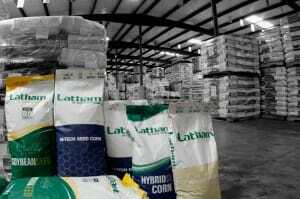
    LathamBags

    Recently, I’ve received calls from concerned farmers on a wide range of topics from volunteer corn to weed resistance and corn rootworms. There is no simple solution to these problems, but rotation is one common management practice that can certainly help.

    Consider how rotation can help with these issues:

    1. Herbicide-Resistant Weeds. Resistance to glyphosate-based herbicides (e.g. Roundup®) is due to using herbicides as the only source of weed management. Weed resistance can be significantly slowed down or even averted altogether with careful crop and herbicide use plans. Bring LibertyLink® or conventional soybeans into your rotation. Likewise, when it comes time to plant corn, use conventional or straight LibertyLink hybrids. Using herbicides that have different modes of action is critical.
    2. Volunteer Corn. With careful crop planning and herbicide usage, volunteer corn can be controlled in both corn and soybeans. Several herbicides (e.g. Select, Fusion, Poast Plus, etc.) will take care of volunteer corn in soybean fields, but persistence is key as more than one application may be needed.Volunteer corn in continuous corn situations can be managed by understanding the herbicide tolerances of the traits involved. For example, most Monsanto-traited hybrids contain only the glyphosate-resistant trait for herbicide use. If you plant corn following one of those hybrids, choose a hybrid that incorporates the LibertyLink trait. If you plan to have many years of continuous corn, stay away from hybrids that contain both the LibertyLink and the glyphosate gene for herbicide resistance. Rotating to soybeans or alfalfa also can help break that cycle.
    3. Corn Rootworm. Continued use of the same rootworm resistant (Bt) trait in corn hybrids, coupled with the lack of required refuge acres, has caused rootworm resistance to become an issue. Rotation is key. Rotate traits between Monsanto, Agrisure and Dow products. They may also need to rotate to other crops (like soybean or alfalfa) if rootworms cannot be managed by rotating traits. Additionally, the use of hybrids with more than one rootworm trait (e.g. SmartStax) may need to be used. Refuge acres must be planted, and Refuge-In-the-Bag (RIB) hybrids make compliance simple. Respect the refuge® and it will greatly increase our likelihood of keeping rootworm traits viable for years to come.

    * Respect the refuge is a registered trademark of the National Corn Growers Association

    November 8, 2012
    Agronomics, Corn, Crop, Disease, General, Soybeans, Weed Control
  • Latham Hi‑Tech Seeds

    O + D = W

    2012homecominglogo

    It’s that time of year when communities show their hometown pride by turning ot for Friday night football games.  Saturday I’ll be heading to Ames, Iowa, where I’ll be celebrating Iowa State’s 100th Homecoming – and hopefully a Cyclone victory.  Whether or not ISU gets the “W” will depend on how well they play as a team – on both sides of the fields.

    Regardless of how good a particular football team is, I’m sure you’ll agree that it can’t win on the gridiron by having only a strong offense or a strong defense. It takes both!

    The same is true whether you’re planting in a corn field or a soybean field.  Remember to plant a minimum or four different seed numbers, with a mixture of offensive and defensive traits.  You also want to make you have a mix of maturities to further reduce your risk.

    As you finalize your seed purchases for 2013, remember:

    1. Diversify your crop plan.
    2. Protect 2013 Yields with Traits.  NOTE:  Not all traited products are created equal.
    3. Respect the refuge.
    4. Plant the right trait for your situation.

    John Latham, President

    October 25, 2012
    Agronomics, Corn, Crop, Soybeans
  • Latham Hi‑Tech Seeds

    Corn Breeding: A Colorful Journey

    Through a series of weekly video blogs, Latham Forage Products Manager Corey Catt shows how corn has evolved through time. This week Corey shares how crossing dent and flint varieties has increased plant health over time. He shows how corn with purple husks and stalks is used as a marker in breeding plots, too.

    http://youtu.be/6C9cOIY3jOE

    Team Latham

    September 24, 2012
    Agriculture, Corn, Crop, General, Industry News
  • Latham Hi‑Tech Seeds

    Genetic Garden Shows How Different Types of Corn React to Drought

    Genetic Garden Shows Drought Stress1

    by Rachel Norby, Seed-2-Soil® Summer Intern

    As you drive through the countryside, it’s evident that different corn hybrids are handling the drought stress differently.  Some hybrids have stronger roots and stalks, so they’re holding up better in these dry conditions.  Other hybrids have weaker stalks and are lodging.

    Latham Hi‑Tech Seeds’ Genetic Garden shows how corn from many different eras is reacting to the drought conditions.  You can see how much better today’s hybrids can withstand the high heat and low moisture than their early ancestors.

    Genetic Garden Shows Drought Stress

    Although minimal irrigation was used to keep our “living museum of corn” alive for the Latham Country Fair on August 25, many varieties still reacted to the drought.  You’ll see lodging in many early varieties.  (NOTE:  “Early” is being used here to reference the chronological history corn of varieties, not as in the relative maturity of hybrids.)

    Open-pollinated corn varieties grown during the Dust Bowl of the 1930s didn’t pollinate then, and you’ll see the same thing happened in our Genetic Garden.  A corn variety found in the Genetic Garden from around the time of the 1988 drought is also showing signs of stress.  One of the differences in the droughts of 1988 and 2012, however, is there was less rainfall during the months of April to June in 1988 than we received in 2012.  This lack of rain during that quarter of the year meant more stress on crops during early season growth compared to this year when the majority of the stress happened around the time of pollination.

    We’d like to invite you to see the differences for yourself!  Take a walk through our “living museum of corn” on Saturday, Aug. 25, during the Latham Country Fair.  We’ll be hosting tours between 9 a.m. and 3 p.m.

    bonnie-harris

    August 13, 2012
    Agronomics, Corn, Crop, Drought, General, Industry News, Seed Technology, Weather
  • Latham Hi‑Tech Seeds

    Corn as High as an Elephant’s Eye

    RachelWithCorn1

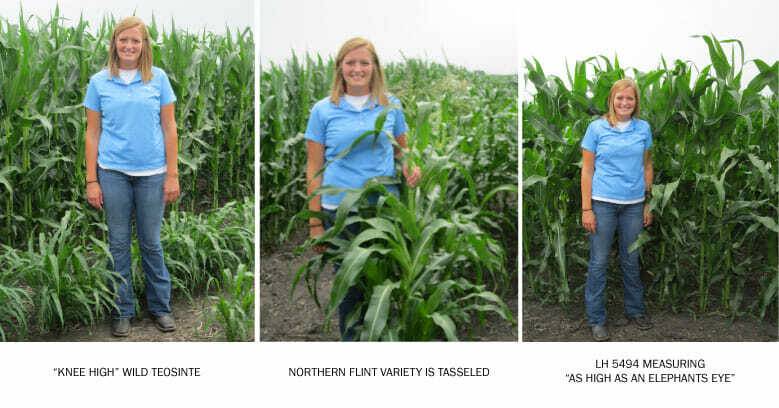
    “Knee high by the Fourth of July” was an expression used for many years by Midwest farmers, indicating their corn crop was expected to yield well if those “knee-high conditions” existed.  These days the lyrics, “The corn is as high as an elephant’s eye,” from the song Oh, What a Beautiful Morning from the 1943 musical Oklahoma! by Rodgers and Hammerstein, is more accurate.

    This year you could even describe much of the corn crop as “high as an elephant’s eye and tasseled by the Fourth of July.”  But a walk into Latham’s Genetic Garden will show you just how much corn varieties and hybrids have evolved from the 19th Century until now.

    On July 4th we saw corn plants of every size: ankle high, knee high, head high and even some that had tasseled.  Temperate teosinte, one of the first ancestors of corn, is about knee high.  Wild teosinte is measuring around knee high.  Northern flint, a red dent corn is tasseled.  Current hybrids like LH 5494 3000 GT are “as high as an elephant’s eye.”  This truly shows the evolution of hybrids at Latham Hi‑Tech Seeds.

    Many of the varieties aren’t equipped to handle the hot, humid and dry weather we have seen.  Because the weather we’ve experienced this growing season is starting to take a toll on the Genetic Garden, we’ve begun to irrigate it.

    Look to TheFieldPosition.com for continued updates on the Genetic Garden.  We’d also like to invite you to see it for yourself!  Take a walk through our “living museum of corn” on Saturday, Aug. 25, during the Latham Country Fair in Alexander, Iowa.

    bonnie-harris

    July 9, 2012
    Agronomics, Corn, Crop, General
  • Latham Hi‑Tech Seeds

    Potassium Deficiency is Growing Problem in Corn

    DeficiencySymptoms
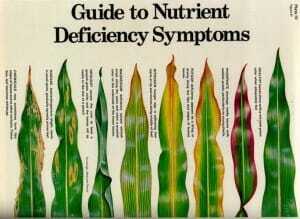
    Potassium deficiency symptoms in corn develop on the edges of older leaves, typically starting at the tip, while the new growth appears normal. (Photo courtesy of the University of Illinois Plant Clinic.)

    While walking fields recently, I’ve seen corn leaves that are yellowing around the leaf margins.  The yellowing starts at the tip of a leaf, extending along its edges to the base of the leaf.  In more severe cases, the edges are brown.

    Corn and soybeans are showing signs of potassium deficiency this growing season. Most of the potassium deficiency I’ve seen so far this season is not due to planting in too-wet soil conditions or compaction, although this certainly could be a reason in some cases.  Instead, I’m seeing more potassium deficiencies where there is an extremely dry soil surface and where root activity has been slow.  Dry conditions typically limit root growth, which explains why soils can have good levels of potassium but nutrients don’t get to the plants.  It also helps explains why, in some fields I have observed, the K deficient symptoms are occurring in the best-drained soils in the field while the more poorly drained areas look better.

    Dry surface soils express K deficiency most often.  Ridge-till, no-till situations and side wall compaction will sometimes show symptoms in dry years.  Irrigation or simply rainfall is a great way to jumpstart the root systems and help the plant develop through the K deficiency.

    It’s important to understand why if and why there is a potassium deficiency because K is an essential nutrient for plant growth that has a large impact on overall yield.  Potassium controls transpiration and respiration, as well as the uptake of certain nutrients including nitrogen and magnesium.

    Photo courtesy of www.omafra.gov.on.ca

    The type of nutrient deficiency determines soil management strategies.  Some people side-dress potash or various forms of K.  Others try foliar products.  One word of warning is that some of these products can be harmful to the plant at certain stages of growth.  A grower should select a low salt form of K and avoid anything with KCl or KSO4 for foliar applications.  A better and safer means is to address the situation by applying potassium before planting 2013.

    Walk your fields now and note where you’re seeing signs of potassium deficiency, so you can be sure to test and possible treat those areas before the 2013 crop is planted.  Another leaf tissue sample can provide helpful information, too.  You can see if there are other nutrient deficiencies in your field.  Tissue sampling is one service provided through Latham’s Seed-to-Soil program.

    Team Latham

    June 28, 2012
    Agronomics, Corn, Crop, Fertility, General
  • Latham Hi‑Tech Seeds

    Corn Rootworm in Northeast Iowa

    Corn Rootworms have arrived in Northeast Iowa nearly three weeks prior to normal years. Farmers are urged to be diligent in scouting fields and monitoring pressures in the coming weeks. For more information, tune into Nick Benson’s most recent YouTube video:

    http://youtu.be/TLNYMhaw-u4

    Team Latham

    June 24, 2012
    Agronomics, Corn, Crop, General, Insects
  • Latham Hi‑Tech Seeds

    See First-Hand How Corn Has Evolved

    RachelNorby1

    As a summer intern at Latham Hi‑Tech Seeds , one of my main projects is caring for the company’s Genetic Garden.  This isn’t your typical vegetable garden!  This garden will tell the story of how corn has evolved over time.

    Planting the Genetic Garden at Latham Hi‑Tech Seeds, with Corey Catt, Forage Specialist

    Forage Products Manager Corey Catt and I on May 18 planted more than 45 different types of corn.  Our “living timeline” features the earliest ancestor of corn, teosinte, to the industry’s latest technology in LH 5494 3000GT.

    The story of corn’s development starts with corn’s wild ancestor teosinte, but it doesn’t resemble corn as we know it.

    Hand planting was required due to the small, delicate seed of teosinte

    Further into the timeline, we’ve planted corn’s tropical ancestors including the Benz Tropical, Cargill Temperate Tropical and PIRICINCO composite varieties.

    Ancestors of our modern day corn include:

    • Varieties of Flints (including Tama Flint from the Iowa Mesquaki Native American Tribe)
    • Reid Varieties (including Osterland Reid which originates from Iowa Falls, Iowa)
    • Golden Glow and Lancaster Sure Crop.  Reid and Lancaster Sure Crop varieties are, which are open-pollinated varieties first developed by U.S. farmers in the late 19th and early 20th centuries.
    • Minnesota 13, a variety developed at the University of Minnesota in 1897.  This variety was very well adapted for a short growing season and so important that it’s now grown across Minnesota.
    • Inbred varieties such as MO 17 and B73, which are very frequently used in many crosses.
    • Farther down the line of the evolution of corn are Ukrainian Dent and Ukrainian Flint Dent varieties
    • A 4-way cross variety
    • LH 74
    • LH 85
    • Two varieties of pod corn in which the seed is covered by a thin husk.  We removed the husk before planting to insure better seed-to-soil contact and thus better germination of the seed.
    Pod Corn and husk.

    In addition to these varieties, our Genetic Garden includes some fun varieties including popcorn and Japonica Striped Maize.  Japonica Striped Maize is an ornamental corn from Japan; its leaves are striped green, yellow, white and pink, providing a rainbow sort of color display.

    Look for updates on the Genetic Garden on TheFieldPosition.com.  We’d also like to invite you to see it for yourself!  Take a walk through our “living museum of corn” on Saturday, Aug. 25, during the Latham Country Fair.

    bonnie-harris

    June 4, 2012
    Corn, Crop, General
  • Latham Hi‑Tech Seeds

    Conditions Favor Rootless Corn Syndrome

    Rootlesscorn1
    Rootless corn (left) compared to corn with normal nodal root development. Photo credited to Monsanto.

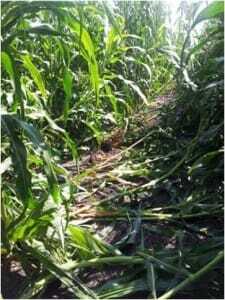
    The change from excessively wet to unusually warm, dry weather has resulted in the development of a substantial crust in fields that were previously worked and planted in late April. Obviously, a thick crust can restrict the emergence of corn and cause underground leafing. The rapid drying of the upper soil layer is also conducive for the development of the “floppy corn,” or Rootless Corn Syndrome.

    The aforementioned weather pattern may mirror situations across Latham Country this spring, but it’s actually an excerpt from an article that was originally written in May 1998 by an agronomy professor at Purdue University in Lafayette, Indiana. Dry surface soils, shallow planting depths, sidewall compaction and cloddy soils all contribute to Rootless Corn Syndrome.  Roots will take the path of least resistance, which means they might grow out the bottom of the seed furrow.

    Such corn plants are technically not root-lodged; they are simply broken over at the base of the stem near the crown area. The nodal roots will appear stubbed off but not eaten. The root tips will be dry and shriveled. For a brief description of normal corn root development, click here for  R.L. (Bob) Nielsen’s “Primer on Corn Root Development.”

    Nodal root growth may resume if more favorable temperatures and moisture conditions return to the fields exhibiting signs of Rootless Corn Syndrome. Cultivation can help by putting soil around the base of plants or aiding in new root development when it does rain.  If the ground is hard, cultivation will help with soil aeration.

    Team Latham

    May 31, 2012
    Agronomics, Corn, Crop, General, Soil
Previous Page
1 … 30 31 32 33 34 … 36
Next Page

Latham Hi‑Tech Seeds

131 180th Street | Alexander, IA 50420

(641) 692-3258

SIGNUP FOR OUR NEWSLETTER
  • Contact
  • Legal
  • Seedware Login
  • Latham Gear

© 2026 Latham Hi‑Tech Seeds. All rights reserved. | Privacy Policy

Latham® Hi-Tech Seeds is a trademark of M.S. Technologies, L.L.C., 103 Avenue D, West Point, IA 52656.