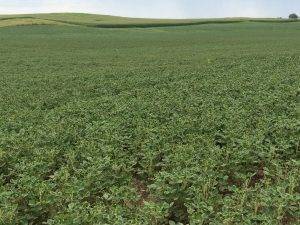
Are soybean fungicides worth it? Tune in while Phil Long discusses the benefits of soybeans fungicides and various pest pressures present in the field. #LathamSeeds
Considerations for Applying Foliar Fungicide to Soybeans
The use of foliar fungicide on soybeans during any growing season is a tough decision. There are many factors that enter into the equation like growth stage of the crop, weather, presence of diseases and history of the field.
Years ago, when fungicides were first made available for post-emergent application on soybeans, many farmers took a “shotgun approach.” Rather than scout their fields, they applied fungicide as more of an insurance against disease. We’re seeing the effects of those decisions as many diseases are becoming resistant to fungicides, especially those in the Qoi (Quinone outside inhibitor) family, commonly called the strobilurins.
Before pulling the trigger on using any foliar-applied fungicide on soybeans, I encourage farmers to walk their fields or hire a competent scout. Here are a few ideas and suggestions for the more common soybean fungal diseases that show up in Latham Country:
White Mold, or Sclerotinia Stem Rot, is widespread across our territory. Infection usually occurs at or just after the R1 (flowering) stage during periods of high humidity and temperatures below 85° Fahrenheit. Look for leaves that are starting to turn yellow after R1 but well before normal senescence should happen. Once leaves turn brown and the stem starts to develop that white, cottony growth leading to dark sclerotia (like mouse droppings) along the stems and pods, it is too late to save that plant. Research from the University of Wisconsin indicates that applications of foliar fungicides registered for use against White Mold can be helpful if applied in the R1 to R3 stage. If you miss the target window for application and the disease becomes severe, harvest that field last so you don’t spread the sclerotia to your other fields.
Septoria Brown Spot is found in most fields in Latham Country but it’s seldom the primary source of lost yield. It can, however, contribute to overall yield loss in fields where Fusarium Root Rot is a problem and when damage from Soybean Cyst Nematode is severe. Severe infestations also can occur in the early part of the season where rainfall is over-abundant. Symptoms are small, irregular-shaped spots on leaves and typically start in the lower canopy and can show up as early as V2 stage and as late as R6. Leaves that are severely infected will turn prematurely yellow and drop from the plant. If warranted, foliar fungicides can be helpful when applied at the R3 to R5 growth stage.
Frogeye Leaf Spot is caused by the Cercospora sojina fungus. Symptoms appear as small, round gray spots on the upper leaf surface with dark reddish-brown borders. Infection can occur anytime throughout the season but is most common after flowering and after periods of warm, humid weather. Check the upper canopy of plants, especially in the R3 to R6 growth stage. Iowa State researchers have shown that an application of a foliar fungicide containing two or more different active ingredients at R3 is fairly effective in reducing the severity of Frogeye Leaf Spot damage. Application of a product containing only strobilurin chemistry (Qoi) was not effective at all due to resistance.
Bob HartzlerBy Bob Hartzler, Extension Weed Scientist, ISU and
Angie Rieck-Hinz, Extension Field Agronomist, ISU
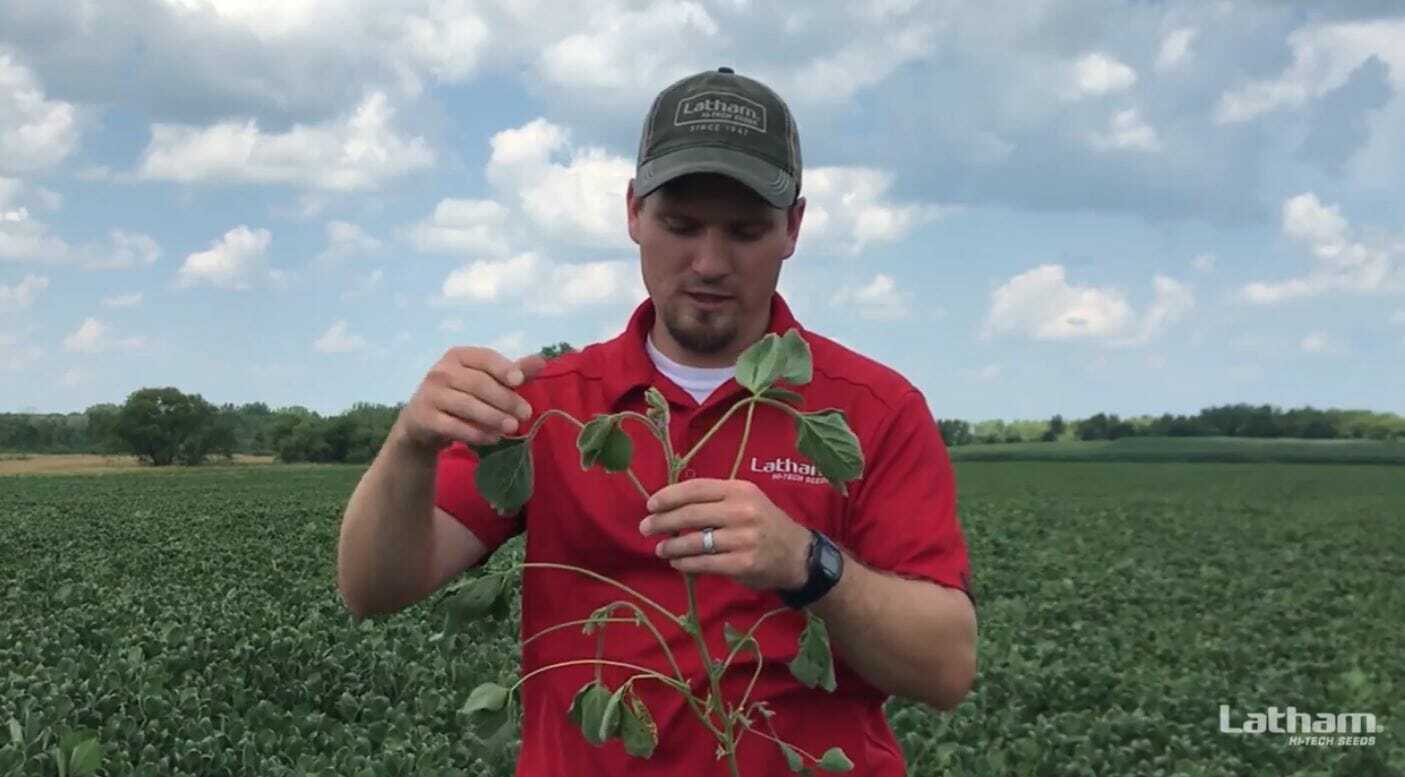
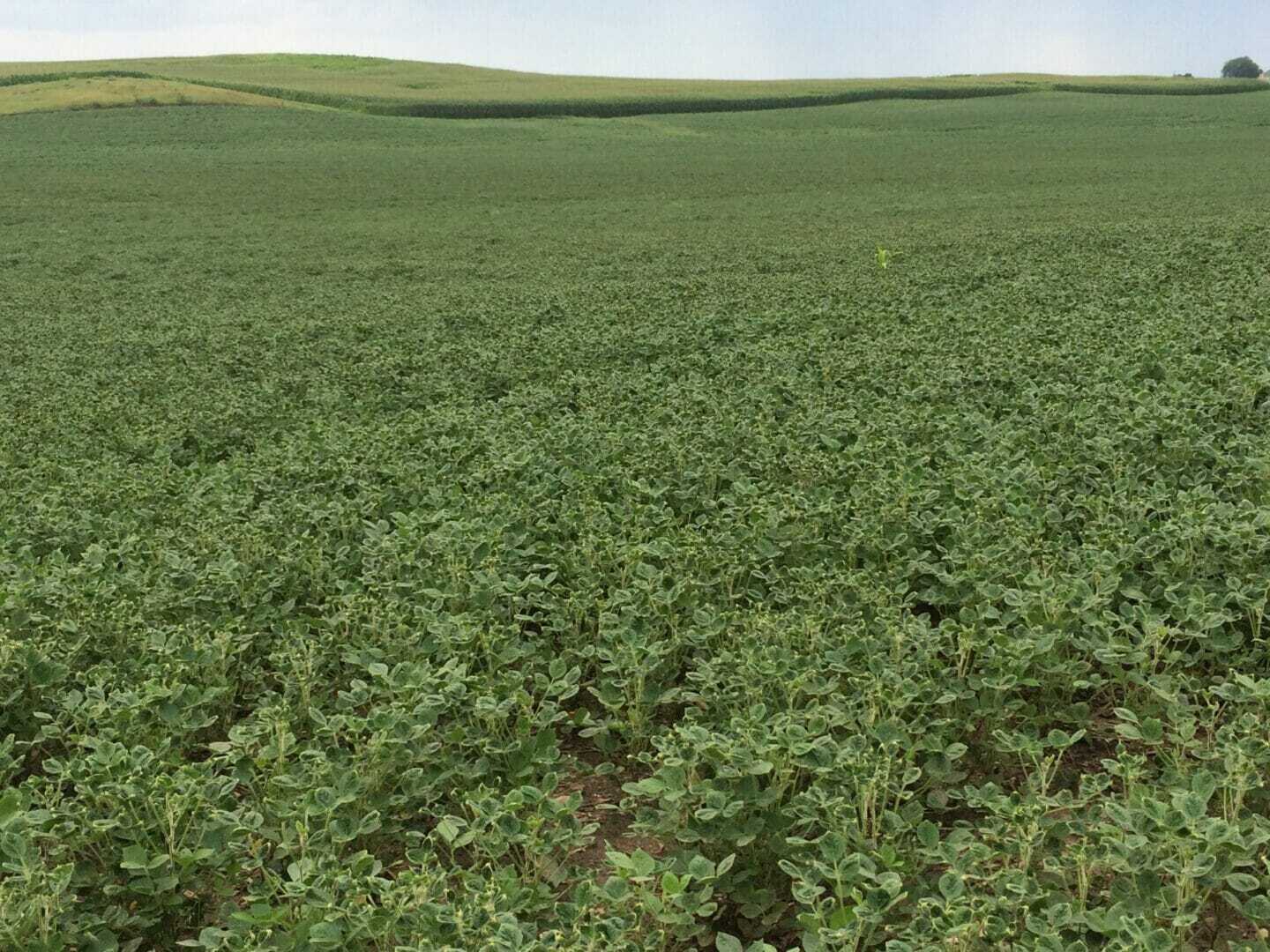
Nearly everyone agrees that dicamba injury to susceptible soybean is worse in 2020 since the introduction of dicamba-resistant soybean in 2017, and even since dicamba was first registered in the 1960s. Dicamba injury can occur from particle drift, volatilization (vapor drift), use of sprayers contaminated with dicamba residues, and movement of the herbicide with water running off treated fields. While not always easy, the first step in dealing with dicamba injury should be determining the most likely source of dicamba.
Angela Rieck-Hinz
In several areas of the state, including north central Iowa, it is apparent that volatilization of dicamba was a leading cause of soybean damage. All susceptible soybean fields in many neighborhoods were damaged, and the injury was uniform from fencerow to fencerow in many, if not most fields. When particle drift is responsible for injury, damage to soybean is usually most severe near the field sprayed with dicamba and lessens as distance from the treated field increases. If a contaminated sprayer was the source, injury typically is worse where sprayer overlaps occur and absent where skips occur in the field.
So why were problems so much greater in 2020 than the first three years of using dicamba in soybean? We believe several factors contributed to the problem. First, corn and soybean planting occurred at a near record pace – 94% and 66% of soybean were planted by May 3 in the region, resulting in the crops emerging and developing together early in the season. Dicamba use in corn has increased in recent years due to a continued spread of herbicide resistance, and in many fields dicamba applications were made later in corn than normal after earlier treatments failed to provide control. Dicamba products used in corn do not have separation or downwind application setbacks and these formulations are known to be more volatile. These factors resulted in dicamba being applied to both corn and soybean fields in an area at the same time, dramatically increasing the amount of dicamba available to move into the atmosphere.
In addition to increased dicamba use, weather conditions made it difficult to complete postemergence herbicide applications during favorable conditions. At Kanawha, in the first two weeks of June there were only 40 hours with wind speeds allowable for dicamba applications in soybean. This resulted in large amounts of dicamba being applied in a short time frame. In addition to high winds, high temperatures were common throughout June and the lack of rain left dicamba on soil and plant surfaces where they can evaporate and move off the field into adjacent areas.
The combination of increased dicamba use across the landscape and favorable conditions for volatilization led to a process that has been called atmospheric loading. Rather than dicamba moving from a single field during or after application, it is thought injury to susceptible plants is due to dicamba coming from multiple fields in an area. The quantity of dicamba leaving a single field might not have been sufficient to cause an adverse plant response, but the dicamba moving from multiple fields exceeded the threshold needed to cause injury.
What should you do if you suspect you have injury to susceptible beans, trees, gardens, horticultural crops or other susceptible plants? Your first step is to review your own herbicide use in corn and beans or weed control in road ditches to assess if you used the wrong product on the soybeans, if your use of dicamba products in your corn could have led to tank contamination that subsequently injured your beans or landscape weed control product could have injured plants. If you can rule this out, your next step is communication with your neighbor to determine if their use of dicamba could be the source. This is not always an easy task and serves as a good reminder to keep those lines of communication open. The next step is to call the Iowa Department of Agriculture and Land Stewardship’s pesticide bureau to file an “Incident Report”. The report must be filed within 60 days after the alleged date that damage occurred and before 25% of the crop is harvested. Contact the pesticide bureau at 515-281-8591.
In many situations, Extension field agronomists, retail agronomists, crop consultants and others are called to provide third-party opinions. Due to the widespread nature of this injury in 2020, it should be noted that pinpointing a source or sources may be nearly impossible.
What is the future for dicamba? Nobody knows how this year’s problems will influence dicamba availability for use in soybean in 2021. Even without the court ruling in early June that vacated registration of three of the dicamba products used in soybean, the products were up for review following granting of a second two-year probationary label for 2019-20. Bayer and other companies are continuing to evaluate new dicamba formulations with lower volatility than the current products. Hopefully EPA will announce their decision in time for people to make appropriate decisions regarding soybean traits for the 2021 growing season, but based on past history, this may not happen.
Find resources by state for dicamba damage investigation below:
This week on our #AskTheAgronomist segment we discuss corn pollination, the impacts of current plant stress and fungicide application. Watch below to learn more! #LathamSeeds
Tune in for in-season soybean scouting with Phil Long! Phil discusses the current growth stage in soybeans and why we are in a critical time for nutrient uptake. Also learn about the soybean yield potential in your field. #LathamSeeds


![BobHartzler[1]](https://www.lathamseeds.com/app/uploads/2020/07/BobHartzler1-150x150.jpg)