Friday (cont.)
The evening passed quickly as we worked our way through the Rider Handbook developed by the Motorcycle Safety Foundation (MSF). The curriculum was well written and the DVDs were well done to reiterate and compliment the lecture.
A few of the more interesting facts that I learned include:
• A person who has several close calls or near misses when driving a car may be prone to similar behavior when operating a motorcycle. (If you’ve ever seen me drive my Torrent or any other four-wheeled vehicle, you understand why this is so fascinating to me. My life somewhat flashed before my eyes!).
• To SEE is to Search for factors that might lead to risky situations; to Evaluate how the factors might interact to create risk, and to Execute an action to maintain a margin of safety.
• Head injuries account for the majority of motorcycle fatalities; helmets reduce the risk of brain injury by 67%.
• A procedure called FINE-C is used to start the engine. It stands for Fuel, Ignition, Neutral, Engine cut-off switch and Choke/Clutch. (Why didn’t anyone teach me this in high school? This would have made learning to drive a clutch so much easier!)
• Crash studies show that running off the road, usually on a curve, accounts for more than 50% of total motorcycle fatalities.
• Never kick at a dog when you’re on a motorcycle. Instead, upset the animal’s timing. Once an approaching dog is spotted, slow down and downshift. Then accelerate past the point of interception.
• Almost 50% of all riders killed have been drinking. The primary effects of alcohol are to diminish visual capabilities and alter good judgment.

 and licensed to go on the ride. Here’s Part 1 of a five-part diary I wrote during my recent motorcycle safety class.
 This article on the formation of Latham Hi‑Tech Seeds and our mission


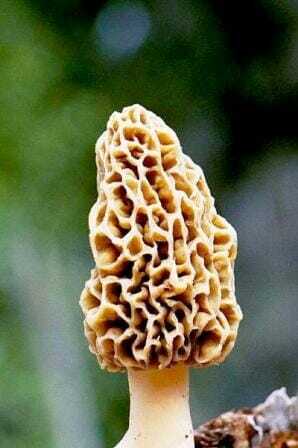
 Among my favorite mushrooms are Morels. These mushrooms can be found growing in Latham territory from approximately Mid-April to Mid-June. The best places to look for these mushrooms are in dead or dying elm trees, apple orchards, ash and poplar trees and sometimes even pine trees. What type of growing conditions are favorable for these treasured fungi you might ask? There’s no science to it, but daytime temperatures of 60 to 70 degrees with night time temps of no less than 40 degrees seem to be the sweet spot conditions in my neck of the woods. Also hunting the first warm day after a rain will promote the best chance of success.