Skip to content
Latham Hi-Tech Seeds

(641) 692-3258

  • Home
  • Performance
  • Products
    • Corn
    • Soybeans
    • Alfalfa
    • Corn Silage
    • Seed Guide
  • Find a Rep
  • Media
    • Blog
    • News
    • Videos
    • Podcasts
    • TECHTalk
  • About Us
    • Company History
    • Our Mission
    • Careers
    • Become a Rep
    • Sowing Seeds of Hope
  • Contact Us
  • Latham Hi‑Tech Seeds

    Bacon Steals the Show at #140ConfDM

    Musings of a Pig Farmer by Larry Sailer

    Bacon – yes, bacon – took center stage yesterday at the 140 Conference in Des Moines. It’s interesting how sometimes the most off-handed comment becomes the one thing that “sticks.”  Nonetheless, I’m grateful for the shout-outs and accolades that were given to this pig farmer from Franklin County, Iowa.

    I have to admit that I really wasn’t sure how my message would be received by a group of bloggers whom primarily live in urban areas like Des Moines and even Chicago.  It turns out that it was really well received! Many people spoke up in support of me and of farmers in general.  They also reaffirmed people’s desire to reconnect with food and to learn how the food actually gets from the farm to their plate.

    This is the reason I was invited to speak.  It’s also why I’ve spoken to more than 70 civic and community groups throughout the state.   I want to help demystify agriculture by starting conversations with consumers, so they can ask questions of a “real Iowa farmer.”

    With less than 2% of the population engaged in production agriculture, it seems that fewer consumers have the opportunity to talk with local farmers and get their questions answered.  I guess that’s was also part of CNN’s fascination when they introduced me last winter as “a farmer who blogs.”

    It was during our trip to Des Moines last February to serve on a panel discussion from CNN’s “The Starting Point” when Deb Brown asked me to speak at the “local” State of NOW /140 Conference she coordinated in Des Moines.  “A local conference,” I thought.  “Surely, that wouldn’t be problem after appearing live on CNN.”

    Little did I realize how just big of an event this would turn out to be!  Unlike the approximately 20 seconds that I had to talk on CNN, I had 10 minutes to talk yesterday at the 140 conference.  I also overhead someone say yesterday that this conference was broadcast live to two million people in more than 20 countries.  WOW.  I’m so glad that I didn’t hear that before I took the stage.  I’m even happier that my wife, Janice, didn’t know how big the audience would be before we got there.

    For the past two weeks, Janice kept asking me when I was going to write my speech and start practicing.  I never did actually write one, which is just as well.  There were so many great agvocates that everything I would’ve said would’ve already been said by them any way.  Ag speakers yesterday included:

    • Shannon Latham – You already know her if you’re reading this blog!
    • Darcy Maulsby – Lifelong Iowan and farm girl from Calhoun County who writes mini blogs about agriculture, business, food and gardening.
    • Heather Lilienthal – As communications specialist for the Iowa Farm Bureau Federation, she fields media calls and develops relationships that help farmers tell the story of Iowa agriculture.
    • Janice Person – Although she was born and raised in Memphis, cotton communications became the major thrust of her career.
    • Chris Chinn – She and her husband, Kevin, are 5th generation farmers.  They live with their two children on their family’s hog farm in Missouri.

    Other speakers whom I greatly enjoyed were Michael Libbie, who talked about the ROI of social media, and Gigi Belmonico and her Bombshells, who collected Purses for Panama.  (Now they’re collecting reading glasses if you’d like to donate to their cause).  Liz Nead, an inspirational speaker, had an entertaining talk about 30-day trials.  For some reason, I can only remember one of them.  As soon as you watch a video of her presentation, you’ll understand why!  Angela Maiers and other teachers talked about how NOW technology is opening their classroom doors to international experiences.  Denise Bonewitz Passehl talked about her online community helped provide support for a rare type of cancer.

    It was also interesting to note that 5 of the speakers on yesterday’s panel were raised in Geneva, Iowa, my hometown.  Considering the town has a population of about 100, it was well represented!  You’ll be able to download each speaker’s presentation in about a week.  I’ll be sure to share that link as soon as it’s available.

    Because so many folks yesterday professed their love for bacon, I thought I’d close by sharing a link to the delicious sounding recipe for Bacon-Wrapped Pork Chops.  Think I’ll light the grill tonight!

    Larry Sailer, Musings of a Pig Farmer

    April 24, 2012
    Agriculture, General, Industry News
  • Latham Hi‑Tech Seeds

    Building Partnerships, Via Twitter

    When I was introduced to Twitter, social media guru Nathan Wright from Lava Row told me that Twitter would connect me with people I should know.  “You need to be there,” my friend and former colleague urged me.  And, with some reluctance, I found myself signing up for a Twitter handle.

    I have to admit that I thought Twitter would open doors for me in places like Des Moines, Iowa, or even Minneapolis, Minnesota.  But I had no idea that Twitter would open doors for me right in my backyard – Franklin County, Iowa!

    My first encounter with a Tweep was really quite unexpected and somewhat random.  It happened in July 2010 at the Franklin County Fair.  I was checking Twitter updates on my SmartPhone during a lull in the Latham Seeds’ booth.  One of the tweets I read was by Deb Brown or @debworks.  I finally looked away from my phone and glanced at the exhibitor next to me.  Ironically, the person working in the booth next to me was none other than Deb Brown herself!

    That meeting turned out to be serendipitous since @debworks is a connector.  In less than two weeks, Deb had connected me with other local business owners who served as vendors for our first ever Latham Country Fair.

    Over the course of two years, we’ve developed a partnership that helps make a difference in Franklin County.  Our biggest collaborative effort was the Harvest Tour we hosted in October 2011.  That Harvest Tour really helped put Franklin County on the map as the attendees were bloggers like Sara Broers, Claire Celsi, Laura Gaulke, Jody Halsted, Heather Lilienthal and Jocelyn Wallace.  Their blog posts helped us gain media recognition and even paved the way for Franklin County representatives to get a live interview on CNN while it was in Des Moines covering the Iowa Caucus.  That’s huge for a county with a population of 10,540!

    The 2011 Harvest Tour is also where I first met Larry Sailer with whom I’ve since partnered on a fundraiser for the Franklin County 4-H Scholarship Endowment.  Larry and I also work together weekly as he authors “Musings of a Pig Farmer” that posts each Tuesday on Latham Seeds’ blog, TheFieldPosition.com.

    Today Larry Sailer and I are among the five Franklin County residents who will be speak today at the State of NOW conference in Des Moines.  I’m looking forward to meeting up with my fellow Franklin County Tweeps in the Capitol City.  I’m also looking forward to meeting other fellow speakers including Janice Person (@jplovescotton) and Judi Graff (@farmnwife).

    Even if you aren’t able to travel to Des Moines, you can participate in live streaming video.  Join us today for the State of NOW!

    • Click Here for the life streaming of the 2012 Des Moines State of NOW 140 Conference. (Live stream should start about 8 A.M.)
    Want to know more about the 140 State of NOW conference in Des Moines? Check out this blog written by Janice Person.

    Larry Sailer, Musings of a Pig Farmer

    April 23, 2012
    Agriculture, Industry News
  • Latham Hi‑Tech Seeds

    Leave the Kids Alone!

    Musings of a Pig Farmer
    by Larry Sailer

    The U.S. Department of Labor (DOL) is apparently moving “full steam ahead” with its plan to implement new farm youth employment guidelines.  Under the proposed rules, simple tasks like using a hand-held flashlight or even a garden hose or unloading a truck are deemed far too dangerous for a teenager.

    While the DOL has pledged to take another look at the language pertaining to a parental exemption regarding youth employment for 14 and 15 year olds, this could just be a smoke screen or a distraction from the larger issues the DOL has yet to address.  The DOL fibbed about easing up on farm youth labor regs, according to an article published yesterday by the American Agriculturist.

    The DOL has not pledged to make any changes that would allow children to work on their grandparents’ farm, their aunt and uncle’s farm, or even that a family farm that is organized as a limited liability corporation, which is commonplace today.  As a grandpa who enjoys having his grandchildren help with farm work, I’m personally concerned about the DOL’s intent to regulate work my grandkids can do on the farm.

    Sailer's grandson Devin plays in ISU's Spring Football Game.

    The strong work ethic and the can-do attitude that is developed through farm work was evident last Saturday as I watched my grandson Devin play in Iowa State University’s spring football game in Ames.  Despite having an injury and tonsillitis, that boy played with heart!  I’m very proud of Devin, and I know that kind of “toughness” is what it takes to play Division 1 football.  But, I also believe a lot of that grit and determination on the gridiron was developed through farm work.

    Devin has enjoyed spending time on our farm and helping me with pig chores from the

    Working on the farm as a child builds a strong work ethic.

    time he was a tot.  He enjoys driving the four-wheeler and farm equipment.  He comes home from college on weekends to help with planting, harvesting, and even cleaning out the hog barns.

    While watching Devin play football last Saturday, I found myself thinking about a comment made during my recent visit with Senator Tom Harkin in Washington, D.C. Sen. Harkin said he thinks the DOL needs to protect farm kids.  And if Sen. Harkin and the DOL get their

    Larry Sailer watching his grandson play football.

    way, kids like Devin would never have a chance to experience farm life.  How do bureaucrats, living in urban areas where the only green space is a park, know more about keeping kids safe on a farm than farm families?

    We cannot let misled Washington bureaucrats destroy 4-H and FFA and the way our kids learn!  Farming friends, I urge you to contact your congressmen and the DOL, so the federal government doesn’t prohibit young people from participating in agriculture – and from carrying on your family traditions.

    Larry Sailer, Musings of a Pig Farmer

    April 17, 2012
    Agriculture, General, Industry News
  • Latham Hi‑Tech Seeds

    Where Does Food Come From?

    Musings of a Pig Farmer
    by Larry Sailer

    Larry Sailer

    Over the last decade – most likely a result of fewer people being personally engaged in production agriculture – there has been a growing trend for consumers to know where their food comes from and how it was raised.  Recent food controversies have brought this issue to light once again.

    A headline in yesterday’s issue of The Des Moines Register read, “More consumers asking for details about their food.”  The article goes onto to state, “If it is meat, many want to know where the animal was raised and how it was fed. If it is produce, they want to know what, if any, chemicals were used to grow and ship it or whether a local farmer tended the fruits and vegetables on their plates.”

    As an Iowa pig farmer, I’m happy to meet with groups about how and why I raise livestock.  Talking with consumers to foster understanding is the primary reason I’m active in Operation Main Street, a speaker corps for National Pork Board, which controls pork check-off funds. Funds are raised when pork producers give a small portion of their income from selling hogs for three things: promotion, research and education.

    Operation Main Street speakers have given 5,352 speeches to 156,711 people in nearly every state. I’ve been a member of the group for five years and have given over 50 presentations to Iowa civic groups.  In just the past week, I’ve spoken with groups in Green Mountain and Waterloo, Iowa.  The folks have always been very receptive of the information and when I explain why I raise pigs the way I do they understand why I do what I do.

    It’s a lot of fun learning about many civic groups that I didn’t even know existed. (Yep, I need to get off the farm more!) A few of the groups I either have spoken or would like to speak to include: Lions Clubs International, Optimist Club, Rotary International, Kiwanis International, Civitan, Jaycees, Exchange Club, Ruritan National, Community Club, Sertoma, Ambucs, National Active and Retired Federal Employees Associations (NARFE), Chamber of Commerce, Masons, High 12 Club, Iowa Dietetic Association, veterinary schools, high school food classes.

    I’m impressed with the number of clubs that exist to do good deeds and want to hear me speak, but my job is not yet done.  As The Register says, more people than ever are taking an interest in learning where there food comes from and how it’s produced.  That means I must give a lot more speeches.  I’m looking forward to it because that also means I have more friends out there to discover!

    Larry Sailer, Musings of a Pig Farmer

    April 10, 2012
    Agriculture, General, Industry News
  • Latham Hi‑Tech Seeds

    Creating Safe Play Areas on the Farm

    Guest blog by Tracy Schlater, Marketing Director for Farm Safety 4 Just Kids

    Children are naturally curious, especially younger children. There are certainly a lot of things to be curious about on the farm, but that curiosity can unknowingly lead children into dangerous places.  A safe play area is a great way to ensure the safety of kids on the farm.

    Here are a few tips to help you establish a safe play area:

    • Separate from traffic and work areas.
    • Include easily identifiable boundaries. Fences are ideal.
    • Select an area that may be easily supervised, such as looking out a back window.
    • Keep it free from dangerous debris.
    • Provide plenty of room to run and explore.
    • Install safe and age-appropriate play equipment.
    A fence provides a terrific boundary for safe play areas. Ron and Arianne Henry of Versailles, Ohio, won a $250 Successful Farming Farm Family grant to help cover the costs.

    If you can’t fence the play area, use landmarks such as trees, bushes, a pole, or a driveway. Walk the boundary with your children. Explain that the boundary is important because it keeps them safe.  Make sure to explain the consequences of breaking the boundary rule. Keep in mind the boundary is only your first line of defense. Supervision is critical, and not just for play areas without a fence.

    Give children reasons to stay in the identified play area. Play items like swings, a sand box, or playhouse make the play area appealing to children. If the farmstead is more enticing than the designated play area, your efforts may not be effective.  A safe, outdoor play area should be located away from livestock, traffic and machinery.

    Let’s keep our next generation of rural children safe!  Celebrate Playground Safety Week, April 23-27, 2012, by taking a look around your farm and assessing what improvements can be made to create safe play areas for your children or grandchildren.   Resources to help you get started include:

    • http://www.marshfieldclinic.org/NCCRAHS/
    • www.playgroundsafety.org
    • http://www.usatoday.com/news/nation/environment/2010-04-22-EARTH_GreenPlaygrounds22_ST_N.htm

    Also keep in mind that Farm Safety 4 Just Kids awards $250 to 10 farm families to conduct safety projects on their farm.  Contact Shari Burgus, education director, for more information at fs4jk@fs4jk.org or 515-331-6506 or 800-423-5437.

    Team Latham

    April 5, 2012
    Agriculture, General, Industry News
  • Latham Hi‑Tech Seeds

    The Pig Farmer Goes to Washington

    Musings of a Pig Farmer
    by Larry Sailer

    United States Capitol

    I felt like a fish out of water while visiting a city that eats a lot of seafood!  But one thing I have learned is that we must make our voices heard in the center of government.  That’s why I traveled recently to Washington, D.C., with a group of 70 state Farm Bureau leaders and spent four days talking to our elected officials.

    You find out real fast in D.C. that everyone has an agenda and often times you don’t agree with it! I was reminded of this lesson on our second day in Beltway when we met with a group from Missouri and listened to Scott Faber from the Environmental Working Group. Although I did not buy into what Faber was trying to sell, it’s always good to listen to someone whose ideas are quite different from your own.

    Next we had a question and answer session with two Senate staffers, Joe Schultz and Tara Smith. The Senators for whom both work serve on the Senate Ag Committees, one from each party.  It was interesting hearing each party’s viewpoint on the new Farm Bill and what it might include.

    Of course, a lot of what the Farm Bill looks like depends on how much money gets appropriated to various programs.  Bill Hoagland from CIGNA met with us about the Federal budget. There’s not much to tell about that meeting as not much happening is happening there!

    Next we watched Mike Adams host a live radio show, AgriTalk Live. He interviewed U.S. Secretary of Agriculture, and Iowa native, Tom Vilsack.  We finished off Day 2 with some briefings from Farm Bureau staff on issues that we wanted to discuss with our congressmen and senators.  A few issues of particular interest to me were child farm labor, taxes, The Clean Water Act, antibiotics and animal housing.

    The next morning we loaded into buses for a tour of the Embassy of Australia.  I always enjoy learning about agriculture elsewhere, and it was very interesting to find out how and what another country is trying to get done in D.C.  We had two speakers, Dr. Chris Parker, Minister-Counsellor for Agriculture, and Cathy Raper, Minister-Counsellor or Trade.

    Over lunch in the Russell Senate Office Building, we listened to the House Ag Chairman Frank Lucas from Oklahoma.  Sen. Lucas said he thinks the Farm Bill was maybe the only bill that has much of a chance to pass before the fall elections! However, many of our group members remain doubtful.

    We split into Farm Bureau districts after that and visited the offices of our Congressmen. I was with a group that had a good visit with Congressman Latham, who is a farmer from my home county and we agree on most issues.  Later that afternoon, we visited our two Iowa Senators, Grassley (Republican) and Harkin (Democrat).   As you can imagine we heard two opposite stories!

    On our final day in D.C., we had the kind of meeting that gets you fired up!  Gail Hansen from the Pew Charitable Trust shared her views on the use of antibiotics in animal agriculture.  Dr. Rich Carvevale from the Animal Health Institute was also there with an opposing view.  This meeting gave me a lot to ponder during the plane ride home.

    Upon reflecting about my time in D.C., I realized just how slowing the wheels of change turn – especially during an election year!  We didn’t come home with any hard and fast answers as no one wants to make a mistake or even take a chance of a blemished record.  But, we did have a chance to make our voices heard and to provide them with viewpoints from the farming community.  Everyone needs to voice his or her opinion in a democracy to make the system work!

    Larry Sailer, Musings of a Pig Farmer

    April 3, 2012
    Agriculture, General, Industry News
  • Latham Hi‑Tech Seeds

    What Do Planting Intentions Mean to Your Business?

    Bill Latham, Chief Technology Officer

    by: Bill Latham

    Ever since the Prospective Plantings and Grain Stocks reports were issued last Friday, March 30, we’ve been trying to analyze the situation. Like many of you, we’re trying to decide how this news – and its impact on commodity markets – might impact our business.  This could certainly be another roller coaster of a ride!

    American farmers are expected to plant 95.9 million acres of corn this spring, which is above the market expectations of 94.7 million.  In fact, this would be the largest number of corn acres  planted since 1937, so the expected yields are multiples over the 1937 crop.  North Dakota leads the “prospective plantings report” with a amazing 1.7 million acres of increase.  Minnesota is up 600,000 acres.  Iowa is up 500,000 acres, and Nebraska up 450,000 acres.

    Barring weather problems, we’re in for a monstrous corn crop, especially with our new genetics and traits.  But there is also a lot of demand for this crop.  It’s a hungry world out there coupled with ethanol usage.  Markets seemed to absorb the news Friday with futures increases.  Even though local new crop prices at just over $5 are more than a dollar less than last season, the upside price potential may not be very good.  Even though we need to replenish supplies, this is a lot of expected corn, folks.

    The  soybean situation is quite bullish at 73.9 million acres, below the market expectations of 75.4, and the resulting market is reflecting this.  That is about 1 million acres less than last year, and experts tell us that is almost a one-to-one switch to corn acres.  One would think this would mean local new crop prices north of $13, but so much depends on other factors such as weather, South American production, world economies, currencies, etc.

    I’m always amazed and impressed with the adaptability of American farmers to react to conditions each year.  Give them a challenge, and they will make the adjustments and come through!  We’ll see what role Mother Nature plays in turning planting intentions into reality.  Thankfully, we have a full lineup of top-shelf Latham® Hi‑Tech Hybrids and Latham® Hi‑Tech Soybeans to meet your needs… even if those needs change in-season.

    Team Latham

    April 2, 2012
    Agriculture, General, Industry News
  • Latham Hi‑Tech Seeds

    “Living to Serve” Defines this Northwest Iowa Volunteer

    Icecreamtruck1

    Learning to Do, Doing to Learn, Earning to Live, Living to Serve.

    The FFA motto is comprised of just 12 short words but, when lived out, these words can make a big impact on rural communities.  Just ask Pam Fuller of Paullina, a community of 1,044 in northwest Iowa.

    Whether Pam looks for community service opportunities or whether such opportunities find her is a lot like asking, “Which came first, the chicken or the egg?”  But the bottom line is that Pam has a passion for helping others.  She has become a tireless fundraiser for high school organizations and activities in her area.  Her current priorities include fundraising for Close Up, the nation’s premier non-profit, civic education organization, and for the South O’Brien FFA Boosters, a Booster Club for the South O’Brien FFA Chapter.

    To help raise money for the Close Up students, who will spend one week of their summer in Washington, D.C., Pam started making lollipops 10 years ago.  She makes 40 different flavors in shapes ranging from snowmen and tulips to hearts and balloons.  Then she sells them at home tracks meets, as well as at home football and basketball games.  If it sounds like she’s spending lots of time in the kitchen, she is!  Pam spends about two to three hours making each batch of 50 lollipops, and last year she made over 6,500 lollipops.  The biggest sellers are cotton candy, strawberry daiquiri and strawberry-watermelon.  (If you’re ever in the area, these lollipops are a real treat!  My kids are a big fan particularly of the strawberry-watermelon ones.)

    In addition to making lollipops, Pam is currently busy planning a pancake fundraiser.  It’s become a tradition for the Southwest O’Brien FFA Alumni Board to host a free-will breakfast the day before Easter.  The menu includes pancakes, sausage and applesauce.  This is just one of three fundraisers the FFA alumni host to help support FFA members’ trips to state and national convention.  They also host a football tailgate that consists of hamburgers, chips and lemonade.  During the basketball season, they’ve become known for their succulent pork loin supper with a side of baked beans.  Today Pam is sharing their bean recipe on TheFieldPosition.

    Pam, who’s a full-time substitute teacher during the school year, doesn’t take off summers from fundraising or working with high school youth.  She and students involved with the Close Up program run a concession stand at the O’Brien County Fair.  In addition to organizing the concession stand, Pam sells ice cream on the fairgrounds.

    The Ice Cream Truck had become a fixture at the O’Brien County Fairgrounds after 25 years.  So when the proprietors decided to retire, Glenn (Pam’s husband) saw it as an opportunity to keep the tradition alive.  He bought the 1962 Chevy ice cream truck in 2009, and Pam started selling ice cream at the 2009 county fair.  Her product offerings include soft serve chocolate and vanilla cones, sundaes and ice cream sandwiches, homemade chocolate chip cookies, plus Wizzards, which are similar to a Dairy Queen® Blizzard®.  Pam also bought a smoothie maker and a sno-cone maker, and at the 2011 county fair, sno-cone sales topped her ice cream sales.

    Year-round Pam serves her community in various ways.  She’s active on church committees and launders and fits the school’s band and chorus uniforms.  Early each morning she delivers the Sioux City Journal – and has done so for 31 years!

    Pam and Glenn also enjoy spending time with their six children and nine grandchildren.  This year they’re hosting two exchange students, one from the Czech Republic and one from Venezuela.  It’s no wonder this family knows how to cook for a crowd!  Perhaps their recipe for Big Batch Baked Beans is just what you need when your family gathers soon to celebrate Easter or reunites this summer.  Pair it with Big Batch Brownies and you will easily be able to feed a small army.

    Team Latham

    March 31, 2012
    Agriculture, General, Industry News
  • Latham Hi‑Tech Seeds

    Celebrating 4-H During Extension & Outreach Week

    Photo courtesy of AgriNews.com

    Musings of a Pig Farmer
    by Larry Sailer

    Today Iowa Gov. Terry Branstad will officially sign a proclamation, declaring March 25-31 as Iowa State University Extension and Outreach Week.  Last year about 1.8 million people, including almost 94,000 youth, benefited from ISU Extension and Outreach educational programs.

    One of the strongest and largest Extension programs benefitting youth is 4-H.  4-H youth programs provide opportunities for youth to develop skills they can use now and throughout their life.

    As someone who has farmed for 50 years, I can attest to the value of learning life skills as a youngster.  Life skills are abilities individuals can learn that will help them to be successful in living a productive and satisfying life.  Goal setting, problem management, resiliency are just a few examples of the skills that have come into play as I’ve raised row crops, hogs and a family in rural Franklin County, Iowa.

    My great grandfather bought our home farm in 1904.  When his oldest daughter got married, he moved to the farm where I grew up.  He kept meticulous notes and passed down his love of the land.  You might say that farming is in my blood; it seemed only natural when I bought my first pigs in 1966 when I was a freshman in high school.  Those pigs were my FFA project for four years and helped open the door to farming.

    I bought my farm in 1972, which was a boom time for agriculture.  I was up to 1,000 acres when the 1980s Farm Crisis hit.  I lost 700 acres of land that I was renting when my lender refused to let me pay more than $80 per acre for rent, and even in those days, that was far below the going rate.

    To make ends meet, I turned my attention from raising crops to raising buildings.  I started my own construction company and became a subcontractor.  I traveled 10 states, putting up hog buildings.  That meant my wife, Janice, and our five children had to run the farm and pigs to feed while I was on the road.

    Our kids developed a strong work ethic and learned to take responsibility from a young age.  Through their involvement in 4-H, they also developed life skills.  As much as they hated doing the paperwork, their 4-H projects helped them understand the importance of keeping good records.  I know their 4-H experiences helped them become successful in their jobs today.

    And that’s why, during Extension & Outreach Week, I’d like to give a shout-out to the thousands of people who volunteer their time to help guide the next generation of state leaders and life-long learners.  Almost 10,000 volunteers guide 4-H members in becoming productive citizens, outstanding communicators, effective leaders, and successful learners. In a recent survey, one Iowa volunteer shared:

    “I feel a great sense of excitement and pride when youth accomplish something they never thought they could do. It is wonderful to see kids work through a project and feel proud of what they can do. This keeps me volunteering in school and church, as well as the 4-H program. I believe youth can be encouraged to do great things.”

    You can help encourage youth to get things by getting involved in your local communities.  In celebration of 100 years of the 4-H program and of Extension and Outreach Week, Franklin County Extension is trying to get 100 “likes” on its Facebook page.  I “like” Franklin County Extension and hope you will, too!

    Larry Sailer, Musings of a Pig Farmer

    March 27, 2012
    Agriculture, General, Industry News
  • Latham Hi‑Tech Seeds

    ISU Students Study Soils & Crops in Costa Rica

    Rachel Norby

    Guest blog post by Rachel Norby

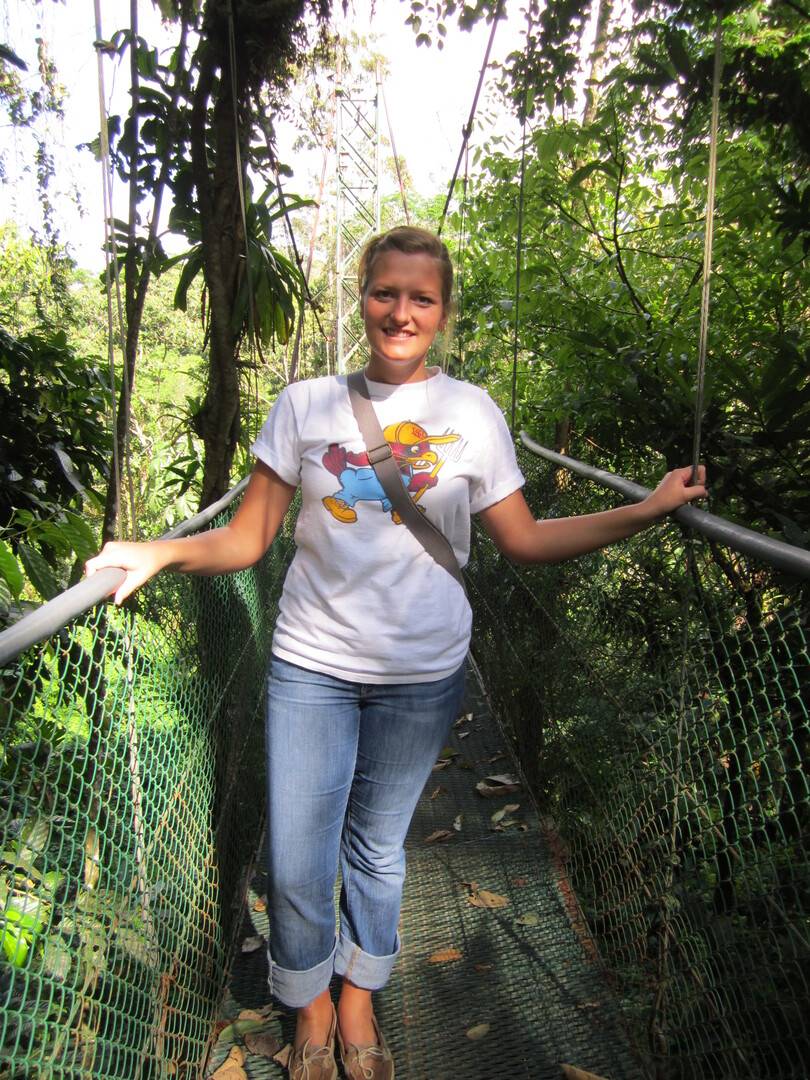
    Rachel Norby, who will intern this summer with Latham Hi‑Tech Seeds, spent Spring Break learning about agriculture in Costa Rica. Get a glimpse of the people she met and the places she visited as you read a daily account of her journey. Click here for Part I of her travels.  Today she shares Part II.

    Monday, March 12

    After stopping in a local town to visit a farm supply store, where the main purchase by my fellow students was machetes, we departed Sarapiqui for the La Corsicana Pineapple plantation.  The variety of pineapple that is grown in Costa Rica originates from Hawaii.

    Upon arriving at the plantation, we loaded onto a sun-shaded wagon and headed into the fields to see the different stages of production.  We first saw an empty field that had recently been plowed under; this area had very sandy soils which are perfect for growing pineapple.  They use a raised bed system to grow the pineapple and also drainage ditches to carry water away from the plants.  Our next stop was a field where a worker was planting roots and shoots from the previously harvested plants to start a new field.

    A worker at La Corsicana Pineapple plantation plants the roots and shoots from previous crops.

    There were acres upon acres of pineapple.  La Corsicana Pineapple plantation has around 3,000 acres of pineapple with an average yield of 2,200 pineapples per acre.

    Our guide picked many fresh pineapples from the field for us to taste and also taught us the correct way to choose a pineapple in the store.  Many people think a ripe pineapple should dent when a fingernail is pushed into the bottom or that it should smell sweet, but all these techniques were proved wrong by an expert in the pineapple industry.

    There are three characteristics to look for when choosing a pineapple:

    1. The fruit should have a big green crown on top;
    2.  The eyes, or skin on the pineapple, should be large and symmetrical; and
    3. The bottom of the pineapple should be golden in color.

    After seeing the fruit in the fields, we were taken to the packing plant where we saw workers wash, sort and box the fruits to be sent all around the world.

    In the afternoon, we visited La Tirimbina Reserve where we toured the rain forest and also learned how indigenous people made chocolate from the cocoa plant.

    Tuesday, March 13

    We were supposed to travel north from the La Fortuna to the city of Los Chiles which is near the Nicaraguan border to visit a citrus farm.  Due to heavy rains in the area, we visited a local citrus farm, TicoFrut.  There we met with the farm manager and were able to see the orange trees at the plantation.

    Citrus production is an important part of Costa Rican agriculture.  Nearly 20,000 hectares, or 50,000 acres, of orange trees are grown here.

    In the afternoon we were able were able to zip-line through the rainforest canopy.  The views into the canopy were amazing.

    Wednesday, March 14

    Today we departed to the Pacific coast and visited the farm of Carlos Rodríguez.  Carlos received his master’s degree in Plant Pathology from Iowa State University.  He has a 180-cow dairy herd and also raises corn, sorghum and soybeans as forage crops.

    The soybean plot on Carlos’ farm is one of the only in the entire country.  The variety he is growing was developed under the research of our hosting professor, Dr. Enrique Villalobos.  I wish I would have been able to get a picture of the shocked looks on our faces when Carlos told us the soybeans were maturity group 12!

    The Rodríguez farm is located at sea level, on some of the only flat land that we saw.  The climate was starting to get more tropical, and you could tell we were getting closer to the coast.  The humidity felt like the middle of a corn field in July!

    We were told the feed rations for the dairy cows was mainly sorghum silage, dried distillers

    Carlos Rodríguez checks his soybeans, which are in a test plot for the Universidad de Costa Rica.

    grains, waste melons, orange peels and pineapple peels.  Since the farm is located near the coast, distillers grains are easier to ship in from the United States.  Carlos pays double what they would cost for us here in Iowa.

    As we approached the farm, fields of melons such as cantaloupe and honey dew lined the roads.  Carlos explained that the company needs to get rid of those melons that don’t meet standards for selling.  He’s able to help dispose of them as an energy source in his feed rations.  The orange and pineapple peels also come from processing plants in the area.

    Following the tour, we spent the afternoon swimming and relaxing at Jacó Beach.  We also watched a beautiful sunset over the Pacific Ocean.

    Thursday, March 15

    We followed the coast south to the town of Parrita where we visited CoopeCalifornia, a local palm oil cooperative.  Costa Rica has approximately 60,000 hectares, or 150,000 acres, of oil palms.

    Before the trees are planted in the plantation, they start in a green house for one year.  The trees are then transplanted in the fields, and only reach around one meter of growth in the first three years.  These short trees make for easy harvest.  The trees in the plantation are cut and replanted after 20 years of production because they reach heights that make harvesting difficult.

    Trying to cut the oil palm bunch down from the tree.

    The bunch or fruit that is harvested from the tree weighs about 20 kilograms, or 45 pounds.  The workers at the farm use a tool with an extendable handle that has an extremely sharp blade on the end.  Due to the extreme heat and humidity in the area, they only work in the fields from 6 a.m. until noon.  During this short time they are able to harvest over 100 bunches.  We tried to harvest the oil palm bunches, and I quickly realized how hard it actually is!

    After the tour we began our travels back to the San Jose area.  We ended the day close to the airport, so we could be ready for our early morning departure on March 16.  It was bittersweet leaving Costa Rica and returning to Iowa as this was truly a once-in-a-lifetime experience.  Our group had so many opportunities to learn about agriculture in Costa Rica.  Special thanks to Dr. Lee Burras, professor from Iowa State University, for a memorable and educational class!

    Team Latham

    March 26, 2012
    Agriculture, General, Industry News
Previous Page
1 … 67 68 69 70 71 … 95
Next Page

Latham Hi‑Tech Seeds

131 180th Street | Alexander, IA 50420

(641) 692-3258

SIGNUP FOR OUR NEWSLETTER
  • Contact
  • Legal
  • Seedware Login
  • Latham Gear

© 2026 Latham Hi‑Tech Seeds. All rights reserved. | Privacy Policy

Latham® Hi-Tech Seeds is a trademark of M.S. Technologies, L.L.C., 103 Avenue D, West Point, IA 52656.