Franklin County 4-H to Hold Pancake Breakfast July 17
WHO: Everyone!
WHAT: Pancake breakfast
WHEN: Sunday, July 17, 2011, from 7:30 to 10:30 a.m.
WHERE: 4-H Food Stand on the Franklin County Fairgrounds
Help support the Franklin County 4-H Scholarship Endowment! All are invited to enjoy food and fellowship during a pancake breakfast presented by Franklin County 4-H.
Free will donations will be accepted to support the youth scholarship endowment fund.
We at Latham Hi‑Tech Seeds wish all of you a Happy and safe 4th of July holiday. We’re proud to be Americans, and thank all soldiers and veterans for fighting for the freedoms we get to enjoy everyday. God Bless the USA!
One reason I’m still celebrating “June Dairy Month” on the first of July is because I want to savor as much of summer as I can. (It seems like the summer passes too quickly once we’ve celebrated the Fourth of July.) Another reason that I’m featuring dairy recipes today is because they will make it easy to entertain guests over the holiday weekend.
Whether you’re planning to celebrate this weekend with a group of 4 or 40, TheFieldPosition.com has the perfect dessert for you! This quick, easy Chocolate Mousse recipe is a cool treat on a hot summer’s day for a Party of 4. The Buster Bar Dessert easily feeds 12 people, while Brownies in a Roaster serves 40.
May you and your family enjoy a safe and fun holiday weekend as you celebrate our nation’s independence and pay tribute to those who have fought for our freedom! From patriotic printables to celebratory centerpieces and hand-made parade wear, FamilyFun offers dozens of craft and game ideas for kids of all ages.
If the weather cooperates, our family will spend as much of the weekend outdoors as possible. We’ll golf, swim, bike and, of course, watch the fireworks.
What’s your favorite way to celebrate the Fourth of July?
Buster Bar Dessert
Ingredients:
1 package of Oreo® cookies
2 c. powered sugar
1 can evaporated milk
1½ sticks margarine or butter
¾ c. chocolate chips
1½ cups Spanish peanuts
½ gallon of vanilla ice cream, softened
Directions:
Crush Oreos and then stir in melted margarine. Pat mixture into 9×13 pan. Set aside.
Mix together powdered sugar, evaporated milk, 1 stick margarine and chocolate chips.
Then boil these four ingredients for 8 minutes, stirring constantly. Let the mixture cool completely.
Meanwhile, sprinkle ¾ c. Spanish peanuts over the Oreo crust. Then slice ice cream over the nuts. Sprinkle ¾ c. Spanish peanuts over the ice cream. Then pour the cooled chocolate sauce on top and place in the freezer.
COOK’S TIP: This dessert is also festive during the holidays. Use the holiday Oreo cookies with peppermint ice cream.
Ames, Iowa company to help small farmers in Africa
Daniel Krohn
Guest blog by:
Daniel Krohn
Sustainability Lead,
Becker Underwood
Becker Underwood located in Ames, Iowa, is a leading-edge developer of biological and specialty products, including seed colorants and polymers, inoculants, beneficial nematodes, mulch and turf colorants and a wide range of agricultural and horticultural solutions. The core of our business is based on increasing agricultural yields by utilizing biologically-based products, with high efficacy, but with low environmental and social impact. All while playing a role in feeding a growing global population.
In 2008, we set out on a mission to address sustainability throughout all of our business practices. Earlier this year we implemented our sustainability strategy, “NET positive,” a goal that Becker Underwood – through its processes, products and policies – has an overall positive impact on the environment and society.
One of our major projects has been our partnership with Iowa State University and the Gates Foundation to help small farmers in Africa by providing them with sustainable biological products that will help improve their yields through inoculation.
The soil conditions in these countries are one of the many hurdles these farmers face. Low amounts of phosphorus and nitrogen in the soil, in addition to extremely dry conditions, are challenges that must be overcome in order for optimal crop growth. Our introduction of inoculates to the land, while not a common practice, allows for more available nitrogen in the soil. Seventy-nine percent of the air we breathe is made of nitrogen and inoculated legumes are able to convert and use this nitrogren. The nitrogen provided by inoculated legumes grown in rotation with other crops helps boost yield and lower fertilizer costs of crops such as corn or small grains, all in an environmentally safe manner. It is our goal, with this process, to double bean production in these areas.
To learn more about ISU’s Center for Sustainable Rural Livelihoods program in Africa, watch this video. To learn more about Becker Underwood’s sustainability initiatives visit our website, www.sustainbu.com.
A recent article in Wallaces Farmer highlighted the benefits growers can receive from using Twitter. It highlighted the fact that even those growers who don’t wish to create content can receive benefits from the site’s 140-character messages by searching for terms or phrases that connect them with relevant information in the industry. For instance, this year farmers are sharing growing information with each other using the term #plant11.
Des Moines recently hosted the state’s first 140 Character Conference, which featured businesses and individuals who are using Twitter’s 140 characters in influential ways. Among the presenters were a few of Iowa’s agriculture voices, who are using Twitter to connect with those in agriculture, tell their company’s story and advocate for agriculture. I was proud to be among the group, sharing information about why we think it’s important to connect with our customers via our blog, Twitter and Facebook accounts to provide them with relevant information that can help them in their fields. I was honored to join the influential individuals below.
Tara Litzenbeger (@johndeeretara), Communications Manager at John Deere, is a well-known online voice in agriculture. She makes social media conversation for a large company look easy. At the recent #140 conference, Tara shared her unique experience behind social media marketing for a company with more than 55,000 employees working out of approximately 60 facilities in 20 countries.
Nathan Wright (@nathantwright) is founder of Lava Row, a social media consulting, strategy and education firm. He provides practical, how-to guidance for individuals and companies looking to connect in a relevant way using social media.
Click here to watch videos of the Des Moines 140 conference speakers.
In addition to the practical benefits of social media connections for both companies and growers, individuals in agriculture who get involved in social media and tell the story of their farm and modern food production are becoming a part of an even larger movement — agvocacy. With less than two percent of world’s population living on or near a farm, each generation’s understanding of how their food goes from farm to plate becomes more disconnected.
It’s never been more important for those of us in food production to agvocate — to tell the story of modern agriculture and remind people that a modern farm is nearly always a family farm. We also need to explain that modern ag practices are developed not only to improve the efficiencies in food production but to improve our quality of life, animal care, as well as the quality of our land, water and air.
I encourage you to get involved advocating for agriculture today. I’ve been so inspired by those farm families sharing with us their stories — and recipes — for our Friday blog posts. I can’t wait to meet more of our customers’ families and hear their stories.
If you’re interested in getting involved using social media, I recommend taking a look at a few of those blogs on our blog roll to the right who are doing a great job of telling their stories. If you’re already involved, I would love to hear how you’re sharing your farm story with consumers.
Grass grows green for this southwestern Wisconsin dairyman on the hillside, but it certainly doesn’t grow under his feet!
The motto, “We get ‘er done fast,” is printed on Dean Paulson’s customized shirt, and there’s good reason for it. He’s got things to do, people to see, and places to go.
Dean is the third generation to raise dairy cattle on his family’s farm near Belmont. When he graduated from high school in 1996, Dean bought 20 milk cows and added them his father’s herd of 75. The two milked for about seven years in a double-five parlor before they started expanding. Today the Paulsons milk 350 cows. They fatten 200 Holstein steers each year and have an average of 60 calves on milk at all times. In addition, they have a custom hay business plus raise corn and soybeans.
“I really enjoy the challenge of operating a dairy farm,” says Dean. “I enjoy being outdoors. I enjoy working with animals and am intrigued with animal productivity.”
Duane Paulsen helps daily on the farm
Dean’s dad, Duane, stepped down from managing the dairy in 2000, but he didn’t step away from the business. He still comes to work before sun up every morning and works as many hours as he ever did.
“My dad loves fixing equipment and doing maintenance. Those aren’t things I enjoy, so our arrangement works out well,” says Dean. “Dad gets a lot of help from my father-in-law, Jim Reiter, who joined our operation in 2007. The two of them really get along, so they often work on projects together.”
In addition to the three family members, Paulson Farms LLC supports three, full-time employees. One employee is primarily responsible for milking, one grinds feed and the other cares for the calves.
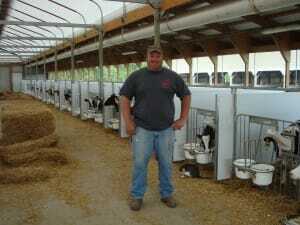
The Paulsons built a calf nursery in the spring of 2010, and Deans says it’s the best investment they’ve made in the past 10 years. Death loss decreased dramatically once the calves had a facility that was built – not retrofitted – for them. Ventilation is much better, especially in the heart of winter and the heat of summer.
Calf and “barn help” pose for a photo in the Paulsen Nursery.
This nursery is just one step the Paulsons have taken to grow their dairy over the past decade. They also expanded their parlor to a double-12. Their cows went through this new parlor for the first time on Dec. 15, 2007, only to have it burn to the ground on Jan. 1, 2009.
Fighting a fire isn’t the way anyone would choose to start off a new year, but true to their motto, the Paulsons rebuilt as soon as possible. Fortunately, the cement of the parlor wasn’t damaged. Their contractor put all of his crews on the job and, within three months, the Paulsons were again milking on their home farm in a new double-12 parlor.
Just 14 months after the new parlor was built, the Paulsons completed a free-style barn. The timing of this project couldn’t have been better as Dean’s uncle in Illinois was looking to move his herd. Two weeks after the free-style barn was complete, Dean moved in his uncles’ cows.
With so many projects underway at a time – and with so many decisions to be made on a daily basis –Dean needs a seed company to deliver more than just seed.
“I really like that Steve Bailie (Latham’s regional sales manager) talked with me about my operation and my ground before he ever tried to sell me seed,” says Dean. “Steve knows where to place Latham’s products and how to manage them for maximum performance. He has the crop expertise that I need.”
Running a diversified operation means Dean forms strategic partnerships and relies on specialists. He also understands the importance of helping support the products he produces, and that’s why dairy foods are a staple in his household. Dean, and his wife, Jessica, are the proud parents of two sons: Tanner, 7, and Trenton, 3. Jessica also works off-farm as branch manager for a local bank.
One of the family’s favorite desserts is Double Chocolate Brownies with cream cheese frosting that Dean’s mom, Dolores, likes to make. This recipe sounds so rich and delicious that I can’t wait to try it. Lucky for me, I already have the ingredients on hand!
Guest blog by Chad Huyser, Director – Sales & Operations, Lely USA.
It goes without saying that farmers in all food production industries work hard year-round, helping to feed our hungry world. The need to more efficiently feed such a rapidly growing population is driving innovation. The evolution in technologies that we use today to care for our livestock and to keep our crops safe is forever-changing the face of modern agriculture.
At Lely, we’re dedicated to providing dairy producers with tools to better manage their herds, including solutions that help increase herd health and improve milk quality. The Lely Astronaut, for instance, allows dairy farmers to milk their herd automatically, which gives them the freedom to spend time with family or focus on other aspects of their operation. It’s because of this that we, at Lely, believe that robotic milking is changing more than the way producers milk their cows. It’s changing the way producers live their lives.
Ten years ago, the Knigge family became the first dairy producers in the U.S. to install robotic milkers on their operation. Hear their story in the video below.
As you know, June is Dairy Month and to celebrate, a number of dairy producers host events to connect with their communities and tell the story of modern dairy. A member of our “Lely Family,” Ehrhardt Dairy Farm, from Monona, Iowa, recently held an Open House inviting the community to see their robotic dairy operation in action. Meet the Ehrhardt’s below.
Another member of the “Lely Family,” Nor-Bert Farms, in Bremen, Indiana, will open their doors June 18 to serve guests a free brunch and provide tours of their robotic dairy farm.
Today, in honor of June Dairy Month, I invite you to raise a glass of milk in honor of the many dairy farmers who provide safe and nutritious milk and dairy products.
More about Lely USA
Since 1948, the Lely brand has played a major role in the advancement of farm equipment, both in America and around the world. From the invention of the ground-driven wheel rake in the 1940s to today’s revolutionary Astronaut robotic milking system, Lely has always worked hard to recognize and anticipate the needs of the dairy farmer. The Astronaut is the latest Lely innovation, developed to enhance productivity, reduce overall operating costs and increase profitability through better herd management.
More information about Lely dairy industry innovations is available at Lely’s website, www.lely.com, or by calling 1-866-LELYUSA. You can also visit Lely’s Facebook page, Twitter page, blog or YouTube page.
Growth Has Been This Dairyman’s Goal Since Childhood
Growing up on a century farm near Lancaster, Wisconsin, Josh Bailie learned the value of hard work and determination at a young age. He’s been milking ever since he could reach the pipeline, which was in sixth grade at the age of 12. And, it’s all he’s ever wanted to do.
“I’ve always wanted to be a dairy farmer. It’s just in my blood!” says this third generation dairyman, with a grin that stretches as far as the meadow behind his milk house.
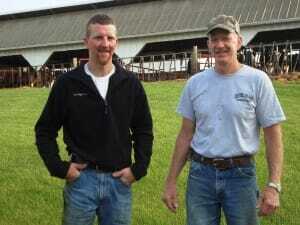
Josh and Terry Bailie pose for a quick photo after morning milking.
Josh bought his own milk cows nearly three years ago when his dad decided he wanted to step back from day-to-day farm management. Today Josh farms in partnership with his parents, Terry and Sue Bailie, and milks on their home place. Although they help each other as needed, they each have their own areas of responsibility: Terry focuses more on crop production and Josh manages the dairy. Sue lends a helping hand in each aspect of the operation.
In addition to milking about 60 Holstein cows, the Bailies have a 60- to 80-head mostly Hereford beef operation. Their Holstein bull calves also become part of the beef operation, while the heifer calves become replacements in their dairy herd.
“I’m thankful for the opportunity to be part of my family’s operation,” says Josh, who worked as a carpenter in Madison for five years before returning to his hometown where he was continuing the trade. “Although I was working outside as a carpenter, I didn’t find quite the same enjoyment as I do now that I’m working outside on my own farm. Owning land and cattle is a dairy farmer’s dream, but it’s so capital intensive. It’s hard to cash flow all of that when you’re just getting started.”
Escalating input costs make cash-flowing difficult enough, but thankfully milk premiums are strong today for high quality milk. Bailie’s Grade A milk is sold to Dean Foods, where it’s processed into bottled milk.
Maintaining high milk yield results in more income, potential profit, and feed efficiency, according to a recent article in Hoard’s Dairyman. And, the Bailies focus on efficiency and productivity.
“My favorite part of dairying is taking care of the animals, which is key to productivity,” says Josh. “When our cows are in good health and are comfortable in their environment, they produce more milk.”
Producing more milk and growing the herd is all a part of Josh’s plan for the future. “I believe dairying is one of the most honorable ways to make a living and to raise a family,” he says.
Fortunately, his fiancée shares this sentiment. Jennifer Sigg was raised on a dairy near Hollandale, Wisc., and she shares Josh’s love for milking. The two have a goal of increasing their dairy herd to 70 cows, which would fully utilize the Bailie’s existing facilities, without the added expense of building or remodeling.
Best wishes to this young couple, who plan to exchange vows on Feb. 18, 2012! Since exchanging recipes is a cherished tradition at bridal showers, here’s a Bailie family favorite for Jennifer’s recipe book – and yours. Of course, it makes use of several dairy products including butter, milk and ice cream. With Real® ingredients like these, it has to be good!
Do you have a favorite recipe that you’d like to share with this young couple?
These on-farm tours will give attendees a chance to see how the robotic milkers work. More importantly, there will be opportunities to hear stories from the herd owners and ask questions about how this robotic technology has affected their animal’s well being, business success and family life.
No preregistration for the tour is needed, just visit the extension webpage or contact Extension representatives listed below for additional information on tour times and meeting places. Extension tour dates, places and times are postedbelow.
As a preview to the tour, here is a video of one farm family implementing robotic milking technology that was featured on Iowa Public Television’s Market to Market. Click here for their story.
ISU Extension Farm Tour Dates, Times and Meeting Places:
June 7, 10 am, South Wayne, WI. Jack Wiegel Farm, 10037 Phillipine Rd, South Wayne, WI. Lely installation. From Browntown, Wi take MM north which turns into M at the Lafayette Co line. At Woodford go west (left) still on M. In one mile go south on Phillipine Road and it is the second farm on the right.
June 7, 1 pm, Stitzer, WI. Jim Lepeska Farm, 1683 Hopewell Rd, Stitzer, WI. DeLaval installation. From Montfort, go south on Hwy 80 2 miles, 5 miles west on Hopewell Rd.
June 14, 9:30 am, Monona, IA. Mark and Sandra Ehrhardt Farm, 567 Big Foot Road, Monona, IA. Lely installation. From Monona, take CR-X26 6 miles, then turn right onto Big Foot Rd. for 2.4 miles, farm on right.
June 14, 1:30 pm, Caledonia, MN. Heintz Badger Valley Farm, Doug and Julie Heintz, 8903 State Hwy. 76, Calendonia, MN 55921. Lely installation. From Caledonia, take Hwy 76 North 8 miles, (long driveway), If coming from North- it is 3 ½ miles south of Houston, MN.
June 15, 10:30 am, Buffalo Center, IA. Hawktree Dairy/Mike Bauman, 3100 Hwy 9, Buffalo Center, IA (just east). Lely installation. 563-583-6496.
June 15, 1:00 pm, Buffalo Center, IA. Stacey’s Dairy/Bruce Meinders, 2307 380th Street, Buffalo Center, IA. Lely installation. From Buffalo Center, west on 9 for 2 miles, South on R14 for 5 miles, west on 380th Street ¼ mile.
For more information about these tours, please contact ISU Extension Dairy Specialists Larry Tranel at 563-583-6496 or Jenn Bentley at 563-382-2949.
A big part of agriculture is the reality that Mother Nature holds an incredible amount of the possibility of success or failure in the palm of her hand. Unfortunately, this year “flooding” has been the word of the season for many in the Midwest.
Just over a month ago the Army Corps of Engineers broke a levee to relieve flooding problems in Cairo, Illinois, and more than 200 square miles of Missouri farmland were submerged in the onslaught of rising waters.
This week residents in South Dakota, Iowa and Nebraska have been evacuating their homes and businesses as the swollen Missouri River continued to rise. Residents close to the Missouri are expected to get four to six feet of water in their homes.
True to the American spirit, hundreds of volunteers are working to minimize expected damage by providing materials and time stacking sandbags to hold waters back. We couldn’t help but join the volunteer effort when we heard about our customers’ and their families who are being affected. Yesterday, our Latham truck drivers and local sales manager drove mini bulk seed bags to South St. Sioux to be used as sandbags.
Our thoughts and prayers are with all of the families and communities affected by flooding this season. Red Cross is working to provide volunteers and funding to those areas affected by flooding. Click here if you would like to donate.

 WHO: Everyone!