Latham Hi-Tech Seeds

(641) 692-3258

  • Home
  • Performance
  • Products
    • Corn
    • Soybeans
    • Soybean Blends
    • Alfalfa
    • Corn Silage
    • Seed Guide
  • Find a Rep
  • Media
    • Blog
    • News
    • Videos
    • Podcasts
    • TECHTalk
  • About Us
    • Company History
    • Our Mission
    • Careers
    • Become a Rep
    • Sowing Seeds of Hope
  • Contact Us
  • Latham Hi‑Tech Seeds

    Iron Chlorosis is Serious Threat to Soybeans

    Ironcholorsis

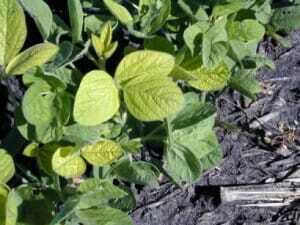
    I’ve received an unusually high number of calls this spring from people, who have noticed all the “yellow soybean fields.” These fields are exhibiting Iron Deficiency Chlorosis (IDC).

    Contrary to popular thought, IDC is not a disease as there are no pathogens, fungi or viruses that can be blamed for this condition. Rather, IDC is a function of the soil type common in the area we call the “Des Moines Lobe.” This area covers most of Central Iowa, continuing north into Minnesota and even further north and west into the Red River Valley region. These soils typically contain some areas that are poorly-drained and also have higher-than-normal pH values.

    This is one of the worst years for IDC in recent memory. Unfortunately, once IDC is noticed in a field, it’s too late to really manage it properly this season. Avoid applying chemicals on these areas that will damage the already-stunted and chlorotic plants. Then be proactive when choosing future soybean varieties for these fields.

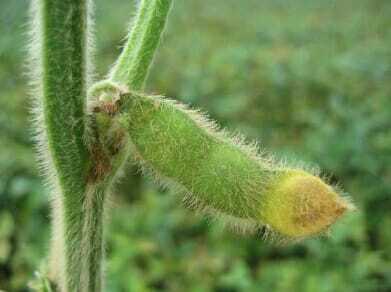
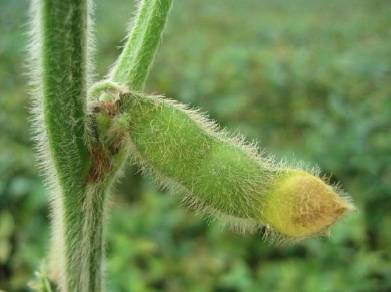
    Iron chlorosis symptom – soybean. Photo © John E. Sawyer

    There is no such thing as complete resistance to IDC, however, some soybean brands (i.e. varieties) are better than others at handling this condition. Because Latham Hi‑Tech Seeds is headquartered right in the heart of North Central Iowa where Iron Chlorosis is a familiar challenge to us, we have always tried to choose soybean genetics that have the best possible scores against this condition.

    Latham® soybean brands like L1585R2, L1783R2, L1985R2 and L2183R2 have all demonstrated that they belong in this elite class of defensive products that are designed to give the best possible performance under some of the toughest conditions that our soybean seed customers run into. This is just one more example of our commitment to bringing the highest performing seed products with the best trait values to all of Latham Country!

    Webspec Admin

    July 2, 2012
    Agronomics, Crop, Fertility, General, Soybeans
  • Latham Hi‑Tech Seeds

    Potassium Deficiency is Growing Problem in Corn

    DeficiencySymptoms
    Potassium deficiency symptoms in corn develop on the edges of older leaves, typically starting at the tip, while the new growth appears normal. (Photo courtesy of the University of Illinois Plant Clinic.)

    While walking fields recently, I’ve seen corn leaves that are yellowing around the leaf margins.  The yellowing starts at the tip of a leaf, extending along its edges to the base of the leaf.  In more severe cases, the edges are brown.

    Corn and soybeans are showing signs of potassium deficiency this growing season. Most of the potassium deficiency I’ve seen so far this season is not due to planting in too-wet soil conditions or compaction, although this certainly could be a reason in some cases.  Instead, I’m seeing more potassium deficiencies where there is an extremely dry soil surface and where root activity has been slow.  Dry conditions typically limit root growth, which explains why soils can have good levels of potassium but nutrients don’t get to the plants.  It also helps explains why, in some fields I have observed, the K deficient symptoms are occurring in the best-drained soils in the field while the more poorly drained areas look better.

    Dry surface soils express K deficiency most often.  Ridge-till, no-till situations and side wall compaction will sometimes show symptoms in dry years.  Irrigation or simply rainfall is a great way to jumpstart the root systems and help the plant develop through the K deficiency.

    It’s important to understand why if and why there is a potassium deficiency because K is an essential nutrient for plant growth that has a large impact on overall yield.  Potassium controls transpiration and respiration, as well as the uptake of certain nutrients including nitrogen and magnesium.

    Photo courtesy of www.omafra.gov.on.ca

    The type of nutrient deficiency determines soil management strategies.  Some people side-dress potash or various forms of K.  Others try foliar products.  One word of warning is that some of these products can be harmful to the plant at certain stages of growth.  A grower should select a low salt form of K and avoid anything with KCl or KSO4 for foliar applications.  A better and safer means is to address the situation by applying potassium before planting 2013.

    Walk your fields now and note where you’re seeing signs of potassium deficiency, so you can be sure to test and possible treat those areas before the 2013 crop is planted.  Another leaf tissue sample can provide helpful information, too.  You can see if there are other nutrient deficiencies in your field.  Tissue sampling is one service provided through Latham’s Seed-to-Soil program.

    Team Latham

    June 28, 2012
    Agronomics, Corn, Crop, Fertility, General
  • Latham Hi‑Tech Seeds

    Corn Rootworm in Northeast Iowa

    Corn Rootworms have arrived in Northeast Iowa nearly three weeks prior to normal years. Farmers are urged to be diligent in scouting fields and monitoring pressures in the coming weeks. For more information, tune into Nick Benson’s most recent YouTube video:

    http://youtu.be/TLNYMhaw-u4

    Team Latham

    June 24, 2012
    Agronomics, Corn, Crop, General, Insects
  • Latham Hi‑Tech Seeds

    Wage a War on Weeds

    Latham Enlist E3 Logo

    As a business owner, I tend to focus on the bottom line.  The bottom line here is that farmers need more weapons in the war against resistance weeds.

    Weeds are more than unsightly.  They’re more than a nuisance…  They’re costly!  Weeds are yield robbers, meaning there is less crop (i.e. food) produced come harvest time.  Yield losses can accumulate very rapidly when weeds compete too long with corn, according to a recent article in The Bulletin.

    Controlling weeds early with a properly timed application of a post-emergence herbicide is key.  The problem is not all post-emergence herbicides are as effective as they used to be; glyphosate-resistant weeds are a growing problem.

    “Sixty percent of farmers reported they have seen a decrease in the effectiveness of the glyphosate system – compared to 45 percent just 24 months ago,” said Damon Palmer, Dow AgroSciences U.S. commercial leader for the Enlist™ Weed Control System.

    Farmers need alternative weed control systems, and that’s one of the reasons that I’m so excited when new tools to fight weed resistance come along like the Enlist weed control system (2,4-D) and the new Genuity Roundup Ready 2 Xtend (Dicamba).

    It’s frustrating to see a new tool like Enlist Corn receive unsavory media attention, leading to public outcry based on fear rather than fact.  Just a few days ago CBS News aired a story entitled, “Controversy flares over ‘Agent Orange corn’.”

    CBS compares the new Enlist Weed Control System with Agent Orange, which was widely used during the Vietnam War. Some people even use “2, 4-D” and “Agent Orange” interchangeably, but that’s not correct.

    The chemical 2,4-D has been used safely in this country since it was initially registered back in the 1947 and was reregistered in 2005.   While Agent Orange did contain 2,4-D like Enlist does, the two products are very different.  Enlist does not contain the 2,4,5-T component of the herbicide or its contaminant, dioxin, as Agent Orange did.

    Let’s focus on the facts and wage the war against weeds, not against the companies that make the weed control products or the farmers who plant food for a growing world population.

    John Latham, President

    June 14, 2012
    Agronomics, General, Weed Control
  • Latham Hi‑Tech Seeds

    Tissue Testing Helps Unlock Full Yield Potential

    A deep, dark, lush green isn’t always the sign of a healthy crop. Sometimes the plant appears healthy but is really suffering from nutrient imbalances. Other times we become suspicious when we see plants with light green colors, or interveinal stripes, and purpling. We begin to ask whether the discoloration is a sign of herbicide, disease or a nutrient insufficiency or imbalance. Further testing is needed to diagnose the situation.

    In the human world, annual physicals help determine if we’re on the right health track. This involves blood tests to find out how we compare to the normal limits scale. Armed with the results, doctors can suggest diet changes, supplements or prescription medicines to bring our bodies into balance.

    As important as blood tests are for humans, so are tissue samples for our crops. Results of the tissue sample will very accurately reflect the nutritional health of the plant and the soil in which the plant receives its food. While soil test results give a good idea of N –P – K levels, tissue samples are more reliable and trustworthy results.

    Tissue samples provide us with the most accurate reflection of the soil and plant’s nutritional matrix. There are 16 essential elements responsible for plant growth and yield. Tissue samples help us know where the plant is so we know where we need to go. By starting early, we can supplement early. If you haven’t sampled in the past, try a field or two this year. Supplement where needed, and get those “WOW” type yields. Click here for tissue sampling instructions.


    Webspec Admin

    June 11, 2012
    Agronomics, Crop, General
  • Latham Hi‑Tech Seeds

    Latham 1884’s have Outstanding Emergence & Early growth

    Soybean

    L1884R2 had such strong emergence that it actually lifted a 6″ square of dirt that is about 1″ thick.  This is a sister line to our number one selling soybean L2084R2.  Look for more updates on this family of varieties as the season progresses.

    Larry Sailer, Musings of a Pig Farmer

    June 11, 2012
    Agriculture, Agronomics, Emergence, General, Industry News
  • Latham Hi‑Tech Seeds

    Potassium Deficiency in Northeast Iowa

    Symptoms of potassium deficiency are surfacing in Northeast Iowa corn fields. These symptoms are most likely the result of dry top soil during late May and early June. Any soil factor that limits root growth and water uptake can limit K uptake. For more information, tune into Nick Benson’s most recent YouTube video:

    http://youtu.be/F7iVHw8BMo4

    Team Latham

    June 11, 2012
    Agronomics, Fertility, General
  • Latham Hi‑Tech Seeds

    Sidewall Compaction in Northeast Iowa

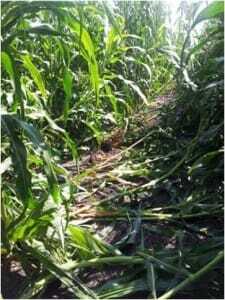
    Nick Benson shows us the sidewall compaction side by side to a normal corn stalks. For more information, tune into Nick Benson’s most recent YouTube video:

    http://youtu.be/kM2xrMgUuxE

    Team Latham

    June 11, 2012
    Agronomics, General, Soil
  • Latham Hi‑Tech Seeds

    Treat Volunteer Corn Like a Weed

    Volunteer corn1
    Would you wait for weeds to get 3 feet tall before treating them? Volunteer corn is an increasing common weed! Photo credits to Purdue University.

    Volunteer corn is not a crop… it’s a weed that grows from grain left in fields after a harvest.  Farmers should treat volunteer corn like a weed and manage it early in the season.

    Three main reasons why volunteer corn should be managed early:

    1. Volunteer corn competes with newly planted crops for nutrients.
    2. Volunteer corn attracts corn rootworms.
    3. If left untreated, volunteer corn could potentially reduce the benefit of crop rotation.

    Like any weed, volunteer corn competes with the growing crop for nutrients.  Volunteer corn is a yield robber!  It’s even more competitive with soybeans.  Soybean yields can be reduced by populations of volunteer corn at 8,000 to 16,000 plants/acre.  Corn yield also can be reduced by populations of volunteer corn of at least 8,000 plants/acre, according to research trials by the University of Minnesota.

    Another reason volunteer corn is a concern is because it creates a “safe harbor” for corn rootworms.  Corn rootworm typically hasn’t been a problem when fields are rotated annually between corn and soybeans because soybeans starve out rootworms that hatch in spring.  However, volunteer corn allows rootworm larvae to complete their feeding cycles.

    In addition to being a food source for rootworm larvae, volunteer corn that is not controlled by tasseling attracts corn rootworm beetles for egg laying.  The beetles lay their eggs in the soil around the base of the volunteer corn.  The eggs will remain dormant until they hatch the next spring.

    Bottom line:  Higher numbers of volunteer corn can build higher corn rootworm populations for the next growing season.  Higher rootworm numbers are especially problematic when those fields are planted to corn the following year in a corn-soybean rotation or in continuous corn.

    Webspec Admin

    June 7, 2012
    Agronomics, General, Weed Control
  • Latham Hi‑Tech Seeds

    Conditions Favor Rootless Corn Syndrome

    Rootlesscorn1
    Rootless corn (left) compared to corn with normal nodal root development. Photo credited to Monsanto.

    The change from excessively wet to unusually warm, dry weather has resulted in the development of a substantial crust in fields that were previously worked and planted in late April. Obviously, a thick crust can restrict the emergence of corn and cause underground leafing. The rapid drying of the upper soil layer is also conducive for the development of the “floppy corn,” or Rootless Corn Syndrome.

    The aforementioned weather pattern may mirror situations across Latham Country this spring, but it’s actually an excerpt from an article that was originally written in May 1998 by an agronomy professor at Purdue University in Lafayette, Indiana. Dry surface soils, shallow planting depths, sidewall compaction and cloddy soils all contribute to Rootless Corn Syndrome.  Roots will take the path of least resistance, which means they might grow out the bottom of the seed furrow.

    Such corn plants are technically not root-lodged; they are simply broken over at the base of the stem near the crown area. The nodal roots will appear stubbed off but not eaten. The root tips will be dry and shriveled. For a brief description of normal corn root development, click here for  R.L. (Bob) Nielsen’s “Primer on Corn Root Development.”

    Nodal root growth may resume if more favorable temperatures and moisture conditions return to the fields exhibiting signs of Rootless Corn Syndrome. Cultivation can help by putting soil around the base of plants or aiding in new root development when it does rain.  If the ground is hard, cultivation will help with soil aeration.

    Team Latham

    May 31, 2012
    Agronomics, Corn, Crop, General, Soil
Previous Page
1 … 54 55 56 57 58 … 67
Next Page

Latham Hi‑Tech Seeds

131 180th Street | Alexander, IA 50420

(641) 692-3258

SIGNUP FOR OUR NEWSLETTER
  • Contact
  • Legal
  • Dealer Center
  • Seedware Login
  • Latham Gear

© 2025 Latham Hi‑Tech Seeds. All rights reserved. | Iowa Web Design by Webspec | Privacy Policy

Latham® Hi-Tech Seeds is a trademark of M.S. Technologies, L.L.C., 103 Avenue D, West Point, IA 52656.