Select Products Built for Battle with Mark Grundmeier
What does it mean for a product to be Built for Battle? Tune in on Sept 10 at 8 AM as Mark Grundmeier shares insight into our highly offensive and defensive soybean product options.
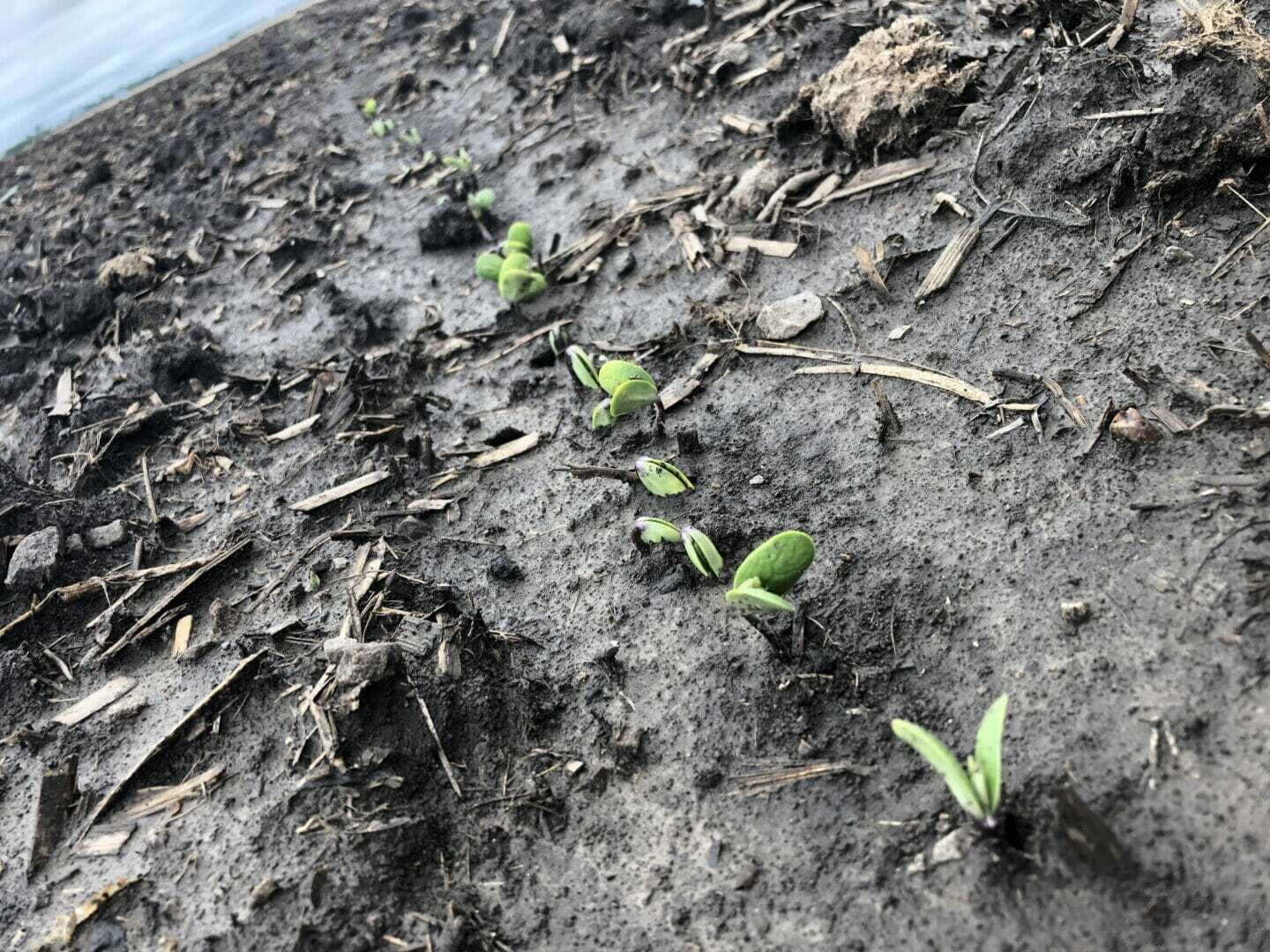
Latham Hi‑Tech Seeds takes great pride in the seed quality that goes into every bag of Latham® seed. You have a great opportunity to observe this first-hand each spring as you watch your crops emerge.
Looking at fields as they emerge can help you gain valuable information to use later in the year. Here are a few steps for you to consider making this growing season:
Take the time to walk your own fields and make notes on what you see for each hybrid.
Note early vigor and growth from high-quality Latham brand seed.
Spend some time early in the growing season, noting differences you see between hybrids.
Contact your Latham Representative to find plots in your area that you can visit to observe emergence.
Determining a hybrid’s uniformity of emergence is so important. The actual stand versus planting rate carries some weight in overall yield, but uniformity of emergence carries the greatest burden of producing top yields. Fields that have all plants emerging in a 24- to 36-hour period will produce the highest yields. Plants that emerge a week later than the first plants will not produce at the same level.
A North Dakota State Crop and Pest report from June 7, 2018, shows corn plants that emerge five to 10 days after the first plants will yield only 65% of the yield of the first emerged plants. Kansas State research shows that a two-leaf stage delay of 1 in 6 plants caused by uneven emergence can result in as much as a 4% yield reduction.
Key notes to take when looking at emergence timing:
Seedbed uniformity
Trash removal from seed furrow area
Uniformity of seed depth
Differences you can note on same hybrid under different field conditions
Your spring observations help tell the story on late-season standability, variability in flowering, and variability in maturity. Early season observations allow you to obtain valuable information. Taking a little time for this will pay huge dividends in understanding end-of-the-year results.
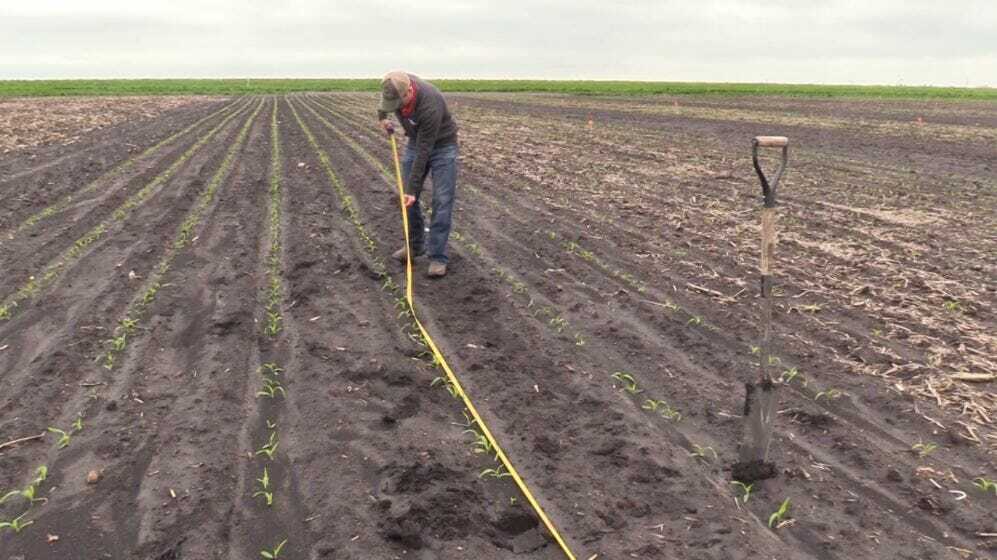
Today we have an update from our Regional Sales Manager in Southern Minnesota. Justin talks about the importance of scouting for even emergence. Watch the video below! #LathamSeeds
Early season scouting can help fine-tune practices for in-season crop management and for the next year’s growing season. Our Corn Product Manager, Lyle Marcus, has created a scouting checklist for you to take to the field.
Planting Furrow
Did the planting furrow close well?
Is there any sidewall compaction created from wet soils?
What can be improved for next season?
Uniform Emergence Across the Field
Is the planting depth correct?
Was seed placed in dry soil in some areas of the field?
Identify the Growth Stage
First leaf, sometimes called the ‘True Leaf’ has a rounded tip. All others that follow have pointed tips and a leaf collar where the base of the leaf attaches to the stem/stalk. Always count the true leaf in your staging. For example, three leaves with collars plus the True Leaf is 4-leaf corn.
Correct staging is very important for herbicide applications.
Soil-Borne Insects
Any seedling damage present?
Use a corn pest management calendar to gauge approximate timing that different insects will begin to emerge.
Note: Many soil-borne insects are controlled by seed treatment, but one big threat can be cutworm. Black cutworm can be devastating to a stand of young plants, but careful monitoring allows timely insecticide treatment to reduce size of affected areas.
Fertilizer Injury
N or K fertilizers with high salt content can damage young roots. If found, what can be done to prevent the issue in the future? One suggestion is placement – final spring tillage pass can incorporate this evenly in soils.
Anhydrous injury
Did planting occur at the application pass and how do you prevent next season?
When side-dressing, escaping gasses will kill leaf tissue. If preparing to side-dress, be sure soil is in proper condition to seal well.
Pre-emerge Herbicide
Scout for weed escapes. What follow-up applications are needed? Keep crop staging in mind for many of the available post options.
Keep these notes for next season. In-season note taking will point you in the right direction for the next cropping season. Give us a call with any questions at 1-877-GO-LATHAM – we are happy to help!
The virtue of patience is most beneficial when the time comes to assess frost or freeze damage in early-season corn. Once a frost or freeze event takes place, do an initial assessment of your field and wait 3-5 days before making any final decision on how to proceed. Young corn plants can tolerate cool temperatures up to V5 since the growing point is still below the soil surface. Early season damage caused by the cold temps does not show up immediately as the cells that get broken from the freezing moisture inside the plant may look normal the first morning after a freeze. Depending on the actual low temperatures, symptoms may take a day or so to appear.
Frost Damage Assessment
Identify Location – Note field locations that experienced the cold temperatures. Also note the lay of the land in those fields such as low spots, hill tops, general slope direction.
Soil Moisture – Record the soil moisture levels across the entire fields, possible dry hill tops and wetter low areas. Moist soil can offer some protection.
Soil Temperature – Check soil temp in different location across the field.
Soil Type – Be conscious of the soil type. Sandy soil cools much faster than silty or clay soils.
Weather Data – Utilize location weather station info to determine the lowest temperature and duration of that temperature.
Frost Damage
Corn at V4 damaged from frost event. Above-ground tissue is dead (brown) but the growing point was still below-ground and is alive (white-yellow tissue)
Young corn plants can tolerate some low temperatures and still survive and achieve high yields. The growing point of the plant remains under the soil until the plant reaches V5. At this stage, you will see five leaf collars showing around the stem. You may have more leaves visible, so count the collars for accurate assessment of crop stage. Low temperatures that do not fall below 30 degrees generally just damage the exposed leaves and do not hurt the growing point. However, recovery of these plants may take some time (up to a full week) depending on weather after the frost. Below is a photo from the Iowa State University Integrated Crop Management newsletter showing a viable growing point after a frost event.
Frost Damage Management
Wait 3 to 5 days with temps above 70 degrees. Wait even longer with lower temperatures.
Assess percentage of damaged plants and survival rate prior to any replant decision.
Allow plants to recover prior to any herbicide or fertilizer applications, this may take a week to 10 days.
Note the amount of leave tissue lost and how it will affect your crop staging.
Loss of two leaves in 4 leaf corn will still be classified as V4. This becomes important for later application of herbicides. Keep the leaf loss in mind when staging corn for later applications to assure you are not past a window that may cause herbicide injury.
Freeze Damage
If you experience low temperatures of 28 degrees or lower for a prolonged period of time, most all the plants in a field will show significant damage. These extended low temperature situations become more critical for assessment. You may see variation across a field due to soil type, soil moisture content or the amount of residue on the field. Corn damaged by a hard freeze will still need patience for assessment. Assess all fields after hard freezing temperatures, even those that have not emerged yet. Check soil temps at 2” level soon after a freeze for a sound understanding of the scope of damage to a field.
Freeze Damage Assessment
Soil Temps – Check soil temps at 2” level in multiple locations of the damaged field to gain knowledge of how widespread the damage has occurred. This needs to be recorded early.
Patience – Wait 3-5 days to allow the full expression of effects of the freeze.
Plant Tissue – Slice open young plants and observe the growing point. Brown and water-soaked tissue vs white or green tissue. See earlier photo for viable plant.
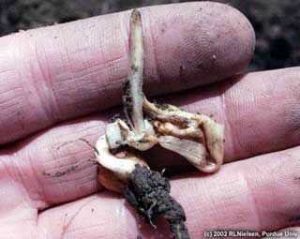
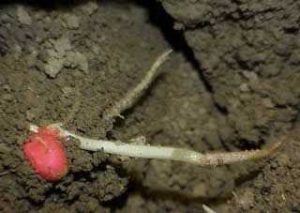
Dig Un-emerged Seeds – Hard kernels remain viable while soft/mushy kernels will not germ or have the energy to push the sprout through the soil.
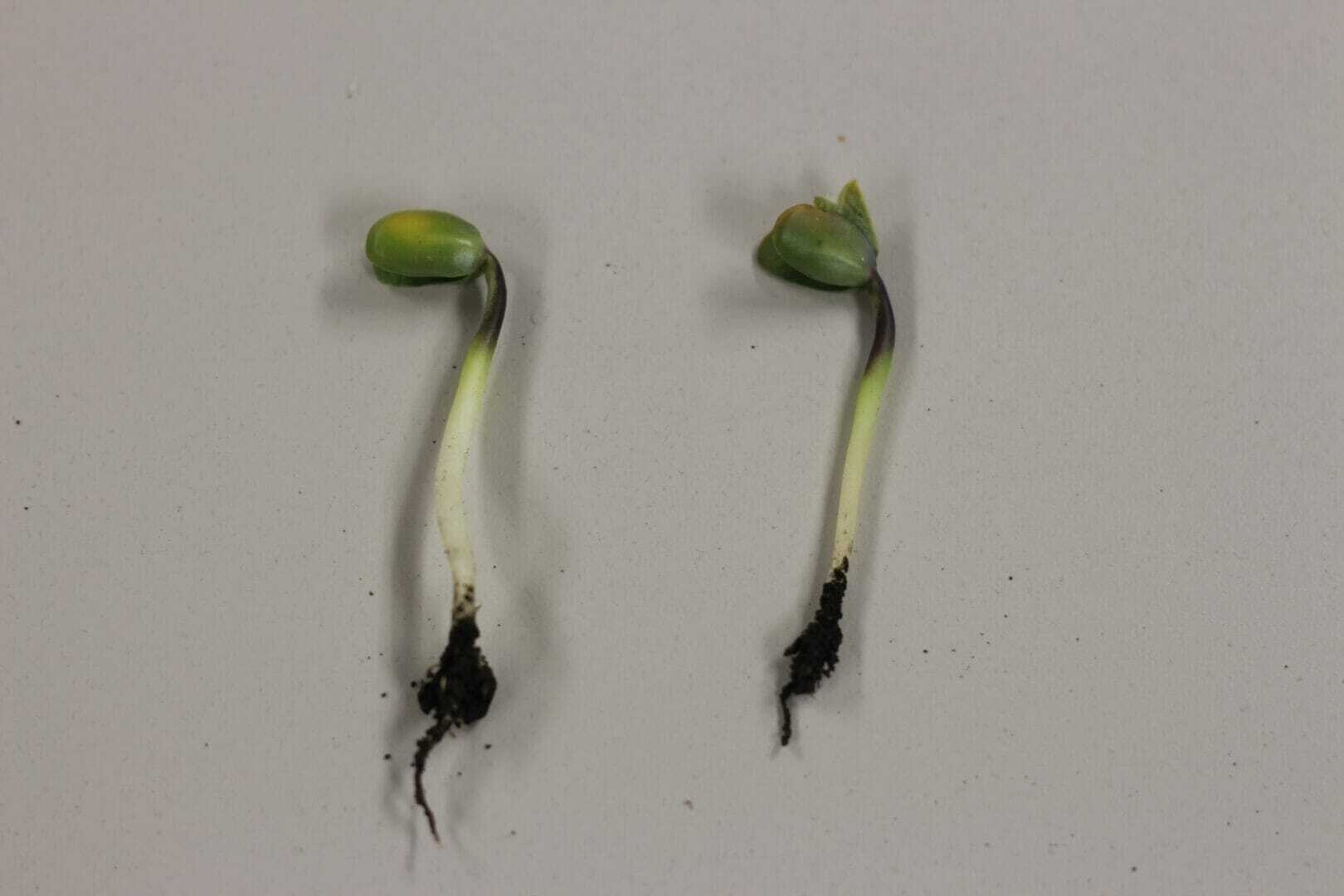
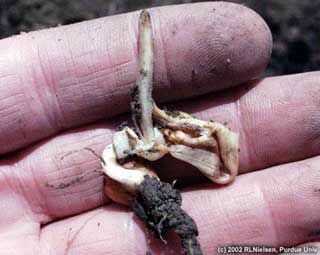
The photo on the left shows leafing out underground due lack of energy of seedling. The photo on the right shows damage to the coleoptile that will result in shoot not having capacity to push through the soil. Photo courtesy of RL Nielsen, Purdue Univ.
Freeze Damage Management
Wait 3 to 5 days with temps above 70 degrees, longer if lower temps.
Slice open emerged plants and determine percentage of population damaged.
Dig up un-emerged seedlings and kernel assess viability and determine percentage of population damaged.
If stand damage is substantial, assess the costs and benefits of leaving the stand versus replanting.
Patience is key when assessing damage from a frost or freeze event. If you allow time for the crop to respond to the event, you will make better decisions for that damaged field.