Latham Hi-Tech Seeds

(641) 692-3258

  • Home
  • Performance
  • Products
    • Corn
    • Soybeans
    • Soybean Blends
    • Alfalfa
    • Corn Silage
    • Seed Guide
  • Find a Rep
  • Media
    • Blog
    • News
    • Videos
    • Podcasts
    • TECHTalk
  • About Us
    • Company History
    • Our Mission
    • Careers
    • Become a Rep
    • Sowing Seeds of Hope
  • Contact Us
  • Latham Hi‑Tech Seeds

    Latham Hi‑Tech Seeds Announces Ryan Schon As General Manager

    Ryan J SchonLatham Hi‑Tech Seeds announces Ryan Schon of Ankeny, Iowa, as its general manager.

    “We’ve had the pleasure of working with Ryan in different capacities for the past 20 years, and we’re pleased that he is has joined our management team,” says John Latham, president of third-generation, family-owned Latham Hi‑Tech Seeds in Alexander, Iowa. “Latham Seeds has experienced 15 consecutive years of growth, and we believe Ryan will help us grow in areas that will allow us to provide even greater support and services to our dealer network and farmer-customers.”

    Latham says Schon’s background in agronomy, marketing, and precision agriculture, combined with his education and experience, will help his company gain greater efficiencies.

    “Ryan’s fresh perspective will allow us to consider new business approaches and opportunities. He also understands the intricacies of working with other family-owned seed companies, plus he has experience working with his own family’s business,” says Latham.

    Schon grew up in Glidden, Iowa, where his family owned a lumber and construction business. His grandparents also farmed in Carroll County.

    “I learned so much growing up in a family business: working hard, making work fun and doing whatever it takes to get the job done,” says Ryan, who earned a Bachelor of Science degree in Agronomy from Iowa State University and holds a Master of Business Administration from Lindenwood University.

    Schon most recently served as senior corporate development manager for Granular and led the post-acquisition integration of Granular with Encirca. He provided a voice for farmers as new Encirca Services were developed with Pioneer Agronomy Science, data scientists, software development, field teams, and external collaborators.

    Prior to working for DuPont Pioneer, Schon was a business development manager and traits marketing lead with Monsanto. He and his family also lived abroad for one and a half years.

    “The most amazing thing I observed is that all those farmers had the same farmer spirit,” says Schon, who has visited farmers on six continents and in about 25 countries. “In many cases, I didn’t know their language and we talked through a local translator. But there’s a universal farmer spirit that comes from putting all your faith in a seed that you’ve put in the ground and knowing that your livelihood depends on what it produces.”

    Schon says he enjoys having the opportunity to return to his Iowa roots and enjoys being part of the U.S. seed industry.

    “The seed industry is so collegial. Practically every seed company started as a family farm,” says Schon. “In a previous job, I organized a customer meeting for leaders from all the independent seed companies. I quickly learned that the best thing we could do is make time at the beginning of the meeting for everyone to spend time together catching up. I don’t think there are many industries where that would be true, and I really enjoy the comradery. I look forward to maintaining and strengthening the contacts I’ve made within the industry. I especially welcome the opportunity to work with the Latham team to lead the the company into this next generation of growth.”

    Latham Hi‑Tech Seeds is a family-owned company marketing hybrid seed corn, soybeans and alfalfa under the Latham® brand name. Since 1947, the Latham name has stood for the latest genetics and highest quality seed. Today it’s owned by third-generation seedsman John Latham and his wife, Shannon, and John’s brother, Chris. They’re committed to bringing world-class technology home® to rural communities in Iowa, Minnesota, the Dakotas, Nebraska and Wisconsin. For more information about Latham or its products, visit www.lathamseeds.com or call 1-877-GO-LATHAM (1.877.465.2842)

    Shannon Latham

    February 4, 2019
    Agriculture, Industry News
  • Latham Hi‑Tech Seeds

    Renewed XtendiMax™ Label

    12.27.18 Blog

    LIBSYN header 2 01

    Join us as Phil Long discusses the new XTENDIMAX™ label!

    https://www.facebook.com/LathamSeeds/videos/379348692818689/

    Laura Cunningham

    December 27, 2018
    #AskTheAgronomist, Agronomics, Crop, Herbicide Technology, Industry News, Seed Technology, Soybeans, Weed Control
  • Latham Hi‑Tech Seeds

    #AskTheAgronomist Special Edition

    Shannon & Mark


    LIBSYN header 2 01

    More Topics. More Expertise. More Value.

    Below we have shared our 5-segment #LiveWithLatham Broadcast! We had our Agronomy & Product Teams with us to talk about the 2018 growing season, Latham® hybrids and varieties, an industry update, on-farm research and our Latham quality standards. Tune in to the segments below.

    https://www.facebook.com/LathamSeeds/videos/206956050211982/

    https://www.facebook.com/LathamSeeds/videos/387560941788121/

    https://www.facebook.com/LathamSeeds/videos/2371959466165669/

    https://www.facebook.com/LathamSeeds/videos/713236272403231/

    https://www.facebook.com/LathamSeeds/videos/643567089391080/


    Laura Cunningham

    December 14, 2018
    #AskTheAgronomist, Agriculture, Corn, Cover Crops, Crop, Industry News, Soybeans
  • Latham Hi‑Tech Seeds

    Give Back this Holiday Season

    BW helping hand

    The brisk air and cozy fall nights excite many Midwesterners for the Thanksgiving and Christmas seasons. As we take time to recognize and be thankful for what we have, it’s important to remember those families and friends that find this season the most difficult time of the year. Unfortunately, disappointment can fill the voids while some families can’t afford to gift their children or prepare a traditional thanksgiving dinner.

    We are challenged to give back to our communities and families in need, whether it is through sharing hot dishes, quality time with each other or financially. Those in the Midwest are known for helping neighbors and friends during the fall and spring when times become highly stressed, where others face many stressful times during the holiday season.

    We encourage you to continue helping the less fortunate throughout this holiday season. Here are some ways people in #NorthIowa are giving back this season:

    • Toys for Tots
    • Salvation Army Red Kettle Drive
    • Meals on Wheels
    • NIACC Annual Coat Drives

    Donating a gift to your local community center is a simple way of giving and can make a young girl’s or boy’s holiday. You never know how much your actions will impact an individual or family, especially during the holiday season when some need it the most. Whether you take part in the giving tree at a local church, donating toys to a shelter or help a relative prepare holiday food, you can make a difference!

    How you demonstrate giving and show caring can also make a difference in your children’s lives. Your actions can make an impression and create a legacy. Giving back can be a gift you gift yourself this season!

    Webspec Admin

    November 9, 2018
    Agriculture, Food & Family, Industry News
  • Latham Hi‑Tech Seeds

    Seeds of Kindness Grew while Farmer’s Last Crop was Harvested

    Virgil Rasmussensm

    It was an emotional morning at the Rasmussen farm Wednesday, Oct. 31. Family and friends, combines and auger wagons, poured in to help bring in a loved one’s last crop. Just five months ago, this same group of dedicated family and friends helped make sure this crop was planted.

    IMG 5701 IMG 5699

    Virgil Rasmussen, who had served for years as Latham® dealer in Emerson, Nebraska, endured a hard-fought fight against Leukemia for the past year. The height of his treatments occurred during the busy spring planting months, and the Emerson community responded in a big way. Five tractors with planters, a seed tender, transport team and a meal prep crew came together to make it happen. With the crop safely in the ground, Virgil was able to focus on getting better. In mid-October, he received the all-clear from his doctor team. He had won the battle against Leukemia!

    IMG 5703 IMG 5700

    It was a surprise to everyone when late last week they received news of Virgil’s illness and sudden passing. Loved ones, with heavy but determined hearts, once again answered the call for help. A harvest bee made up of friends and neighbors arrived to show their love and support to Virgil’s wife, Irene, and their family, as they put Virgil’s last crop safely in the bins.

    IMG 5698

    IMG 5702

    Virgil enjoyed his life’s work in agriculture. He planted and harvested 42 crops on his home farm east of Emerson. Whether it was full-scale out in the fields or a 1/16th size toy replica, Virgil will be remembered for his love of tractors and for his unique ability to customize toy tractors of various models. Virgil was a proud grandparent. He also loved fishing and providing great service to his seed customers. We at Latham Seeds are grateful for the opportunity to have known Virgil, and we extend our thoughts and prayers to the entire Rasmussen family.

    Virgil Rasmussen

    When a farming family is in need or facing crisis, friends and neighbors pull together to take care of every detail right down to the field meal. In honor of all the helping hands that worked to bring home Virgil’s crop, we share this favorite field meal for Swedish Meatballs.

    Laura Cunningham

    November 2, 2018
    Agriculture, Beef, Food & Family, Industry News, Recipes
  • Latham Hi‑Tech Seeds

    SDS in 2018 Not as Severe as Feared

    Rsz0907SDSFieldfoliarsymptoms
    Rsz0907SDSFieldfoliarsymptoms
    Photo credit: Iowa State University

    It was feared the wet, cooler weather conditions in 2018 would be ideal for Sudden Death Syndrome (sds) infestations. This soil-borne fungus overwinters in fields. Although it does not affect corn plants, it can survive in corn residue and then attack soybean fields in subsequent years. Based on what I have seen as I’ve traveled across Latham Country, the infestations do not seem to be as severe as feared. I’m finding Brown Stem Rot (BSR) is more prevalent in fields than it has been in recent years. Foliar symptoms of SDS and BSR are almost identical. To tell the difference between the two, you must split stems and dig up roots. I make this point because I believe many reported cases of SDS should be attributed to BSR.

    Why hasn’t Sudden Death been a larger problem this year? To confirm my theories, I called Dr. Daren Mueller, an Iowa State University Extension Plant Pathologist. Dr. Mueller also has observed less evidence of severe SDS and said his colleagues from neighboring states are seeing less SDS pressure, as well. The following are some of Dr. Mueller’s thoughts on possible reasons for this:

    » DELAYED PLANTING: The Sudden Death fungus attacks soybean roots as early as the V2 stage. Wet, cool weather favors SDS infestations, but such conditions also prevent soybeans from being planted very early. It has been proven by numerous researchers that one way to combat SDS severity is to plant later. Once farmers were able to get soybeans planted this spring, the temperature had turned very warm. Warm soil temps in early May caused soybeans to emerge quickly, lessening the chance of root infestations.

    » SDS TOLERANCE: Seed companies, in general, have done a better job of developing cultivars with improved tolerance to Sudden Death. Dr. Mueller was quick to point this out as a management strategy that is working well. At Latham Hi‑Tech Seeds, we’ve been focusing on SDS as part of our IRONCLAD™ defensive package since 2013. (IRONCLAD is available exclusively from Latham Seeds.)

    » COMPACTION: Farmers are doing a much better job of reducing compaction in their fields by waiting for soils to get fit before they’re worked. Research proves the SDS fungus thrives in compacted areas of fields.

    » SOYBEAN CYST NEMATODE (SCN): Research shows higher SCN populations can cause SDS infestations to be more severe, so managing SCN is an important step.

    » SEED TREATMENTS: Products like ILeVO® are an important tool in the fight against SDS. Dr. Mueller stresses that while ILeVO is very good, it is not a “silver bullet” for preventing SDS. My experience with Latham research shows soybeans treated with ILeVO yield an average of 4 to 8 bushels per acre (bu/A), and it is effective 70-80% of the time.

    Effective management for SDS includes all the above factors plus more going forward. At Latham Seeds, we strive to be on the forefront of the battle against this disease and other yield-robbing pests that affect your yield and bottom line.

    Mark Grundmeier, Product Manager

    October 29, 2018
    Industry News, Tech Tuesday
  • Latham Hi‑Tech Seeds

    Unearth Yield-Limiting Factors

    7 Wonders

    We all desire more yield. Although plant genetics are responsible for massive amounts of yield gain since we transitioned from open pollinated corn to hybridization, it’s time we take a deeper look. It’s time we rediscover soil’s role in increasing yield and redefine plant diets.

    “We can increase real organic matter 0.1% per year on intensely managed farms, and that increases our corn yield goal 2.7 bushels,” Ken Rulon of Arcadia, Indiana, is quoted as saying in a June 2018 issue of The Furrow magazine. “When you increase organic matter the soil becomes darker, and everybody in the world knows darker soil is more productive.”

    Rulon can prove using no-till and cover crops is improving soil quality— and returning a net profit of $57.76 per acre on his family’s 6,300-acre farm. He and his family have worked extensively with Purdue University researchers, whose replicated plots show the same results. The Rulons are producing higher yields using 20 pounds less phosphorus, 30 pounds less potash and 35 pounds less nitrogen per acre than conventional practices.

    7 WondersHealthy soil has amazing water-retention capacity. The Furrow article illustrates how improved soil structure, specifically organic matter (OM), has helped reduce yield losses during dry conditions. This is important because the timing of rain events is unpredictable. Case in point: this season fields in the Upper Midwest received high volumes of rain during short amounts of time. Improving the OM in the soil helps absorb water more quickly, holding it in the root zone like a massive soil sponge. Therefore, good soil structure also helps reduce erosion.

    Each soil type and growing climate is uniquely different, making It critical that you do some research on your own farm. You know which fields need more attention, so consider giving that piece of ground some TLC. Develop a plan. Consider a Solvita® soil test as a good starting point. Need more inspiration? Check out the 7 Wonders of Corn Yield by Dr. Fred Below.

    Thinking long term for that piece of ground will help cast a vision. Have improved soil health define part of your life legacy and give an amazing gift to humanity!

    Webspec Admin

    October 22, 2018
    Industry News, Tech Tuesday
  • Latham Hi‑Tech Seeds

    Weed Management: Herbicide Mixing is Best Practice for Mitigating Weed Resistance

    Weed Resistance

    Research conducted in Illinois by Dr. Aaron Hagar and his associates revealed, not surprisingly, that management factors are most important when it comes to the occurrence and the severity of resistance.

    Dr. Hager’s team also concluded that herbicide mixing, and not herbicide rotation, is the best practice for mitigating weed resistance. Using two herbicides with different sites of action each time you spray for weeds makes it 83 TIMES LESS LIKELY that weed resistance will develop!

    The following steps will help you put effective weed management practices in place:

    1. Identify your driver weed. Which weed will most likely develop resistance and has, historically, been the most difficult to control in your fields? For most of us in the Upper Midwest, this is Waterhemp. Depending on your geography, however, the driver weed could be Palmer Amaranth, Kochia, Marestail, Ragweed, etc.
    2. ALWAYS use a pre-plant or pre-emergence application. Never rely exclusively on post-emergent control options.
    3. ALWAYS follow label directions. When applying post-emerge products, make certain you do not exceed the labeled weed height for optimum control.
    4. Mix herbicides. Each time you make a herbicide application, use two products with different sites-of-action for controlling your driver weed.
      • There are many lists available online from universities.
      • If you have a weed population that is already resistant to glyphosate, then glyphosate is NOT an effective site-of-action product against your driver weed.
      • If you are trying to control a broadleaf weed, like Waterhemp, adding a product for volunteer corn does NOT give you an extra site-of-action for the broadleaf weed.
    5. Have a plan ready. Remember, selection for herbicide resistance happens every time you make a pass across the field. Make plans now for a comprehensive and sustainable weed management program.

    Implementing an effective weed management program is critical to protecting the effectiveness of seed options. Weeds can and will overcome all trait options given enough time. While we all recognize the value of having multiple options for herbicide-resistant traits, the end-result will eventually be the same unless we protect against weed escapes now.

    Mark Grundmeier, Product Manager

    September 18, 2018
    Agronomics, Herbicide Technology, Industry News, Tech Tuesday, Weed Control
  • Latham Hi‑Tech Seeds

    Latham® Products on Display Today at Annual Field Day

    IMG 3845

    Just as many 4-H and FFA members look forward to the county fair to exhibit the projects they’ve worked so hard on, we at Latham Hi‑Tech Seeds look forward to our annual fall field day in Alexander. It’s a time for us to celebrate Willard and Evelyn Latham’s legacy on our family’s Iowa Century Farm. It’s also a great time to celebrate current seed technologies while looking at those that will be available in the near future.

    Latham® brand products are selected for their yield potential, as well as for their ability to overcome specific regional challenges.  Here’s an overview of what attendees will see today on our Alexander Research Farm:

    • Enlist™ Soybean Demos: See field demonstrations of new Enlist technology that gives plant tolerance to 2,4-D chemistry. There will also be demonstrations showing how this technology is different from Xtend (Dicamba-tolerant) soybeans, as well as plots showing drift and volatilization.

    Screenshot 2018 09 14 09.18.47

    • Product Lineup: See the new and existing Latham® brand products we’re offering for 2019 planting. Latham has six different soybean technologies in production, so you will learn the strengths and weaknesses of each technology to find the best fit for your farm.  Corn hybrids on display range from 92- to 113-day maturities; they can be viewed at both the Stress Wheel Demo and the Corn Product Showcase. Latham’s tremendous group of alfalfa products will be on display for farmers interested in the very best quality hay for dairy or beef cattle.

    Screenshot 2018 09 14 09.19.20

    • Forage Showcase / Silage and Nutrient Studies / Population and Row Spacing Demos: Besides being one of the greatest alfalfa specialists in the Upper Midwest, Latham Forage Product Manager Corey Catt is also one of the very best corn silage and nutrition experts in the field. Join Corey as he walks through his studies on forages, nutrition and seed management.
    • Nitrogen Testing: Latham Precision Agronomist Phil Long will discuss the nitrogen testing he’s conducting in corn. He also will share tips for getting the most out of your nitrogen.
    • Nemastrike Testing: Did you know that 80% of the fields tested across the Corn Belt have nematode pressure? By piercing and infecting the roots of the plant, nematodes steal nutrients and water. The damage they cause creates pathways for secondary issues like bacterial and fungal infections. We’re testing this seed treatment technology on corn and soybeans to see the right fit for Latham customers.
    • Cover Crops: Phil Long and Corey Catt will discuss Latham’s different cover crop options to maximize return while increasing soil health.

    No field day would be complete without a tailgate lunch. Butcher’s Catering of Mason City, Iowa, will be serving up pulled pork and apple crisp. Today we’re sharing with you one of our favorite recipes for Harvest Pulled Pork. This crockpot friendly recipe is perfect for busy families.

    Shannon Latham

    September 14, 2018
    Food & Family, Industry News, Pork, Recipes
  • Latham Hi‑Tech Seeds

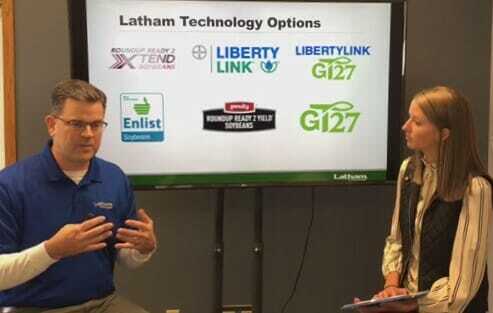
    Latham Introduces 12 Soybean Products in New LLGT27™ Trait Package

    Tech Tuesday Rebrand 02
    Tech Tuesday Rebrand 01
    LATHAM’S 2019 LINEUP OF SOYBEANS INCLUDES 12 PRODUCTS IN THE LIBERTYLINK® GT27™ (LLGT27) TRAIT PACKAGE, GIVING UPPER MIDWEST FARMERS ANOTHER TOOL AGAINST WEEDS THAT ARE DEVELOPING RESISTANCE TO VARIOUS HERBICIDES.

    The LLGT27 portfolio features the first, fully-approved triple-herbicide-stacked soybean trait available to U.S. farmers. Previously referred to as “Balance GT/LL,” the LLGT27 soybeans feature tolerance to Liberty® herbicide, glyphosate herbicide (e.g. Roundup®, Glyphos®, etc.) and a new formulation of isoxaflutole (possibly to be named Balance Bean), which is going through the EPA registration process. IMPORTANT NOTE: All current formulations of isoxaflutole herbicides have not been cleared for over-the-top application on soybeans.

    We learned the LLGT27 products were approved on July 3 — just days before Latham® Dealer Kickoff in Minneapolis — and we quickly pulled together what information we had on those products.Latham Soybean Product Team members will continue to evaluate these lines and will share results at our post-harvest meetings. We know farmers will have questions about handling herbicide applications to optimize weed control, and we plan to answer those questions at that time, as well.

    Feel free to call with any questions about this exciting new technology, which will be available for spring 2019 planting! Some of our production growers planted their acres to LLGT27 products in 2018, but we expect demand could be larger than supply this year. If you’re interested in trying some of these products, place your order early!

    Mark Grundmeier, Product Manager

    August 14, 2018
    Industry News, Seed Technology, Tech Tuesday
Previous Page
1 … 8 9 10 11 12 … 95
Next Page

Latham Hi‑Tech Seeds

131 180th Street | Alexander, IA 50420

(641) 692-3258

SIGNUP FOR OUR NEWSLETTER
  • Contact
  • Legal
  • Dealer Center
  • Seedware Login
  • Latham Gear

© 2025 Latham Hi‑Tech Seeds. All rights reserved. | Iowa Web Design by Webspec | Privacy Policy

Latham® Hi-Tech Seeds is a trademark of M.S. Technologies, L.L.C., 103 Avenue D, West Point, IA 52656.