Latham Hi-Tech Seeds

(641) 692-3258

  • Home
  • Performance
  • Products
    • Corn
    • Soybeans
    • Soybean Blends
    • Alfalfa
    • Corn Silage
    • Seed Guide
  • Find a Rep
  • Media
    • Blog
    • News
    • Videos
    • Podcasts
    • TECHTalk
  • About Us
    • Company History
    • Our Mission
    • Careers
    • Become a Rep
    • Sowing Seeds of Hope
  • Contact Us
  • Latham Hi‑Tech Seeds

    Count Your Blessings, One by One

    Devin Iowa State1

    I am a rich man.  No, I’m not talking about being a rich farmer.  That I’m not! But, I am rich in the ways that matter most.

    The tragic events that unfolded this past week – from Boston to West Texas – caused me to pause for a moment and think about how good life really is here in the Heartland.  For example, yesterday was Earth Day.  Such a day reminds me of what a wonderful world God has created!  I also caused me to reflect upon the change Janice and I are making as we transfer our memberships to the church she attended as child.

    Thinking about Janice’s childhood then caused me to reflect upon my own childhood.  I was born to farm!  From the time I was a toddler, I literally followed in the steps of my great grandfather, my grandpa and my dad.  Fifty years later, I’m still proud to call myself a farmer – but it hasn’t always been easy.

    In the 70s, I was one of what they called the “Young Tigers.”  I reached my goal of farming 1,000 acres, which at that time, was worth $1,000 per acre.  I spent all my available hours working on the farm.  As a workaholic, I was focused on the wrong goals!

    My way of thinking changed a decade later.  On my 30th birthday, I married Janice and had an instant family.  We joked that “something had to go” to make room for four kids, so I sold my airplane.  During the 1980s Farm Crisis, I sold off some farmland.  Janice ran the farming operation, including doing hog chores, while I took an off-farm job working construction.  We built hog units across the Midwest, so I was gone from home too much of the time.  We did what we was required to provide for our growing family at the time, and we were all thankful when I could return to farming full time.

    Over the last 30 years, I’ve become very wealthy in a non-material way.  Our family has brought us so much joy!  The past two weeks have been particularly enjoyable: our grandchildren Jessica and Zach went to prom; and grandson Devin finally was healed enough to play some great football in Iowa State’s spring game!


    I mentioned in a previous blog post that each of our grandkids has his/her unique talents and interests. Some, like Devin and Jessica, have a passion for sports.  Carlie enjoys writing and dancing.  Darin enjoys hunting, fishing and gardening.  Zach is interested in wood working and mechanics.  Hallie, Lindi and Jessica are very artistic.  Sydney is an avid reader, while Quinten is a computer guru.

    Today I’m showing some of my favorite photos of each.  While it’s not exactly a “Wordless Wednesday” post, it’s about as close as this proud grandpa can get!

    Hopefully, looking through family photos will help you remember to take time to count your blessings.  I can’t think of anything better to do, especially on a gray day!

    Larry Sailer: April 23 – slideshows

    Larry Sailer, Musings of a Pig Farmer

    April 23, 2013
    Agriculture, General, Industry News
  • Latham Hi‑Tech Seeds

    DIY, Build Your Own Burger Bar

    Roscoes Buger

    “DIY” is the buzzword among people who enjoy making crafts and repurposing antiques, but we all know that “do it yourself” was a farmer’s motto long before the advent of Pinterest! With that said, however, I have found many inspiring “build your own burger bar” ideas on Pinterest.  I’m not sure what intrigues me most about this concept – the idea that this type of building doesn’t actually involve a hammer and nails or the fact that the end result is so tantalizing for the taste buds.

    Burgers are the top of the list of my all-time favorite foods, so I enjoy taking a self-guided burger tour across Iowa while traveling the state to visit Latham® dealers and customers. I’m always on a mission to find a recipe that I can share on TheFieldPosition.com.

    Roscoe’s Burger, one of the top burgers in Iowa

    I’ve had the pleasure of taste-testing burgers from some of the Top 10 restaurants in Iowa’s Best Burger Contest. I loved the signature “Roscoe’s sauce” at Roscoe’s in Norwalk.  I also enjoyed every bite of a Rodeo Burger, topped with pepper straws, at the 1st Street Grill in Keosauqua in southeast Iowa. (I wonder if I could make them at home, similar to onion strings, only substituting onions for green pepper strips. Hmm…)

    My burger fetish started in 2011 when the Iowa Beef Council treated us to “tailgate lunches” during the WHO Radio – Latham Seeds Crop Tour.  Michelle delivered gourmet burgers, fresh and hot, to the fields where we were broadcasting “The Big Show” live. They also shared tips on how we could make tastier burgers at home. The number one mistake people make is squishing burgers with a spatula; they literally squeeze all of the flavorful juices out of the meat.

    To grill like a master, the Iowa Beef Council offers these grilling tips:

      • Grill burgers and steaks over medium heat.
      • Use a long-handled spatula to turn burgers and tongs to turn steaks.
      • Remove beef from the grill when the temperature reaches 10° below the desired doneness.
      • Never leave food out of refrigeration for more than 2 hours. If the temperature is above 90°F, food should not be left out more than 1 hour.
        Keep hot food hot — at or above 140°F. Place cooked food in chafing dishes, preheated steam tables, warming trays, and/or slow cookers.
        Keep cold food cold — at or below 40°F. Place food in containers on ice.
      • Plan your menu early. Do prep work a day or two prior.

    Because we “eat with our eyes first,” it’s important to make sure your condiments are as pleasing to one’s eyes as the burgers are to the tongue! Food that is aesthetically pleasing to the eye may help trigger appetite. Plus, food that is prepared and displayed well may also entice someone to eat what they’d otherwise avoid.

    Make your condiments more appealing by displaying them attractively as part of a burger bar. Check out all the Pinterest-inspired ideas that we’ve pinned to the Latham Seeds “burger board.”  If you decide to experiment on your own, I’d love to see your creations. Feel free to send your photos to shannonl@lathamseeds.com.

    If you’re feeling inspired to mix up some burgers this week, try Rachel Ray’s version of the Tex-Mex Bacon Cheeseburger. The chipotle ketchup is simple to make and definitely complements the burger. I recommend serving these burgers with a side of fresh pineapples and strawberries plus Mexican fruit dip.

    Shannon Latham

    April 19, 2013
    Beef, General, Recipes
  • Latham Hi‑Tech Seeds

    Fields Not Yet Fit for Planting

    Weather update
    With temperatures hovering around freezing and more snow flurries in the forecast, the only place planters are “rolling” now is down the road.

    Daytime highs during the month of April haven’t been much warmer than the average lows for this time of year.  As a result, soil temperatures haven’t warmed much during the last week.  Plus, many fields are too wet to work after nearly a weeks’ worth of rains.

    As eager as everyone is to get corn planted early, we need to let soil temperatures and soil conditions – not the calendar – dictate planting dates.  Early planting dates lead to higher yield only when conditions are fit for planting.

    Optimal planting conditions include warm, moist soils.  Right now our soils are cold and wet.  We recommend soil temperatures of 50 to 55 degrees at corn planting time.  But current 4-inch soil temperatures in Northwest Iowa are only averaging 39 degrees; they’re averaging 42 degrees in North Central Iowa.

    Soil temperature isn’t the only factor delaying the planting this spring.  Iowa experienced its wettest week since July 2010 with a statewide average of 2.90 inches of rain, according to the April 15th crop report by the Iowa Department of Agriculture and Land Stewardship.  We need soils to dry before fieldwork can begin, but more rain is in the forecast.  The forecast for the area surrounding Latham headquarters calls for a 100 percent chance of thunderstorms today with total rainfall of one inch.  There’s a 60 percent chance for another quarter to a half inch of rain tomorrow with snow in the forecast for Friday.

    From the sounds of it, field work isn’t likely to begin anytime soon.  Be sure to wait for “fit conditions” before getting your planter out of the shed.  To avoid working soils that aren’t fit, there are 3 things for Midwest farmers to consider:

    1. Be sure soil temperatures are at least 50 degrees before planting corn.
    2. Check the moderately long-range and long range weather forecast to ensure ambient air temperatures won’t freeze seedlings.
    3. Reduce or minimize soil compaction by:
      1. Avoiding wet soils,
      2. Reducing tillage, and
      3. Using the right implements.

    Working soils that are too wet leads to yield loss and more problems during the growing season from soil compaction.  Restricted root development, nutrient deficiency and reduced infiltration rate are among the top 10 reasons to avoid soil compaction.  For ways to reduce soil compaction, click here.

    Select a territory in the drop-down menu below to view your region’s most recent crop updates.

    Choose your region:Iowa- Central and Eastern: Kevin MeyerIowa- North Central: Latham HeadquartersIowa- Northeast: Nick BensonIowa- Northwest: Glenn FullerIowa- Central: Nick ColemanIowa- Western: Bart PetersonIowa- Southwest: Larry KrapflMinnesota- Southeast and Iowa Northeast: Craig HaalandMinnesota- Southwest: Greg BrandtNorth Dakota- Southeast: Gary GeskeSouth Dakota- Notheast: Scott StadheimSouth Dakota- Southeast: Bill EichackerWisconsin- Southwest: Steve Bailie

    Webspec Admin

    April 17, 2013
    General, Season, Summer
  • Latham Hi‑Tech Seeds

    Fear Spreads Faster than Wildfire!

    Science is Madness1

    While sipping my morning cup of coffee, I usually browse my social media news feed.  While doing so last Thursday, I came across a post entitled “Did You Know?” on the blog Jean’s Boots Are Made for Talking.  Imbedded in this post was a video that I’d seen before, and honestly, it blows my mind every time I watch it. This video virtually reminds how we’re not isolated in our own part of the word, and it also explains why I believe we must work diligently to educate others about farming practices and how their food is grown.

    Why should farmers care about consumers? The long and short of it is that hate stems from fear. People, who lack a clear understanding of GMOs, for example, fear the GMOs and hate everyone who grows GMO crops.  More consumers need to understand why farmers plant GMOs, for example.

    Another reason farmers should care about consumers’ thoughts and opinions is because – thanks in large part to social media – misinformation spreads faster than wildfire.  Below is an excerpt from a post I saw last week on Facebook:

    DANGER TO YOUR FAMILY!!
    from the Department of Life Education:

    The small cocktail (baby) carrots you buy in small plastic bags are made using the larger crooked or deformed carrots, which are put through a machine that cuts and shapes them.  What you may not know and should know is the following…

    There is no truth to the myth that the whitish film on baby cut carrots is a chlorine residue from carrot processing.

    Once the carrots are cut and shaped into cocktail carrots they are dipped in a solution of water and chlorine. (This is the same chlorine used in your pool).  Since baby carrots don’t have a skin or natural protective covering, they’re given a higher dose of chlorine.

    You’ll notice that once you keep these carrots in your refrigerator for a few days, a white covering will form. This is the chlorine which resurfaces!  At what cost do we put our health at risk to have esthetically pleasing vegetables?  I used to buy those baby carrots for vegetable dips. I know that I will never buy them again!!!

    I was watching this conversation – trying to decide if when and how to engage – when I saw a fellow agvocate, Carolyn Olson, post. Carolyn shared “Myth & Fact about the white film on baby carrots” and then shared a related link for waterandhealth.org.  Great job, Carolyn!

    It’s difficult to always be in the right place at the right time as Carolyn was, but I hope this explains why there is a group of agvocates speaking out and trying to have that conversation. I hope this also helps explain why we need more farmers to join our effort.  Agvocating: It’s harder to say than do.  Just do it!

    Related Posts:

    • Chlorine in carrots?
    • Carrot and Shtick
    • Bleach on carrots

    Larry Sailer, Musings of a Pig Farmer

    April 16, 2013
    Agriculture, General, Industry News
  • Latham Hi‑Tech Seeds

    Genetically Modified News?

    Earth1

    Guest blog by Dan Gogerty, Communications editor for CAST

    Information comes at light speed and in bulk proportions through websites, news releases, and social media outlets.  This can be good and bad. For example, the topic of genetically modified food – plant and animal – becomes mind numbing with the barrage of articles and opinions.  Maybe we consumers of news need a bit of genetic modification ourselves in order to handle it all.

    Most, not all, seem to agree that GMO plants used in food have not been a research-proven hazard, but some say there are other problems with the concept, and they speculate that problems could surface. Food from biotech animals brings up a similar mix of opinions, but the tone is even more edgy.

    The following links show a wide variety of opinions, but many other sources are available:

    • The FDA provides a questions & answers page about food from genetically engineered plants.
    • This agri-journalism site by Ag Professional gives a top-ten list of positives about biotech crops.
    • This Farm Aid site provides opinions and links about GMO crops, some of them questioning the practice.
    • A blog from the “Chicks on the Right” favors the new law supporting GMO crops, and it provides a link to the Mark Lynas’ speech. The “chicks” also have a DDT problem with Rachael Carson.
    • Maybe this writer could be called “Dude on the Left.” He opposes the new GMO law, and he seems skeptical of the wide use of biotech food products. This letter is a farmer’s pro-GMO response.

    SIDEBAR by Shannon Latham
    From Dan Gogerty’s guest post, it is evident there are two sides to every (news) story.  “Dude on the Left” obviously believes the “Farmer Assurance Provision” was put in place to protect Monsanto.  “Why do GMOs need protection?” he asks.  Here’s why…

    It’s farmers who need the protection!  The so-called “Monsanto Protection Bill” doesn’t protect Monsanto.  The true name is the “Farmers Assurance Provision.”  This provision was added to a bill that was signed into law on March 26 for the express purpose of protecting farmers!  The intention of the provision is to mitigate the effects of repeated and future litigation from anti-biotech activists, who have been using the courts to impede the use of biotech crops.

    My hope is that, by providing several articles with points and counterpoints, today’s blog post will help set the record straight.  For additional background information on GMOs and why they’re planted, read:

    • Necessity-Genetically Engineered Crop
    • The Truth Behind GMOs
    • Why Farmers Plant GMO Crops

    Team Latham

    April 15, 2013
    General, Industry News, Seed Technology
  • Latham Hi‑Tech Seeds

    “Dish This” Contest Promises to Serve Up Fun

    Franklin County 4-H members who earned top awards in 2012 for promoting Iowa-grown foods include Collin Meints, in the Junior division, as well as Kendra Vanness and Ben Fahrmann in the Senior divisions.

    Not everyone understands how food is grown.  Even those who buy fresh produce at the Farmer’s Market or try their hand at gardening aren’t always familiar with how to fix it.  Thanks to a revamped program being offered July 18 at the 2013 Franklin County Fair, however, fairgoers can learn a thing or two from 4-H members.  After all, these recipes will be simple enough for a fourth grader to fix!

    An updated version of the Promote Your Commodities contest, Dish This!, features the use of Iowa-grown products in food dishes.  New contest categories include: Appetizer / Snack, Salad / Side Dish, Main Dish, Bread and Desserts.

    The 2013 Franklin County Fair will be the fourth time Collin Meints of the West Fork Winners 4-H Club in Sheffield, Iowa, has participated in this contest.  When school gets out for the summer, he’ll be busy conducting research on websites and paging through cooking magazines to gain ideas for this year’s entries.  Of course, trying new recipes means he and his family get to “taste test” new recipes throughout the summer.

    “My favorite part of this contest is getting to taste everyone’s entries once the judging is complete at the fair,” said Collin.  “My older brother participated in this contest before I was old enough to join 4-H.  He had fun, so I knew that I wanted to enter this contest once I became a 4-H member.”

    Not only has he entered this contest, he’s conquered it!  Last year he took top honors in the Soy, Dairy, Beef and Pork categories.  Collin is sharing two award-winning recipes with us on TheFieldPosition.  His recipe for Pork and Bean Bars, promoting soybeans, earned him a purple ribbon in 2012.  Collin also received a purple ribbon in 2010 for promoting dairy with a Morning Orange Drink.

    Team Latham

    April 12, 2013
    Desserts, General, Recipes
  • Latham Hi‑Tech Seeds

    Standard Planting Guidelines Might Not Apply in 2013

    The main objective at planting time is to provide seed with an environment that promotes rapid germination and vigorous early growth.  Corn needs water, aeration and temperature – all in the right portions – as well as seed-to-soil contact to germinate and emerge.  Obviously, soil temperature and soil moisture are key to germination.  If the soil is too dry or too cold, the seed will just lay in the ground without germinating.

    When soil moisture is at field capacity, the optimum planting depth is 2” deep for corn and 1.5” deep for soybeans.  We know current field conditions in some areas across Latham Country aren’t “optimal.”  In dry conditions, seeding depth can differ.  If we receive the rain that’s forecast in the next 10 days, however, soil moisture could be more than adequate at planting time.

    Three factors affect corn’s response to seeding depth: (1) soil texture; (2) tillage system; and (3) residue cover.  Knowing the soil texture will help dictate how deep seeds need to be placed for adequate available moisture for successful germination.  No-till fields should retain adequate soil moisture at a reasonable planting depth in most years.  Minimum-till also helps conserve moisture.

    Planting too deep just may have the opposite effect of what you’d like.  There are two major problems that can result from planting too deep: (1) delayed emergence and (2) uneven stands.  Stands may become uneven due to crusting, too.  If a hard, pounding rain falls shortly after planting, seedlings can have a very hard time breaking through crusted soils.

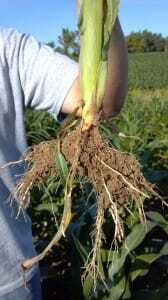
    Also keep in mind that planting too shallow can also provide negative results.  Corn seed planted too shallow most often results in poor root development and may affect the crop all the way to harvest.  Seeds that are planted too shallow have a tendency to develop “rootless corn syndrome,” causing plants to fall over because they lack nodal root development.

    There are “best management practices” farmers can implement this spring.  Keep the conservation of moisture in mind, and make the most of the good field conditions.  Fewer passes across the field with disks or field cultivators will help conserve moisture.  Also bear in mind how the amount of residue may affect planting conditions. Take notice of debris in the field.  Too many stalks or root balls can inhibit seed emergence.

    Related Posts:

    • Corn Seed Depth: Back to the Basics
    • Soil and Management Factors Affect Planting Depth
    • Adjusting Down Pressure
    • Soil Capillary Action
    • 4-Inch Soil Temperature Map
    • Till Less for More Water

    Webspec Admin

    April 10, 2013
    General, Season, Spring
  • Latham Hi‑Tech Seeds

    Unemployment and Apathy Grow Poverty

    Most Midwest farmers have spent the past week preparing for the spring planting season and closely monitoring soil temperatures in anticipation of #plant13.  There are a few things that I still need to get done before I head to the field, but I’ll admit, my energy level is low right now.

    While eating my lunch on Friday, I was trying to figure out why I have less ambition than I used to.  Several thoughts came to mind:

    1. It’s been a long winter.  (Those early spring snowfalls dampened my spirits, even though I appreciate the moisture they brought.)
    2. I’m not a spring chicken any more.  (I’ve been farming for 50 years!)
    3. During the winter months, I’m less physically active even though hog chores keep me pretty busy.

    Then I had the proverbial “light bulb moment…”  I believe government has played a large role in my recent frump.  It seems that apathy and anxiety has become a pandemic affecting our nation.  Why?

    Breaking news on Friday, April 5, was that U.S. unemployment numbers are lower.  This sounds like good news until you realize that unemployment fell for all the wrong reasons – five times as many people quit looking for work than jobs that were created!  The job participation rate of “prime-age” workers, age 25 to 54, fell to match the lowest reading since 1984, according to CNN.

    While taking a lunch break on Friday, I continued to wonder why fewer Americans are feeling the need to search for a job when I came across an article by Tim Elmore, author of Growing Leaders.  He makes a case for how adults are stealing ambition from kids:

    “One of the most valuable commodities we can cultivate in this emerging generation of kids is ambition,” writes Elmore.  “By wanting our children and students to be happy, we may have created the most depressed population of kids in recent history. By leading them in this way, we have all but removed ambition in them…  Think about it. If I grow up in a world where almost everything has been given to me, or made easy—I start feeling entitled to it.”

    Have Americans become so politically correct that we’re taking the will to learn away from our kids?  Every kid is different, yet many sports programs and educational endeavors try to treat everyone equally.  My own grandkids provide a great example. Some, like Devin and Jessica, have a passion for sports.  Carlie enjoys writing and dancing.  Darin enjoys hunting, fishing and gardening.  Zach is interested in wood working and mechanics.  Hallie, Lindi and Jessica are very artistic.  Sydney is an avid reader, while Quinten is a computer guru.

    Each one of my grandchildren have different talents, skill sets and interests, but they’re driven to pursue their passions. That’s what we need!  We need to do away with “cookie cutter mentality,” which reminds me of the one-size-fits-all approach our government has taken to the school lunch program.

    Speaking of government… I received a notification on Friday of an update from the Caffeinated Thoughts blog with news that Iowa Senator Brad Zaun filed a bill (Senate File 336) to repeal the Iowa Department of Education and the Iowa State Board of Education.  Senator Zaun believes an increase in educational funding will not lead to an increase student performance.  He says he wants “real education change” and is quoted as saying, “This bill will increase student performance and give parents 100% choice.”

    Regardless of whether you’re Republican, Democrat or Independent, the fact remains that America is facing big issues that need to be addressed.  Unless we change current policies and attitudes, unemployment and poverty is only going to grow.  How can a nation maintain its position as a World Leader then?

    Other related posts:

    • 11 Facts About Poverty in America
    • Hunger Has a Cure
    • Congress ignores America’s poverty crisis

    Larry Sailer, Musings of a Pig Farmer

    April 9, 2013
    Agriculture, General, Industry News
  • Latham Hi‑Tech Seeds

    “Buy Local” Initiative Brings “Dough” to Rural Communities

    BuyLocal

    Knowing where food comes from and how it is grown is becoming increasingly important for many U.S. consumers. Connecting consumers with local producers is one goal of the Healthy Harvest of North Iowa’s “Buy Fresh. Buy Local.” initiative.

    Local food initiatives help fuel stronger communities. Each dollar spent on locally grown food keeps dollars circulating through the community, which can have a big impact on rural communities. The average Iowa family spends $137.90 weekly on food. Residents in the Iowa counties of Franklin and Wright spend $69 million annually on food.

    “If we could capture 10% of the food dollars in Franklin and Wright counties, that means $6.9 million would be reinvested in our local communities! Even a 1% market share would be significant,” said Jan Libbey, coordinator for Healthy Harvest of North Iowa.

    Team Latham

    April 8, 2013
    Agriculture, General, Industry News
  • Latham Hi‑Tech Seeds

    Locally-Grown Wheat Makes Bread “Homemade” from Start to Finish

    Carlson Family

    Thirty-five years ago, Cathy Carlson was interested in finding a way to provide a second income without having to leave home.  She had always enjoyed baking and was fascinated by wedding cakes, so she enrolled in adult education classes through North Iowa Area Community College (NIACC) in Mason City and launched a home-based business.

    Today Cathy’s Country Cook’n is known for beautiful wedding cakes, creative birthday cakes and festive cupcakes, as well as other delicious baked goods like cookies, pies and breads.  (Side note:  I’ve always loved the Spiderman birthday cake that Cathy made years ago for our son.  Because it was comprised of individual cupcakes, it was especially easy to serve to kids.)

    Cathy’s baking business continues to expand through partnerships with local businesses and consumers.  She and her husband, Dennis, about three years ago became charter members of a regional food working group called Healthy Harvest of North Iowa.  During the Christmas season, they run a retail store inside Carlson Learning Tree Lodge that features wares from local vendors including homemade jams, jellies, candies, baked goods, sewing items and handcrafted wood items.

    During the rest of the year, Carlson’s Learning Tree Lodge has a variety of uses from business retreats and environmental workshops to Girl Scout Day Camp and Vacation Bible School classes.  It’s also home base for the many classes that Cathy offers on everything from wreath making to bread baking.

    Cathy Carlson takes “homemade” to a new level by growing wheat in North Central Iowa and then using it to make her own bread.

    Cathy takes “homemade bread making” to a whole new level by growing her own wheat.  Three years ago she and Dennis had the opportunity to purchase an additional five-acre field adjacent to their farm.  They were talking about what to plant in that field when Cathy had the idea to try growing wheat.

    Although no other farmer in the area raises wheat, that didn’t deter Cathy.  She researched what type of wheat could be grown in North Iowa.  She also had to find someone to sew it and harvest it since all area farmers are equipped to harvest corn, soybeans and a few oats and alfalfa.

    Word soon spread and the Carlson’s neighbors offered their help.  One neighboring farmer brought over his drill the first year.  Another neighbor with a small combine used for oats said he would be glad to harvest the wheat.  A third neighbor offered to window the wheat.  Then Cathy learned that Rainbow Feed & Grain in Hampton had an oat-cleaning system that could be used for wheat, too.

    In the heart of corn and soybean country, where does one go to process wheat?  Cathy searched the Internet and found someone who sold mills in Iowa Falls – only about 20 miles away.  Now Cathy is able to grind about 5 pounds of wheat in only 3 minutes right in her kitchen.  She usually grinds 40 pounds at a time and then freezes it to bake fresh wheat bread.

    Home-ground wheat must to be kept in the freezer because it includes wheat germ, which gets extracted from the wheat flour sold in stores to extend its shelf life.  Because wheat germ is a protein source, Cathy’s homemade wheat bread is good source of vitamins and is higher in fiber.  She’ll even sell you a bag of wheat flour if you’re interested in baking your own bread.

    BAKER’S TIP: Our palettes aren’t used to 100% whole wheat, so Cathy converts recipes by using half white flour and half whole wheat flour.  Pure wheat flour doesn’t rise as high as white flour, so Cathy also experiments to see how much I can add to sweet breads and still get a good rise.

    Try your hand at baking muffins, wheat bread or rolls at home.  Today Cathy is sharing her recipe for “60 Minute Rolls.”  If you’re not that confident in your baking abilities, sign up for one of the many classes that Cathy offers.


    Kizoa slideshow: No title – Slideshow

    Team Latham

    April 5, 2013
    General, Recipes, Sides
Previous Page
1 … 88 89 90 91 92 … 160
Next Page

Latham Hi‑Tech Seeds

131 180th Street | Alexander, IA 50420

(641) 692-3258

SIGNUP FOR OUR NEWSLETTER
  • Contact
  • Legal
  • Dealer Center
  • Seedware Login
  • Latham Gear

© 2025 Latham Hi‑Tech Seeds. All rights reserved. | Iowa Web Design by Webspec | Privacy Policy

Latham® Hi-Tech Seeds is a trademark of M.S. Technologies, L.L.C., 103 Avenue D, West Point, IA 52656.