
Today we will be covering soybean harvest! Tune in for in-field tips. #AsktheAgronomist
Video Link: https://www.facebook.com/LathamSeeds/videos/1892500697529870/


Today we will be covering soybean harvest! Tune in for in-field tips. #AsktheAgronomist
Video Link: https://www.facebook.com/LathamSeeds/videos/1892500697529870/


Tune in as we dissect a corn plant at its current stage on Ask the Agronomist!
FB Live Video: https://www.facebook.com/LathamSeeds/videos/10156497920517138/


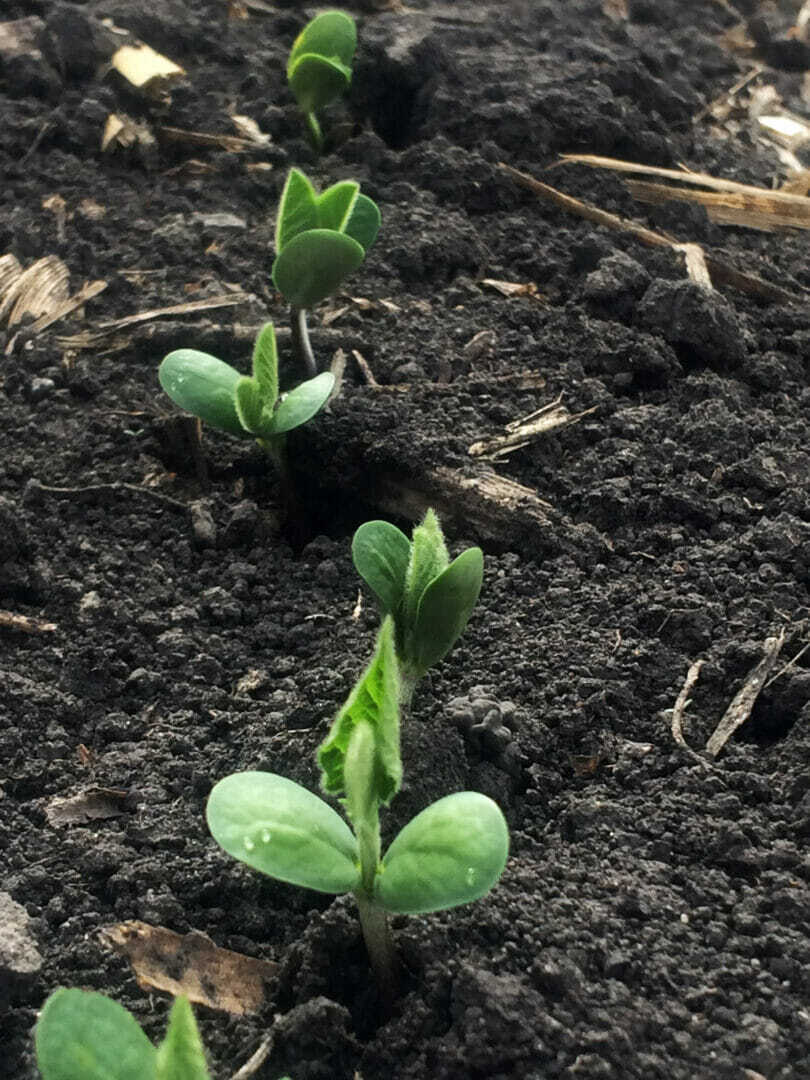
The spring of 2018 will be remembered for too much rain and cold temperatures, which all contributed to one of the most challenging planting seasons in recent history. Farmers were concerned about getting their seed in the ground early enough to capture full yield potential, but one must take more than planting date into consideration. Soil conditions at the time of planting and the short-term weather forecast also play an important role in germination and emergence, as many were reminded when they saw poor emergence and weak stands.
With this in mind, the following guidelines will help you evaluate soybean stands and determine whether re-planting is necessary:
» PLANTING DATE: In a five-year study completed by Latham’s research team across multiple states, there was no significant yield difference between soybeans planted before May 15. We evaluated planting dates of late April and early May to mid-May. Planting on or before June 1 averaged 95% of expected yield. In fact, yields didn’t drop to the 85% and lower range until soybeans were planted after June 15. These results compare very closely to similar studies done by university researchers throughout our trade territory.
» PLANT POPULATION: Soybean stands can suffer from a wide variety of problems that will reduce population: hail, disease, insects, cold soil temps at planting time, compaction and planter failures. The biggest problem we find is that stand reductions almost never occur evenly across the field, so farmers must be diligent in scouting their fields and take the necessary time to evaluate their stands properly.
I recommend taking 10 stand counts in the area with the worst damage and 10 counts in the part of the field that was not affected or affected just slightly. At each point, measure off 10 feet of row and count the number of live, viable plants. You can take the average of your 10 points and compare them to the table on Page 3 to see how many plants per acre you have remaining.
A stand of 100,000 evenly distributed plants generally gives you optimum yield. Remember that as the growing season progresses, it is much more difficult to establish a good stand of soybeans. This means you might be better off leaving a stand of 75,000 plants on July 1 rather than trying to establish a new population. A stand of 75,000 on May 15, however, seems very inadequate and would warrant replanting.
Evaluating your stands early will help you identify concerns while there is still time to remedy the situation. If you have questions on evaluating your soybean stands, feel free to contact me or Phil Long.

Thanks for tuning into Week Nine of our “Ask the Agronomist” Audiocasts. Guest Agronomist and Latham Hi‑Tech Seeds Regional Sales Manager for Eastern Iowa, Jerry Broders will be filling in for Latham’s Senior Agronomist, Mark Grundmeier. To listen to Jerry’s response to this week’s question about rapid growth syndrome, play the audio file below. (more…)
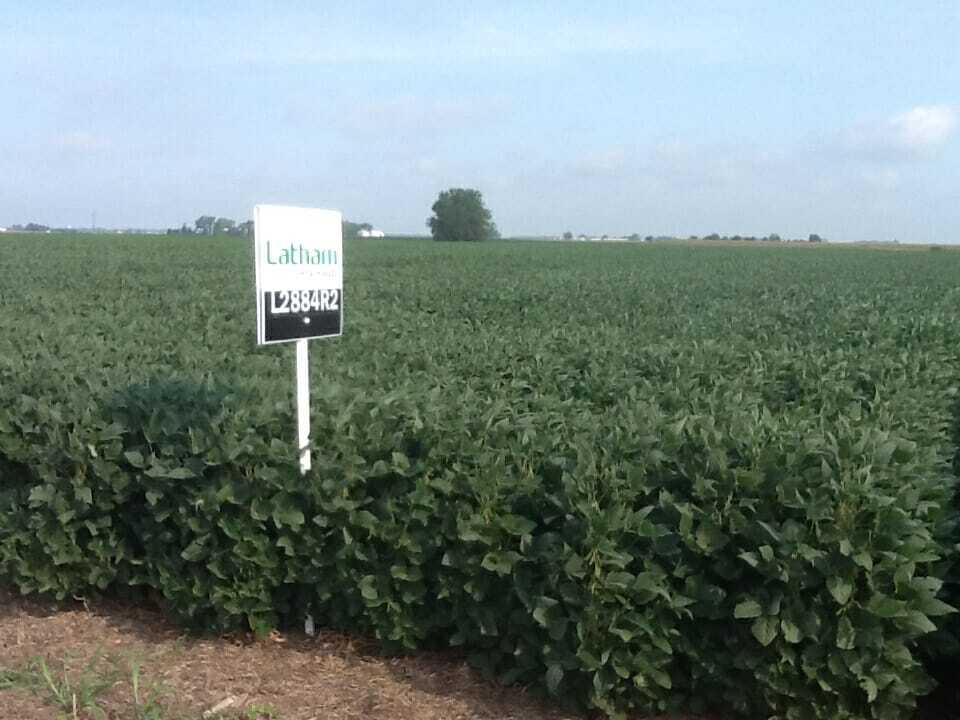
 July makes corn and August makes soybeans, as the saying goes. That’s because adequate moisture levels are especially crucial during two key developmental stages: germination and reproduction-seed development. Having adequate moisture wasn’t an issue at germination time as record rain fell in Iowa after Easter. The Midwest experienced wet, cold weather in May and into June, yet some areas haven’t received a drop of moisture for the past three or four weeks.
Moisture during the reproductive stages has a major impact on yield potential. When water is short during this growth stage, soybeans show signs of drought stress. Plants may abort flowers, and the numbers of pods set is reduced. Fewer seeds per pod are produced per pod, and smaller seed may result. Because dry conditions can slow or stop the nitrogen fixation needed by the plant to produce soybeans, yields will be lowered.
Anytime you get this type of weather, other stress factors arise. You may notice soybean fields turning yellow, which is a common symptom of Iron Deficiency Chlorosis (IDC). IDC is a function of the soil type, so it’s most common in poorly-drained soils with higher-than-normal pH values.
Unfortunately, it’s too late to really manage IDC properly by the time it’s noticed in a field. The best defense is a good offense. Note trouble spots now, and then be proactive when choosing future soybean brands for these fields. In fact, Latham Hi‑Tech Seeds gives the IRONCLADTM designation only to those soybeans bred for high yields with a strong defensive package.
There is no such thing as complete resistance to IDC, but some soybean brands (i.e. varieties) are better than others at handling this condition. Because Latham Hi‑Tech Seeds is headquartered North Central Iowa – where Iron Chlorosis is a familiar challenge – we have always tried to choose soybean genetics that have the best possible scores against this condition. Visit with your local Latham® dealer about specific products that would best fit your farm, or feel free to call our office directly at 1-877-GO-LATHAM.
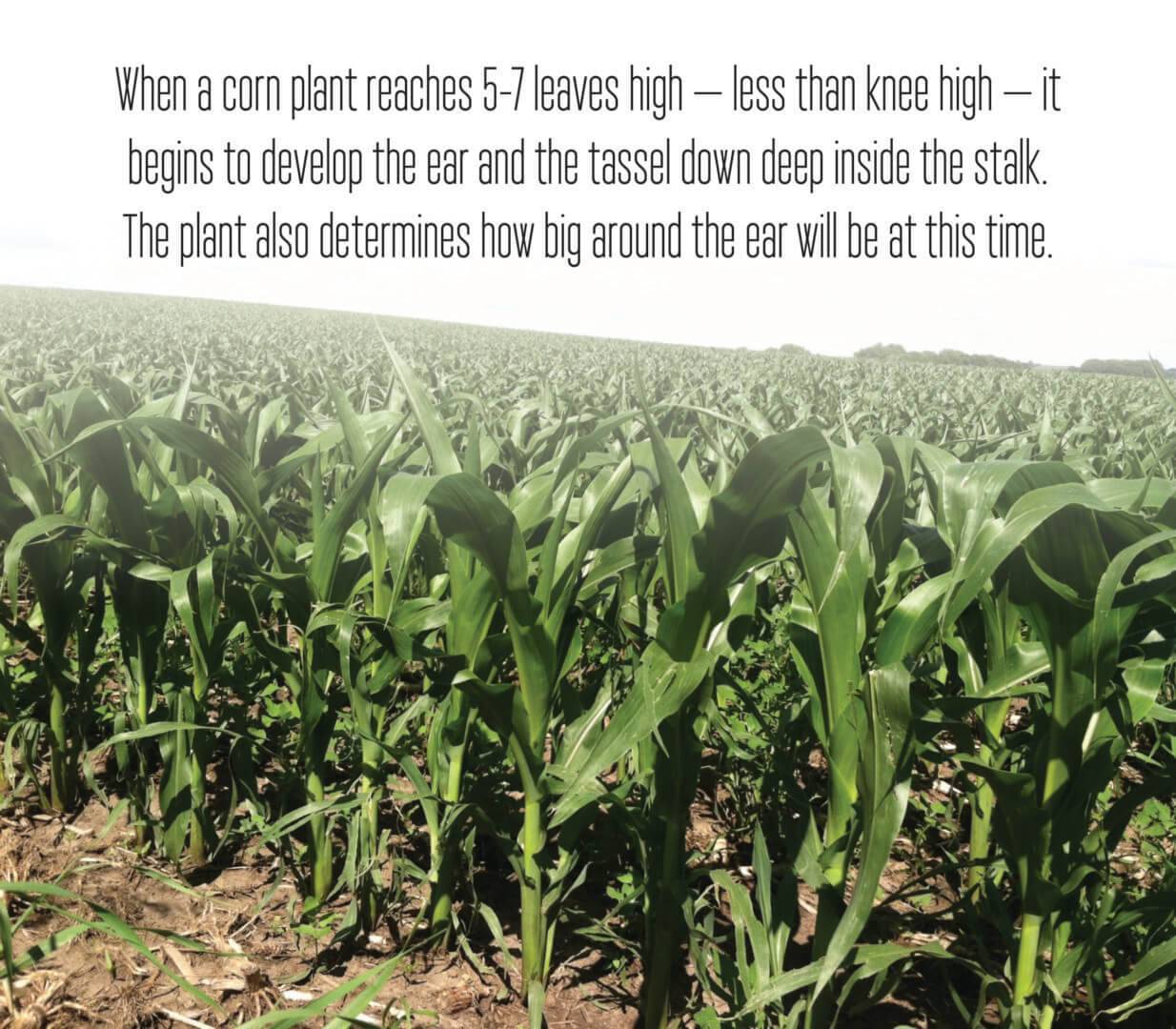
 Just as diet and nutrition play a key role in how well an athlete performs, corn plants need a well- balanced diet for optimal performance. We’re at a critical point in the growing season as ear size is being determined, so the slightest nutritional deficiency now can cost you yield in the end. Take a plant tissue analysis to assess where your fertility program is, and then make plans to protect your crop from in-season nitrate loss. In a wet spring like this one, it’s common for nitrate leaching to occur. However, there’s still time to remedy the situation. Nitrogen is a mobile nutrient, so the timing of fertilizer application is critical to meet a plant’s needs. Nitrogen management, spoon feeding the plant when it needs it, unquestionably affects total yield. Once you’ve fed the crop, you control weeds to maximize plant health. Early-season weeds rob yields you cannot see at harvest. Crops have a better chance of reaching optimal yield when they’re not competing with weeds for sunlight, water and nutrients. Weeds should be controlled with tillage, herbicides, or a combination of tactics so the crop can become well established under weed-free conditions. By following 5 small steps, farmers will make giant strides toward weed control:
Rotating between various herbicide traits is important from the standpoint of reducing weed resistance. Rotating traits, especially insect resistance traits in corn, is especially important for the same reasons – to decrease the risk of insects becoming resistant to those traits and also to improve overall trait performance. We need to be good stewards of these traits and rotate them whenever possible!

 Once again, this week we were reminded just how cruel Mother Nature can be! Crazy late-spring thunderstorms and tornados swept across Latham Country from eastern Nebraska through eastern Iowa on Monday evening. Heavy rains fell early this week across the Dakotas and into Minnesota and Wisconsin, too.
More than six inches of rain fell on Monday night in some areas of Franklin County, Iowa, with an additional 1.5 to 2 inches falling last night. Winds gusting at 70 miles per hour flattened crops, power lines and grain bins alike. The loss of property is disheartening, and our hearts go out to those who are trying to clean up and put the pieces together again. (Click here for tips on talking with consumers about storm damage.)
“The farmer has to be an optimist or he wouldn’t still be a farmer,” said Will Rogers, the cowboy entertainer who was known for his wit and wisdom. So today, we’re going to talk about the silver lining. Our crops needed moisture. Although they got more than they needed this week, the tile lines are running again. Moisture is building in the soil profile. With first crop hay baled, this rain will get the second cutting of alfalfa off to a good start. The warm temperatures and high humidity we’re experiencing will cause crops to grow like weeds!
Speaking of weeds, let’s hope the top soil dries enough soon for the corn and soybeans to get sprayed before they get too tall. Volunteer corn is prevalent in some areas this year, and volunteer corn must be treated as a weed. It not only competes with plants for moisture and nutrients, but volunteer corn is a food source for rootworm larvae. Volunteer corn that is not controlled by tasseling attracts corn rootworm beetles for egg laying.
It’s imperative that farmers continue scouting fields at least weekly to stay ahead of weed, insect and disease pressure. For an update on what Latham’s Regional Sales Managers are seeing in their territories, click on “From the Field” and choose a region from the drop-down box on the right-hand side.
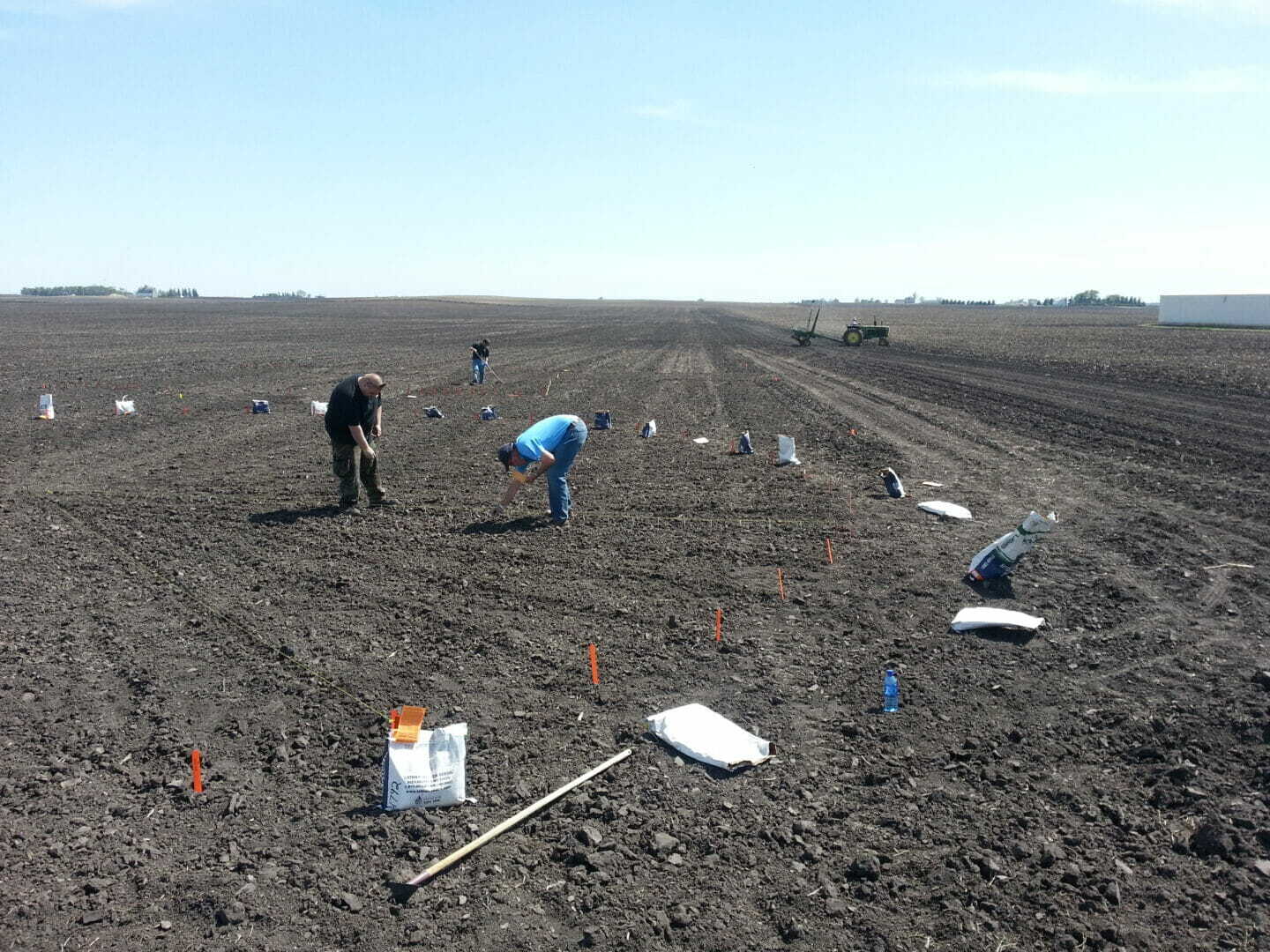

Warm temperatures and below normal precipitation allowed soybean planting and crop progress to advance rapidly. At Latham headquarters in Alexander, we finished planting our corn plots and are nearly done with planting soybeans. Yesterday a welcome one inch of rain fell, which brought planting to a halt.
Statewide corn has been planted on 96% of the acres intended for 2014, as of the week ending May 25. Soybean planting is 80% complete, which was double the previous week’s progress. Nationally, corn has been planted on 88% of the acres and has emerged on 60%, according to the U.S. Department of Agriculture. Soybeans have been planted on 59% of the U.S. acres and with 25% emerged.
“With just sporadic rainfall last week, crop planting proceeded quickly and now both corn and soybean planting progress is slightly ahead of the 5 year average,” notes Iowa Secretary of Agriculture Bill Northey in his May 27 crop report. “After the extremely late planting last year farmers are excited to get the crop in the ground in a more-timely manner this year.”
For a look at crop conditions around our six state territory, click here, or select a region from the drop down above.
 We’ve all heard the saying, “Anything worth having is worth waiting for.” But did you ever think about how this familiar quote applies to farming? We must remember that planting season is more like running a marathon than a sprint.
Highly competitive runners have to deliberately pace themselves. They also have to avoid jumping the gun. This, too, applies to farming. You see, many farmers jump the gun and switching corn hybrid maturities too soon. Corn planted in early June can make decent yields, and there’s no need to switch from corn to soybeans until after that.
When you switch maturities, you forfeit maximum potential and have essentially decided to lower your yield expectations! Based on my experiences over the past 35 years – as well as research findings from many Midwest land grant institutions – I can tell you with confidence that full-season hybrids and varieties outperform early maturing hybrids and varieties.
There becomes a point in time where the advantages of planting a full-season hybrid diminishes to the point where shifting to a shorter-season hybrid or variety will generally result in drier corn and higher yields come fall. Following is a summary of factors to consider when deciding whether to switch corn or soybean maturities.
I’ll use northern Iowa and southern Minnesota as an example. If your maturity range is 98- to 109-days (which is what I use for the Latham Research Farm), then you should generally not deviate from those maturities until at least May 25. If all you have left to plant is your 98-day hybrids, then you can safely extend your planting window to about June 7-10. On the other hand, if you only have your 109-day hybrids left to plant, you’ll probably be better off switching to 95- or 99-day products.
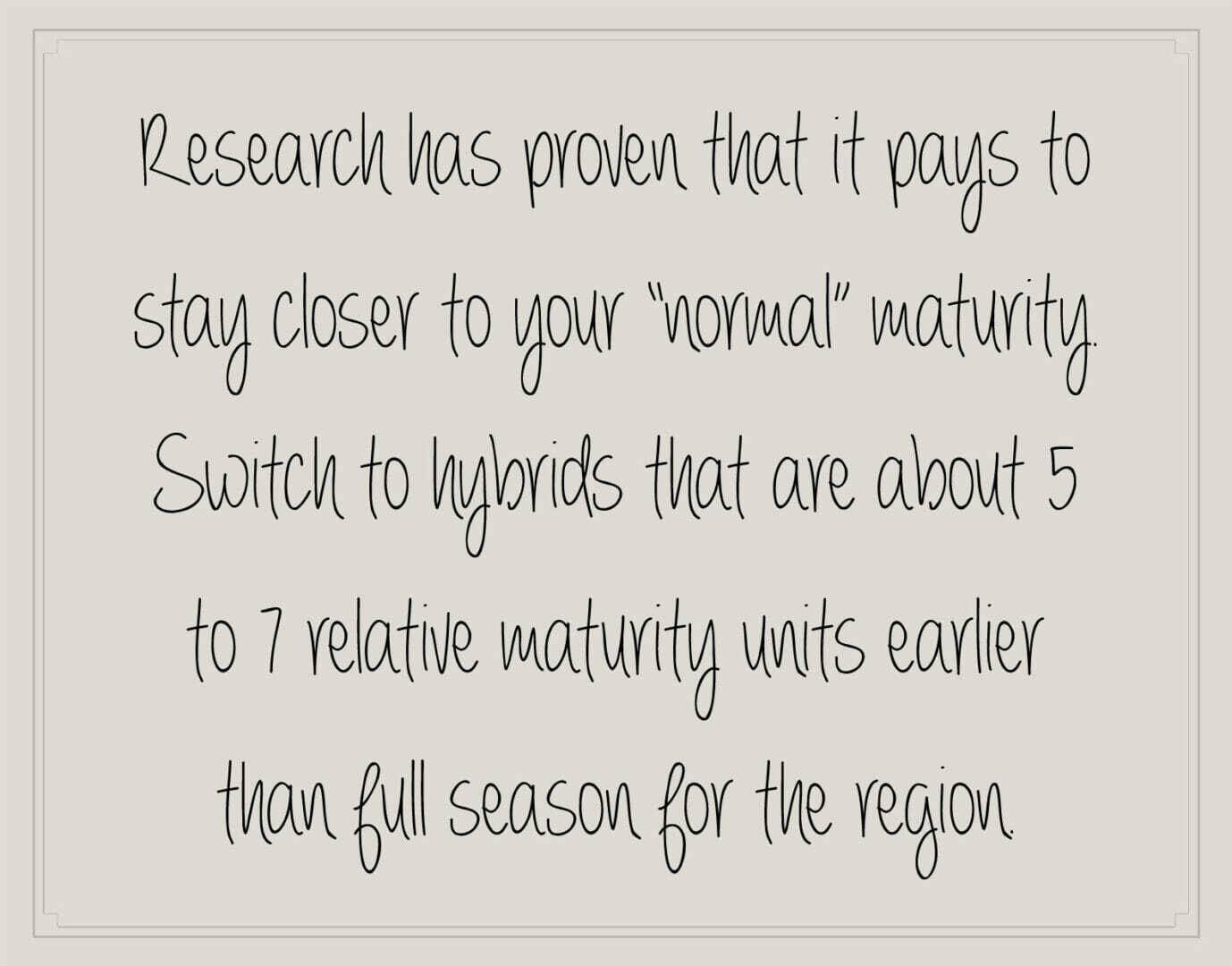
That brings us to the next subject… if you must switch, how early of a hybrid is needed? You don’t need to take it to extreme and switch from 109 RM to an 85-day hybrid. Research has proven that it pays to stay closer to your “normal” maturity. Switch to hybrids that are about 5 to 7 relative maturity units earlier than full season for the region. Yields in this scenario will be greatly improved if northern Iowa and southern Minnesota farmers (from the example above) move toward a 92- to 95-day hybrid that is more closely adapted to the area.
The decision to switch maturity with delayed corn planting is difficult because of so many variables including: available GDUs, first frost date and fall drying conditions. With this in mind, here are some general guidelines:
| Location within Iowa |
Full Season RM | Switch to on May 20 |
Switch to on May 30 |
| South of I-80 | 114-117 | 108-111 | 108-111 |
| Central | 110-115 | 107-110 | 107-110 |
| North of I-80 | 109-113 | 105-108 | 105-108 |
This spring has been anything but normal. We are currently sitting at 67% of corn planted and 39% of soybeans planted. With the higher-than-average number of unplanted acres, we could be looking at a contender for 2013 prevent plant numbers. Although this has been tough for many of our farmers and dealers throughout the growing season, there has been a positive response for corn and soybean markets. With a few more days of drier weather, Latham Country could make a lot of #plant19 progress.
We have received many questions this spring about when it is time to switch soybean varieties. The good news is soybeans are not as picky about maturity and delayed planting as corn. The typical maturity range for your area can be planted up to Mid-June without any worries. For those in the northern part of the territory, that date is closer to Early June. Its not a good idea to jump down more than 0.5 maturity group for your area. Remember soybeans mature based on night-length and not heat units, so they will make it to maturity, but the full season maturity encourages them to accumulate more nodes (i.e. more pods) before fully switching to seedfill.
Rules of Thumb on Later Planting:
Soybean Yield Expectations & Physiological Maturity |
||||||
|
Relative yield percent and Bushels Per Acre based on a 60 bpa potential yield |
||||||
| Planting Date | Northern Iowa | Central Iowa | Southern Iowa | |||
| Late April | 100% | 60.0 bpa | 96% | 57.6 bpa | 98% | 58.8 bpa |
| Early May | 96% | 57.6 | 100% | 60.0 | 100% | 60.0 |
| Mid May | 99% | 59.4 | 96% | 57.6 | 98% | 58.8 |
| Early June | 81% | 48.6 | 93% | 55.8 | 89% | 53.4 |
| Mid June | 61% | 36.6 | 59% | 35.4 | 82% | 49.2 |
| Early July | 33% | 19.8 | 45% | 27.0 | 47% | 28.2 |
| NOTE: All yields through mid-May are not statistically different from 100% yield. | ||||||
| SOURCE: ISU Extension publication PM 1851, “Soybean Replant Decisions” | ||||||